An Application Service Provider is a company that provides software applications over the internet.
Businesses no longer have to install and maintain these applications on their computers. Instead, they can access them through the ASP’s servers.
This can be a considerable cost saving for businesses, as they do not have to purchase and maintain such software.
One thing to know before reading on: the ASP is largely a historical model. It was the late-1990s attempt at delivering business software over a network, it mostly collapsed in the early 2000s, and what solved the problem it could not is the SaaS model we use today. The term still appears in older contracts and textbooks, which is why it is worth understanding properly.
What is an application service?
Application service is a type of service that allows businesses to outsource their computing needs. This type of service can save money and improve efficiency.
It can also help businesses maintain compliance within their industry. It is a business model in which the provider hosts and maintains applications and services for customers. The customer then accesses the applications and services remotely.
What is an application service provider?
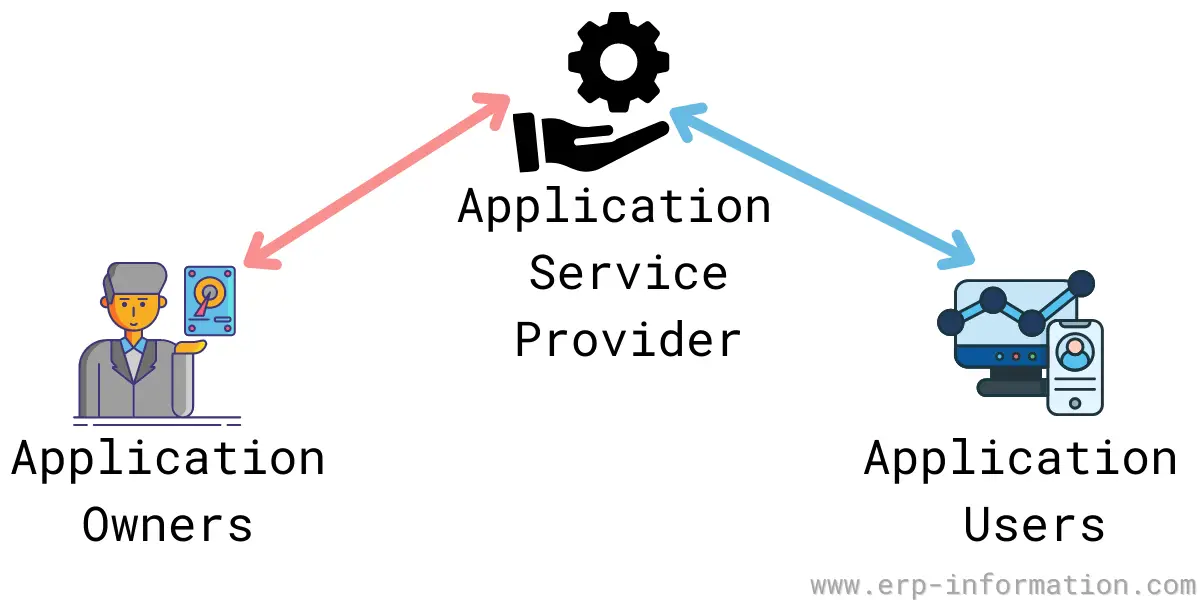
An Application Service Provider is a company that provides software applications over the internet. This service allows businesses to outsource their computing needs, saving money and improving efficiency.
In addition, they can provide a wide range of software applications that would otherwise be unavailable to small and medium-sized businesses.
Very few providers now sell themselves under this label, so in practice the choice you are making today is between a multi-tenant SaaS product and a single-tenant hosted or managed arrangement, which is the ASP model under a newer name. The things that decide it are the
- Size of your business
- The type of software you need
- And the level of customer support you require.
How does it work?
An ASP runs the software on its own servers and rents access to it. In the classic arrangement the customer signs an outsourcing contract, the provider installs and operates the application, and staff reach it over a network rather than from a local install. The customer often still owned the software license itself, with the ASP charging for hosting and management around it, which is one of the clearest differences from SaaS.
With it, users can save their work on a remote server and work through a web-based interface.
The application service provider includes software suppliers and network providers.
The service provider operates software applications and handles the servers supporting the software.
They give information to end-users through the internet and allocate bills in the following ways.
- Use-base fee structure
- Feature-base fee structure
- Monthly or annual fee structure
- Combination of the above three fee structure
Fees usually cover hosting, support and maintenance. Classic ASPs were single-tenant, meaning each customer got its own instance of the application rather than sharing one with everybody else, which made isolation and per-customer configuration straightforward. In practice some providers ran those instances as virtual servers on shared hardware, and how much separation you actually got depended on the provider.
Evolution
The term dates from the late 1990s, not the 2000s. The ASP Industry Consortium was formed in May 1999 by 22 companies, among them AT&T, IBM, Cisco, Compaq, Citrix, Sun Microsystems, Ernst & Young and Great Plains Software, to promote the model and work on standards. Separately, several vendors built commercial ASP operations of their own: Qwest ran hosted enterprise applications out of its CyberCenters, and won multi-year contracts to deliver ERP that way.
SAP R/3 was among the first heavyweight business applications offered this way, and Microsoft made back-office products such as SQL Server and Windows NT Server available on a pay-as-you-use basis at around the same time. Both are period details: R/3 has since been succeeded by S/4HANA, and Windows NT Server is long retired.
During the 2000s, ASPs started offering integrated applications and renamed themselves web service providers, application infrastructure providers, and managed service providers.
As time flew, cloud computing services came and were IaaS (Infrastructure-as-a-service), SaaS (software-as-a-service), and PaaS(platform-as-a-service). They provide third-party applications.
Application service provider example
A genuine ASP example looks like this: a manufacturer licenses an ERP or payroll package, and instead of running it in its own server room, pays a provider to install that copy on dedicated hardware and keep it running. The customer gets a system configured to its own requirements, on its own instance, reached over a private link or the internet. Qwest Cyber.Solutions did exactly this from its CyberCenters, including a five-year contract to run ERP for Redback Networks.
It is worth naming what an ASP is not, because the two get confused constantly. Gmail, Yahoo Mail and Google Docs are not ASP services. They are free consumer products running one shared multi-tenant system for hundreds of millions of people, with no per-customer instance, no license for the customer to own and no individually negotiated contract. That is the SaaS pattern, and in most respects it is the opposite of the ASP one.
Other everyday use cases are credit card payment processing, accounting, and bookkeeping.
You’re a small business owner who wants to find a better way to manage your accounting and bookkeeping. Hiring an in-house accountant or bookkeeper is daunting, not to mention expensive.
Here the distinction matters. An ASP would host the accounting software for you, so your own bookkeeper works in a system somebody else installs, patches and backs up. It does not do the bookkeeping. A firm that keeps your ledgers for you is an outsourced accounting or business process outsourcing provider, which is a different service bought for different reasons, and the two are often sold side by side.
Different kinds of ASP services
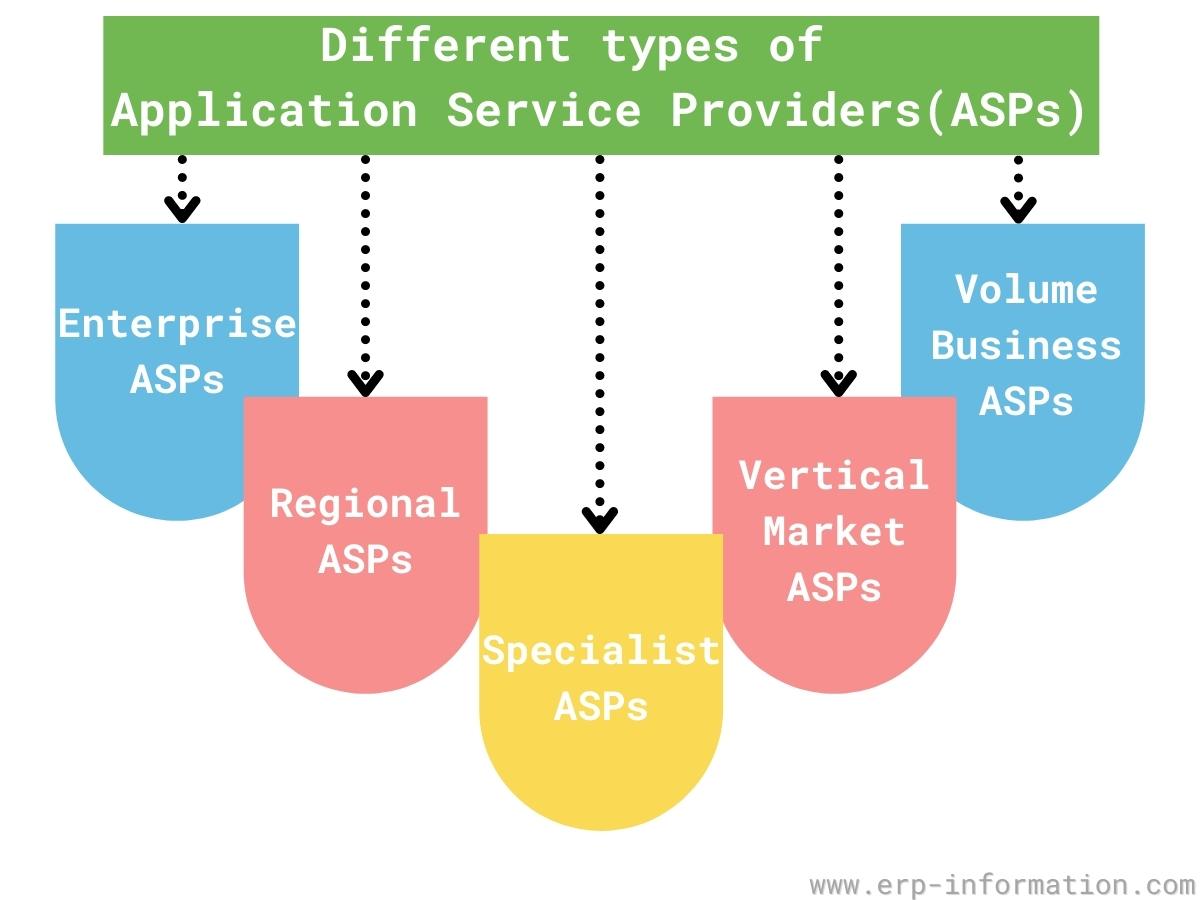
Enterprise ASPs are designed for complex businesses to suit their intense requirements. As a result, the user interface is more comprehensive and has greater administrative power.
Regional ASPs are suitable for small businesses that cover small geographic locations. They can be a good choice for companies looking to expand but are still in their early stages.
Specialist ASPs cater to specific accounting, human resources, payroll, Customer Relationship Management, etc. These are ideal for businesses that operate within a particular niche and require specialized software to manage their tasks.
Vertical market ASPs are industry-specific and provide unique tools and features for specific niches, e.g., retail or healthcare industries.
Volume Business ASPs provide applications for which the customers pay in advance and are well aware of the services that fall in the brackets of the packages designed.
Those categories come from the era when the model was current, and the vendor landscape behind them has moved on. Qwest no longer exists as a company: CenturyLink acquired it in April 2011 and renamed itself Lumen Technologies in September 2020. HP separated into HP Inc. and Hewlett Packard Enterprise in 2015. SAP still sells enterprise software, but delivers it as cloud services rather than as an ASP arrangement.
Why is application service provider important?
The appeal was mainly financial. Buying business software outright meant paying for licenses, servers and the people to run them before it produced any value, which put serious systems out of reach for smaller companies. Renting access converted that capital cost into a predictable running cost, and handed the upgrades and backups to somebody whose job it was.
Our system becomes complex because of these things, such as applications, software, etc. They increase the financial burden on the companies. So it is better to lease the applications instead of owning them.
Advantages
- It allows you to reduce the cost of the organization.
- It Allows you to choose the modules with good processing abilities at a low cost.
- It helps to maintain software and hardware efficiently.
- It makes easy use of software for the organization through automatic software upgrades and technical support.
- It helps to reduce the load on hardware and human resources.
Disadvantages
- In a single-occupant condition, applications acquired by one client are closed from the other customer’s application. Hence costs will not reduce as they accept more customers.
- Isolation varied. Where a provider ran many customers as virtual servers on shared hardware rather than on dedicated machines, the separation was weaker than the single-tenant label implied.
- The business might be affected if the provider closes or goes bankrupt, as users depend on their servers and applications.
- They may not give the latest version updates, leading to a lack of security and features.
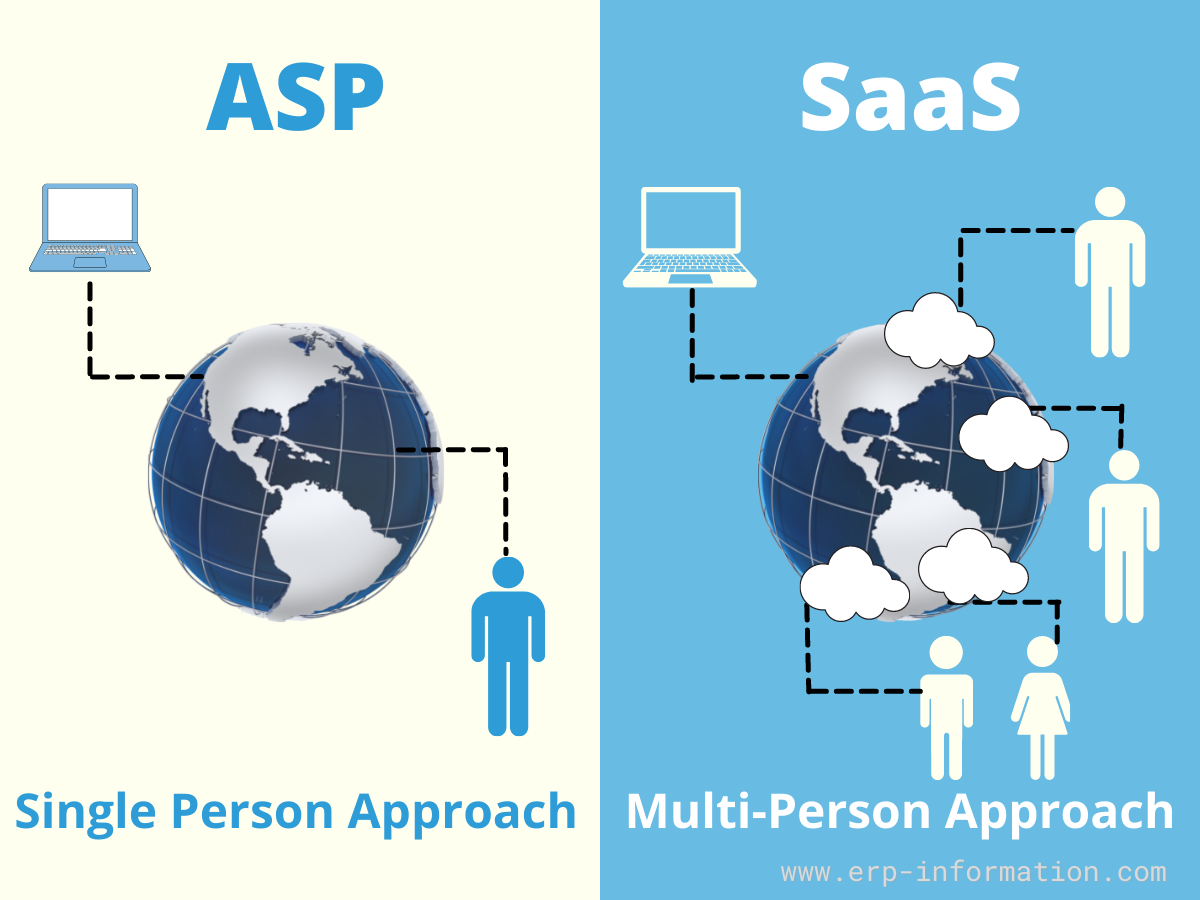
How does the ASP model differ from SaaS?
| SaaS (Software as a Service) | ASP |
| It provides the same features to all users | It can provide customized solutions for a single user |
| The solution is managed, maintained, and supported by the provider. That means the provider has all the control. | With this, the user can control the solution and demand the service he wants. |
| Service level agreement is common to all users. | Service level agreement is distinctive to each user. |
| The solution is always based on the internet. | Delivery did not have to run over the public internet. ASPs often served customers across private networks or leased lines. |
| Users cannot buy the software from a third-party retailer. | Users can buy the software from a third-party retailer. |
What happened to the ASP model?
It failed commercially, and the reason is worth understanding because it explains the shape of the software industry today.
The economics did not work. Giving every customer its own instance of the application meant the provider carried a separate installation to configure, patch, upgrade and support for each one. Costs rose in step with the customer count instead of falling, so the margins never arrived. Bandwidth was the other problem: delivering a heavy client-server application over the connections available around 2000 was a poor experience, and many of the applications being hosted had never been designed to be used remotely in the first place.
The ASP market fell apart in the early 2000s alongside the dot-com collapse. The providers that came through it mostly stopped calling themselves ASPs and re-emerged as managed service providers, application infrastructure providers or web service providers.
What fixed it was multi-tenancy: one instance of purpose-built software serving every customer at once, with their data separated logically rather than physically. One system to patch and upgrade means the cost of adding a customer is close to nothing, which is the whole basis of the SaaS business model. Salesforce, founded in 1999, was initially described in ASP terms and became the standard example of doing it the multi-tenant way instead.
The single-tenant idea did not disappear, though. It survives under different names, as managed hosting, dedicated cloud or private cloud, and it is still bought for the same reasons ASP customers bought it: heavy customization that a shared system will not allow, licenses the customer already owns, or rules requiring data to sit on identifiable hardware.
FAQs
What does ASP stand for and what is an application service provider?
ASP stands for application service provider. It is a company that runs business software on its own servers and rents access to it, so the customer does not install or maintain the application itself.
It was the main way of delivering software over a network in the late 1990s and early 2000s, and the model has since been superseded by SaaS.
What is an example of an application service provider?
A representative example is a company licensing an ERP or payroll package and paying a provider to install that copy on dedicated hardware and keep it running, reached over a private link or the internet. Qwest ran hosted enterprise applications from its CyberCenters this way, including a five-year contract to deliver ERP for Redback Networks.
Gmail, Yahoo Mail and Google Docs are often given as ASP examples, and they are not. Those are free multi-tenant consumer services with no per-customer instance and no license the customer owns, which is the SaaS pattern rather than the ASP one.
Is an ASP the same as SaaS?
No, though they are closely related and SaaS grew out of the ASP idea.
The technical difference is tenancy. An ASP gave each customer a separate instance of the application, which could be customized for that customer but had to be patched and upgraded separately. SaaS runs one multi-tenant instance for everybody, with data separated logically.
The commercial difference follows from it: an ASP customer often owned the software license and negotiated an individual service level agreement, whereas a SaaS customer subscribes to a service the provider owns and everyone gets the same version.
Do application service providers still exist?
Not under that name, for the most part. The ASP market collapsed in the early 2000s and the survivors rebranded as managed service providers or application infrastructure providers.
The underlying arrangement is still sold, as managed hosting, dedicated cloud or private cloud, and it is chosen for the same reasons as before: deep customization, customer-owned licenses, or regulatory requirements about where data physically sits.
What are the costs associated with using an ASP?
Charges were typically a recurring fee covering hosting, support and maintenance, billed per user, per feature, or as a flat monthly or annual amount, sometimes combining those.
The cost the customer often still carried separately was the software license itself, since in the ASP model that frequently belonged to the customer rather than the provider. That is a real difference from a SaaS subscription, where the fee covers the software as well.
Conclusion
The ASP was an idea ahead of the infrastructure available to it. Renting business software instead of buying, installing and staffing it was the right instinct, and it is how most software is now sold. What the early providers lacked was the multi-tenant architecture that makes it profitable and the bandwidth to make it pleasant.
If you meet the term today it is most likely in an old contract, a textbook, or a job description that has not been rewritten in fifteen years, and it is worth knowing that what is usually meant now is either SaaS or managed hosting. If you are actually choosing between a hosted single-tenant system and a multi-tenant SaaS product, the questions that decide it are whether you need configuration nobody else has, whether you must hold the software license yourself, and whether your industry’s rules require your data on identifiable hardware.
Using Google Search? Add erp-information.com as a preferred source.