
Capacity planning is the work of matching what you are able to produce against what you are going to be asked to produce, far enough ahead that you can still do something about the gap. Too little capacity costs you sales and expedite premiums. Too much means paying for machines and people that stand idle.
The part most introductions skip is that capacity planning is not one activity. It happens at three levels, over three different horizons and at three levels of detail, and the technique changes at each one. That structure is set out below, after the measures you need in order to state capacity as a number in the first place.
Evaluate Capacity Planning using our Capacity Planning Calculator.
Capacity Planning Definition
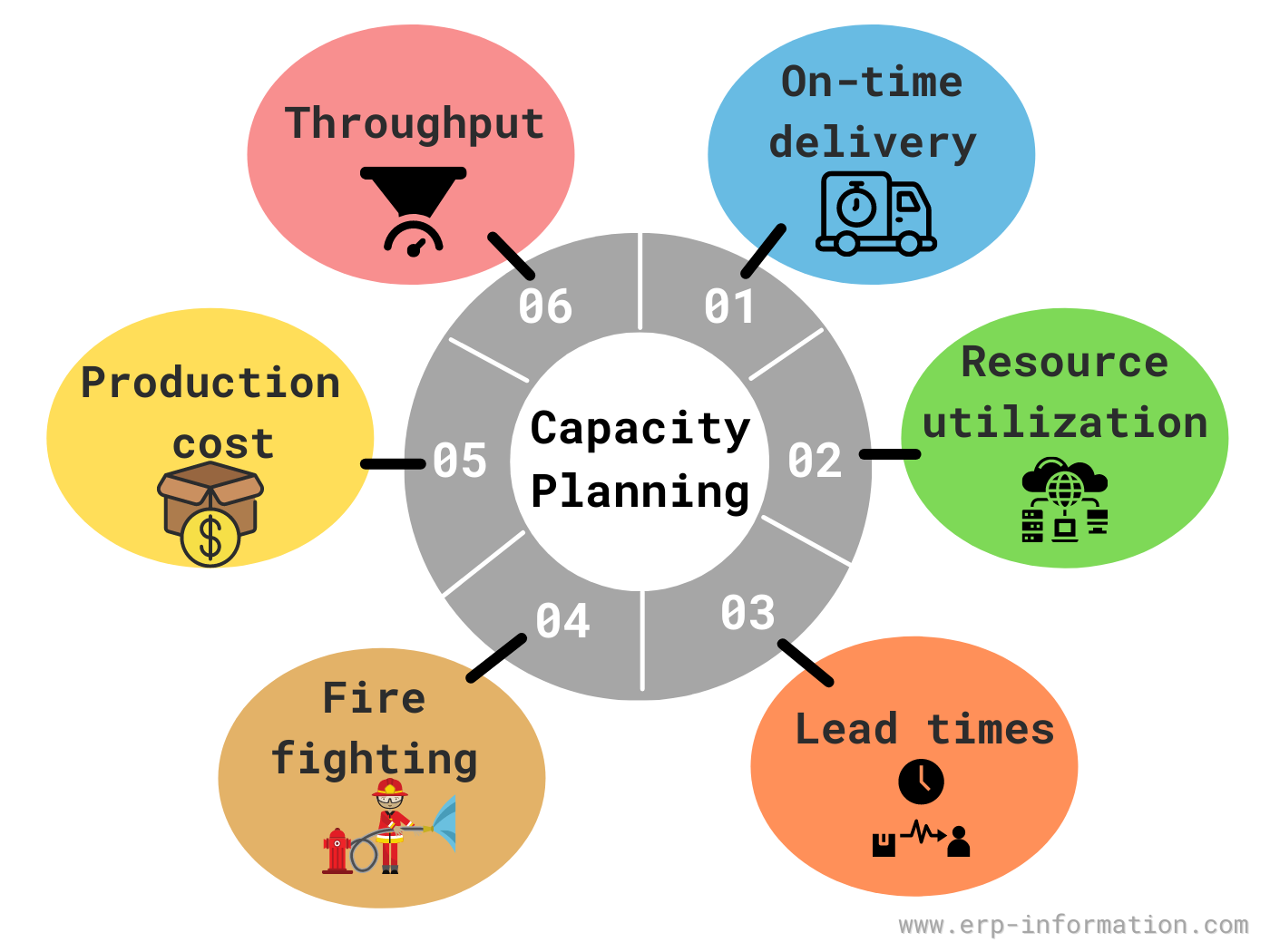
Capacity planning is the process of determining the production capacity needed by an organization to meet changing demands for its products or services.
It involves assessing current capacity, forecasting future demand, and planning for the necessary resources to ensure that the organization can efficiently and effectively meet those demands.
This includes managing resources such as labor, equipment, and facilities to avoid overproduction or underproduction, optimizing costs, and maintaining a balance between supply and demand.
Capacity planning is integral to resource management because it helps a company meet demand without going over or under budget.
The capacity planning process is crucial in project management. It is related to project management knowledge areas like:
- Work Management
- Resource Management
- Time Management
- Team Management
The Goal of Capacity Planning
- Assessing how much capacity an organization currently has.
- Predicting how much capacity will be needed in the future.
- Ensuring the necessary resources are available when needed.
A few related terms that we need to know before proceeding are:
Resource Planning and Resource Management
Resource capacity planning is forecasting future resource needs and allocating current resources to meet those needs.
It includes forecasting the demand for people, money, materials, and machines and then assigning those resources in a way that will meet projected requirements.
Resource management is the process of managing resources in an enterprise. It ensures the enterprise has enough resources to meet its current and future needs.
How Capacity Is Measured: Design Capacity, Effective Capacity, Utilization and Efficiency
Before you can plan capacity you have to be able to state it as a number, and operations management uses three that are easy to confuse.
- Design capacity is the maximum output under ideal conditions. It is the number on the equipment specification, and no real plant sustains it.
- Effective capacity is design capacity less the allowances you know you have to make: planned maintenance, changeovers, breaks, quality checks, the product mix you actually run. This is the honest number to plan with.
- Actual output is what you really produced, which lands below effective capacity once you absorb breakdowns, absence, material shortages and scrap.
Two ratios follow from those three, and mixing them up is the most common error in capacity reporting:
Utilization = Actual output ÷ Design capacity
Efficiency = Actual output ÷ Effective capacity
They answer different questions. Efficiency asks how well you performed against a realistic plan. Utilization asks how much of the theoretical maximum you captured, and it will always look worse because the allowances are still in the denominator.
Worked example
A line is rated at 1,000 units per week. Planned maintenance, changeovers and breaks account for 200 units of that, so effective capacity is 800. Last week the line actually produced 680.
| Measure | Value | Calculation |
|---|---|---|
| Design capacity | 1,000 units | Equipment rating under ideal conditions |
| Effective capacity | 800 units | 1,000 less 200 units of known allowances |
| Actual output | 680 units | What was produced |
| Utilization | 68.0% | 680 ÷ 1,000 |
| Efficiency | 85.0% | 680 ÷ 800 |
Reporting 68% to a board that expects 85% starts an argument about the wrong thing, which is why the denominator has to be stated every time the number is quoted.
Two cautions worth carrying into any capacity review. Utilization is only really meaningful at the bottleneck, because every other work centre has idle time by definition, so chasing high utilization everywhere just builds inventory in front of the constraint. And a plant deliberately runs a capacity cushion, the slack held above expected demand; the right size of that cushion is a business decision about how much you are willing to pay to absorb demand spikes and breakdowns, not a number to minimise.
Different Capacity Planning Strategies
What is strategic capacity planning?
Strategic planning is the proactive part of capacity planning, ensuring that the enterprise has the resources to meet its long-term goals. There are four common capacity planning strategies: the lead strategy, the lag strategy, the match strategy, and the adjustment strategy.
Lead strategy
Lead capacity planning is when you increase your capacity ahead of anticipated future demand to meet that demand as soon as possible.
In lead strategy, you can either add resources to your current system or expand your system. Adding resources is the most common way to increase capacity. However, you can do it as part of resource planning.
Example
A popular ice cream company that experiences a surge in demand every summer. To ensure they can meet this seasonal demand, they use a lead capacity planning strategy.
In the spring, before the summer rush, the company decides to increase its production capacity. They do this by hiring additional workers and extra ice cream machines. This proactive approach ensures that when summer arrives, they can immediately meet the higher demand without delays.
Lag strategy
The lag strategy is when you delay expanding capacity until after experiencing demand.
A lag strategy can be problematic since you may find yourself in a situation where demand has increased, and there’s no capacity to meet the demand.
Example
Imagine a trendy coffee shop that has become very popular, attracting more customers. The owner waits to see consistently high demand before expanding the seating area and hiring more staff, using a lag strategy.
As a result, the coffee shop struggles to keep up with the increased demand, leading to long wait times and overcrowding. This delay causes the shop to potentially lose customers and damage its reputation until it finally increases its capacity to meet the demand.
Match strategy
The match strategy is adding capacity only after the ongoing capacity matches the current demand. This is the best for budgeting because you will only be buying capacity when needed.
However, this strategy does not work well with fast-changing demand. If the whole industry is changing, your capacity might not be enough to meet that change in demand, and you will have a bad customer experience.
Example
Imagine a popular online clothing store using a match strategy for its inventory, waiting until stock matches demand before ordering more. This budget-friendly approach works well unless fashion trends change rapidly.
If a style suddenly becomes popular, the store might run out of stock before it can restock, causing customers to turn to competitors and resulting in lost sales and a poor customer experience.
Adjustment strategy
The adjustment strategy is gradual changes to either capacity or demand based on past performance.
For example, if you notice that you come close to or exceed your capacity during your busiest months, you will adjust by increasing your capacity in preparation. This strategy is an excellent method because it’s gradual and doesn’t have a lot of negative consequences if it fails.
Some more strategies
Forecasting
Forecasting is a common capacity planning technique used by many organizations to help anticipate future needs and plan for changes in demand.
By analyzing past trends and considering predicted future events, organizations can build models that help them predict more accurately how much they need to produce.
Anticipation model
A technique used for capacity planning is anticipation modeling, which focuses on forecasting future demand using historical data and then adjusting existing resources in advance of actual requirements to ensure smooth operations when demand increases suddenly or decreases substantially.
Outsourcing
In some industries, outsourcing is becoming an increasingly popular capacity planning strategy.
Typically, companies will identify the services and processes critical to their success and then leverage an outside vendor or partner who can execute those processes more efficiently than they currently do.
Demand management
A related approach is demand management, which smooths demand to fit available capacity by influencing when and how much customers buy, using levers like pricing, promotions, appointments, lead-time quoting, and order backlogs.
Done well, this keeps service steady without carrying excess capacity, since demand is shaped to match what the operation can produce.
6 Steps in the Capacity Planning Process
Effective capacity planning involves the assessment of existing capacity and the identification of later requirements. It also includes developing plans to ensure that sufficient resources are available when needed.
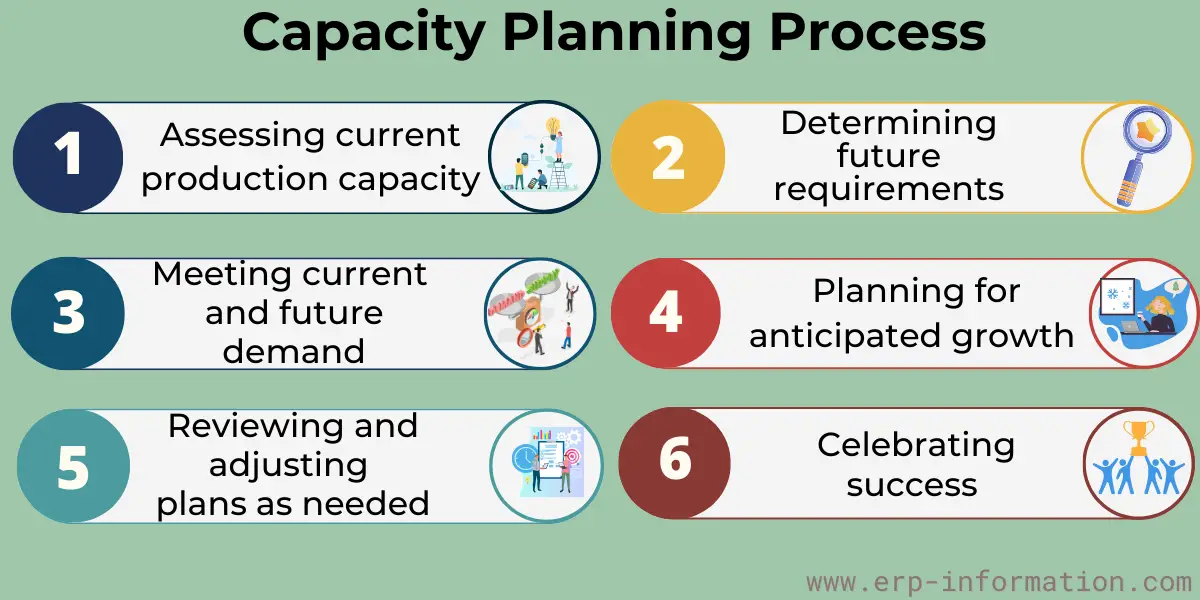
The steps involved in capacity planning are:
1. Assessing current production capacity
Current production capacity assessment is the first step in any capacity planning process. Next, you need to understand what resources you have at your disposal and how they’re currently used in resource planning. This can include everything from people and equipment to office space and data storage.
2. Determining future requirement
It may seem daunting, but planning for growth is essential. Whether your business is expanding or anticipating more traffic on your website, you need to know what capacity you’ll need down the road.
3. Planning for anticipated growth
It is essential, but it’s also important to be realistic about potential needs. It’s better to overestimate than underestimate, so don’t be afraid to think big!
4. Meeting current and future demand
It is the ultimate goal of capacity planning. Of course, you want to ensure you have enough resources available at all times, but it’s also important not to waste money on excess capacity.
5. Reviewing and adjusting plans
Reviewing and adjusting plans as needed will help your business grow steadily instead of haphazardly. No matter what kind of changes come up, whether related to growth or anything else, you should always be willing and able to adapt.
6. Monitor and refine
Capacity planning is not one-and-done. Track actual output and utilization against the plan, and feed what you learn back into the next cycle so forecasts and buffers get more accurate over time.
Types of Capacity Planning
There are three types of capacity planning.
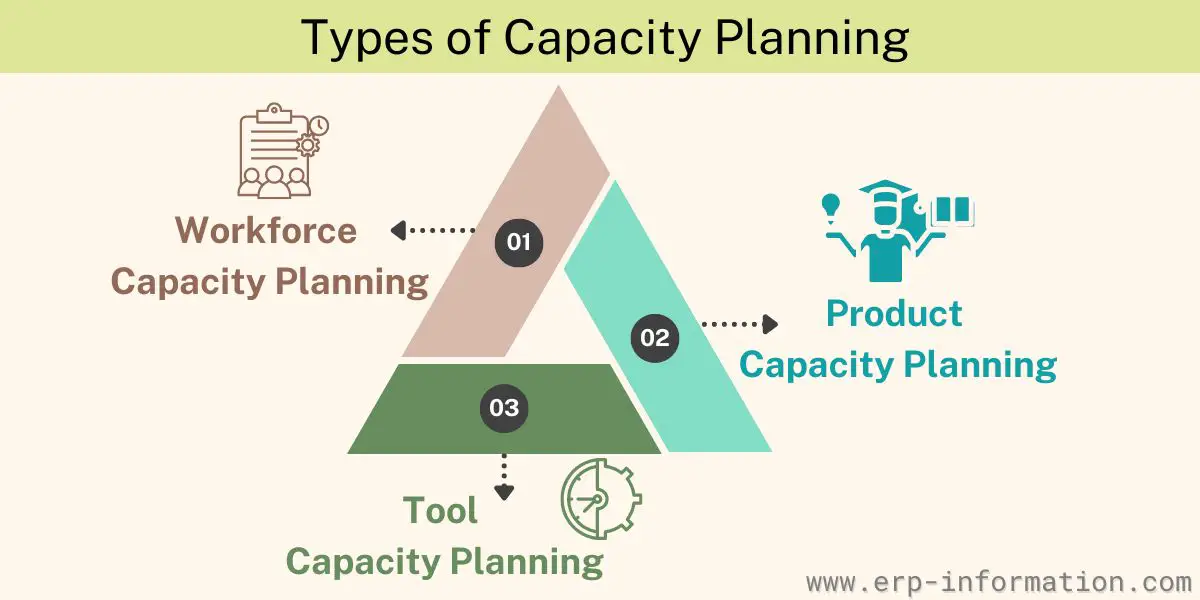
Workforce capacity planning
Workforce capacity planning focuses on managing your human resources to ensure you have the necessary workforce to meet demand effectively. It helps you determine how far in advance to initiate hiring or downsizing, ensuring you have the right number of employees to complete tasks efficiently.
Product capacity planning
Product capacity planning ensures you have the production capability to meet varying product demands. It allows you to adjust production levels by securing the necessary materials and labor to align with market demand fluctuations.
In this way, it helps you maintain a balance between supply and demand, optimizing resources and minimizing waste.
Tool capacity planning
This capacity planning ensures your business has all the essential tools, such as machinery, vehicles, assembly line components, and other resources, required to produce and deliver your products or services promptly and efficiently.
Capacity Planning vs Resource Planning
| Capacity planning | Resource planning |
| Capacity planning is a strategic way of finding the required production capacity for the organization to meet changing demands for its products. | Resource planning is a specific procedure assigning resources (like people, equipment, and materials) to project activities based on their availability and the needs of the project. |
| The objective is to ensure that there are enough resources (like equipment, space, and labor) available to produce the required amount of goods or services. | The main objective is to ensure that the right resources are available at the right time and place to complete project tasks efficiently. |
| It focuses on the overall capability of the production system and the overall process of the organization. | It focuses on optimizing the utilization of resources within the constraints of a project. |
| It involves forecasting demand, determining the production capacity needed, and planning for future capacity requirements. | It involves assigning specific resources to tasks, managing resource availability, and resolving conflicts over resource allocation. |
| It often has a longer-term perspective, looking at future demand and preparing for it months or even years in advance. | It typically has a shorter-term perspective, focusing on the needs of current or upcoming projects. |
| Commonly used in manufacturing and service industries to balance capacity with demand. | Commonly used in project management across various industries to ensure project deadlines are met and resources are used efficiently. |
The Three Levels of Capacity Planning
This is the part that turns capacity planning from a vague idea into something you can actually run. Capacity is not checked once. It is checked at three levels that mirror the production planning hierarchy, each over a longer horizon and in less detail than the one below it.
| Level | Checked against | Horizon and detail | Typical decision |
|---|---|---|---|
| Resource requirements planning (RRP) | The production plan and sales and operations plan | Longest horizon, roughest detail, aggregate resources | Build a line, lease a building, hire a shift |
| Rough-cut capacity planning (RCCP) | The master production schedule | Medium term, deliberately approximate, a few key work centres only | Is this MPS realistic before we commit to it? |
| Capacity requirements planning (CRP) | The output of MRP, including released and planned orders | Short term, detailed, every work centre and routing | Overtime, reroute, subcontract this week |
| Input/output control | Actual work released and completed | Execution, now | Is the queue growing at this work centre? |
The reason for the split is cost of computation against cost of being wrong. RCCP looks at only a handful of critical resources because running full detail on a schedule you have not committed to yet is wasted effort, and at that horizon an approximate answer is enough to tell you the plan is impossible. CRP does the detailed arithmetic once the material plan exists, when the answer has to be right because you are about to release the work.
A practical consequence: if capacity problems keep appearing at CRP, the fix is usually not better CRP. It is that RCCP was skipped or waved through, and an unachievable master schedule was accepted upstream.
Tools and Systems
Capacity planning tooling falls into three honest categories, and which one you need depends far more on your scale than on any product comparison.
- Spreadsheets. Still the most widely used capacity planning tool, and entirely adequate for a single site with a handful of critical work centres. They stop being adequate when the routing data changes faster than anyone can maintain the model.
- The capacity modules inside your ERP or MRP system. If you already run MRP, RCCP and CRP functionality is usually present and often switched off, because it depends on routing and work centre data that nobody has kept current. Fixing that data is normally a bigger win than buying anything.
- Advanced planning and scheduling (APS) systems. Finite capacity scheduling that plans against real constraints rather than assuming infinite capacity, which is what basic MRP does. Worth it when the sequence and the constraints genuinely drive your throughput.
Note that “capacity planning” also names a separate discipline in IT, sizing servers, storage and network capacity, and the tooling there is a different market entirely. If you arrived here looking for infrastructure sizing rather than production capacity, the concepts of design capacity, utilization and headroom carry across, but the products do not.
Whatever you use, the constraint on capacity planning is almost never the software. It is whether your routings, work centre calendars and standard times reflect what actually happens on the floor.
Who is Involved in Capacity Planning?
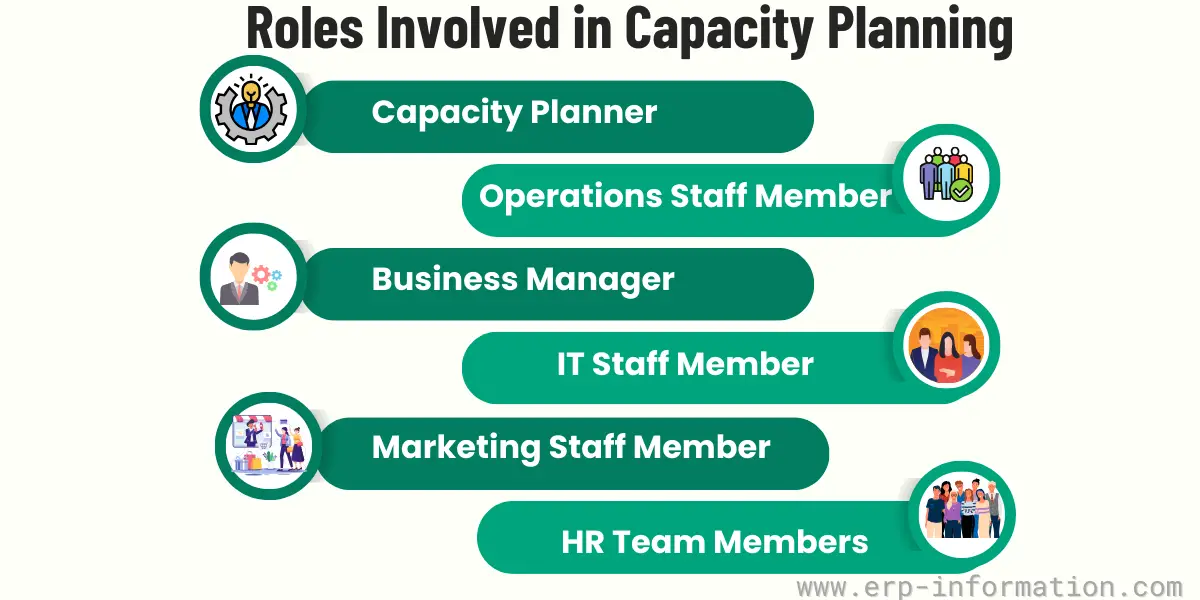
The roles involved in capacity planning can vary depending on the organization but typically include members from different enterprise areas, such as human resources, information technology, marketing, and manufacturing.
It is strategic planning that a company should regularly undertake to ensure the organization can meet its current and future demands.
Roles involved in it are :
Capacity Planner
Responsible for the collection and analysis of information, as well as for creating an actionable capacity plan. They work closely with business managers to understand their requirements and translate those into a technical context.
This includes identifying future demand patterns based on industry trends, sales forecasts, or any other factor that can help predict changes in resource usage (e.g., product growth, new initiatives, workforce increase).
The capacity planner gathers information throughout the organization to give decision-makers insight into current performance levels and what might happen in the future.
Operations Staff Member
An Operations Staff Member is an individual involved in the business’s day-to-day operations. They are responsible for ensuring that resources are available when needed and those production goals are met.
Business Manager
The individual is ultimately responsible for the success or failure of the business unit/department. Therefore, they must understand their capacity requirements to make informed decisions about future growth or initiatives.
Information Technology (IT) Staff Member
They are involved in supporting and managing the technology infrastructure within the organization. This includes evaluating current systems, recommending upgrades/changes, and working with vendors to procure necessary hardware/software.
In some cases, they may also be involved in designing and building new applications or modifying existing ones to meet organizational needs better.
Marketing Staff Member
Part of the organization that is responsible for marketing and brand development. They understand current demand patterns, evaluate how new initiatives may impact future capacity needs, etc.
Human Resources (HR) Team Members
They guide hiring plans/targets, training requirements, etc. Therefore, they need to be consulted when assessing future resource demands.
Benefits
Capacity planning allows businesses to forecast future production needs and ensure they have the resources to meet demand.
- It helps businesses optimize their resources and avoid costly overages or shortages.
- It enables businesses to plan for future growth and expansion.
- Effective capacity planning can help businesses manage their current resources more efficiently.
- It can help businesses react quickly to changes in demand.
Resource management software can automate much of the capacity planning process, making it easier and faster for businesses to accurately picture their current and future needs.
Best Practices
Among many best practices, we are listing effective practices.
- Ensure you have a clear understanding of your system requirements. That includes understanding your desired uptime, peak loads, anticipated growth, etc.
- Work with vendors to understand their capabilities and limitations. Make sure you know what they can provide regarding resources and assistance.
- Run load tests on your systems to get a realistic picture of performance under real-world conditions. That will help you identify potential bottlenecks and capacity issues before they cause problems in production.
- Utilize monitoring tools to track key performance indicators (KPIs) in your production environments.
How Do You Determine Production Capacity?
The production capacity is the maximum number of units your company can produce in a given period. It includes all resources, including labor hours and machines.
To determine your production capacity, you must first understand your available resources. This includes understanding the amount of space you have, the number of workers you have, and the amount of equipment you have.
The steps are as follows.
- Assess Resources:
- Count your workers.
- Measure the available work hours.
- Evaluate your equipment.
- Calculate Time:
- Determine how long it takes to produce one unit of your product.
- Compute Capacity:
- Multiply the number of workers by the available work hours.
- Divide this total by the time it takes to produce one unit.
- Example Calculation:
- Workers: 5
- Work Hours: 8 hours per day
- Production Time: 2 hours per unit
- Calculation:
- Production Capacity = (5 workers × 8 hours) divided by 2 hours per unit = 20 units per day
You can calculate your Production capacity using our Online Production capacity calculator
Note: Production capacity is flexible. It can change based on product demand. If demand increases, you might need more workers or longer hours to boost capacity.
FAQs
What is capacity planning?
Capacity planning is the process of matching the output a business is able to produce against the demand it expects, far enough ahead that the gap can still be closed. Too little capacity causes lost sales, expediting and missed delivery dates; too much means paying for equipment and labour that stand idle. It is carried out at three levels, from long-term aggregate resource decisions down to detailed short-term scheduling of individual work centres.
What are the steps in the capacity planning process?
The process set out on this page is six steps: assess current capacity, determine future requirements, plan for anticipated growth, meet current and future demand, review and adjust the plan, then monitor and refine it. Step counts differ between sources, and you will see the same process presented as four, six or eight steps; the sequence matters far more than the number, and it is a loop rather than a one-off exercise.
What are the three capacity planning strategies?
Lead, lag and match. A lead strategy adds capacity ahead of forecast demand, which captures growth but risks paying for idle capacity if the demand does not arrive. A lag strategy adds capacity only after demand is proven, which protects cash but risks lost sales and expediting. A match strategy adds capacity in smaller increments as demand develops, splitting the difference. The right choice depends on how costly a stockout is against how costly idle capacity is in your business.
What is the difference between utilization and efficiency?
They share a numerator and differ in the denominator. Utilization is actual output divided by design capacity, the theoretical maximum. Efficiency is actual output divided by effective capacity, the realistic maximum after planned maintenance, changeovers and breaks are deducted. Utilization therefore always reads lower. A line producing 680 units against a design capacity of 1,000 and an effective capacity of 800 is running at 68% utilization and 85% efficiency. Always state which denominator you used.
What is the difference between RCCP and CRP?
Both check capacity, at different points and different levels of detail. Rough-cut capacity planning (RCCP) tests the master production schedule against a small number of critical work centres over the medium term, and is deliberately approximate because the schedule is not yet committed. Capacity requirements planning (CRP) runs after MRP, uses planned and released orders with full routings, and covers every work centre in detail over the short term. If capacity problems keep surfacing at CRP, the usual cause is that RCCP was skipped upstream.
What is capacity planning in ERP?
In an ERP system, capacity planning is the function that compares the workload created by the production plan against the available hours at each work centre. Most ERP and MRP systems ship with rough-cut capacity planning and capacity requirements planning modules already included. They are frequently switched off, because they depend on accurate routings, standard times and work centre calendars, and the data has drifted from what actually happens on the floor. Fixing that data is usually more valuable than buying additional software.
What are the types of capacity planning?
By resource, capacity planning is commonly split into workforce capacity planning (do we have enough people with the right skills), product or production capacity planning (can the equipment produce the required volume), and tool or machine capacity planning (are the specific tools and machines available when needed). These cut across the three planning levels rather than replacing them.
Conclusion
Capacity planning goes wrong in predictable ways, and none of them are really about forecasting. The first is quoting a capacity number without saying which denominator it came from, so utilization and efficiency get compared as though they measure the same thing. The second is chasing high utilization everywhere instead of at the constraint, which just piles inventory in front of the bottleneck. The third is treating the capacity cushion as waste to be squeezed out, until the first demand spike or breakdown proves what it was for.
The fourth is structural and the most expensive. If capacity shortfalls keep appearing at the detailed short-term level, week after week, the problem is almost never the short-term plan. It is that the rough-cut check was skipped and an unachievable master schedule was accepted upstream, so the shop floor is being asked to absorb a decision that was made months earlier.
If you are starting from nothing, start small and honest: pick your genuine constraint, work out its effective capacity rather than its design capacity, and compare that against the demand you have already accepted. That single comparison usually explains more about your delivery performance than a full planning system will in its first year.