
SCADA, short for Supervisory Control and Data Acquisition, is the software layer that lets a small team monitor and control industrial equipment spread across a wide area from one screen. It pulls live readings from sensors and controllers in the field, shows them to operators, raises an alarm when something drifts out of range, and sends commands back to open a valve, start a pump, or trip a breaker. Utilities, water and wastewater plants, pipelines, factories, and power grids all run on it.
A SCADA system does not control the machinery itself. It sits above the devices that do, the PLCs and RTUs on the plant floor, and supervises them: gathering their data, storing it, and giving operators a way to step in. That supervisory role, stretched across sites that can be miles apart, is what separates SCADA from a single machine controller.
What is SCADA System?
It is a control system that collects data from industrial processes, typically over a wide area, often for monitoring and control.
It can include hardware and software for gathering data, transmitting the data across a network, and displaying the data on operator screens.
This system connects sensors and remote servers to control equipment such as pumps and motors. The acronym SCADA stands for Supervisory Control And Data Acquisition.
How does it work?
A typical SCADA system includes a central computer that collects data from numerous field devices, such as sensors and controllers. Then the data is processed and displayed on a human-machine interface (HMI), which allows operators to monitor the process and make changes as necessary.
Using logic-based rules, operators can select the completion of specific tasks or the beginning of others to maintain the desired output at the remote site. That can be everything from regulating a power plant to overseeing a water filtration system.
Sometimes, the HMI may also be used to issue alarms or take automated action in response to certain conditions.
While SCADA systems have been in use for many years, technological advances have made them increasingly sophisticated and capable of integrating with other systems, such as enterprise resource planning (ERP). As a result, the system plays an increasingly important role in operating industrial facilities worldwide.
Importance of SCADA
SCADA systems as intelligent assistants for factories and critical facilities. They monitor operations in real-time, promptly alerting us to any anomalies. This enhances efficiency, saves resources, and enables remote control to prevent risky situations. Furthermore, they store historical data, aiding in proactive issue prevention.
SCADA systems enhance safety measures and protect against unauthorized access to vital equipment. They ensure smooth operations and minimize downtime. Their versatility allows seamless integration with various machines, making them suitable for diverse tasks.
They also assist with regulatory compliance, ensuring adherence to necessary standards. They present data visually for easy comprehension, enabling swift response to issues.
In case of any deviations, they promptly notify us. This efficiency not only saves time and money but also promotes environmentally-friendly practices.
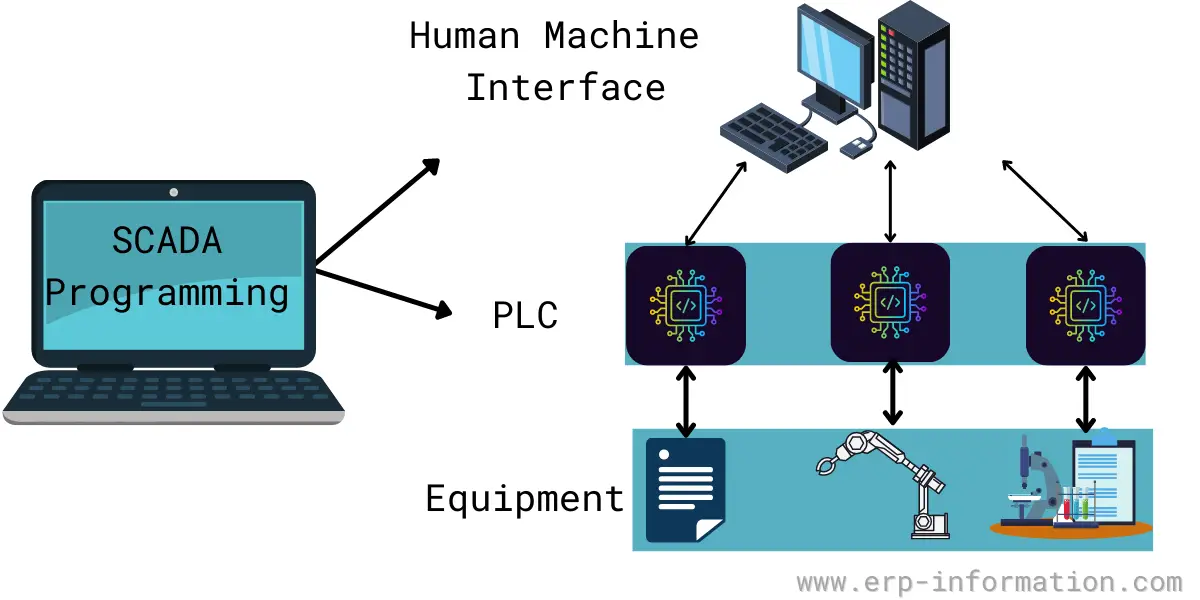
SCADA system components
The key components include:
The field devices
Field devices are input devices such as sensors, valves, and actuators that collect data from the process being monitored or controlled. Both devices are controlled and monitored by field controllers.
Field controllers
The control room operator interface equipment allows the operator to view process data and issue commands to the field devices. Controllers use algorithms to process data from field devices and make decisions on controlling operations in the field.
Two types of controllers are there.
- Remote terminal units (RTUs): These individual devices scattered around the plant or facility collect data from sensors and then relay that information back to the master station.
- Programmable logic controllers (PLCs) – These devices interface with the actuators (controllers) to control processes.
Supervisory computer
The main computer oversees and controls the entire SCADA process, which collects data from field devices and provides commands to field controllers.
Human-machine interface (HMI)
This graphical interface allows the operator to view real-time data from the RTUs and make changes to controller settings if necessary.
Communication infrastructure
This enables communication between the field devices and field controllers. It can be either wired or wireless.
SCADA system architecture
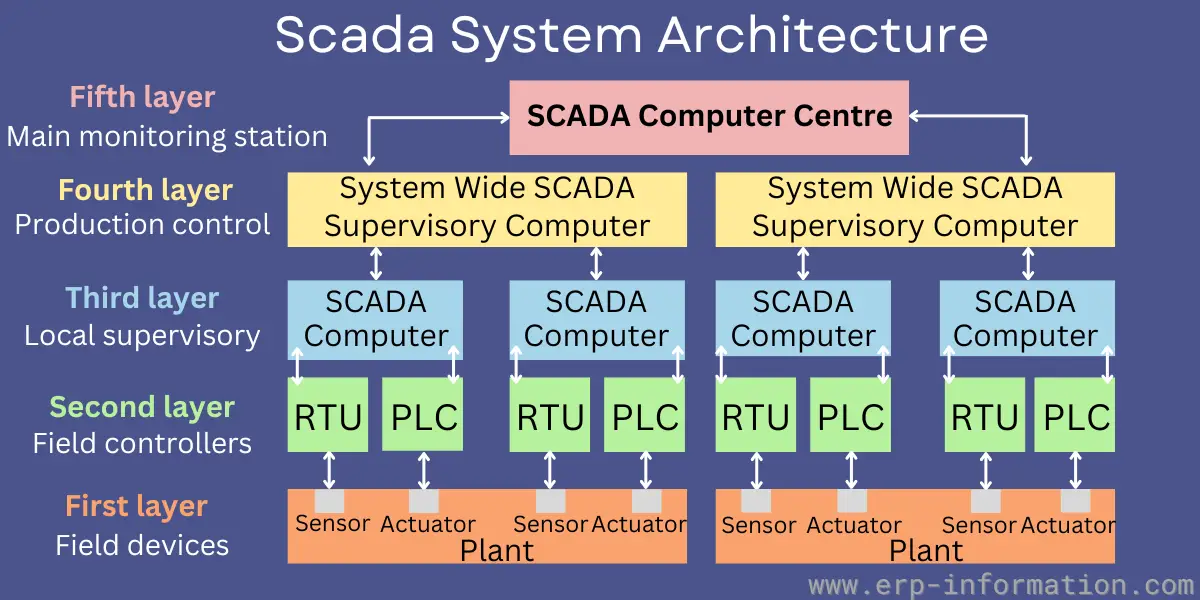
- The first layer (Field devices) consists of sensors and actuators that collect data and perform actions in the field.
- The second layer (Field controllers) includes local controllers such as RTUs and PLCs. They get data from sensors and send the command to actuators.
- The third layer (Local supervisory) consists of local supervisory devices that gather data from field controllers and give commands to those who must carry them out.
- The fourth layer ( Production control) includes many local supervisory systems that collect data from local supervisory systems and generate reporting to the next layer.
- The fifth layer (Main monitoring station) includes a SCADA computer system and manages all ongoing processes.
Examples of SCADA system
1. Smart city
The SCADA system is crucial for smart cities in efficiently managing various urban services and infrastructure like power grids, traffic lights, power consumption, and wastewater management.
SCADA systems collect real-time data from multiple sources, enabling centralized monitoring, control, and automation of different processes to optimize resource utilization, improve service quality, and enhance overall city operations. Here are some key uses of SCADA systems in a smart city:
Energy management
SCADA helps monitor and analyze energy consumption patterns across the city, allowing for better load balancing, demand forecasting, and integrating of renewable energy sources. That leads to more efficient power distribution, reduced energy wastage, and lower greenhouse gas emissions.
Water and wastewater management
With the help of SCADA, people can monitor water usage, detect leaks, and manage water distribution networks effectively. By automating the control of pumps, valves, and treatment processes, SCADA solutions ensure optimal water supply, minimize water loss, and maintain water quality standards.
Transportation management
In smart cities, SCADA helps to monitor and control traffic signals, public transportation schedules, and road conditions, leading to improved traffic flow.
Waste management
SCADA systems can help smart cities optimize waste collection routes, monitor waste levels, and automate recycling or waste-to-energy processes.
Environmental monitoring
By collecting data from various sensors and devices, SCADA systems can track air quality, noise levels, and other environmental parameters in real time.
Public safety and security
SCADA systems can also monitor and control surveillance cameras, streetlights, and emergency response systems, ensuring a safe and secure environment for residents and visitors.
2. Smart manufacturing
Smart manufacturing uses scada to monitor and control data from machinery sensors for predictive maintenance and enhance safe operations. Here are some key uses of SCADA systems in smart manufacturing:
Process monitoring and control
SCADA monitors production processes, equipment performance, and product quality. That helps manufacturers to identify bottlenecks, inefficiencies, or potential issues and make timely adjustments to optimize the production process.
Predictive maintenance
By tracking equipment performance and analyzing historical data, SCADA systems can predict when a machine will fail or require maintenance. That helps manufacturers schedule maintenance proactively, reducing downtime and minimizing disruptions to production.
Energy management
SCADA systems can monitor and control energy consumption across the entire manufacturing facility, providing insights into energy usage patterns and highlighting opportunities for optimization.
Integration with other systems
SCADA systems integrate with other manufacturing technologies, such as Manufacturing Execution Systems (MES), Enterprise Resource Planning (ERP) systems, and Industrial Internet of Things (IIoT) platforms. That enables seamless data exchange and collaboration across different departments.
SCADA Implementation Steps
Implementing a SCADA (Supervisory Control and Data Acquisition) system is a methodical process that involves several key steps. By certain steps, one can systematically implement a SCADA system customized for specific needs, ensuring reliable data acquisition, control, and monitoring in industrial and critical infrastructure applications.
Here’s a stepwise implementation plan:
- Define Objectives and Requirements: Begin by identifying the specific goals of your SCADA system. Define the system’s operational requirements, including the types of sensors, data frequency, and communication protocols required.
- Select Hardware Components: Choose the hardware elements that will form the backbone of your SCADA system. This includes PLCs (Programmable Logic Controllers), RTUs (Remote Terminal Units), communication devices, and servers. Ensure that these components are reliable and suitable for your application.
- Design the Communication Network: Establish a robust communication infrastructure. Determine the best communication protocol (e.g., Modbus, DNP3) and network topology (star, ring, or mesh) for your needs. Ensure redundancy and fault tolerance to maintain continuous data flow.
- Install Sensors and Field Devices: Place sensors and field devices strategically in the physical environment to collect data. Ensure they are appropriately calibrated and correctly wired to the data acquisition hardware.
- Develop Control Logic: Create control algorithms using appropriate programming languages (e.g., ladder logic, structured text) for PLCs and RTUs. These algorithms dictate how the system will respond to sensor data and control the processes.
- Implement HMI (Human-Machine Interface): Design and develop an HMI interface to allow operators to interact with the SCADA system. This should provide real-time data visualization, alarm management, and control options.
- Set Up Data Storage and Database: Configure a database system to store historical data and system events. Properly design data structures for efficient storage and retrieval of information.
- Implement Security Measures: Prioritize security by applying measures such as firewalls, access controls, user authentication, and encryption to safeguard your SCADA system from unauthorized access and cyber threats.
- Test and Simulation: Rigorously test the system with simulations to ensure it behaves as expected and can handle various operational scenarios. Verify that alarms, control actions, and data logging work correctly.
- Implement Redundancy and Failover: Introduce redundancy at critical points to minimize downtime and data loss. This may include redundant servers, power supplies, and communication paths.
- Configure Alarms: Set up alarm parameters and notification procedures to alert operators when the system detects abnormal conditions or failures.
- Integration with Existing Systems: If necessary, integrate the SCADA system with other enterprise systems, like ERP or MES (Manufacturing Execution System), to facilitate data sharing and decision-making across the organization.
- User Training: Provide training for operators, engineers, and maintenance personnel to ensure they understand how to use the SCADA system effectively and respond to various situations.
- Compliance and Documentation: Configure the system to comply with industry-specific regulations and standards. Maintain comprehensive documentation that includes system architecture, hardware configurations, and software code for reference and auditing purposes.
- Ongoing Maintenance and Monitoring: Develop a maintenance plan that includes regular system checks, software updates, and data backups. Monitor the system’s performance and security, making necessary adjustments over time.
- Regular Audits: Conduct periodic security and performance audits to ensure that the SCADA system remains secure, compliant, and efficient.
SCADA vs PLC vs DCS
SCADA is often lumped together with PLCs and a DCS, but the three sit at different levels of the control stack, and most plants use all of them. A PLC (programmable logic controller) is the ruggedized computer that actually runs a machine or process, reacting in milliseconds. A DCS (distributed control system) coordinates continuous, plant-wide processes under one redundant architecture, and is the standard wherever a failure would be dangerous or costly, such as a refinery or a power station. SCADA is the supervisory layer above them: it does not control the equipment itself but monitors and commands the PLCs, RTUs, and DCS controllers underneath, often across sites spread over a wide area.
| PLC | DCS | SCADA | |
|---|---|---|---|
| What it is | A controller for one machine or process | A plant-wide system for continuous processes | A supervisory layer over controllers |
| Scope | A single machine or line | One plant or process unit | Many sites, often far apart |
| Controls the field? | Yes, directly | Yes, directly | No, it supervises PLCs, RTUs, and DCS |
| Best for | Fast, discrete, machine-level control | High-hazard continuous processes | Wide-area monitoring and control |
| Response | Milliseconds | Milliseconds, with heavy redundancy | Seconds, at the supervisory level |
In practice the lines blur. A modern SCADA system may talk to a DCS and hundreds of PLCs at once, and vendors sell hybrid platforms that do all three jobs. The distinction that stays useful is what each one does: PLCs and a DCS control, SCADA supervises.
History of SCADA
Monolithic SCADA systems
We can call them 1st generation systems. In the 1960s and 1970s, RTUs at industrial sites were directly connected to mainframe computers.
Distributed systems
This is the second-generation system. In the 1980s, because of powerful computers, the system could share data at the plant level.
Networked systems
It can be a third-generation system. In the 1990s, the system became more interoperable because of the development and adoption of standard network protocols.
It meant they could be scaled across enterprises’ industrial infrastructures without difficulty or risk because enterprise integration was possible through a wider variety of devices used in conjunction with these networks – something which would have been impossible before.
IIoT-based systems
This is the latest or fourth-generation system. In the 2000s, the system is introduced as the SCADA system, and since then, vendors have been developing web-based software to enable data transparency across platforms.
Today’s cloud computing has made this even more important as it changes how SCADAs function, emphasizing accessibility through universally available interfaces such as browsers running on handheld devices or laptops at home; and desktop computers sitting behind your desk.
SCADA architecture is used in various industries, from manufacturing to transportation to energy production. Its popularity is due to its ability to provide real-time monitoring and control of large-scale systems and its relative affordability compared to alternative solutions.
SCADA security: the risk of connecting OT to IT
For decades SCADA ran on isolated networks, and much of its security came from that isolation, the so-called air gap. That assumption no longer holds. As SCADA connects to corporate IT, cloud services, and remote access, the gap between operational technology (OT) and IT has narrowed, and the attack surface has grown with it.
The deeper problem is the protocols. The languages SCADA uses to talk to field devices, chiefly Modbus (common in manufacturing) and DNP3 (common in utilities), were designed decades ago for reliability, not security. Many carry no encryption or authentication, which leaves their traffic open to interception, spoofing, and command injection: an attacker who reaches the network can read or forge control messages. Newer standards such as OPC UA and DNP3 Secure Authentication add encryption and authentication, and are the right choice for any system exposed beyond a closed network.
The clearest warning was Stuxnet in 2010, malware that crossed an air-gapped facility on a USB drive and reprogrammed Siemens PLCs to damage centrifuges while showing operators normal readings. It proved that even isolated industrial systems can be reached, and that SCADA security has to be built in through network segmentation, strict access control, patching, and monitoring, rather than assumed.
Benefits
Enhanced communication
Current communication protocols improve accessibility to information and control.
Scalability
Modern systems are more scalable than legacy systems. That means they can handle more workloads and meet the demands of modern businesses.
Additionally, they are better supported by hardware and software, making them more reliable and easier to use. Finally, SCADA systems can use cloud computing to meet demand when necessary.
Efficiency
By allowing for centralized control of distributed systems, they increase efficiency by reducing the need for manual input and oversight.
Interoperability
Interoperability between different SCADA systems allows for greater coordination and collaboration between facilities, improving overall system performance.
Finally, they are often deployed with security features that help protect critical infrastructure from cyberattacks.
Great support
The system provides a wide range of support options. Legacy systems may have limited options, while modern systems are more likely to be well-supported by vendors.
That makes it easier to determine help when you need it. In addition, commercial off-the-shelf hardware, open networking standards, and modern software development platforms make third-party support more accessible.
FAQs
Who uses SCADA?
It is used by many organizations and businesses, including water and wastewater utilities, power companies, gas utilities, oil refineries, chemical plants, food processing plants, mining, manufacturing, and power generation.
The system is often used to monitor critical infrastructures like dams, bridges, and nuclear power plants.
Typically it can be used in environments that are dangerous or remote.
Which industries commonly utilize SCADA systems?
SCADA systems find extensive application across various sectors, including energy (power generation and distribution), water and wastewater treatment, oil and gas, manufacturing, transportation, building management, and more.
How do SCADA systems contribute to enhancing security?
They bolster security through measures like firewalls, access controls, authentication, and encryption, effectively safeguarding against unauthorized access and cyber threats. Redundancy and failover configurations are often employed to maintain system integrity.
How are alarms and notifications handled within SCADA systems?
SCADA systems allow for the configuration of alarms that promptly alert operators when abnormal conditions or system failures occur. Notifications can be disseminated via email, SMS, or other communication channels, depending on the system’s configuration.
What role does data storage and historical data play in SCADA systems?
Data storage is a vital component, serving the purposes of trend analysis, regulatory compliance reporting, and historical reference. It empowers operators and engineers to assess past performance and make well-informed decisions.
How do SCADA systems manage emergency situations and system failures?
SCADA systems should have an emergency response plan in place, outlining protocols for addressing critical incidents. Disaster recovery procedures are implemented to minimize the impact of system failures.
What is the difference between SCADA and DCS?
A DCS controls a continuous process inside a single plant directly and with heavy redundancy, which suits high-hazard operations such as refining or power generation. SCADA supervises rather than controls: it monitors and commands PLCs, RTUs, and even DCS controllers, usually across sites spread over a wide area. Many facilities run both, with SCADA sitting above the DCS.
Is SCADA a cybersecurity risk?
It can be. Older SCADA protocols such as Modbus and DNP3 often lack encryption and authentication, and connecting SCADA to IT networks and the cloud has removed the isolation these systems once relied on. The Stuxnet attack in 2010 showed that even air-gapped systems can be compromised. Modern practice protects SCADA with network segmentation, strict access control, and secure protocols like OPC UA.
Conclusion
SCADA systems provide an efficient and effective way to manage and monitor industrial processes.
They are used in various industries, including water treatment, power generation, and manufacturing. The article covered important concepts of it, including its architecture, components, and history.