A DCAA compliant accounting system is a government contractor’s accounting system that a federal contracting officer has determined to be adequate for a cost type contract. The Defense Contract Audit Agency (DCAA) audits that system and reports its findings. DCAA does not approve, certify or endorse any accounting system, and it does not approve any accounting software product.
The short version, in DCAA’s own words. Its published contractor briefing asks and answers the exact question: “How do I get a DCAA approved government accounting system? You cannot. There is no such thing as a DCAA approved government accounting system.” Approval itself is real, but it belongs to the contracting officer, who under DFARS 242.7502(b) determines acceptability and approves or disapproves the system on the auditor’s report. This page uses the real terms, reproduces both official checklists in full, and explains what changes on 1 October 2026.
What is a DCAA Approved Accounting System?
The phrase people search for is DCAA approved accounting system. The thing that actually exists is an accounting system a contracting officer has found adequate. FAR 16.301-3(a)(3) states that a cost reimbursement contract may be used only when “the contractor’s accounting system is adequate for determining costs applicable to the contract or order”. Adequate is the test. Approved is not.
Three different offices are involved, and confusing them is the most common and most expensive mistake a new contractor makes.
| Who | What they actually do | Authority |
|---|---|---|
| DCAA (Defense Contract Audit Agency) | Audits. Submits “information and advice to the requesting activity” on the acceptability of costs and reviews the accounting aspects of cost control systems. It recommends. It does not decide. | FAR 42.101(a) |
| The contract administration office (DCMA in most DoD cases) | “Determine the adequacy of the contractor’s accounting system.” This is the office that makes the call. | FAR 42.302(a)(12) |
| The contracting officer | “Determine the acceptability of a contractor’s accounting system and approve or disapprove the system.” If there are no material weaknesses the contracting officer notifies you in writing that the system “is acceptable and approved”. This is the only approval that exists. | DFARS 242.7502(b) and (d)(2) |
This is why the search term DCMA approved accounting system is closer to the truth than DCAA approved accounting system, though neither is the language the regulation uses. Here is the full vocabulary, with the status of each term.
| Term | Real? | What it means |
|---|---|---|
| DCAA approved accounting system | No | Not a federal designation. DCAA’s own FAQ: “You cannot. There is no such thing as a DCAA approved government accounting system.” |
| Approved accounting system (by the contracting officer) | Yes | Frequently missed, because most articles overcorrect and say no approval exists at all. It does. DFARS 242.7502(d)(2)(i) has the contracting officer notify you in writing that your system is “acceptable and approved”. The approver is the contracting officer, never DCAA. |
| DCAA certified accounting system | No | No certification programme exists for systems or for software. |
| DCAA approved software | No | No product holds any DCAA approval. Compliance is a property of how you run the system, not of the product licence you buy. |
| Adequate accounting system | Yes | The FAR test that gates cost type awards. FAR 16.301-3(a)(3), FAR 42.302(a)(12). |
| Acceptable accounting system | Yes | Defined term in the DFARS clause: a system complying with the 18 criteria in DFARS 252.242-7006(c). |
| Acceptable for award | Yes | The wording on the pre award survey form itself, Standard Form 1408. |
What are the requirements for a DCAA approved accounting system?
Two official checklists exist, they are not the same length, and they apply at different moments. The diagram below is a practical twelve point summary of what the two have in common. The authoritative lists are reproduced in full underneath it, exactly as the government publishes them.
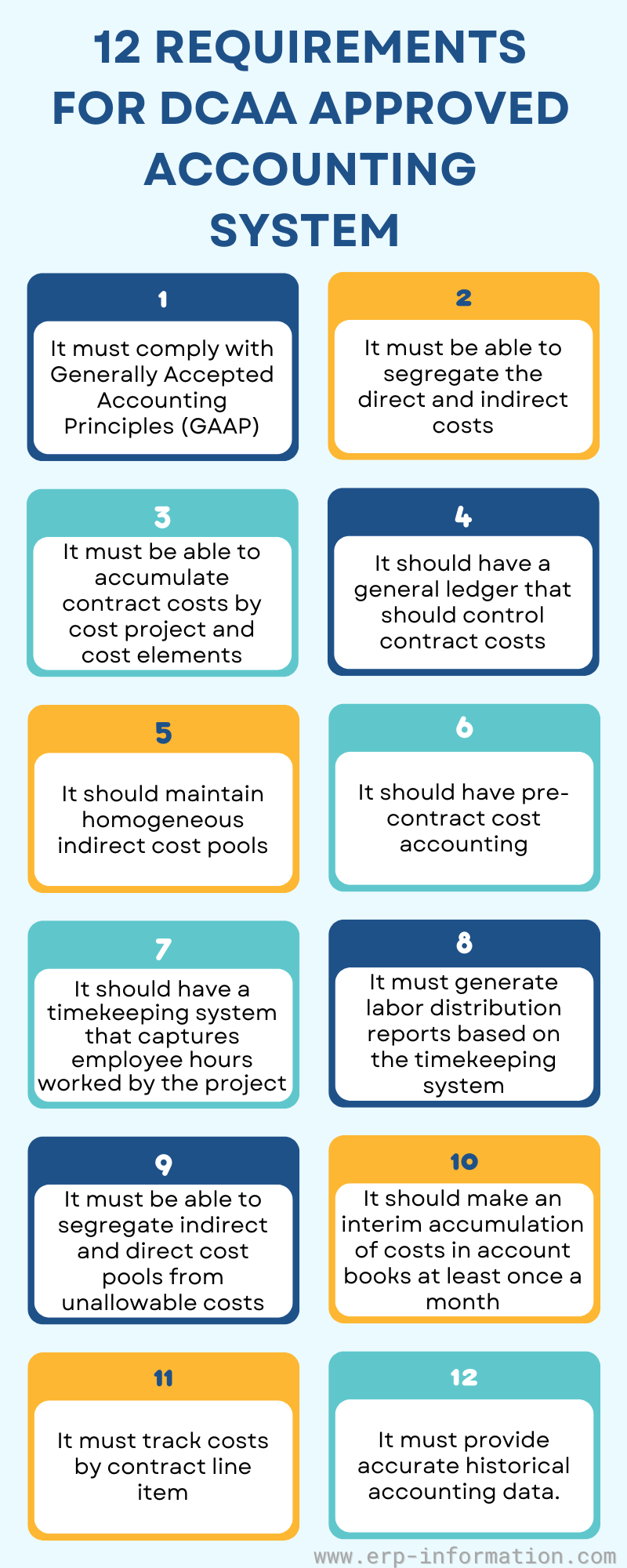
- The system must comply with Generally Accepted Accounting Principles (GAAP).
- It must be able to segregate the direct and indirect costs.
- It must accumulate contract costs by cost project and cost elements.
- It must have a general ledger that should control contract costs.
- It must maintain homogeneous indirect cost pools.
- It must have pre-contract cost accounting.
- It must have a timekeeping system that captures employee hours worked by the project.
- It must generate labor distribution reports based on the timekeeping system.
- It must be able to segregate indirect and direct cost pools from unallowable costs.
- It must make an interim accumulation of costs in account books at least once a month.
- It must track costs by contract line item.
- It must provide accurate historical accounting data.
The SF 1408 checklist, reproduced in full
Before a contracting officer awards a cost type contract, the accounting system is evaluated on Standard Form 1408, Preaward Survey of Prospective Contractor (Accounting System). The form is prescribed by FAR 53.209-1(f), the current revision is 1/2014, and it carries OMB control number 9000-0011. Its own footer states that the “previous edition is NOT usable”. Within the Department of Defense, DCAA is normally the agency that performs this survey.
Section II of the form is the evaluation checklist. It has 15 scored items, each marked Yes, No or Not Applicable. This is the complete list, in the form’s own wording and order.
| Item | SF 1408 Section II wording |
|---|---|
| 1 | Except as stated in Section I narrative, is the accounting system in accord with generally accepted accounting principles applicable in the circumstances? |
| 2a | Proper segregation of direct costs from indirect costs. |
| 2b | Identification and accumulation of direct costs by contract. |
| 2c | A logical and consistent method for the allocation of indirect costs to intermediate and final cost objectives. (A contract is final cost objective.) |
| 2d | Accumulation of costs under general ledger control. |
| 2e | A timekeeping system that identifies employees’ labor by intermediate or final cost objectives. |
| 2f | A labor distribution system that charges direct and indirect labor to the appropriate cost objectives. |
| 2g | Interim (at least monthly) determination of costs charged to a contract through routine posting of books of account. |
| 2h | Exclusion from costs charged to government contracts of amounts which are not allowable in terms of FAR 31, Contract Cost Principles and Procedures, or other contract provisions. |
| 2i | Identification of costs by contract line item and by units (as if each unit or line item were a separate contract) if required by the proposed contract. |
| 2j | Segregation of preproduction costs from production costs. |
| 3a | Accounting system provides financial information required by contract clauses concerning limitation of cost (FAR 52.232-20 and 21) or limitation on payments (FAR 52.216-16). |
| 3b | Accounting system provides financial information required to support requests for progress payments. |
| 4 | Is the accounting system designed, and are the records maintained in such a manner that adequate, reliable data are developed for use in pricing follow-on acquisitions? |
| 5 | Is the accounting system currently in full operation? (If not, describe which portions are (1) in operation, (2) set up but not yet in operation, (3) anticipated, or (4) nonexistent.) |
Item 5 is the one that surprises people. The form asks whether the system is currently in full operation, and it allows a surveyor to record that parts of it are merely “set up, but not yet in operation” or “anticipated”. A design on paper is not a passing answer.
Section I of the form records the recommendation, and its three options are worth reading literally, because none of them is the word “approved”:
- Prospective contractor’s accounting system is acceptable for award of prospective contract: Yes.
- No, with the deficiencies explained in the narrative.
- Yes, with a recommendation that a follow on accounting system review be performed after contract award.
The third option is the outcome most small contractors actually receive, and it is a pass. Source: Standard Form 1408 (Rev. 1/2014), published by GSA.
The 18 criteria in DFARS 252.242-7006
After award, a Department of Defense contract carries the clause DFARS 252.242-7006, Accounting System Administration. Under DFARS 242.7503 the clause is used whenever the contract is a cost reimbursement, incentive type, time and materials or labor hour contract, or a contract with progress payments based on costs incurred or on percentage or stage of completion. Note what that means: the clause follows the contract type. It is not limited to large contractors.
The clause defines an acceptable accounting system as one that complies with the criteria below and gives reasonable assurance that laws are complied with, that cost data are reliable, that the risk of misallocations and mischarges is minimised, and that charges are consistent with billing procedures. The current version is dated January 2025, amended at 90 FR 5734 on 17 January 2025.
| # | The system shall provide for |
|---|---|
| 1 | A sound internal control environment, accounting framework, and organizational structure. |
| 2 | Proper segregation of direct costs from indirect costs. |
| 3 | Identification and accumulation of direct costs by contract. |
| 4 | A logical and consistent method for the accumulation and allocation of indirect costs to intermediate and final cost objectives. |
| 5 | Accumulation of costs under general ledger control. |
| 6 | Reconciliation of subsidiary cost ledgers and cost objectives to general ledger. |
| 7 | Approval and documentation of adjusting entries. |
| 8 | Management reviews or internal audits of the system to ensure compliance with the contractor’s established policies, procedures, and accounting practices. |
| 9 | A timekeeping system that identifies employees’ labor by intermediate or final cost objectives. |
| 10 | A labor distribution system that charges direct and indirect labor to the appropriate cost objectives. |
| 11 | Interim (at least monthly) determination of costs charged to a contract through routine posting of books of account. |
| 12 | Exclusion from costs charged to Government contracts of amounts which are not allowable in terms of FAR part 31 and other contract provisions. |
| 13 | Identification of costs by contract line item and by units, if required by the contract. |
| 14 | Segregation of preproduction costs from production costs, as applicable. |
| 15 | Cost accounting information as required by the limitation of cost, limitation of funds and allowable cost and payment clauses, and to readily calculate indirect cost rates from the books of accounts. |
| 16 | Billings that can be reconciled to the cost accounts for both current and cumulative amounts claimed and comply with contract terms. |
| 17 | Adequate, reliable data for use in pricing follow-on acquisitions. |
| 18 | Accounting practices in accordance with standards promulgated by the Cost Accounting Standards Board, if applicable, otherwise Generally Accepted Accounting Principles. |
What the 18 criteria ask for that SF 1408 does not
Most published guides treat the two lists as the same thing. They are not. Reading them side by side, the post award clause adds four obligations that never appear on the pre award form, and these are the ones that catch contractors out in their first post award review:
- Reconciliation of subsidiary cost ledgers to the general ledger (criterion 6). SF 1408 asks only that costs accumulate under general ledger control.
- Approval and documentation of adjusting entries (criterion 7). A journal entry with no approval trail is a finding here and is invisible on the pre award form.
- Management reviews or internal audits of the system itself (criterion 8). You must audit your own compliance, on a schedule, and keep the evidence.
- Billings reconcilable to the cost accounts for current and cumulative amounts (criterion 16), and the ability to readily calculate indirect cost rates from the books (criterion 15).
Running the other direction, SF 1408 asks one question the clause does not: is the system in full operation today. Passing a pre award survey and then quietly deferring the timekeeping rollout is how a clean SF 1408 turns into a post award material weakness.
What changes on 1 October 2026
The Cost Accounting Standards Board issued a final rule on 1 September 2026 that substantially raises the CAS monetary thresholds, effective 1 October 2026. This matters here because CAS coverage is what triggers the payment withholding clause discussed in the next section, and because criterion 18 above turns on whether CAS applies to you.
| Threshold | Before 1 Oct 2026 | From 1 Oct 2026 |
|---|---|---|
| Basic CAS applicability | $2.5 million (tied to the Truthful Cost or Pricing Data statute) | $35 million, a stated amount, decoupled from that statute |
| The “trigger contract” concept | $7.5 million trigger contract | Eliminated |
| Full CAS coverage and Disclosure Statement | $50 million | $100 million |
| Agency head waiver authority | $15 million | $100 million |
The Board describes the rule as “deregulatory” and quantifies it. On five years of FPDS data covering FY2020 to FY2024, 773 entities were subject to full coverage and Disclosure Statement requirements, with aggregate contract values of $1.22 trillion. Applying the new $100 million threshold reduces that to 564 entities while retaining $1.21 trillion of the dollars, which the Board calls “a nearly 30 percent reduction in entities … with a less than one percent loss of the dollars”. For the basic threshold the Board estimated the change would cut CAS covered business segments by roughly 60 percent while keeping over 90 percent of covered dollars.
The change was codified by Section 1806 of the 2026 National Defense Authorization Act. Source: Increase of Monetary Thresholds and Other Matters Related to Cost Accounting Standards Program Requirements, 91 FR 56056, RIN 0348-AB85.
Read this carefully, because it is easy to get backwards. Rising CAS thresholds do not relax the accounting system criteria. DFARS 252.242-7006 attaches to the contract type, so a small contractor on a single cost reimbursement award still faces all 18 criteria. What the new thresholds change is whether the separate payment withholding clause, DFARS 252.242-7005, applies at all, because that clause reaches only CAS covered contracts. From 1 October 2026 a great many contractors will be inside the criteria and outside the withholding.
What happens if your accounting system is found inadequate
This is where the real consequences live, and they are specified to the percentage point in DFARS 252.242-7005, Contractor Business Systems (current version January 2025). The clause applies to contracts covered by the Cost Accounting Standards.
| Stage | What happens | Clock |
|---|---|---|
| Initial determination | The contracting officer notifies you in writing of any material weaknesses, described in enough detail for you to understand the deficiency. | You respond in writing within 30 days |
| Final determination | The contracting officer evaluates your response and issues a final determination, which may include system disapproval and a notice to withhold payments. | Issued after review |
| Withholding begins | 5 percent of amounts due from progress payments and performance based payments, and 5 percent withheld from billings on interim cost vouchers. | Correct, or submit a corrective action plan, within 45 days |
| Withholding reduced | If you submit an acceptable corrective action plan within 45 days and the contracting officer determines you are effectively implementing it, withholding drops to 2 percent. | Until weaknesses are corrected |
| Ceilings | 5 percent maximum for one business system. 10 percent maximum where multiple business systems have material weaknesses. | Per payment |
The accounting system is one of six contractor business systems the clause covers. The others are earned value management, estimating, material management and accounting, property management, and purchasing. That is how a contractor reaches the 10 percent ceiling: weaknesses in two systems at once.
A material weakness is defined in the clause as a deficiency, or combination of deficiencies, such that there is a reasonable possibility that a material misstatement will not be prevented or detected and corrected on a timely basis, where reasonable possibility means “probable” or “more than remote but less than likely”.
Types of DCAA Audits
DCAA is the audit agency for most defence contractors. FAR 42.101(b) states that “for contractors other than educational institutions and nonprofit organizations, the Defense Contract Audit Agency (DCAA) is the responsible Government audit agency”, with cognizance for universities and nonprofits determined under the OMB Uniform Guidance instead.
Under FAR 42.101(a) the auditor is responsible for three things, and the wording is deliberately advisory throughout:
- Submitting information and advice to the requesting activity, based on analysis of the contractor’s financial and accounting records, as to the acceptability of incurred and estimated costs.
- Reviewing the financial and accounting aspects of the contractor’s cost control systems.
- Performing other analyses and reviews that require access to the contractor’s financial and accounting records supporting proposed and incurred costs.
In practice a contractor meets DCAA at three moments: the pre award accounting system survey on SF 1408 before a cost type award, post award accounting system reviews against the 18 criteria, and the annual incurred cost submission audit that settles actual indirect rates. Forward pricing proposal audits arrive separately whenever you bid cost type work.
Compliance Audit
Compliance work is not a single event. Cost allowability is tested against FAR part 31, and CAS compliance is tested only where CAS applies to the contract. Either can be examined at any point in the contract’s life, and the accounting system review is what determines whether the underlying records can support that testing at all.
How to get your accounting system determined adequate
There is no application to file and no approval to request. The sequence is driven by the contracting officer, and it starts because you are in line for a cost type award. This is what actually happens:
- You bid, or are about to be awarded, a cost type contract. The contracting officer cannot award it until the accounting system is adequate under FAR 16.301-3(a)(3).
- The contracting officer requests a pre award accounting system survey. You do not initiate this and you cannot buy it. The request goes to the cognizant audit agency, normally DCAA.
- DCAA performs the survey against SF 1408 and records a recommendation in Section I, along with any deficiencies in the narrative.
- The contract administration office determines adequacy under FAR 42.302(a)(12). In DoD this is normally DCMA, not DCAA.
- After award, the 18 criteria apply and the system can be reviewed again. Weaknesses are handled through the initial and final determination process, with the payment consequences set out above.
Write the policies and procedures first
Almost every SF 1408 item is a question about a documented, consistently applied practice, not about a software feature. Criterion 2c asks for a method of allocating indirect costs that is logical and consistent, which is a written allocation policy. Criterion 8 of the DFARS list asks for management reviews or internal audits against “the contractor’s established policies, procedures, and accounting practices”, which presupposes that those documents exist. A contractor with an excellent product and no written procedures fails; a contractor with modest tooling and disciplined written procedures passes.
Choose the right accounting software
Several accounting software packages are designed to meet the DCAA requirements. While choosing an accounting software package, it is important to ensure it can generate the reports that the DCAA requires.
Implement the accounting software and configure it to meet the DCAA requirements
Once you have chosen an accounting software package, you must implement and configure it to meet the DCAA requirements. This may require you to make changes to your accounting procedures and controls.
Document your accounting system and procedures
The DCAA requires that you have documentation of your accounting system and procedures. This documentation should include a description of your accounting system, your accounting procedures, and your internal controls.
Run the system for a full accounting cycle before the survey
SF 1408 item 5 asks whether the accounting system is currently in full operation, and gives the surveyor room to record that parts are only “set up, but not yet in operation”. Timekeeping is the usual failure point, because criterion 2e requires a system that identifies employees’ labour by cost objective every day, and there is no way to demonstrate that retrospectively. Close at least one month, produce a labour distribution report from real timesheets, and reconcile it to the general ledger before anyone visits.
Three things that do not exist, and are worth knowing before you pay for any of them.
1. A “DCAA approved auditor”. There is no DCAA accreditation for outside firms. A consultant or CPA can prepare you, document your procedures and run a mock review, all of which is genuinely useful, but no private firm can confer a government determination.
2. An application or submission to DCAA. You cannot submit your system to DCAA for approval, and a request for proposal plays no part in it. DCAA states this plainly: “DCAA does not perform audits requested by a contractor. DCAA only performs these audits based on a request from a federal entity who is responsible for determining the acceptability of a contractor’s system.”
3. A DCAA “Certificate of Compliance”. No such certificate is issued. What exists is an audit report to the requesting activity and, where the clause applies, a written determination from the contracting officer. If a vendor or consultant offers to get you certified, that is a strong signal to look elsewhere.
Accounting software used by government contractors
None of the products below is DCAA approved, because no product is. What differs between them is how much of the compliance work the product does for you out of the box, and that is the only useful way to compare them. A purpose built government contracting system arrives with indirect cost pools, project cost structures, compliant timekeeping with audit trails and incurred cost reporting already modelled. A general accounting product can be made to work, but you supply that structure yourself and you carry the risk of getting it wrong.
Two cautions before the list. First, a vendor saying its product is DCAA compliant is marketing shorthand, not a government designation; read it as designed to support the criteria. Second, the determination is made about your system as you actually operate it, so the same product can pass at one contractor and fail at another.
1. QuickBooks
QuickBooks is general purpose accounting software, not a government contracting system, and it is not approved by DCAA or by anyone else. It is nonetheless the most common starting point for small contractors, and contractors do pass pre award surveys running it. What makes that work is everything built around it: a chart of accounts designed for direct and indirect segregation, indirect cost pools and a documented allocation base, daily timekeeping with an audit trail of changes, and written policies. Out of the box QuickBooks provides none of that structure, and its native timekeeping is not designed for the daily labour distribution that criterion 2e of SF 1408 expects.
DCAA addresses QuickBooks by name in its contractor briefing, and the answer is worth reading in full: “An accounting system is more than just a software package. It includes accounting methods, procedures, and controls. Many accounting software application can be part of an acceptable accounting system or set up in a manner that fails to meet the requirements of an acceptable system.” Intuit is equally careful in the other direction. Its DCAA marketing is scoped to QuickBooks Time, never to the general ledger, and carries the disclaimer that “compliance with applicable laws is the responsibility of the business”.
This is why a small contractor on QuickBooks usually adds a layer for the parts QuickBooks does not do. Two such products publish their prices, which is unusual in this market and makes budgeting possible. Prices read from each vendor’s own site on 13 September 2026:
| Add-on | What it adds | Published price |
|---|---|---|
| ICAT, by ICAT Systems | Indirect rate calculation, indirect cost allocation to contracts from the QuickBooks general ledger, profit and loss by job, labour distribution, and the schedules required under FAR 52.216-7 for the incurred cost submission. | US$1,200, US$2,400 or US$3,600 per year by tier, unlimited users, licensed per QuickBooks company file |
| Hour Timesheet | Timekeeping only, with bi-directional QuickBooks Online and Desktop sync. It does not do indirect rate pools or incurred cost submissions. | US$40 per month base plus US$14 per user per month |
One planning note if you are considering the ICAT route. Intuit stopped selling QuickBooks Desktop Pro Plus, Premier Plus and Mac Plus as new subscriptions to United States customers on 30 September 2024, with QuickBooks Desktop Enterprise unaffected and existing subscribers able to renew. Confirm current platform support with the vendor before committing.
Features
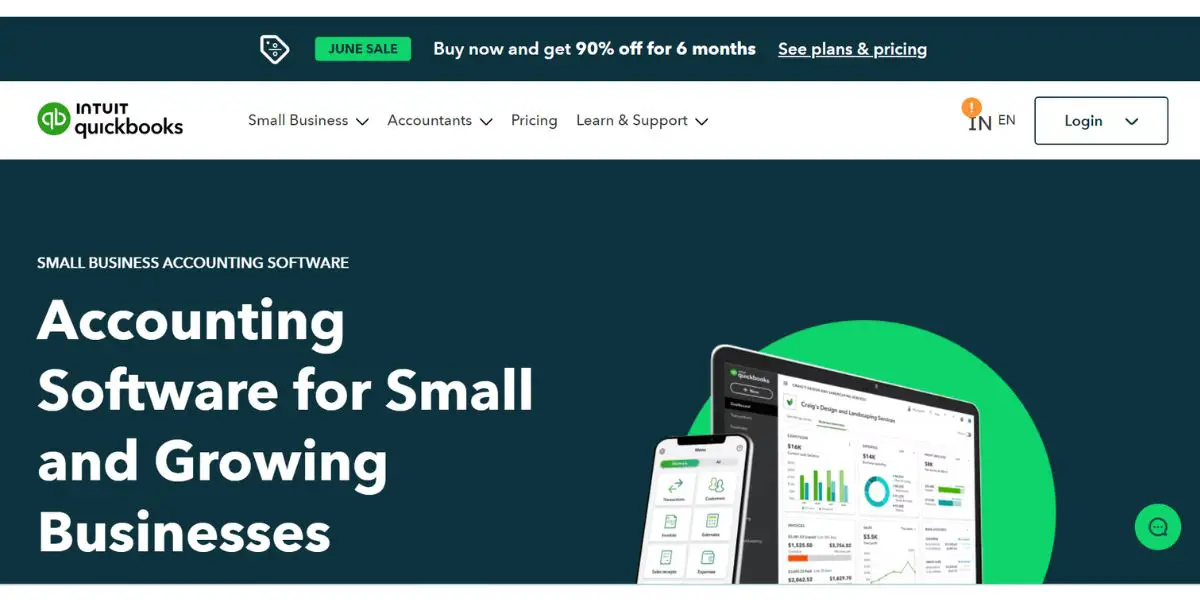
- Manage bills
- Track income and expenses
- Invoice customers
- Reports
- Maximize tax deductions
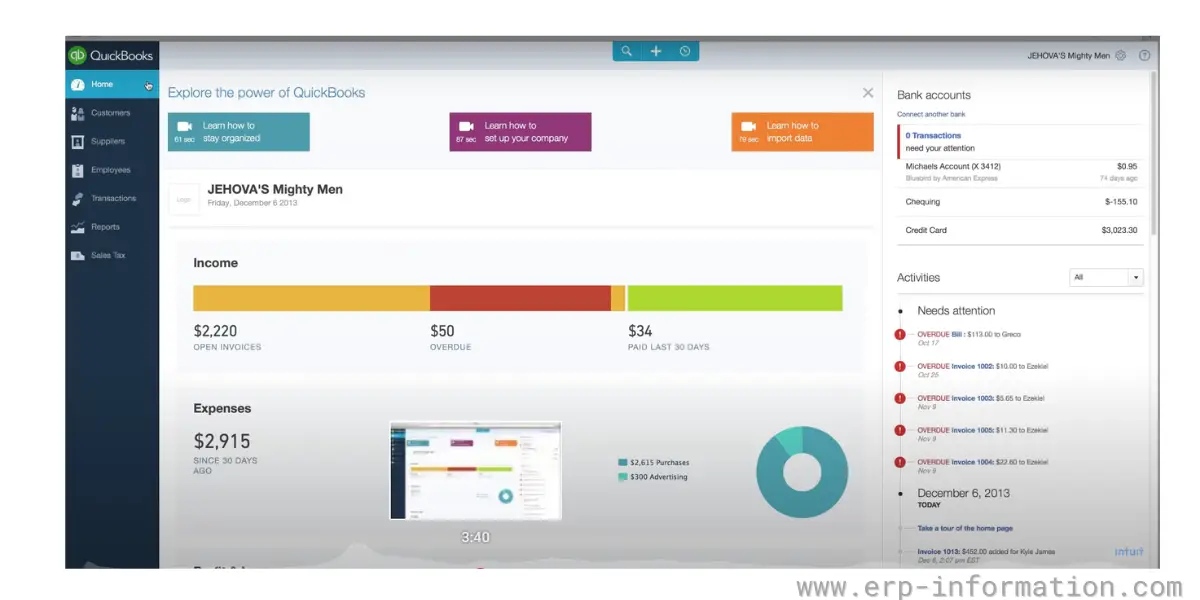
Screenshots of QuickBooks
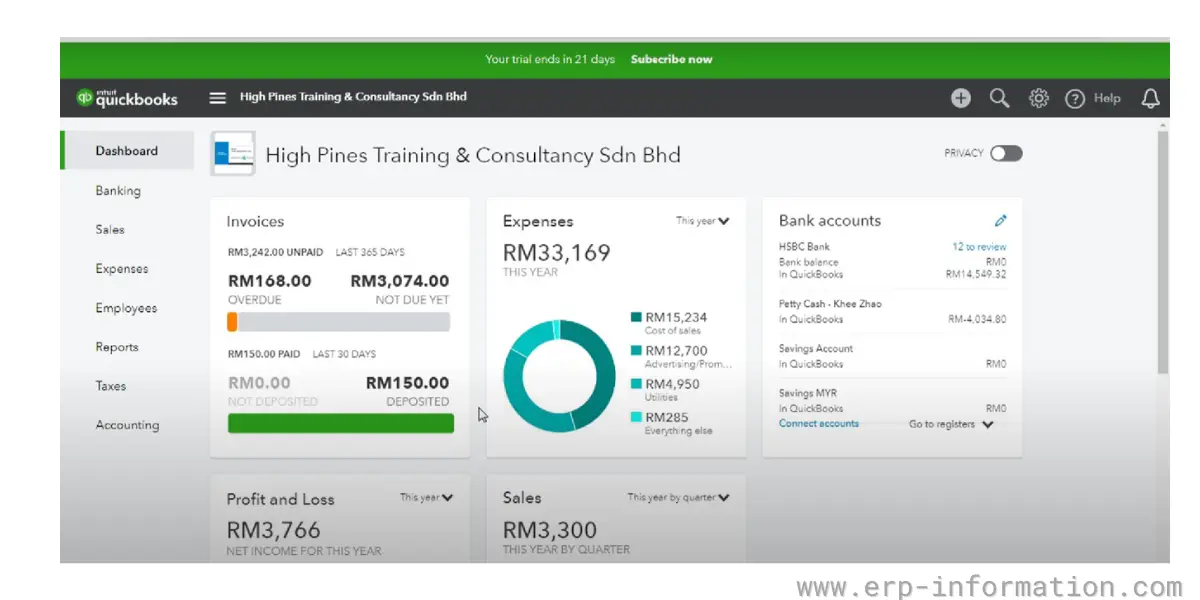
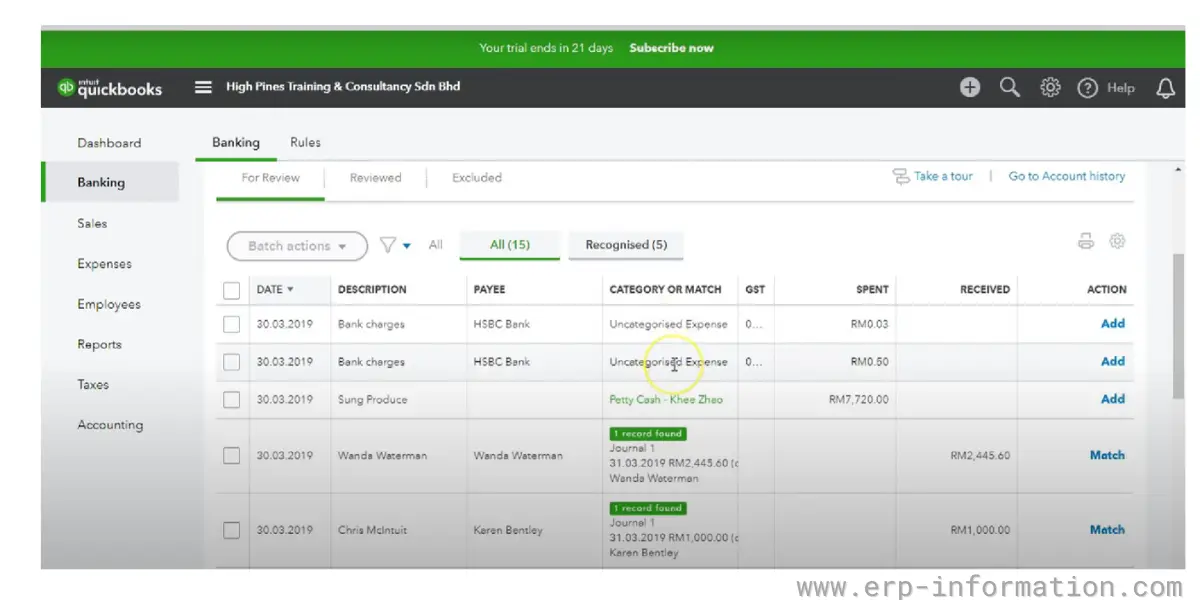
Pricing
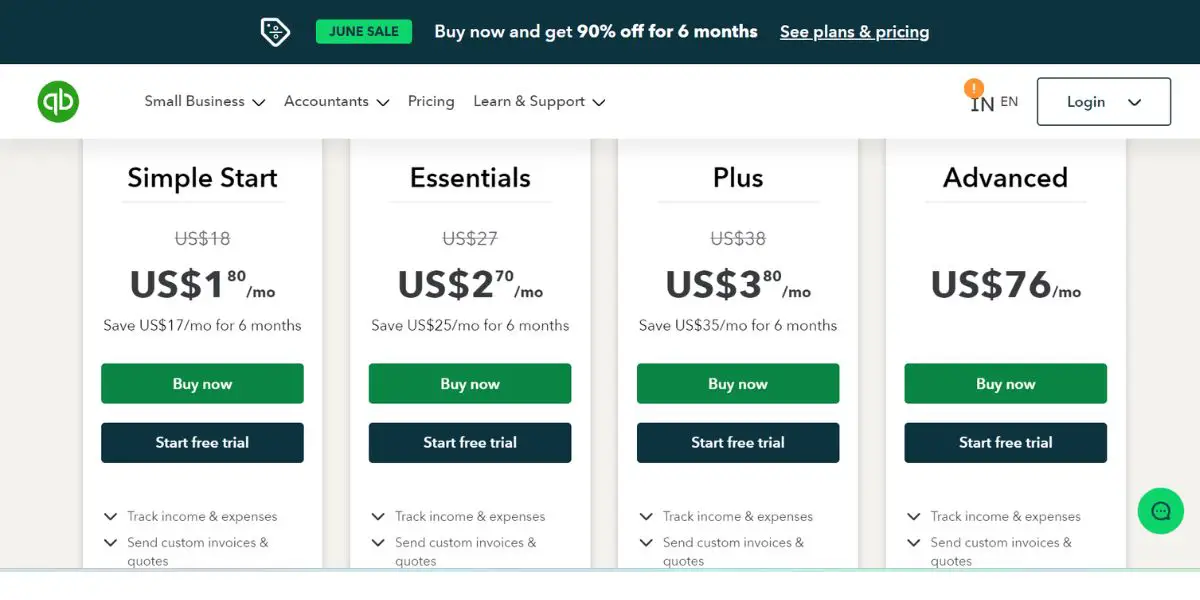
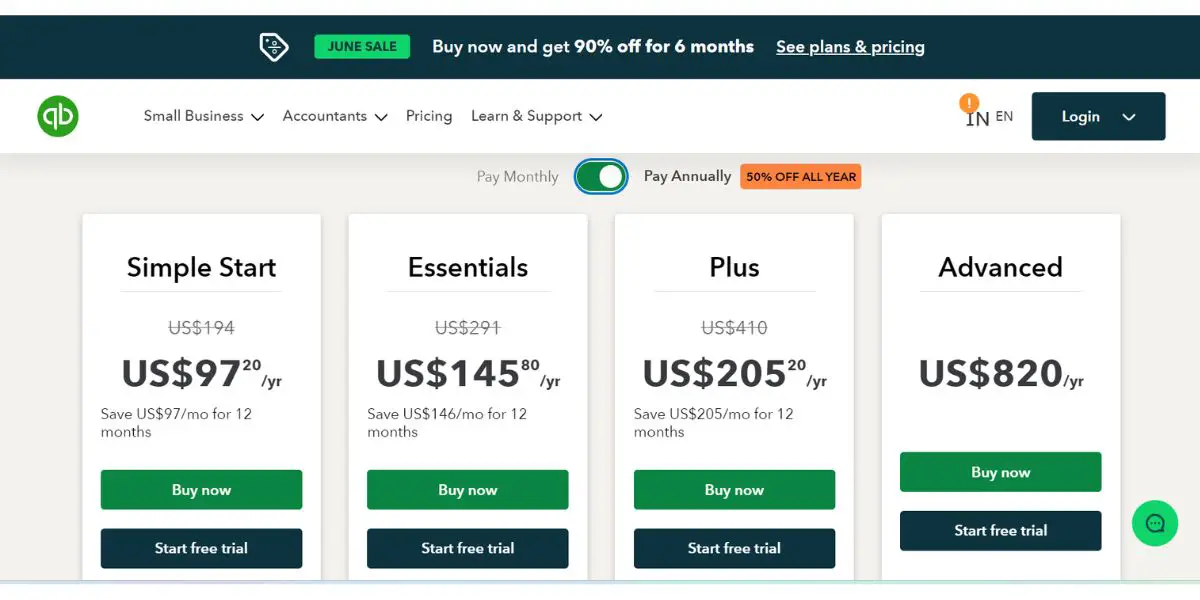
QuickBooks Online has four plans. These are the list prices published by Intuit on 13 September 2026, read from the vendor’s own pricing page.
| Plan | List price per month |
|---|---|
| Simple Start | US$38 |
| Essentials | US$85 |
| Plus | US$140 |
| Advanced | US$340 |
Intuit runs near continuous introductory discounts, currently 50 percent off for three months, alongside a 30 day free trial. Promotional rates change often, so check the vendor’s pricing page rather than any third party figure, including this one, before you budget.
The two screenshots below are a June 2024 snapshot, kept for reference. The prices shown in them are no longer current and are superseded by the table above.
 Likes
Likes
- Simplifies all accounting tasks.
- Widely used by businesses of all sizes.
- Provides accurate data reporting.
- Integrates well with other platforms and software.
- Easy setup for sending customer invoices and managing payments and receipts.
- User-friendly interface for quick learning and usage.
- Offers multiple payment options like ACH, credit card, and PayPal.
- Supports multiple users across different locations.
 Dislikes
- Customer service needs improvement.
- Limited customization options for specific needs.
- Difficult account recovery if you forget your password or phone number.
- Lacks functionality to send sales receipts for bank transactions.
- Match feature for bank transactions does not work well.
- Contains more bugs than expected.
Other details
| Deployment | Cloud, SaaS, Web-Based |
| Supported device | Mac, Windows, Android, iPhone, iPad |
| Supported languages | English |
| Support | Email/Help Desk, FAQs/Forum, Knowledge Base, Phone Support, 24/7 (Live Rep), Chat |
| Training | Live Online, Webinars, Documentation, Videos |
| Customer ratings | Capterra: 4.3 out of 5 (5931+ reviews), G2: 4.0 out of 5 (3255+reviews) |
User opinion
QuickBooks accounting software simplifies all accounting tasks and is widely used by businesses of all sizes. It provides accurate data reporting and integrates well with other platforms and software. It offers multiple payment options like ACH, credit card, and PayPal, and supports multiple users across different locations.
However, customer service needs improvement, and some users find it difficult to fully customize certain features. Account recovery can be challenging if you forget your password or phone number, and the software lacks the functionality to send sales receipts for bank transactions.
2. Accounting Seed
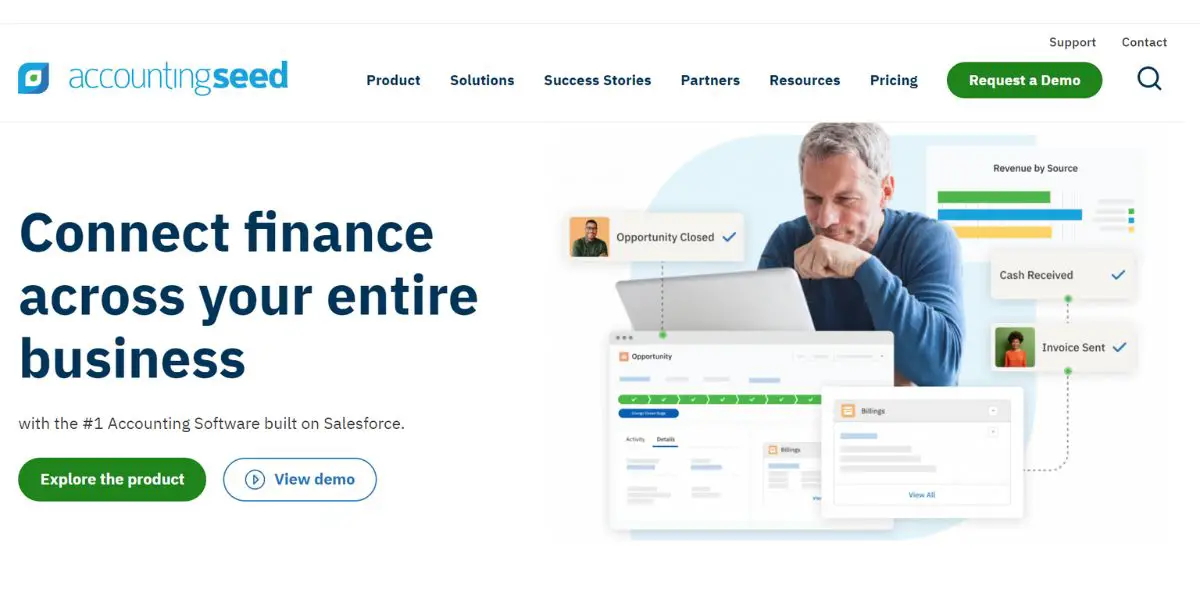
Accounting Seed is a Salesforce native accounting platform, and it is not a government contracting product. Its own industry list covers aviation, construction, education, legal, nonprofit, professional services, manufacturing and others, with government contracting absent, and its former government accounting page now redirects to a generic solutions page carrying no DCAA, FAR, indirect rate pool or incurred cost content. Accounting Seed itself states that there are no accounting systems formally approved by the DCAA. Treat it as a general accounting and project accounting option that would need contractor specific cost pool and timekeeping design layered on top. It offers a variety of features to help businesses manage their finances. It is easy to use and suitable for companies of all sizes.
Features
- Financial dashboards and reports
- General ledger
- Project accounting
- Tax accounting
- Order management
Pricing
To get pricing of Accounting Seed financial software, you need to fill out the form available on its official website.
Supported industries
- Automotive
- Construction and Maintenance
- Education
- Energy and Utilities
- Financial services
Likes
- It provides customizable options to meet specific needs
- Invoice creation is easy and secure, even you can send them to clients from anywhere
- The platform is straightforward to use and effective
- It is easy to integrate and automate data sourcing
- Easily connects to banks and other financial institutions
- This software is scalable and flexible
- The system is easy to use and displays transactions clearly and concisely, making them easy to understand
Dislikes
- The mobile application is unavailable for iOS version 17
- Implementation and maintenance are costly, particularly for small businesses
- Increased flexibility in payment settings would be beneficial for users
Other details
| Deployment | Cloud, SaaS, Web-Based |
| Supported languages | English |
| Support | Email/Help Desk, FAQs/Forum, Knowledge Base, Phone Support |
| Training | Webinars, Documentation, Videos |
| Customer ratings | Capterra: 4.3 out of 5 (91+ reviews) |
User opinion
AccountingSeed software is highly customizable, user-friendly, and effective, with strong integration capabilities and clear transaction displays.
However, the absence of a mobile application for iOS version 17 and the cost of implementation and maintenance, particularly for smaller businesses are major downsides. Additionally, more flexibility in payment settings would enhance the user experience.
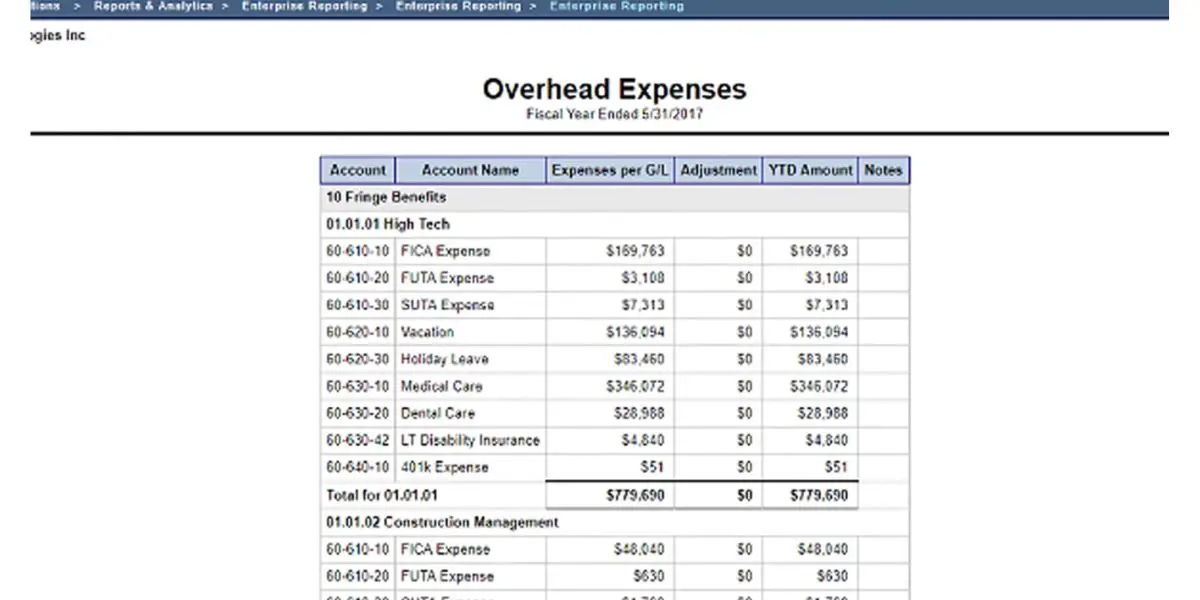
3. Deltek Costpoint
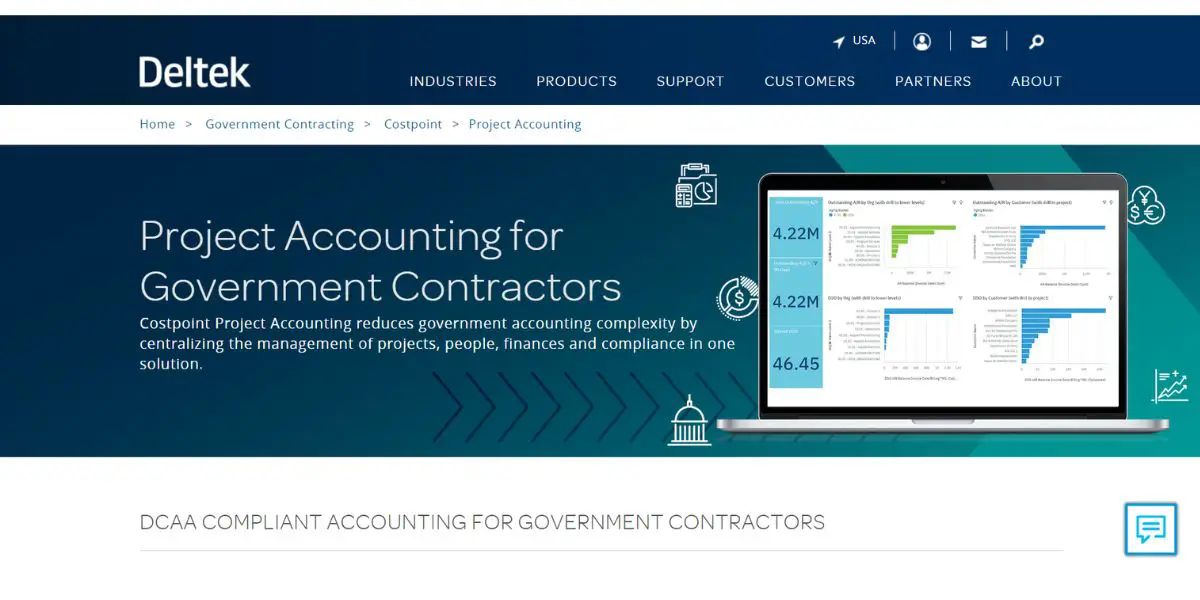
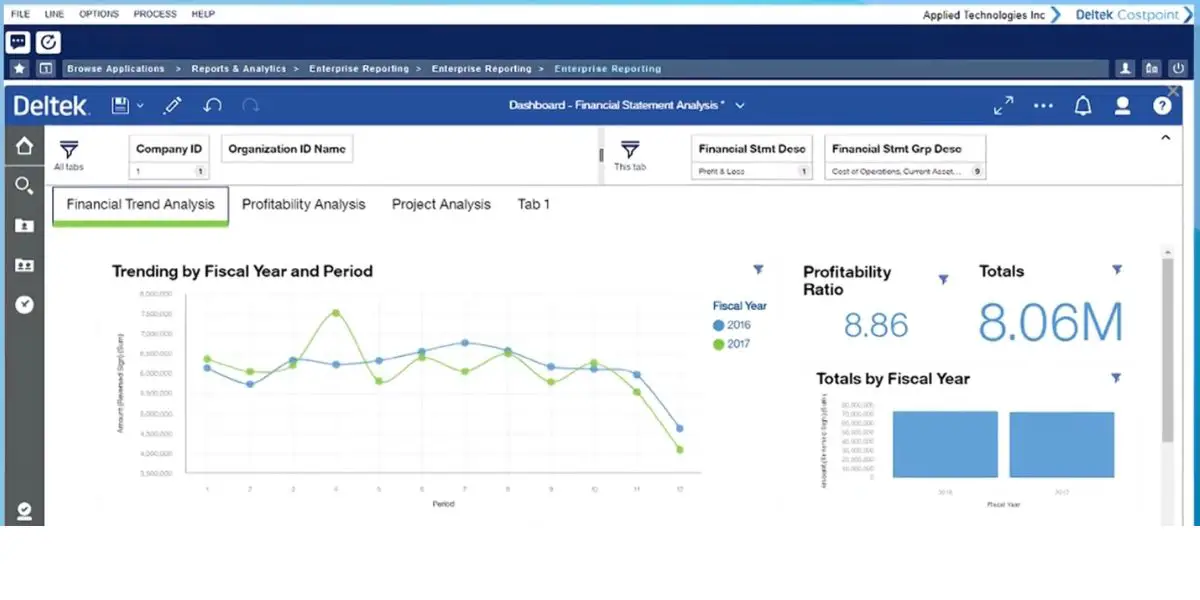
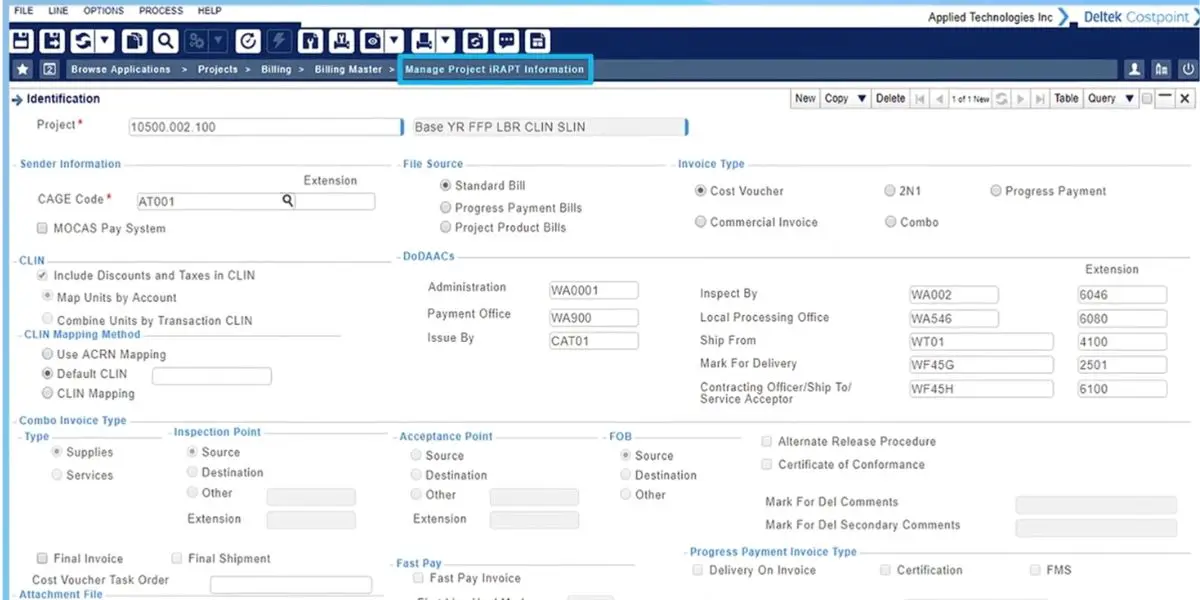
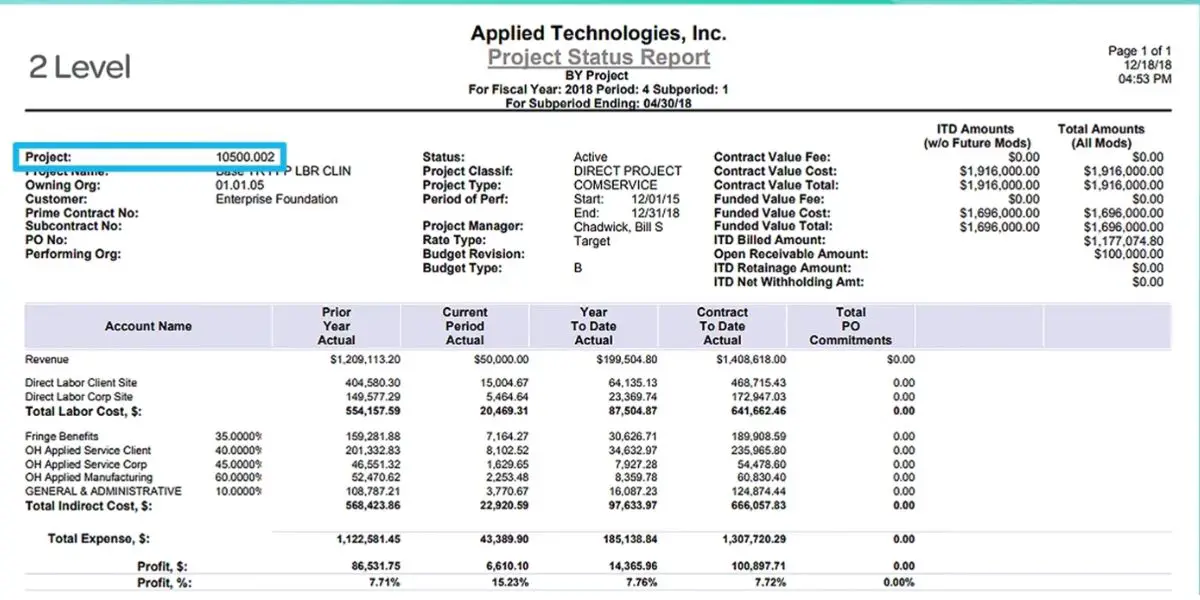
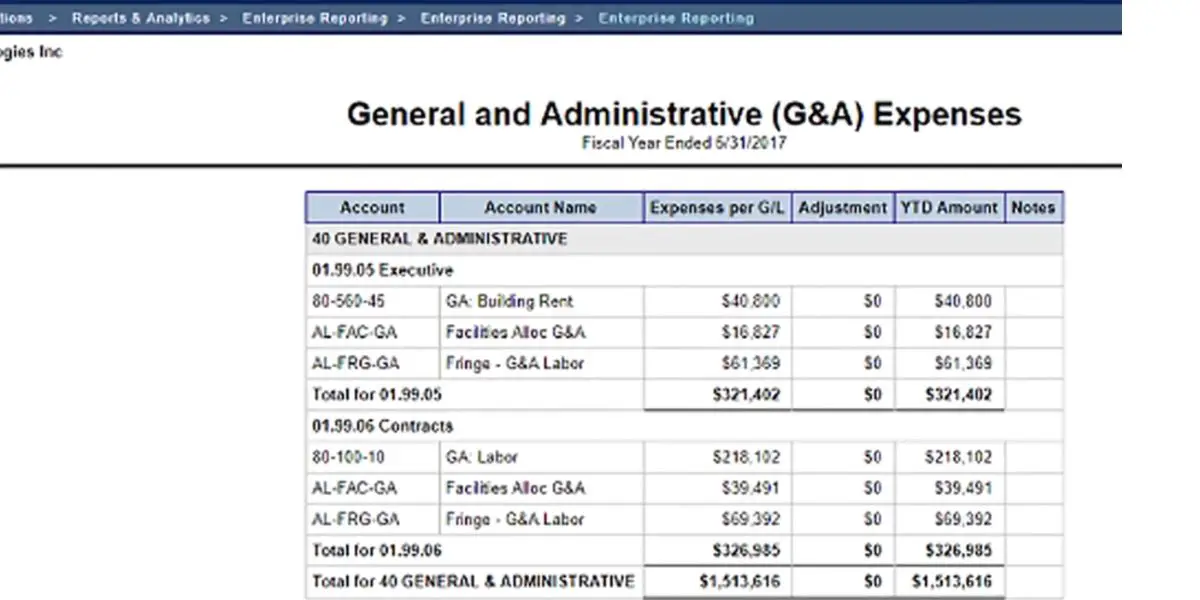
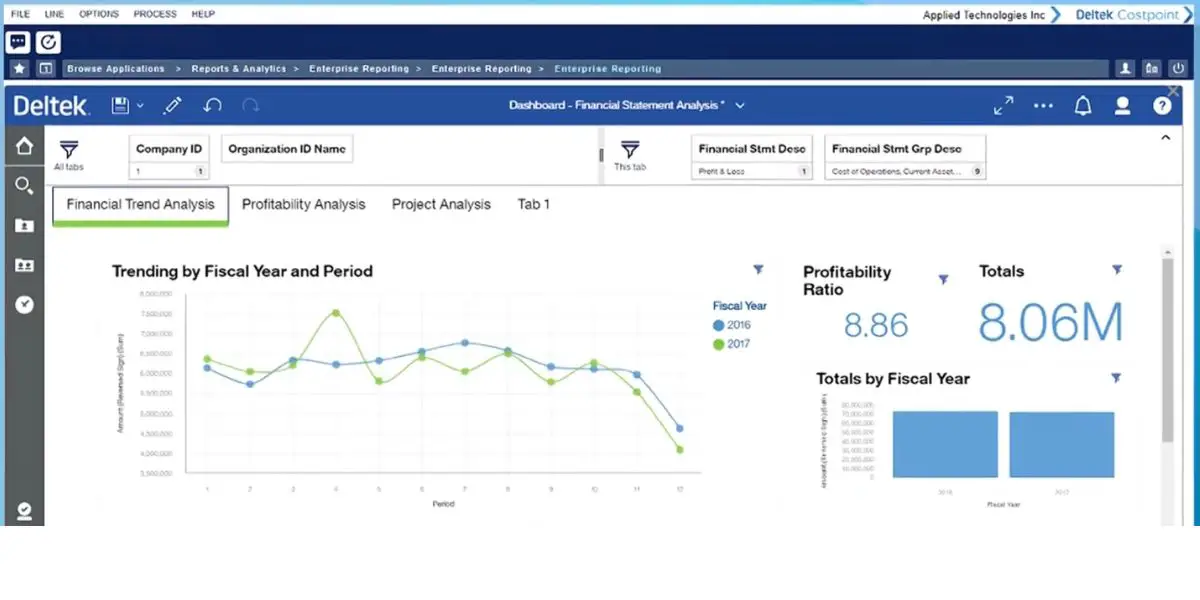
Deltek Costpoint is an ERP built specifically for government contractors. It is not government approved, since no product is, but it is the most widely deployed system among mid size and large defence contractors and it models indirect rate structures, project cost accounting and incurred cost reporting natively.
It offers a variety of features that can help companies keep track of their spending, invoicing, and other essential data. The trade off is scale: it carries implementation cost and administrative overhead that a contractor on a single small cost type award is unlikely to need.
Features
- Financial management from bid to invoice
- Segregate and allocate costs
- Accounting process automation
- Multi-company and currency compatibility
- Subcontractor management integration
Screenshots of Deltek Costpoint
Pricing
The vendor does not disclose pricing details. Instead, you need to get a quote by filling out a form on their website.
Supported industries
- Accounting and CPA
- Architecture and Engineering
- Consulting
- Government and Contracting
- Aerospace and Defense
- Energy, Oil, and Gas
Likes
- The software is user-friendly and easy to navigate.
- Numerous modules are available to learn and utilize.
- Extensive fields are available for data entry.
- Provides highly normalized database structure.
- Provides project-based accounting.
- Integrates with other products via built-in Web Services tool and multiple data pre-processors.
Dislikes
- Search features can be tricky at times.
- Slight learning curve for new users.
- Some aspects of the product are not intuitive.
- Certain processes can be time-consuming.
- Recent version upgrades have introduced new bugs.
- Bug fixes can take considerable time to be released.
Other details
| Deployment | Cloud, SaaS, Web-Based |
| Supported device | Mac, Windows, Android, iPhone, iPad |
| Supported languages | German, English, French, Dutch |
| Support | 24/7 (Live Rep), Chat |
| Training | In-person, Live Online, Webinars, Documentation |
| Customer ratings | Capterra: 4.0 out of 5 (203+ reviews), G2: 4.0 out of 5 (203+ reviews) |
User opinion
It has significantly reduced the complexity of government accounting by consolidating project management, financials, and compliance into one powerful platform. Costpoint’s ability to centralize the management of projects, people, finances, and compliance is a real improvement.
However, there are some drawbacks. The search features can be tricky at times, and new users may face a slight learning curve. Some aspects of the product are not intuitive, and certain processes can be time-consuming.
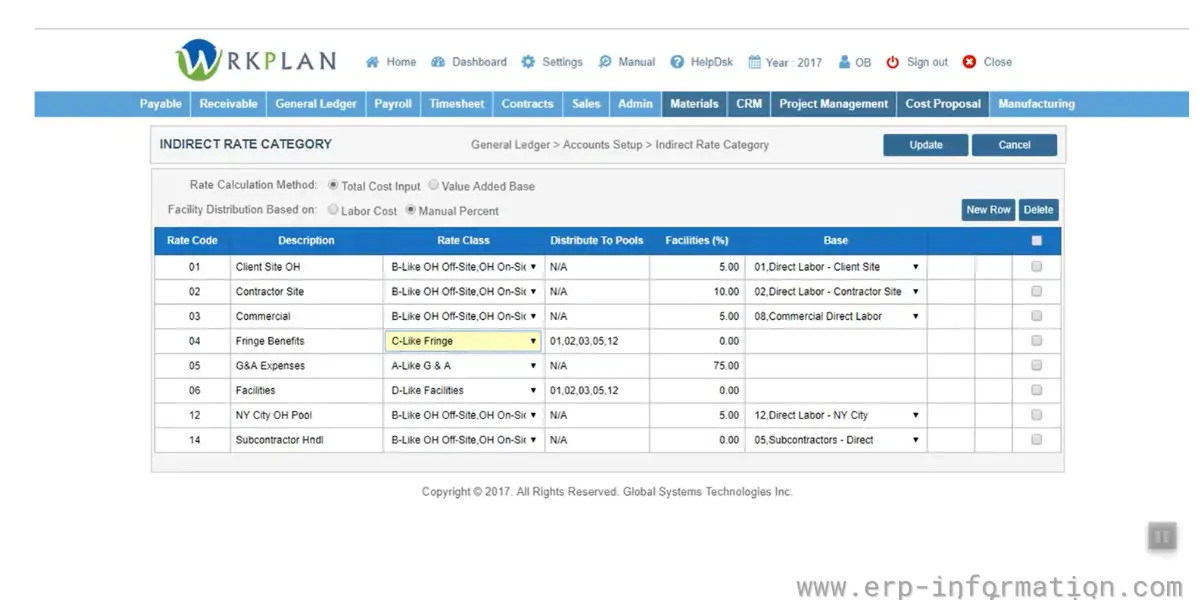
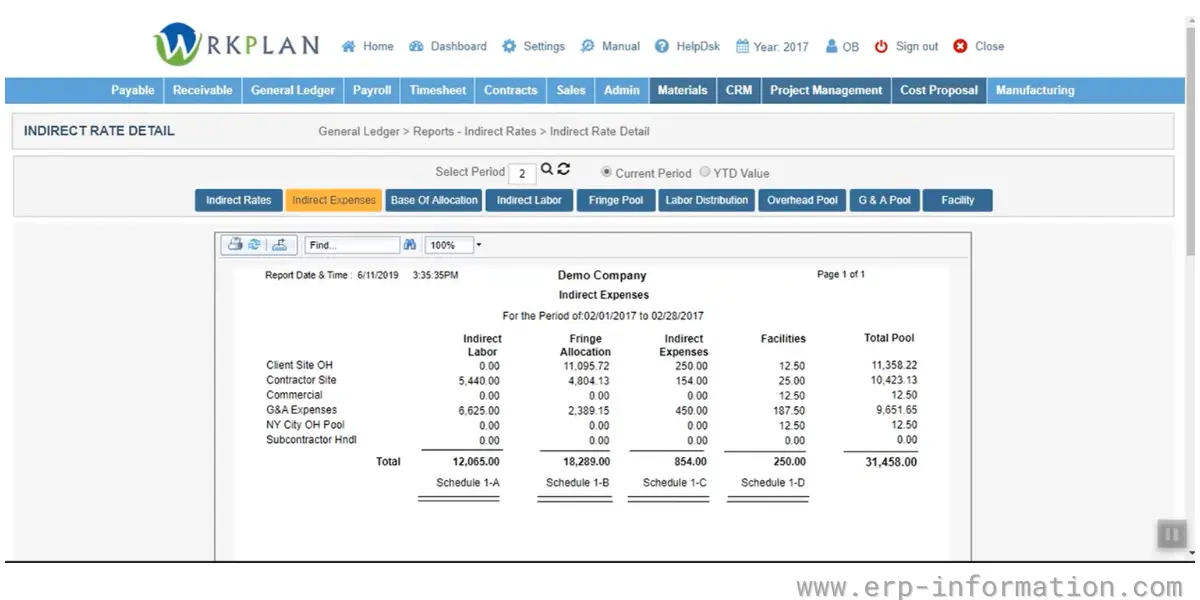
4. WrkPlan
WrkPlan is a web based ERP and timekeeping system aimed at small and mid size government contractors, combining project accounting, contract management and timesheets in one place.
It also integrates with QuickBooks, which is how a contractor already on QuickBooks can add contract cost structure and timekeeping without replacing the general ledger. As with every product here, it supports the criteria; it does not confer compliance.
Features
- Government contract management
- Project billing and accounting
- Incurred cost submission
- Time and expenses
- Budgeting and forecasting
- Extensive reporting
Screenshots of Wrkplan
Pricing
The vendor does not provide the pricing details. To get pricing details, you need to contact the vendor directly.
Likes
- The software is easy to get started with.
- Exceptional customer service; questions are addressed within 24 hours by a human being.
- User-friendly interface for the ERP and timekeeping system.
- The timekeeping system includes a mobile app.
Dislikes
- Some accounting modules require many manual steps, especially for edits.
- Manual steps may be necessary to meet DCAA compliance.
Other details
| Deployment | Cloud, SaaS, Web-Based |
User opinion
WrkPlan is essential for ensuring DCAA compliance and streamlining operations. With fully integrated project accounting, contracts management, and timesheets, WrkPlan eliminates the hassle of juggling multiple systems and spreadsheets.
It provides the user-friendly interface of both the ERP and timekeeping systems. However, some of the accounting modules involve many manual steps, particularly when making edits.
5. PROCAS
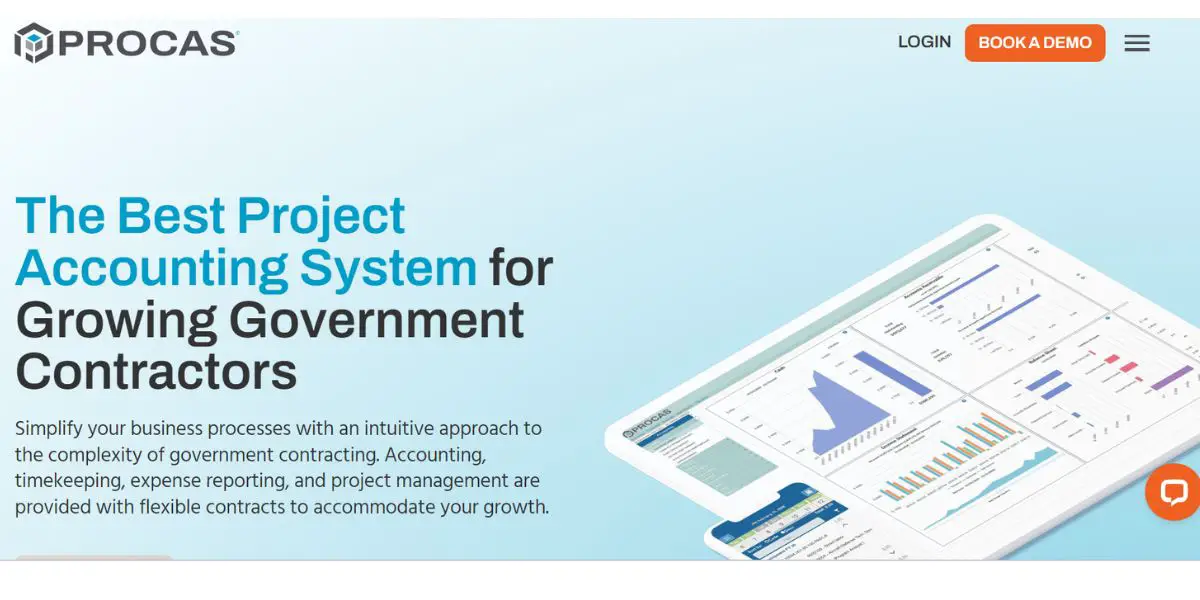
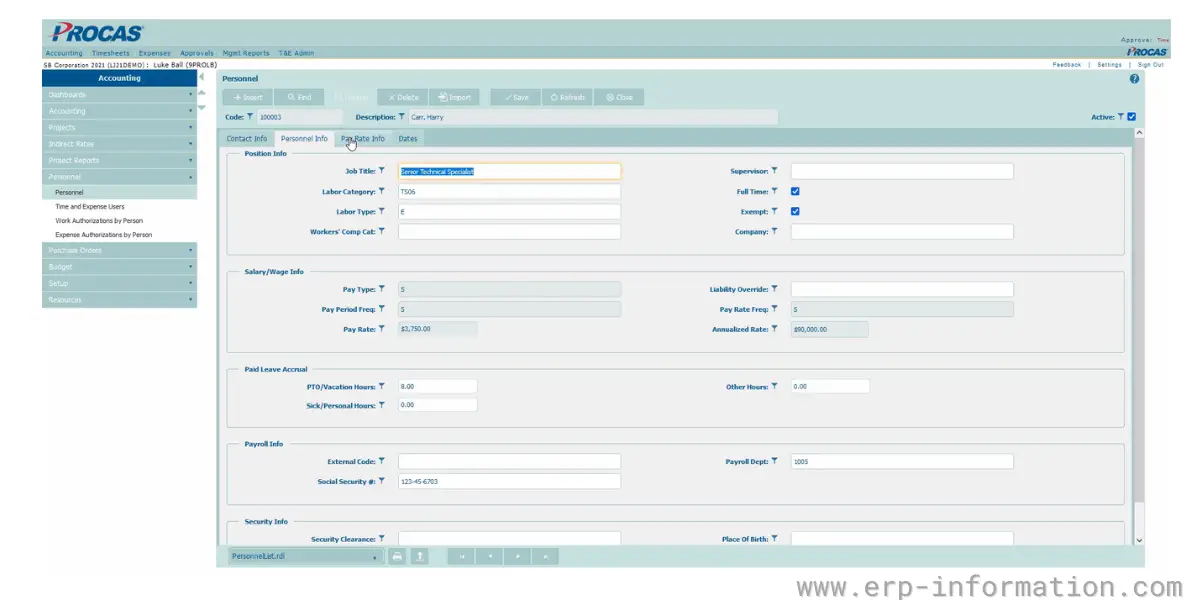
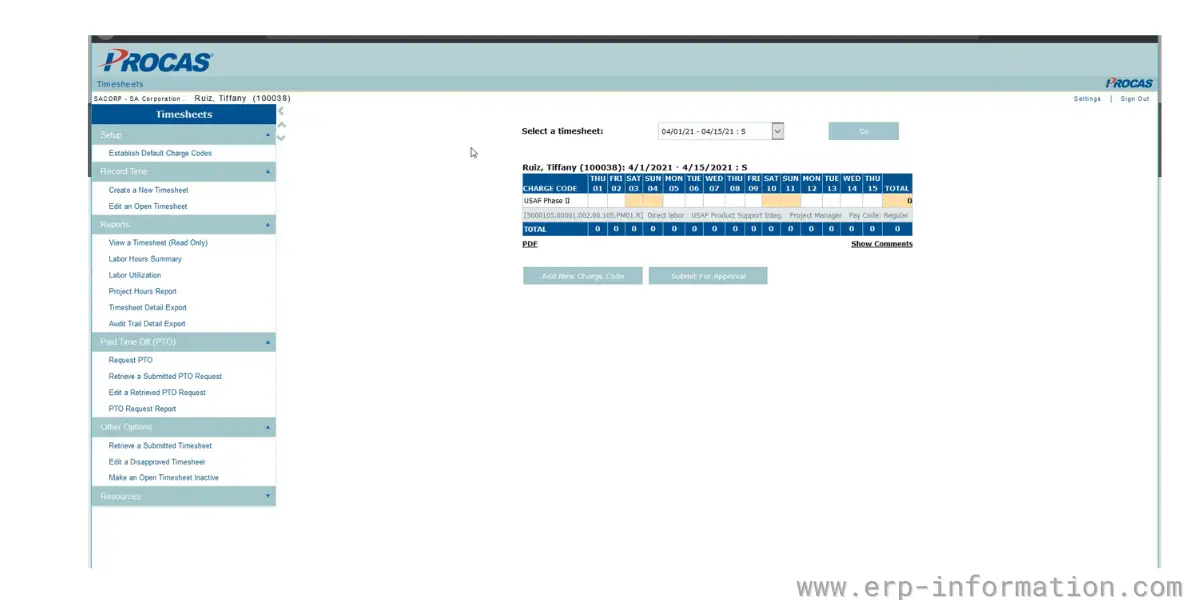
PROCAS is an integrated accounting, timekeeping and expense system built for government contractors. It is not approved by DCAA, and no product is, but it is designed around the DFARS accounting system criteria and is aimed squarely at small and mid size contractors rather than large primes.
Features
- Accounting
- Timekeeping
- Expense Reporting
- Management Report
- Web API For Business Intelligence Systems
Screenshots of Procas
Pricing
Pricing details are not publicly available. You need to contact the vendor to get details.
Likes
- User-friendly interface
Dislikes
- Issues in reporting.
- Lacks of standardization of report generation procedures across modules.
- Completing an expense report can be challenging due to the lack of clear instructions.
Other details
| Deployment | Cloud, SaaS, Web-Based |
| Support | Phone Support |
| Training | Live Online, Webinars, Documentation, Videos |
| Customer ratings | Capterra: 4.8 out of 5 (6+reviews), G2: 4.2 out of 5 (3+reviews) |
User opinion
It simplifies the business processes and allows you to focus on what matters most – delivering exceptional projects to clients. The integration of accounting, timekeeping, expense reporting, and project management all in one platform has truly streamlined operations.
It offers a user-friendly interface that makes navigation straightforward. However, there are some areas for improvement. Reporting issues and a lack of standardization across modules can make generating reports challenging. Additionally, completing an expense report can be difficult due to unclear instructions.
Systems this page does not cover
Two purpose built government contracting systems are widely used and are not reviewed above. They are named here so the list is not misleading by omission. No pricing is given for either, because neither publishes a rate card, and no ranking is implied.
- Unanet GovCon, a project based ERP aimed at government contractors, covering project accounting, resource planning and timekeeping.
- JAMIS Prime ERP, a cloud ERP built specifically for government contractors and project focused organisations.
One detail worth noticing while you shop. Read how each vendor words its own claim. Checked on 13 September 2026, JAMIS titles its site DCAA Compliant Accounting Software and PROCAS describes itself as an accounting system built for DCAA compliance. Neither says approved, and neither should, because the word does not exist in this context. A vendor that does claim DCAA approval or DCAA certification is telling you something useful about its rigour.
FAQs
Is there such a thing as a DCAA approved accounting system?
No. DCAA’s own contractor briefing puts it directly: you cannot get one, because there is no such thing as a DCAA approved government accounting system. An approval does exist, but it is issued by the contracting officer, not by DCAA. Under DFARS 242.7502(b) the contracting officer determines acceptability and approves or disapproves the system, acting on the auditor’s report, and notifies the contractor in writing when the system is acceptable and approved.
What is DCAA compliance?
DCAA compliance means your accounting system, policies and records can withstand audit against the applicable federal criteria. Before a cost type award that means the 15 items on Standard Form 1408. After award on a DoD contract it means the 18 criteria in DFARS 252.242-7006(c), covering segregation of direct and indirect costs, timekeeping by cost objective, labour distribution, monthly posting, exclusion of unallowable costs under FAR part 31, and billings reconcilable to the cost accounts.
Is QuickBooks DCAA compliant?
DCAA answers this one by name. Asked whether QuickBooks or any other accounting software is an acceptable accounting system for federal contracting, it replies that an accounting system is more than just a software package, that it includes accounting methods, procedures and controls, and that many software applications can be part of an acceptable system or set up in a manner that fails to meet the requirements. QuickBooks is used successfully by small contractors, but only with added job cost structure, indirect rate pools, compliant daily timekeeping and written procedures. Intuit itself scopes its DCAA language to time tracking only and states that compliance with applicable laws is the responsibility of the business.
What is the difference between DCAA and DCMA?
DCAA is the auditor and DCMA is the administrator. FAR 42.101(a) makes the auditor responsible for submitting information and advice on the acceptability of costs and for reviewing the accounting aspects of cost control systems. FAR 42.302(a)(12) gives the contract administration office the job of determining the adequacy of the accounting system. DCAA recommends, DCMA and the contracting officer decide.
What happens if my accounting system is found inadequate?
On a CAS covered contract, DFARS 252.242-7005 lets the contracting officer withhold 5 percent of amounts due from progress payments, performance based payments and interim cost vouchers. You have 30 days to respond to an initial determination and 45 days to correct the weaknesses or submit an acceptable corrective action plan, which reduces the withholding to 2 percent. Withholding is capped at 5 percent for one business system and 10 percent across multiple systems.
Do the 2026 CAS threshold increases mean I no longer need a compliant accounting system?
No, and reading it that way is a costly mistake. From 1 October 2026 the basic CAS applicability threshold rises from 2.5 million to 35 million dollars and the 7.5 million dollar trigger contract is eliminated. That changes whether the payment withholding clause DFARS 252.242-7005 reaches you. It does not change DFARS 252.242-7006, which attaches to the contract type, nor FAR 16.301-3(a)(3), which still requires an adequate accounting system before any cost type award.
Conclusion
The single most useful thing a new government contractor can do is stop looking for approved software and start building an auditable system. No product carries a DCAA approval, because there is none to carry. What the government examines is whether direct and indirect costs are properly segregated, whether labour is captured against cost objectives every day, whether unallowable costs under FAR part 31 are excluded, whether the books are posted at least monthly, and whether written policies describe all of it consistently.
Work the two checklists on this page directly. Use SF 1408 to prepare for the pre award survey, then use the 18 criteria in DFARS 252.242-7006(c) to see what a post award review will add, particularly ledger reconciliation, documented adjusting entries and internal audits of your own compliance. Choose tooling after that, on the basis of which system you can actually operate and document, not on the basis of a compliance badge.
How this page was researched. Every criterion, threshold, percentage and deadline above was read from the primary source on 13 September 2026, not from secondary summaries: the SF 1408 form PDF published by GSA, the FAR and DFARS text on acquisition.gov, the clause text on eCFR, and the Cost Accounting Standards Board final rule in the Federal Register. Where a figure could not be verified against a primary source it has been left out rather than estimated.
Primary sources
- Standard Form 1408, Preaward Survey of Prospective Contractor (Accounting System), Rev. 1/2014, GSA
- DFARS 252.242-7006, Accounting System Administration (Jan 2025), eCFR
- DFARS 252.242-7005, Contractor Business Systems (Jan 2025), eCFR
- DFARS 242.7503, Contract clause, acquisition.gov
- FAR 16.301-3, Limitations and FAR 42.302, Contract administration functions, acquisition.gov
- FAR 42.101, Contract audit responsibilities, acquisition.gov
- Increase of Monetary Thresholds and Other Matters Related to Cost Accounting Standards Program Requirements, 91 FR 56056, effective 1 October 2026
- Accounting System Requirements and Pre-Award Audits, DCAA. The frequently asked questions quoted on this page are at pages 35 and 36.
- QuickBooks Online pricing, Intuit
- Accounting system requirements – DCAA