Deltek Costpoint is the ERP most large US government contractors run their contract accounting on. Deltek says 84% of the top 25 government contractors use it, which tells you both what it is good at and who it was designed around.
That focus is the whole story. Costpoint is not a general-purpose ERP that happens to handle federal work. It is built around the cost accounting rules a contractor has to satisfy to bill the government and survive an audit, and much of what feels heavy about it exists because those rules are heavy.
This review covers what Costpoint actually includes, how the Essentials edition differs from the full product, real pricing ranges, the release cadence you are contractually obliged to keep up with, where it falls short, and which Deltek product you actually need if you are not a government contractor.
Current release: Costpoint 2026.3
Release model: quarterly. Version numbers have followed a year-and-quarter format since 2025.1; the old 8.x numbering stopped at 8.2 (June 2023).
What is Deltek Costpoint ERP?
Costpoint is a cloud enterprise resource planning (ERP) system for government contracting and defense work. It combines project accounting, timekeeping, procurement, manufacturing and workforce management on a single database, so labor and material costs land against the right contract, at the right rate, with an audit trail behind them.
The reason contractors buy it rather than a mainstream ERP is the accounting model. Costpoint tracks indirect cost pools and allocation bases natively, computes provisional and actual indirect rates, and produces the incurred cost submission and billing formats the government expects. Retrofitting that onto a commercial ERP is possible but expensive, and it is where most GovCon ERP projects go wrong.
Who owns Deltek?
Deltek has been a subsidiary of Roper Technologies since December 2016, when Roper bought it for $2.8 billion. It operates as a standalone business from Herndon, Virginia. That matters for a buyer mainly in one way: Roper runs acquired software companies for cash generation and long product life rather than aggressive reinvention, which is consistent with what Costpoint customers report, namely steady incremental releases and very long support tails.
Costpoint Essentials vs full Costpoint
This is the first fork in the road and most reviews skip it. Deltek sells two packagings of the same product, and quoting the wrong one is the usual reason a small contractor concludes Costpoint is unaffordable.
| Costpoint Essentials | Full Costpoint | |
| Built for | Small and growing contractors, typically pre-award through early production work | Mid-size to large contractors, multi-entity, manufacturing or complex indirect rate structures |
| Scope | Project accounting, financials, time and expense, budgeting and forecasting, business intelligence | Everything in Essentials plus manufacturing, supply chain and procurement, shop floor time, capture and contract management, full HCM |
| Commercial model | One monthly fee that includes licences and implementation | Subscription priced by user and module, implementation quoted separately |
| Published price | $800 per month for 10 users, all in | Not published; quoted per deal |
| Time to go live | Deltek targets 60 days or less | Commonly 4 to 9 months, longer for multi-entity |
Deltek states that 88% of Costpoint customers are small and midsize businesses, so Essentials is not a fringe SKU. If you are under roughly 25 users, have a single legal entity and no manufacturing, ask for Essentials by name, because a salesperson scoping the full product will produce a very different number.
Deltek Costpoint modules
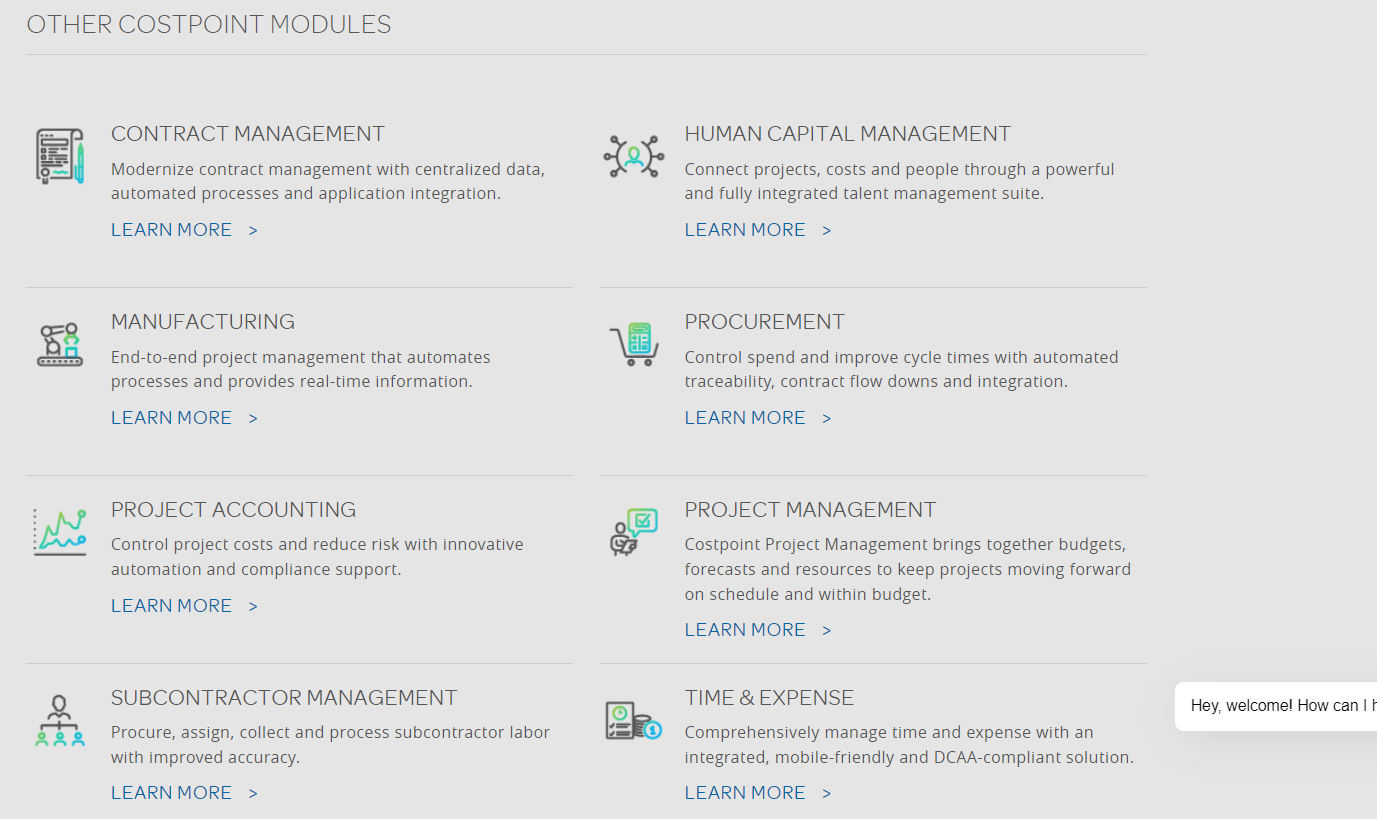
Deltek groups Costpoint functionality into the ERP modules below. Not all of them are licensed by default, and the manufacturing and supply chain pieces in particular are a separate conversation from core accounting.
Accounting and financial management
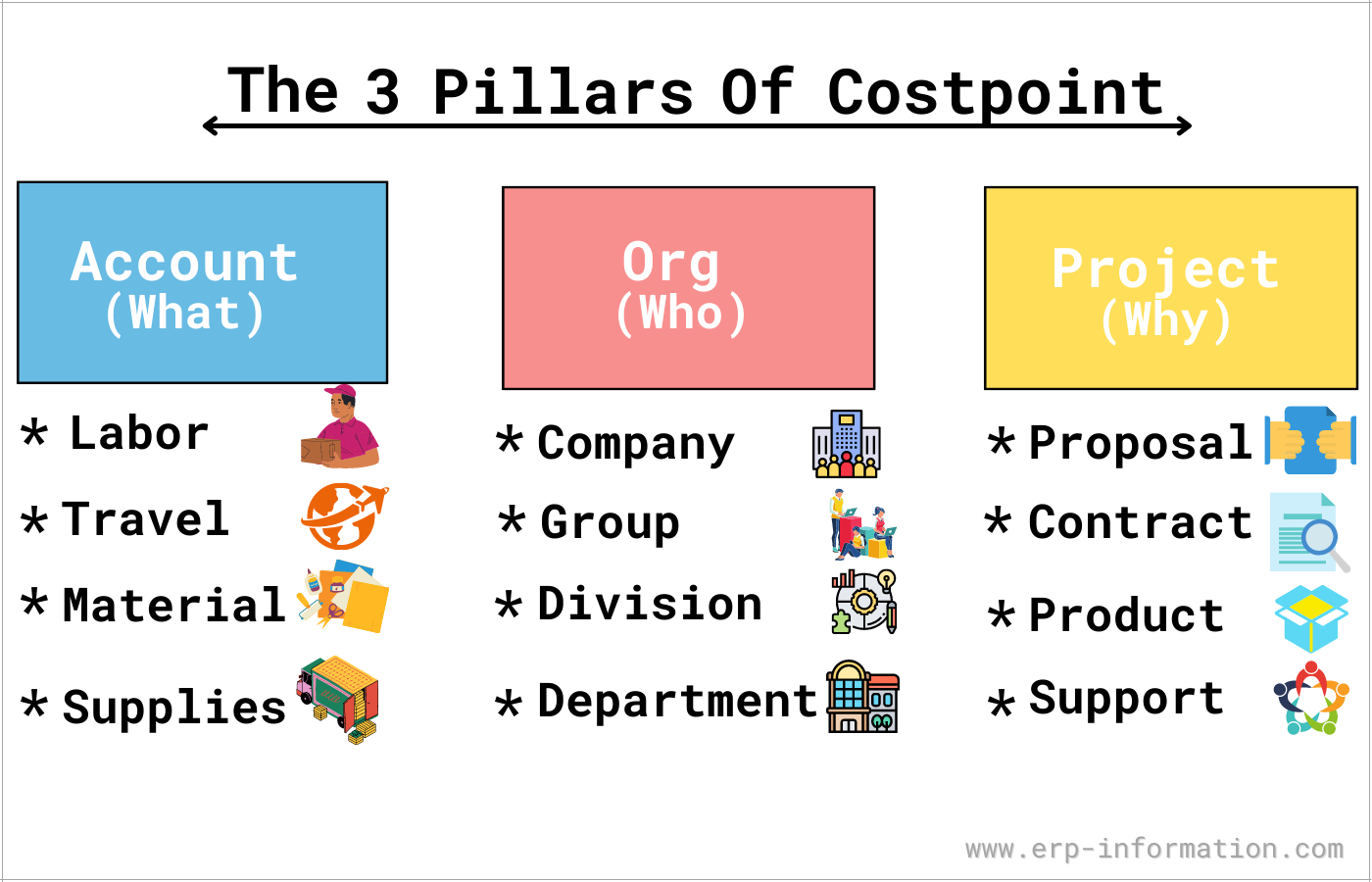
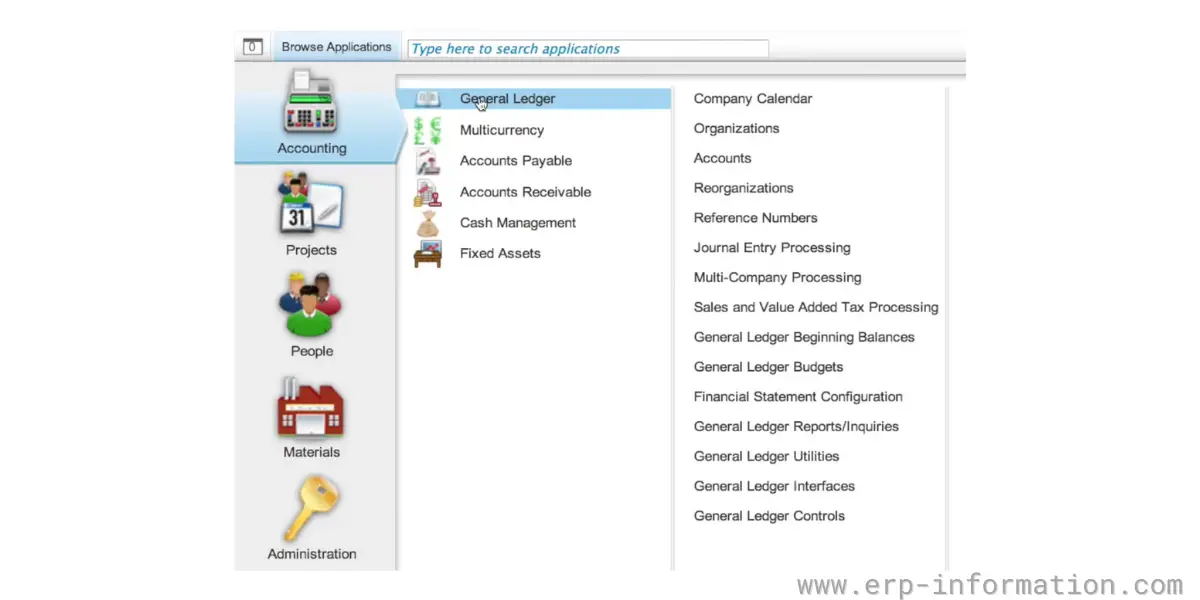
The finance core covers general ledger, accounts payable and purchase orders, accounts receivable and billing, bank reconciliation, fixed assets, and multi-currency. The part that distinguishes it is project-level costing: every transaction carries a project, account and organisation, and indirect cost pools allocate across them under rules you configure once and then defend to an auditor.
Time, expense and workforce management
Daily timesheet capture with the audit trail DCAA expects, expense entry and reimbursement, payroll and payroll integration, and the HCM functions covering recruiting, onboarding, performance and compensation. Time entry can be done from Microsoft Teams and Outlook, which is a genuine improvement given how much DCAA exposure comes from people filling in timesheets late.
Planning and resource management
Project budgeting, estimate at completion and estimate to complete, revenue forecasting, and staffing plans against funded and unfunded work. This is the project management layer that programme managers live in, as distinct from the accounting behind it.
Capture and contract management
Opportunity capture through award, then contract records, modifications, funding, ceilings and closeout. This links to contract management practice and to Deltek’s GovWin IQ opportunity database, which is a separate subscription rather than part of Costpoint. Contractors comparing this against a general-purpose equivalent usually look at NetSuite contract management, which handles the commercial side but not federal funding and ceiling tracking.
Manufacturing, supply chain and shop floor
This is the part people forget Costpoint has. Production control, bills of material, material requirements planning, inventory, source-to-pay procurement, and shop floor time collection for direct labour on the production floor. It is why defense manufacturers who also build hardware can stay on one system instead of bolting an ERP onto their accounting.
Business intelligence and Dela AI
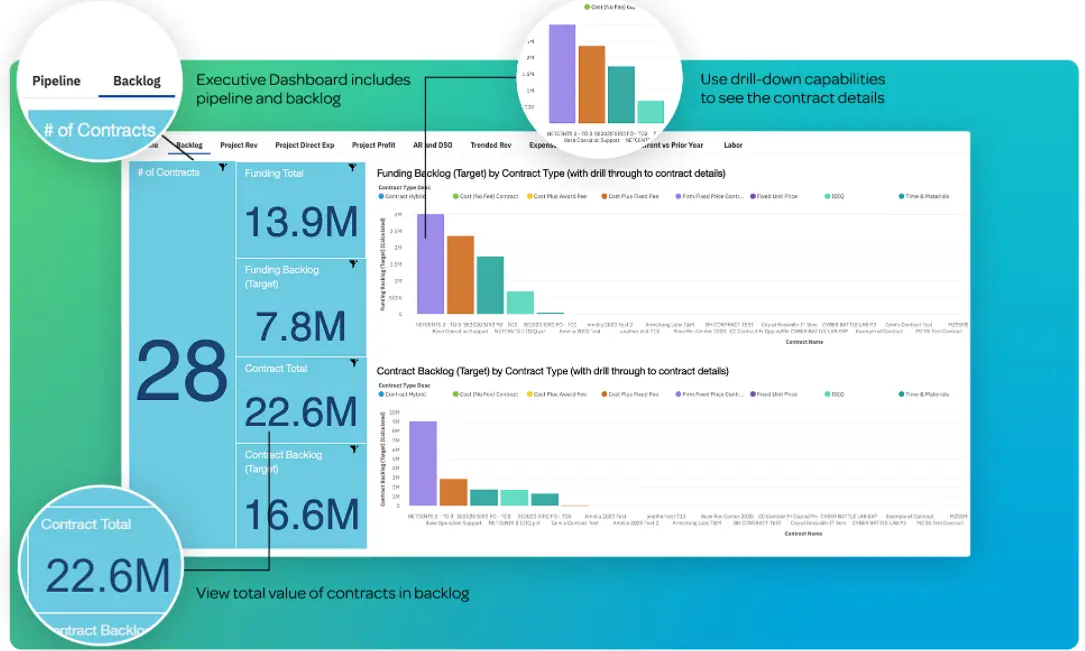
Dashboards and reporting sit on the same database as transactions, so rate and backlog reporting does not need a nightly export. Deltek’s AI layer is branded Dela. In current releases that means Ask Dela for natural-language questions, which can be pointed at your own uploaded documentation so it answers using your travel or timekeeping policy rather than generic help text; Smart Summaries; and Dela Agents that draft work such as time entry, expense creation, contract records and requests for quotation. Deltek added a framework for building custom agents in the 2026.1 release.
Compliance and security: DCAA, FAR and CMMC
Compliance is the reason Costpoint costs what it costs, so it is worth being precise about what the software does and does not give you.
On the accounting side, Costpoint is designed to support an accounting system that passes a DCAA review, and to satisfy Federal Acquisition Regulation (FAR) Part 31 cost principles and Cost Accounting Standards where they apply, alongside GAAP. The important caveat that vendors gloss over: no software is DCAA certified. DCAA audits your accounting system and your practices, not your ERP. Costpoint gives you the segregation of direct and indirect costs, the timekeeping audit trail and the rate calculations an auditor looks for, but a badly configured Costpoint will still fail a review.
On the security side, the relevant offering is Costpoint GovCon Cloud Moderate (GCCM), launched in late 2020 for contractors handling controlled unclassified information. GCCM has achieved FedRAMP Moderate Ready status and completed a FedRAMP Moderate Equivalency assessment with a third-party-assessor-validated body of evidence, supports CMMC 2.0 requirements, and keeps ITAR-restricted data in the United States managed by US-only support personnel. If your contracts carry DFARS 252.204-7012, this is the deployment you need rather than the standard Deltek cloud.
Deltek Costpoint pricing
Deltek publishes no list price for full Costpoint; everything below the Essentials line is quoted per deal. The figures here are the ranges third-party ERP advisories and procurement benchmarks consistently report, and they are ranges for a reason.
| Cost line | Typical range |
| Costpoint Essentials | $800 per month for 10 users, licences and implementation included (Deltek published) |
| Full Costpoint subscription | Roughly $75 to $200 per user per month, depending on role and modules |
| Implementation | About $30,000 for a small contractor to $500,000 or more for complex multi-entity |
| Annual support and maintenance | Around 20% of licence value |
| Implementation timeline | 4 to 9 months for full Costpoint |
| 100 to 300 user deployment | Roughly $180,000 to $450,000 per year in subscription after negotiation |
Two practical notes. First, benchmark data shows discounts in the 20% to 32% range off initial quotes in exchange for three-year commitments, so the first number you are given is not the number. Second, licences are only part of the spend: implementation, data migration from whatever you are running now, and the internal time of the people who know your rate structure usually exceed the first year of subscription.
Implementation
Costpoint implementations are led either by Deltek’s own consultants or by a certified partner, and for GCCM deployments the partner needs to be GCCM-certified specifically. A typical project covers chart of accounts and project structure design, indirect rate pool and base setup, opening balance and history migration, billing format configuration, timekeeping policy setup, integration to payroll or banking, and parallel running through at least one month-end close.
The design decision that costs the most to get wrong is the project work breakdown structure, because it determines how you can bill, report and audit for the life of the system and is painful to restructure afterwards. Budget real time from your controller for it, not just from the implementation partner.
Release cadence, and the upgrade obligation buyers miss
Deltek moved Costpoint to a quarterly release model with version 8.2 in June 2023, and changed the numbering so that versions read as year and quarter from 2025.1 onward. So the sequence runs 8.2, then 2025.1 through 2025.4, then 2026.1, 2026.2 and 2026.3.
The part that catches finance teams out is what that cadence obliges you to do. Each quarterly release gets three months of active support, then six months of maintenance support, then sustaining support only. Deltek requires customers to apply at least two quarterly releases each calendar year, and to be on the current year’s Q2 release or later in order to receive the calendar-year-end updates that deliver W-2 and 1099 changes.
Read that as a compliance dependency rather than an IT preference. A contractor who lets upgrades slip risks arriving at year end without current payroll tax forms, which is a materially worse problem than the upgrade would have been. Budget for two upgrade windows a year and treat the Q2-or-later rule as a hard deadline.
Services and support plans
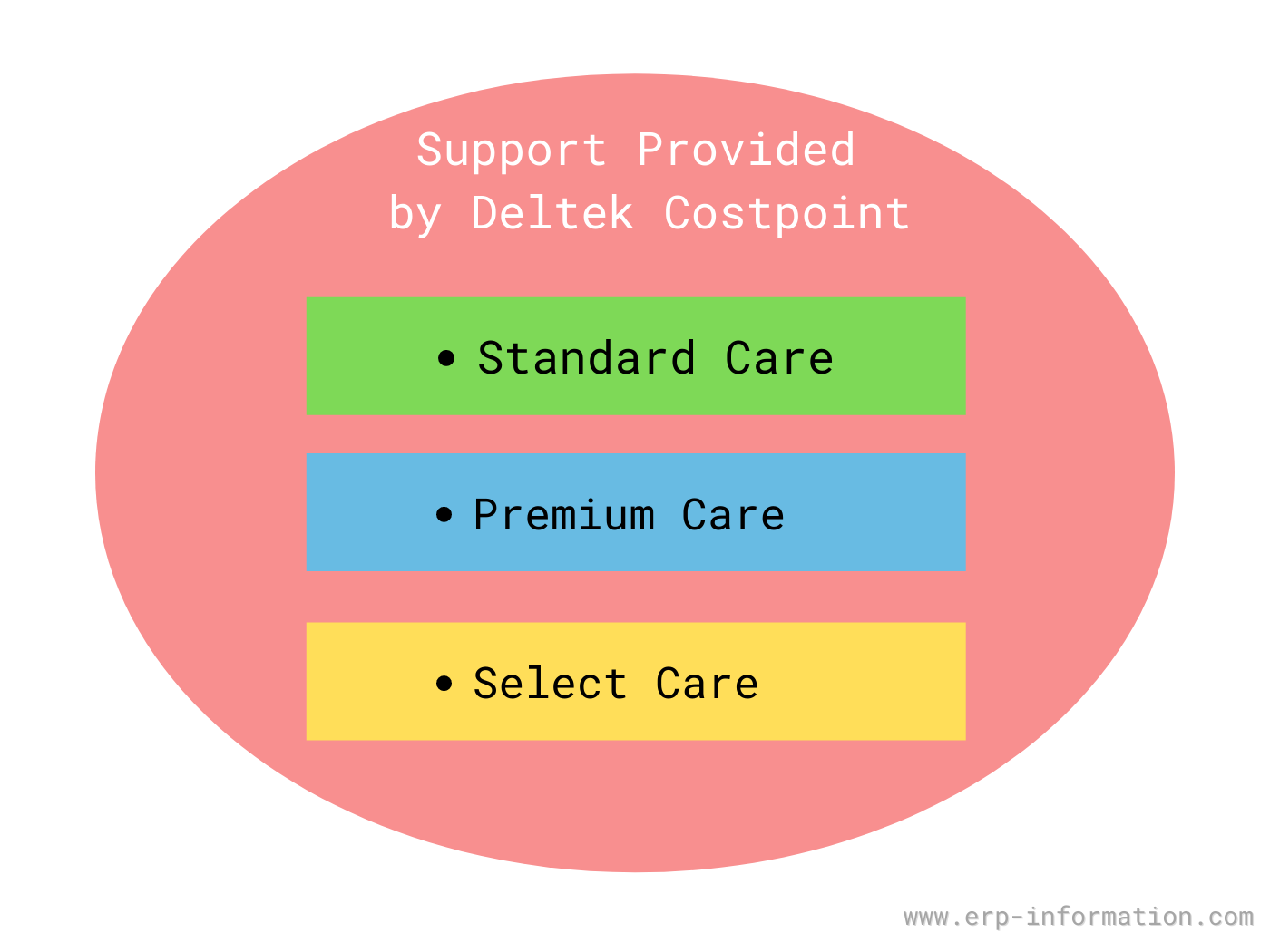
Deltek sells three support tiers. The differences that actually bite are the case bank, the number of people allowed to open cases, and severity 1 response time.
| Standard Care | Premium Care | Select Care | |
| Coverage | Business hours | 24×5 for severity 1 | 24×7 for mission-critical |
| Authorised contacts | 8 | 10 | 15 |
| Case bank | 30 cases a year, unlimited during a new customer’s first year | Unlimited | Unlimited |
| Severity 1 response | 3 hours | 2 hours | 1 hour |
| Severity 2 response | 4 hours | 3 hours | 2 hours |
| Extras | Online support centre | Priority handling | Dedicated Select Care manager, priority case handling |
The 30-case bank on Standard Care is the line to check before signing. It is unlimited for a new customer’s first year, which is exactly when you will use the most cases, and then it becomes a budget. Organisations that go live on Standard Care and keep customising tend to discover this in year two.
Advantages
Indirect rates are native, not a workaround
Cost pools, allocation bases, provisional and actual rate calculation and the resulting reporting are built in. On a commercial ERP this is typically a spreadsheet layer maintained by one person, which is both a key-person risk and an audit weakness.
One system for contractors who also build hardware
Because manufacturing, MRP, inventory and shop floor time sit in the same product as contract accounting, a defense manufacturer can keep direct production labour and material costs flowing straight to the contract without an integration.
Timekeeping built for audit
Daily entry, change reasons, approval trails and floor-check-friendly records are standard rather than configured. Timekeeping is the single most common finding in a DCAA review, so this carries disproportionate weight.
A deep GovCon partner and talent ecosystem
Because it dominates the segment, experienced Costpoint accountants and implementation partners are relatively easy to hire. On a niche competitor that pool is much thinner, and it becomes a real constraint during a growth phase or a CFO transition.
Disadvantages and limitations
Cost and effort scale faster than headcount
Implementation runs from around $30,000 to well past $500,000 and takes months rather than weeks on the full product. For a contractor with simple commercial-style work and no cost-reimbursable contracts, that effort buys compliance machinery you may not need.
The learning curve is steep and the interface shows its age
Costpoint exposes a lot of configuration, and screens are dense with fields most users never touch. Deltek has been rolling out a redesigned interface with a role-based command centre, but plenty of customers are still on older screens depending on which quarterly release they are running.
The quarterly upgrade treadmill is mandatory
Two releases a year is not optional if you want year-end payroll updates, as covered above. Heavily customised environments feel this more than most.
Expense reporting is fiddly
A consistent user complaint is repeated data entry to complete an expense report, PDF-oriented attachment handling for receipts, and system messages that are frequent without being informative.
Pricing opacity
Outside Essentials, nothing is published. You cannot budget from the website, and quotes vary enough between deals that benchmarking against other contractors of your size is genuinely worth the effort.
What industries does it support?
Costpoint’s addressable market is narrower than Deltek’s overall industry list, and it is worth separating the two because Deltek sells different products to different sectors. Costpoint is aimed at:
- Federal government contractors, prime and subcontractor
- Aerospace and defense, including hardware manufacturers
- Management and IT consulting firms working on federal contracts
- Engineering and professional services firms with cost-reimbursable federal work
- Research institutions and nonprofits managing federal grants and awards
- State and local government contractors with similar cost accounting obligations
If you are an architecture, engineering or construction firm, a marketing agency or a consultancy with no federal exposure, Costpoint is not the Deltek product you want. That is Vantagepoint, Maconomy or WorkBook territory, and buying Costpoint instead means paying for compliance machinery you will never switch on.
Costpoint vs Vantagepoint, and what happened to Deltek Vision
Deltek sells several project-based ERP products and the naming does not make the differences obvious. The short version: Costpoint is for government contractors, Vantagepoint is for professional services firms, and Vision is the old professional services product that Vantagepoint replaced.
| Deltek Costpoint | Deltek Vantagepoint | Deltek Vision | |
| Built for | Government contracting and defense | Professional services: architecture, engineering, consulting | The same professional services market, previous generation |
| Core strength | Indirect rates, DCAA-ready timekeeping, contract compliance, manufacturing | Projects, resources, CRM and accounting in one modern browser-based system | Superseded by Vantagepoint |
| Status | Current, quarterly releases | Current, and the upgrade target for Vision customers | End of life. Support ends 31 December 2026 |
| Fit test | You bill the government on cost-reimbursable or CAS-covered contracts | You run commercial projects and need utilisation and profitability, not FAR compliance | Migrate |
If you are still on Vision, the deadline is real. Deltek moved Vision 7.6 to sustaining support in January 2026 after a final year-end update, meaning no new enhancements, hot fixes or regulatory updates, and support ends entirely on 31 December 2026. Deltek cloud customers lose access to their Vision instance during the first quarter of 2027. Vantagepoint was built on the Vision foundation, so configurations and user-defined content carry over, and the Vantagepoint licence is included with an active Vision subscription. The cost is the migration project and the retraining, not the software.
One correction worth stating plainly, because it circulates widely: Vision was never the manufacturing and distribution product in Deltek’s line-up. Both Vision and Vantagepoint are professional services systems. Costpoint is the one with manufacturing.
Deltek Costpoint alternatives
Alternatives split into two groups, and mixing them up wastes evaluation time. The first group actually competes for GovCon deals. The second group is where you look if compliance is not the driver.
Purpose-built GovCon alternatives
- Unanet is the most common head-to-head. It is purpose-built for government contractors, A/E and professional services, with more than 3,100 project-driven organisations using it, and it typically comes in below Costpoint on licence cost. It is usually the stronger choice for small and mid-size contractors without manufacturing.
- JAMIS Prime ERP is a cloud project ERP aimed squarely at government contractors, generally positioned as more approachable than Costpoint at the mid-market end.
- PROCAS targets the small contractor end, where the requirement is a defensible accounting system rather than a full ERP.
General ERP alternatives
- NetSuite, usually paired with a GovCon add-on from a partner to handle indirect rates.
- Sage Intacct, strong on project and grant accounting, common with nonprofits and research organisations.
- Microsoft Dynamics 365 Business Central or Finance, again dependent on partner extensions for GovCon compliance.
- Acumatica, whose construction and project editions suit contractors whose federal exposure is limited.
- IFS Cloud, worth a look for asset-intensive defense organisations where maintenance and field service matter as much as accounting.
- Epicor Kinetic, for defense manufacturers weighing manufacturing depth against compliance depth.
Two names that appear on older comparison lists should be dropped. FinancialForce was renamed Certinia in 2023 and is a professional services automation product on Salesforce rather than a GovCon accounting system. Microsoft Dynamics GP is closed to new customers, so it is not a candidate for a new evaluation regardless of how it compares on features.
Costpoint customers
Deltek reports that 84% of the top 25 government contractors run Costpoint, and that 88% of Costpoint customers are small and midsize businesses. Publicly referenced customers include Aero Simulation, BGI LLC, Digital Consulting Services, Technology Management Company, LogiCore, Sealaska Government Services and GHD. Deltek as a whole serves around 22,000 organisations across more than 80 countries.
FAQs
What is the latest version of Deltek Costpoint?
Costpoint 2026.3 is the current release. Deltek moved Costpoint to quarterly releases with version 8.2 in June 2023 and changed the numbering to a year-and-quarter format from 2025.1 onward, so versions now read 2025.1 through 2025.4, then 2026.1, 2026.2 and 2026.3.
Is Deltek Costpoint DCAA compliant?
No software is DCAA certified, because DCAA audits your accounting system and practices rather than approving products. What Costpoint provides is the machinery an audit looks for: segregation of direct and indirect costs, configurable cost pools and allocation bases, provisional and actual indirect rate calculation, and a daily timekeeping audit trail. A poorly configured Costpoint can still fail a DCAA review.
How much does Deltek Costpoint cost?
Costpoint Essentials is published at $800 per month for 10 users with licences and implementation included. Full Costpoint is quote-only; third-party benchmarks put it at roughly $75 to $200 per user per month, with implementation from about $30,000 for a small contractor to $500,000 or more for a complex multi-entity deployment, and annual support around 20% of licence value.
What is the difference between Deltek Costpoint and Deltek Vantagepoint?
Costpoint is built for government contracting and defense, where indirect rates, FAR compliance and DCAA-ready timekeeping drive the design, and it includes manufacturing and supply chain. Vantagepoint is built for professional services firms such as architecture, engineering and consulting practices, and focuses on projects, resources, CRM and accounting without the federal compliance layer.
When does support for Deltek Vision end?
Support for Deltek Vision ends on 31 December 2026. Deltek moved Vision 7.6 to sustaining support in January 2026 after a final year-end update, which means no further enhancements, hot fixes or regulatory updates. Deltek cloud customers lose access to their Vision instance during the first quarter of 2027. The upgrade path is Deltek Vantagepoint, and the Vantagepoint licence is included with an active Vision subscription.
How often do I have to upgrade Costpoint?
At least twice a year. Deltek requires customers to apply a minimum of two quarterly releases each calendar year, and you must be on the current year’s Q2 release or later to receive the calendar-year-end updates that deliver W-2 and 1099 changes. Each quarterly release gets three months of active support, then six months of maintenance support, then sustaining support only.
What is Costpoint GovCon Cloud Moderate?
GCCM is the Costpoint cloud deployment for contractors handling controlled unclassified information. It has achieved FedRAMP Moderate Ready status and completed a FedRAMP Moderate Equivalency assessment with a third-party-assessor-validated body of evidence, supports CMMC 2.0 requirements, and stores ITAR-restricted data in the United States with US-only support personnel. Contracts carrying DFARS 252.204-7012 generally need GCCM rather than the standard Deltek cloud.
Conclusion
Costpoint earns its position because it treats federal cost accounting as the product rather than an add-on, and because the ecosystem of people who know it is the deepest in the segment. If you hold cost-reimbursable or CAS-covered contracts, especially if you also build hardware, the shortlist is short and Costpoint is on it.
The honest counterweight is that the same compliance depth is dead weight if you do not need it. A small contractor with firm-fixed-price work, or a services firm with no federal exposure, will get further with Unanet, Sage Intacct or Deltek’s own Vantagepoint. And whichever way you go, price the implementation and the two-upgrades-a-year commitment alongside the subscription, because that is where the real budget sits.
References:
- Deltek Costpoint official product page
- Deltek Costpoint 2026.3 release notes (release cadence and support windows)
- Costpoint Essentials for small government contractors
- Costpoint GovCon Cloud Moderate
- Deltek customer support plans
- Deltek Vantagepoint upgrade resources (Vision end of support)
Using Google Search? Add erp-information.com as a preferred source.