Non renewable resources are those that we cannot create more of. Once they’re gone, they’re gone for good. So it’s important to learn about these resources, their worldwide consumption, current consumption rate, and how to use them sustainably to preserve them for future generations.
Every figure below carries the source it came from and the year it describes, so you can see how current it is. The page ends with the question the word “non-renewable” invites: if these resources are finite, when do they run out? The usual answer, a fixed number of years, misreads how reserves are actually counted.
What is a non-renewable resource?
A non-renewable resource is one that nature replaces far more slowly than we consume it. The forming processes are geological and run over millions of years, so on any human timescale the stock is fixed and every tonne extracted is a tonne less in the ground. Non-renewable resources include the fossil fuels, coal, oil and natural gas, the nuclear fuel uranium, and mined minerals such as iron, copper, gold and silver.
These resources are often used to produce energy or to build things such as cars and phones.
It is important to use non-renewable resources sparingly so that they can last for a long time. Some ways to help preserve nonrenewable resources include recycling and using less energy.
Non renewable resources examples
Non-renewable resources are used in energy production, manufacturing, and construction. They are finite in the sense that matters: the geological processes that made them run on timescales of millions of years, so nothing we do replaces them at the rate we extract them.
10 examples of non-renewable resources
- Crude oil, refined into gasoline, diesel, jet fuel and the feedstock for most plastics.
- Natural gas, burned for heat and power and used to make nitrogen fertilizer.
- Coal, still the largest single fuel for electricity generation worldwide.
- Uranium, the fuel for nuclear reactors.
- Iron ore, smelted into the steel in buildings, cars and machinery.
- Copper, the metal that carries almost all electricity and data cabling.
- Bauxite, the ore aluminum is refined from.
- Gold, used in jewelry and in electronics for its conductivity and corrosion resistance.
- Phosphate rock, mined almost entirely to make fertilizer, with no substitute.
- Sand and gravel, the bulk ingredient of concrete and the most-mined solid material on earth.
The first four are burned for energy and are gone once used. The rest are mined, and most of them can be recycled repeatedly, which is why metals sit awkwardly in this category. The sections below take each group in turn.
What are the different types of non-renewable resources?
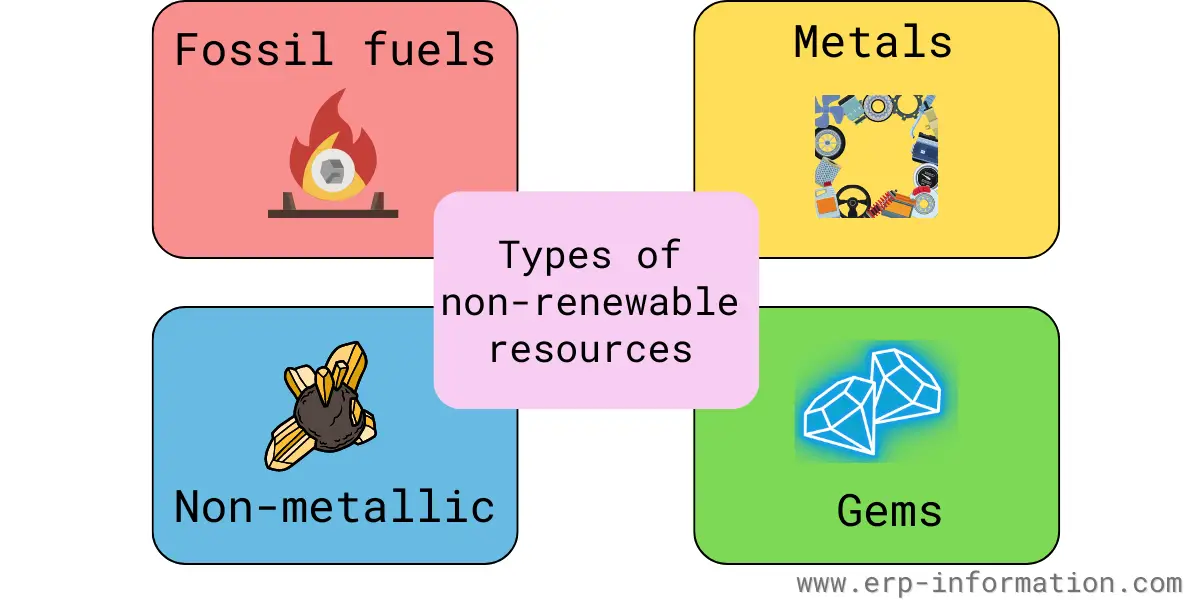
There are different types of non-renewable resources, each with its unique characteristics. The image shows some of the most common types:
1. Fossil Fuels
Fossil fuels are materials that are burned to create energy. Coal, crude oil, and natural gas are all examples of fossil fuels. They’re called fossil fuels because they’re made from the remains of prehistoric plants and animals.
Crude Oil
It is one of the nonrenewable resources used most widely. It’s made up mostly of hydrocarbons and other organic compounds. It is a fossil fuel that is extracted from the ground and then refined into various products like gasoline, diesel fuel, kerosene, and plastics.
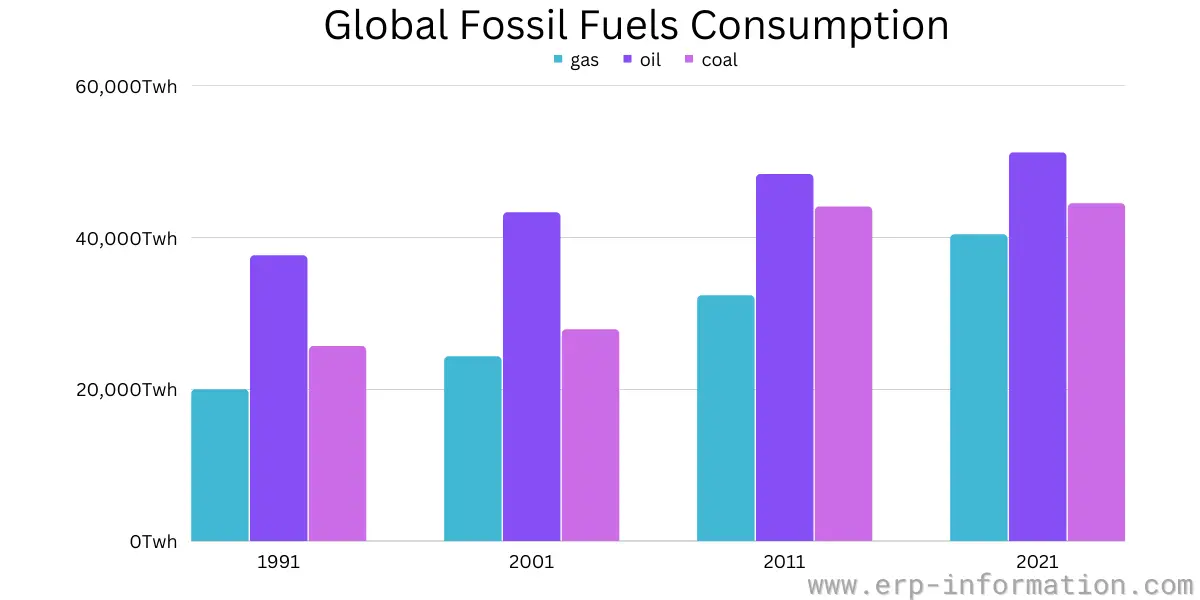
Oil can be burned to generate electricity or to power machinery, though in most countries it is now used mainly for transport. The common belief that most of the world’s oil comes from the Middle East and Russia is out of date: the United States has been the single largest crude oil producer since 2018.
- The United States consumed an average of 20.6 million barrels of petroleum a day in 2025, about 7.52 billion barrels for the year, according to the US Energy Information Administration.
- The United States is also the largest crude oil producer in the world, averaging a record 13.6 million barrels a day in 2025. It has held that position since 2018, and now out-produces Russia and Saudi Arabia by roughly 40%.
- Worldwide, oil demand reached about 103 million barrels a day in 2025, according to the Energy Institute Statistical Review of World Energy.
Where crude oil actually goes
Transport is the largest single use of oil, which is why oil demand tracks road freight and aviation more closely than it tracks electricity. The rest is split between petrochemicals, which turn oil into plastics, solvents and fertilizer ingredients, and industrial heat. Very little of the world’s oil is now burned to generate electricity: coal, gas, nuclear and renewables do that job.
You will often see this consumption figure turned into a countdown, as in “oil has about 50 years left”. That number is a reserves-to-production ratio, and it does not mean what it appears to mean. The section on how long these resources last explains why.
Natural gas
It is another nonrenewable resource. It is a fossil fuel often found in underground reservoirs and extracted using drilling or fracking methods. It’s used for heating and cooking, and to produce electricity. Natural gas is also used in the production of fertilizers and plastics. Russia, Iran, Qatar, and the United States have the largest natural gas deposits.
World natural gas demand reached about 4,122 billion cubic meters in 2024, roughly 4.1 trillion cubic meters, and grew again in 2025 (Energy Institute Statistical Review of World Energy).
Gas is the fossil fuel most often described as a “bridge” because burning it releases less carbon dioxide per unit of energy than coal. That is true at the point of combustion, but methane leaking from wells and pipelines is itself a potent greenhouse gas, so the size of the advantage depends on how tightly the supply chain is run.
Coal
It is a fossil fuel mined from the ground to produce energy. Coal is made from dead plant material that has been compressed over millions of years. It is often used in power plants to generate electricity and in certain industrial processes such as steel production.
- World coal demand hit a record of about 8.85 billion tonnes in 2025, after another record of 8.79 billion tonnes in 2024, according to the International Energy Agency. Coal use has not peaked, despite frequent predictions that it has.
- Coal has two main uses that are hard to separate from modern industry. Most of it is burned in power stations, where coal-fired generation still produced more electricity than any other single source in 2024. The rest is largely metallurgical coal, used to turn iron ore into steel, plus a significant share in cement production. Both steel and cement are difficult to decarbonize because the coal is doing chemistry, not just supplying heat.
Coal has the longest reserve life of the fossil fuels, commonly quoted at somewhere between 100 and 150 years depending on the edition and the source, and the spread between those figures is itself a warning about how soft the number is. Note also that the trade body once called the World Coal Association renamed itself FutureCoal in November 2023, so older citations to the WCA refer to the same organisation under its former name.
Nuclear energy, or nuclear fuel
It is a nonrenewable resource used to generate electricity. Nuclear power plants use uranium, a radioactive element, as fuel to generate heat which is then converted into electricity.
Uranium can be found naturally in soil or ore deposits and produced synthetically for fuel in nuclear power plants. Nuclear fuels can also be used for medical and military applications.
- The NEA and IAEA “Red Book” put identified recoverable uranium resources at about 7.9 million tonnes as of 1 January 2023, which is enough for more than 135 years at the current rate of use.
- Nuclear power supplies about 9% of the world’s electricity from roughly 440 operable reactors. Its share of total energy, which includes transport and heating, is far smaller, at a few percent.
- We use uranium as a shielding material in some containers that store and transport radioactive materials.
2. Metals
Metals are materials used to make things like cars, computers, and jewelry. They’re called metals because they’re a group of metallic luster elements. Some common metals include copper, aluminum, and gold.
Gold
Minerals such as gold or silver are also considered nonrenewable resources. These minerals are found in the earth’s crust and mined to be used in various industries such as building bridges, aircraft, manufacturing electronics, medical equipment, and more.
- World gold mine production was about 3,300 tonnes in 2025, with reserves put at roughly 66,000 tonnes (US Geological Survey). The World Gold Council reports a higher production figure because it counts artisanal and small-scale mining differently.
- It is used in cell phones, computers, and other high-tech devices as it is a great electricity conductor.
Aluminum
World primary aluminum smelter production was about 74 million tonnes in 2025, up from 72.8 million tonnes in 2024 (US Geological Survey). China alone accounts for roughly 45 million tonnes of that, about three-fifths of world output. Aluminium is refined from bauxite, and global bauxite resources are estimated at 55 to 75 billion tonnes, so the constraint on aluminum is the electricity the smelting consumes rather than the ore.
Copper
World copper mine production was about 23 million tonnes in 2025, while refineries turned out about 29 million tonnes, the difference being copper recovered from scrap. Identified reserves stand at about 980 million tonnes (US Geological Survey). Copper demand is closely tied to electrification, because motors, cabling and grid connections all need it.
3. Nonmetallic Minerals
Nonmetallic minerals are materials that don’t have a metallic luster. Some examples include sand, limestone, and marble. Nonmetallic minerals have a lot of different uses, including construction materials and fertilizers.
4. Gems
Gems are materials that are used to make jewelry. Diamonds, rubies, and sapphires are all examples of gems. Gems come from two different places: mines and water environments. Mines are where gems are usually found near the surface of the earth.
Water environments are where gems form when dissolved minerals precipitate out of water and form crystals.
Diamond
It is a nonrenewable resource that is mined from the earth. It is used in jewelry and other decorative items. Diamonds are prized for their hardness and beauty but have industrial uses such as cutting tools and drill bits.
Diamond is forged under extreme temperatures and pressures about 100 miles below the earth’s surface that few other substances can endure. The carbon atoms in diamonds are linked together equally in all directions. Hence it is very strong and requires another diamond even to scratch.
Diamond is used to make Diamond windows, Diamond speaker domes, heat sinks, etc.
Those are the main groups. Two of them behave very differently once the resource is in use, and the distinction is worth holding on to: the fuels are consumed, while the metals are only borrowed. Burning coal, oil or gas destroys it permanently, but the copper in a cable or the aluminum in a can is still copper and aluminum after use, and can be recovered indefinitely. That is why recycling changes the supply outlook for metals and does nothing at all for fuels.
Hence it is important to use nonrenewable resources responsibly. That means reducing consumption, implementing more efficient practices, and investing in renewable energy sources like solar, wind, and geothermal power.
So to help preserve them, people should practice responsible resource management techniques such as reducing, reusing, and recycling materials. That will help ensure that these resources are available for future generations.
Why is it important to preserve non-renewable resources?
Non-renewable resources are important to preserve because they are finite natural resources. Once they are gone, there will be no other resources, which means they are gone forever. Non-renewable resources are also important to preserve because they can be used to create energy.
For example, non-renewable resources are used to create both electricity and heating. These resources also provide important raw materials for manufacturing, construction, and other industries. Nonrenewable resources can also be used to manufacture essential products like cars, planes, and computers.
Preserving non-renewable resources helps protect the environment by reducing our reliance on fossil fuels and other harmful substances. Non-renewable resources are also an important part of the global economy, providing jobs and income for many people.
However, if non-renewable resources are not managed properly, they can be depleted quickly and without replacement, leading to economic instability in some areas.
Different ways to preserve non renewable resources
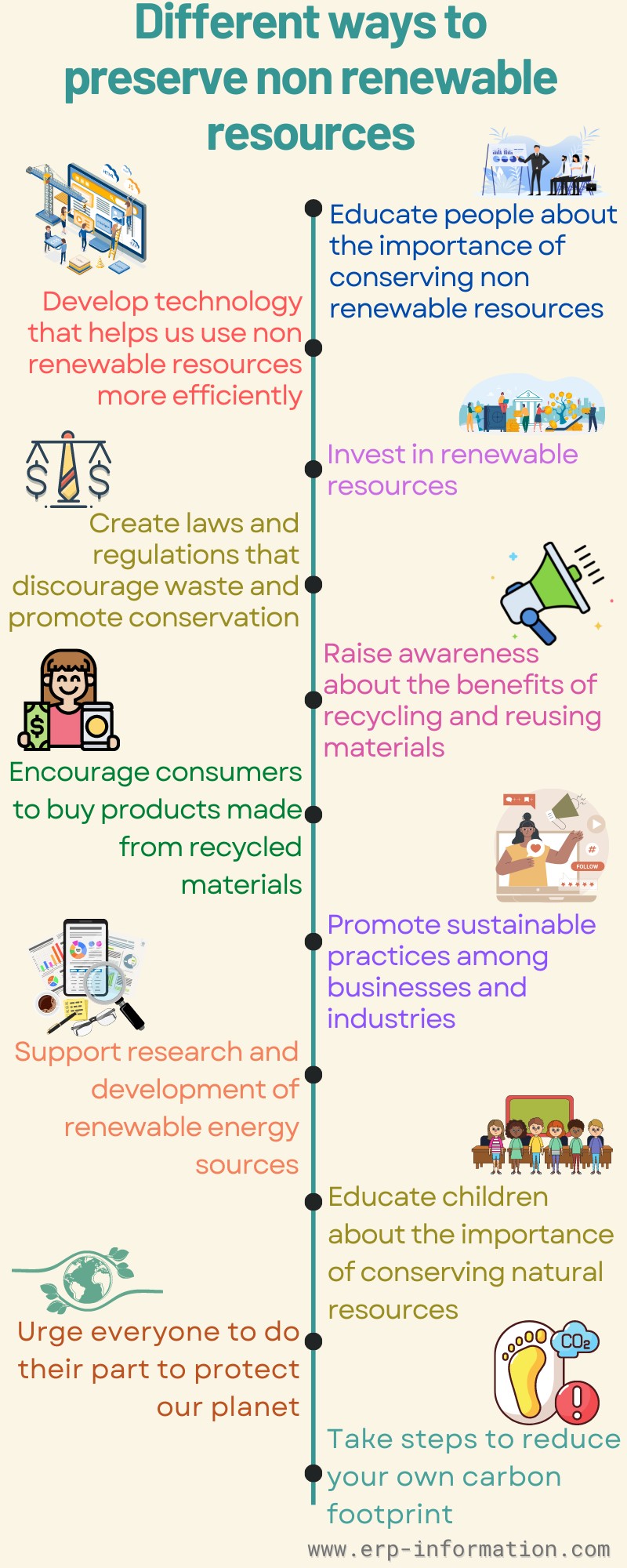
Use less of it in the first place
Efficiency is the only lever that reduces demand without requiring anyone to give something up, and it is the one with the longest track record. A modern gas boiler, an LED bulb and a well-insulated wall each deliver the same service as what they replaced while drawing a fraction of the fuel. At industrial scale the same logic applies to motors, furnaces and compressed air systems, which is where most industrial energy is quietly wasted.
Recycle the metals, because you cannot recycle the fuels
This is the distinction that matters most and the one most conservation advice blurs. Burning coal, oil or gas destroys it: the carbon ends up in the atmosphere and no process returns it to the ground on any useful timescale. Metals are different. Aluminium, copper, steel and gold survive use unchanged, and recycled aluminum takes roughly a twentieth of the electricity that smelting fresh metal from bauxite requires. For a metal, the effective size of the resource depends as much on collection rates as on what is left in the ground.
Substitute where a substitute genuinely exists
Electricity generation has real alternatives, and wind, solar, hydro and nuclear now displace fossil fuel at scale. Some other uses do not yet. Nitrogen fertilizer is made from natural gas, cement production releases carbon dioxide from the limestone itself rather than only from the fuel, and there is no substitute at all for phosphate rock, which is mined almost entirely to feed crops. Being honest about which uses are easy to replace and which are not is more useful than treating every barrel as equally negotiable.
Design products that can be taken apart
Recycling rates are set at the design stage more than at the recycling plant. A device glued shut, or an alloy blended so that its components cannot be separated, is effectively a one-way use of the metals inside it. Repairability, standard fasteners and single-alloy components are unglamorous decisions that decide whether material comes back into circulation or is downcycled into something less valuable.
Nonrenewable resources are valuable assets for our environment. Conservation of these resources is essential to ensure our planet’s future sustainability.
With small changes in everyday habits, initiatives from governmental bodies, conservation efforts from non-governmental organizations, and sustainable alternatives, we can ensure that these resources will be available for future generations.
How long will non-renewable resources actually last?
Almost every figure you will see quoted for this, including the ones higher up this page, is a reserves-to-production ratio. It is a simple division: proved reserves divided by the amount produced in a year. If reserves are 50 times annual output, the ratio is 50 years.
The ratio is useful, but it is not a countdown, and reading it as one has been a reliable way to be wrong for a hundred years. Proved reserves only count what is known about and economic to extract at today’s prices with today’s technology. Raise the price, improve the drilling, or survey somewhere new, and reserves grow without a single new atom of oil appearing. The clearest illustration is the United States, where the reserves-to-production ratio for oil has sat between roughly 8 and 17 years since 1920. On a naive reading the country should have run dry during the Great Depression. It is currently the largest oil producer on earth.
What actually happens as a deposit depletes is gradual rather than sudden. The cheapest and most accessible material is taken first, output from a field rises to a peak and then declines, and the cost of each additional unit creeps up. There is no cliff edge on a particular date.
Two honest caveats sit on the other side of that argument. Reserves growing on paper does not mean extraction is harmless, and for fossil fuels the binding constraint now looks likely to be climate policy and cost rather than physical exhaustion, since known reserves already contain far more carbon than can be burned within agreed temperature limits. And a ratio that is comfortable at today’s consumption tightens quickly if consumption climbs: the NEA and IAEA note that uranium demand could exceed today’s identified resource base within this century if nuclear capacity grows and no new resources are found.
The practical takeaway is to treat these numbers as a measure of how comfortable current supply is, not as an expiry date.
Non renewable resources vs renewable resources
| Nonrenewable resources | Renewable resources |
| They are finite natural resources. | They are replenished on a human timescale, so they are not exhausted by use. That is not the same as infinite: the flow available at any moment is limited. |
| They take millions of years to form and can not replenish or restore in a short period. | They can replenish or restore over a short period. |
| Extraction and consumption of nonrenewable resources lead to environmental challenges such as air pollution, water pollution, land degradation, and global warming. | They emit little or no carbon dioxide in operation, but they are not impact-free. Building them requires mined metals, wind and solar farms take up land, and large dams alter river ecosystems. |
| Examples: Oil, Natural gas, Coal, and nuclear energy. | Examples: Solar, wind, hydroelectric, geothermal, and biomass energy. |
Note: metals sit awkwardly in this classification. They are non-renewable, because the ore bodies took geological time to form and are not being replaced. What sets them apart from fuels is not that they are plentiful but that they are not destroyed by use, so recycling returns them to the supply.
How do non renewable resources affect the environment?
Non-renewable resources can significantly impact the environment due to how they are extracted, processed, and used. As a result, they cause many environmental issues, including:
Air pollution: Burning fossil fuels releases carbon dioxide, sulfur dioxide, and nitrogen oxides, contributing to smog and acid rain. These pollutants can significantly impact human health, vegetation, and ecosystems.
Water pollution: Non-renewable resources can be extracted in ways that contaminate water sources. For example, fracking for natural gas releases chemicals that can seep into groundwater, potentially contaminating drinking water sources.
Habitat destruction: Extracting non-renewable resources often involves removing large amounts of topsoil and vegetation, which can damage or destroy wildlife habitats and disrupt ecosystem function.
Climate change: Fossil fuels are the largest contributor to greenhouse gas emissions, which cause climate change. The extraction, transportation, and consumption of non-renewable resources contribute to warming the planet and impacting global weather patterns.
Land degradation: Mining non-renewable resources such as gold and iron can result in soil erosion and degradation, leading to long-term damage to the productivity and health of the land.
FAQs
How do non renewable resources affect the climate change?
Non-renewable resources contribute significantly to climate change by producing greenhouse gases when extracted, processed, and burned. Burning fossil fuels like coal, oil, and gas release carbon dioxide (CO2).
This CO2 then accumulates in the atmosphere, traps heat from the sun, and causes global warming. This process contributes to rising sea levels, melting glaciers and polar ice caps, drought, and extreme weather events, which can have serious consequences for both human and natural systems.
What is the difference between renewable and non-renewable resources?
The difference is the rate at which nature replaces them, not how much is left.
Renewable resources such as solar, wind, hydro, geothermal and biomass are replenished on a human timescale, so using them this year does not reduce what is available next year.
Non-renewable resources such as coal, oil, natural gas, uranium and mined minerals formed over millions of years, so extracting them permanently draws down the stock.
Renewable does not mean impact-free: wind and solar need mined metals and land, and large dams change river ecosystems.
Are metals renewable or non-renewable resources?
Metals are non-renewable, because the ore bodies took geological time to form and are not being replaced.
In practice they behave very differently from fuels. Burning a barrel of oil destroys it, whereas copper, aluminum, steel and gold survive use and can be recycled repeatedly without losing their properties.
That is why the usable supply of a metal depends as much on collection and recycling rates as on what remains in the ground.
Will the world run out of oil in 50 years?
Almost certainly not in the way that figure suggests. The number is a reserves-to-production ratio, which divides proved reserves by current annual production.
It is a snapshot, not a countdown, and it shifts whenever prices, technology or discoveries change what counts as recoverable. The United States has kept an oil reserves-to-production ratio of roughly 8 to 17 years since 1920 and is now the world’s largest producer.
Production is far more likely to peak and decline gradually than to stop on a date.
What are the main types of non-renewable resources?
Four groups cover almost all of them.
Fossil fuels: coal, crude oil and natural gas.
Nuclear fuel: chiefly uranium.
Metals and their ores: iron, copper, aluminum from bauxite, gold and silver.
Non-metallic minerals: phosphate rock, limestone, sand and gravel, and gemstones such as diamond.
Conclusion
Non-renewable resources are a vital part of our lives, and knowing what they are and how to use them is crucial.
Two things are worth carrying away. The first is that “non-renewable” describes the rate a resource forms, not a countdown to an empty tank, and the reserve figures quoted as deadlines are ratios that have been recalculated upward for a century. The second is that fossil fuels and mined metals behave differently: burn a barrel of oil and it is gone, but the copper in a cable can be recovered and used again, which is why recycling changes the arithmetic for metals and not for fuels.
References
Our World in Data, Global fossil fuel consumption
US Energy Information Administration, How much oil is consumed in the United States?
Energy Institute Statistical Review of World Energy, data via Our World in Data
International Energy Agency, Coal 2025
US Geological Survey, Mineral Commodity Summaries 2026
World Nuclear Association, Nuclear Power in the World Today
Using Google Search? Add erp-information.com as a preferred source.