
A validation master plan (VMP) is the single document that states what a regulated site validates, how, in what order, and who approves it. In the European Union it is not optional. Annex 15 of the EU GMP guide requires that “the key elements of the site qualification and validation programme should be clearly defined and documented in a validation master plan (VMP) or equivalent document”.
Two things about a VMP are widely misunderstood. First, it is not a protocol: it schedules and governs validation work, it does not execute it. Second, it is deliberately short. PIC/S is blunt on the point: the VMP “should be a summary document and should therefore be brief, concise and clear” and “should not repeat information documented elsewhere”. It is the map, not the territory.
A VMP also has nothing to do with validating a product idea in the market sense. The word “validation” here is the GMP meaning: documented evidence that facilities, equipment, utilities, processes and systems do what they are supposed to do, reproducibly.
This guide gives the seven elements Annex 15 actually requires in a VMP, the PIC/S chapter structure, the validation matrix that sits at the core of the plan, a template outline you can copy, and the qualification sequence (URS, DQ, FAT/SAT, IQ, OQ, PQ) the plan has to schedule.
What is validation master plan (VMP)?
A VMP is the document that describes a site’s overall approach to qualification and validation: what is in scope, the strategy for each class of item, who is responsible, how acceptance criteria are set, and how the programme is kept current when things change.
PIC/S defines it as “a document that summarises the firm’s overall philosophy, intentions and approach to be used for establishing performance adequacy”. The important word is summarises. Detail lives in the protocols and reports the VMP points to.
Which rules actually require one
Whether a VMP is mandatory, and what it must contain, depends on what you manufacture and for which market. This is the question most VMP articles skip.
| If you are | The governing text | Is a VMP named? |
|---|---|---|
| A medicinal product manufacturer in the EU or a PIC/S member state | EudraLex Volume 4, Annex 15 (Qualification and Validation), effective 1 October 2015 | Yes. Annex 15 paragraph 1.4 requires a VMP or equivalent document, and 1.5 lists what it must include or reference |
| Inspected against PIC/S recommendations | PIC/S PI 006-3, 25 September 2007 | Yes. A full chapter defines VMP scope, format and content |
| A US drug manufacturer | 21 CFR Parts 210 and 211 | Not by name. The CGMP rules require validated processes and written procedures; a VMP is the accepted way to organise that, not a cited requirement |
| A finished medical device manufacturer for the US market | 21 CFR Part 820, amended by the Quality Management System Regulation (QMSR), effective 2 February 2026, which incorporates ISO 13485:2016 by reference | Not by name. Planning of validation activity is required; the document title is yours to choose |
The practical consequence: if an EU or PIC/S inspector asks for your validation master plan, “we do not have one, we plan validation project by project” is a finding. In a US device context the same content may legitimately sit in a quality plan under another name.
Why do we need it?
Because validation is expensive and an inspector will ask you to justify its extent. The VMP is where you record the reasoning: why this system was qualified to this depth, why that one was excluded, and what the risk basis for the decision was. Annex 15 requires that the scope and extent of qualification be “based on a justified and documented risk assessment”.
PIC/S sets out who the document is really for, and it is worth quoting because it explains the tone a good VMP takes. It helps management “to know what the validation programme involves with respect to time, people and money”; it helps the validation team “to know their tasks and responsibilities”; and it helps GMP inspectors “to understand the firm’s approach to validation”.
That third audience is the one people forget. A VMP written so an inspector can follow the logic in twenty minutes is doing its job. One that runs to 200 pages of copied protocol detail is not.
Essential elements of VMP
Most guidance on this topic, including the diagram below, presents a practitioner’s list: scope and objectives, regulatory compliance, validation strategy, deliverables, timetable, documentation and review. That list is useful and it is what the rest of this section covers. It is not, however, the list the regulation gives, and the difference matters at inspection.
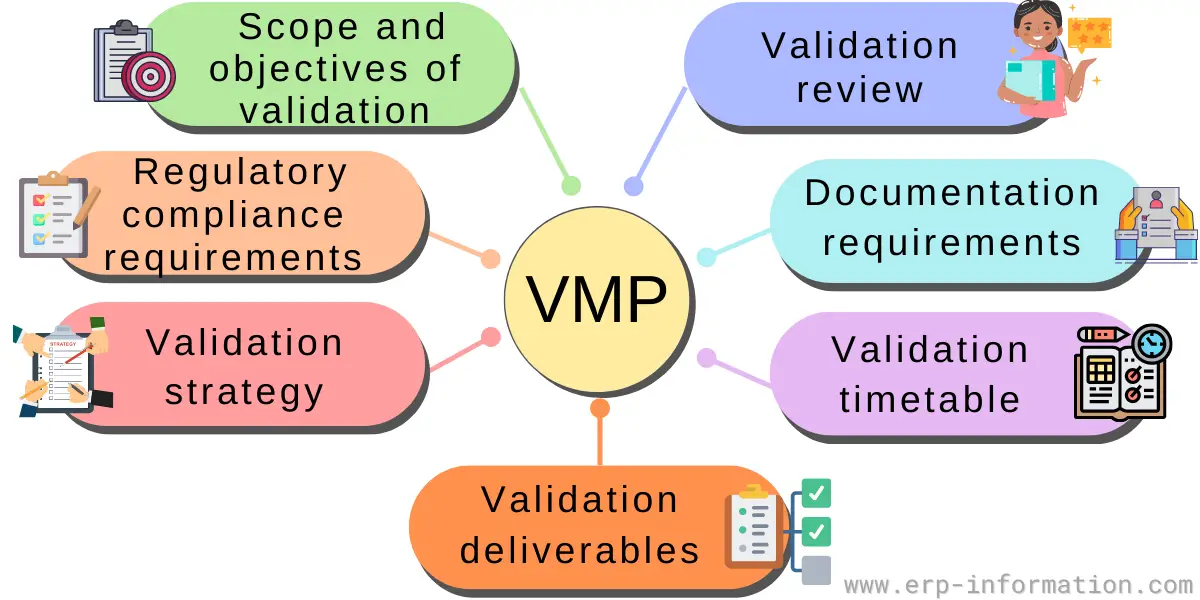
Some essential parts of a VMP include:
Scope and objectives of the validation: This should outline the system or product to be validated, any applicable regulatory requirements, and the desired outcome.
Regulatory compliance requirements: These are the rules and laws that need to be followed locally to make sure everything is done right.
Validation strategy: This outlines the approach that will be taken to validate the system or product, such as whether it will include a software validation or performance qualification. It should also detail any risk management strategies and how they will be implemented.
Validation deliverables: This should detail any documentation required for system or product validation, such as user manuals and training materials.
Validation timetable: This should set out the timeline for each validation activity, such as when protocols must be written, tests conducted, and reports generated.
Documentation requirements: The necessary documents and papers required are covered here. Such as guides and training material, to indicate that the system or product is working well.
Validation review: This should outline the process for verifying and approving validation activities and any other quality assurance checks that need to be performed.
The seven elements Annex 15 actually requires
Annex 15 paragraph 1.5 states that the VMP “should define the qualification/validation system and include or reference information on at least the following”. This is the checkable list. If you are writing a VMP for an EU or PIC/S site, work from this one.
| Annex 15 paragraph 1.5 requires | What it means in practice | |
|---|---|---|
| i | Qualification and validation policy | The site’s stated position on how much validation is enough and on what basis. Usually half a page, approved by management |
| ii | Organisational structure including roles and responsibilities for qualification and validation activities | Who writes protocols, who executes, who reviews, who approves. Name functions rather than individuals so the document survives staff changes |
| iii | Summary of the facilities, equipment, systems, processes on site and the qualification and validation status | The inventory. This is what becomes the validation matrix |
| iv | Change control and deviation management for qualification and validation | How a change to a qualified system triggers assessment and possible requalification, and what happens when a protocol fails. Commonly missing from VMP templates found online |
| v | Guidance on developing acceptance criteria | The rule for setting limits, so that criteria are not invented per protocol to match whatever the equipment happens to do |
| vi | References to existing documents | The pointers to SOPs, policies, protocols and reports that let the VMP stay short |
| vii | The qualification and validation strategy, including requalification, where applicable | The approach per class of item, plus the periodic review cycle that keeps qualified status alive |
Compare that against the practitioner’s list above and two mandated items have no counterpart at all: change control and deviation management, and requalification. Both are the elements that keep a validated state current rather than describing how it was first achieved. PIC/S requires change control independently, asking for “a statement of the company’s commitment to controlling critical changes to materials, facilities, equipment or processes”.
If you take one thing from this page: a VMP that describes only the initial qualification campaign, with no change control and no requalification cycle, is incomplete against the regulation that requires it.
The validation matrix, which PIC/S calls the core of the plan
PIC/S describes “the core of the VMP being the list / inventory of the items to be validated and the planning schedule”, and asks for it in matrix format. In practice this single table is what an inspector turns to first, and it is the part most often reduced to a vague paragraph.
PI 006-3 says the matrix should contain the items covered and the extent of validation required (IQ, OQ and PQ), the validation approach, revalidation activities, and actual status with future planning. A workable shape:
| Item | Type | Extent | Approach | Status | Requalification |
|---|---|---|---|---|---|
| Purified water system | Utility | DQ, IQ, OQ, PQ | Prospective, 3 phase PQ | Qualified, Mar 2026 | Annual review, full requalification on major change |
| Fluid bed dryer FBD-02 | Equipment | IQ, OQ, PQ | Prospective | OQ complete, PQ scheduled Q3 | 3 years or on change |
| HVAC, Grade C suite | Facility | DQ, IQ, OQ, PQ | Prospective | Qualified | Annual, plus environmental trend review |
| Tablet compression process, Product A | Process | Process validation | Prospective, ongoing process verification thereafter | 3 batches complete | Continuous, via OPV |
| LIMS | Computerised system | CSV per Annex 11 | Risk based, supplier assessment leveraged | Qualified, v4.2 | On upgrade or config change |
| HPLC assay, Product A | Analytical method | Method validation | Per ICH Q2 | Validated | On method or specification change |
Keeping the status column honest is the whole point. A matrix showing three overdue requalifications is a working document. One where everything reads “Qualified” is usually one nobody maintains.
Validation master plan examples
VMPs are not formally classified into types by any regulation. What genuinely differs between plans is scope: which part of the business the plan governs. Annex 15 anticipates this directly, noting that “for large and complex projects, planning takes on added importance and separate validation plans may enhance clarity”. These are the four scopes you meet in practice.
Example 1: Site validation master plan
The default. One plan covering an entire licensed site: facilities, utilities, equipment, processes, computerised systems, cleaning and analytical methods. It carries the site validation policy and the full matrix, and it is the document an inspector expects to be handed.
Typical length is 15 to 40 pages, most of which is the matrix. It is normally reviewed annually and re-approved when the site changes materially.
Example 2: Project validation master plan
Written for a defined capital project: a new production line, a facility extension, a technology transfer. It has a start and an end, and it usually runs alongside the site VMP rather than replacing it. PIC/S recommends exactly this for large builds, adding that the project VMP “should be part of the total project management”.
The distinguishing content is the interface with engineering: FAT and SAT scheduling, commissioning boundaries, and the handover point at which engineering documentation becomes qualification evidence.
Example 3: Computerised system validation master plan
A VMP restricted to GxP computerised systems: ERP, MES, LIMS, chromatography data systems, building management, and the spreadsheets people forget are systems too. In the EU the governing text is Annex 11 alongside Annex 15, with 21 CFR Part 11 applying to records and signatures for the US market.
What this plan must add over a general VMP: the system inventory with GxP impact assessment and software category, the supplier assessment approach, data integrity controls, and the position on how much supplier testing evidence you intend to leverage rather than repeat.
That last point moved recently. FDA’s Computer Software Assurance for Production and Quality System Software guidance was issued in draft on 13 September 2022 and finalised on 24 September 2025. It endorses a risk based approach in which assurance effort concentrates on software whose failure would affect product quality or patient safety, with lighter and unscripted testing elsewhere and vendor evidence used where justified. It applies to device production and quality system software rather than to drug manufacture, so state plainly in your plan which framework you are working under.
Example 4: Cleaning validation master plan
Frequently separated out because its logic is self contained: worst case product selection, equipment grouping and families, residue and microbial acceptance limits, sampling method with recovery studies, and the analytical methods used. PIC/S devotes a full chapter of PI 006-3 to cleaning validation for this reason.
Where a dedicated plan exists, the site VMP should reference it rather than duplicate it. Duplication is how two documents end up disagreeing about an acceptance limit.
Whichever scope you are writing for, the plan has to schedule the same underlying sequence of qualification stages. That sequence is the next section, and it is the part the template outline further down has to hang on.
The qualification sequence a VMP has to schedule
Annex 15 sets out the stages “from initial development of the user requirements specification through to the end of use of the equipment, facility, utility or system”. The definitions below are the ones given in the Annex 15 glossary, not paraphrases, because these are the words an inspector will use.
| Stage | Definition in Annex 15 | What the VMP schedules |
|---|---|---|
| URS User requirements specification | “The set of owner, user and engineering requirements necessary and sufficient to create a feasible design meeting the intended purpose of the system” | That a URS exists before design is frozen, and that it stays “a point of reference throughout the validation life cycle” |
| DQ Design qualification | “The documented verification that the proposed design of the facilities, systems and equipment is suitable for the intended purpose” | The check that the design meets the URS and complies with GMP, done before anything is bought or built |
| FAT / SAT Factory and site acceptance testing | Not a qualification stage as such. Annex 15 allows evaluation at the vendor before delivery | Which vendor tests may be credited so they are not repeated at IQ or OQ, where transport and installation cannot have affected the result |
| IQ Installation qualification | “The documented verification that the facilities, systems and equipment, as installed or modified, comply with the approved design and the manufacturer’s recommendations” | Installation against drawings, collection of supplier documentation, instrument calibration, verification of materials of construction |
| OQ Operational qualification | “The documented verification that the facilities, systems and equipment, as installed or modified, perform as intended throughout the anticipated operating ranges” | Tests at upper and lower operating limits and at worst case. May be combined with IQ as an IOQ where complexity allows |
| PQ Performance qualification | “The documented verification that systems and equipment can perform effectively and reproducibly based on the approved process method and product specification” | Testing with production materials or proven equivalents, at worst case batch sizes, with a justified sampling frequency |
Three points that catch people out:
- Completing OQ unlocks other work. Annex 15 notes that a successful OQ “should allow the finalisation of standard operating and cleaning procedures, operator training and preventative maintenance requirements”. If your plan schedules SOP approval and operator training before OQ closes, the sequence is wrong.
- PQ does not always come last on its own. It normally follows IQ and OQ, but Annex 15 allows it to be performed with OQ or with process validation where that is appropriate.
- Computerised system validation is not a step between OQ and PQ. It is a parallel discipline covering a different class of item, governed by Annex 11 in the EU. A system can be undergoing CSV while the equipment it controls is in OQ.
Retrospective validation, and why two guidance documents disagree
Older VMP templates still offer prospective, concurrent and retrospective validation as three equal options, because PIC/S PI 006-3 lists all three and dates from 2007. Annex 15 was revised in 2015 and closed that door: “Retrospective validation is no longer considered an acceptable approach.”
If you are copying a VMP template that offers retrospective validation as a route, that template predates the current Annex 15. Concurrent validation survives but needs justification and documented approval.
Keeping qualified status alive
The stages above establish a qualified state once. Two mechanisms maintain it, and these are the Annex 15 elements most often missing from a VMP:
- Change control and deviation management. Every change to a qualified system gets assessed for validation impact before it is made, with the outcome recorded: no action, partial requalification, or full requalification. Deviations found during execution need the same rigour, because a protocol that failed and was quietly re-run is the single most damaging thing an inspector can find.
- Periodic review and requalification. Annex 15 asks for the strategy “including requalification, where applicable”. State the review interval per class of item and the trigger conditions, and be prepared to defend the interval on risk rather than on habit.
For processes, ongoing process verification takes over from periodic requalification: documented evidence that the process “remains in a state of control during commercial manufacture”, collected continuously rather than in a campaign every three years.
No matter which scope of validation master plan you are writing, the template outline below covers the sections it needs.
What is a validation master plan template?
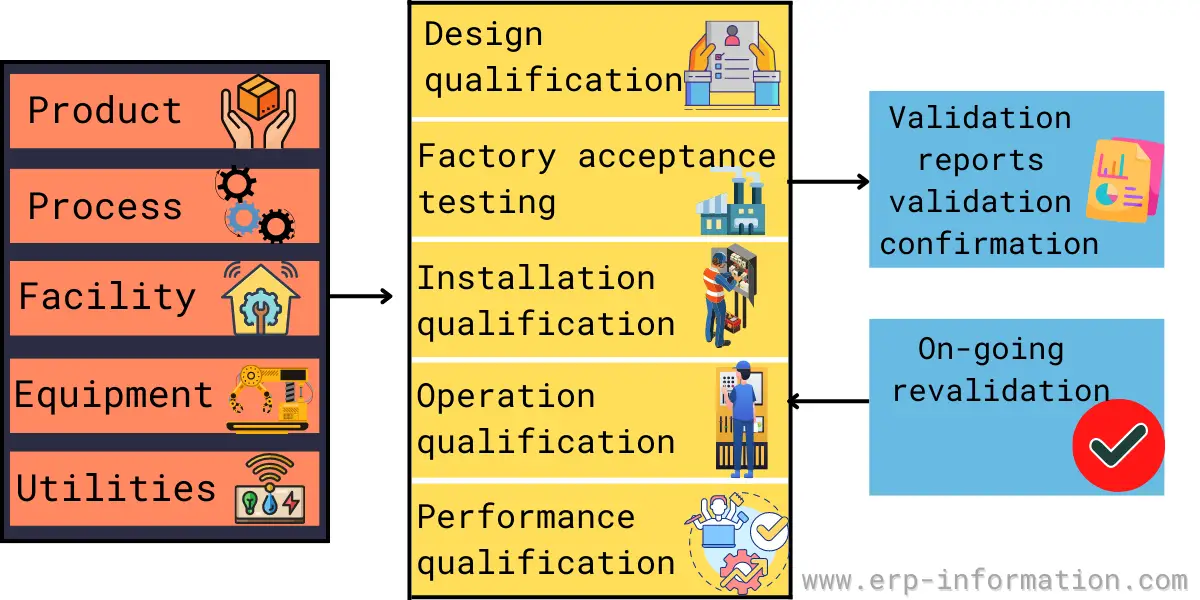
This template is a tool for creating a customized plan for validating a product, system, or process. It can include information such as the scope of work, timeline, resources needed, risk assessment criteria, quality control procedures, and acceptance criteria.
It can also outline the roles and responsibilities of each team member involved in validation activities.
Here we are providing the outline of the template. That includes
1. Purpose
To document the overall validation strategy and to determine the necessary tasks to validate facilities, utilities, equipment, processes, and products.
2. Scope
To define the scope of validation activities, including company, buildings, and products.
3. Responsibility
To define the roles and responsibilities of the validation team members or departments.
4. Standard operating procedures (SOPs)
To guide and support validation activities. The list of SOPs are
- Validation SOPs
- Metrology, facilities, and engineering SOPs
- Quality control SOPs
- Quality assurance SOPs
5. Validation overview
To provide overall product quality assurance. The validation process defines how the entire manufacturing system is consistent and reliable.
The types of validation to reach the manufacturing process validated state are Equipment, Utilities, Facilities, Computer systems, Cleaning, Sterilization, Methods, and Process.
- 5.1 Installation qualification
- 5.2 Operation qualification
- 5.3 Computerised system validation (a parallel activity, see above)
- 5.4 Performance qualification
- 5.5 Method validation
6. Product validation
To define the validation activities for each product. After the facility, utility, and equipment validation, the manufacturing process should be validated to check whether the products meet the final product specification.
All the parameters like manufacturing time, room temperature, product temperature, and equipment settings will be mentioned.
7. Process description
Please outline your process in this section. Document sampling tests for both in-process and final products. Validate the initial process by conducting three studies for each product formulation and filling/packaging configuration.
This approach ensures adherence to predetermined specifications for both in-process and final products, offering a reliable measure of variability across consecutive runs.
All documents related to manufacturing products are readied for assessment and used as part of the decision-making process for releasing products.
8. Validation scheduling and control
It refers to the completion of scheduled validation of equipment, services, and systems. After equipment installation and system construction, appropriate documentation and change control systems are established.
Documentation of standard operating procedures, calibration, qualification/validation protocols, batch records, training, and preventive maintenance help the validation process.
9. Facility validation
It consists of warehousing, facility cleaning validation, microbial contamination prevention and control, and environmental monitoring.
10. Utility validation
This includes a Heating Ventilation and air Conditioning System, WFI Generation and Distribution System, Clean Steam Generation and Distribution System, Nitrogen Gas System, Clean Compressed Air (CCA), Plant Steam, Chilled Water System (CHW), Heating Hot Water System (HHW)
11. Equipment validation
Constitutes Tanks, Vessels, and Skids, Temperature Controlled Chambers and Rooms (CTUs and CTRs), and Equipment Cleaning and Sterilization Validation
12. Additional things
Constitutes training, calibration, change control, spare parts and maintenance management, logbooks, and checklists. Calibration and preventive maintenance belong in the VMP because a qualified instrument that has drifted out of calibration is no longer qualified.
When creating a VMP, it is important to consider the product design, intended use, user profiles, and regulatory requirements. The template should be altered to meet the specific needs of the project at hand and may require modifications over time as processes evolve or new regulations are introduced.
A well-crafted VMP template can be a valuable asset in ensuring compliance with applicable standards while saving time and helping to ensure the success of validation activities.
An easy-to-follow template can also streamline communication between team members, making it easier to track progress and identify potential issues before they become major obstacles.
VMP checklist
We are providing checkpoints for VMP. These checkpoints are designed to guide the evaluation of a Validation Master Plan, ensuring it is thorough, educational, and effective in outlining the validation process.
They serve as critical elements in achieving successful validation activities and maintaining the highest standards in product quality.
1. Resource Needs and Timelines
- Check Point: Does your Validation Master Plan comprehensively identify the potential resource requirements for specific validation activities? Is there a well-defined plan for establishing project timelines to ensure timely completion?
- Importance: This ensures that all necessary resources, including personnel, equipment, and materials, are identified in advance. Clear project timelines contribute to efficient planning and execution of validation activities.
2. Leadership Understanding
- Check Point: Is your VMP designed to effectively educate the leadership team on the necessity and value of validation activities concerning product quality?
- Importance: A well-informed leadership team is crucial for obtaining necessary support and resources. This checkpoint ensures that the VMP serves as a tool for communicating the importance of validation in maintaining and enhancing product quality.
3. Prospective Schedules and Timelines
- Check Point: Does your VMP consist of prospective schedules and timelines for validation projects, providing a roadmap for when each validation activity is planned to occur?
- Importance: Prospective schedules and timelines enhance planning and coordination, helping teams and stakeholders understand the sequence and duration of validation activities. This contributes to efficient project management.
4. Comprehensive Validation Coverage
- Check Point: Does your VMP provide detailed coverage of all activities related to process validation, as well as qualifications for manufacturing equipment and utilities?
- Importance: A comprehensive VMP ensures that all critical aspects of validation are addressed, including the validation of processes, equipment, and utilities. This helps in maintaining compliance and product quality.
Benefits
Having a validation master plan in place is essential for successfully producing quality products that meet regulatory standards. In addition, it helps to ensure that all validation activities are conducted efficiently and timely and reduces the risk of non-compliance.
Risk management
It provides a systematic approach to assess and manage validation risks associated with the manufacturing process. It identifies potential risk areas and helps identify solutions to mitigate them.
Quality assurance
A VMP provides details on ensuring quality throughout the entire production process, from raw materials through finished products, by establishing standards that each stage of production must meet.
Compliance
The plan helps to ensure that the facility complies with federal, state, and local regulations. It identifies areas where there may be potential non-compliance and guides how to manage them.
Streamlined processes
It helps streamline processes, as all validation activities are documented in one centralized document. That allows for easier and more efficient tracking of validation efforts.
Cost savings
By documenting the steps and processes associated with validating a product or process, it is possible to identify areas where efficiencies can be made and costs reduced. Having a well-defined validation master plan reduces the amount of time spent on validating a product or process.
FAQs
Is a validation master plan a regulatory requirement?
In the EU and in PIC/S member states, effectively yes. Annex 15 of the EU GMP guide states that the key elements of the site qualification and validation programme should be clearly defined and documented in a validation master plan or equivalent document. US CGMP rules for drugs (21 CFR 210 and 211) and the device regulation in 21 CFR 820 require validation and planning but do not name the document, so equivalent content may sit in a quality plan under a different title.
Who is responsible for writing and approving the VMP?
Quality assurance or a dedicated validation function normally writes it, with engineering, production, QC and IT contributing their sections. PIC/S states that the VMP should be agreed by management, so senior sign off is expected rather than optional. Name functions rather than individuals in the document so it survives staff changes.
How long should a validation master plan be?
Shorter than most people expect. PIC/S states that the VMP should be a summary document and should therefore be brief, concise and clear, and that it should not repeat information documented elsewhere but refer to existing documents such as policies, SOPs and validation protocols. A site VMP of 15 to 40 pages, most of it the validation matrix, is normal. Length usually signals copied protocol detail that belongs in the protocols.
What is the difference between a validation master plan and a validation plan?
The VMP governs a whole site or programme and sets policy, responsibilities, strategy and the overall schedule. A validation plan or protocol covers one system, process or project and contains the actual tests and acceptance criteria. Annex 15 notes that for large and complex projects, separate validation plans may enhance clarity, so the two coexist: the VMP points to the plans beneath it.
What goes in a computer system validation master plan?
Everything a general VMP contains, plus a GxP inventory of computerised systems with impact assessment and software category, the supplier assessment approach, data integrity and audit trail controls, and a stated position on how much supplier testing evidence you will leverage instead of repeating. In the EU, Annex 11 governs computerised systems alongside Annex 15, and 21 CFR Part 11 applies to electronic records and signatures for the US market.
How often should a VMP be updated?
PIC/S states plainly that a VMP requires regular updating. Most sites review it annually and re approve it whenever something material changes: a new production line, a significant facility modification, a change of ownership, or a shift in validation policy. The validation matrix inside it changes far more often than that, which is why many sites hold the matrix as a controlled attachment rather than in the body of the document.
What are typical KPIs for a validation master plan?
Useful measures are the percentage of items in the matrix with current qualified status, the number of overdue requalifications, protocol deviations per executed protocol, average time from protocol approval to report approval, and the proportion of changes correctly assessed for validation impact before implementation. Avoid measuring only protocols completed, since that rewards volume rather than a maintained validated state.
Is retrospective validation still allowed?
Not under the current Annex 15, which states that retrospective validation is no longer considered an acceptable approach. Older templates still list it as an option because PIC/S PI 006-3 dates from 2007, before the 2015 Annex 15 revision. Concurrent validation remains possible but needs documented justification and approval.
Conclusion
The difference between a VMP that passes inspection and one that generates findings is rarely writing quality. It is whether the plan covers the two elements Annex 15 names and most templates omit: change control and deviation management, and requalification. A plan that documents how a validated state was first achieved, and is silent on how it is maintained, describes a moment rather than a system.
The second most common problem is length. Both Annex 15 and PIC/S treat the VMP as a summary that references detail held elsewhere. If your draft is repeating acceptance criteria that already live in a protocol, the protocol is the correct home and the VMP should point at it.
Start from the seven Annex 15 elements, build the matrix first because it is the core of the plan and the part an inspector reads first, then write the narrative around it.
Sources
- EudraLex Volume 4, Annex 15: Qualification and Validation, European Commission, Brussels, 30 March 2015, operational from 1 October 2015. Paragraphs 1.4 and 1.5 and the glossary definitions quoted above.
- PIC/S PI 006-3, Recommendations on Validation Master Plan, Installation and Operational Qualification, Non-Sterile Process Validation, Cleaning Validation, 25 September 2007.
- Medical Devices; Quality System Regulation Amendments, FDA final rule, published 2 February 2024, effective 2 February 2026 (the QMSR).
- Computer Software Assurance for Production and Quality System Software, FDA final guidance, announced 24 September 2025.
- Validation master plan example (PDF)