
Distribution Requirements Planning (DRP) answers a question that sounds simple and is not: to keep every warehouse, distribution center, and store stocked without burying the business in inventory, what should each location order, and when? DRP answers it with a time-phased plan. It takes the demand forecast at each stocking point, subtracts the stock already on hand and in transit, and works backward through the delivery lead time to schedule replenishment orders before a shortage can happen.
The method borrows its arithmetic from Material Requirements Planning (MRP), the technique factories use to plan components. What changes is the direction it looks. MRP looks inward at a single plant. DRP looks outward across a network of locations, and it lets the requirements at the smallest branch roll all the way up to the plant or supplier that feeds them. Planning the whole chain from the customer backward is what makes DRP more than a reorder rule.
What is distribution requirements planning?
Distribution Requirements Planning is a time-phased method for planning inventory replenishment across a multi-echelon distribution network. For every product at every location, it projects future stock levels period by period and schedules the orders needed to keep each location above its safety stock and below the point of costly overstock. To do that, DRP needs six inputs for each item and location:
- The demand forecast at that location, plus any firm customer orders
- Current on-hand inventory
- Safety stock, the buffer held against demand and supply variability
- Stock already on order and in transit (open orders)
- The replenishment lead time from the supplying location
- The order quantity or lot-sizing rule the location uses
The DRP record: the six lines that decide every order
Every DRP calculation runs on one small table, repeated for each product at each location and read left to right across future periods, usually weeks. Six lines do the work:
- Gross requirements: the demand expected in each period, from the forecast plus any known customer orders.
- Scheduled receipts: stock already ordered and in transit, due to arrive in a given period.
- Projected on-hand: the inventory expected at the end of each period. It equals the previous period’s on-hand, plus any receipts, minus that period’s gross requirements.
- Net requirements: the shortfall that appears when projected on-hand would drop below safety stock. This is the trigger to order.
- Planned order receipts: the replenishment quantity DRP schedules to arrive in the period where the shortfall would occur, sized to the location’s lot rule.
- Planned order releases: the same order shifted earlier by the lead time. This is the line that tells the planner to act now.
The projected on-hand line is the engine. DRP walks it forward one period at a time, and the moment it would fall below safety stock, it places a receipt in that period and back-schedules the release by the lead time.
A worked DRP example
Take one product at a single distribution center. It opens the horizon with 50 units on hand, holds 20 units of safety stock, orders in fixed lots of 100, and its supplying warehouse delivers in one week. The forecast for the next six weeks is 30, 40, 30, 50, 40, and 30 units.
DRP reads the projected on-hand line forward. Week 1 ends at 20 (50 minus 30), right at safety stock. Week 2 would fall to minus 20, so DRP schedules a 100-unit receipt in week 2 and, because the lead time is one week, releases that order in week 1. On-hand recovers to 80. The same shortfall appears in week 4, which triggers a receipt in week 4 and a release in week 3.
| DRP record | Week 1 | Week 2 | Week 3 | Week 4 | Week 5 | Week 6 |
|---|---|---|---|---|---|---|
| Gross requirements | 30 | 40 | 30 | 50 | 40 | 30 |
| Scheduled receipts | ||||||
| Projected on-hand | 20 | 80 | 50 | 100 | 60 | 30 |
| Planned order receipts | 100 | 100 | ||||
| Planned order releases | 100 | 100 |
Read down the last line and you have the order schedule: release 100 units in week 1 and another 100 in week 3. None of it is guesswork. Change the forecast, the safety stock, the lot size, or the lead time, and the table recomputes the releases.
How requirements roll up the network
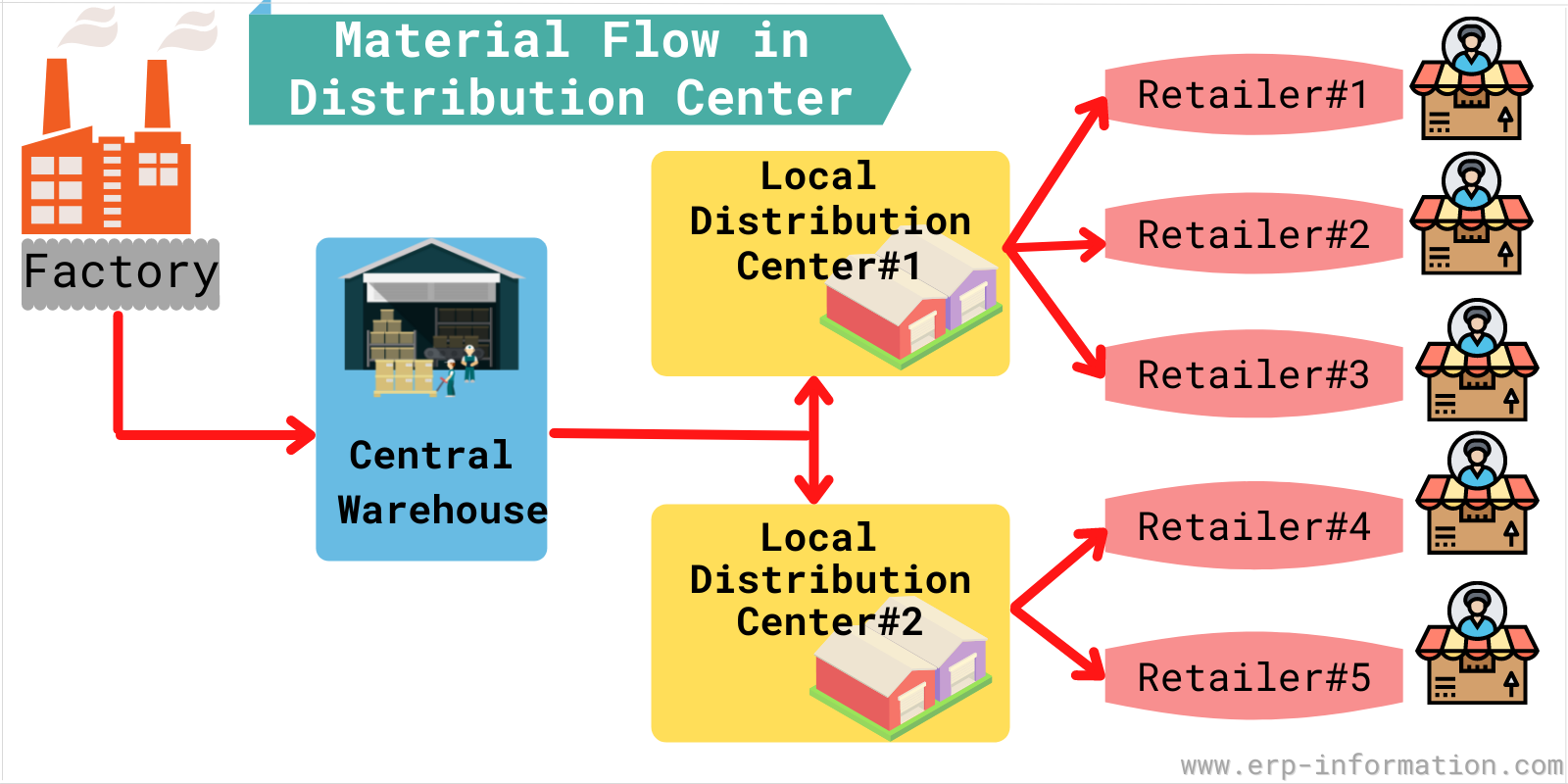
A real network has more than one location, and this is where DRP earns its name. The planned order releases at each distribution center are not only instructions to that center. They are demand on whatever location supplies it. So DRP takes every DC’s release line, sums the releases that land in each week, and feeds that total in as the gross requirements of the central warehouse. The central warehouse then runs the same six-line calculation against its own on-hand, lead time, and lot size, and its releases become demand on the plant or supplier above it.
Requirements therefore climb the chain one echelon at a time, from the store to the regional DC to the central warehouse to the plant. Each level sees a clean, time-phased picture of what the level below it will actually order, weeks before the orders arrive. That forward visibility is what lets a company hold less inventory at every tier and still avoid stockouts, and it is the one thing a simple reorder-point system at each location cannot give you.
Push or pull: two ways to run DRP
DRP is a planning engine, not a philosophy, and companies run it in two directions.
In a pull setup, replenishment is driven from the bottom. Each location works out what it needs from its own demand, and those needs flow up the network. Pull keeps decisions close to the customer, but because every location reacts to its own local swings, a small change at the shelf can amplify into a large swing upstream, the effect known as the bullwhip.
In a push setup, a central planner decides how much to send each location from one forecast and pushes it down. Push is usually cheaper to run because stock is planned and held centrally, but service can slip when the central forecast is out of touch with what is actually selling in a given region. Most mature operations blend the two, planning centrally with DRP while letting fast-moving or volatile items pull.
DRP vs MRP
DRP and MRP are often confused because they share the same arithmetic. The difference is what they plan and which way requirements flow.
| Distribution Requirements Planning | Material Requirements Planning | |
|---|---|---|
| Plans | Finished goods across a distribution network | Components and materials inside a plant |
| Demand | Independent: forecast customer demand at each location | Dependent: derived from the production schedule through the bill of materials |
| Driven by | Customer demand, which the firm does not control | The master production schedule, which the firm sets |
| Requirements flow | Up the network, from stores and DCs toward the plant | Down the bill of materials, from finished product to parts |
| Typical horizon | Longer, often 12 to 26 weeks for seasonal goods | Shorter, often a 4 to 8 week frozen horizon |
| Answers | What to ship, where, and when | What to make or buy, and when |
They are complementary, not competing. In an integrated supply chain DRP plans the finished goods moving toward customers and MRP plans the components moving into production. The handoff between them, where DRP’s demand on the plant becomes an input to the master schedule that drives MRP, is where much of the real planning value sits, and it is also the part most often left disconnected.
DRP II: planning the resources, not just the stock
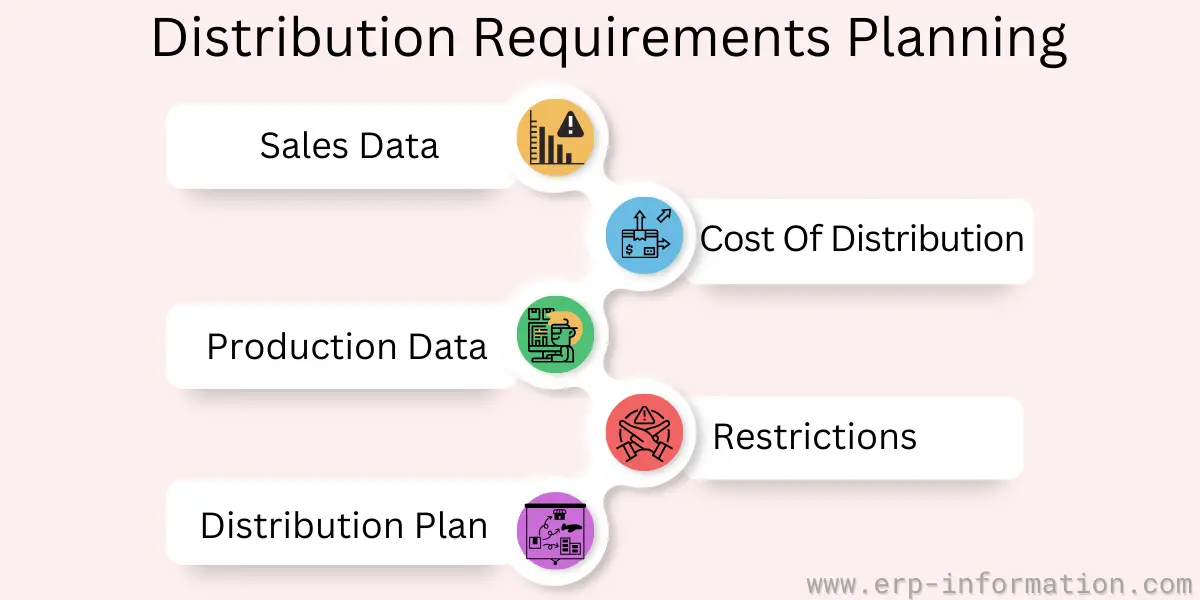
The acronym DRP hides two related ideas, and mixing them up is common. Distribution Requirements Planning is the time-phased replenishment logic above. Distribution Resource Planning, sometimes called DRP II, is the wider system built on top of it.
The replenishment plan tells you what stock will move and when. Once you know that, you can also work out the resources needed to move it: the warehouse space it will occupy, the trucks and shipping capacity to carry it, the labor to handle it, and the cash tied up along the way. DRP II extends the same time-phased plan to those resources, so a company can see not just that 100 units are due into a DC in week 3, but whether it will have the dock space, the staff, and the working capital to receive them.
The approach was set out by Andre Martin, who developed it in the 1970s and codified it in his 1983 book Distribution Resource Planning. It went on to become the planning engine behind Quick Response and Continuous Replenishment programs, where a supplier restocks a retailer’s shelves automatically from shared demand data.
What DRP needs, and where it breaks
DRP is only as good as the numbers feeding it, and that cuts both ways.
It needs accurate, current data: real inventory positions at every location, honest lead times, and a demand forecast at each stocking point rather than one number for the whole company. Because the calculation is mechanical, a wrong safety stock or a stale lead time produces a confidently wrong order. This is why DRP lives inside an ERP or supply chain planning system, where inventory, sales, and purchasing share one live set of records instead of separate spreadsheets. A good forecast is the other half; teams often pair DRP with a demand model, and you can size the forecast that feeds it with a tool like our single exponential smoothing forecast calculator.
Its main weakness is inherited from that forecast. DRP assumes the forecast is roughly right, so demand that is highly erratic, promotion-driven, or brand new with no history can push the plan around and, in a pull setup, amplify into the bullwhip effect upstream. It also treats lead times as fixed, so a supplier who slips delivery breaks the schedule. Teams handle this by reviewing the plan on a regular cycle, tracking a few honest metrics such as fill rate, inventory turns, and forecast error, and raising safety stock only where the variability is real rather than trusting a single run.
Conclusion
DRP turns a network of separate stocking decisions into one connected plan. By reading a simple time-phased table forward at every location, and letting each level’s orders become the demand on the level above, it gives a company a weeks-ahead view of what it will actually need to ship, make, or buy. The math is old and the logic is plain, but fed with clean data it remains one of the most dependable ways to hold less inventory and still have the right product in the right place when a customer asks for it.
What is the difference between DRP and MRP?
MRP plans the components and materials needed inside a plant, working down the bill of materials from a production schedule the company controls. DRP plans finished goods across a distribution network, working up from independent customer demand the company can only forecast. They use the same time-phased arithmetic and are complementary: DRP’s demand on the plant feeds the schedule that drives MRP.
How does distribution requirements planning decide what to order?
DRP projects on-hand inventory forward one period at a time, subtracting each period’s forecast demand and adding any incoming stock. When projected on-hand would fall below the safety stock, it schedules a replenishment order to arrive in that period, sized to the location’s lot rule, and releases the order earlier by the delivery lead time.
What is DRP II or Distribution Resource Planning?
Distribution Resource Planning, or DRP II, extends the replenishment plan to the resources needed to carry it out: warehouse space, transportation, labor, and working capital. Distribution Requirements Planning decides what stock moves and when; DRP II checks that the capacity and cash to move it will be there. Andre Martin set out the approach in his 1983 book.
Is DRP a push or a pull system?
DRP can run either way. In a pull setup each location’s own demand drives replenishment up the network, keeping decisions close to the customer but risking the bullwhip effect. In a push setup a central planner allocates stock from one forecast, which is cheaper to run but can miss local demand. Many companies blend the two.
Using Google Search? Add erp-information.com as a preferred source.