Enterprise architecture (EA) is the practice of describing an organization across four domains, business, data, application, and technology, so that its IT and its strategy stay aligned as both change. It gives leaders one map of how the business works today and a planned path to where it needs to be, instead of a pile of disconnected systems and diagrams.
EA is the umbrella. The frameworks that structure it (TOGAF, the Zachman Framework) and the disciplines beneath it (business architecture, enterprise data modeling) are how it gets done. This guide covers the four domains, what EA delivers, the main frameworks, and the real tools and certifications.
What is enterprise architecture?
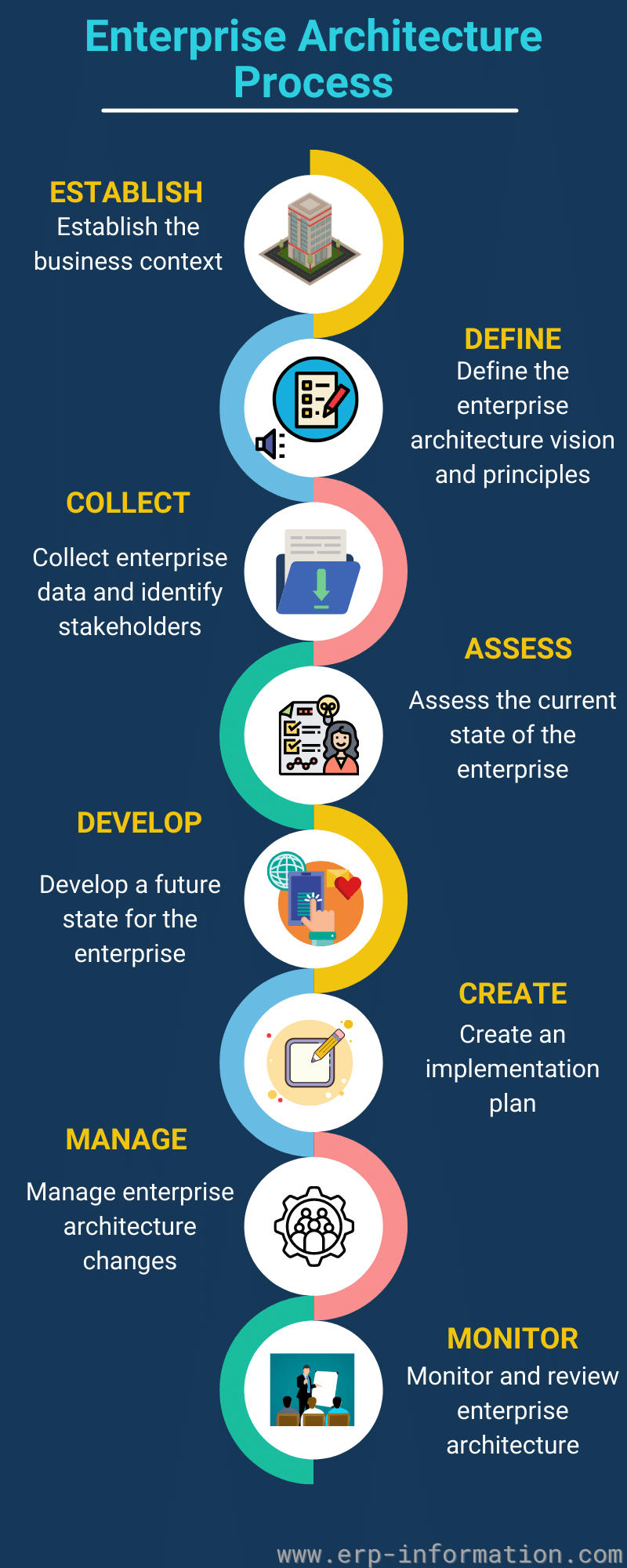
Enterprise architecture maps an organization’s systems, applications, data, and processes, shows how they relate, and keeps them pointed at the same strategic goals. It documents the current state, defines a target state, and lays out the roadmap between them. The value is coherence: when a new technology or a strategy shift lands, EA shows what it touches before anyone commits budget to it.
The four domains of enterprise architecture
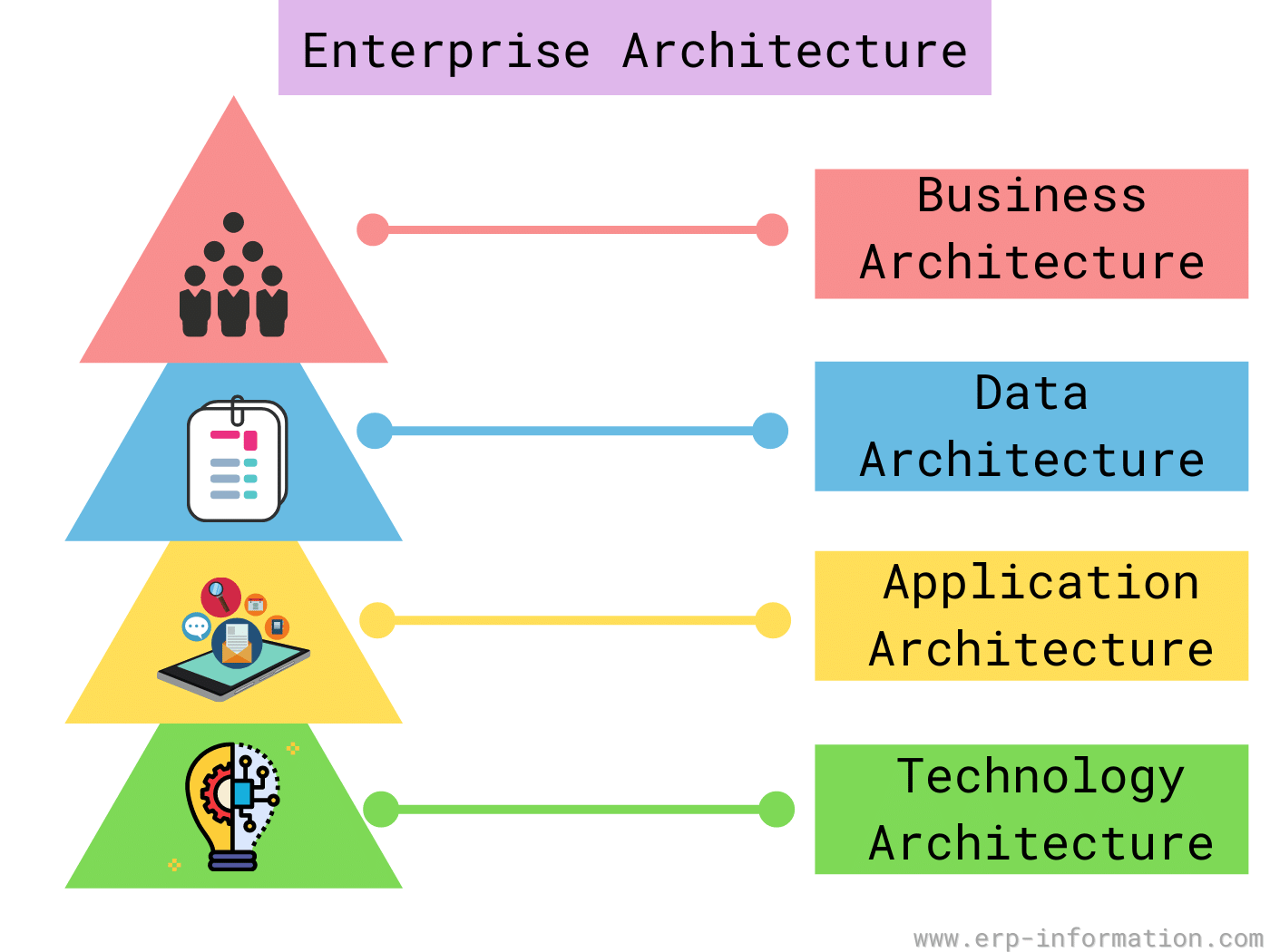
Almost every framework organizes EA into the same four domains, from the business goals at the top down to the infrastructure everything runs on.
| Domain | What it covers |
|---|---|
| Business | Capabilities, processes, organization, and strategy |
| Data / Information | The data the business relies on, and how it is defined and governed |
| Application | The applications and how they integrate to support the business |
| Technology | Infrastructure, platforms, middleware, and networks |
What enterprise architecture delivers
Done well, EA is a practical tool, not a documentation exercise. Its concrete payoffs are:
- Business and IT alignment. A shared language and a shared map, so IT investment tracks business goals instead of drifting from them.
- A rationalized application portfolio. Duplicate and unsupported systems become visible, which is usually where the first real cost savings come from.
- Faster, safer change. Because dependencies are documented, the impact of a change can be assessed before it is made, which speeds up transformation and reduces the risk of breaking something downstream.
- Better risk and compliance posture. Tracing a regulation to the systems and processes it governs shows exactly what has to change.
The honest caveat: EA programs stall more often on people than on method. Without executive sponsorship and a habit of keeping the models current, an architecture practice slides into shelfware. The strongest programs stay lightweight and tie every artifact to a decision someone actually needs to make.
Enterprise architecture frameworks
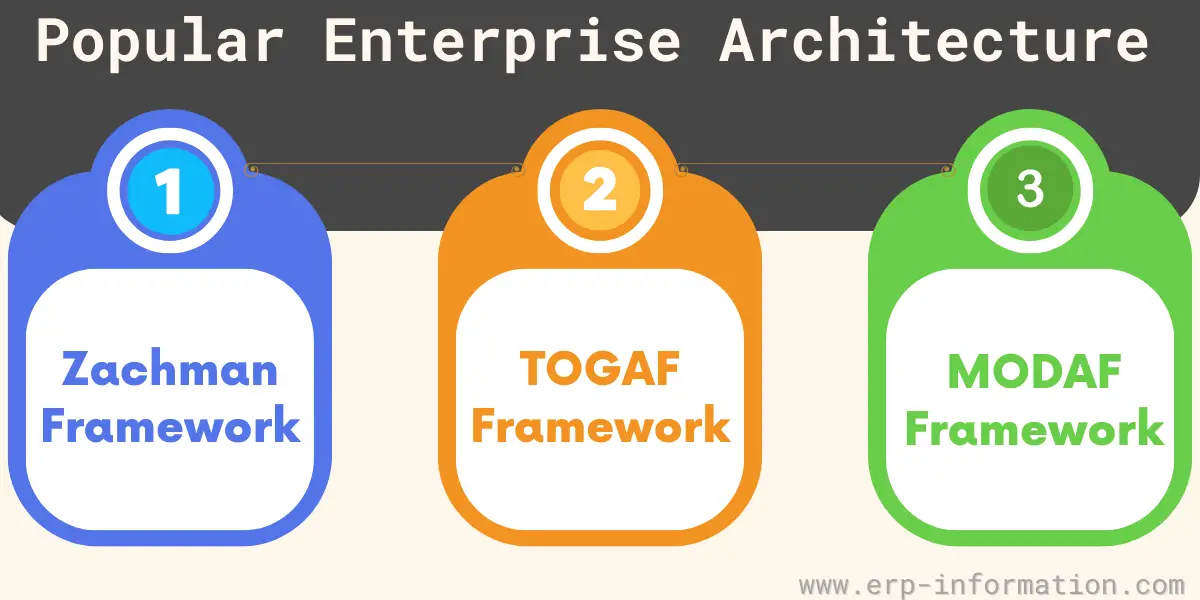
A framework gives EA a ready-made structure so you do not start from a blank page. The three named most often are below; for a full side-by-side of these plus FEAF, DoDAF, and UAF, see our guide to enterprise architecture frameworks.
Zachman Framework
The Zachman Framework is a classification schema, not a sequence of steps. It arranges architecture into a six-by-six matrix: six columns for the questions asked of the enterprise (what, how, where, who, when, why) and six rows for the perspectives that answer them, from the executive’s scope down to the functioning enterprise. Each of the 36 cells holds one model, so it tells you what to document, not the order to build it in.
TOGAF Framework
The TOGAF Framework is the most widely used in commercial practice. Where Zachman classifies, TOGAF prescribes a method: its Architecture Development Method (ADM) is a cycle of eight phases plus ongoing requirements management.
- Preliminary: establish the architecture capability, principles, and governance
- Phase A: Architecture Vision
- Phase B: Business Architecture
- Phase C: Information Systems Architecture (data and application)
- Phase D: Technology Architecture
- Phase E: Opportunities and Solutions
- Phase F: Migration Planning
- Phases G and H: Implementation Governance, then Architecture Change Management
MODAF Framework (retired)
The MODAF Framework organized architecture into seven viewpoints (Strategic, Operational, Service-Oriented, Systems, Acquisition, Technical, and All Views). Note that it is now retired: the UK Ministry of Defence has withdrawn MODAF and moved to the NATO Architecture Framework (NAF). It is covered here because its viewpoint structure carried forward into NAF and UAF.
Enterprise architecture tools
Dedicated EA platforms hold the architecture in a shared repository, so a capability links to the applications, data, and initiatives that touch it and a change in one place is visible everywhere. The established options include:
- LeanIX, Ardoq, and Bizzdesign HoriZZon – modern, collaborative SaaS platforms.
- MEGA HOPEX and Avolution Abacus – established enterprise repositories with strong analysis.
- Sparx Enterprise Architect and Orbus Software – modeling-led tools, often paired with UML and ArchiMate.
Enterprise architecture certifications
The credentials that actually certify enterprise architecture, as opposed to cloud or solution architecture, are few and worth knowing:
| Certification | Body | Notes |
|---|---|---|
| TOGAF Certification | The Open Group | The most widely held EA credential; current version is TOGAF 10 (2022) |
| Zachman Certified – Enterprise Architect | Zachman International / FEAC | Four levels, built around the Zachman ontology |
| Certified Enterprise Architect (CEA / ACEA) | FEAC Institute | Method-based certification, with an associate (ACEA) entry level |
| Vendor academies (e.g. LeanIX) | Tool vendors | Product-specific training, useful once a platform is chosen |
Cloud and platform certifications such as AWS, Azure, or Salesforce architect credentials are valuable, but they certify solution or infrastructure architecture, not enterprise architecture. Keep the distinction clear when planning a career path.
Who is involved in enterprise architecture?
EA is a team effort, not a solo role. The core participants are:
- Enterprise architects own the overall framework, decide what gets designed or redesigned, and keep the architecture coherent.
- Domain and IT architects turn the target architecture into something that can actually be built and run.
- Business analysts capture the business requirements the architecture has to satisfy.
- Executive sponsors and stakeholders fund the work and keep it tied to real business priorities; without them, EA stalls.
FAQs
What is the purpose of enterprise architecture?
The purpose of enterprise architecture is to keep an organization’s IT and strategy aligned as both change. It documents the current state across the business, data, application, and technology domains, defines a target state, and maps the roadmap between them, so investment and change decisions can be made with a clear view of what they affect.
What are the four domains of enterprise architecture?
Business, data (or information), application, and technology. The business domain covers capabilities, processes, and strategy; the data domain covers the information the business relies on; the application domain covers the systems that support it; and the technology domain covers the infrastructure everything runs on.
Which frameworks are used for enterprise architecture?
The most common are TOGAF, a methodology built around the Architecture Development Method, and the Zachman Framework, a classification schema. FEAF (US federal), DoDAF, and UAF (defense) are also widely used, and MODAF has been retired in favor of NAF. Many organizations combine Zachman for completeness with TOGAF for delivery.
How is enterprise architecture different from solution architecture?
Enterprise architecture is broad and strategic: it covers the whole organization across all four domains and sets the context that projects work within. Solution architecture is narrow and tactical: it designs one specific system or solution to fit that context. EA sets the direction; solution architecture delivers a piece of it.
Conclusion
Enterprise architecture is the discipline that keeps a whole organization coherent: four domains, one map, and a roadmap from where the business is to where it needs to be. Pick a framework that fits how prescriptive you need to be, keep the models light and current, and tie every artifact to a real decision. Done that way, EA earns its keep by making change cheaper, faster, and less risky, rather than by producing documentation nobody reads.
References