
The promise date is the date a supplier formally commits to, having checked that it can actually be met. It is the answer to “when will this order be ready”, given only after material and capacity have been tested rather than estimated.
Three dates get used interchangeably in conversation and should not be. Confusing them is how a supplier ends up judged late on a date it never committed to.
| Date | Whose it is | What it marks |
|---|---|---|
| Promise date | The supplier commits it | The date the order will be shipped or made available |
| Due date | The customer expects it | The date the customer wants the goods in hand |
| Ship date | Recorded after the fact | The date the goods actually left |
The gap that matters: a promise date covering shipment does not cover transit. If your customer reads it as an arrival date and you meant a despatch date, you will both be right and still end up in dispute. Say which one you mean, in writing.
Definition
The promise date holds significant weight in any transaction or contract. It signifies the vendor’s commitment to deliver goods or services to the customer within a specified timeframe.
This crucial date is determined through meticulous planning, taking into account various factors such as production timelines, processing activities, and transit durations to ensure the product reaches the customer on or before the promised date.
For effective management, companies often rely on robust systems like Master Production Schedules (MPS) to track and uphold these promise dates. This approach enables them to monitor and maintain a clear overview of all upcoming commitments within a designated time frame.
Moreover, determining the promise date isn’t just an arbitrary decision; it involves thorough communication and coordination between the vendor and the customer.
Understanding the customer’s requirements, aligning them with production capabilities, and factoring in potential contingencies are crucial steps in arriving at a realistic promise date that both parties can rely on.
In essence, the promise date is a cornerstone in the supply chain, reflecting the vendor’s dedication to fulfilling their commitment to the customer while ensuring operational efficiency and customer satisfaction.
Importance
The promise date is more than just a day; it’s a commitment to customers, a way to keep them happy and build trust. It’s like a special promise to deliver what’s needed when it’s needed, making sure everyone’s satisfied, and things run smoothly. It proves to be the key to achieving customer satisfaction and your success ultimately.
Imagine you order something online, and the seller promises it will arrive on a specific date. When they keep that promise, it builds trust. You know you can rely on them. Trust is like the glue that holds business relationships together.
Setting a promise date makes businesses plan things carefully. It ensures everyone is on the same page. When a business tells you a product will be ready by a certain date, it’s like a clear message that helps you plan. Businesses that stick to promise dates often have a great reputation.
How does it help to build up trust?
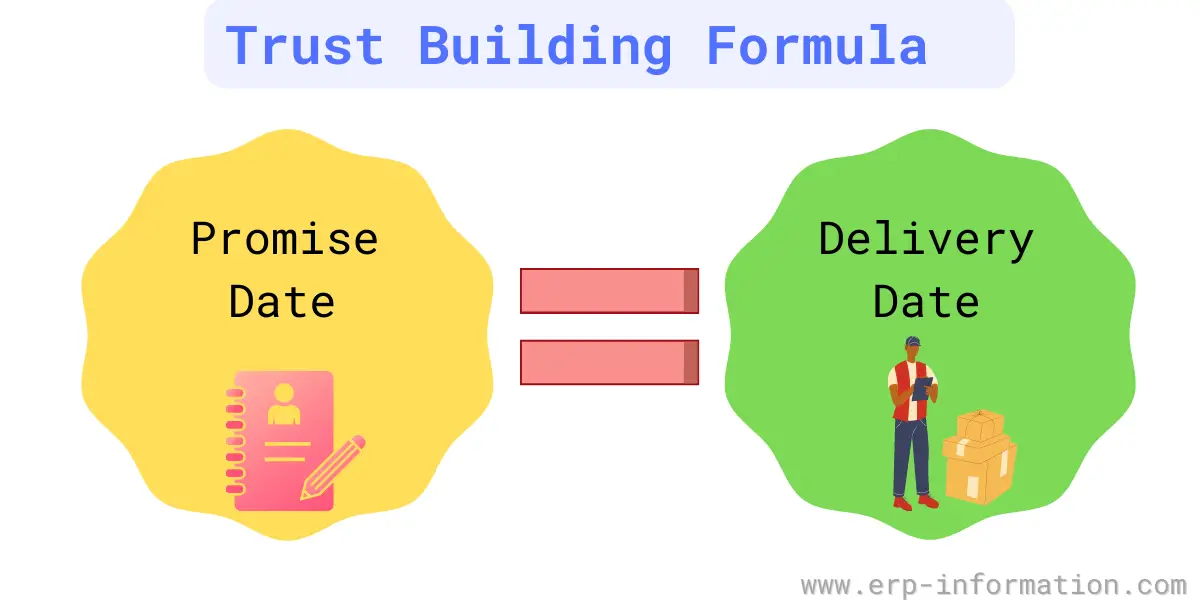
- Prompt delivery date by the company shows confidence and transparency in work. In addition, it sends a positive message about the company’s reputation.
- If the customer is kept waiting for an extended period without a promised delivery date, they might doubt the firm’s competency, even though there has been no delay.
- A good follow-up routine on dates that are due or missed due to unforeseen situations is essential. This way, the customer knows that the firm is into the job and has taken full responsibility until the delivery is complete.
- Good customer service is vital and does not go unnoticed.
- Customer satisfaction is also a company policy. A good reputation and positive reviews depend primarily on customer feedback from on-time deliveries. In addition, it boosts the company’s vendor rating.
The promised delivery date is a critical component. A computer-generated system generally manages it and is regularly followed up.
An unmet delivery date needs to be appropriately addressed with valid reasons and the following delivery date. If not, it can result in the customer leaving for another seller with a more sincere track record.
How do you calculate the promise date?
We can calculate it by considering Available to promise (ATP) and capable to promise (CTP). That is because ATP and CTP are fundamental concepts of business.
Available to promise allows you to calculate dates based on the reservation system. In addition, it checks the availability of unreserved items in the inventory. With the help of this information, a company can calculate it easily.
Capable to promise allows you to check the resource availability like workforce equipment and raw materials to meet customer orders.
Lead time estimation and promise date
It is essential to estimate the lead time and find an accurate promise date. There will be two kinds of vendors. One is an idealist, and another is a realist. The below image shows the difference between these two types of vendors’ estimated lead times.
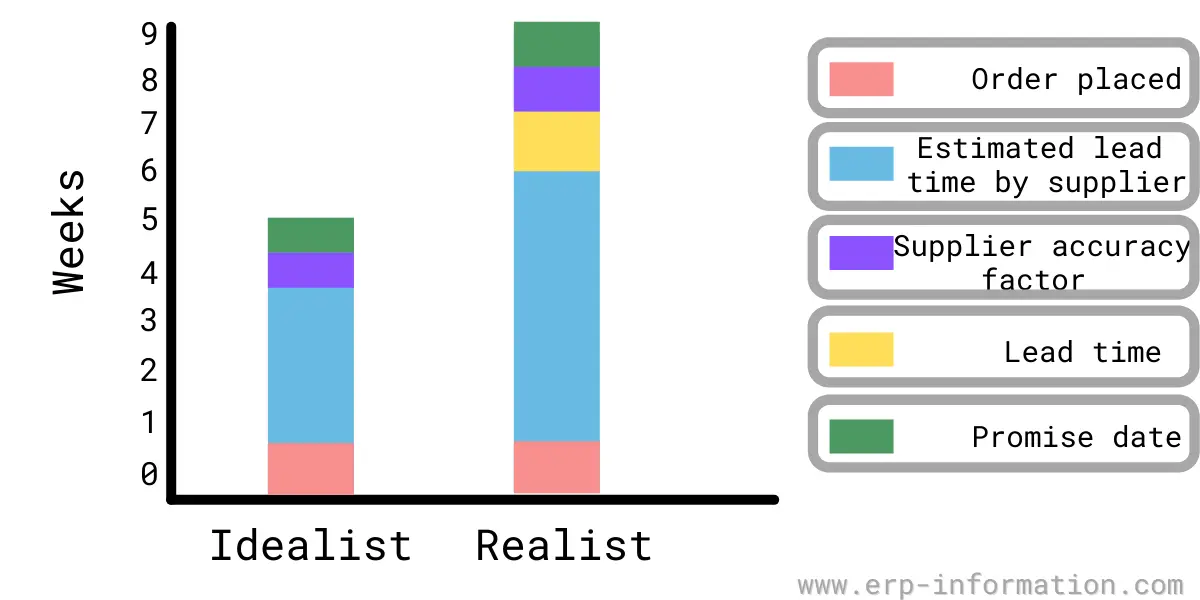
The image compares two suppliers quoting the same order. The customer orders in week 1 and the quoted lead time is a range of 4 to 6 weeks. What separates them is which end of that range they build on, and whether they allow for their own track record.
| Component | Optimistic supplier | Realistic supplier |
|---|---|---|
| Order placed | Week 1 | Week 1 |
| Lead time used | 4 weeks (bottom of the range) | 6 weeks (top of the range) |
| Supplier accuracy factor | Not applied | Applied |
| Inbound and outbound transit | Included | Included |
| Promise date given | Week 5 | Week 9 |
The same order, the same quoted range, and a four week difference in what the customer is told. The optimistic quote is not a better service level, it is an untested one: it assumes the fastest possible path with nothing going wrong, so it converts any ordinary variation straight into a missed date.
The supplier accuracy factor is the part most often left out. It is simply your own measured history: if you have historically delivered at the top of your quoted range, or past it, that record belongs in the promise. A supplier that quotes week 9 and ships in week 8 keeps a customer. One that quotes week 5 and ships in week 8 loses one, having done exactly the same work.
Few do’s and don’ts of promise date
- Do not assign an arbitrary date without consulting the lead time required for your system to generate a finished product.
- Ask the customer for a probable delivery date according to their comfort before assigning your possible date. Simply inquiring about their convenience is fine.
- Do not forget to follow up on backorders, which should be met soon.
- It is no use giving delivery dates one after the other to keep account of your books. It will only give rise to anger and discontent. Try to meet the dates anyhow.
- Keep the proceedings of your company clean. The customer must be informed about the number of business days they require, and under no situation should they be given a close date to impress.
The promised delivery dates must also consider the distance you need to deliver (if you are delivering to their homes) and the lead time required for your vendor to travel.
An on-time delivery also shows how efficiently your system works, which might return the customer for another order.
FAQs
What is the difference between the promise date and the Due date?
The promise date is your commitment to ship the order, and the due date is the customer’s expectation for when they should receive it.
The due date might fall within a certain date range that the customer finds acceptable, as specified in the “Not Before, Not After” terms.
Conclusion
A promise date is only worth as much as the check behind it. Derived from an availability check it is a commitment; picked to satisfy the person asking, it is a guess that will be measured against you later.
Two habits carry most of the value. Quote from the top of your lead time range and include your own accuracy history, so the date survives ordinary variation. And state explicitly whether the date is despatch or arrival, because that single ambiguity produces more disputes than genuine lateness does.
Using Google Search? Add erp-information.com as a preferred source.