The Supplier Evaluation Risk Rating, usually shortened to SER Rating or SER score, is a Dun and Bradstreet score that answers one narrow question: how likely is this supplier to stop trading in the next 12 months? It runs on a scale of 1 to 9, where 1 is the lowest risk and 9 is the highest.
It is worth being precise about what that score does and does not tell you, because this is where most buyers misread it. The SER Rating is a financial failure model. It does not measure whether a supplier ships on time or whether the parts pass inspection. A supplier can hold a SER Rating of 1 and still deliver late every month.
What the SER Rating means at a glance
| Item | Detail |
|---|---|
| Full name | Supplier Evaluation Risk Rating |
| Also called | SER Rating, SER score |
| Provider | Dun and Bradstreet |
| Scale | 1 to 9 |
| Best score | 1, the lowest risk |
| Worst score | 9, the highest risk |
| What it predicts | Probability the business seeks relief from creditors or ceases operations |
| Time window | The next 12 months |
| What it does not measure | Product quality, delivery performance, service levels |
| Type | Statistical model built on D and B commercial data |
What is the SER Rating?
Dun and Bradstreet describes the SER Rating as its proprietary scoring system for assessing the probability that a business will seek relief from creditors or cease operations within the next 12 months. In plain terms it is a supplier failure forecast, expressed as a single digit.
Buyers use it as a screening and monitoring tool. If you are placing a long-term contract, or single-sourcing a component, the question of whether the supplier will still exist when the contract matures is a real risk, and the SER Rating is a cheap way to put a number on it.
How the 1 to 9 scale works
The scale is ordinal and it runs the opposite way to a school grade. A low number is good.
| SER Rating | Reading | What it usually means in practice |
|---|---|---|
| 1 to 3 | Lower risk | The modelled chance of failure in the next year is at the low end. Normal monitoring. |
| 4 to 6 | Moderate risk | Worth a closer look, particularly for sole-source or high-value spend. |
| 7 to 9 | Higher risk | The model puts this supplier among the most likely to fail. Consider dual sourcing, shorter payment terms, or contingency stock. |
The bands above describe how buyers commonly act on the score. The scale itself is what Dun and Bradstreet defines: 1 is the lowest risk and 9 is the highest.
What the SER Rating actually measures, and what it does not
This is the part that trips people up, and it is worth stating bluntly because a lot of material online gets it wrong.
It does measure
- The likelihood the supplier becomes inactive or ceases operations within 12 months
- Financial and commercial distress signals drawn from D and B data
It does not measure
- Product or service quality. Nothing in the model inspects your goods.
- Delivery or on-time performance. A financially sound supplier can still miss every promised date.
- Responsiveness, service levels or commercial behaviour.
If you need to score suppliers on quality, delivery and price together, that is a different exercise entirely, using a weighted scorecard rather than a credit-bureau score. The methods for that are covered in vendor rating methods, including the categorical, weighted point and cost ratio approaches. The practical answer for most procurement teams is to run both: SER for viability, a scorecard for performance.
What data goes into the SER Rating
Dun and Bradstreet builds the rating from statistical models and predictive data attributes rather than from a single ratio. The factors it names include:
- Company finances, including assets, liabilities and net profit
- Payment experiences, also called trade references
- Suits, liens, judgments and bankruptcy filings
- Employee count
- Whether the company owns its facilities
- Industry
- Region
Two consequences follow from that list. First, a thin file hurts you: a company with little reported trade data gives the model less to work with. Second, industry and region are inputs, so two businesses with similar accounts can score differently.
SER Rating compared with the other D&B scores
Buyers routinely confuse the SER Rating with PAYDEX, and they answer completely different questions. PAYDEX looks backwards at how a company has paid its bills. SER looks forwards at whether the company survives.
| Score | Scale | What it answers |
|---|---|---|
| Supplier Evaluation Risk (SER) Rating | 1 to 9, 1 is best | Will this business cease operations within 12 months? |
| PAYDEX | 1 to 100, higher is better | How promptly has this business paid its bills? 80 and above is low risk. |
| D&B Failure Score | 1 to 5 | Probability of financial distress such as a bankruptcy filing within 12 months. |
| D&B Delinquency Predictor Score | 1 to 5 | Likelihood of late payments or payment failure. |
| D&B Rating | Composite | Overall creditworthiness from company size and balance sheet strength. |
A supplier with a strong PAYDEX and a poor SER Rating is paying today out of a business the model expects to be in trouble within the year. That combination is exactly the one worth catching early.
Why a SER Rating declines
A rating moves when the underlying data moves. The common causes are:
- New suits, liens or judgments appearing against the business
- Deteriorating financials, such as falling net profit or a weakening balance sheet
- Slower payment experiences reported by that supplier’s own creditors
- A shrinking business, for example a falling employee count
- Less data reaching D and B, which leaves the model with a thinner file
- Sector-wide pressure, since industry is one of the inputs
Notice what is absent from that list. A late delivery to you will not move a supplier’s SER Rating, because delivery data never enters the model.
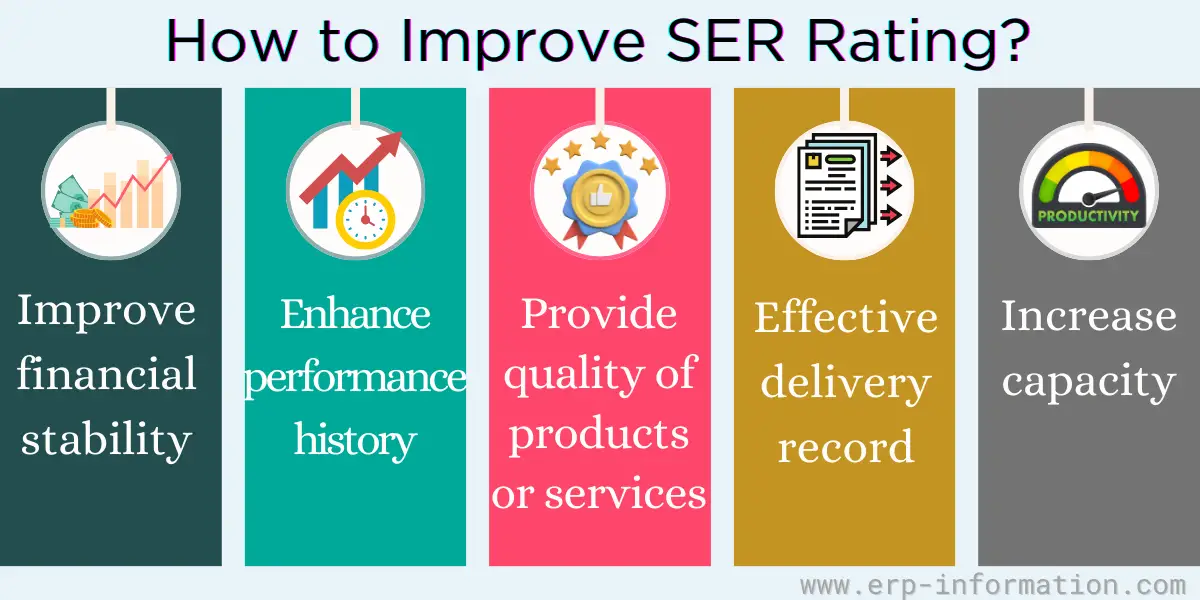
How to improve your SER Rating
If you are the supplier being scored, you cannot edit the rating, and no one can remove it for you. You can only change the data underneath it. In rough order of effect:
- Pay your own suppliers on schedule. Payment experiences are a named input, and they are among the few you control month to month.
- Clear suits, liens and judgments, and make sure anything already settled is recorded as settled.
- Keep your D and B file current and complete. A thin or stale file gives the model less evidence of a healthy business.
- Strengthen the balance sheet, since assets, liabilities and net profit are inputs. This is the slowest lever but the most durable one.
- Ask trade partners to report. More reported trade experiences mean a fuller payment history.
Treat this as a medium-term exercise. The rating reflects accumulated evidence, so a single good month will not move it.
How buyers should use the SER Rating
- Set a threshold, not a veto. Many teams flag 7 to 9 for review rather than automatic rejection, because a high score on a small or new supplier may reflect a thin file rather than genuine distress.
- Weight it by exposure. A rating of 6 matters far more for a sole-source critical component than for a commodity with ten alternatives.
- Monitor, do not just onboard. The value is in noticing a rating that moves the wrong way mid-contract.
- Pair it with a performance scorecard. SER covers viability. Quality, delivery and price need their own measurement.
- Ask before you act. A declining rating is a prompt for a conversation with the supplier, not a conclusion on its own.
Frequently asked questions
What is a SER score?
SER stands for Supplier Evaluation Risk. It is a Dun and Bradstreet score from 1 to 9 that estimates the chance a business will seek relief from creditors or cease operations within the next 12 months. A score of 1 is the lowest risk and 9 is the highest.
Is a high or low SER Rating better?
Lower is better. The scale runs from 1 to 9, with 1 representing the lowest risk of failure and 9 the highest. It runs the opposite way to PAYDEX, where a higher number is better.
What is a good SER Rating?
There is no official pass mark. Ratings of 1 to 3 sit at the low-risk end of the scale, and most buyers set their own threshold, commonly flagging 7 to 9 for review. The right cut-off depends on how exposed you are to that supplier.
Does the SER Rating measure delivery or product quality?
No. It is a financial failure model built on commercial data such as finances, payment experiences, and suits and liens. Delivery performance and product quality are not inputs, so they must be measured separately with a supplier scorecard.
How is the SER Rating different from PAYDEX?
PAYDEX scores past payment behaviour on a 1 to 100 scale, where 80 and above indicates low risk. The SER Rating forecasts the chance of the business failing within 12 months on a 1 to 9 scale. One looks backwards at payment habits, the other forwards at survival.
How do I improve my SER Rating?
You cannot change the rating directly, only the data behind it. Pay your own suppliers on time, resolve outstanding suits and liens, keep your Dun and Bradstreet file complete and current, and strengthen the balance sheet over time.
The short version
The SER Rating is a single digit from 1 to 9 that estimates whether a supplier will still be trading in a year, with 1 being the safest. Read it as a viability signal, weight it against how exposed you are to that supplier, and measure quality and delivery separately with a supplier rating method built for the job. Used that way it is a genuinely useful early warning. Used as a general supplier grade, it will mislead you.
Using Google Search? Add erp-information.com as a preferred source.