
A level production strategy keeps output at a constant rate in every period, no matter how demand rises or falls. Instead of speeding up and slowing down the factory, the company produces the same amount each month and lets inventory absorb the swings: stock builds up when demand is low and is drawn down when demand is high. It is one of the three core aggregate planning approaches, alongside the chase strategy and the hybrid strategy.
The trade is simple: you gain a steady workforce and smooth operations, and you pay for it by carrying more inventory. That makes level production a strong fit when demand is fairly predictable and the product can be stored.
Run the numbers for your own plan with our level production strategy calculator.
What is level production strategy?
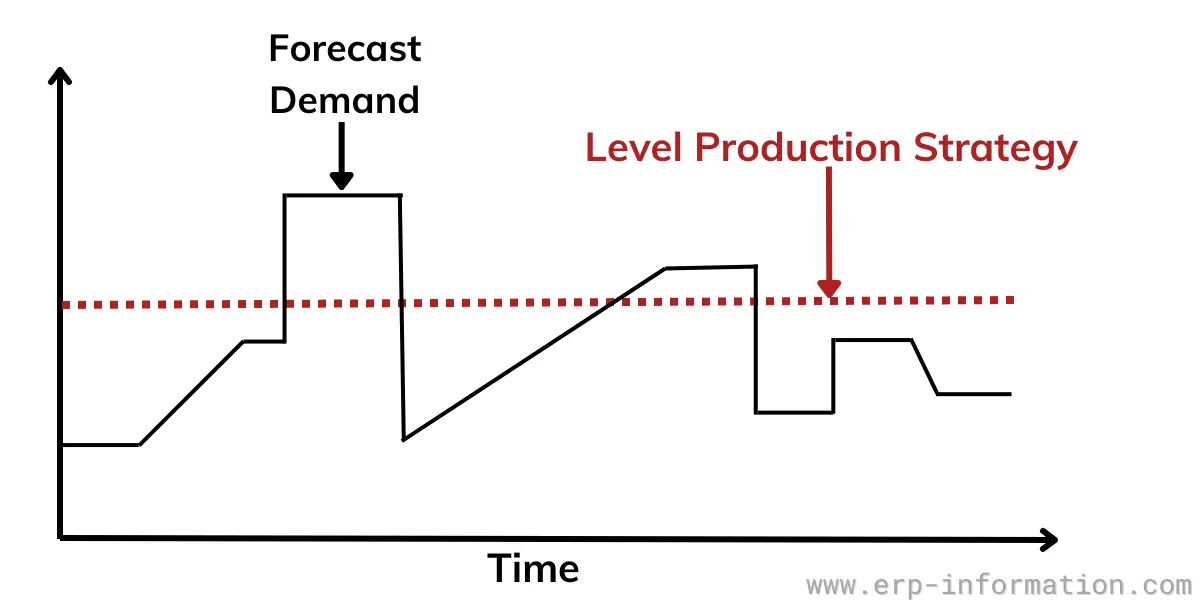
Level production strategy sets a single production rate, usually close to the average demand over the planning horizon, and holds it steady. The plant runs at the same pace through busy and quiet periods alike. Inventory becomes the shock absorber: in slow months the extra output goes into stock, and in peak months that stock is released to cover the gap between demand and the fixed production rate.
Because the rate never changes, the company avoids the churn of hiring, laying off, and retraining workers, and it keeps machines running at a consistent load. The cost of that stability shows up as higher average inventory and the storage, insurance, and cash tied up with it.
How does level production work?
Planning a level strategy comes down to three steps:
- Forecast total demand across the planning horizon, for example a full year or a season.
- Set one production rate that covers that demand, typically the average per period, and staff the line to hit it.
- Let inventory balance the difference each period. Produce the same amount every month, bank the surplus when demand is below the rate, and draw it down when demand runs above it.
The one thing to watch is cumulative demand. If early demand outruns cumulative production before inventory has built up, you get a stockout. Planners guard against this by starting with a buffer of finished stock or by setting the rate slightly above the plain average.
Level production formula
A handful of formulas turn a demand forecast into a level plan:
- Level production rate = Total demand ÷ Number of periods
- Workers required = Level production rate ÷ Units produced per worker
- Ending inventory = Beginning inventory + Production − Demand
- Production required = Total demand − Beginning inventory
The ending inventory of one period becomes the beginning inventory of the next, which is how the buffer carries stock from quiet months into busy ones.
Level production strategy example
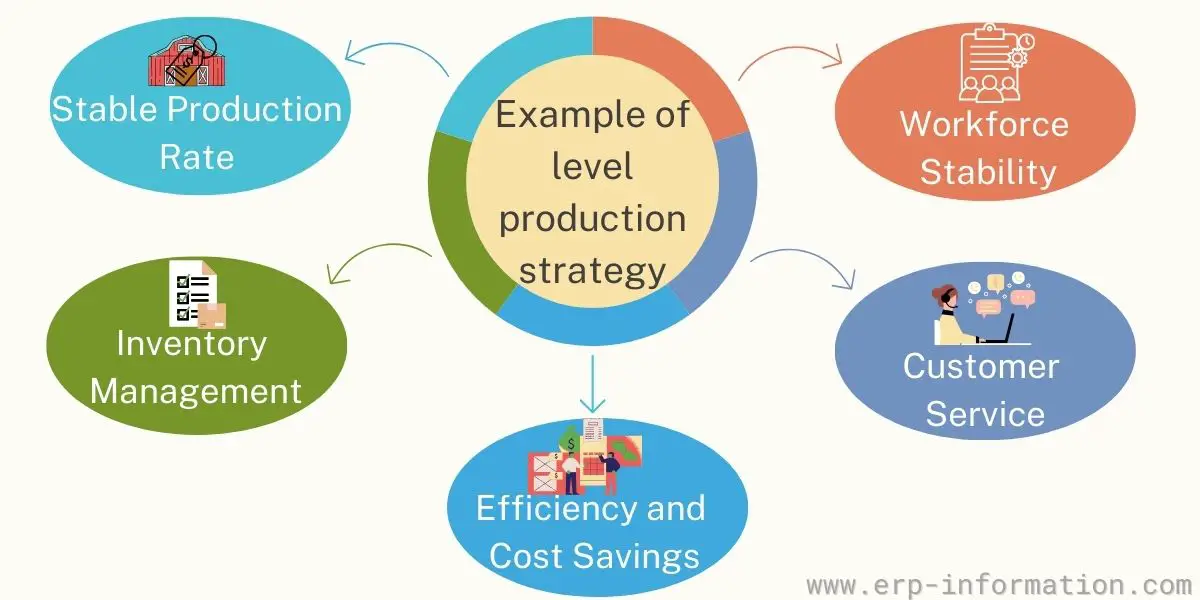
Take a bicycle manufacturer whose demand climbs through spring and summer and falls off in autumn. Over a six-month season the forecast looks like this, for a total of 3,600 bikes:
Level production rate = 3,600 ÷ 6 = 600 bikes per month. If one worker builds 120 bikes a month, the plant needs a steady 600 ÷ 120 = 5 workers for the whole season. Starting from zero inventory, here is how the plan plays out:
| Month | Demand | Production (level) | Change in stock | Ending inventory |
|---|---|---|---|---|
| 1 | 300 | 600 | +300 | 300 |
| 2 | 400 | 600 | +200 | 500 |
| 3 | 600 | 600 | 0 | 500 |
| 4 | 700 | 600 | −100 | 400 |
| 5 | 800 | 600 | −200 | 200 |
| 6 | 800 | 600 | −200 | 0 |
| Total | 3,600 | 3,600 |
Production never changes, yet every month’s demand is met. In months 1 and 2 the plant builds a cushion of 500 bikes; from month 4 onward that cushion is spent covering demand that runs above 600. The company holds a stable crew of five and a smooth line all season, and the price of that stability is the inventory carried in the middle months. Enter your own figures in the level production calculator to see the same table for your demand.
Level vs chase vs hybrid production strategy
Level production is one answer to seasonal demand. The chase strategy is the opposite approach, and the hybrid strategy sits between them. The difference is what each one holds constant and what it lets vary.
| Level strategy | Chase strategy | Hybrid strategy | |
|---|---|---|---|
| Production rate | Constant every period | Adjusted to match demand | Mostly steady, flexed at peaks |
| Inventory | Builds and draws down as a buffer | Kept as low as possible | Moderate |
| Workforce | Stable, no hiring or layoffs | Hire, lay off, or use overtime | Small, planned adjustments |
| Main cost | Inventory carrying cost | Hiring, firing, overtime, training | A balance of both |
| Best for | Predictable demand, storable goods | Seasonal or volatile demand, perishable goods | Most real operations |
In practice, few plants run a textbook level or chase plan. Most use a hybrid: they hold a steady base rate and add overtime or a temporary shift only for the sharpest peaks, which keeps both inventory and labor churn in check.
When to use a level production strategy
A level strategy earns its keep when the conditions favor holding stock over flexing the workforce:
- Demand is predictable. A reliable forecast keeps the fixed rate close to real need, so inventory neither piles up nor runs short.
- The product stores well. Goods that are cheap and safe to hold, such as canned food, bikes, or electronics, suit the buffer approach. Perishable or bulky items do not.
- Hiring and training are costly. When skilled labor is hard to find or expensive to train, a stable crew is worth the inventory it requires.
- Fixed costs are high. Running expensive equipment at a steady, high utilization spreads those costs over more units.
Factors to consider in level production
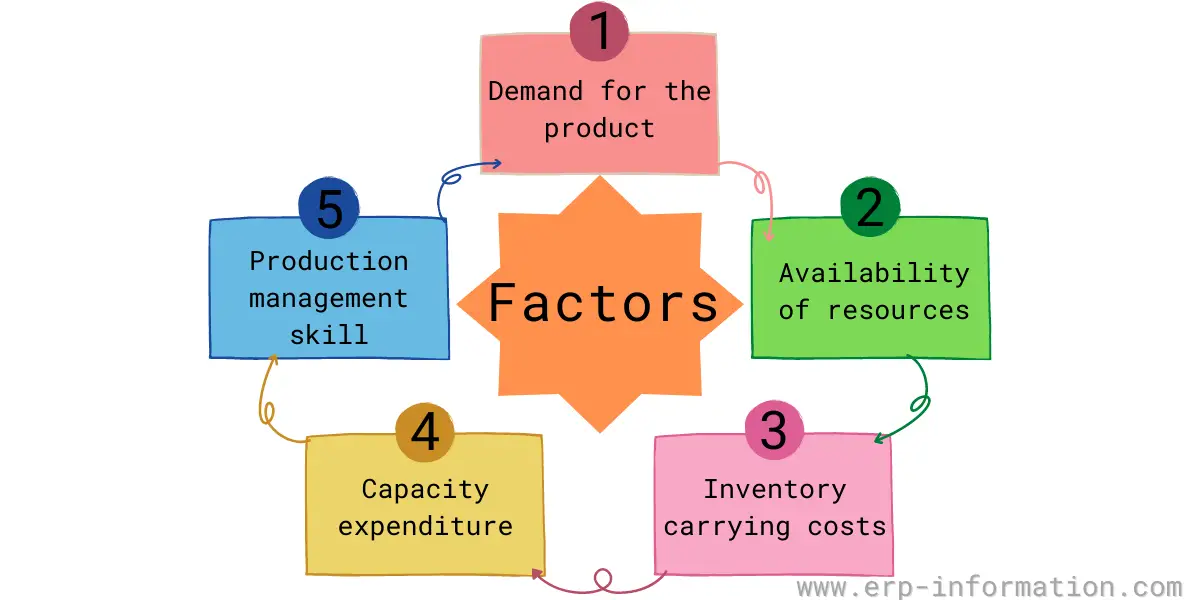
- Demand forecast: the plan is only as good as the forecast behind it. Set the rate too low and you risk stockouts; set it too high and you tie up cash in surplus stock.
- Resource availability: raw materials, labor, and capacity have to support the fixed rate every period, not just on average.
- Inventory carrying cost: storage, insurance, obsolescence, and tied-up cash all rise with the buffer, so weigh them against the savings from a stable workforce.
- Capital cost: the equipment and space needed to sustain the rate. You can size the outlay with our capital expenditure calculator.
- Production management: holding a steady rate while demand moves takes disciplined scheduling and skilled operators.
Advantages and disadvantages of level production
| Advantages | Disadvantages |
|---|---|
| Stable workforce, so no repeated hiring, layoffs, or retraining | Higher average inventory and the carrying cost that comes with it |
| Smooth, efficient operations and consistent product quality | Risk of stockouts if demand outpaces the fixed rate |
| Economies of scale from steady, high equipment utilization | Risk of overstock if demand falls short of the forecast |
| Simple to schedule and manage once the rate is set | Inflexible, and slow to respond to sudden shifts in the market |
FAQs
What is the difference between level and chase production strategy?
A level strategy holds production constant and lets inventory rise and fall to meet changing demand, which keeps the workforce stable but raises carrying cost. A chase strategy does the reverse: it changes production each period to match demand, holding little inventory but hiring, laying off, or using overtime to flex output. Level suits steady, storable demand; chase suits seasonal or perishable demand.
What are some level production strategy examples?
Industries with high fixed costs and fairly predictable demand lean on level production. Food and beverage processors run steady output of bread, milk, and cereal; automotive plants build a consistent number of vehicles each month; consumer electronics makers hold a fixed rate on phones, TVs, and laptops; and pharmaceutical firms manufacture drugs and vaccines at a constant pace. In each case the steady rate lowers unit cost and keeps supply reliable.
How is level production strategy helpful for fast-food chains?
Fast-food operations use level production to keep prep steady in a high-volume, low-margin setting. Staple items are made at a consistent pace tied to expected demand, which keeps a dependable supply on hand, uses staff and equipment evenly, cuts waste, and holds quality steady through the day. The result is lower cost per item and shorter waits at the counter.
How do you calculate the level production rate?
Divide total forecast demand by the number of periods in the plan. For 3,600 units over six months, the level rate is 3,600 ÷ 6 = 600 units per month. You produce that amount every period and let inventory absorb the difference between it and each month’s actual demand.
Conclusion
Level production trades higher inventory for a stable workforce and a smooth, predictable factory. It shines when demand is steady enough to forecast and the product can be stored, and it struggles when demand is volatile or the goods cannot sit in a warehouse. Weigh the carrying cost against the savings from a constant crew, compare it with the chase and hybrid approaches, and you will know whether holding your production rate flat is the right call for your operation.