Weather and climate hit business operations hard, from storm-related outages to supply-chain disruption and long-term climate risk. IBM Environmental Intelligence is IBM’s enterprise platform for turning weather, geospatial, and climate data into decisions.
IBM now markets it as “IBM Environmental Intelligence,” though its documentation and APIs still use the original name, Environmental Intelligence Suite (EIS); both refer to the same product. This review covers what it does, the big change after IBM sold The Weather Company, its AI, capabilities, pricing, competitors, and honest drawbacks.
What is IBM Environmental Intelligence Suite?
IBM Environmental Intelligence is a cloud platform that combines weather data, geospatial analytics, climate-risk analytics, and carbon and emissions data in one place. Businesses use it to plan around severe weather, assess the physical climate risk to their assets, and support sustainability reporting. It is delivered mainly through APIs, dashboards, maps, and alerts.
IBM launched it in 2021, built on data from The Weather Company, which IBM had owned since 2016.
| Vendor | IBM |
| Product | IBM Environmental Intelligence (documentation name: Environmental Intelligence Suite, EIS) |
| Launched | 2021 |
| What it does | Weather data, geospatial analytics, climate-risk analytics, and carbon and emissions data |
| Delivery | Cloud SaaS, via APIs, dashboards, maps, and alerts |
| Weather data | From The Weather Company (sold by IBM to Francisco Partners in 2024; IBM still licenses the data) |
| AI | watsonx, plus the IBM and NASA Prithvi geospatial foundation models |
| Related IBM products | Envizi (ESG reporting), Maximo (asset management) |
| Pricing | Enterprise, quote-based |
| Best for | Large, weather- and asset-exposed enterprises (utilities, agriculture, insurance, energy) |
| Website | ibm.com/products/environmental-intelligence |
The Weather Company sale: what changed
The most important recent change: in August 2023 IBM agreed to sell The Weather Company, including Weather.com, Weather Underground, and its data business, to the private-equity firm Francisco Partners, and the deal closed on February 1, 2024. The Weather Company now operates as an independent company.
Crucially, IBM kept Environmental Intelligence. Its announcement stated plainly that IBM would retain its sustainability software business, including EIS, and would continue to use The Weather Company’s weather data to feed it. So the consumer weather brands left IBM, while the enterprise Environmental Intelligence software stayed, now sourcing weather data from the newly independent Weather Company. For buyers, that ongoing dependence on a third party for core weather data is worth keeping in mind.
Benefits of Licensing
IBM environmental intelligence suite licensing provides usage-based licensing to select which one is useful for your organization. The table below provides details of different usage volumes with varying base components.
| Base components monthly | Base usage volumes (minimum) |
| Dashboard visualization and alerting | 100 dashboard locations 1000 alert assets 20000 alert emails |
| Geospatial analytics | 10000 query units 1.5 TB raster storage 250GB vector storage |
| Standard weather data API s | 1 million API calls |
| Premium weather data APIs | Not available |
| Development APIs | 1000 API calls per day for non-production use |
Pricing
Contact the vendor directly for pricing details. The pricing depends on the product options with industry-specific modules. Standard Suite Foundation is the basic product option. Other options are
- Standard Suite + Premium Weather Data APIs
- Standard Suite + Vegetation Management
- Standard Suite + Outage Prediction
- Standard Suite Foundation + Agriculture
- Standard Suite Foundation + Aviation
Major Capabilities
Carbon performance engine
This creates a system to manage environmental risks and track carbon emissions to meet sustainability goals.
This is a collection of six endpoints. Like stationary, fugitive, and mobile emissions, location-based, market-based, distribute, and transport emissions to meet GHG protocol. These can be alternatives for scope three emission outputs.
Benefits
- AI-driven augmentation capacity to handle the data and natural language processing.
- Fast-tracking the transformation of emission data to carbon equivalents with the help of APIs.
- It is automatically updating the data for customers.
Outage prediction
Predicting the weather-related loss of power or power outages can be done using a Machine learning prediction model, which helps to take action to minimize the disturbance. This can immediately respond to weather-caused power outages.
Benefits
- More accuracy in prediction
- Intensify the customer experiences
- Quick restoration
Regenerative agriculture
There is a requirement to meet consumer demand in the agricultural field, so there is a need to increase agricultural production. In addition, it will help maintain food’s nutritional quality.
Digital transformation has given a good platform to increase productivity. It combines AI, unique agricultural intelligence, the Internet of Things (IoT), data analytics, and predictive insights.
Benefits
- Increases the yield, increases the profitability
- Improved sustainability
- Quality production
IBM renewable forecasting
IBM Renewables Forecasting is a Global Business Services-led solution that uses AI and analytics to create forecasts for wind and solar farm assets.
This helps utility operators increase the integration of renewables into the grid while optimizing operational efficiencies, resiliency, and reliability.
Benefits
- Increases the renewable source utilization, e.g., Solar energy, wind energy
- Improve the solar and wind power forecast accurately.
Vegetation management
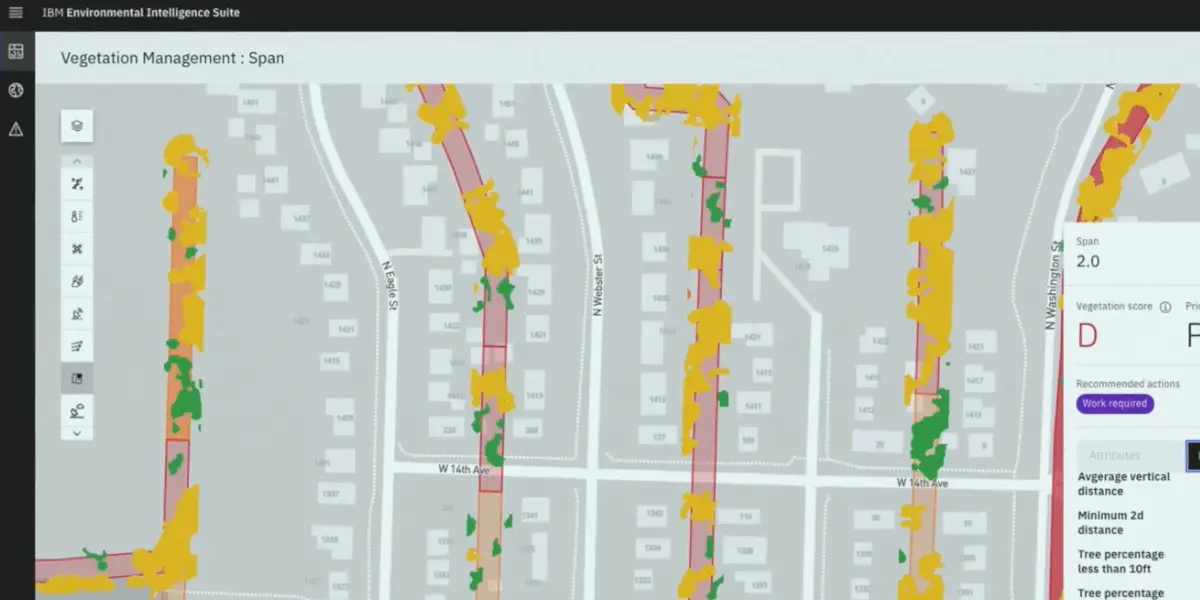
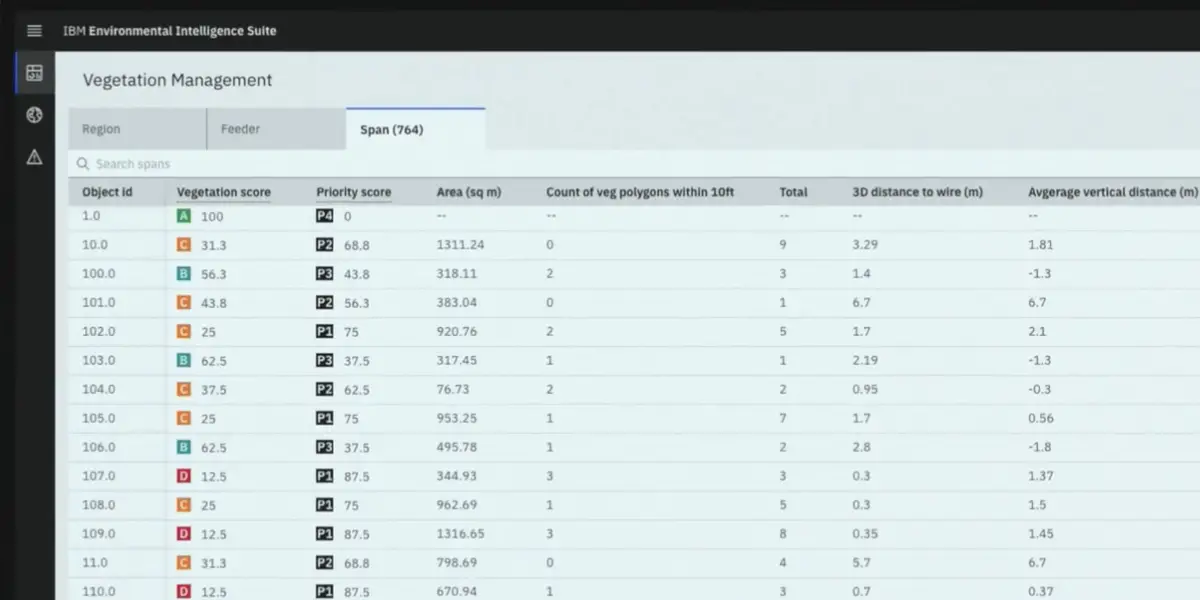
Vegetation Management is a program that uses artificial intelligence and analytics to check the state of vegetation across the entire service territory and identifies the high-risk circuits.
Benefits
- Automatically evaluate the vegetation overgrowth in all distance
- Identifies where vegetation threatens the powerline
- Cost-effective
Weather intelligence
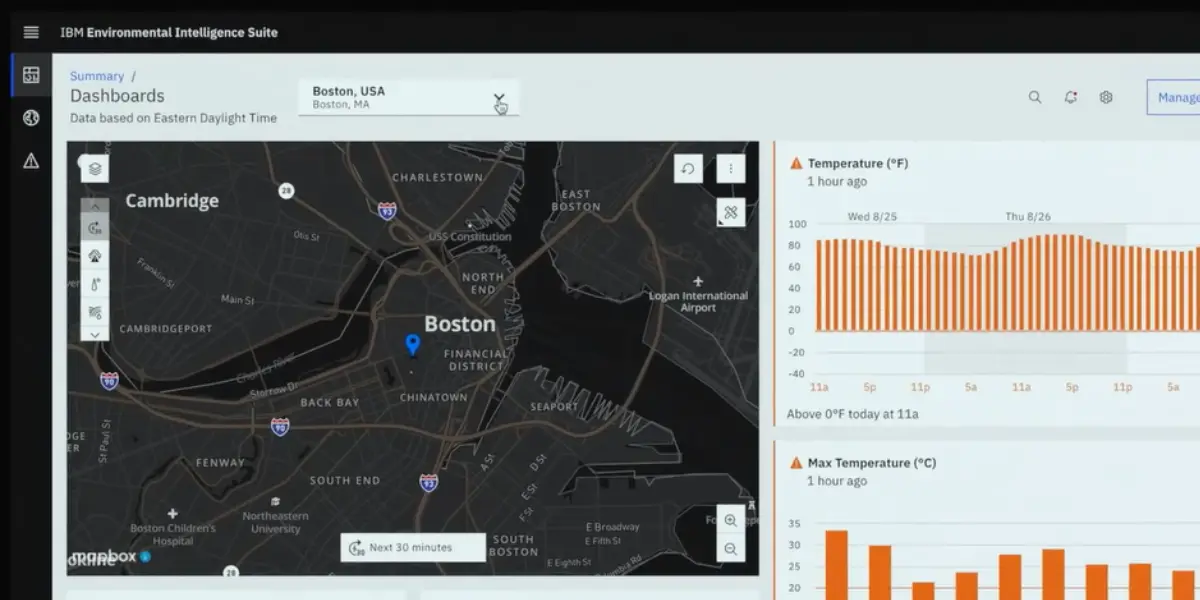
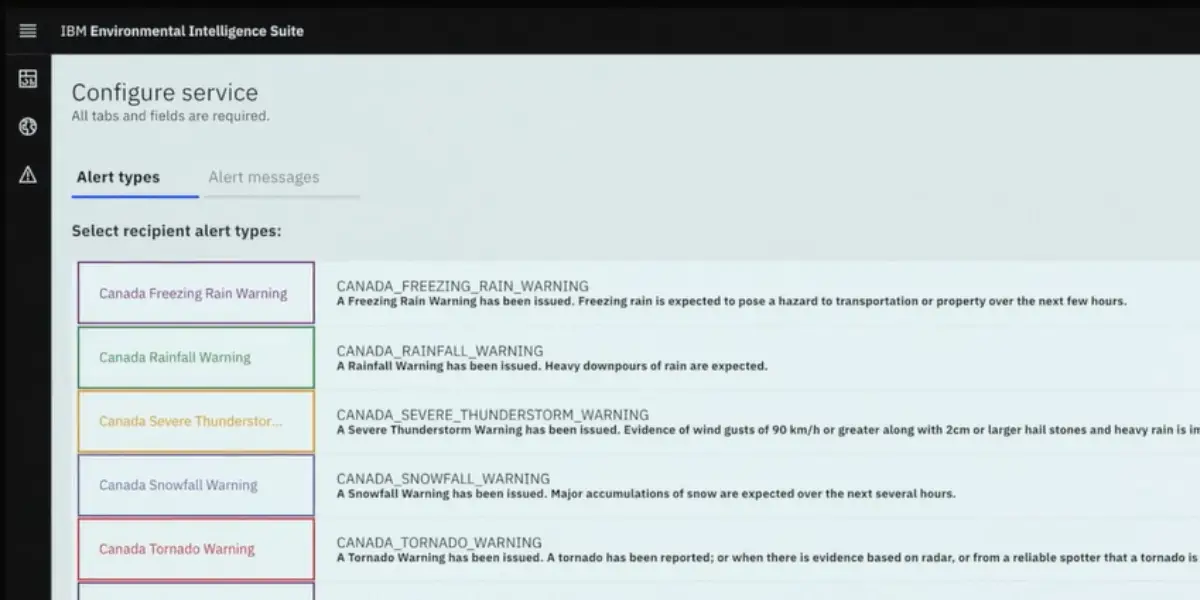
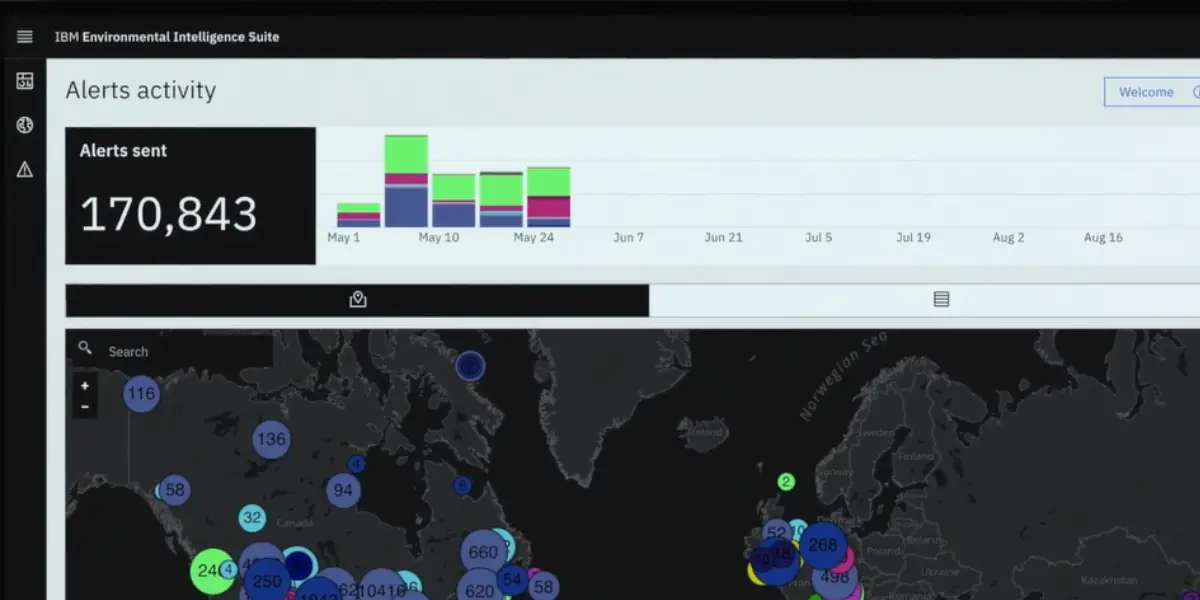
IBM’s Environmental Intelligence Suite has tools to help businesses make better decisions about the weather. That includes dashboard visualizations and powerful alerting capabilities.
Benefits
- Accurate weather forecast is possible with the integration of human and AI forecasts.
- Good user experience with mobile accessibility, intuitive dashboard, alerting, charts, etc
watsonx and AI in Environmental Intelligence
AI is central to the product. IBM feeds it with watsonx foundation models, including the Prithvi family of open geospatial and weather-climate models that IBM built with NASA. Those models power use cases such as flood and wildfire mapping, crop and infrastructure climate-risk estimates, and monitoring forest carbon projects. IBM has also added watsonx features that connect environmental risk to asset and maintenance work.
How EIS fits with IBM Envizi and Maximo
Environmental Intelligence is one of three related products in IBM’s sustainability and asset portfolio, and buyers often confuse them:
- Environmental Intelligence (EIS) handles weather, geospatial, and climate-risk analytics.
- Envizi, which IBM acquired in 2022, is the ESG and sustainability data-management and reporting hub, supporting frameworks like CSRD. IBM now brands its climate-risk analytics as “Envizi Climate Risk Insights,” a sign it is consolidating the two.
- Maximo is IBM’s asset-management suite; EIS and Envizi feed weather and emissions data into asset operations.
Other information
| Deployment | Cloud SaaS, delivered via APIs, dashboards, and alerts |
| Best for | Mid-size to large enterprises and government, in weather- and asset-exposed sectors |
| AI | watsonx foundation models, including IBM and NASA’s Prithvi geospatial models |
| Related products | IBM Envizi (ESG reporting), IBM Maximo (asset management) |
| Support | Enterprise support (business hours and online) |
Drawbacks
- Enterprise-only and API- and integration-heavy: it is built for data teams, not quick self-serve use.
- Quote-based pricing with no clear public rates, so budgeting is hard up front.
- IBM’s overlapping products (EIS versus Envizi climate risk) can make it hard to tell which one you need.
- Core weather data now comes from the third-party-owned Weather Company, an external dependency.
- Reviewers note a learning curve, with tutorials needed to get going.
Alternatives
- Weather and climate-risk data: Tomorrow.io, DTN (WeatherSentry), AccuWeather, and The Weather Company itself (now independent)
- Physical climate-risk analytics: Jupiter Intelligence, One Concern, and Understory
- ESG, carbon, and sustainability (closer to IBM Envizi): Watershed, Persefoni, Sphera, and Manifest Climate
Conclusion
IBM Environmental Intelligence is a strong fit for large, weather- and asset-exposed organizations, especially in utilities, agriculture, insurance, and energy, that want to combine weather, geospatial, and climate-risk data with their operations and are already invested in IBM’s stack. Its AI depth (watsonx and the Prithvi models) and breadth of data are real strengths.
The trade-offs: it is an enterprise, API- and integration-heavy platform with quote-based pricing, so it is not a quick self-serve tool; IBM’s overlapping products can confuse buyers; and its core weather data now comes from a third-party-owned Weather Company. If you mainly need ESG and carbon reporting rather than weather and geospatial analytics, IBM Envizi or tools like Watershed and Persefoni may fit better.
Reference
Learn more about IBM Environmental Intelligence Suite
Frequently asked questions
What is IBM Environmental Intelligence Suite?
It is IBM’s enterprise cloud platform that combines weather data, geospatial analytics, climate-risk analytics, and carbon and emissions data. IBM now markets it as IBM Environmental Intelligence, while its documentation still calls it Environmental Intelligence Suite (EIS). It is delivered through APIs, dashboards, maps, and alerts.
Did IBM sell Environmental Intelligence with The Weather Company?
No. IBM sold The Weather Company (Weather.com, Weather Underground, and its data business) to Francisco Partners, announced in August 2023 and closed in February 2024, but it kept Environmental Intelligence. IBM continues to license The Weather Company’s weather data to feed the product.
What is the difference between IBM EIS and IBM Envizi?
They are separate but related products. Environmental Intelligence handles weather, geospatial, and climate-risk analytics, while Envizi (which IBM acquired in 2022) is the ESG and sustainability data-management and reporting hub. IBM has started consolidating climate risk under the Envizi brand.
How much does IBM Environmental Intelligence cost?
IBM does not publish a definitive public price; it is enterprise, quote-based, and licensed by usage and modules. Specific monthly tier prices that appear on some aggregator sites are unverified, so contact IBM for a quote.
What are the alternatives to IBM Environmental Intelligence?
For weather and climate-risk data, alternatives include Tomorrow.io, DTN, and Jupiter Intelligence. For ESG and carbon reporting, closer competitors are IBM’s own Envizi, Watershed, Persefoni, and Sphera.