Order release is the step that turns a planned or newly created production order into a live order the shop floor may work on, so material can be issued and shop papers printed. The reversed phrase, release order, usually means something else: a purchase order called off against a contract, a carrier’s release of cargo, or an advertising instruction.
Which meaning you need depends on where you met the term. This guide covers each one from its own source. Those sources are ERP documentation from SAP, Microsoft, Oracle and Odoo, the US federal acquisition rules, the X12 and Odette EDI standards, carriers’ bills of lading, US and Indian customs notices, and the Government of India’s advertising policy.
Order release or release order? Six meanings
The table maps the common meanings. Find the row that matches where you saw the term, then jump to its section.
| Where you saw it | What is released | Name of the step or document |
|---|---|---|
| Manufacturing ERP | A production order, to the shop floor | Order release; status Released (SAP: REL) |
| MRP planning | A planned order, offset by lead time | Planned order release |
| Purchasing | Part of a contract or blanket agreement | Release order, call-off, blanket release, delivery order |
| Automotive and EDI | Quantities against a scheduling agreement | Delivery schedule, customer release (X12 830, 862) |
| Shipping and customs | Cargo from the carrier, port or customs | Delivery order, cargo release, Out of Charge |
| Indian government | An advertisement, or budget funds | Release Order (RO), Budget Release Order |
If you saw “Released” as a status on a shopping or courier tracking page, it is that company’s own label, and only its help pages define it. And in US criminal procedure, a release order is the order a judge issues when releasing a defendant before trial, with the conditions attached (18 U.S.C. 3142).
Where order release sits in production activity control
In production planning, order release is the first phase of shop floor control, also called production activity control. India’s IGNOU course on production management lists the phases as order release, order scheduling and order progress (IGNOU BME-012, Unit 12):
- Order release provides the documents needed to take the order through the factory. “The collection of the document is sometimes called the shop packet.”
- Order scheduling carries out dispatching: it produces a dispatch list showing which orders should be worked at each work center.
- Order progress monitors the status of orders, work in process and other signs of progress and performance.
The ASCM Supply Chain Dictionary defines order release as “The activity of releasing materials to a production process to support a manufacturing order.” It defines dispatching as “Selecting and sequencing available jobs to be run at individual workstations and assigning those jobs to workers.” (ASCM). The order of the phases matters: dispatching can only sequence orders that have already been released, so an urgent order still waiting for release is invisible to the shop floor.
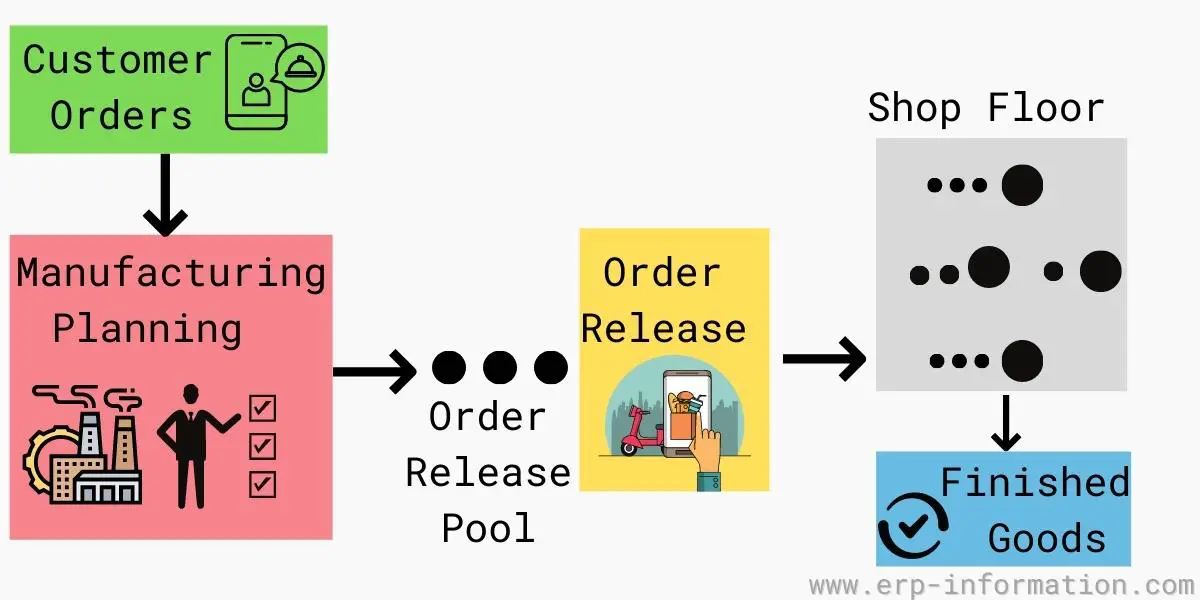
What happens when a production order is released?
Every ERP records release as a status change, and the change unlocks work. SAP states it directly: “A production order must be released, before it can be processed.” A new SAP order has the status CRTD. Until it is released, confirmations cannot be entered, shop floor papers cannot be printed and goods cannot be issued or received against it. “Releasing the order lifts these restrictions.” (SAP Help)
| System | Status before and after release | What release allows |
|---|---|---|
| SAP S/4HANA | CRTD (created) to REL; PREL if only some operations are released | Goods movements, confirmations, printing shop floor papers |
| Microsoft Dynamics 365 | Created, Estimated, Scheduled to Released | Production can begin; pick lists and job cards can be printed |
| Oracle | Unreleased to Released | Transactions against the job or work order |
| Odoo 19 | Draft to Confirmed (no separate release step) | Stock rules and component reordering are triggered |
SAP S/4HANA
- Header or operation. Releasing at header level gives the order and all its operations the status REL. Releasing single operations gives the order PREL, and “An operation can only be released if the preceding operation has been released.”
- Automatic or collective. The production scheduling profile can release orders automatically when they are created, and the CO05N app releases many orders at once (SAP Help).
- Checks at release. SAP can check the availability of material, capacity and production resources and tools when the order is released. The result goes into the release log, and a missing component sets the status “missing part” in the order header (SAP Help). The capacity check looks at every operation and its work center, including the load from other orders.
Microsoft Dynamics 365 Supply Chain Management
A production order moves through Created, Estimated, Scheduled, Released, Started, Reported as finished and Ended. Microsoft says you release the order when the schedule is finished and the material is available, and “When the production order is released, the status of the order changes to indicate that the production can begin.” Release can print pick lists, job cards and route cards, and can send the BOM lines to warehouse management. It can also physically reserve materials if the item model group is set up that way (Microsoft Learn).
Oracle and Odoo
In Oracle E-Business Suite, a Released job can be transacted against and its quantity moves to the queue of the first operation. An Unreleased job can be updated but not transacted against (Oracle EBS 12.2). Oracle Fusion uses the same Unreleased and Released statuses for work orders (Oracle Fusion). Odoo 19 has no release step at all: a manufacturing order goes from Draft to Confirmed, and confirming it triggers the stock rules and the reordering of components (Odoo 19 source).
Once released, the manufacturing order becomes an open order. In MRP terms, its quantity stops being a planned order receipt and becomes a scheduled receipt.
Order release process
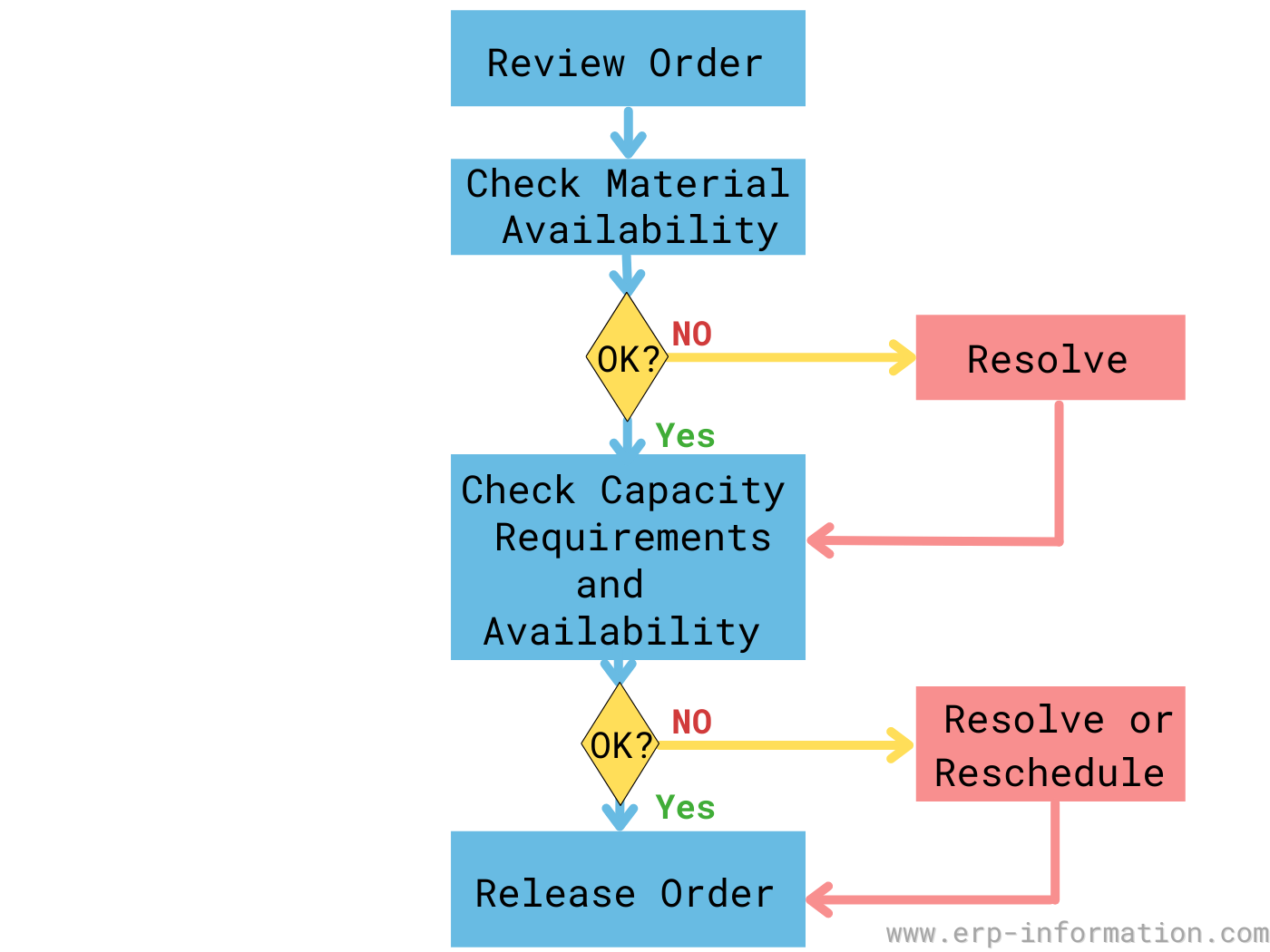
The flowchart shows the decision a planner makes for each order. It follows the checks SAP and Microsoft run at release:
- Review the order. Confirm the quantity, due date and routing.
- Check material availability. If components are short, resolve the shortage first. In SAP, a missing component is flagged as a missing part in the order header.
- Check capacity. Compare the order’s operations with the load already on each work center. If there is not enough capacity, resolve it or reschedule the order.
- Release. The status changes, shop papers print, and material can be issued.
For how capacity is planned before release, see capacity requirements planning and the master production schedule.
Order release management
Order release management is the policy that decides when orders are allowed onto the shop floor. The simple policy releases each order on its planned release date. The alternative, known in research as workload control, keeps orders in a pool and releases them only when the shop can absorb them. One review describes it: “orders are held back in a pre-shop pool and input to the shop floor is regulated in accordance with workload limits or norms.” (Lancaster University review)
Releasing too early and too late both cost you
Release too early and work waits on the floor instead of in the pool. A study of order release puts it simply: “If a job is released too early, it often has to wait in front of the station.” (Lancaster University). Queues lengthen, and because average throughput time equals work in process divided by output rate, more work on the floor means longer lead times (Hamburg University of Technology).
Release too late and the shop runs dry. The same Hamburg paper warns that setting work in process too low “leads to interruptions in the material flow and thus to costly losses in capacity utilisation and productivity.”
Control the workload, not just the dates
Under workload control, the release rule is explicit: “A job is released if the new workload at each work center in the job’s routing is below its workload norm; otherwise, the job is retained in the pre-shop pool.” (Thürer et al.). In one simulation study, controlled release cut shop flow time by about 32% compared with releasing every order immediately. Total time in the system fell only about 12%, because orders waited in the pool instead (University of Minho). The same idea underlies input and output control: input to a work center should match what it can actually produce.
What is planned order release in MRP?
In material requirements planning, “planned order release” is a row in the MRP grid, not a status. ASCM defines it as the quantity derived from planned order receipts by offsetting them by the lead time. The planned order receipt is when the material should arrive; the planned order release is when the planned order must be launched for it to arrive in time (ASCM).
A University of Houston operations text gives the example: “The planned order receipt of 300 units in week 3 must be released in week 2 since the leadtime is 1 week.” (Gardner). ASCM adds that planned order receipts differ from scheduled receipts because they have not been released yet. When the planner acts on the planned order release, it becomes a real order, and that is the order release described above. For how these rows are calculated, see net requirements.
What is a release order in purchasing?
In purchasing, a release order is an order placed against an agreement that already exists. The buyer negotiates price and terms once, in a contract or blanket agreement, then releases quantities as they are needed. In SAP’s words, a contract is an outline purchase agreement “against which release orders (releases) can be issued for agreed materials or services as and when required during a certain overall time-frame.” (SAP Help)
SAP notes that outside its system these are also called blanket releases, contract releases, call-off orders or call-offs. To create one you need only the contract number, the quantity and the delivery date; the price, vendor data, payment terms and instructions are copied from the contract (SAP Help). A quantity contract is fulfilled when the releases reach the agreed quantity, and a value contract when they reach the agreed value. Our released value and quantity calculator tracks how much of a contract is left.
| System or rulebook | The agreement | The release |
|---|---|---|
| SAP S/4HANA | Quantity or value contract | Contract release order |
| Oracle E-Business Suite | Blanket purchase agreement; planned purchase order | Blanket release; scheduled release |
| Oracle Fusion | Blanket purchase agreement | Purchase order release |
| Microsoft Dynamics 365 | Sales agreement; purchase agreement | Release order action (sales); purchase order applying the agreement |
| Odoo 19 | Blanket order | Quotation or purchase order created from it |
| US federal FAR | Delivery-order or task-order contract; blanket purchase agreement | Delivery order; task order; order under the agreement |
Oracle describes the same idea: “You can issue a blanket release against a blanket purchase agreement to place the actual order” (Oracle EBS). Oracle Fusion can stop a release that would exceed the agreement line’s limit. Dynamics 365 has a Release order action that creates a sales order from a sales agreement (Microsoft Learn). Its older AX 2012 documentation, now archived, defined a purchase release order as a purchase order released from a purchase agreement (Microsoft, archived). In US federal buying, the equivalent is the delivery order: “Delivery order means an order for supplies placed against an established contract or with Government sources.” (FAR 2.101)
Release as approval: purchase requisition release
“Release” has a second meaning in purchasing: approval. SAP’s release procedure routes a purchase requisition or purchase order for sign-off when it meets conditions such as a value limit, with up to eight release codes in a release strategy. SAP itself says that in both uses, releasing is like giving the green light to go ahead (SAP Help).
What is a customer release? Delivery schedules and EDI
In automotive supply, a “customer release” is the customer’s instruction to ship quantities against a long-running agreement. Odette, the European automotive standards body, explains that purchase orders in that industry set up framework contracts, and actual delivery requirements are sent separately, usually as EDI messages (Odette).
SAP calls the agreement a scheduling agreement. On the sales side, “The customer sends in sales scheduling agreement releases, referred to as delivery schedules, at regular intervals to release a quantity of the material.” (SAP Help). On the purchasing side, SAP says one delivery schedule can replace a large number of separate purchase orders or contract release orders (SAP Help).
| Message | What it carries | SAP equivalent |
|---|---|---|
| X12 830 Planning Schedule with Release Capability (EDIFACT DELFOR, Odette DELINS) | Forecast quantities; can also authorize shipments | Forecast (FRC) delivery schedule |
| X12 862 Shipping Schedule (EDIFACT DELJIT) | Precise, near-term shipping requirements | JIT delivery schedule |
The X12 830 can be a simple forecast, a forecast that commits the supplier to resources, or a forecast that is also an order release. X12 notes that “the order release capability eliminates the need for discrete generation of purchase orders.” The 862 supplements the 830 with daily rather than weekly requirements (X12).
What is a release order in shipping and customs?
In shipping, cargo release is, in Maersk’s words, “the authorization process of getting goods that have arrived at a port or terminal to be released to the importer or consignee.” The goods must also be cleared by customs at the destination before they can be released (Maersk). How the carrier releases them depends on the transport document:
- Original bill of lading. The consignee presents an original bill of lading. MSC’s terms say “one original Bill of Lading, duly endorsed must be surrendered by the Merchant to the Carrier (together with outstanding Freight and charges) in exchange for the Goods or a Delivery Order.” (MSC bill of lading terms)
- Telex or express release. The shipper surrenders the original bill of lading at the port of loading, and the carrier sends the release details to the destination, so the consignee does not need the paper original.
- Sea waybill. It is not a document of title, and the carrier delivers on proof of the consignee’s identity, after freight and charges are paid (MSC sea waybill terms).
The delivery order is the document the carrier hands over at the destination: “A delivery order is a physical document released by Maersk at the destination port to the consignee or their agent.” For air cargo, the Montreal Convention gives the consignee the right to delivery on arrival once the charges are paid (Montreal Convention).
United States: CBP cargo release
US customs law defines an entry as the data filed with CBP to secure the release of imported merchandise from CBP custody. Any release before liquidation is a conditional release (19 CFR 141.0a), and liquidation is “the final computation or ascertainment of duties” (19 CFR 159.1). In the ACE system, “A 1C message is issued to signify that CBP has cleared cargo and it is admissible to leave the port.” (CBP)
India: delivery order, Out of Charge and gate pass
Indian customs notices describe the import sequence at a port or container freight station (CFS):
- The importer or customs broker pays the shipping line or consol agent the freight and delivery order (DO) charges, and the line sends the DO to the custodian (JNCH Facility Notice 85/2015).
- Customs permits clearance for home consumption once duty and charges are paid (Customs Act, 1962, section 47), and the order can be made electronically (Customs Act). In customs practice this clearance is called Out of Charge (OOC) (Bengaluru Customs).
- The custodian verifies the DO, obtains Out of Charge from customs and issues a gate pass. “However, the CFS shall release the cargo only after production of Delivery Order.” (JNCH Public Notice 65/2012)
Release order in India: advertising and budgets
In India, “release order” also has two common government meanings.
Release Order (RO) in advertising
The Central Bureau of Communication (CBC), set up in December 2017 by merging the Directorate of Advertising and Visual Publicity (DAVP) and other units (CBC), places government advertisements in newspapers. Its print policy, written when the body was called BOC, says “Advertisements to publications will be released by BOC through a Release Order (RO).” It adds: “No publication will publish BOC advertisement without receipt of the relevant Release Order.” Publications must bill against the RO within 30 days of publication (CBC print media policy 2020).
A CBC procedure document dated December 2025 defines a release order as a formal instruction to a publication stating when and where an advertisement must appear, including its size and placement (CBC procedure). The Hindi version of the policy keeps the English term: रिलीज़ ऑर्डर (आरओ) (CBC Hindi policy).
Budget Release Order (BRO)
In state finance, a Budget Release Order authorizes a department to spend a stated sum from its budget. Andhra Pradesh’s 2026-27 guidelines say issuing the release order “is a prerequisite to incur the expenditure”. They also cap the share of a budget head that can be provided by the end of each quarter (AP Finance Department). This example is from Andhra Pradesh; for another state, check that state’s finance department.
What does a release order form contain?
There is no single release order form; what the document contains depends on the meaning:
- Purchasing release. The contract or agreement number, the quantity, and the delivery date. Price and terms come from the agreement. SAP’s release documentation records each release’s number, date, quantity and value (SAP Help).
- Production order release. Not a separate form: the order’s status changes and the shop papers print, such as pick lists, job cards and route cards.
- Shipping delivery order. Issued by the carrier or its agent to the consignee at the destination, after the bill of lading and charges are settled.
- Advertising RO in India. Which publication, when and where the advertisement appears, its size and placement, and the campaign’s emphasis and target readers.
If you are drafting a purchasing release, it only needs what changes from one call-off to the next, such as the quantity and date: SAP copies the price and terms from the contract automatically (SAP Help).
FAQs
What is the meaning of release order?
It depends on the context. In purchasing, a release order is a purchase order issued against an existing contract or blanket agreement, calling off part of the agreed quantity or value. In shipping, it is the carrier’s authorization, usually a delivery order, to hand cargo to the consignee. In Indian government advertising, a Release Order (RO) is the instruction to a publication to carry an advertisement.
What is the difference between order release and a release order?
Order release is a step in production planning: a production order is released so the shop floor can start work, issue material and print shop papers. A release order is a document: a call-off against a purchasing contract, a cargo release from a carrier, or an advertising release order.
What does Released mean on a production order?
It means the order is authorized for production. In SAP S/4HANA a new order has the status CRTD and cannot have goods movements, confirmations or printed shop papers until it is released to REL. In Microsoft Dynamics 365 the Released status indicates that production can begin.
What is a release order in shipping?
It is the carrier’s authorization to hand imported cargo to the consignee, usually given as a delivery order. With an original bill of lading, one original must be surrendered and freight paid first. With a sea waybill or a telex release, no paper original is needed at destination. Customs must also clear the goods.
What is a release order (RO) in advertising?
In India, it is the order the Central Bureau of Communication issues to a newspaper or other publication to carry a government advertisement, stating when and where it appears and its size. Its policy says no publication will publish the advertisement without the release order, and bills must be submitted against it within 30 days.
What is the difference between planned order release and planned order receipt?
In MRP, the planned order receipt is the quantity planned to arrive in a period, and the planned order release is the same order launched earlier by its lead time. With a one-week lead time, a receipt needed in week 3 is released in week 2.
Which meaning of release order applies to you?
- On a production order in your ERP: release means the order may start. Check material and capacity first, and keep orders in a pool if the shop is already loaded.
- On a purchase order or contract: it is a call-off against an agreement. Check that the release stays within the agreed quantity or value.
- From a supplier or customer in automotive: it is a delivery schedule against a scheduling agreement, usually an X12 830 or 862 message.
- From a shipping line or port: it is the cargo release. Settle the bill of lading and charges, get the delivery order and customs clearance.
- From a government department in India: it is either an advertising RO from CBC or a budget release order from the finance department.
For the customer-facing side of orders, see our guide to customer orders.
How we researched this page (checked 14 October 2026). Production release facts come from SAP S/4HANA 2025, Microsoft Dynamics 365, Oracle and Odoo 19 documentation, the ASCM dictionary and peer-reviewed workload control research. Purchasing and EDI facts come from SAP, Oracle, Microsoft, Odoo, the FAR, X12 and Odette. Shipping and customs facts come from Maersk and MSC, US federal regulations and CBP, and Indian customs notices; the advertising and budget meanings come from CBC and the Andhra Pradesh Finance Department. An earlier version of this page described only production release, mixed it with customer order confirmation and shipping, said design work stops without a release order, and showed a software release management diagram as order release management. All are corrected.
References
- SAP S/4HANA 2025: Order release (production orders)
- SAP S/4HANA 2025: Release production orders (CO05N)
- SAP S/4HANA 2025: Availability check in shop floor control
- Microsoft Learn: Production process overview (Supply Chain Management)
- Oracle E-Business Suite 12.2: Discrete job statuses
- Oracle Fusion 26D: How you manage work order statuses
- Odoo 19 source code: manufacturing order states
- IGNOU BME-012, Unit 12: Shop floor control
- ASCM Supply Chain Dictionary, 20th edition
- University of Houston, Gardner: Material requirements planning
- Lancaster University: Workload control review
- Thürer et al.: Pool sequencing and order release (Lancaster University repository)
- University of Minho: Order release simulation study
- Lancaster University: Order release timing paper
- Hamburg University of Technology: WIP and throughput time
- SAP S/4HANA 2025: Contracts
- SAP S/4HANA 2025: Contract release orders
- SAP S/4HANA 2025: Scheduling agreements (purchasing)
- SAP S/4HANA 2025: Sales scheduling agreements
- SAP S/4HANA 2025: Release procedure for purchasing documents
- Microsoft Learn: Purchase agreements
- Microsoft Learn: Sales agreements
- Microsoft Dynamics AX 2012: Create a purchase release order (archived)
- Oracle E-Business Suite 12.2: Purchase order types and releases
- Oracle Fusion 26D: Purchase orders and purchase agreements
- Oracle Release Management glossary
- Odoo 19: Blanket orders
- FAR 2.101: Definitions (delivery order, task order)
- FAR 16.501-1: Indefinite-delivery contracts, definitions
- FAR 13.303-1: Blanket purchase agreements
- X12: Transaction sets (830, 862)
- Odette: Ordering process
- Maersk: Cargo release explained
- MSC: Bill of lading terms and conditions
- MSC: Sea waybill terms and conditions
- Montreal Convention 1999 (EUR-Lex)
- 19 CFR 141.0a: Definitions (eCFR)
- 19 CFR 159.1: Liquidation defined (eCFR)
- CBP: ACE frequently asked questions
- Customs Act, 1962 (India), section 47
- Jawaharlal Nehru Custom House: Facility Notice 85/2015
- Jawaharlal Nehru Custom House: Public Notice 65/2012
- Bengaluru Customs: Standing Order 03/2023 (Out of Charge)
- Central Bureau of Communication: Print Media Advertisement Policy 2020
- Central Bureau of Communication: Standard operating procedure for bill processing
- Central Bureau of Communication: FAQ
- Central Bureau of Communication: Print media policy (Hindi)
- Andhra Pradesh Finance Department: BE 2026-27 CBRO guidelines
- 18 U.S.C. 3142: Release or detention of a defendant pending trial
Using Google Search? Add erp-information.com as a preferred source.