Planned cost is the cost you expect to incur before the work is done: planned quantities of materials, labour and overhead multiplied by planned prices and rates. For a product it is usually called the standard cost; in a project it is the planned value. Compare it with actual cost only after scaling it to the output you actually achieved.
Skipping that last step is a common mistake. In the two worked examples below, a production order that looks 17.8% over plan turns out to be 1.8% under, and a project that looks under budget is in fact over budget and behind schedule.
Calculate Actual Cost Using Our Actual Cost Calculator Online
About this video (note added 17 October 2026): it was made in January 2023 and repeats mistakes this page has since corrected. A product’s planned cost includes production overhead, not only direct materials and labour (0:54, 2:10 and 5:05). Actual cost does not add sunk costs (2:16). In earned value management, cost variance is earned value minus actual cost, not planned cost minus actual cost (3:52). The 30% accuracy figure at 1:32 is given without a source.
Definition
CIMA, the management accounting body, defines a standard cost as “the planned unit cost of the product, component or service produced in a period” (CIMA Official Terminology). A project uses the same idea at a larger scale: the planned cost of the work scheduled to date.
In a manufacturing ERP the figure is built from the bottom up. SAP S/4HANA first determines the quantity structure, “being the BOM and routing”, then values the materials and activities with prices and adds overhead through a costing sheet (SAP Help, cost estimate with quantity structure).
The bill of materials gives the quantities; the routing and each work centre give the hours.
Planned cost per unit = (planned material quantity × planned price) + (planned labour hours × planned rate) + (planned activity × overhead rate)
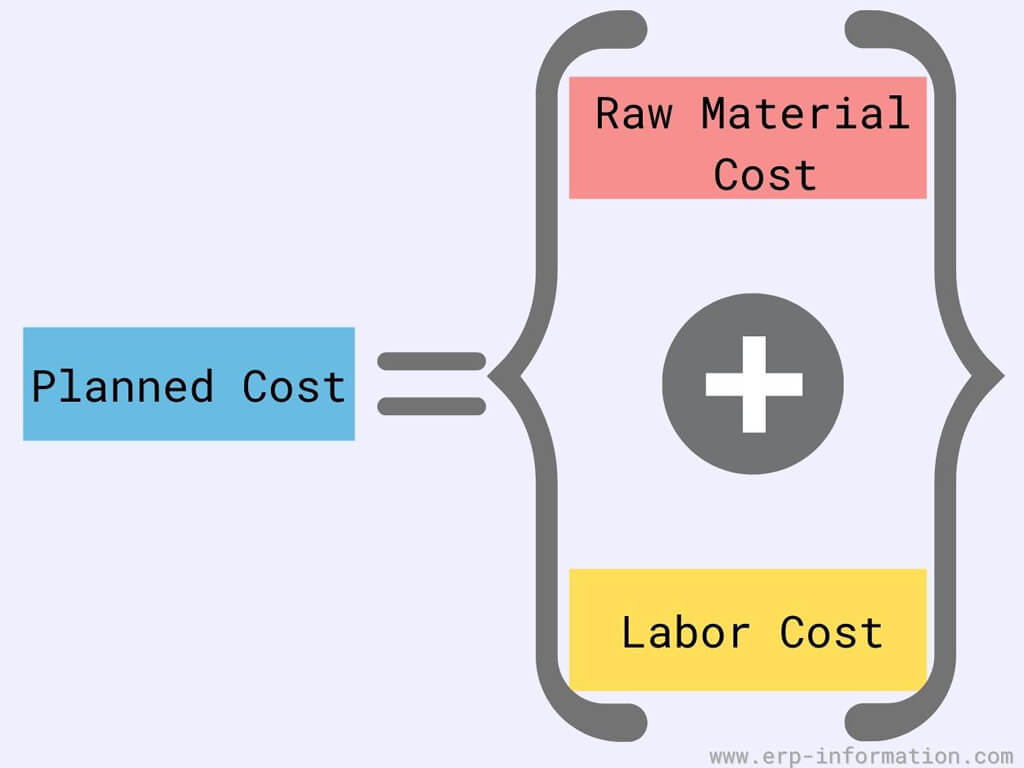
Overhead belongs in it. Under IAS 2, which Ind AS 2 repeats for India, conversion costs include “a systematic allocation of fixed and variable production overheads” (IAS 2 para 12, EU text of 8 March 2026; Ind AS 2).
Fixed overhead is spread over the normal capacity of the plant, and the amount per unit “is not increased as a consequence of low production or idle plant” (para 13).
For pricing, some systems go further: SAP’s example cost components include overhead for administration and for sales and distribution (SAP Help, cost components). IAS 2 keeps selling costs and administrative overheads that do not contribute to production out of the cost of inventory, along with abnormal waste and most storage costs (para 16).
What planned cost is used for
- Pricing and quoting: you know what a unit or a job should cost before you commit to a price.
- Valuing inventory: IAS 2 and Ind AS 2 say the standard cost method “may be used for convenience if the results approximate cost” (para 21). US GAAP sets the same condition: standard costs are acceptable if “adjusted at reasonable intervals to reflect current conditions” (ASC 330-10-30-12, as quoted by SEC staff).
- Judging production: SAP describes its product cost planning as the source of “Standards with which to assess production efficiency” (SAP Help).
- Controlling projects: planned value is the yardstick in earned value management, covered below.
| Where | Usual name | What it is |
|---|---|---|
| Product | Standard cost | Planned cost of one unit for a period |
| Production order | Planned cost, preliminary cost estimate | Planned cost of the order’s lot size |
| Project | Planned value (PV), or BCWS | Budget assigned to the work scheduled to date |
| Department or company | Budget | A plan for a period of time |
Planned cost principles
GAO, the US government’s audit office, says a reliable cost estimate has four characteristics (GAO Cost Estimating and Assessment Guide, GAO-20-195G, p. 184). They apply to a product’s planned cost as much as to a project budget:
- Comprehensive: it “includes all possible costs”, with none omitted or counted twice and the key assumptions written down.
- Well documented: it “can easily be repeated or updated and traced to original sources”.
- Accurate: each cost element is estimated with the best method for its data and adjusted for inflation.
- Credible: it has been tested with sensitivity and risk analysis, reconciled with an independent estimate and cross-checked with other methods.
GAO names three common ways to build the numbers: “analogy, engineering build-up, and parametric” (GAO-20-195G). An analogy starts from the cost of a similar job; an engineering build-up costs every piece at the lowest level and adds them up; a parametric estimate relates cost to one or more technical, performance or programme parameters.
CIMA adds that standards come either from past records or from engineering studies of the work, and that control works best when standards are set for the quantities of material, labour and services in each operation rather than for one total product cost (CIMA, standard costing and variance analysis).
Accounting standards set two more rules. Standards must reflect “normal levels of materials and supplies, labour, efficiency and capacity utilisation”, and they must be “regularly reviewed and, if necessary, revised in the light of current conditions” (IAS 2 para 21; Ind AS 2 para 21).
India’s AS 2, for companies not on Ind AS, requires results that “approximate the actual cost” (AS 2 para 18).
ERP systems hold the standard fixed between reviews. In SAP, releasing a standard cost estimate “can only be done once in a period” (SAP Help); Business Central keeps standard costs “frozen until a decision is made to change them” (Microsoft Learn).
Oracle tells you to “review the variance between actual transaction costs and the standard cost” and update the standard when needed (Oracle 26D).
Planned cost vs Actual cost
Actual cost is what the same output really cost: actual quantities at actual prices, plus the overhead actually incurred. Our guide to actual cost explains how it is built.
| Planned cost | Actual cost | |
|---|---|---|
| Known | Before the work starts | After the work is done |
| Built from | Planned quantities at planned prices | Actual quantities at actual prices |
| Overhead | Absorbed at a planned rate | Overhead actually incurred |
| In an ERP | Standard cost estimate or costing version | Goods issues, time confirmations, invoices |
| Used for | Prices, inventory at standard, the yardstick | Margins, variances, updating the standard |
The two can only be compared for the same output. If you planned 1,000 units and made 1,200, the 1,000-unit plan is the wrong yardstick, because every cost that varies with volume should have risen.
Textbooks call the corrected yardstick the flexible budget. OpenStax warns that comparing actual results with the original static budget “may be like comparing apples to oranges”, while a flexible budget allows “a comparison of apples to apples” (OpenStax, Principles of Managerial Accounting 7.4).
For cost variances, Open Cost Accounting takes the budgeted quantity from the flexible budget, never the static one (Open Cost Accounting, chapter 7).
ERP systems do the same thing for you. SAP calls the scaled plan the target cost: “The planned costs are adjusted to the actual costs by dividing the confirmed quantity by the planned quantity” (SAP Help, target costs), and “Variances are always calculated by comparing the target costs with the control costs” (SAP Help, target cost versions).
Microsoft says Dynamics 365 production variances “don’t reflect a comparison to the production order’s estimated costs”; they compare reported activity with the standard cost calculation (Microsoft Learn).
Worked example: one production order, two verdicts
Our calculation, in any currency. A product’s planned cost is 20.00 a unit: 2 kg of material at 3.00 (6.00), 0.5 labour hours at 20.00 (10.00) and overhead of 8.00 per labour hour (4.00). The plan was 1,000 units. The plant made 1,200.
| Cost | Plan, 1,000 units | Plan, 1,200 units | Actual, 1,200 |
|---|---|---|---|
| Materials | 6,000 | 7,200 | 7,378 |
| Labour | 10,000 | 12,000 | 11,682 |
| Overhead | 4,000 | 4,800 | 4,500 |
| Total | 20,000 | 24,000 | 23,560 |

- Against the original plan: 23,560 − 20,000 = 3,560 over, or 17.8%. It looks like a bad result.
- Against the plan for 1,200 units: 23,560 − 24,000 = −440, a favourable variance of 1.8%.
The split shows where the 440 came from:
- Material price: (3.10 − 3.00) × 2,380 kg = 238 unfavourable
- Material usage: (2,380 − 2,400 kg) × 3.00 = 60 favourable
- Labour rate: (19.80 − 20.00) × 590 hours = 118 favourable
- Labour efficiency: (590 − 600 hours) × 20.00 = 200 favourable
- Overhead: 4,800 absorbed against 4,500 incurred = 300 over-absorbed, favourable
- Total: 238 − 60 − 118 − 200 − 300 = −440, so 440 favourable
Price variances use the actual quantity; quantity variances use the planned price, measured against the quantity planned for the output achieved (2 kg × 1,200 = 2,400 kg).
SAP’s cloud edition uses the same structure for its input price and input quantity variances (SAP Help, variance categories in event-based posting). A price gap on bought-in material is the purchase price variance.
Why does actual cost differ from planned cost?
Every gap between planned and actual cost has a cause, and ERP systems label it. SAP assigns each variance to a category that names the cause (SAP Help, variance categories):
| Cause | SAP category | What happened |
|---|---|---|
| Price | Input price variance | Materials or activities cost more or less per unit than planned |
| Quantity | Input quantity variance | More or less material or machine time used than planned |
| Substitution | Resource-usage variance | Different materials or activities used than planned |
| Scrap | Scrap variance | More or less operation scrap than the routing planned |
| Lot size | Lot size variance | Setup and other fixed costs spread over a different quantity |
| Valuation | Output price variance | Output credited at a price other than the target |
Other systems use different names for the same causes. Dynamics 365 Supply Chain Management calculates lot size, production quantity, production price and production substitution variances (Microsoft Learn). Oracle Fusion Cloud adds resource efficiency, batch size and yield variances (Oracle 26D).
Odoo gives the everyday version: an operation takes longer than estimated, more components are needed, or component prices change (Odoo 20 documentation).
Some gaps come from the plan itself. If the bill of materials or routing on an order differs from the one used for the standard, SAP reports it separately as a planning variance (SAP Help, variance calculation).
Favourable or unfavourable: which sign means what?
Watch the sign. Accounting systems usually subtract the plan from the actual, so a positive variance is unfavourable: Business Central defines variance as actual cost minus standard cost (Microsoft Learn), and SAP’s target and actual comparison shows actual costs minus target costs (SAP Help).
Earned value does the opposite, as the next section shows: there a negative cost variance is the overrun.
Earned value management system
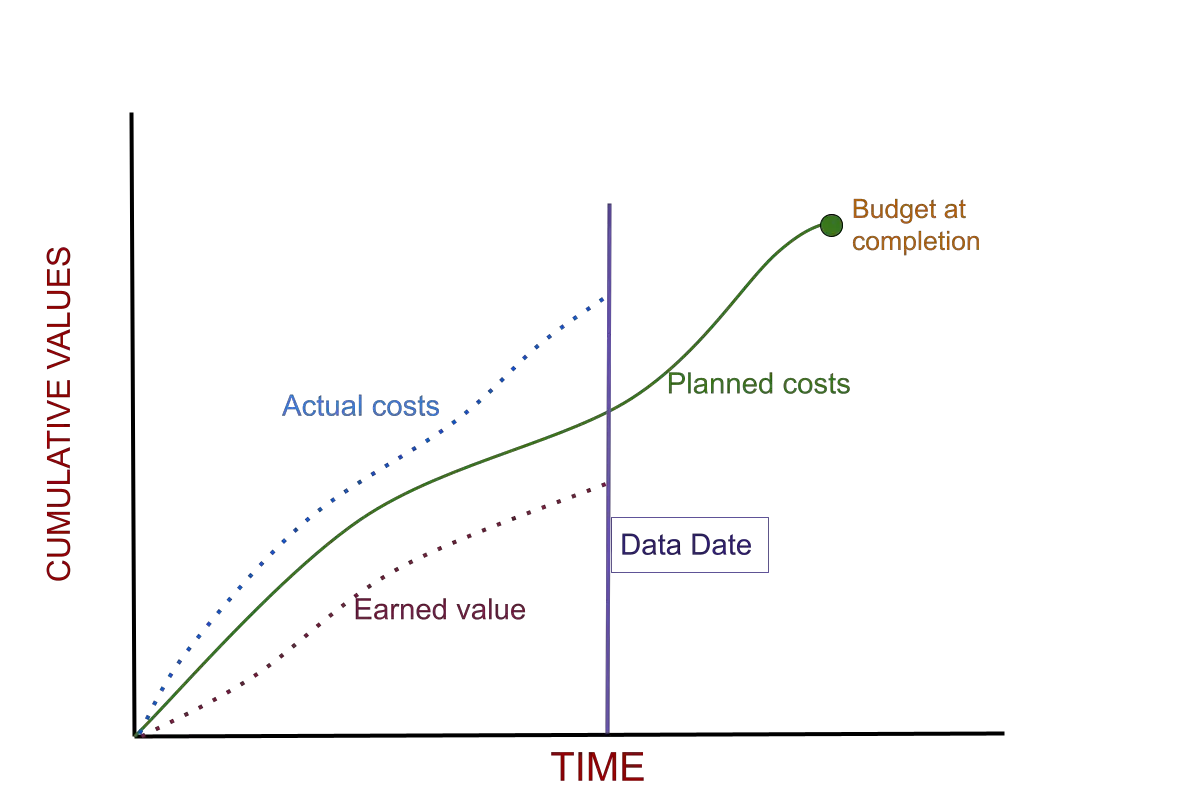
Earned value management (EVM) applies planned cost to projects. PMI defines it as a methodology that “combines scope, schedule, cost, and resource measurements to assess project performance and progress” (PMI Lexicon of Project Management Terms, version 5.0, January 2026). It uses three numbers, and planned cost sits inside two of them:
- Planned value (PV), or budgeted cost of work scheduled (BCWS): “The authorized budget assigned to scheduled work”.
- Earned value (EV), or budgeted cost of work performed (BCWP): “the measure of work performed expressed in terms of the budget authorized for that work”. In GAO’s words, it is measured “in terms of the planned cost of work actually completed” (GAO-20-195G, p. 216).
- Actual cost (AC), or actual cost of work performed (ACWP): “The realized cost incurred for the work performed on an activity during a specific time period”.
Cost performance is judged by comparing EV with AC, never PV with AC. PMI defines cost variance as “the difference between the earned value and the actual cost”, and schedule variance as “the difference between the earned value and the planned value”.
The US Department of Defense’s guide adds the sign rule: “A positive value indicates a favorable condition, and a negative value indicates an unfavorable condition” (DoD EVMS Interpretation Guide, 24 June 2026).
Cost variance (CV) = EV − AC
Schedule variance (SV) = EV − PV
Comparing AC with PV mixes two questions: is the work on budget, and is it on schedule? NASA’s guide for control account managers is blunt: “EV metrics never compare just BCWS to ACWP, planned versus actual” (NASA EVM reference guide, p. 15-2).
GAO’s cost guide gives the classic case. A contract calls for 4 miles of railroad track in 4 weeks for $4 million. After 3 weeks only $2 million has been spent, and “An analysis of planned versus actual expenditures suggests that the program is underrunning its estimated costs”.
But only 1 mile is laid, so the job is 25% complete, and at that rate it will cost $8 million and take 12 weeks (GAO-20-195G, p. 207).
Planned Value vs Earned Value vs Actual Cost
| Measure | What it tells you | Also called |
|---|---|---|
| Planned value (PV) | Planned cost of the work scheduled to date | BCWS |
| Earned value (EV) | Planned cost of the work actually done | BCWP |
| Actual cost (AC) | What the work done actually cost | ACWP |
| Cost variance | EV − AC; negative means over budget | CV |
| Schedule variance | EV − PV; negative means behind schedule, in money | SV |
| Cost performance index | EV ÷ AC; below 1.0 means the work cost more than planned | CPI |
Worked example: month 3 of a project
Our calculation. A 300,000 ERP rollout is planned to be half done by the end of month 3, so PV is 150,000. The team has spent 135,000 (AC) and finished 40% of the work, so EV = 0.40 × 300,000 = 120,000.
- AC against PV: 135,000 against 150,000 looks 15,000 under plan. Wrong test.
- CV = EV − AC = 120,000 − 135,000 = −15,000. The work done cost 15,000 more than its budget.
- SV = EV − PV = 120,000 − 150,000 = −30,000. The project is 30,000 worth of work behind schedule.
- CPI = 120,000 ÷ 135,000 = 0.889. If the remaining 180,000 of work keeps that efficiency, it costs 180,000 × 135,000 ÷ 120,000 = 202,500, so the forecast at completion is 135,000 + 202,500 = 337,500, or 37,500 over budget.

Microsoft Project shows both sign conventions, which catches people out. Its earned value field CV is calculated as “CV = BCWP - ACWP”, so a positive number means under budget (Microsoft Support, CV fields).
Its plain Cost Variance field is “Cost Variance = Cost - Baseline Cost”, where cost includes the remaining cost, so there a negative number means under budget (Microsoft Support, Cost Variance fields). Read the column name before you read the sign.
Microsoft’s own earned value article describes the trap: a garden project has spent $1,500 where $2,000 was planned, the manager thinks “Great, I’m saving money”, and then sees that only one and a half of the two planned gardens are done, so the project is behind schedule (Microsoft Support).
Our guide to actual cost in project management covers CPI and the estimate at completion in more detail.
The rules are current as of October 2026. PMI’s Lexicon is version 5.0 (January 2026). SAE revised the EVM standard EIA-748 to revision E on 17 February 2026, cutting its guidelines from 32 to 27 (SAE, EIA-748-E).
ISO replaced ISO 21508:2018 with ISO 21508:2026 in February 2026 (ISO 21508:2026). GAO-20-195G (March 2020) is still GAO’s current cost guide. For the wider discipline, see our guide to project management.
Where do ERP systems keep planned cost?
| System | Planned cost lives in | Actual compared with |
|---|---|---|
| SAP S/4HANA 2025 | Standard cost estimate from BOM and routing | Target cost: plan scaled to the confirmed quantity |
| Dynamics 365 SCM | Costing version with standard or planned cost records | The standard cost calculation, not the order estimate |
| Business Central | Item standard cost, rolled up in the Standard Cost Worksheet | Standard cost, per cost component |
| Oracle Fusion 26D | Cost scenario rolled up and published | The work definition used in the rollup |
| Odoo 20 | MO cost from the BoM, operations and work centres | Real cost of the manufacturing order |
SAP S/4HANA (2025 FPS02) keeps several target cost versions; only version 0, built on the current standard cost estimate, feeds the variances settled to profitability analysis (SAP Help).
In SAP S/4HANA Cloud Public Edition 2608 with event-based production cost posting, “target cost versions are not used anymore”: target cost is always calculated from the current standard cost estimate, on the fly (SAP Help, 2608).
Dynamics 365 Supply Chain Management uses a costing version with planned costs mainly for what-if work: it is “often used to support cost calculation simulations” (Microsoft Learn). Business Central builds standard cost from material, capacity, subcontracting and overhead; Microsoft’s worked example adds 10% overhead plus a fixed rate of 3 and totals 77.80 (Microsoft Learn).
Oracle Fusion Cloud plans costs in a cost scenario of item standard costs, resource rates and overhead rates, rolls them up and publishes them (Oracle 26D).
One warning from its own guide: if a product’s standard cost is keyed in by hand rather than rolled up, the whole cost of components and resources on its work orders ends up as job close variance (Oracle 26D).
Odoo 20 calls its planned figure the MO cost: what the order should cost from its bill of materials. It compares that with the real cost; once the order is produced, the MO Cost column is updated to match the Real Cost column.
Odoo’s Compute Price from BoM button “does not set the price permanently”: in Odoo’s example a BoM cost of 65.00 and a real cost of 70.00 average to 67.50 (Odoo 20 documentation).
Which SAP tables hold planned cost?
In SAP S/4HANA, plan data sits in table ACDOCP, which SAP calls “the main table for planning” (SAP Help). Released production and process orders write their plan costs there under plan categories PLANORD01, “Manufacturing Order Plan Cost”, and PLANORD02, “Manufacturing Order Standard Cost” (SAP Help). Actual costs sit in the universal journal, ACDOCA.
The classic Controlling totals tables COSP and COSS remain, but SAP says their actual data is “now completely contained in table ACDOCA”, while “statistical postings and target data remain” in COEP, COSS and COSP (SAP Help). In reports, value type 01 is plan and 04 is actual (SAP Help, value types).
We found table KEKO in SAP’s public help only as the trigger table for replicating material cost estimates in Central Finance (SAP Help), and no SAP page documenting the tables behind a cost estimate’s itemization, so we do not list them here.
FAQs
What is the difference between planned cost and budget?
A budget is a plan for a period of time. CIMA defines it as a quantitative expression of a plan for a defined period of time, drawn up for business units, departments, products, teams or the entire organisation. A planned cost is the expected cost of one unit, order or piece of work; for a product, CIMA calls it the standard cost, the planned unit cost. Budgets are often built from planned costs: standard prices and quantities are the building blocks of a budget.
How can you reduce your product’s planned cost?
Change what the plan is built from. Planned cost is planned quantities times planned prices plus overhead, so lower it by redesigning the bill of materials, shortening routings and setup times, negotiating material prices, or raising normal capacity utilisation so fixed overhead is spread over more units. Lowering the standard without changing the process does not reduce cost; it only produces unfavourable variances when the actual costs arrive.
Which scenario is an example of planned cost versus actual cost?
A bakery plans a batch of 1,000 loaves at 0.80 each before baking starts: 800 is the planned cost. After the run, the invoices and time records show the batch cost 860: that is the actual cost. If the bakery baked 1,100 loaves instead of 1,000, the fair comparison is 860 against 1,100 times 0.80, which is 880, so the batch came in 20 under plan rather than 60 over.
Which planned cost comparison should you use?
The right comparison depends on what you are judging:
- A production order: compare actual cost with the standard cost of the quantity actually produced, as SAP’s target cost, Dynamics 365’s standard cost calculation and Oracle’s work definition do. Then read price, quantity, lot size and scrap variances separately.
- A project: compare earned value with actual cost for cost, and earned value with planned value for schedule. Never read AC against PV.
- A department budget: flex it first. CIMA’s definition of budget flexing moves variable costs to the allowance for the volume actually achieved and keeps fixed costs at the original budget (CIMA, budgeting).
- Inventory at standard: review the standards regularly; IAS 2, Ind AS 2 and US GAAP accept them only while the results approximate cost.
How this page was checked (17 October 2026): each definition, rule and ERP behaviour above was read in the issuing body’s own document: IAS 2 (EU text consolidated to 8 March 2026), Ind AS 2 (ICAI 2025-26 edition), CIMA Official Terminology, PMI Lexicon 5.0, GAO-20-195G, the DoD EVMS Interpretation Guide of 24 June 2026, and vendor documentation for SAP S/4HANA 2025 FPS02 and Cloud 2608, Dynamics 365, Oracle 26D and Odoo 20. The worked examples are our own calculations.
Correction: earlier versions of this page said planned cost covers only direct costs and that a variance is favourable when actual cost is below planned cost. Both statements were wrong and are corrected above.
Using Google Search? Add erp-information.com as a preferred source.