
A Shop Order, often called a work order or production order, is a critical document in manufacturing and other industries that deal with physical products.
It authorises the shop floor to begin a specific job: make this item, in this quantity, by this date. Until one is released, the work is only planned.
Terminology, since it varies by system: shop order, work order and production order are used more or less interchangeably for the same manufacturing document. Work order is also the standard term in maintenance, where it authorises a repair on an asset rather than the production of a saleable item, which is the source of most of the confusion around the word.
Definition
A shop order is a work order used to authorize and track the production of parts and products through the shop. It is the same as the production order.
It includes information about the product to be manufactured, such as the item number, quantity, date needed, priority, and layout. This information helps the shop plan and schedule production.
In addition, it can also be used to track progress and identify any problems that arise during production. As a result, it is an essential tool for managing and controlling the production process.
What is a shop order template?
A shop order template carries what the shop floor needs in order to build the item: the shop order number, the item or part number, the quantity, the due date and priority, the operations and work centres involved, and the materials to be issued against it.
It may also carry special instructions, drawing revisions or inspection requirements. Once released it goes to the shop floor, not to a supplier.
Production books labour and material against it as the work proceeds, which is how progress and cost are tracked. It stays open until the quantity is complete and received into stock, then it is closed and its actual costs are settled.
How does a shop order act as an invoice?
Let us assume that a maintenance company receives a shop order internally through phone or e-mail from the customer.
In this case, the person who does maintenance work for that customer takes a printout of the shop order to take to the working location.
Once he is done with the work or service, the customer checks his work, immediately signs it, and pays for the service. Suppose the customer cannot pay the amount on the spot. At that time, this shop order converts into an invoice.
Shop order form
Following is the sample template used to fill out the form.
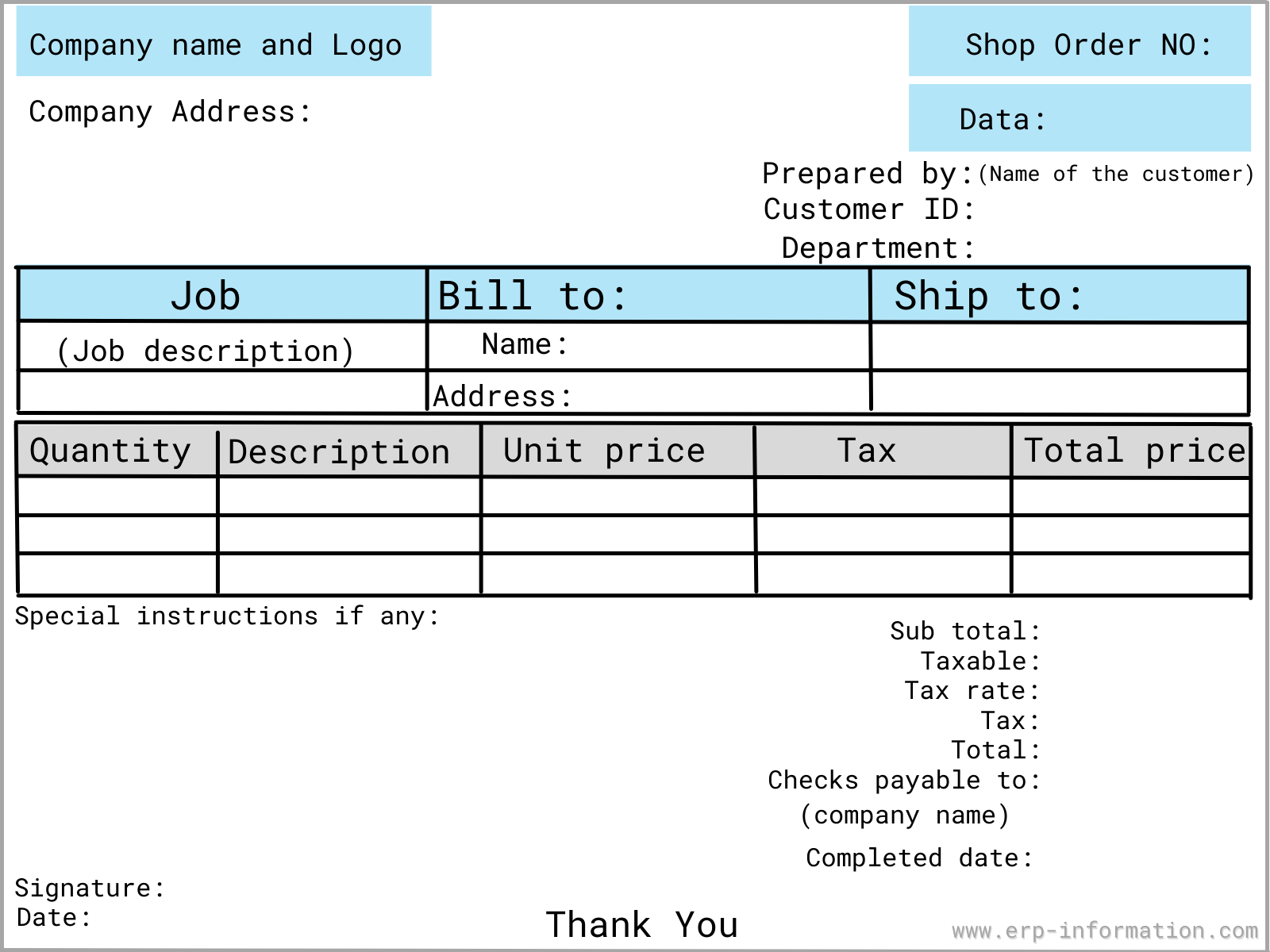
Typically, each of the forms will have the following fields in them.
- Company name and logo: The company name or logo here will be mentioned. (Logo is optional)
- Shop Order No: It is the unique work order number that helps to identify work.
- Date: It is the issued date of the order
- Job: This field describes the work to be done with complete details.
- Bill to: Name and address of the customer who has to pay the bill for the work done.
- Ship to: Sometimes, the bill to address is different from the shipping address. In that case, the ship-to field indicates the shipping address of the final product.
- Quantity: It is the number of hours spent on the work or the number of products manufactured.
- Taxed: It indicates whether the item or job is taxable or not (in most cases, they are taxed).
- Tax rate: Indicates tax rate for a particular job or product.
- Special instructions: You can mention any special instructions here about discounts or something like that.
Work order meaning
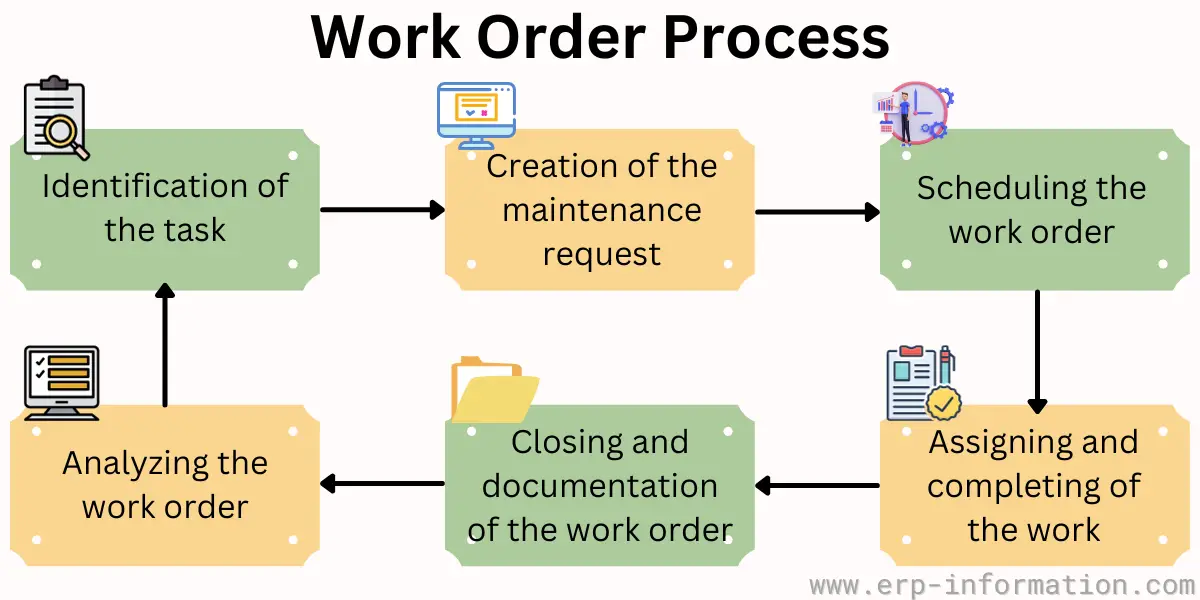
A work order is a document that gives a complete picture of maintenance tasks and outlines the process of completing those tasks.
It contains many details such as the scope of the job, assignee of the job, authorized person of the job, etc.
A shop order is internal. It is raised inside the organisation, by planning or by one department on another, and it authorises your own shop floor to do work. Customers do not issue shop orders; a customer issues a purchase order, and that demand is what may cause a shop order to be raised in response.
The distinction is worth keeping straight because the two documents face opposite directions. A purchase order goes out to a supplier and commits money. A shop order stays in and commits your own capacity and materials.
| Document | Raised by | Sent to | Authorises |
|---|---|---|---|
| Purchase order | The buyer | An external supplier | Buying goods or services |
| Shop order | Planning, internally | Your own shop floor | Making the item in-house |
| Sales order | The seller | Held internally | Fulfilling a customer order |
It details the item to be manufactured, the quantity, the due date and the work to be done.
Sometimes, this shop order or work order acts as an invoice.
Conclusion
The shop order is the same as the production order, and it is used to authorize and track the production of parts and products through the shop.
As we explored the journey from start to finish, dissecting the shop order form and how it mirrors an invoice, it became clear that these unassuming documents play an instrumental role in keeping the wheels of the industry turning.
They not only facilitate a smooth and organized production process but also serve as a vital record of work accomplished.
The practical point is the one most easily lost: a shop order is an instruction to yourself. It commits your capacity and your materials, and it is the record against which actual labour and cost are booked. Treat it as a customer-facing or supplier-facing document and both the costing and the scheduling stop making sense.