Food and beverage ERP is general manufacturing software plus the things a food plant cannot run without: formula and recipe management with yield scaling, lot and batch traceability in both directions, shelf life and first-expired-first-out picking, catch weight for products sold by variable weight, allergen segregation, and the quality records that survive an audit or a recall.
One thing to settle before you read the list. All ten systems below are process manufacturing ERP, built for companies that make food and drink. If you run restaurants, hotels, bars or cafes, what you need is a point of sale and hospitality management system, which is a different category of software with different vendors.
What is Food and Beverage ERP Software?
A food and beverage ERP software package does what any ERP does, covering finance, inventory management and production scheduling. What separates it from generic manufacturing ERP is a short list of capabilities that a food or drink producer cannot operate without:
- Formula and recipe management. Batch sizes scale by yield rather than by whole units, and the system has to handle substitutions, potency and rework without breaking the cost roll-up.
- Bidirectional lot traceability. From a finished pallet back to every raw lot, and forward from a suspect raw lot to every customer who received it. This is the capability a recall turns on.
- Shelf life and FEFO. Picking by first expired, first out rather than first in, first out, with expiry driving allocation and write-off.
- Catch weight. Selling by variable weight while stocking by case, common in meat, poultry, cheese and seafood, and a frequent reason generic ERP fails in food.
- Allergen and quality control. Segregation rules, sanitation sequencing between runs, and certificates of analysis held against the lot.
Types of Food and Beverage ERP Software Systems
Following are six of the most common segments,
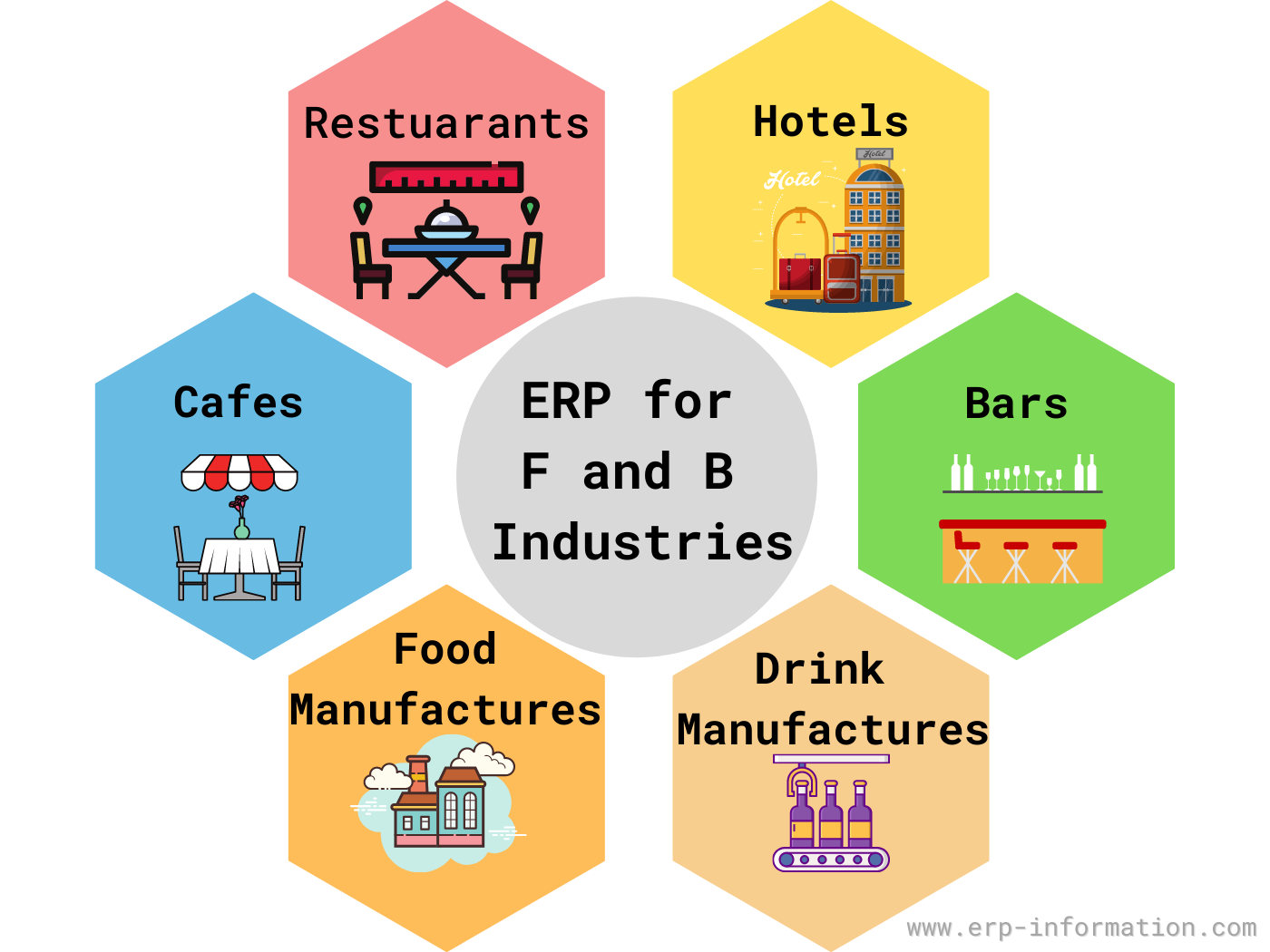
For Restaurants
Restaurants run on a point of sale system with recipe costing, food cost percentage tracking and labor scheduling behind it. Multi-site groups add central purchasing and commissary production. This is hospitality software rather than manufacturing ERP, and none of the ten systems reviewed below target it.
For Hotels
Hotels need their food and beverage outlets costed separately from rooms, which means a property management system with banquet and event catering, per-outlet stock control and interdepartmental transfers. Again, hospitality software rather than ERP.
For Bars
Bars live or die on pour cost. The software that matters tracks variance between poured and sold volume, handles keg and bottle inventory at partial units, and keeps the licensing and age-verification records the regulator expects.
For Cafes
Cafes need the lightest footprint of the four: recipe costing for drinks and pastries, waste tracking, and a point of sale that closes the day without a back office team.
For Food Manufacturers
Food manufacturers are the segment the rest of this article is about. It covers everything from bakery, dairy, meat and beverage producers to adjacent regulated categories such as infant formula, nutraceuticals and pet food, all of which need formula management, lot traceability and shelf life control rather than a point of sale.
Therefore, food companies need unique food manufacturing software systems to help the food industry with many different things they have to do, including food safety.
For Drink Manufacturers
Drink manufacturers make drinks that are not for people to drink. This can be things like juice, soda, or other kinds of drinks made to be put in a package.
So, drink manufacturers need to use unique software systems to help them with the many things they must do.
Each of them may have one or more of the following integrated.
Point of Sale (POS) system with ERP integration
Point of Sale (POS) systems manage transactions at the point of sale. So, your ERP system must have an integrated POS system. That will help you to track sales and inventory data in real time.
POS system and Food Ordering System Integration
Food ordering systems are used to receive orders from customers. In addition, they allow people to order food and drinks from their suppliers. These systems also can track inventory levels and receive delivery notifications.
ERP systems with CRM (Customer Relationship Management) integration
A CRM system is used to manage customer data. For example, it can help you track customer interactions, preferences, and purchase history. As a result, you can create more targeted marketing campaigns and improve customer service.
ERP system with HRM (Human Resources Management) integration
An HRM system is used to manage employee data. It can help you to track employee roles, responsibilities, and performance. Additionally, it can help to handle payroll processing and employee benefits.
Full ERP systems for food and beverage manufacturers
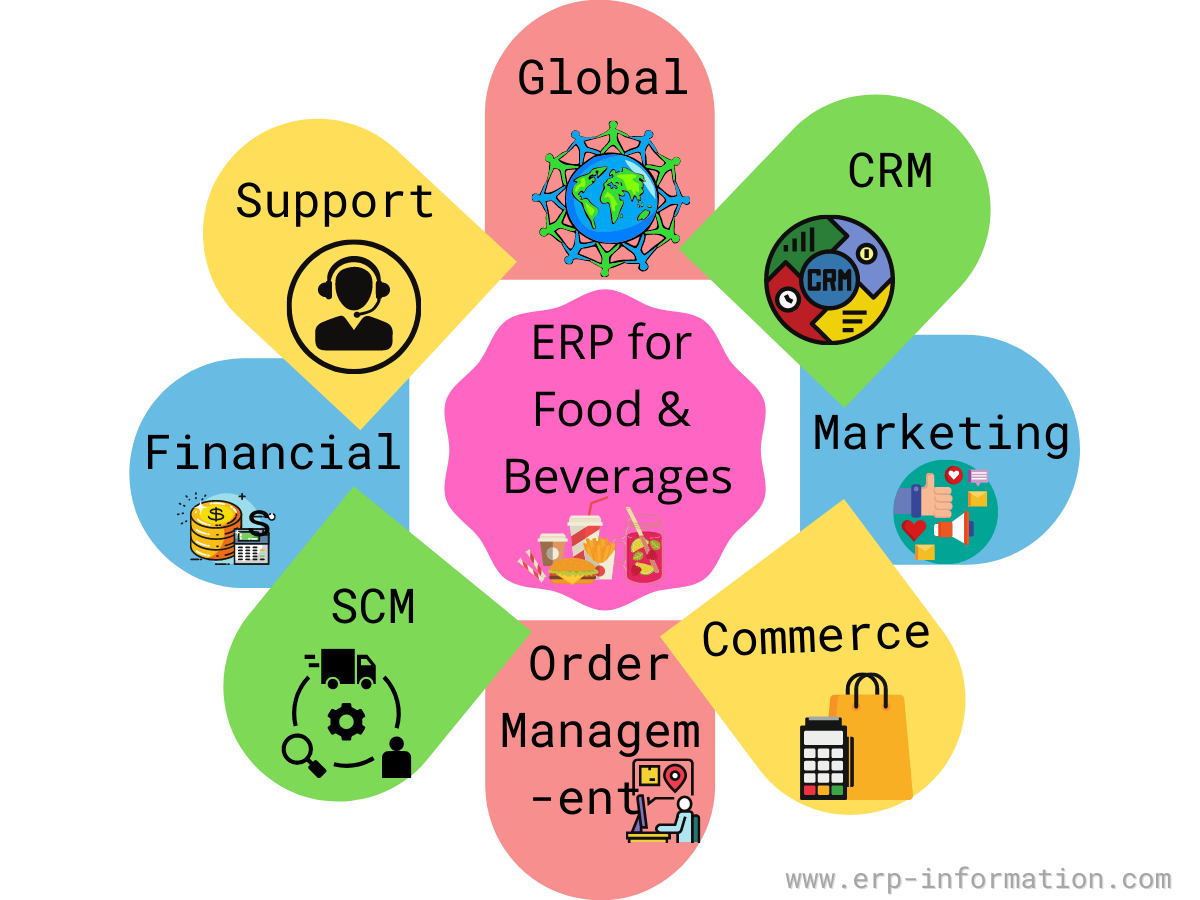
A complete ERP system will include all of the above features. In addition, it will help you with your financial management, inventory, operations, and customers.
Each type of system has its unique benefits that can help streamline the operations of food and beverage companies.
For example, a restaurant may need a system to help manage inventory, track recipes, and menus, and handle orders. A hotel may need a system to help manage reservations, room service orders, and banquet events. And so on.
Benefits of Using ERP Software in the Food and Beverage Business
Following are the few benefits of using automation in the f&b industry,
- Allows organizations to accurately track inventory and keep records of all expenses associated with Food and Beverage operations in one centralized location
- Food and Beverage ERP software can help improve efficiency in Food and Beverage operations, as well as decrease the amount of time needed to compile reports
- Many Food and Beverage ERP software also offer features that allow for the analysis of sales data, which companies can use to make better business decisions
How to Choose the Right F&B ERP Software for Your Business?
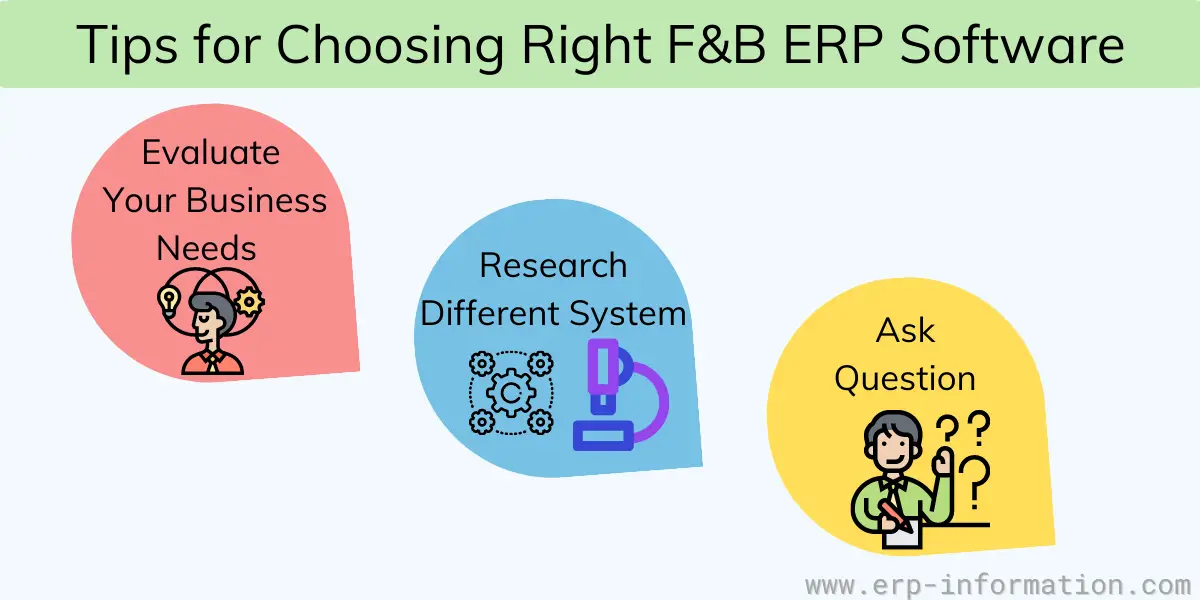
Evaluate your business needs
Before choosing an ERP software system, you need to evaluate your business needs. What tasks does your business need to automate? What features and functionality are essential to you? Make a list of your requirements and compare different systems to see which ones offer the required features.
Research different systems
Once you have a list of requirements, it’s time to research. Compare different software systems to see which ones meet your needs. Read reviews and watch demos to understand better how each system works.
Ask questions
When you’ve found a few promising systems, it’s time to ask questions. Talk to the vendors and ask about features, functionality, scalability, beverage supply chain fit, and support. Make sure you have a good understanding of how each system works before deciding.
The right food and Beverage software can make a big difference in the success of your business.
Take the time to research different systems and compare them before deciding. The right system can help improve efficiency and productivity, reduce costs, and improve customer service.
Implementing ERP Software in the Food and Beverage Business
Here are the steps involved in implementing,
- Define the business process and requirements
- Evaluate different options
- Select the best solution for your organization
- Implement the ERP Software
- Train employees on how to use the system
Define the Business Processes and Requirements
The first step in implementing ERP software is to define the business processes that the system will support. That includes understanding how the company operates, what tasks need to be automated, and what data needs to be captured.
Next, you need to decide what you want the software to do. Again, knowing if the software will work for you is essential.
Evaluate Different Software Options
Once you have defined the business processes and requirements, it is time to evaluate different options. Many other options are available, so carefully compare them based on their features and functionality. This will help you select the best system for your organization.
Select the Best Software for Your Organization
After evaluating different options, it is time to select the best one for your organization. First, you need to ask yourself what you need. If you have enough money, it is OK.
Implement the Software
Once you have selected the best solution for your organization, it is time to implement it. The implementation process should be carefully planned and executed for successful deployment.
This includes configuring the system to meet your specific requirements, testing it thoroughly, and training employees to use it.
Train Employees on How to Use ERP Software
The final step in implementing an ERP solution is training employees. This should include general training on navigating the system and specific training on using the features and functionality relevant to their job.
In addition, the company should fully train employees on using the Food and Beverage software before it is used.
Software Available for Hotels, Restaurants, Bars, and Cafes
- Easy InnKeepingEasy InnKeeping
- Rezku POS
- Square Point of Sale
- Trumpia
- Hosthub
- HotelBee
Traceability is the requirement that should drive your shortlist
The single biggest reason a food manufacturer replaces a generic system is the FDA Food Traceability Rule, usually called FSMA 204. It is codified at 21 CFR Part 1, Subpart S, it was published on 21 November 2022 and it has been in effect since 20 January 2023. It applies to anyone who manufactures, processes, packs or holds a food on FDA’s Food Traceability List.
What the rule asks for maps almost directly onto ERP functionality. You need a documented traceability plan, you must assign a traceability lot code, and you must keep records at each critical tracking event, meaning harvesting or cooling, initial packing, first land-based receiving, shipping, receiving and transformation.
Then comes the part that decides whether a spreadsheet is survivable. Under section 1.1455, records must reach an FDA representative within 24 hours of a request. During an outbreak or a recall, that information must be supplied as an electronic sortable spreadsheet. Producing that from paper batch tickets inside a day is not realistic, which is why traceability is the capability worth testing hardest in a demo.
On the deadline, be careful what you read. The original compliance date was 20 January 2026. FDA published a proposed rule on 7 August 2025 to extend it by 30 months to 20 July 2028, and comments closed that September. As of August 2026 that extension is still a proposed rule and no final rule amending the date has appeared in the Federal Register, though FDA has continued to administer the rule in other respects. Plan to 20 July 2028, but treat it as a planning date rather than settled regulatory text, and check the docket before you cite it in a board paper.
The ten systems compared
| System | Who owns it | Typically bought by | Publishes pricing? |
|---|---|---|---|
| S2K Enterprise | VAI | Distributors and mid-market food processors | No |
| IFS | IFS | Larger, asset-heavy producers | No |
| SYSPRO | SYSPRO | Mid-market process manufacturers | No |
| Oracle NetSuite | Oracle | Growing brands wanting cloud finance plus manufacturing | No |
| BatchMaster | BatchMaster | Formula-driven batch producers, often alongside an existing accounting system | No |
| Enterprise 21 (E21 ERP) | TGI, trading as E21 ERP | Small and mid-sized processors and distributors | No |
| Deacom | ECI Software Solutions | Batch and process manufacturers wanting a single-codebase system | No |
| Aptean | Aptean | Food-specific editions by sub-vertical | No |
| DELMIAWorks (formerly IQMS) | Dassault Systèmes, sold under SolidWorks | Plants wanting ERP and shop-floor MES together | No |
| QAD | QAD | Redzone, owned by Thoma Bravo | Multi-site and global manufacturers | No |
None of these vendors publishes list pricing, which is normal for process manufacturing ERP. Expect the quote to be driven by user count, the number of plants, and how much of the traceability and quality suite you switch on. The implementation and data migration is routinely the larger half of the first year.
10 Best ERP for Food and Beverage
Following are the few f&b software solutions available for food and beverage manufacturing in the USA.
1. S2K Enterprise
S2K Enterprise is one of the best Food and Beverage ERP software on the market. It has a wide range of features that make it perfect for businesses in the food and beverage industry. It enhances customer experience while maximizing efficiencies throughout the organization.
Features
- Work orders
- Material requirements planning
- Capacity requirement planning
- Shopfloor control
- Product Quality
- Purchasing
- Customer orders
- Inventory management
- Sales Analysis
- Retail management
- Rebates and allowances
- Warehouse and route management
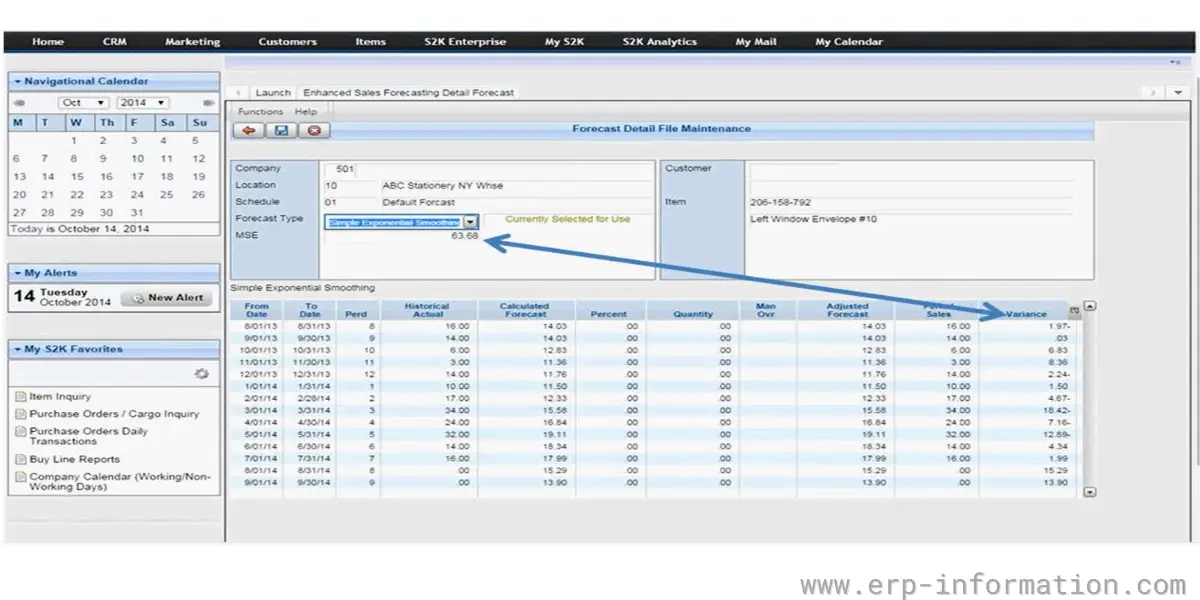
Screenshot of S2K Enterprise
Pricing
The vendor does not provide the pricing details. You need to contact the vendor directly.
 Likes
Likes
- Manages supply chain with improved workflow and reduced cost.
- Enhances cash-and-carry and retail operations.
- Easy to manage the stock.
- Easy to gather all the information.
- Easy to manage warehouse and inventory.
- It does not require any integration.
 Dislikes
- The user interface is not user-friendly.
- Item code contains a maximum number of characters.
- The finance module needs to improve more.
- Need more skill to operate the software.
- Limited ability to do capacity planning and budgeting.
- Lack of flexibility.
- It is not easy to export reports quickly.
- It has some glitches and gooey screens which is frustrating for the end-users
- Modifications are not easy
Other details
| Deployment | Cloud, SaaS, Web-Based |
| Supported device | Mac, Windows, Linux, Android, iPhone, iPad |
| Supported languages | English, Spanish |
| Support | Email/Help Desk, Knowledge Base, Phone Support, 24/7 (Live Rep), Chat |
| Training | In-person, Live Online, Webinars, Documentation, Videos |
| Customer ratings | Capterra : 4.3 out of 5 (9+ reviews), G2: 3.4 out of 5 (4+reviews) |
User opinion
It has everything you need to manage your inventory, accounting, and other business operations. It’s easy to use and can be customized to fit your specific needs.
With S2K Enterprise, food distributors can optimize their supply chain and customer relationships, resulting in more efficient operations. It helps reduce overall delivery time, resulting in faster customer delivery.
2. IFS
IFS software is a cloud-based leading enterprise resource planning (ERP) software provider for the food and beverage industry.
The industry-specific products are connected to a single data model and use embedded digital innovation to help customers deliver their best at the moment of service.
It also provides cloud-based solutions for manufacturing and distribution, asset maintenance, and service-based operations.
Features
- Finance
- Human capital management
- Commerce
- Customer relationship management
- Manufacturing
- Supply chain management
- Procurement
- Projects
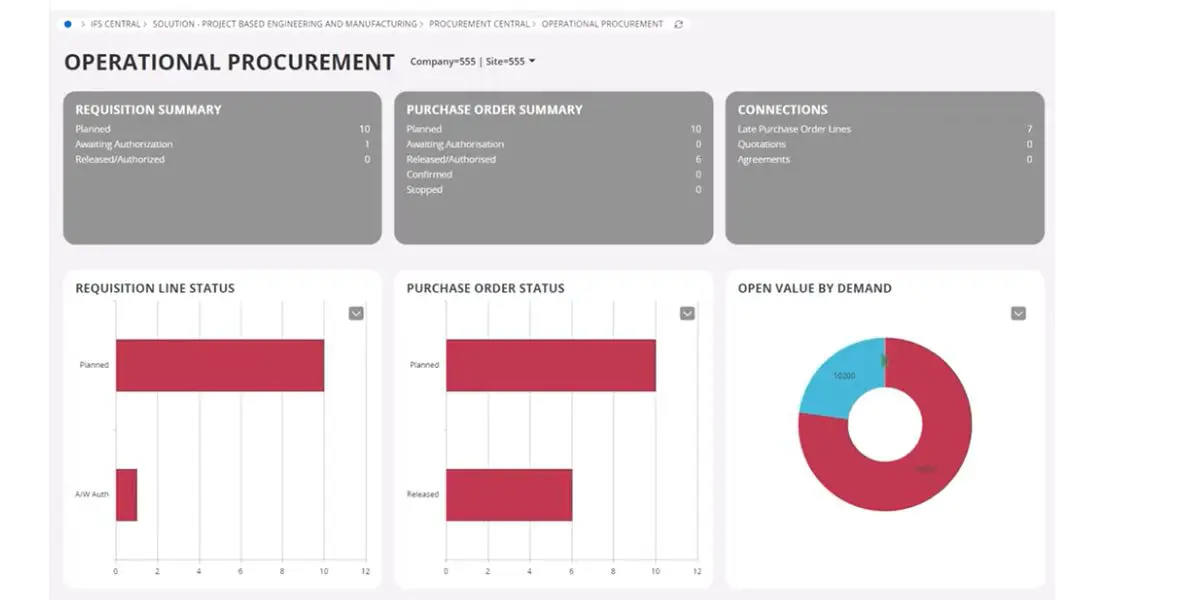
Screenshots of IFS
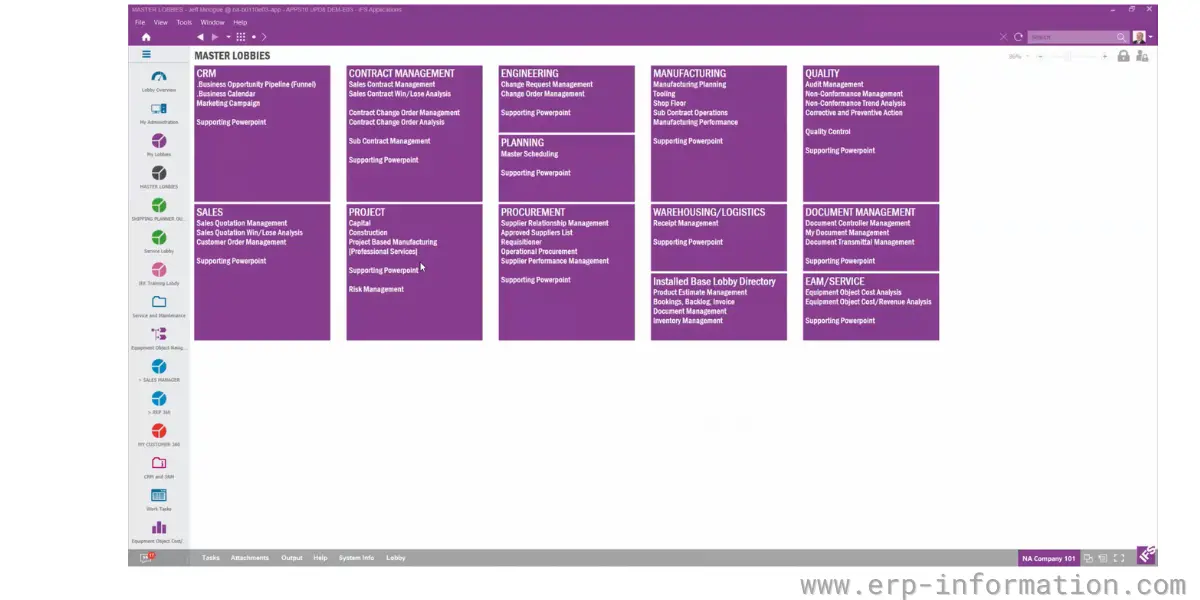
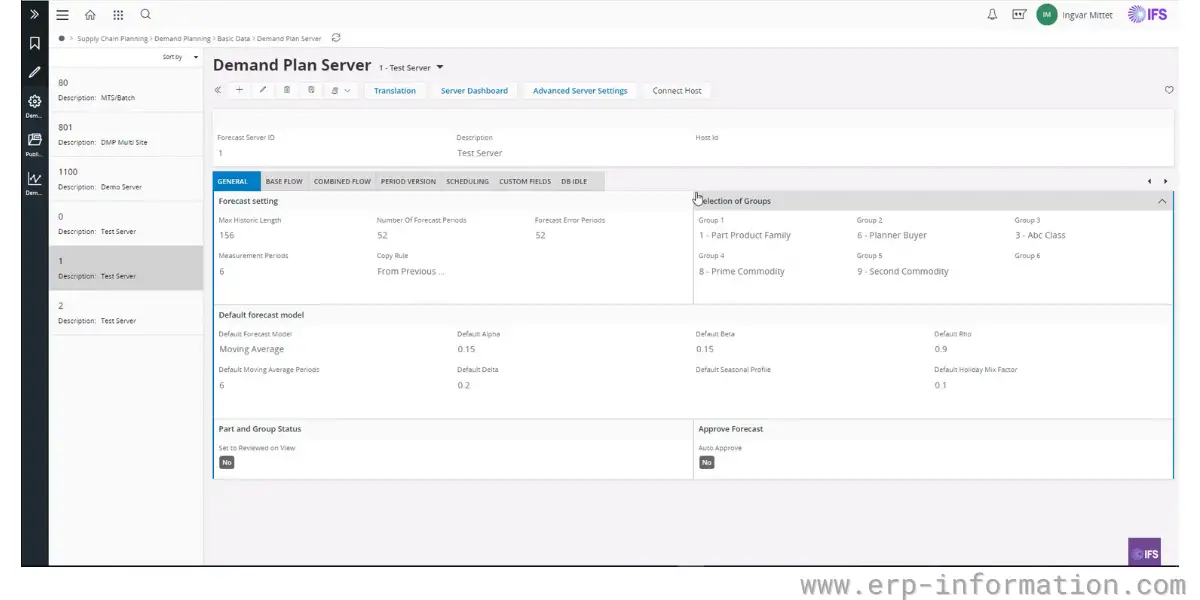
Pricing
The vendor has not provided the pricing details on the website.
Likes
- Provides good visibility of the supply chain.
- It allows you to streamline your process as per the new requirements and reduces the impact on your productivity.
- Reduces complexity by not providing unnecessary features.
- Easy to manage assets.
- It is very structured and user-friendly.
- Easy to access information from the dashboard.
Dislikes
- The modification takes more time.
- The software is expensive.
- Some obvious features are no longer available in the Cloud.
- Not useful for payroll calculation.
- Technical documentation is hard to understand.
- It takes more time to fix bugs.
- The software lacks integration with essential third parties.
- The software’s interface is not intuitive, making it difficult for users to navigate.
- The Business Reporter tool is not as simple to use
Supported industries
- Aerospace and Defense
- Energy Utilities and Resources
- Construction and Engineering
- Manufacturing
Other details
| Deployment | Cloud, SaaS, Web-Based |
| Supported device | Mac, Windows, Linux, Android, iPhone, iPad |
| Supported languages | English |
| Support | Email/Help Desk, Knowledge Base, Phone Support, 24/7 (Live Rep), Chat |
| Training | In-person, Live Online, Webinars, Documentation |
| Customer ratings | Capterra : 4.5 out of 5 (23+ reviews), G2: 4 out of 5 (190+reviews) |
User opinion
It’s packed with features that will help you manage your food and beverage operations effectively and efficiently.
The software simplifies complexity, reduces costs, and minimizes risks by orchestrating customers, people, and assets. It helps businesses plan, manage, and optimize critical asset availability, achieve operational excellence, and increase workforce productivity.
3. SYSPRO
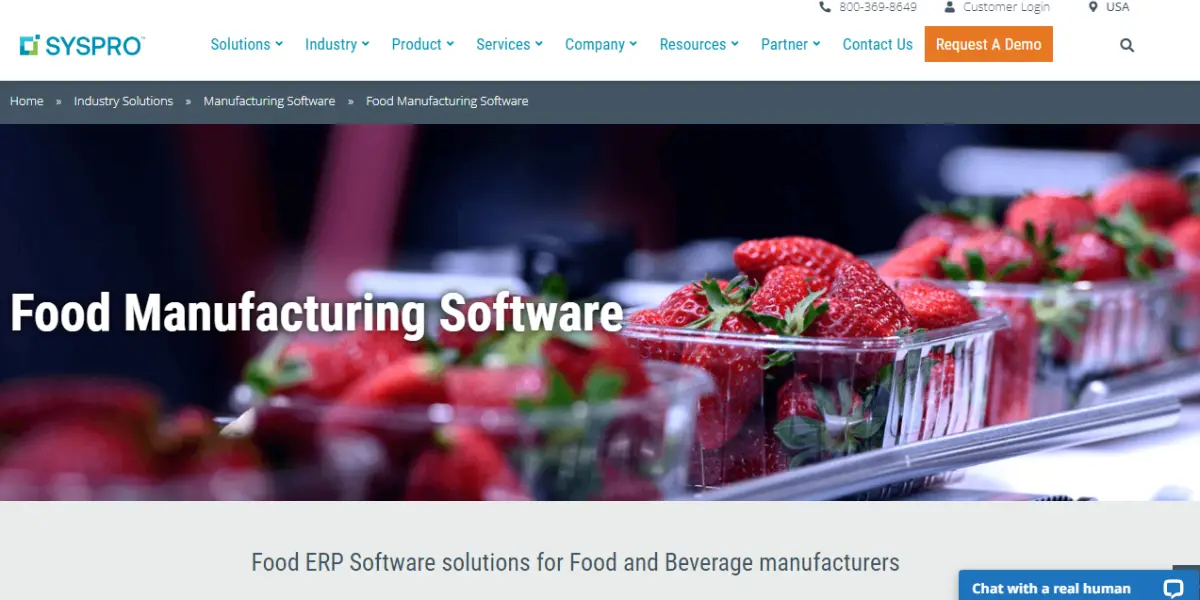
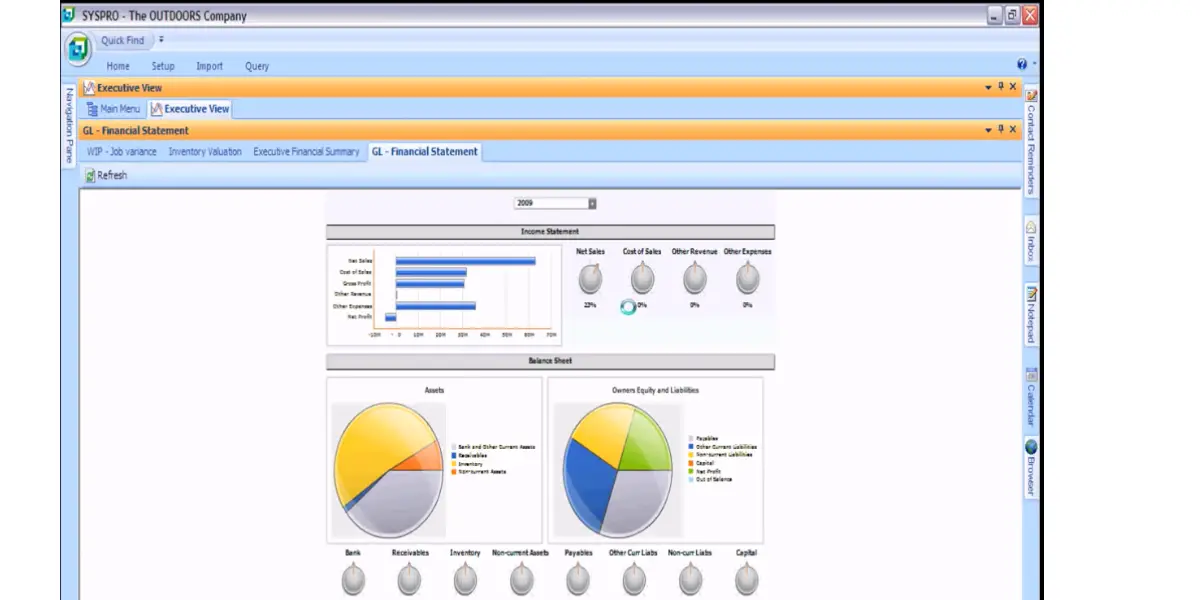
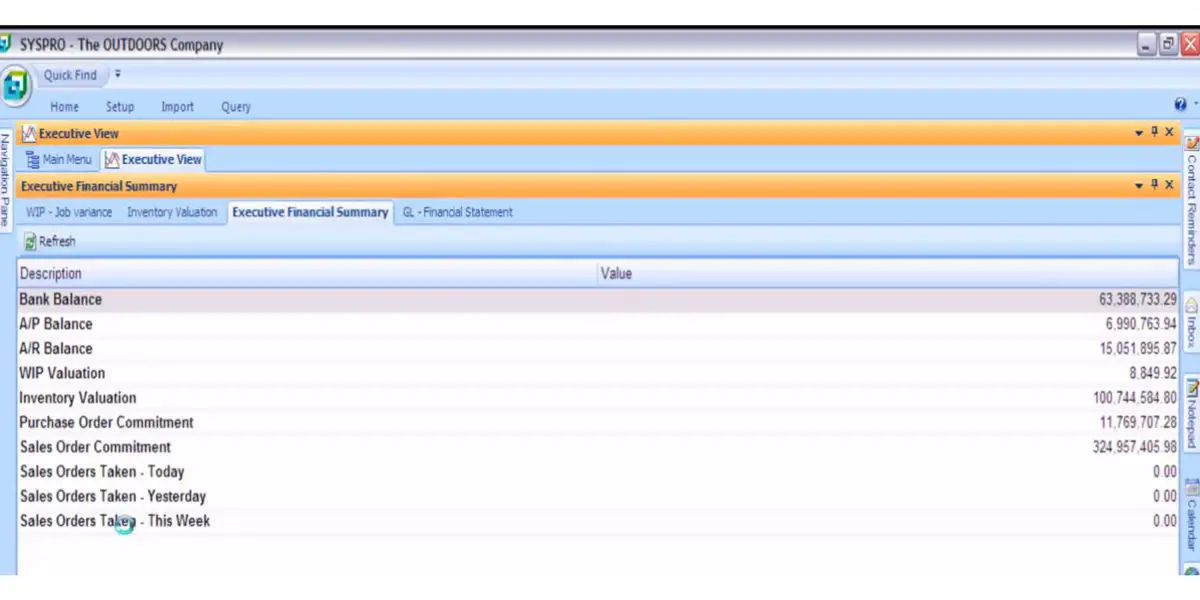
SYSPRO is a world-leading enterprise resource planning (ERP) software provider for manufacturing and distribution industries. It provides functionalities for both manufacturing and distribution of food and beverages.
It also includes self-service, supply chain extensibility, and customization, which allows businesses to tailor the software to their specific needs.
It supports out-of-the-box integrations and connectors that allow customers to integrate technologies seamlessly into their existing systems.
Features
- Comply with food safety regulations
- Raw material traceability
- Accurate records for recipes and formulas
- Quality control of incoming raw materials
- Supply chain management
- Financial management
- Warehouse and logistics operations
- Sales and customer satisfaction
Screenshots of SYSPRO
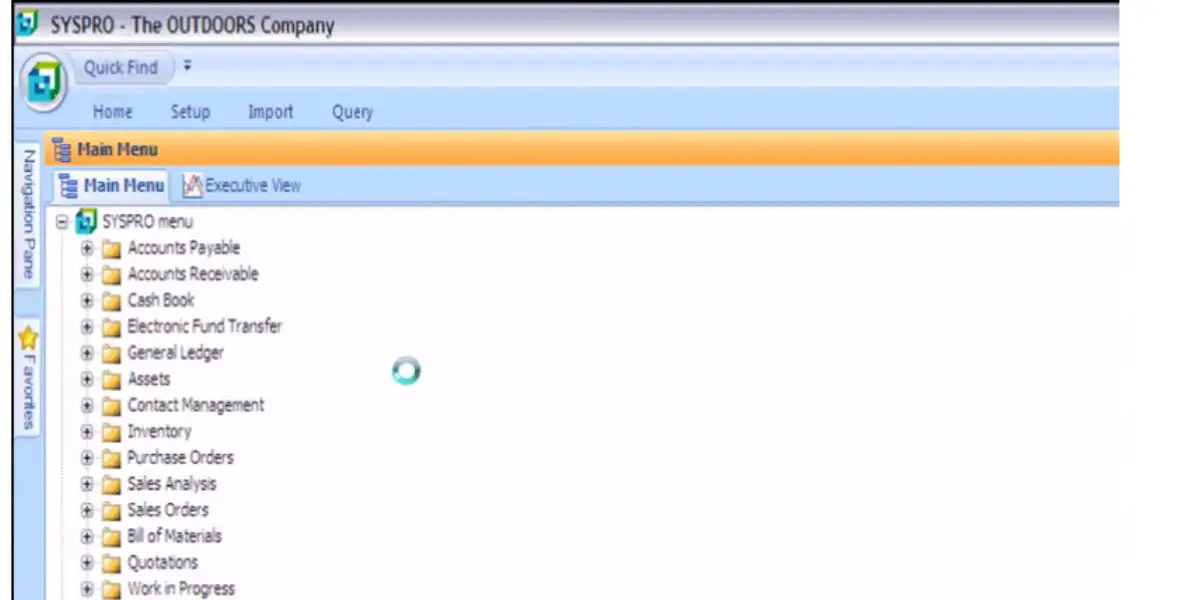
Pricing
Not provided by the vendor. Contact the vendor for pricing details.
Likes
- Enhances the productivity
- Reduces the production cost
- It helps to identify the defective product
- Increases the visibility of co-product and by-products
- Streamlines and automates the process
Dislikes
- Multiple customer accounts cannot be managed at a time.
- It doesn’t allow other systems to plug into it.
- Material issue processes are complex.
- Difficult to extract data for analysis.
- Issues are there with the shipping system.
- Inefficient order management.
- The inability to work on multiple orders simultaneously
- Inefficient reporting system
Supported industries
- Plastics and Rubber
- Packaging
- Medical Devices
- Furniture and Fittings
- Electronics
Other details
| Deployment | Cloud, SaaS, Web-Based |
| Supported device | Mac, Windows, Linux, Android, iPhone, iPad |
| Supported languages | German, English, French, Dutch, Spanish |
| Support | Email/Help Desk, FAQs/Forum, Knowledge Base, Phone Support, Chat |
| Training | In-person, Live Online, Webinars, Documentation, Videos |
| Customer ratings | Capterra : 4.2 out of 5 (98+ reviews), G2: 4.1 out of 5 (201+reviews) |
User opinion
SYSPRO is a top-quality ERP software for the food and beverage industry. It offers comprehensive functionality and a wide range of features that can help businesses in this industry streamline their operations and improve efficiency.
SYSPRO is also very user-friendly, which makes it easy to learn and use. Overall, it is an excellent choice for businesses in the food and beverage industry looking for a top-notch ERP solution.
You can deploy the software in the cloud, on-premise, or accessed via any mobile device.
4. Oracle NetSuite
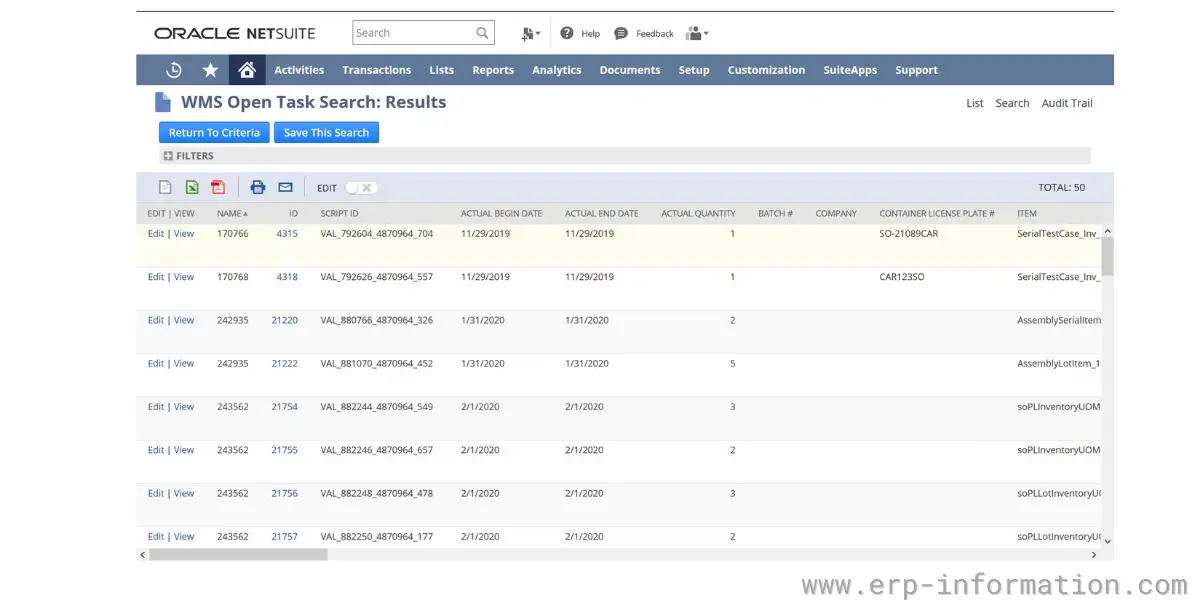
NetSuite is one of the most popular ERP software for food and beverage companies. It offers a comprehensive suite of applications that helps companies manage their finances, inventory, and operations.
In addition, NetSuite is known for its scalability and flexibility, making it a great choice for businesses of all sizes.
Features
- CRM, marketing, and promotions
- Product data management
- Order Management
- Planning and scheduling
- Supply chain management
- Production control
- WMS
- Quality management
- Shop floor control
- Financials
Screenshots of Oracle NetSuite
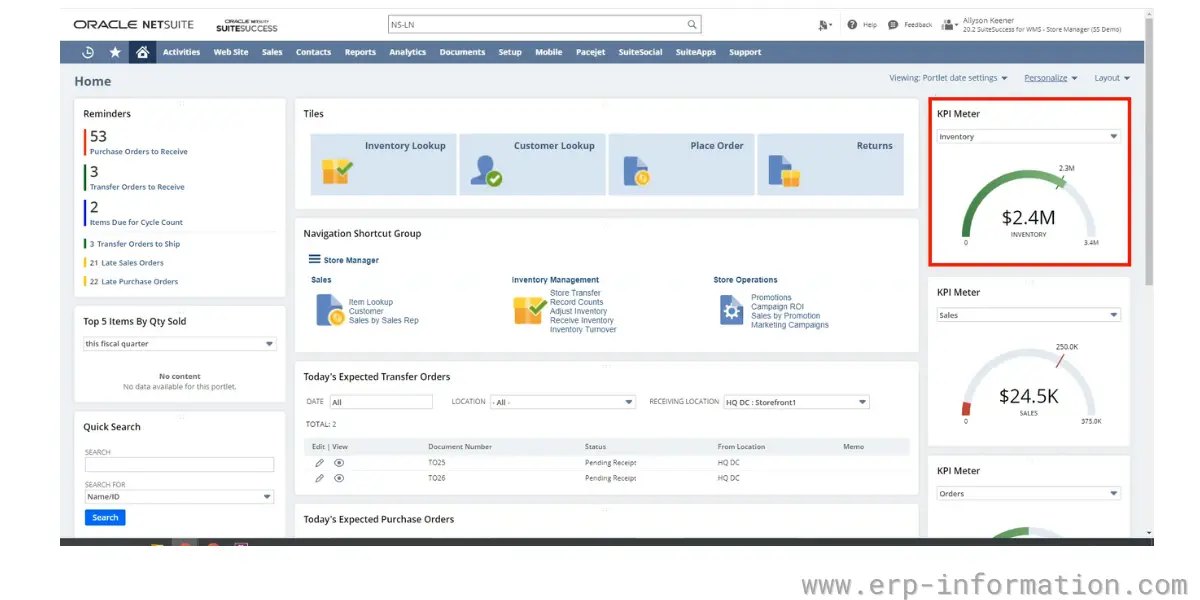
Pricing
Not provided by the vendor.
Likes
- It is easy to understand and deliver reports
- It provides strong expense management
- Provides a 360-degree view of customers with the customer service solution
- It offers good support to the customers through its case management system
Dislikes
- Inconsistent Export Functionality
- Complex Custom Report Creation
Other details
| Deployment | Cloud, SaaS, Web-Based |
| Supported device | Android, iPhone, iPad |
| Supported languages | German, English, French, Dutch, Spanish |
| Support | Email/Help Desk, FAQs/Forum, Knowledge Base, Phone Support, 24/7 (Live Rep), Chat |
| Training | In-person, Live Online, Webinars, Documentation, Videos |
| Customer ratings | Capterra: 4.1 out of 5 (1172+ reviews) |
User opinion
It helps to manage inventory, track sales and expenses, and more. In addition, it is user-friendly and easy to learn, so you can get up and running quickly.
The platform includes functionalities tailored specifically for the unique requirements of business users, including food and beverage manufacturers and distributors.
5. BatchMaster
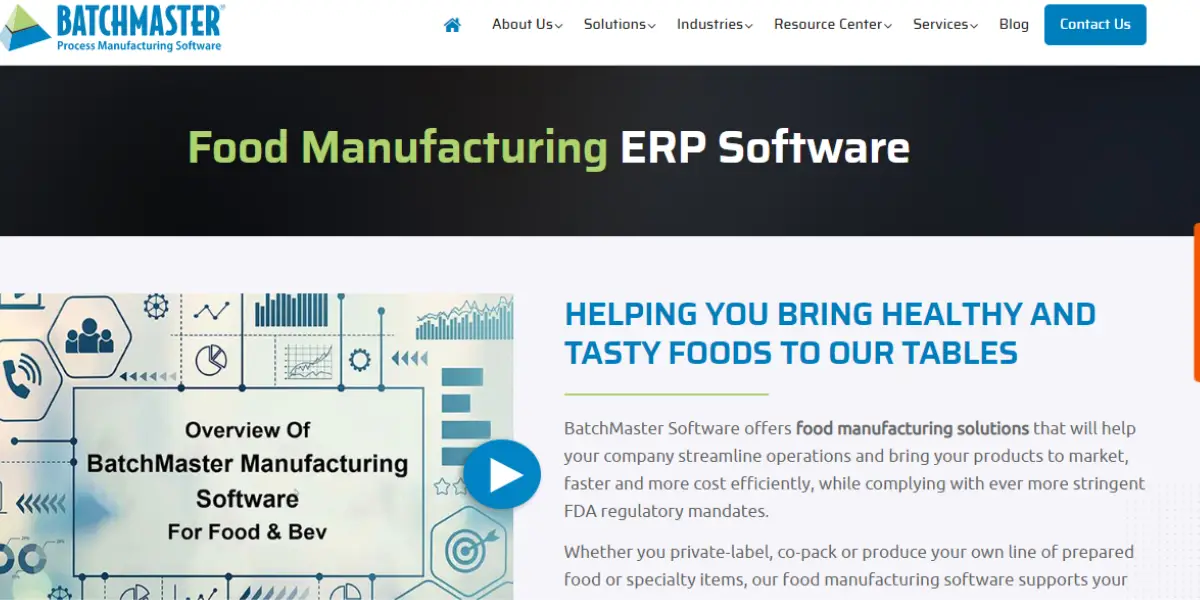
If you’re looking for ERP software specifically tailored to the food and beverage industry, BatchMaster is a great option.
It’s a cloud-based software that can be accessed from anywhere, which is ideal for businesses with multiple locations. It also offers recipe and formula management, inventory management, and quality control.
Features of food manufacturing
- Costing and analysis
- Formulation and packaging
- Inventory
- Planning and scheduling
- Batch production
- Quality management
- Packaging BOM
- Tracking and Compliance
- Product costing
- Master production schedule
- Material requirements planning
- Mobile warehousing
Screenshot of BatchMaster
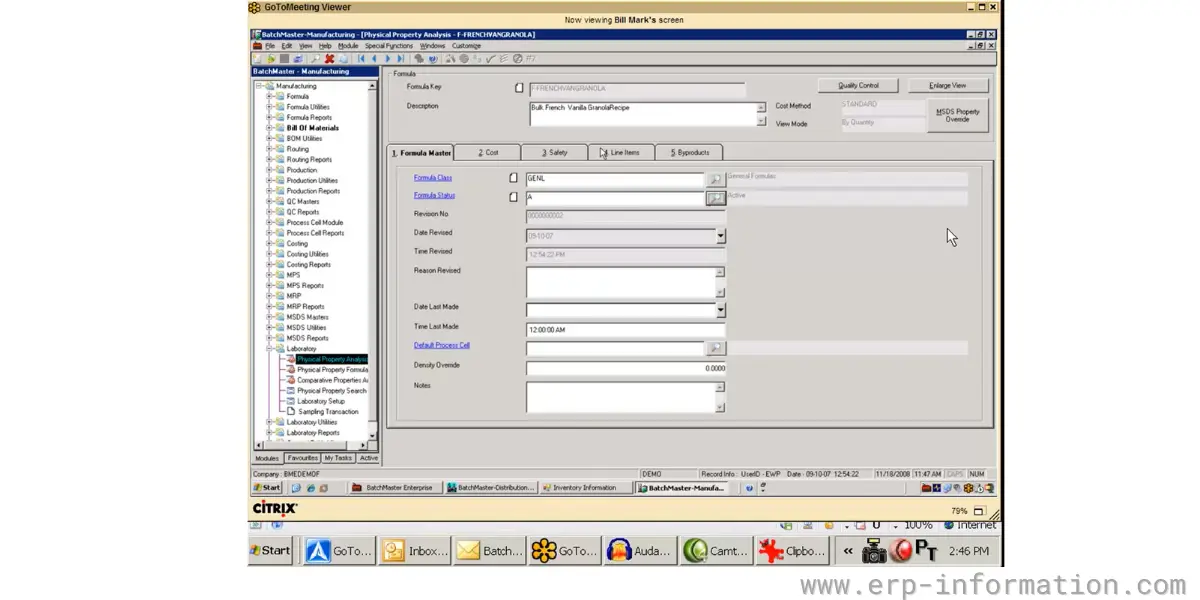
ERP modules for food manufacturing
- HR
- Marketing
- Customer relationship management
- Accounting
- Sales
- Purchasing
- Manufacturing
- Supply chain management
Pricing
The vendor does not disclose pricing details.
Likes
- It helps in compiling customer requirements easily and quickly.
- Generates FDA nutritional and ingredient labels.
- Generates lot numbers for semi-finished and finished products automatically.
- Generates customized COA reports.
Dislikes
- It is expensive
- The software is not user-friendly
- Layout and models are not easy
- Occasional Clunky Programming
- Unnecessary complexities
Supported industries
- Dairy
- Dressing and Sauces
- General Chemicals
- CBD Production
Other details
| Deployment | Cloud, SaaS, Web-Based |
| Supported device | Windows, Chromebook, Linux, Mac, Android, iPhone, iPad |
| Supported languages | German, English, French, Dutch, Spanish |
| Support | Email/Help Desk, FAQs/Forum, Knowledge Base, Phone Support, 24/7 (Live Rep), Chat |
| Training | In-person, Live Online, Webinars, Documentation, Videos |
| Customer ratings | Capterra: 4.8 out of 5 (5+ reviews), G2: 3.6 out of 5 (4+reviews) |
User opinion
BatchMaster ERP software is a process manufacturing software specifically designed for Food and beverage. It helps streamline operations and improve efficiency.
It is easy to use and gives great features such as recipe management, ingredient tracking, and inventory control.
It can be added to QuickBooks, Sage 100 / 300, Microsoft Dynamics GP, and SAP Business One or run as a full ERP solution.
The manufacturers can streamline their operations and ensure industry compliance while maintaining quality control and traceability throughout the production process.
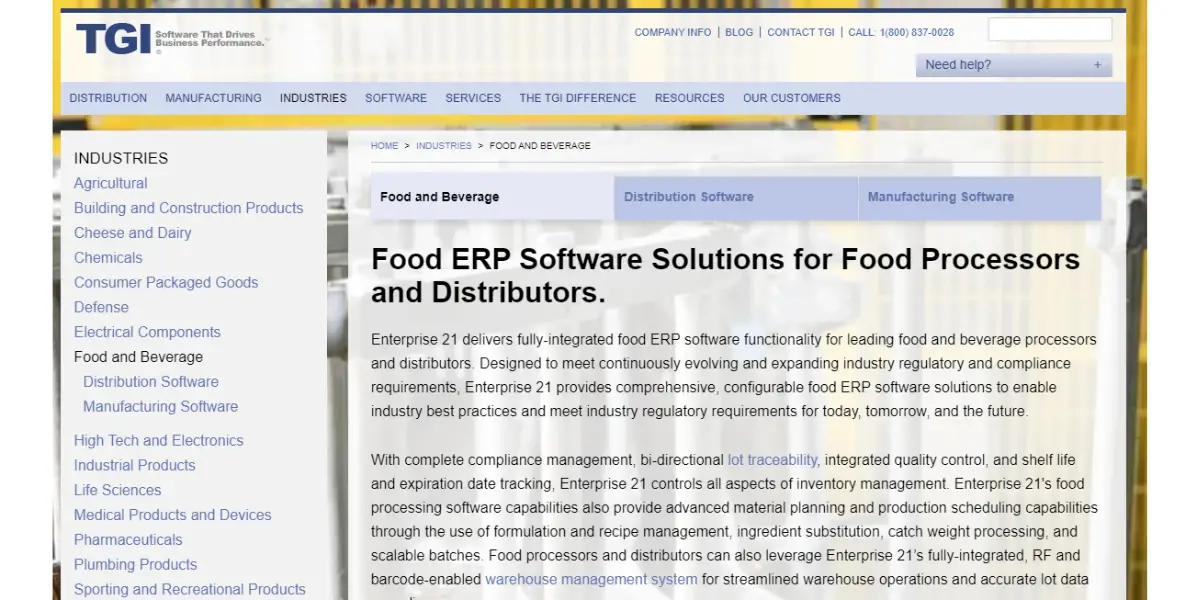
6. Enterprise 21
Enterprise 21 is an integrated ERP for small and mid-sized processors and distributors. Its vendor, Technology Group International, now trades as E21 ERP and its old tgiltd.com domain redirects to e21erp.com.
The software is designed to facilitate industry best practices and includes comprehensive functionality to manage the enterprise’s complete business operations.
Features
- Compliance management
- Bi-directional lot traceability
- Integrated quality control
- Shelf life and expiration date tracking
- Formulation and recipe management
- Ingredient substitution
- Catchweight processing
- Warehouse management
- Financial management
- Purchasing
- CRM
- BUSINESS Intelligence
- Order management
Pricing
Not provided by the vendor. Contact the vendor directly for the details.
Likes
- It provides a fully integrated food ERP software functionality
- It helps to meet industry regulatory requirements
- Provides advanced material planning and production scheduling capabilities
Dislikes
- More skills are required to use the software.
- It becomes slow sometimes.
- Lack of auto-apply functionality
- Inefficient payment matching
Supported industries
- Agricultural
- Chemicals
- Cheese and Dairy
- Defense
- Life Sciences
Other details
| Deployment | Cloud, SaaS, Web-Based |
| Supported device | Windows, Linux, Mac |
| Support | 24/7 (Live Rep), Chat |
| Customer ratings | Capterra: 4.5 out of 5 (5+ reviews) |
User opinion
It is a food and beverage management software and has all the features to manage your inventory, track your sales and finances, and more. In addition, it’s easy to use and can be customized to fit your specific needs.
Enterprise 21 is scalable, so you can easily grow and adapt to the changing needs of the business.
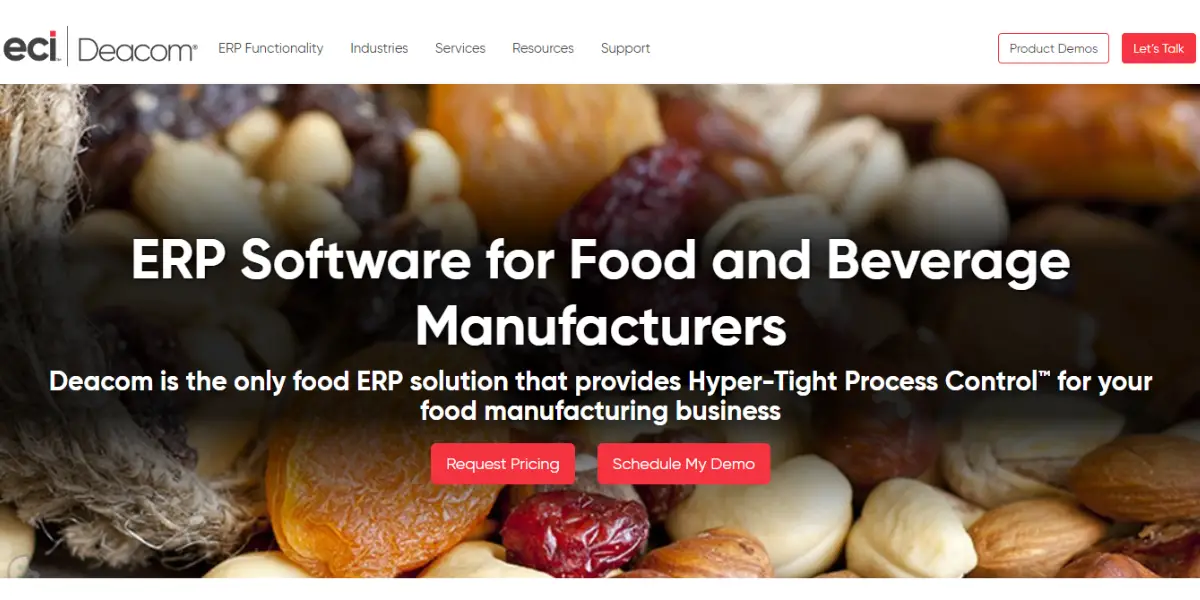
7. Deacom
Deacom is a process manufacturing ERP built on a single codebase, which is its main pitch: functionality arrives as part of the core product rather than as bolt-on modules. It has been owned by ECI Software Solutions since 2021 and is still sold as Deacom ERP.
Features
- Batch production
- Catch-weight management
- Labor tracking
- Maintenance
- MES
- Serialization
- Weigh up
- Formulation
- Supply chain planning
- Sales
- Accounting
- Warehousing
- Document generation
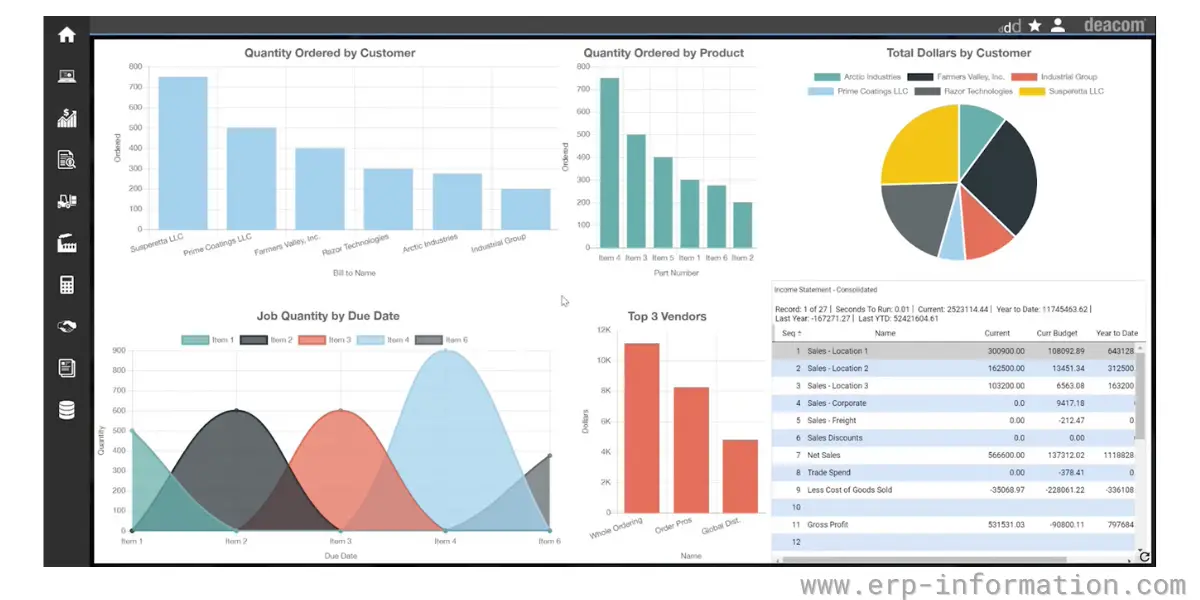
Screenshot of Deacom
Pricing
Not provided by the vendor.
Likes
- It provides all the features for the food and beverage business
- No need to have third-party integration
- You can easily plan and schedule production at multiple locations
- Solves the issues of raw material consumption
Dislikes
- It is not user-friendly
- It has a high learning curve
- Limited users can be used
Supported industries
- Health and Beauty
- Chemical
- Medical Device
- High-Tech
Other details
| Deployment | Cloud, SaaS, Web-Based |
| Supported device | Windows, Linux, Mac, Chromebook, Android, iPhone, iPad |
| Support | Email/Help Desk, Phone Support, 24/7 (Live Rep), Chat |
| Training | In-person, Live Online, Webinars, Documentation |
| Customer ratings | Capterra: 4.5 out of 5 (5+ reviews) |
User opinion
Deacom offers a wide range of functionalities that help to reduce the burden caused by multi-system complexities and avoid the manual workarounds that can plague traditional ERP implementations.
Its unique architecture enables all required functionality to be included in a single platform, eliminating the need for third-party integrations or bolt-ons.
8. Aptean
Aptean is a food ERP system with all the specialized capabilities and functionalities. It will take care of all the processes of food and beverages, like manufacturing, processing, delivering, etc.
It has specialized food ERP solutions you need to conquer your industry challenges.
Features
- Bi-directional ingredient tracking
- Demand balancing
- Food waste reduction
- Automatically calculated weight
- Lot tracing
- Product management
- Supply chain management
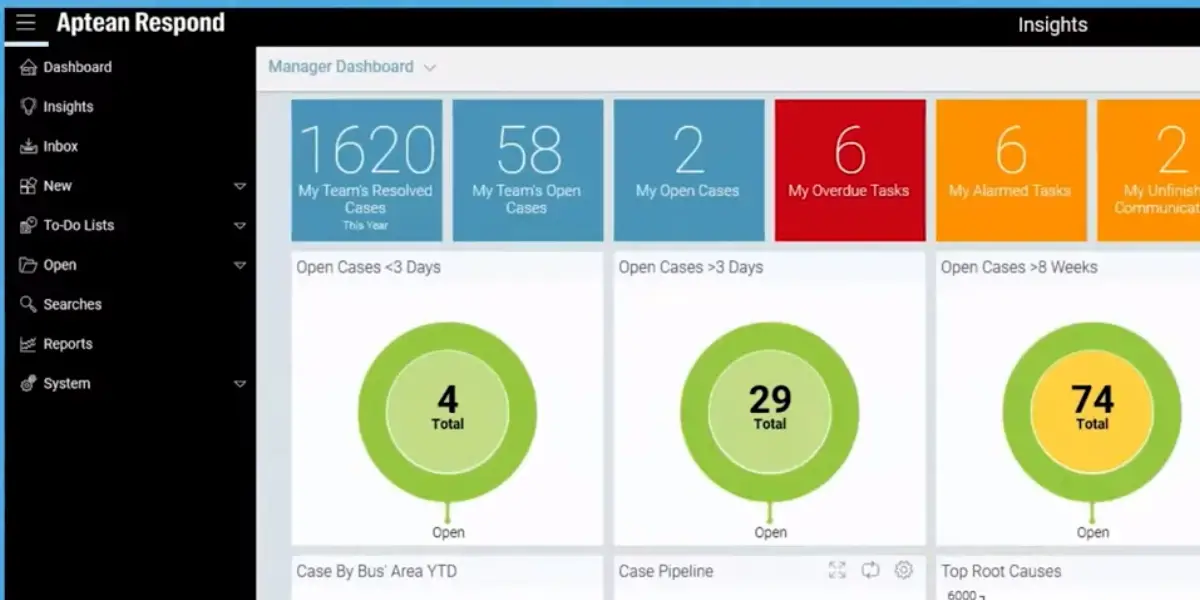
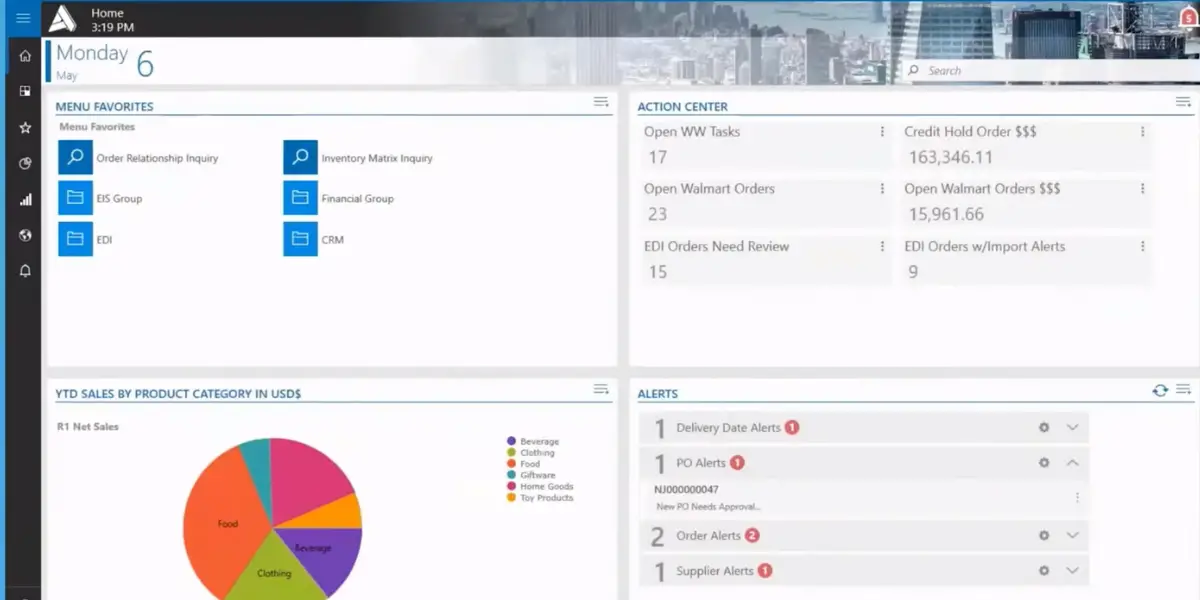
Screenshots of Aptean
Pricing
The vendor does not provide pricing details.
Likes
- Easy to customize
- Easy Tracking
- Easy to build reports
- Multi-currency options
- SCM supports a wide range of product variations
Dislikes
- Lack of control over features
- Lack of flexibility
Supported industries
- Fashion and Apparel
- Industrial Manufacturing
- Process Manufacturing
- Financial services
Other details
| Deployment | Cloud, SaaS, Web-Based |
| Supported device | On-Premise – Windows, Linux, Mobile – Android, iPhone, iPad |
| Support | Live Online, Documentation, Videos, In-Person, Webinars |
| Training | In-person, Live Online, Webinars, Documentation, Videos |
| Customer ratings | Capterra: 4.1 out of 5 (4+reviews), G2: 4.5 out of 5 (1+ reviews) |
User opinion
It is one of the good ERPs for food and beverages. You can do your delivery process without any damage to increase customer satisfaction. It helps to reduce maintenance costs and increase the visibility of the maintenance process. Its PLM feature speedup up your R&D processes.
9. DELMIAWorks (IQMS)
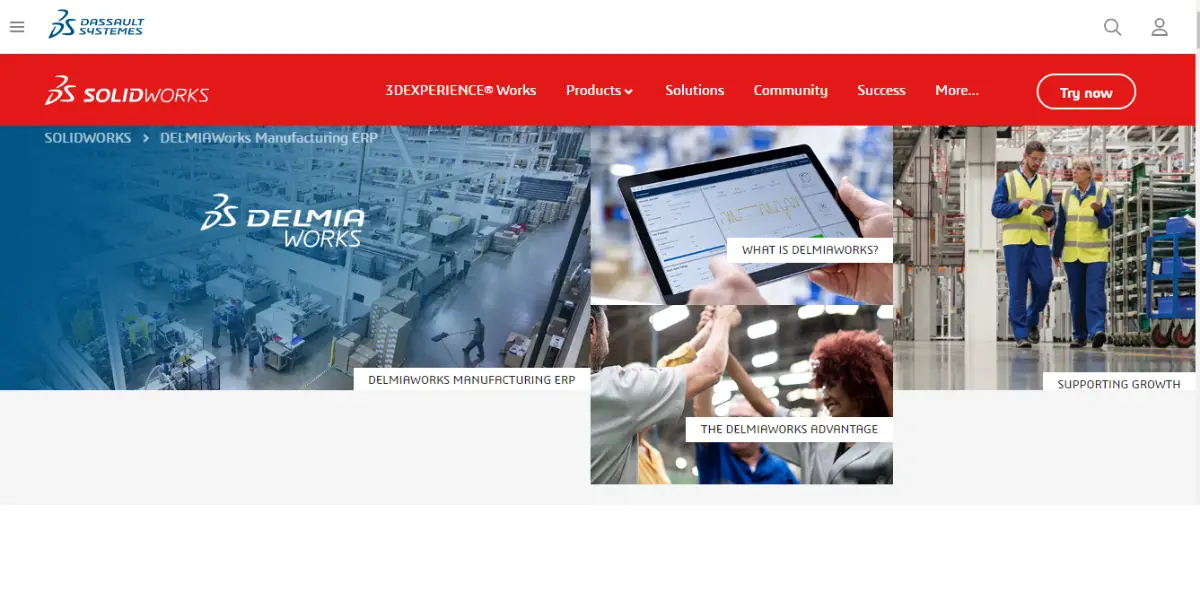
DELMIAWorks, previously sold as IQMS, combines ERP with shop-floor manufacturing execution, which suits plants that want production monitoring and traceability in the same system. It is owned by Dassault Systèmes and is now marketed under the SolidWorks brand.
In addition, DELMIAWorks offers a complete food manufacturing ERP and MES solution. That means every part of your business, from human resources and financial management to warehouse control and quality assurance, is connected.
Features
- Multiple UOM supported
- Private labeling functionality
- Quality and Compliance reporting
- Streamline your scheduling with a powerful engine that easily handles high-volume workloads
- Enable intricate sequencing and waiting periods
- Recipe flexibility with batch processing capabilities
Pricing
Contact the vendor directly for pricing details.
Likes
- Cut down on unnecessary waste and save money by avoiding ingredient spoilage and lot expiration challenges.
- Streamline and expedite customer auditing processes with automated tools.
- Ensuring customer orders are on time and fulfilled.
- Powerful management of the inventory of ingredients and production resources.
Dislikes
- Some customers feel that it is expensive.
- Lack of coverage of accounting payroll and corporate finance.
- The user interface is not good enough.
- The security section is difficult to manage.
- The implementation process is a difficult task.
Supported industries
- Aerospace and Defense
- Transportation and Mobility
- Life Science
- Home and Lifestyle
- High-Tech
Other details
| Deployment | Cloud, SaaS, Web-Based |
| Supported device | Windows, Linux, Android |
| Support | Email/Help Desk, FAQs/Forum, Knowledge Base, Phone Support, Chat |
| Training | In-person, Live Online, Webinars, Documentation, Videos |
| Customer ratings | Capterra: 4.1 out of 5 (286+ reviews) |
User opinion
DELMIAWorks is an end-to-end manufacturing ERP system offering a comprehensive solution for discrete and process manufacturers.
It provides a single platform to manage and monitor the entire manufacturing process, allowing for a modular and scalable approach.
The software offers extensive functionality, including finance, production, quality assurance, and supply chain management, catering to mid-market manufacturers.
10. QAD
QAD is a manufacturing ERP aimed at multi-site and global producers, covering inventory, order processing, forecasting and quality. The company now trades as QAD | Redzone after acquiring the Redzone connected-workforce platform in 2023, and it has been owned by the private equity firm Thoma Bravo since 2021.
Using QAD for food and beverages, businesses can reduce costs, increase efficiency and accuracy, improve customer service, and gain competitive advantages.
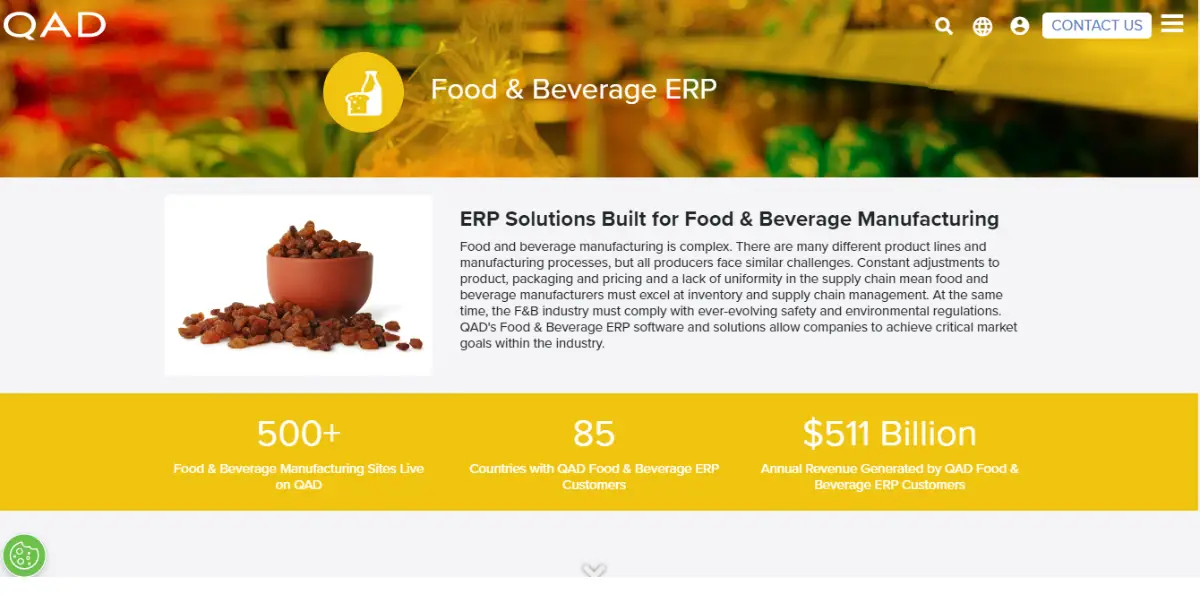
QAD’s Food & Beverage ERP software and solutions allow companies to achieve critical market goals within the industry.
Features
- Verticle segmentation helps to focus more on ERP.
- QAD food and beverages include QAD adaptive ERP, QAD adaptive information, QAD EQMS
- Supply chain management
- Quality and transportation management
- Digital ERP
Pricing
Contact the vendor directly for pricing details.
Likes
- Easy monitoring of supply chain and tracking orders.
- Digitalization helps effective management of food and beverages.
- Useful for shelf-stable products, like spirits, wine, candy, and confections.
- With QAD, your food and beverage manufacturing companies can count on quick and reliable cloud implementation.
- Better customer service through enhanced tracking of customer orders and preferences.
Dislikes
- Setting up data sheets can be lengthy.
- It is not Android/Windows-friendly.
- The sales plan and project management plan need to be improved more.
Supported industries
- Automotive
- Consumer products
- Hight-Tech
- Life Science
Other details
| Deployment | Cloud, SaaS, Web-Based |
| Supported device | Mac, Chromebook, Windows, Linux, Android, iPhone, iPad |
| Supported languages | Bulgarian, Czech, Danish, German, Greek, English, Finnish, French, Croatian, Hungarian, Italian, Japanese, Korean, Lithuanian, Dutch, Norwegian, Polish, Portuguese, Romanian, Russian, Slovak, Slovenian, Spanish, Swedish, Turkish, Ukrainian, Chinese (Simplified) |
| Support | Email/Help Desk, FAQs/Forum, Knowledge Base, Phone Support, 24/7 (Live Rep), Chat |
| Training | In-person, Live Online, Webinars, Documentation, Videos |
| Customer ratings | Capterra: 3.8 out of 5 (17+ reviews), G2: 3.5 out of 5 (16+ reviews) |
User opinion
QAD is a leading provider of innovative business software and services for global food and beverage manufacturing companies. It focuses on deploying technologies that simplify application support, enhance usability, and accelerate learning.
FAQs
What is ERP in the food industry?
ERP in the food industry refers to the integrated management of core business processes, often using specialized software, to streamline and optimize operations within food manufacturing, distribution, and retail.
It’s a comprehensive system that encompasses various facets like inventory management, supply chain logistics, quality control, and financial management tailored specifically to the food sector.
Conclusion
Shortlist on the food-specific capabilities rather than the general ERP feature grid, because that is where these systems actually differ. Take a real product, ideally one with a variable weight and an allergen, and make each vendor demonstrate the formula scaling, the catch weight handling, the shelf life allocation, and a backward and forward trace on a lot you nominate.
Then ask the FSMA 204 question directly: show me the electronic sortable spreadsheet this system produces for a nominated lot and date range, and tell me how long it takes. A vendor who can do that in the demo has solved the problem you are actually buying for. Get the implementation and data migration quoted in writing alongside the licenses, because that is the number that decides the first year.
Reference