Subtractive manufacturing makes a part by removing material from a solid starting piece, called stock, until only the designed shape is left. Turning, milling, drilling, grinding, electrical discharge machining (EDM), laser cutting and waterjet cutting are all subtractive. ISO/ASTM 52900 sets it beside the two other families, additive and formative manufacturing.
Formlabs calls it an umbrella term for machining and other material removal processes. What it buys you is accuracy: online machining services quote ±0.005 inch (0.13 mm) as their standard tolerance on metal parts. What it costs is material, because everything that is not the part leaves the machine as chips.
What is Subtractive Manufacturing?
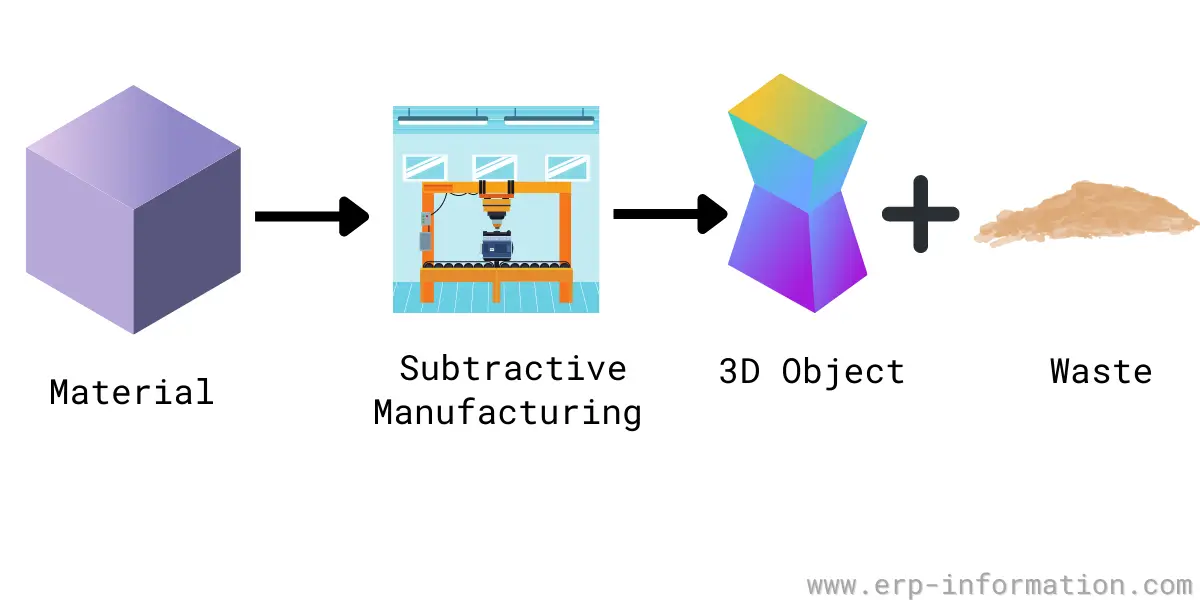
Subtractive manufacturing is any process that shapes a part by taking material away. NASA researchers describe the category as every process that makes a final or intermediate product “through the removal of material”, and name drilling, turning, milling, boring, broaching and grinding as examples (Watson and Taminger, 2018). Groover’s textbook adds the defining condition: the starting material is a solid “from which material is removed” until the remaining shape is the part (Groover, 7th ed., ch. 1).
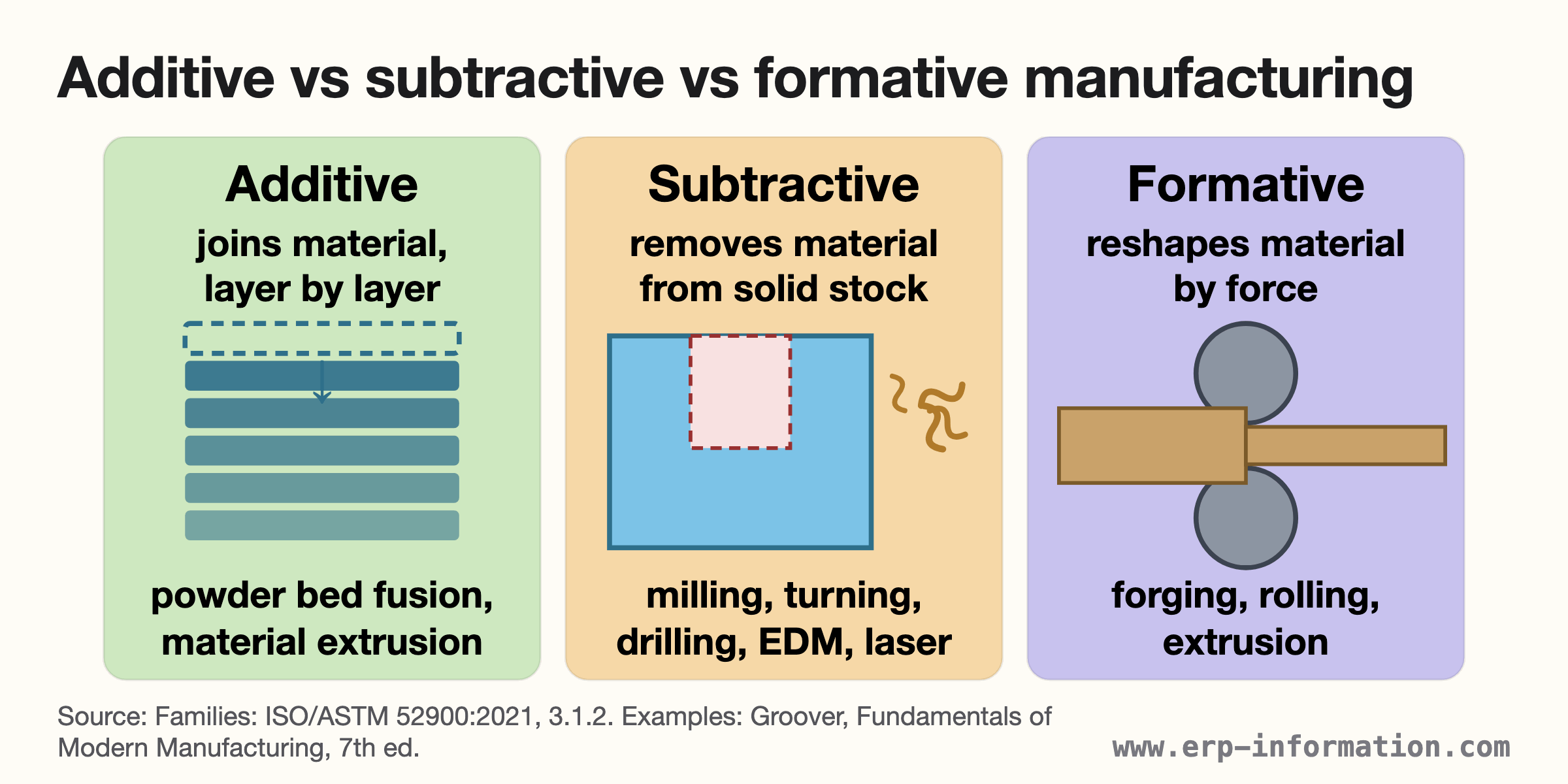
The vocabulary standard for 3D printing draws the line from the other side. ISO/ASTM 52900:2021 defines additive manufacturing as a “process of joining materials to make parts” from 3D model data, usually layer upon layer, and sets it “as opposed to subtractive manufacturing and formative manufacturing methodologies”. Its example of a subtractive method, in the entry on rapid tooling, is “CNC milling”. ISO reviewed and confirmed this edition in 2025, and it is still current.
| Family | What happens to the material | Examples |
|---|---|---|
| Additive | Joined, usually layer upon layer | Powder bed fusion, material extrusion |
| Subtractive | Cut away from solid stock; the waste leaves as chips or particles | Milling, turning, drilling, grinding, EDM, laser and waterjet cutting |
| Formative | Reshaped by forces that exceed the material’s yield strength | Forging, rolling, extrusion |
Is rolling a subtractive process?
No. Rolling reshapes metal under compression and cuts nothing away. DIN 8580:2022-12, the German standard that sorts every manufacturing process into six main groups, files it under forming (Umformen): rolling is part 2 of DIN 8583, “Manufacturing processes forming under compressive conditions”. Turning, milling, drilling and grinding sit in a different main group, cutting (Trennen). TU Bergakademie Freiberg’s lecture notes put its defining trait in one line: “Dabei ist die Endform des Werkstückes in der Ausgangsform enthalten.” (The final shape of the workpiece is contained in the starting shape.) Groover’s textbook also lists rolling with the bulk deformation processes. An earlier version of this page listed rolling as a kind of CNC machining; that was wrong.
The six DIN 8580 main groups are primary shaping (Urformen), forming (Umformen), cutting (Trennen), joining (Fügen), coating (Beschichten) and changing material properties (Stoffeigenschaft ändern). The 2022 edition, which replaced the 2003 one, added additive manufacturing as group 1.10 under primary shaping, so DIN and ISO/ASTM agree that 3D printing is not a subtractive process.
Example
The everyday example is a CNC mill cutting a part out of a block. On a CNC machine the shape comes from a program: “a virtual model designed in CAD software serves as input for the fabrication tool”, and CAM software turns it into tool paths (Formlabs). The controller reads those paths in a standard program format; ISO 6983-1:2009 “specifies requirements and makes recommendations for a data format for positioning, line motion and contouring control systems used in the numerical control of machines”. Programs can reach shop-floor machines over a direct numerical control (DNC) link. MIT’s Servomechanisms Lab built the first numerically controlled machine tool in 1952, under US Air Force sponsorship (MIT Museum).
Worked example: a small housing milled from aluminum (our calculation)
Take a block of 6061 aluminum, 100 × 60 × 40 mm, and mill an open pocket 80 × 40 × 30 mm into it after skimming 1 mm off the top face. The result is a small electronics housing with 10 mm walls and a 10 mm floor. Density 2.70 g/cm³ comes from a 6061-T6 material data sheet.
| Quantity | How it is worked out | Result |
|---|---|---|
| Stock bought | 100 × 60 × 40 mm | 240 cm³, 648 g |
| Face skimmed | 100 × 60 × 1 mm | 6 cm³ |
| 80 × 40 × 30 mm | 96 cm³ | |
| Finished part | 240 − 6 − 96 | 138 cm³, 373 g |
| Chips | 6 + 96 = 102 cm³ | 275 g (42.5% of the block) |
| Buy-to-fly ratio | 648 g ÷ 373 g | 1.74 : 1 |
How long does the pocket take to rough out? Sandvik Coromant’s milling formulas give the metal removal rate as Q = ap × ae × vf ÷ 1000 (cm³/min). The table feed is vf = fz × n × z, and the spindle speed is n = vc × 1000 ÷ (π × Dc) (Sandvik Coromant). Assume a 12 mm, 3-flute end mill at cutting speed 300 m/min and 0.05 mm per tooth, cutting 6 mm deep and 6 mm wide. Then n = 7,958 rpm, vf = 1,194 mm/min and Q = 43 cm³/min, so the 96 cm³ pocket needs about 2.2 minutes of pure cutting. Finishing passes, rapid moves and tool changes come on top. These inputs are illustrative; take real cutting data from your tool maker for your machine.
Real parts are often far more wasteful than this housing, which keeps 57.5% of its block. NASA researchers report that “Buy-to-fly ratios of 10-to-1 are common in aerospace applications”, meaning only about 10 percent of the metal bought ends up in the part (Watson and Taminger). TWI measured a titanium aerospace part machined from solid at 10.9 : 1 and notes the ratio “can be as poor as 20:1 and is rarely as good as 4:1” (TWI). In dentistry, about 90 percent of the starting block is milled away to make a typical restoration such as a crown (Torabi et al., 2015).
Types of Subtractive Manufacturing Processes
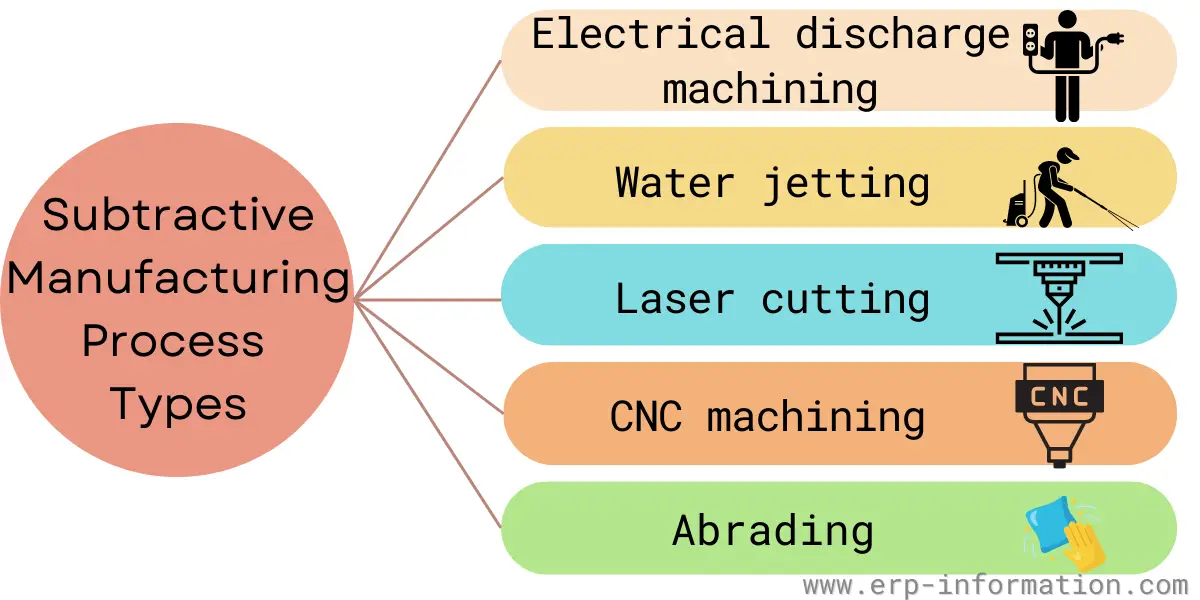
Textbooks sort subtractive processes by how the material is removed. Conventional machining uses a tool that touches the work, either a sharp cutting edge or abrasive grains. The IIT Kharagpur course notes list “turning, boring, milling, shaping, broaching, slotting, grinding” as conventional. Everything else is nontraditional, and “classification of NTM processes is carried out depending on the nature of energy used”: mechanical (waterjet, ultrasonic), electro-thermal (EDM, laser, electron beam), electrochemical and chemical (NPTEL, IIT Kharagpur, Lesson 35).
| Process | How it removes material | What it cuts, and the catch |
|---|---|---|
| Turning | “a single-point cutting tool removes metal from a rotating workpiece to reduce its diameter” (Groover) | Cylindrical parts such as pins, shafts and spacers (Fictiv) |
| Milling | “a work part is fed past a rotating cutter with multiple cutting teeth” (Groover) | Pockets and ribs cut from a solid block, as in stiffened aerospace plates (NASA) |
| Drilling | “a rotating drill bit is fed into the work to create a round hole” (Groover) | Holes |
| Grinding | A wheel of bonded abrasive grains, an undefined cutting edge (TU Freiberg) | Finishing, including hardened surfaces (Mazak) |
| Waterjet | Water at up to 94,000 psi, with or without garnet abrasive, erodes the material (Flow) | Pure water: foam, gasket, plastic, food. Abrasive: metal, ceramic, stone, glass, composite. No heat-affected zone; OMAX advises against tempered glass |
| Laser cutting | The beam heats the material until it melts or vaporizes (TRUMPF) | Steel, aluminum, plastics, glass, wood, ceramics, 0.5 to over 30 mm thick (TRUMPF) |
| Plasma cutting | An electric arc between electrode and workpiece drives a jet of ionized gas (Hypertherm) | Conductive metals; the arc has to run to the workpiece |
| EDM (wire or sinker) | Sparks between an electrode and the workpiece in dielectric fluid erode the material (Makino) | Conductive materials of any hardness; cannot cut plastic (Sodick); slower than conventional machining |
Two details matter when you pick between them. Lasers differ by wavelength: TRUMPF says the CO2 laser “achieves very good absorption with organic materials” such as wood, while “Unlike CO2 lasers, solid-state lasers are also suitable for cutting copper or brass.” (TRUMPF TruFlow; TRUMPF 2D laser cutting brochure). And EDM needs a workpiece that conducts electricity: “Work material to be machined by EDM has to be electrically conductive.” (NPTEL, Lesson 39). Wire EDM feeds a thin metal wire through the part; sinker EDM pushes a shaped electrode into it (Sodick).
When to Use Subtractive Manufacturing?
Use it when one of these is true:
- The part needs tight tolerances. Protolabs “can hold a machining tolerance of +/- 0.005 in. (0.13mm)” at its automated plant (Protolabs); Xometry holds metals to ±0.005 in and plastics to ±0.010 in by default, and goes “sub +/- 0.001” inch when the drawing calls for it (Xometry).
- The part is mostly solid. NASA’s energy model compares the two routes by how much of the part’s bounding box is solid: “For volume fractions greater than the critical value, subtractive manufacturing is more efficient.” (Watson and Taminger).
- You must start from a particular solid material. Between them, cutting tools, abrasives, sparks and jets cut almost any solid, from foam and plastics to hardened steel (see the process table above).
Look elsewhere when:
- The part is mostly empty space or has closed internal channels. Below the critical volume fraction, “additive manufacturing is more energy efficient” (NASA), and a cutter cannot reach a cavity that has no opening. Compare the two routes in our additive vs subtractive manufacturing guide.
- You need many identical parts with little waste. Groover notes that machining tends to be wasteful of material, while “certain casting and molding operations, often convert close to 100%” of the starting material into product.
How to Choose the Proper Subtractive Process?
Seven things decide it: the material, the part’s shape and size, the tolerance, the surface finish, the quantity, the lead time and the budget. The questions below put them in a working order: material first, then shape, then tolerance, and only then quantity, lead time and budget.
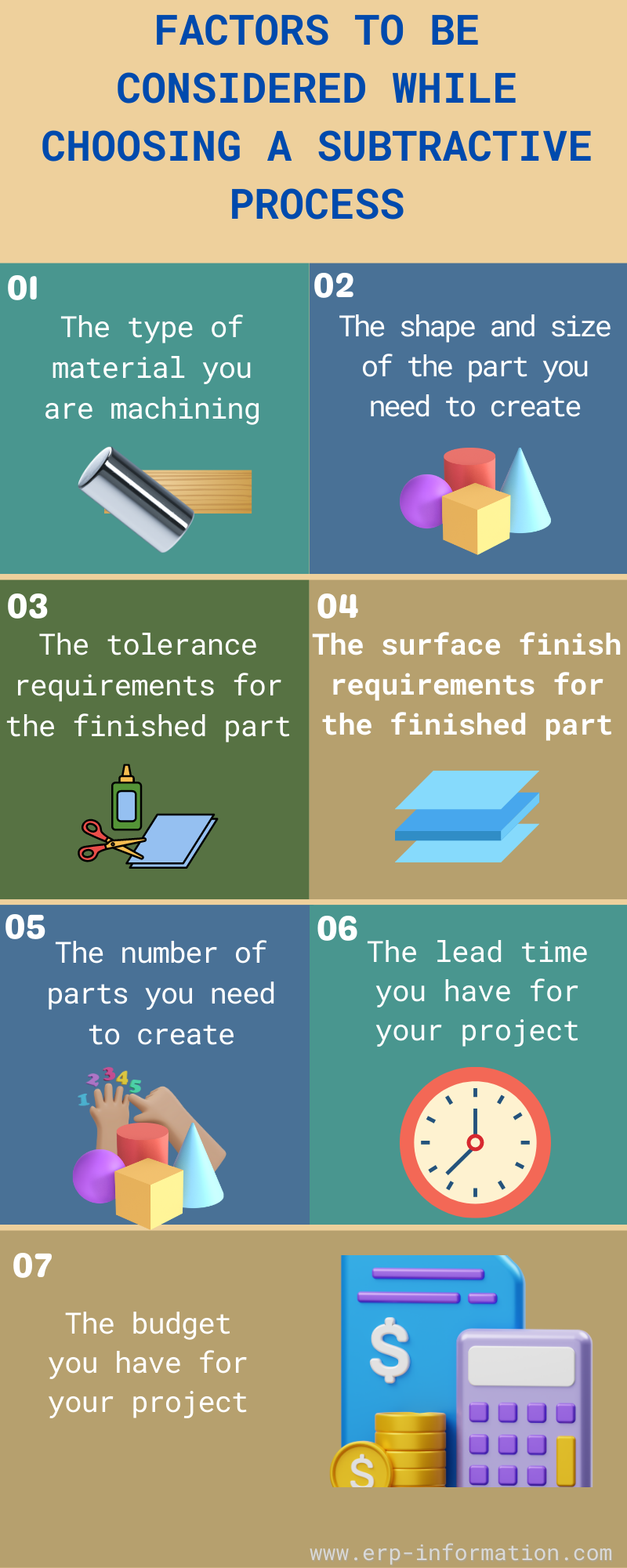
- Does the material conduct electricity? EDM and plasma need a conductive workpiece (NPTEL; Hypertherm). For glass and stone, look at an abrasive waterjet; for plastics and wood, a laser, a waterjet or cutting tools.
- Must the part stay cool? Abrasive waterjet “is a cold cutting process and creates no heat-affected zones (HAZ)” (OMAX). Laser and EDM are electro-thermal processes.
- Is it a flat profile or a 3D shape? Laser, waterjet and plasma cut through sheet and plate. Turning makes cylindrical parts such as pins and shafts, drilling makes round holes, and milling cuts pockets and other features out of a solid block. Wire and sinker EDM handle “deep pockets, complex internal features” (Fictiv).
- Is the material hardened? EDM machines “conductive materials of any hardness” (Makino). For hardened surfaces, Mazak notes the traditional sequence: hardening, “followed by grinding for finishing” (Mazak).
- How tight does it really need to be? Put tight tolerances only on the features that need them. Protolabs, Xometry and Hubs all apply a general-tolerance standard, ISO 2768, to dimensions that carry no tolerance of their own. ISO 2768-1:1989 is about to change: on 13 October 2026 ISO listed a new ISO 2768 as “under publication” and says it “Will replace ISO 2768-1:1989”.
- Then quantity, lead time and budget. Ask for quotes on at least two candidate processes for the quantity you actually need.
Advantages and Disadvantages

- Tight tolerances
- Good finish off the machine
- Almost any solid material

- Material waste
- Shapes a tool cannot reach
- Machine and coolant hazards
Advantages
- Accuracy. ±0.005 in (0.13 mm) is a routine standard tolerance, and tighter is possible on request; Hubs quotes “tolerances down to ±.020 mm” (Hubs).
- A good surface straight off the machine. Hubs lists an as-machined finish of Ra 3.2 µm with smoother grades as options; Xometry’s standard is “125 Ra or better”.
- Almost any material. Cutting tools must be harder than the work; for harder or heat-sensitive materials there are EDM, waterjet and lasers. Groover notes the cutting operations “are most commonly applied to solid metals, performed using cutting tools that are harder and stronger than the work metal”.
Disadvantages
- Material waste. “Material removal processes (e.g., machining) tend to be wasteful of material, simply by the way they work.” (Groover). The stock is “sized by the extreme dimensions of the part” and most of it can end up as chips (NASA). Metal scrap can go back for recycling, which NASA’s energy model counts, but in dental milling “recycling of the excess ceramic material is not feasible” (Torabi et al.).
- Shapes the tool cannot reach. In dental milling, “The precision fit of the inside contour of the restoration depends on the size of the smallest usable tool” for each material (Torabi et al.). Closed internal channels cannot be machined at all.
- Tool wear. In ceramic dental milling, the same review says tools are “exposed to heavy abrasion and wear, therefore, withstanding only short running cycles”.
- Process-specific limits. EDM is slower than conventional machining (Makino); EDM and plasma need a conductive workpiece; laser cutting slows as the material gets thicker (TRUMPF).
Is subtractive manufacturing dangerous?
It can be, which is why US law requires guarding. OSHA’s general rule for all machines, 29 CFR 1910.212, requires one or more methods of guarding to protect people “from hazards such as those created by point of operation, ingoing nip points, rotating parts, flying chips and sparks.” Grinders have their own rule, 29 CFR 1910.215, for abrasive wheel machinery.
Coolant mist is the other hazard. NIOSH “recommends that exposures to MWF aerosols be limited to 0.4 milligrams per cubic meter of air (thoracic particulate mass)” over a workday, and lists hypersensitivity pneumonitis, chronic bronchitis, impaired lung function, asthma and skin problems among the effects (NIOSH, archived page). NIOSH estimates that about 1.2 million workers in machining and metal-forming jobs are potentially exposed to metalworking fluids.
Where is subtractive manufacturing used?
- Aerospace structures. TWI traces poor buy-to-fly ratios to “components being machined from oversized ingots, forgings or extrusions” (TWI).
- Dental crowns and bridges. CAD/CAM systems mill restorations from prefabricated ceramic or metal blocks (Torabi et al.).
- Molds, dies and cavities. Die-sinking EDM is used for “machining of complex cavities” in “difficult to machine conductive materials” (AgieCharmilles).
- Sheet and plate parts. Laser, plasma and waterjet machines cut parts from flat stock, a routine step in discrete manufacturing.
What is hybrid manufacturing?
Hybrid manufacturing combines additive and subtractive steps, often in one machine. DMG MORI’s LASERTEC 65 DED hybrid puts “Milling, turning, grinding, laser pre-heating, additive manufacturing and DMG MORI scan3D integrated in one single machine” (DMG MORI). Mazak describes its hybrid multi-tasking machines the same way: they “enable machining during the layering process, allowing the shape of each layer to be refined as the build progresses.” (Mazak). For the printing side, see additive manufacturing; our 3D print time calculator estimates how long a print will take.
FAQs
Is CNC machining subtractive manufacturing?
Yes. CNC machining removes material from a solid workpiece under program control, and ISO/ASTM 52900 names CNC milling as an example of a subtractive method. The standard program format for numerical control is ISO 6983-1, which ISO last confirmed in 2025.
Is 3D printing subtractive or additive?
Additive. ISO/ASTM 52900 defines additive manufacturing as joining materials to make parts from 3D model data, usually layer upon layer, as opposed to subtractive manufacturing. Hybrid machines do both: they deposit metal with a laser and then mill it in the same machine.
Is rolling or forging a subtractive process?
No. Both reshape metal by force without cutting any away, so they are formative (deformation) processes. Groover’s textbook classes forging and rolling as deformation processes, and DIN 8580 files rolling under forming (Umformen), not under cutting (Trennen).
Why does subtractive manufacturing waste so much material?
The stock has to be as big as the part’s outer dimensions, and everything outside the part leaves as chips. Buy-to-fly ratios of 10 to 1 are common for machined aerospace parts, according to NASA researchers, and about 90 percent of the block is milled away for a typical dental restoration. Metal chips can be recycled; leftover dental ceramic cannot.
Can one machine do both additive and subtractive work?
Yes. Hybrid machines combine the two. DMG MORI’s LASERTEC 65 DED hybrid, for example, integrates milling, turning, grinding and laser deposition in one machine, so a feature can be built up and then machined to size.
Which subtractive process fits your part?
Start from the material and the shape. A conductive, hardened part with fine internal detail points to EDM; a flat profile points to laser or waterjet, or plasma if the metal conducts; a cylindrical part to turning; and pockets to milling. Then set tolerances only where the part needs them. If most of the block would end up as chips, price a near-net-shape blank as well: in TWI’s titanium example it cut the buy-to-fly ratio from 10.9 : 1 to 3.7 : 1.
How we researched this page (checked 13 October 2026). Definitions and classification come from ISO/ASTM 52900, DIN 8580 and 8583, TU Bergakademie Freiberg and IIT Kharagpur course notes and Groover’s textbook. Process facts come from the machine makers’ own pages (Makino, Sodick, Flow, OMAX, TRUMPF, Hypertherm, DMG MORI, Mazak). Tolerances come from Protolabs, Xometry and Hubs, formulas from Sandvik Coromant, waste figures from NASA, TWI and a dental review, and safety rules from eCFR and NIOSH. Numbers marked as our calculation can be redone from the inputs shown. An earlier version of this page listed rolling as CNC machining, said EDM cuts plastics, said subtractive manufacturing uses less material, and showed a packaging-line photo as its main image; all are corrected.
References
- ISO/ASTM 52900:2021, Additive manufacturing: General principles, Fundamentals and vocabulary (confirmed 2025)
- DIN 8580:2022-12, Manufacturing processes: Terms and definitions, division (DIN Media)
- DIN 8583-2, Manufacturing processes forming under compressive conditions: Part 2, Rolling (DIN Media)
- TU Bergakademie Freiberg, Fertigungstechnik lecture notes: Trennen (DIN 8580, DIN 8589)
- Groover MP. Fundamentals of Modern Manufacturing, 7th ed., chapter 1 (Wiley excerpt)
- Groover MP. Fundamentals of Modern Manufacturing, 7th ed., table of contents (Wiley excerpt)
- NPTEL, IIT Kharagpur, Manufacturing Processes II, Lesson 35: Non-traditional machining
- NPTEL, IIT Kharagpur, Manufacturing Processes II, Lesson 39: Electrical discharge machining
- ISO 6983-1:2009, Numerical control of machines: Program format and definitions of address words, Part 1
- ISO 2768-1:1989, General tolerances, Part 1 (stage: to be revised)
- ISO 2768 (edition 2), Tolerance limits for general specification of linear and angular sizes (under publication)
- Watson JK, Taminger KMB. A decision-support model for selecting additive manufacturing versus subtractive manufacturing based on energy consumption. J Cleaner Production 2018 (NASA NTRS manuscript)
- TWI. Linear friction welding of Ti-6Al-4V for aerostructure applications (2016)
- Torabi K, Farjood E, Hamedani S. Rapid prototyping technologies and their applications in prosthodontics, a review of literature. J Dent (Shiraz) 2015;16(1):1-9
- Sandvik Coromant: Milling formulas and definitions
- Protolabs material data sheet: aluminum 6061-T651/T6
- Protolabs: CNC milling design guidelines
- Xometry: CNC machining service
- Hubs (Protolabs Network): CNC machining service
- Flow International: How waterjet works
- OMAX: Waterjet cutting
- TRUMPF: Laser cutting
- TRUMPF: TruFlow CO2 lasers
- TRUMPF: 2D laser cutting brochure (US)
- Hypertherm: How does a plasma cutter work?
- Makino: EDM machining process
- Sodick: What is an EDM machine used for?
- DMG MORI: LASERTEC 65 DED hybrid 2nd Generation
- Mazak: Additive manufacturing
- Fictiv: CNC machining services
- AgieCharmilles: Die-sinking EDM
- Formlabs: Additive vs. subtractive manufacturing
- 29 CFR 1910.212, General requirements for all machines (eCFR)
- 29 CFR 1910.215, Abrasive wheel machinery (eCFR)
- NIOSH: Metalworking fluids (archived topic page)
- MIT Museum: A Numerically Controlled Milling Machine (film record, 1952 machine)
Using Google Search? Add erp-information.com as a preferred source.