Contract lifecycle management (CLM) is the process of running a contract through eight stages (initiation, planning, drafting, negotiation, execution, management, renewal and close-out), together with the software that keeps a record of each step. The ANSI-approved NCMA Contract Management Standard groups the same work into three phases: pre-award, award and post-award.
This page explains what happens at each stage, who usually owns it and what it should leave on record. It also covers the laws that put hard deadlines on three of the stages: e-signature rules at execution, automatic-renewal notice laws at renewal, and limitation periods that decide how long a closed contract must be kept. Every statute and standard cited below was checked at its official source on 5 October 2026.
What is a Contract Lifecycle?
A contract lifecycle is the sequence a contract passes through, from the business need that triggers it to the day no obligation under it survives. That last day usually comes after the expiry date: confidentiality, indemnity and audit clauses often outlive the term, and a claim for breach can be brought until the limitation period runs out.
The National Contract Management Association (NCMA) describes the lifecycle in its Contract Management Standard (Fourth Edition, ANSI/NCMA ASD 1-2019 (R2025)), which is approved as an American National Standard. It has three phases. In pre-award, the buyer develops a solicitation and the seller develops an offer. In award, the parties form the contract, which includes negotiating it. In post-award, they perform the contract and then close it.
Every contract follows that arc, whether it is a two-page NDA or a ten-year outsourcing deal. What changes with value and risk is how much control each stage needs: a standard NDA may need no negotiation at all, while a regulated supply agreement can spend weeks in negotiation and approval.
What is Contract Lifecycle Management?
Contract lifecycle management is the discipline of running every stage of that lifecycle through one process and one record, so that anyone can answer four questions about any contract: what did we agree, who owns it, what do we owe each other next, and when does it end or renew.
CLM software automates that discipline. A typical CLM system combines a central repository, a template and clause library for drafting, redlining and version control for negotiation, approval workflows, e-signature (built in or integrated), obligation and milestone tracking, renewal alerts and reporting. Gartner evaluated 16 vendors in its 2025 Magic Quadrant for Contract Life Cycle Management.
CLM is not the same as contract administration. Contract administration is the post-award work of managing a signed contract; in US federal procurement it has its own part of the Federal Acquisition Regulation, FAR Part 42, Contract Administration and Audit Services. CLM covers the whole span, from the first request to the archived record.
What are the Stages of Contract Lifecycle Management?
Contract lifecycle management has eight stages in the model used on this page: initiation, planning, drafting, negotiation, execution, management, renewal and close-out. Stages 1 to 3 fall in NCMA’s pre-award phase, stages 4 and 5 in the award phase, and stages 6 to 8 in the post-award phase.
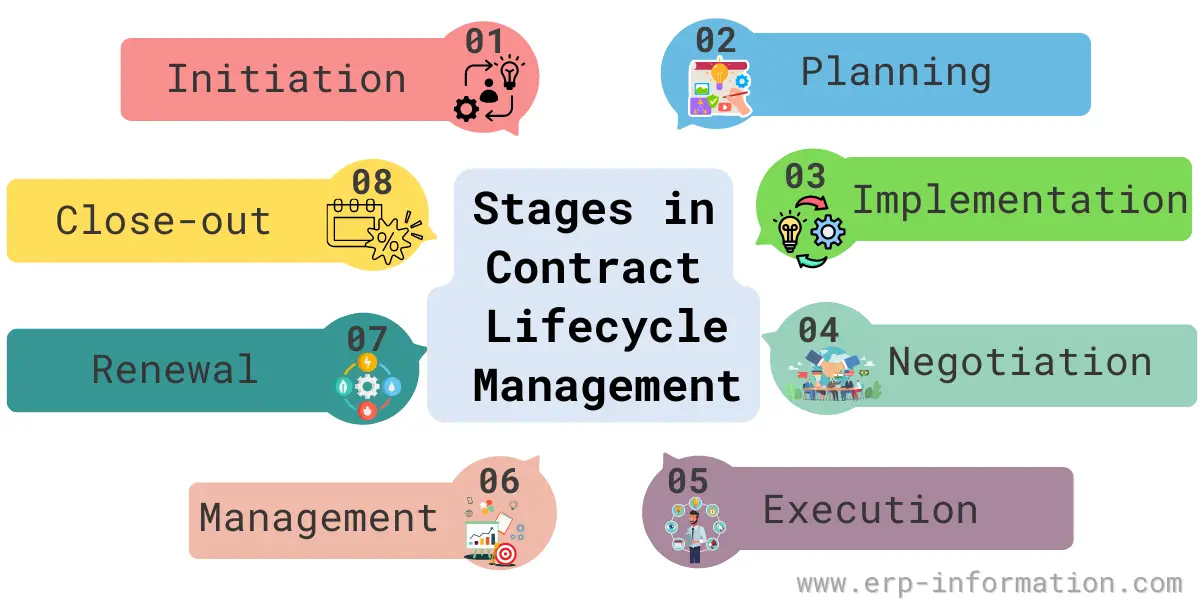
| Stage | NCMA phase | What happens | Usually owned by | Leaves on record |
|---|---|---|---|---|
| 1. Initiation | Pre-award | The business asks for a contract and supplies the facts: counterparty, purpose, value, dates, data involved | Requester (sales, procurement, HR) | Intake request |
| 2. Planning | Pre-award | Choose the contract type, the template or the other side’s paper, the approval route and the checks the deal triggers | Legal or contract manager, with procurement or sales | Chosen template, approval route, risk flags |
| 3. Drafting | Pre-award | Build the first draft from approved templates and clauses | Legal, or the business for low-risk templates | First draft linked to the request |
| 4. Negotiation | Award | Exchange redlines until both sides accept the same text | Legal and the commercial lead | Version history and a list of agreed deviations |
| 5. Execution | Award | Internal approvals, then signature by authorised signatories | Approvers and signatories | Signed copy, signature audit trail, approval log |
| 6. Management | Post-award | Deliver, invoice, track obligations and milestones, record amendments | Contract owner in the business; finance for payments | Obligation register, amendments, payment records |
| 7. Renewal | Post-award | Renew, renegotiate or exit before the notice deadline | Contract owner and procurement | Renewal decision and the dated notice |
| 8. Close-out | Post-award | Confirm delivery and payment, settle open issues, archive | Contract manager and finance | Close-out record and retention end date |
Initiation
Initiation starts when someone in the business needs a contract: a supplier to buy from, a customer to sell to, an NDA before a meeting. The cheapest control in the whole lifecycle sits here. A short intake form captures the counterparty’s full legal name, the purpose, the estimated value, the start date, whether personal data will be shared and whose paper will be used. A request that arrives without those facts sends legal back to the requester with questions before drafting can begin.
Planning
Planning decides how the contract will be built before anyone writes a clause. The decisions are the contract type (fixed price, time and materials, cost-reimbursement or subscription), whether to start from your template or the other side’s paper, which approvals the value and risk require, and which specialist checks apply. NCMA’s standard calls this work “plan solicitation” on the buyer side and “plan sales” on the seller side.
Some of those checks are legal requirements, not preferences. Under Article 28(3) of the EU GDPR, processing of personal data by a processor “shall be governed by a contract or other legal act” that sets out the subject-matter and duration of the processing, its nature and purpose, the type of personal data and the categories of data subjects. A planning step that flags personal data early means the data processing terms are drafted with the main contract instead of being added after signature.
Drafting
Drafting turns the plan into a first version. In a mature process it is assembly rather than writing: the draft is built from an approved template and a clause library that holds pre-approved fallback wording for the clauses that usually get negotiated. Low-risk documents such as a mutual NDA can then be generated by the business without waiting for legal, and legal’s time goes to the contracts that need it.
When the other side insists on its own paper, drafting becomes review: compare its text against your standard positions and mark every deviation before negotiation starts.
Negotiation
Negotiation is the exchange of redlines until both parties accept the same text. NCMA places it in the award phase, inside the domain it calls Form Contract. Two records matter here: the version history, so that nobody signs a draft other than the agreed one, and a list of every deviation from your standard positions, so the business knows later what it actually agreed.
A negotiation playbook sets those positions in advance. Start with the clauses that are fought over most. WorldCC’s Most Negotiated Terms 2024 report, based on responses from 937 organisations and supported by Icertis, ranks limitation of liability first, price and price changes second and indemnification third, followed by termination and payment. For each of those clauses the playbook gives the preferred wording, the acceptable fallbacks and the person who can approve anything beyond them.
Execution
Execution means signing. Before anyone signs, the contract passes the internal approvals set at planning, such as finance above a value threshold, legal for non-standard terms and security when the other side will touch your systems or data. Then the authorised signatories sign. The stage should leave three things on record: the fully signed copy, the approval log and the signature audit trail.
In the United States, the ESIGN Act, 15 U.S.C. § 7001(a), says a contract “may not be denied legal effect, validity, or enforceability solely because an electronic signature or electronic record was used in its formation.” It does not force anyone to sign electronically, and § 7003 excludes some documents, including wills, family-law matters, court documents, certain notices such as utility cut-offs and product recalls, and most of the Uniform Commercial Code apart from Articles 2 and 2A (sales and leases of goods). The Uniform Electronic Transactions Act has been enacted in 52 of the 53 US jurisdictions the Uniform Law Commission tracks; New York relies on its own Electronic Signatures and Records Act instead.
In the European Union, Article 25 of the eIDAS Regulation (EU) No 910/2014, as amended by Regulation (EU) 2024/1183, says an electronic signature “shall not be denied legal effect and admissibility as evidence in legal proceedings solely on the grounds that it is in an electronic form”, and that “a qualified electronic signature shall have the equivalent legal effect of a handwritten signature.” Since the 2024 amendment, the rule that a qualified signature from one member state is recognised in all the others sits in a new Article 24a.
Not every guide uses the word this way: Wolters Kluwer, for one, uses “execution” for performing the contract after signature. The stage comparison below shows where the models differ.
Management
Management is the longest stage, running from signature to expiry. Its job is to make sure both sides do what they promised: deliveries and service levels, payments and price adjustments, reports, insurance certificates and audits. An obligation register lists each duty with an owner and a due date, so the commitments do not live only in the memory of whoever negotiated them.
Changes go through a formal amendment, signed under the same authority rules as the original. NCMA’s standard treats managing changes, remedies and disputes as post-award work. Side letters and changes agreed by email are where a contract repository stops matching reality, so they belong in the record too.
Contract Renewal
Renewal is where missed dates cost money. Many contracts renew automatically for another term unless one party gives notice before a deadline set in the contract. The date that matters is that notice deadline, not the expiry date, so renewal alerts belong on the notice deadline and should fire early enough to compare alternatives.
Two US states regulate automatic renewal between businesses directly. Under New York General Obligations Law § 5-903, an automatic renewal clause in a contract for service, maintenance or repair of real or personal property cannot be enforced against the customer unless the supplier sends written notice, personally or by certified mail, at least 15 and not more than 30 days before the customer’s deadline to cancel. The law covers firms and corporations as well as individuals, and it does not apply where the renewal period is one month or less. Wisconsin Statutes § 134.49 goes further for business equipment leases and business services: the renewal terms must be disclosed and signed or initialled at signing, and where both the initial term and the renewal term exceed one year, the seller must send a reminder 15 to 60 days before the customer’s deadline to decline. A seller that skips the reminder and then refuses to let the customer out can owe twice the customer’s damages, or the lesser of twice the periodic payment and $1,000, plus costs including reasonable attorney fees.
Two rules often quoted here do not govern business renewals. The FTC’s 2024 “click-to-cancel” amendments to its Negative Option Rule were vacated by the Eighth Circuit on 8 July 2025, and the FTC removed their text from the Code of Federal Regulations on 12 February 2026 before starting a new rulemaking. California’s Automatic Renewal Law protects a “consumer”, defined as someone buying “for personal, family, or household purposes”, so a company buying for its business is outside it.
Close-out
Close-out confirms that everything is finished: goods delivered and accepted, services performed, invoices paid, credits and retentions settled, and property or data returned or destroyed. NCMA’s standard defines its Close Contract domain as “verifying all the requirements of the contract are satisfied, settling unresolved matters, and reconciling the contract to make final payment.”
Close-out does not end every obligation. Confidentiality, indemnity, audit rights and data-return clauses often survive termination, so the close-out record should list what survives and until when, then set a retention end date for the archived contract (see how long to keep a contract).
US federal contracts have written close-out deadlines. Under FAR 4.804-1, firm-fixed-price contract files should be closed within 6 months of the contracting officer receiving evidence of physical completion, contracts that need indirect cost rates settled within 36 months, and all others within 20 months; a file stays open while the contract is in litigation or a termination is unfinished. The same time standards carry over unchanged into the Revolutionary FAR Overhaul deviation for Part 4 of 14 August 2025, renumbered 4.308-2, and FAR 4.805 keeps the contract file for 6 years after final payment. A proposed rule of 23 June 2026 would renumber the section again, as 4.309-2; no final rule had been published by 5 October 2026.
How Many Stages Does Contract Lifecycle Management Have?
There is no single count. The 21 guides we read on 5 October 2026 list anywhere from 3 to 12 stages, and the ANSI-approved NCMA standard uses three phases and five domains. The table shows the main models.
| Source | Stages | How it splits the lifecycle |
|---|---|---|
| NCMA Contract Management Standard | 3 phases, 5 domains | Pre-award (develop solicitation, develop offer), award (form contract), post-award (perform contract, close contract) |
| CIPS (UK procurement body) | 12 stages in 4 phases | Nine of the twelve stages happen after the contract is awarded |
| Wikipedia | 8 | Request, authoring, negotiation, approval, signature, obligation, compliance, renewal |
| Juro and Agiloft | 8 | Request through renewal; Agiloft’s best-practice guide adds record keeping as the last stage |
| ContractSafe | 7 | Ends with renewal, termination or closeout |
| Sirion | 7 | Ends with renewal, expiration or termination |
| Icertis | 7 in its summary, 9 in its walkthrough | Both lists end at expiry or renewal |
| Wolters Kluwer | 6 | Signature sits inside approval; “execution” means performing the contract |
| Thomson Reuters | 5 | Initiation, negotiation, execution, monitoring, closure |
| Docusign | 5 | Generation, negotiation, routing, approval and signature, storage: nothing after signature |
| Salesforce | 3 | Creation, execution, post-execution |
| This page | 8 | Initiation, planning, drafting, negotiation, execution, management, renewal, close-out |
Most of the difference is labelling: one source’s “review and approval” is another’s “execution”. Three differences are real and worth knowing before you design a process or buy software:
- What “execution” means. Most vendors use it for signing. Wolters Kluwer uses it for delivering the goods or services after signature. Agree on one meaning inside your organisation.
- Whether the lifecycle ends at signature. Docusign’s five stages stop at storage, and procurement bodies such as CIPS put most of the work after award. Sell-side tools tend to model the first half in detail and buy-side bodies the second.
- Whether close-out is a stage. Wikipedia, Juro and PandaDoc end at renewal. A lifecycle without a close-out stage has no step at which surviving obligations and the retention date get recorded.
Which Laws Set Deadlines in the Contract Lifecycle?
Most of the contract lifecycle runs on deadlines the parties choose. A few are set by law, and CLM software is often bought precisely to meet them. The table lists the rules that most often apply to business contracts in the US, the UK and the EU, by stage. It is a map, not legal advice: the contract’s governing law decides which rules apply.
| Stage | Rule | Applies to | What it requires |
|---|---|---|---|
| Planning | EU GDPR, Art. 28(3) | Organisations using a processor for personal data under the GDPR | A contract that sets out the subject-matter, duration, nature and purpose of the processing, the data types and the data subjects |
| Execution | ESIGN Act, 15 U.S.C. § 7001 | US interstate and foreign commerce | A contract cannot be denied effect solely because it was signed electronically; exceptions in § 7003 |
| Execution | UETA and New York ESRA | US state law (UETA in 52 of 53 jurisdictions) | The same equivalence of electronic and handwritten signatures at state level |
| Execution | eIDAS Regulation, Art. 25 | European Union | A qualified electronic signature has the legal effect of a handwritten one |
| Renewal | N.Y. Gen. Oblig. Law § 5-903 | Service, maintenance and repair contracts that renew for more than a month, including between businesses | Supplier’s written reminder 15 to 30 days before the customer’s cancellation deadline, or the renewal clause is unenforceable |
| Renewal | Wis. Stat. § 134.49 | Business equipment leases and business services in Wisconsin | Renewal terms disclosed and signed or initialled at signing; reminder 15 to 60 days before the deadline when both terms exceed a year |
| Renewal | Cal. Bus. & Prof. Code § 17602 | Consumers only | Annual reminders and fee-change notices for consumer subscriptions; does not cover business buyers |
| Renewal | FTC click-to-cancel rule (2024) | Nobody: vacated 8 July 2025 | No obligation; the FTC restarted rulemaking in March 2026 |
| Close-out | FAR 4.804-1 (4.308-2 in the 2025 deviation) | US federal government contracts | Close the file within 6 months (firm-fixed-price), 36 months (indirect rates to settle) or 20 months (all others) of physical completion; keep it 6 years after final payment |
| Close-out and archiving | Limitation statutes (see the next table) | Every contract | Sets how long a claim can arrive after the contract ends, and so the minimum retention period |
How Long Should You Keep a Contract After It Ends?
Keep a contract at least until no claim can be brought under it. That means the limitation period for a breach claim, counted from the last date a breach could have happened, plus any longer period set by a surviving clause, a regulator or a tax rule. Limitation periods usually run from the breach, not from signature or expiry, which is why many organisations set retention as the end of the contract plus the longest limitation period that could apply. Brown University’s procurement office, for example, keeps contracts “for the life of the contract plus ten years (the Statute of Limitations in Rhode Island for contract claims).”
| Jurisdiction | Contract | Limitation period | Source |
|---|---|---|---|
| England and Wales | Simple contract (signed in the ordinary way) | 6 years from the cause of action | Limitation Act 1980, s.5 |
| England and Wales | Contract made as a deed (a “specialty”) | 12 years | Limitation Act 1980, s.8 |
| US states that adopted UCC Article 2 | Sale of goods | 4 years from breach; the contract may cut it to 1 year but not extend it | UCC § 2-725 |
| California | Written contract (oral: 2 years) | 4 years | Code Civ. Proc. § 337, § 339 |
| New York | Contract, written or oral, other than for goods | 6 years | CPLR § 213 |
| Texas | Debt and claims with no other period | 4 years; a contract may not shorten it below 2 years | Civ. Prac. & Rem. Code §§ 16.004, 16.051, 16.070 |
| Rhode Island | Civil actions generally | 10 years | R.I. Gen. Laws § 9-1-13(a) |
Three practical consequences follow. First, in England and Wales the way a contract is signed matters: signing as a deed doubles the exposure from 6 to 12 years, so retention rules should key off the execution form as well as the contract type. Second, the governing law decides the period, which is why governing law belongs in the contract metadata. Third, an electronic copy is enough in the US: 15 U.S.C. § 7001(d) says a legal requirement to keep a contract “is met by retaining an electronic record” that accurately reflects it and stays accessible for the required period. In the EU, the 2024 eIDAS amendment added electronic archiving as a trust service, and qualified archives must keep documents legible “at least throughout the legal or contractual preservation period”.
How Do You Implement Contract Lifecycle Management?
Implementing CLM means putting one process and one record in place for the stages above. Software helps, but the order matters: first decide where contracts live, then what data to capture about each one, then how new contracts get drafted, then how contract data reaches the systems that act on it.
Central repository
Most organisations start with contracts scattered across email, shared drives and filing cabinets, which means nobody can see all of them. A central repository fixes that: every signed contract, amendment and side letter is stored in one place, linked to its counterparty, with access set by the contract owner.
Loading legacy contracts is the expensive part. Each one needs its key dates and terms extracted. AI extraction now does much of that work, but the fields that drive alerts, such as expiry date, renewal type and notice period, should be checked by a person before the system starts relying on them.
Metadata to capture for every contract
A repository is only searchable and only sends useful alerts if the same fields are captured for every contract. This is the minimum set we recommend, with the stage that should supply each field:
| Field | Why it matters | Set at stage |
|---|---|---|
| Counterparty full legal name | Finds every contract with one company, including affiliates | Initiation |
| Contract owner | Gives each obligation and renewal decision a named person | Initiation |
| Contract type and parent agreement | Links each SOW, order and amendment to its master agreement | Planning |
| Effective date and expiry date | Defines the term | Execution |
| Renewal type (automatic, by agreement, none) | Tells you whether silence means renewal | Execution |
| Notice period and notice deadline | Drives the renewal alert; the deadline is what the law and the contract enforce | Execution |
| Value, currency and payment terms | Feeds budgets, accruals and invoice checks | Execution |
| Governing law | Decides which limitation period and renewal rules apply | Negotiation |
| Personal data processed (yes or no) | Flags contracts that need data processing terms | Planning |
| Surviving obligations | Lists clauses that outlive the term, such as confidentiality and indemnity | Close-out |
| Retention end date | Tells records management when the contract may be destroyed | Close-out |
Contract authoring
Companies use a contract management solution to write contracts inside the system instead of only uploading finished files. Approved clauses go into a clause library, clauses are combined into templates, and templates become the starting point for every new draft. Colleagues can then work on the draft with whoever wrote it, and the final version is saved straight into the repository with its metadata.
Advanced integration
Integration moves the commercial terms of a signed contract into the systems that run the business, so that payment terms, suppliers or customers, products and prices are handled automatically. A signed supplier agreement should update the supplier and price records in the ERP; a signed customer contract should update billing and the CRM. Without integration, the same terms are keyed in twice and the two copies drift apart.
Benefits of Contract Lifecycle Management (CLM)
The best public measure of what weak contract management costs comes from World Commerce & Contracting (WorldCC), the professional body for contract management, formerly IACCM. Its research with Deloitte, covering 1,236 organisations between April 2021 and December 2022, measured how far contracts fall short of the value expected from them:
We estimate that average value erosion now stands at 8.6%, with the best performers operating at a little over 3% and the worst more than 20%.
WorldCC and Deloitte, The ROI of Contracting Excellence, June 2023, restated by WorldCC in June 2026
The figure many CLM vendors still quote, “up to 9% of annual revenue”, is IACCM’s 2012 estimate. It was an average rather than a ceiling, and WorldCC’s newer research measures erosion as a share of contract value, not revenue. The same 2023 report found that 78% of organisations had invested in CLM in the previous five years. The benefits below are where that value is won back:
- One answer to “what did we agree?” The signed text, every amendment and the negotiated deviations sit in one record instead of several inboxes.
- Fewer missed notice deadlines. Alerts tied to notice deadlines stop unwanted automatic renewals, and suppliers covered by the New York and Wisconsin renewal laws can show they sent the reminders those laws require.
- Faster, more consistent drafting. Templates and a clause library let the business produce routine contracts itself, so legal reviews only the exceptions.
- Lower risk. Approval workflows enforce signature authority, and the obligation register makes sure promises such as service levels, insurance and audits are tracked after signature.
- Evidence for audits and disputes. A CLM system keeps the approval log, the signature audit trail and the version history that show who agreed what, and when.
Challenges
Despite the benefits, organisations meet the same problems when they implement CLM:
- Legacy contracts: older contracts have no metadata. Someone has to extract the dates, notice periods and owners, and check the fields that drive alerts.
- Contracts signed outside the system: if people can still sign by email or on paper without the contract reaching the repository, the record is incomplete and every report built on it is wrong.
- Cost: enterprise CLM licences are usually quoted rather than published, and implementation and data migration add to the licence fee.
- Integration: contract data has to reach the ERP and CRM to be useful, which needs field mapping and an owner on each side.
- Change management: CLM changes who drafts, approves and signs. That needs training, a clear approval matrix and leadership that refuses contracts outside the process.
Contract Lifecycle Management Best Practices
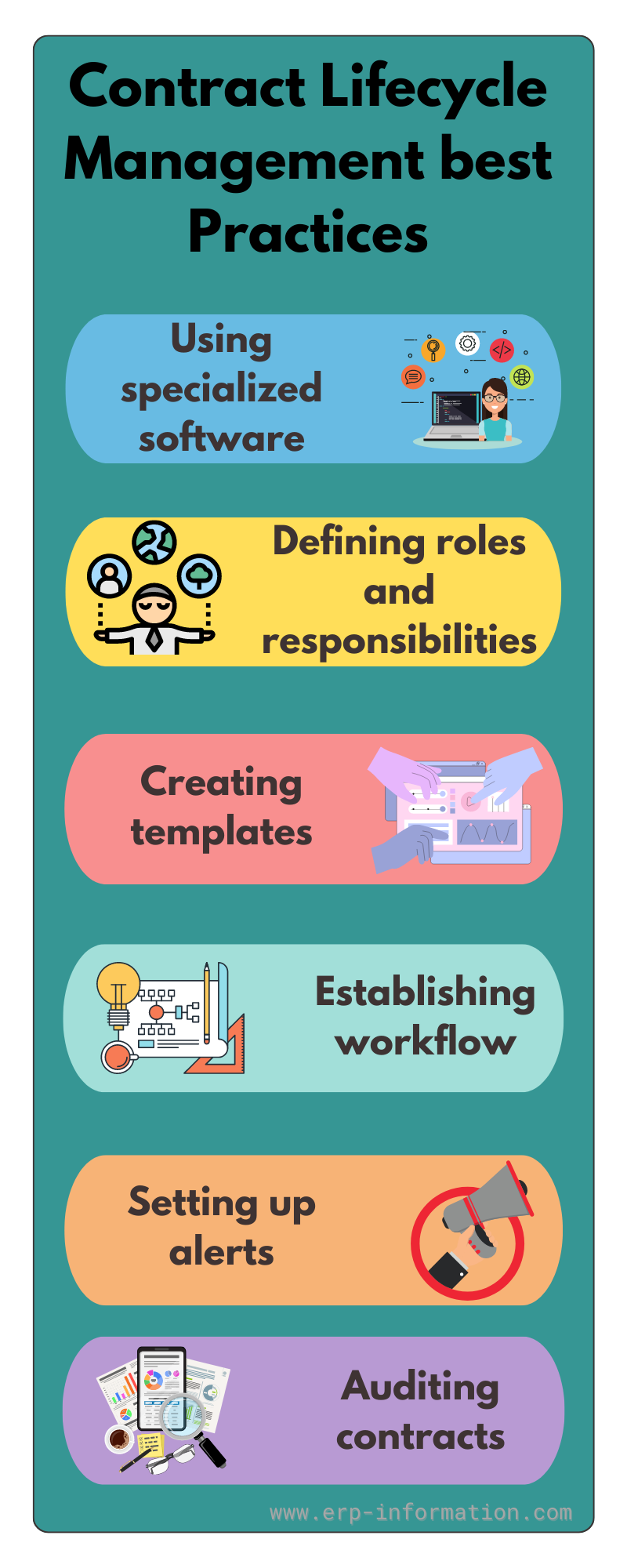
Using specialized software
Buy software for the stage that hurts most. If signed contracts get lost or renew by surprise, a repository with obligation tracking and renewal alerts matters more than AI drafting. If sales deals wait on legal, drafting and approval workflow inside the CRM matters more. A spreadsheet can track a few dozen contracts, but it cannot hold version history, enforce approvals or prove when a notice was sent.
Defining roles and responsibilities
Give every stage an owner, and write down signature authority: who may sign which contract types, up to what value. The stage table above is a starting point. The contract owner in the business, not legal, should own obligations and renewal decisions, because they are the people who know whether the supplier is performing.
Creating templates
Make templates for the contracts you sign most often, such as NDAs (Non-Disclosure agreements), master services agreements, statements of work, purchase orders and data processing agreements. Give each template an owner and a review date, and keep approved fallback clauses next to the preferred wording so negotiators do not draft from scratch.
Establishing workflow
Set an approval matrix by value and risk, for example finance above a value threshold, legal for any deviation from the template, and security when the counterparty will access your systems or data. Run approvals in parallel where they are independent, and record each approval in the contract’s audit trail.
Setting up alerts
Set renewal alerts against the notice deadline, not the expiry date. Use two alerts: one early enough to run a sourcing exercise or renegotiate, and one shortly before the deadline. Suppliers selling services under New York § 5-903 need a third date: the window 15 to 30 days before the customer’s deadline in which their own reminder must be sent. Add alerts for obligations too, such as price reviews, insurance renewals and report due dates.
Auditing contracts
Audit the repository against reality at least once a year. Check that every contract signed in the period is in it, that expired contracts were closed out, and that the alert fields are filled in. Track contract cycle time, the number of days from request to signature, by contract type. WorldCC’s 2025 research found that “the average contract cycle time varies enormously across organizations, with the best performers operating almost 4 times faster than the worst”. For supplier contracts there is one independent benchmark: APQC puts the median at 40 days, weekends included, from opening negotiations to signature, in a sample of 3,081. Its clock starts at negotiation, not at the request, so measure the same span before comparing, and track your own figures quarter on quarter.
Best Contract Life Cycle Management Software
The table checks each vendor’s owner, analyst position and published price at its own website, newsroom or marketplace listing on 5 October 2026. Gartner’s 2025 Magic Quadrant for Contract Life Cycle Management evaluated 16 vendors and named five Leaders: Sirion, Ironclad, Agiloft, Docusign and Malbek. For plans, screenshots and a longer list, see our guide to contract lifecycle management software.
| Product | Owner (October 2026) | Gartner 2025 | Published price | Best known for |
|---|---|---|---|---|
| ContractWorks | Onit, Inc. (bought ContractWorks’ maker SecureDocs in January 2022) | Not evaluated | Three plans, no dollar amounts shown; every plan includes unlimited users and is sized by document count | A simple repository with built-in e-signature licences |
| Contract Logix | LegalSifter (acquired October 2024) | Not evaluated | Quote only | Mid-market CLM on Microsoft Azure; e-signature through Docusign and Adobe Sign integrations |
| Ironclad | Independent (Ironclad, Inc.) | Leader | Quote only | No-code Workflow Designer; runs on Google Cloud |
| SAP Ariba Contracts | SAP SE (bought Ariba in 2012) | Not evaluated | Quote only | Buy-side contracts inside SAP’s procurement suite; SAP resells Icertis for advanced CLM |
| Icertis | Independent; interim co-CEOs since July 2026 | Visionary (a Leader from 2020 to 2024) | $200,000 a year for 100 users (Microsoft Azure Marketplace list price) | Enterprise CLM built on Microsoft Azure, with an SAP solution extension |
| Sirion (formerly SirionLabs; SirionOne was an older product name) | Majority-owned by Haveli Investments since February 2026 | Leader | $150,000 for 12 months for 100 users (AWS Marketplace list price) | Post-signature depth: obligations and supplier performance |
| Salesforce Contracts | Salesforce | Not evaluated | $50 per user per month, billed annually, on top of Sales Cloud | Sell-side contracts on the CRM record; not sold standalone |
| Docusign CLM | Docusign, Inc. (CLM came from SpringCM, acquired in 2018) | Leader | Quote only; the published IAM plans ($40 to $75 per user per month) cover e-signature and workflow, not CLM | E-signature and CLM from one vendor, embedded in Salesforce |
| Agiloft | Independent; KKR strategic investment in 2024 | Leader | $25,000 for 12 months for 20 power users and 1 admin (AWS Marketplace list price) | No-code configuration of workflows, approvals and data models |
| Conga CLM | Thoma Bravo portfolio company; bought the PROS B2B pricing business in February 2026 | Challenger | Quote only (the $0.00 on Microsoft’s marketplace is a placeholder, not a price) | Born on Salesforce’s AppExchange; quoting, pricing and contracts in one suite |
Salesforce itself is a CRM company, not a contract management vendor. Its native option, Salesforce Contracts, is an add-on that Salesforce says is not a standalone product and requires Sales Cloud. Salesforce teams can also run a partner CLM app inside Salesforce, such as Conga or Docusign CLM.
Three of these vendors publish a list price only on a cloud marketplace, not on their own website: Icertis on Microsoft’s Azure Marketplace, and Sirion and Agiloft on AWS Marketplace. At 100 users, the Icertis and Sirion listings work out to about $2,000 and $1,500 per user per year. Analyst positions also move: Icertis was a Gartner Leader every year from 2020 to 2024 and a Visionary in 2025, while it, Agiloft, Ironclad and Sirion each announced a Leader placement in Forrester’s Contract Lifecycle Management Platforms Wave, Q1 2025.
None of these products appeared in CISA’s Known Exploited Vulnerabilities catalog when we checked it on 5 October 2026. Published prices are list prices; enterprise CLM is usually sold on negotiated multi-year terms, so treat them as a starting point.
FAQs
What is a contract management system?
A contract management system is software that stores every contract in one repository and manages it through its lifecycle: drafting from templates, negotiation with version control, approval workflows, e-signature, obligation tracking and renewal alerts. Systems that cover every stage from request to close-out are sold as contract lifecycle management (CLM) software.
What are the stages of contract lifecycle management?
A common eight-stage model is initiation, planning, drafting, negotiation, execution (signing), management, renewal and close-out. The ANSI-approved NCMA Contract Management Standard groups the same work into three phases: pre-award, award and post-award. Vendor guides list anywhere from 3 to 9 stages because they split or merge the same steps.
What does CLM stand for?
In contracting, CLM stands for contract lifecycle management: the process of managing a contract from the first request to close-out, and the software that supports it. Gartner spells it contract life cycle management.
Is an electronically signed contract legally binding?
Generally yes. In the US, the ESIGN Act (15 U.S.C. 7001) says a contract may not be denied legal effect solely because an electronic signature was used, with exceptions such as wills, family-law matters and court documents. In the EU, Article 25 of the eIDAS Regulation gives a qualified electronic signature the same legal effect as a handwritten one.
How long should you keep a contract after it ends?
Keep it at least until no claim can be brought under it: the end of the contract plus the longest limitation period that could apply, and longer if a surviving clause or a regulator requires it. Examples: 6 years for a simple contract in England and Wales, 12 years for one made as a deed, 4 years from breach for a sale of goods under UCC 2-725, and 6 years after final payment for US federal contract files.
Where can I find a contract lifecycle management PDF?
The most authoritative free download is the National Contract Management Association’s Contract Management Standard (Fourth Edition), which NCMA offers free to members and non-members and which defines the pre-award, award and post-award phases. You can also print this page or save it as a PDF from your browser.
How We Researched This Page
This page was rebuilt on 5 October 2026. We read each statute and standard at its official source on that date: the US Code via Cornell’s Legal Information Institute, the New York, Wisconsin, California and Rhode Island legislature sites, legislation.gov.uk, EUR-Lex, the eCFR, acquisition.gov and the Federal Register, plus the Eighth Circuit opinion that vacated the FTC rule. We read NCMA’s Contract Management Standard crosswalk and WorldCC’s own publications for the figures they report, and each named CLM vendor’s own website, newsroom and pricing page for the vendor facts.
To build the stage comparison we read 21 pages returned by web searches for “stages of contract lifecycle management” and related questions. We did not test CLM products hands-on, and nothing on this page is legal advice: check the law that governs your own contracts with a lawyer before relying on a deadline.
Conclusion
Contract lifecycle management is eight stages and one record. The stages most organisations underinvest in are the last three: management, where obligations are tracked; renewal, where a missed notice deadline locks you into another term; and close-out, where surviving obligations and the retention date should be written down. Those are also the stages where the law sets the deadlines, so they are where a CLM process earns its keep.
References
- NCMA, Contract Management Standard, Fourth Edition (ANSI/NCMA ASD 1-2019 (R2025)) and Third to Fourth Edition crosswalk
- WorldCC and Deloitte, The ROI of Contracting Excellence (June 2023), WorldCC restatement (June 2026) and IACCM 2012 estimate
- WorldCC, Contract Management: An Overlooked Driver of Business Agility and Financial Performance (2025)
- 15 U.S.C. § 7001 and § 7003 (ESIGN Act), Uniform Law Commission, UETA, N.Y. State Technology Law § 304
- Regulation (EU) No 910/2014 (eIDAS), consolidated text of 18 October 2024 and Regulation (EU) 2016/679 (GDPR)
- N.Y. General Obligations Law § 5-903, Wis. Stat. § 134.49, Cal. Bus. & Prof. Code § 17601 and § 17602
- Custom Communications, Inc. v. FTC, No. 24-3137 (8th Cir. July 8, 2025), 91 FR 6507 (Feb. 12, 2026) and 91 FR 12318 (Mar. 13, 2026)
- Limitation Act 1980, s.5 and s.8, UCC § 2-725, Cal. Code Civ. Proc. § 337, N.Y. CPLR § 213, Tex. Civ. Prac. & Rem. Code ch. 16, R.I. Gen. Laws § 9-1-13
- 48 CFR 4.804-1, 4.805, FAR Overhaul Part 4 deviation (14 August 2025) and proposed rule, 91 FR 37550 (23 June 2026)
- WorldCC, Most Negotiated Terms 2024 and APQC, average cycle time to establish a contract with a supplier
- Gartner, Magic Quadrant for Contract Life Cycle Management, 2025 (figure as published by Sirion) and Brown University, Contract Management Lifecycle
Using Google Search? Add erp-information.com as a preferred source.