
Every master production schedule has a near-term stretch where planners deliberately stop making changes. That stretch is the frozen zone, and it exists for a simple reason: once you have committed materials, capacity, and labor to specific orders, reshuffling them costs more than it saves.
This guide explains what the frozen zone is, how it fits alongside the slushy and liquid zones, where the demand and planning time fences sit, and how ERP and MRP systems enforce it. A worked schedule at the end shows exactly what happens when a change request lands inside the fence versus outside it.
What is the frozen zone?
The frozen zone is the near-term portion of the master production schedule, typically the first one to four weeks, in which the near-term schedule is firm. Quantities, due dates, and usually the build sequence cannot change without senior-management approval. Its boundary is set by the demand time fence.
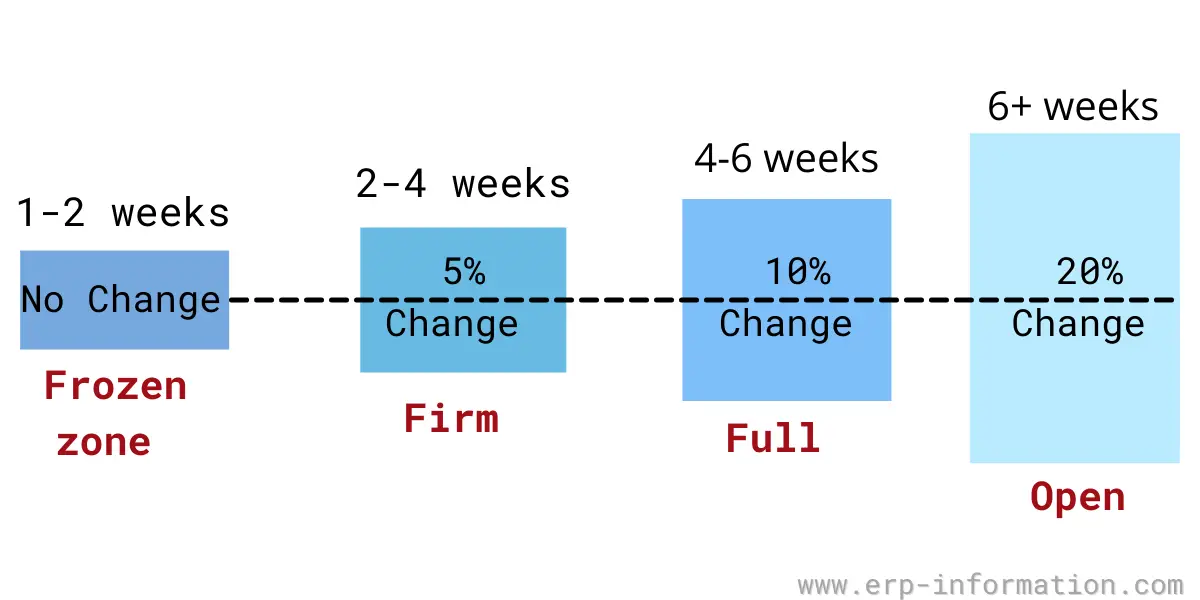
The problem the frozen zone solves is a familiar one for every planner: sales wants the flexibility to promise changes, while the shop floor needs a stable schedule to actually build to. Organizations do their sales and operations planning in the open part of the horizon and execute against the locked part. A time fence is the line that separates the two.
Outside the fence, in the liquid zone, you can freely revise purchase orders and production plans. Inside it, you cannot, at least not without a formal exception. A high rate of inside-the-fence changes is itself a warning sign: it usually means the forecast or the fence length is wrong, not that the rules should be relaxed.
Frozen, slushy, and liquid zones
A master schedule is usually split into three time zones. The frozen zone is only the first of them. Moving outward from today, each zone allows a little more freedom to change the plan:
| Zone | Typical horizon | What can change | Who can authorize a change |
|---|---|---|---|
| Frozen (firm zone) | Now → demand time fence (~1–4 weeks) | Effectively nothing: quantities, dates and sequence are locked; materials and capacity are already committed | Senior/executive management only, by exception |
| Slushy (trading zone) | Demand time fence → planning time fence (weeks to ~2 months) | Changes are possible but must be negotiated and re-checked for material and capacity availability | Master scheduler with sales and manufacturing agreement |
| Liquid (free/open zone) | Beyond the planning time fence, out to the planning horizon | The plan changes freely within the limits of the production plan; the system reschedules automatically | The planning system, within plan limits, with no cost penalty |
The slushy zone is where most real negotiation happens. Materials and capacity are partly committed, so a change is not free, but it is not forbidden either, so sales and manufacturing trade off the cost of the change against the value of the order. The liquid zone is where demand planning and rough-cut capacity planning do their work before anything is committed.
Demand time fence vs planning time fence
Two time fences mark the boundaries between the zones, and MRP treats each one differently:
- Demand time fence (DTF) is the nearest fence, and the edge of the frozen zone. Inside it the system plans from actual customer orders only and ignores the forecast, so no forecast-driven demand is planned in the frozen window. This is the fence senior management guards.
- Planning time fence (PTF) is the farther fence, and the edge of the slushy zone. Between the DTF and the PTF the system uses the greater of the forecast or booked orders and will not create or reschedule firm planned orders on its own; the master scheduler manages changes by hand. Beyond the PTF, in the liquid zone, MRP plans automatically.
A practical way to set them: the demand time fence is usually placed around the final assembly or shipping lead time, and the planning time fence around the cumulative (end-to-end) lead time of the product. Those lead times are what make a change expensive inside the fence in the first place.
A worked example: inside vs outside the frozen zone
Take a plant that builds one product to an eight-week master schedule. The demand time fence sits at the end of week 2, and the planning time fence at the end of week 5. Weeks 1–2 are frozen, weeks 3–5 are slushy, and weeks 6–8 are liquid.
| Week | 1 | 2 | 3 | 4 | 5 | 6 | 7 | 8 |
|---|---|---|---|---|---|---|---|---|
| Zone | Frozen | Frozen | Slushy | Slushy | Slushy | Liquid | Liquid | Liquid |
| Scheduled build | 100 | 100 | 100 | 100 | 100 | 100 | 100 | 100 |
Now two customers ask for an extra 50 units:
- Request for week 1 (frozen): rejected by default. Materials and capacity for weeks 1–2 are already committed, so the extra 50 units only fit if executive management overrides the fence and accepts the disruption and cost. The master scheduler does not decide this alone.
- Request for week 4 (slushy): negotiable. The scheduler checks whether material and capacity can be freed, then sales and manufacturing agree on whether the order is worth the change.
- Request for week 7 (liquid): accepted routinely. It is far enough out that MRP simply plans the additional materials and capacity on the next run, with no penalty.
Same request, three different answers, and that is the entire point of the frozen zone. It is not about refusing customers; it is about pushing changes to the point in the horizon where they are still cheap to make.
How long is the frozen zone?
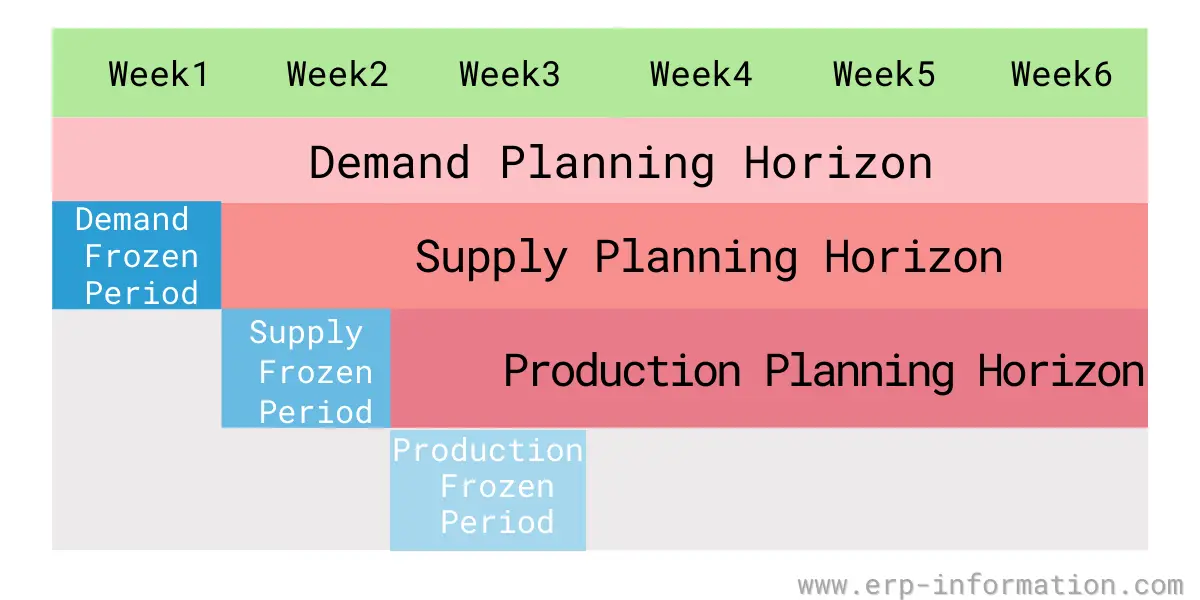
There is no universal number. The frozen period has to cover, at a minimum, the review time plus the lead time to obtain materials and build the product, which is the window in which a change is genuinely impossible to absorb. In practice that lands most plants somewhere between one and four weeks, and many treat the first calendar month of the schedule as frozen.
Set it too short and you invite last-minute churn that the shop floor cannot absorb; set it too long and you turn away business you could have profitably taken. The frozen period is also what cleanly separates demand planning, supply planning, and execution, so most teams review its length whenever lead times or demand volatility shift.
How do you unfreeze the frozen zone?
Even with careful forecasting, unexpected orders and shipping delays still hit the frozen window. A static planning tool cannot resolve that on its own. The practical answer is a supply-and-operations-execution (S&OE) layer with automation that manages the exception without simply tearing up the schedule:
- It gives a clear view of shortages and sends early warnings before they become crises.
- It surfaces issues immediately so you can take preventive action instead of reacting late.
- It connects the people across the supply chain so an exception is decided by the right group, not one planner.
- It centralizes communication and keeps a record of what was decided and why.
- It uses history and analytics to judge whether breaking the fence is actually worth it.
Frozen zone example
Consider an appliance factory that reviews and firms up its production orders once a month. Once a month’s orders are released, that first calendar month becomes the frozen zone: the quantities on those orders cannot be changed or cancelled unless both the buyer and the supplier formally agree.
If a large customer calls midway through that month asking to double an order, the plant does not simply say yes. The components have been ordered and line time has been booked against the existing quantities, so the request is either pushed into the next unfrozen month or escalated for management approval as a costly exception. That is the frozen zone doing its job, protecting a schedule the whole plant is already building to.
Click here for the Online Production Capacity Calculator
How ERP and MRP systems enforce the frozen zone
In a modern system the frozen zone is not a manual convention. It is configured and enforced automatically. You set the demand and planning time fences on each item, and the planning engine changes its own behavior on either side of them:
- Material requirements planning (MRP) stops generating and rescheduling firm planned orders inside the fences, so the near-term plan holds still while the far-term plan keeps flexing.
- Manufacturing resource planning (MRP II) and supply chain planning tools tie those fences to real capacity and material constraints so the lock actually reflects what the plant can do.
- Inside the demand time fence the system consumes actual demand only and ignores the forecast, which is what keeps the frozen quantities firm.
Getting the fences right in the software is what turns the frozen zone from a policy people argue about into a rule the system quietly keeps.
FAQs
What is a frozen period?
The frozen period is the near-term stretch of the production schedule that a company will not change. It is used in manufacturing to keep a consistent flow of output. Because materials and capacity are already committed, the frozen period stops last-minute changes that would disrupt that flow, and any exception needs management sign-off.
What is the difference between the frozen, slushy, and liquid zones?
They are three time zones of the master schedule with increasing freedom to change. The frozen zone (now to the demand time fence) is locked. The slushy zone (demand time fence to planning time fence) allows negotiated changes that are re-checked for material and capacity. The liquid zone (beyond the planning time fence) can change freely, and the system reschedules it automatically.
How long should the frozen period be?
Long enough to cover review time plus the lead time to get materials and build the product: usually one to four weeks, and often the first calendar month of the schedule. Too short invites last-minute churn; too long turns away business you could have taken.
What is a demand time fence?
The demand time fence is the boundary of the frozen zone. Inside it, MRP plans from actual customer orders only and ignores the forecast, so near-term changes require management approval. Firming of planned orders is governed by the separate planning time fence. It is usually placed around the final assembly or shipping lead time.
How do you identify the frozen zone in your production schedule?
Look for the timeframes that are fixed or immovable: those set by the demand time fence, committed materials, released orders, or contracts. Everything inside that boundary is the frozen zone. Changes in that window need coordination and approval well ahead of time to avoid disruption.
Conclusion
The frozen zone is the fixed, near-term core of the master production schedule, the window where the plan is deliberately held still so the plant can execute. Read it alongside the slushy and liquid zones and it stops looking rigid and starts looking like what it is: a way to push every change to the point in the horizon where it is still cheap to make. Get the demand and planning time fences right in your ERP system, and the schedule protects itself.