
A packing department is the team and work area that turns finished or picked goods into shipments. It checks the goods against the order or batch record, packs them in the right layers, codes and labels every pack, checks count and weight, records what was packed and hands the shipment to dispatch.
The name is used for three different things, and search results mix them up:
- The packing department of a factory, at the end of production. In pharma, food and garment plants it is a controlled area with its own records.
- The packing area of a warehouse, between picking and shipping, where picked orders are packed and labelled for outbound transport.
- The packaging department of a brand owner, which designs and develops the packaging itself alongside product development, as the packaging teams at Coca-Cola, Unilever and General Mills do.
This guide is about the first two: the people who pack. Below are the types of packing in legal terms, the roles India’s national job standards define, the process with its control points, what Indian law requires on every pack, the GMP controls of a pharma packing line, and the transport tests a pack should pass.

What is Packing?
Packing is the work of putting a product into packaging that protects it during storage, handling and transport and identifies it to whoever handles it next. The packing department does that work; the packaging it uses is specified by whoever designs it.
Key points
- Packing happens in layers, from the pack the customer opens to the shipper carton on a pallet.
- Every pack carries identification: at least a product name, a batch or lot number in regulated industries, and in India the declarations the Legal Metrology rules require.
- Good packing is checked, not assumed: count, weight and label text are verified before a pack leaves the line.
- In pharma, food and other regulated plants the department works to written procedures and keeps a record for every batch it packs.
Types of Packing
Packing is usually described in three layers. EU law defined them in Directive 94/62/EC, and its definitions are a useful reference:
| Type | What it is | Typical example |
|---|---|---|
| Primary (sales) packaging | Packaging that makes up a sales unit for the final user or consumer at the point of purchase | The bottle, blister strip or pouch the customer buys |
| Secondary (grouped) packaging | Packaging that groups a number of sales units, whether sold together or used to restock shelves | The carton or multipack that holds several sales units |
| Tertiary (transport) packaging | Packaging that eases handling and transport of sales units or grouped packs and prevents transport damage | The shipper carton, shrink wrap and pallet |
From 12 August 2026 the EU Packaging and Packaging Waste Regulation (EU) 2025/40 applies and repeals that directive. It defines the three layers only as sales, grouped and transport packaging, and its recitals say these correspond to primary, secondary and tertiary packaging. It also adds e-commerce packaging: the transport packaging used to deliver goods ordered online. On the shop floor, primary, secondary and tertiary remain the everyday terms.

Packing department roles and responsibilities
India’s national job standards (Qualification Packs approved by the National Skills Qualifications Committee) describe the packing jobs in each industry. These are the current ones, with what each standard says the job holder does:
| Job role (standard, NSQF level) | What the job holder does, per the standard |
|---|---|
| Secondary and Tertiary Packaging Assistant, pharma (LFS/Q0217, level 2) | Stacks, wraps and cartons drug product batches under supervision; labels cartons with batch details; records the work in the Batch Packaging Record; follows line clearance; reconciles unused and damaged packaging material |
| Manufacturing and Packaging Assistant, pharma (LFS/Q0216, level 3) | Checks the packaging machine and its calibration and validation tags; spots product mix-ups and reports them; handles cold-chain and light-sensitive products; supports line clearance and the Batch Packaging Record |
| Finisher and Packer, apparel (AMH/Q2255, level 2.5) | Checks, irons, folds and packs garments, then labels, marks and cartons them to the buyer’s instructions; packs as per invoice and weighs packed goods |
| Packing Machine Operator, food (FIC/Q7002, level 3) | Loads food and packaging materials into packing machines; does primary, secondary and tertiary packing; tests packaging material integrity; labels secondary packs with batch number and expiry date |
| Tertiary Goods Packaging Machine Operator, logistics (LSC/Q2216, level 4) | Runs case packers, labellers, palletisers, stretch wrappers and strapping machines; sets machine speed for the product; weighs packages against limits; watches for jams and misfeeds |
Two things the standards leave out. A warehouse packer standard exists (LSC/Q2303), but its current version shows no approval, so treat it as a description rather than a qualification. And we found no national standard for a packing supervisor.
Across all of them, the department’s responsibilities come down to the same list:
- Check incoming goods and packaging materials against the order, batch record or packing instructions.
- Clear the line before each new batch or order, so nothing from the last run is left behind.
- Pack in the right layers and add protection for fragile goods.
- Code and label every pack, and keep labels under control.
- Count, weigh and inspect packs; segregate anything that fails.
- Record what was packed, and reconcile labels and printed materials at the end of the run.
- Stack, wrap and palletise, then hand over to dispatch with the paperwork.
Packing department process, step by step
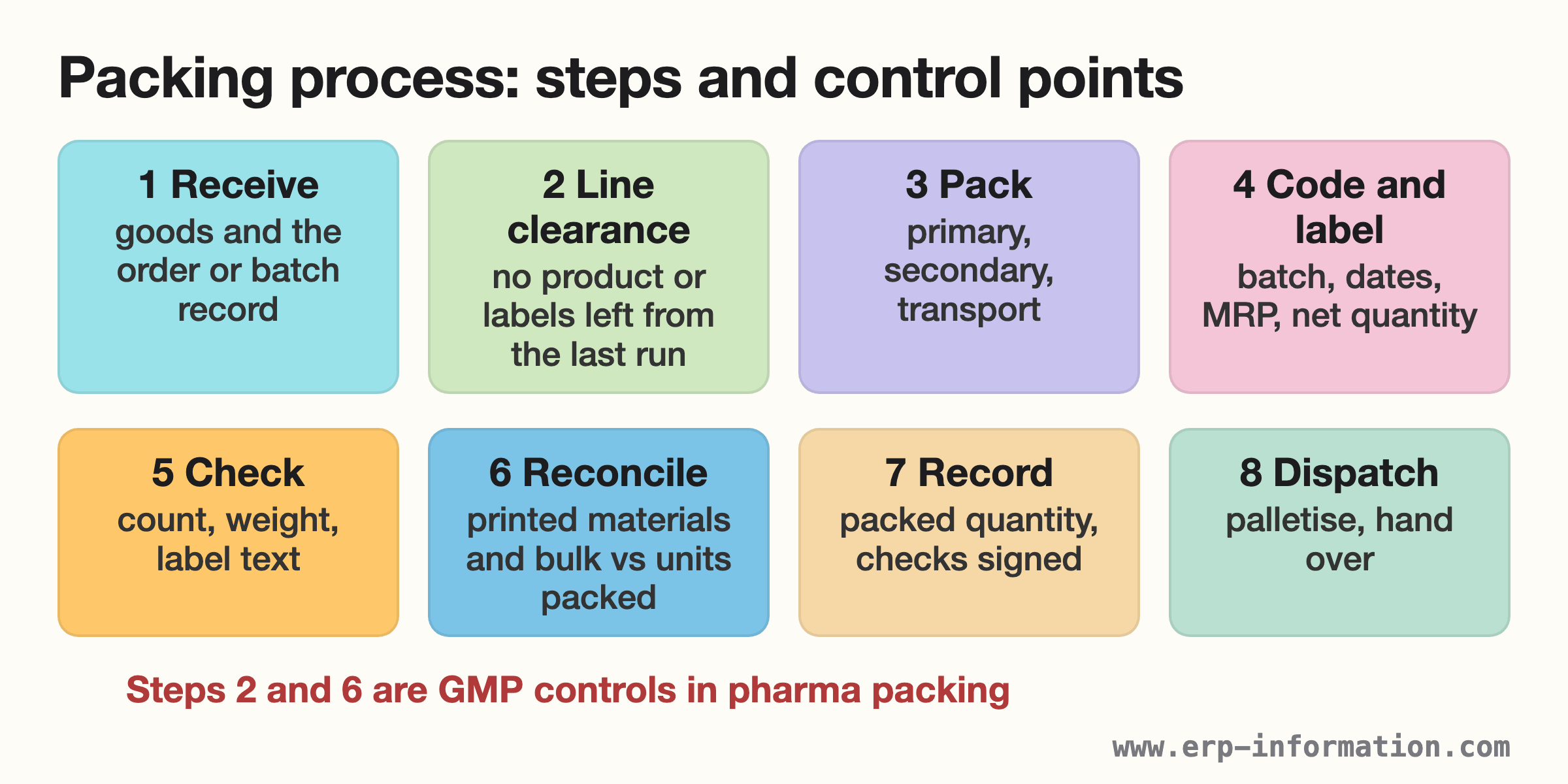
The process is the same in a pharma plant, a garment factory and a warehouse; what changes is how much of it is written down and signed. In order:
- Receive and verify. Check the goods and packaging materials against the order or batch record for quantity and identity before anything is packed.
- Clear the line. Confirm that no product, labels or documents from the previous run are left on the line or the printers.
- Pack. Primary, then secondary, then transport packing, with extra protection for fragile items.
- Code and label. Print or apply the batch number, dates and, in India, the mandatory declarations, then check that the printing is correct.
- Check. Count, weigh and inspect a sample of finished packs, including the label text.
- Reconcile. Compare the bulk product and printed materials used with the number of units packed; investigate any gap.
- Record. Complete the packing record: quantities, checks done and who did them.
- Dispatch. Stack and palletise, then hand over to the dispatch team.

What a packed product must carry in India
In India, Rule 6 of the Legal Metrology (Packaged Commodities) Rules, 2011 requires every package to bear a plain and conspicuous declaration of the details below. Getting them right is the packing department’s job, because it is the last place they can be checked. As amended up to 21 September 2026:
| Declaration | What the rule requires |
|---|---|
| Name and address | Of the manufacturer, and of the packer if different; for an imported pack, of the importer |
| Country of origin | For imported products: the country of origin, manufacture or assembly |
| Common or generic name | Of the commodity, and the name and quantity of each product in a multi-product pack |
| Net quantity | In standard units of weight or measure, or by number |
| Month and year of manufacture | Manufacture only: the words pre-packed or imported were removed from 1 April 2022 |
| Retail sale price (MRP) | In Indian currency, stated as inclusive of all taxes |
| Unit sale price | Price per gram, kilogram, millilitre, litre, metre or unit, in the current format from 1 January 2024; not needed where it equals the MRP, or for combination or multi-piece packs |
| Consumer care details | Name, address, telephone number and email address for complaints |
Two rules catch packing teams out. Stickers may not be used to alter or add any of these declarations (Rule 6(3)), so a wrong printed MRP means re-packing, not over-labelling. And food packs follow the Food Safety and Standards labelling rules for the manufacturer details instead of clause (a).
How do you Improve your Product Packaging?
If you work in a packing department, most improvements come from testing and checking rather than from the look of the pack:
- Test the shipper against the route it travels. Drop, vibration and impact tests (see packaging tests below) show whether a carton survives before customers find out.
- Match protection to fragility. Fragile goods need extra protective material such as bubble wrap or polystyrene chips; sturdy goods do not, and over-packing costs money on every shipment.
- Get the label right first time. In India a wrong declaration cannot be fixed with a sticker, so check label text before the run, not after it.
- Use standard handling symbols. ISO 780 sets the graphical symbols for the handling and storage of packages, so any handler reads them the same way.
- Make the pack easy to open, with clear directions such as tear here, and never put misleading information on it.
- Measure the line. Track the damage and return rate, the share of packs failing checks, and packs per hour; a change that helps one and hurts another is not an improvement.
Importance of Packing
Packing protects the manufacturer, the shipper and the customer at once:
- It protects the product from dust, moisture, insects and breakage on the way to the customer.
- It identifies the product, its batch and its maker, which is what makes a recall or a complaint traceable.
- It carries the information the law requires, such as the MRP and net quantity in India.
- It makes goods easy to carry, stack and store.
- It cuts losses: every unit damaged in handling is a replacement, a refund or a write-off.
- It markets the product on the shelf, which matters for consumer goods far more than for medicines.
Packaging Methods
Packaging methods differ by industry. Common materials include corrugated carton boxes, plastic films and containers, glass, metal and paper. This guide groups the methods into four:

1. Plastic packaging
Plastic bottles, tubs, films and pouches are light and can be made airtight, which suits liquids and foods such as water, oil, milk and yogurt.
2. Pharma packaging
Medicines are packed under GMP, with the line clearance, coding checks and reconciliation described in the pharma section below.
3. Anti-corrosive packaging
Metal parts and machinery are packed to keep moisture away from the metal during long storage or long-distance export shipments.
4. Flexible packaging
Pouches, wrappers and films that change shape with their contents. Food products use them widely to keep the product fresh while using little material.
Packing Department in Pharma Industries
In a pharma plant the packing department works under Good Manufacturing Practice (GMP), and the rules are specific. The table compares two of the main GMP texts, the US regulation and the EU GMP guide:
| Control | US: 21 CFR 211 | EU GMP, Chapter 5 |
|---|---|---|
| Check materials on arrival | Packaging and labelling materials sampled and examined before use (211.122) | Checked on delivery to the packaging department for quantity, identity and conformity (5.52) |
| Line clearance | Packaging facilities inspected immediately before use to confirm all previous product is removed (211.130(e)) | Work area, lines and printers free of previous products, materials and documents, done to a checklist (5.50) |
| Identify the batch | Every product identified with a lot or control number (211.130(c)) | Product name and batch number displayed at each packaging line (5.51) |
| Check printing and packs | Packed units examined during finishing; a representative sample checked for correct labels (211.134) | Printed codes and expiry dates checked and recorded; on-line checks of appearance, completeness and over-printing (5.55, 5.59) |
| Reconcile | Labelling issued, used and returned reconciled; discrepancies investigated (211.125(c)) | Bulk product and printed materials reconciled against units produced (5.61) |
| Destroy leftovers | Excess labelling bearing lot numbers destroyed (211.125(d)) | Unused batch-coded materials destroyed and the destruction recorded (5.62) |
India’s revised Schedule M (G.S.R. 922(E), 28 December 2023) brings the same controls into Indian law and makes them stricter in one respect: line clearance “shall be recorded” (para 18.5.2). Large manufacturers (turnover above Rs 250 crore) had six months from publication to comply, small and medium ones twelve. Small and medium manufacturers that applied in Form A with an upgrade plan could extend to 31 December 2025 (G.S.R. 127(E)); we found no later extension in CDSCO’s notifications.
Functions of packing in pharma
- Protection: the pack keeps the medicine from leaking, breaking or degrading.
- Identification: product name, strength and batch number on every pack prevent mix-ups.
- Information: dosage, contents, manufacturing and expiry dates, handling and cautions.
- Traceability: the batch number and packing record link every pack back to its batch.
Packaging tests: drop, vibration and other transport tests
Drop, vibration, impact and rolling tests are transport tests for complete, filled transport packages. Pharma companies use them, and so do many other industries that ship goods; they are not pharma-specific. The standards:
| Test | ISO standard | Indian Standard |
|---|---|---|
| Drop (vertical impact) | ISO 2248 | IS 7028 Part 4 |
| Horizontal impact: inclined plane or pendulum | ISO 2244 | IS 7028 Part 3 |
| Vibration at fixed low frequency | ISO 2247 | IS 7028 Part 2 |
| Vibration at variable frequency | ISO 8318 | IS 7028 Part 12 |
| Rolling | ISO 2876 | IS 7028 Part 5 |
The revolving drum test, still listed by some guides, comes from ASTM D782, which ASTM withdrew in 1999. For whole test plans, ASTM D4169 sequences the hazards of a distribution route, and ISTA publishes three series: 1 (non-simulation integrity tests), 2 (partial simulation) and 3 (general simulation). ISTA’s Test Project 3P is a general simulation test for packages shipped through a parcel delivery system within India.
Packing in ERP and warehouse systems
In an ERP the packing department works with handling units. SAP defines a handling unit as a physical unit of packaging materials and the goods in it, with a unique scannable number such as an SSCC. Handling units can be nested, so cartons go into a pallet that is itself a handling unit.
- A packing instruction is the template: it lists the materials and packaging materials that go into a handling unit, so customer packing requirements are held in the system and the packing proposal can be automatic.
- Packing in the delivery: delivery items are packed directly in the outbound delivery, and handling units can be packed inside each other on as many levels as needed.
- In a warehouse management system the same work happens at a work centre, where products are packed into handling units and handling units into other handling units.
The payoff is traceability: because handling units nest, the number on a pallet leads to every carton packed inside it, which is what a customer asks for when a delivery is short.
FAQs
What does a packing department do?
It turns finished or picked goods into shipments. The department checks goods and packaging materials against the order or batch record, clears the line, packs the goods in layers, codes and labels every pack, checks count and weight, records what was packed and hands the shipment to dispatch.
What are the roles in a packing department?
India’s national job standards define packing roles by industry: a Secondary and Tertiary Packaging Assistant and a Manufacturing and Packaging Assistant in pharma, a Finisher and Packer in apparel, a Packing Machine Operator in food, and a Tertiary Goods Packaging Machine Operator in logistics. Supervisors lead these teams; we found no national standard for the supervisor role itself.
What is line clearance in packing?
Line clearance is the check, before a new batch is packed, that the packing line, printers and work area hold no product, labels or documents from the previous run. EU GMP requires it to be done to a checklist, and India’s revised Schedule M requires it to be recorded.
What must be printed on a packed product in India?
Under Rule 6 of the Legal Metrology (Packaged Commodities) Rules, 2011: the name and address of the manufacturer or packer (and importer for imports), country of origin for imports, the generic name, net quantity, month and year of manufacture, the MRP inclusive of all taxes, the unit sale price where it differs from the MRP, and consumer care contact details.
What are the materials generally used for packing?
The common ones are paper and corrugated board, plastics, glass, metals such as steel and aluminium, and wood. The right choice depends on the product, the route it travels and, for food and medicines, the rules on materials that touch the product.
Where to start, depending on your role
- Joining a packing department: read the job standard for your industry in the roles table; it is the list of tasks you will be assessed on.
- Running one: make line clearance, label control and reconciliation routine on every run, not only on audit days, and measure damage and check failures every week.
- Packing for the Indian market: check every label against the Rule 6 list before the run, because a printed error cannot be fixed with a sticker.
- Shipping by parcel or export: test the shipper to ISO 2248 and ISO 2247 or an ISTA procedure before the first large order.
How we researched this page (10 October 2026). We read the primary texts: 21 CFR Part 211, EU GMP Chapter 5, India’s revised Schedule M and its extension notification, the Legal Metrology (Packaged Commodities) Rules with each amending Gazette notification, EU Directive 94/62/EC and Regulation (EU) 2025/40, the NSDC Qualification Pack documents for each job role, the ISO, BIS, ASTM and ISTA records for the transport tests, and SAP’s documentation on handling units. We also read 15 of the pages that compete for these searches; none covered India’s labelling rules or Schedule M. Where a source could not be confirmed, such as a national standard for packing supervisors, we say so.
References (read 10 October 2026)
- Department of Consumer Affairs, Legal Metrology: Packaged Commodities Rules 2011 and amending notifications
- CDSCO, G.S.R. 922(E), revised Schedule M, 28 December 2023
- CDSCO, G.S.R. 127(E), Schedule M timeline extension, 11 February 2025
- eCFR, 21 CFR Part 211 Subpart G, Packaging and Labeling Control
- European Commission, EudraLex Volume 4, Part I, Chapter 5: Production
- EUR-Lex, Directive 94/62/EC on packaging and packaging waste (consolidated)
- EUR-Lex, Regulation (EU) 2025/40 on packaging and packaging waste
- NSDC Qualification Pack LFS/Q0217, Secondary and Tertiary Packaging Assistant (pharma)
- NSDC Qualification Pack LFS/Q0216, Manufacturing and Packaging Assistant (pharma)
- NSDC Qualification Pack AMH/Q2255, Finisher and Packer (apparel)
- NSDC Qualification Pack FIC/Q7002, Packing Machine Operator (food)
- NSDC Qualification Pack LSC/Q2216, Tertiary Goods Packaging Machine Operator (logistics)
- ISO 2248, vertical impact test by dropping
- ISO 2244, horizontal impact tests
- ISO 2247, vibration tests at fixed low frequency
- ISO 8318, sinusoidal vibration tests using a variable frequency
- ISO 2876, rolling test
- ISO 780, graphical symbols for handling and storage of packages
- Bureau of Indian Standards, IS 7028 (Part 4), performance tests for complete, filled transport packages
- ASTM D4169, performance testing of shipping containers and systems
- ISTA test procedures, including Test Project 3P for parcel delivery within India
- SAP Help Portal, Handling Unit
- SAP Help Portal, Packing Instruction
- SAP Help Portal, Packing in Inbound and Outbound Deliveries
- Packaging Digest, How Should Packaging Departments Be Organized and Why? (2 September 2026)
Using Google Search? Add erp-information.com as a preferred source.