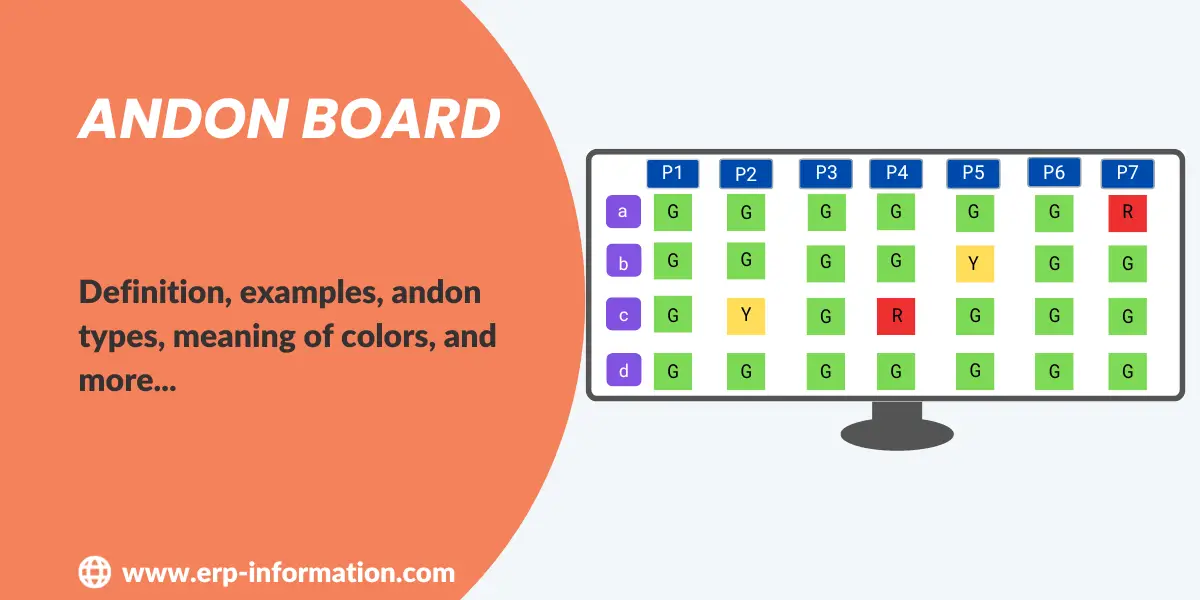
When something goes wrong on the production line, it can cause many headaches for workers and managers. This means that products are not being made properly, which can also lead to safety issues.
Andon Board is a visual management tool that helps quickly identify and solve production line problems. It uses color-coded lights to indicate the severity of the problem. This allows workers and managers to address the issue immediately.
An andon board is the shared display that shows the live state of a production line, so a problem is visible to everyone the moment it happens rather than at the end of the shift. Below: what the colors mean, the operator-called and machine-called types, and where the board earns its place in lean manufacturing.
Andon Board Definition
Andon Board is a display board used in the manufacturing industry. It indicates the existence of a problem at a specific workstation. The issue might be technical or related to quality. The workers can push the button and notify the managers or other workers when they find an issue.
What does the word Andon mean?
The term “Andon” comes from the Japanese word for the paper lantern.
The Japanese call their form of quality control the “Andon” system. Andon means “guiding light,” which they use to acknowledge that jobs are done without interruption.
Toyota first discovered it, which utilized the Jidoka quality control method. It has now become an indispensable part of the Lean approach.
Andon meaning in manufacturing industries is “the status display.”
Jidoka is a Japanese term. The meaning of ‘Autonomation‘ is ‘Automation with a human touch.’
The system gives more authority to the workers. For example, they can stop production when they detect any particular defect.
Initially, these were light signals in the manufacturing process. They signaled the status based on the color.
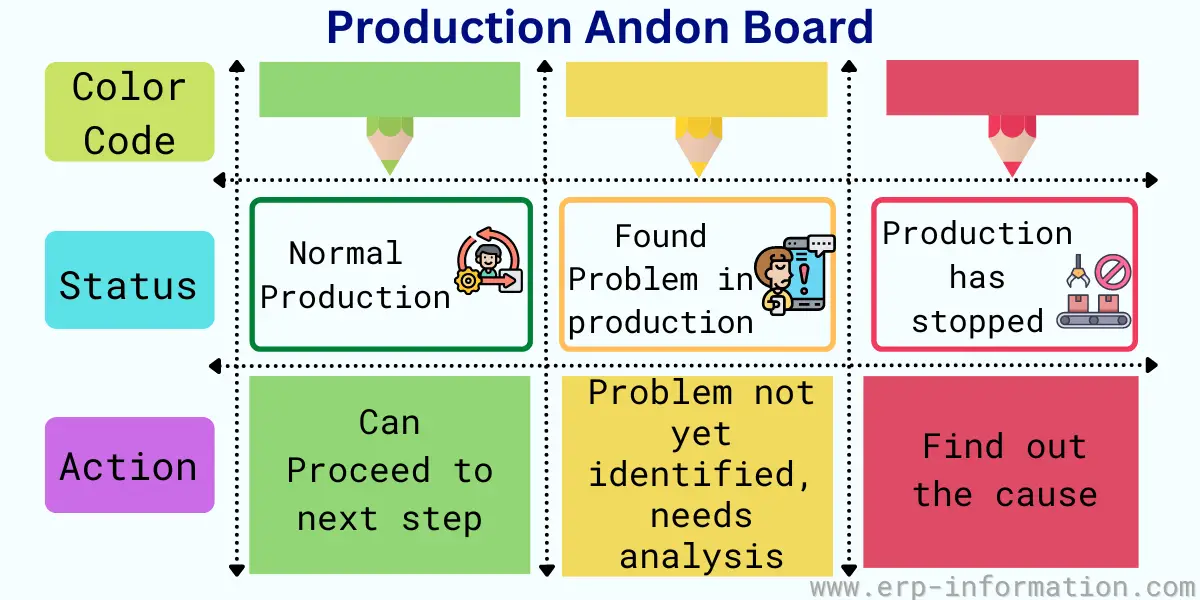
Over time andon boards have evolved and are with far more superior technology. Modern alert systems use different modes to highlight the issues. Examples are pre-recorded verbal messages, text, and other graphic elements.
Though displays are sophisticated, their purpose has not changed: efficient communication and real-time status of the plant floor.
Different Levels of Andon
- Andon Light: It is a traditional Andon usually pull cord and light.
- Andon Board: The board that shows the status of all production lines of the organization in one central location.
- Andon System: It contains additional signal sources like sensors and alerts
- Andon Digital System: The digital system Integrates the concepts of Andon with digital manufacturing.
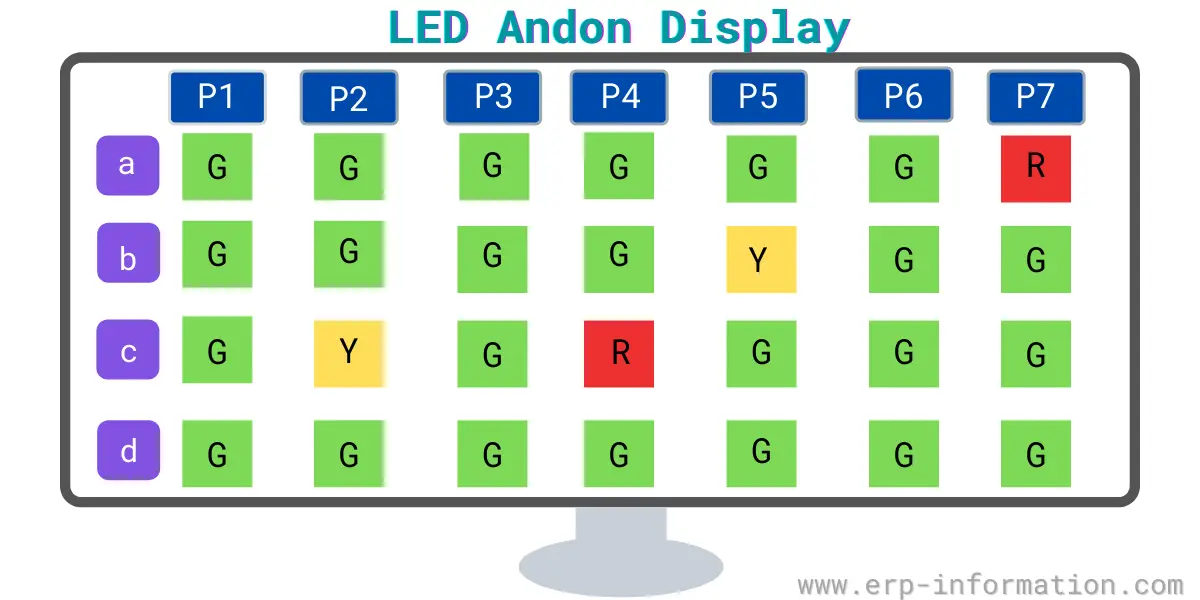
The below image shows the LED Andon Display of a manufacturing plant.
Andon Types
Operator controlled andons
Manual operators in the assembly line trigger the andons. They may do it by using static buttons, pulling the cord, or using a voice command in a few modern systems.
Machine controlled andons
These are automatically activated andons. When criteria fixed in the assembly line are not met or lacking, it is triggered.
Andon Colors and Their Meanings
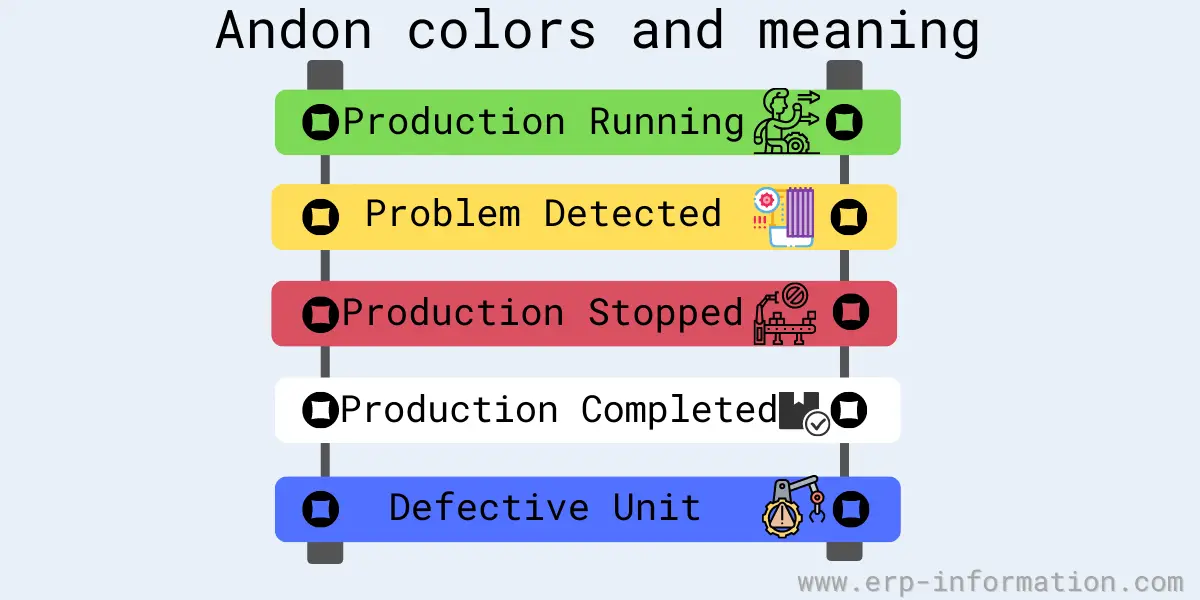
- Green – Production is running correctly and will move to the next level
- Yellow – problem detected, the operator needs assistance from an expert to fix the problem
- Red – Production stopped since the solution for the problem is not identified and needs further investigation
- White – Production run completed. The next run could be scheduled if required.
- Blue – Defective unit, this need not stop the process; even the number of faulty units could be displayed.
What is Andon in Lean Manufacturing?
Andon in lean manufacturing is a system that warns workers, operators, and managers about problems in real time. With the help of alerts, immediate corrective action can be taken.
It helps in addressing process or quality control issues with immediate attention. That further observes the reduction of production bottlenecks.
It clears any glitches that might lead to slow production. It also avoids complete production halts soon.
More specifically its uses in lean manufacturing plants are as follows.
Uses of andon board in lean manufacturing plants
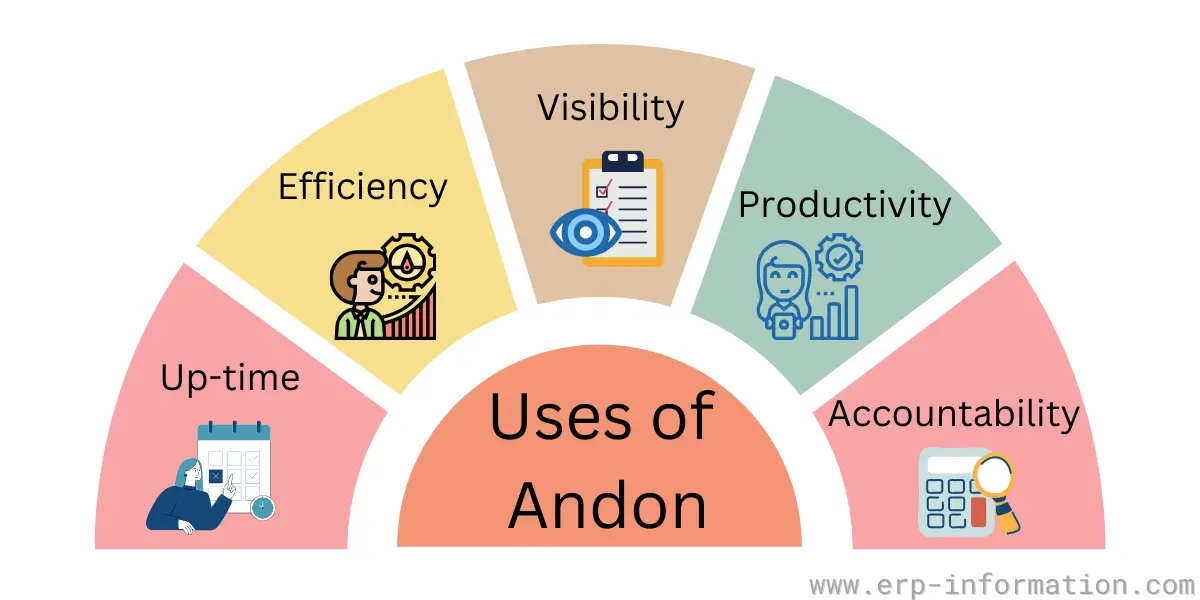
- Visibility – The possibility of fixing problems of downtime, quality, and safety in real-time
- Productivity – Attending to problems as they occur in the manufacturing process increases productivity
- Accountability – Effective delegation of accountability, and responsibility to operators
- Up-time – Since it helps in quicker identification and fixing manufacturing issues, downtime is reduced
- Efficiency – Provides an effective and consistent way of communication. That helps in saving money and time
Let us explore it with scenarios.
Scenario 1
Take a vehicle assembly line, where each station carries an indicator showing green, yellow, or red.
While the work at a station is completed inside its cycle time, the indicator stays green and the vehicle moves on down the line.
If the operator hits a problem, a part that will not seat correctly or a missing component, they signal it and the station turns yellow. The line is still moving at this point. Yellow means the team leader has been called and is on the way, and most calls are closed out here without the line ever stopping.
If the employee cannot fix it correctly and quickly, the production stops, and the team members gather and solve the problem in that production line.
Scenario 2
It is used in web-based companies also. But, of course, you all know the very famous online shopping site Amazon.
It uses andon for its customer service because providing good customer service is its top priority. Thus, Amazon calls it “customer service andon cord.”
Whenever a problem occurs in customer service, this cord alerts the manager to sort out the problem. Here andon is not aboard. It is a digital system.
Advanced Features of Modern Andon Systems
- Integrates with enterprise resource planning (ERP), computerized maintenance management system (CMMS), and manufacturing execution system (MES)
- Making extensive use of the Internet of Things (IoT)
- Issuing tickets with workflow
- Mobile client applications to get alert notifications
- Email, SMS, and mobile application push notifications
- Automatically track production counts and cycle time
- Big data analysis and reporting system about recorded events of andon inputs
Advantages of Andon Board
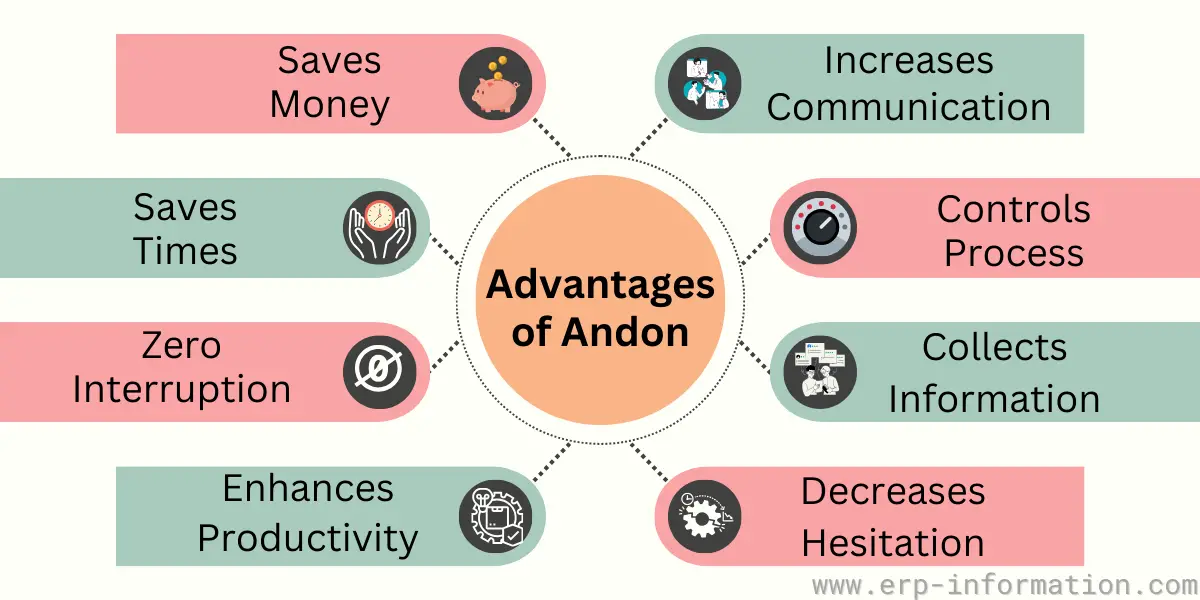
Saves time
Since andon board is a visual display, it allows you to understand the situation and problems in the production line. So that it helps to reduce the problem detecting time, avoids stopping the production line, and saves time.
Saves money
The saving that matters is not the minutes, it is the scrap and rework avoided. A defect caught at the station affects one unit. The same defect found at final inspection affects every unit built since it started, and each of those has to be pulled, examined, and in many cases taken apart again. Stopping early is cheap precisely because the alternative scales with how long the problem stayed invisible.
Increases communication
It helps flow information throughout the production line through visual or sound signals. Hence it improves the internal communication between workers, supervisors, and managers.
Controls process
An andon board does not predict problems; it makes the current state of the line impossible to miss, which is a different and more useful thing. Its by-product is the record: every call logged with a reason and a duration. Sorted by cause, that log tells you which few stoppages account for most of the lost minutes, and it is the availability data that overall equipment effectiveness analysis needs.
Calculate your OEE with our Overall Equipment Efficiency Calculator
Collects accurate information
To support an effective management system, information about the function of the production line should move from lower-level workers to a higher authority. Andon board helps to collect accurate information about the production line.
Decreases hesitation
Problems get hidden when raising one is slow or reflects badly on the person raising it. An andon makes the signal quick and routine, so issues surface while they are still small. That reduces downtime and improves both quality and safety, but only where calling for help is treated as doing the job properly rather than as an admission of failure.
Enhances productivity
It allows the workers or operators to take immediate action when they find a problem without waiting for a higher authority. This rapid determination of the issues and solutions helps to increase productivity.
Fewer long stoppages
Andon does not remove interruptions, and a system that promised to would be missing the point. It trades many short, deliberate pauses for the few long ones that happen when a fault is discovered far downstream, by which time every unit built since has to be inspected or reworked.
What Will Be the Future?
Andon board manufacturers are looking for ways to improve the traditional system while maintaining simplicity.
While many andons can be used in lean manufacturing plants, the most common type is a red light with an audible sound or buzzer.
In the future can expect complete Automation of detecting the problems and notifying them in manufacturing plants.
They are building machine learning models based on andon inputs for different industry verticals. With these models, input patterns could be analyzed better for future enhancements.
Replace cords, buttons, and screens in legacy systems with modern systems will be inevitable.
FAQs
What is an example of Andon in everyday life?
Your car’s dashboard is the best example. It warns you about the existence of fuel, whether it is complete or finished.
One more example is when a Xerox machine or scanner has problems. It warns the operator with a signal light.
What is the purpose of andon board?
The primary purpose of an andon board is to swiftly notify operators of any issues occurring on the production line. Serving as a real-time alert system, andon ensures that operators are promptly informed about any disruptions in the manufacturing process.
This immediacy is crucial as it empowers operators to address the problem at its source, right on the spot. By doing so, the andon system facilitates a rapid resolution, allowing the assembly line to resume its normal operation without prolonged interruptions.
In essence, the Andon board acts as a proactive tool, enabling efficient problem-solving and contributing to the overall smooth functioning of the production process.
What types of information are typically displayed on an andon board?
An Andon board typically displays a spectrum of critical information essential for real-time monitoring and efficient decision-making in a manufacturing setting.
Production Status
Real-time updates on production progress, highlighting whether the assembly line is operating within expected parameters.
Machine Status and Alerts
Immediate notifications about any malfunctions or abnormalities in machinery, allowing swift response to prevent disruptions.
Quality Control Metrics
Metrics related to product quality, defect rates, and adherence to quality standards, enabling operators to address issues promptly.
Workstation Efficiency
Information on the efficiency of individual workstations or production cells, aiding in identifying bottlenecks or areas for improvement.
Conclusion
The Andon Board is a critical element of lean manufacturing. It can serve as your early warning system for potential problems. It would help if you never forgot the importance of having an engaging, informative board that employees can easily read from anywhere in the plant.
The board itself is cheap; what makes it work is the response behind it. A light that nobody is accountable for answering becomes wallpaper within a week, which is why the plants that get value from andon define who responds, and how fast, before they hang the first display.
Using Google Search? Add erp-information.com as a preferred source.