If you are trying to buy this, the first thing to know is that “Microsoft Cloud for Sustainability” is not the thing you buy. The product with a price on it is Microsoft Sustainability Manager. Microsoft for Sustainability is the umbrella suite, and Microsoft Cloud for Sustainability now survives mainly as the name of the underlying data model and the community forum.
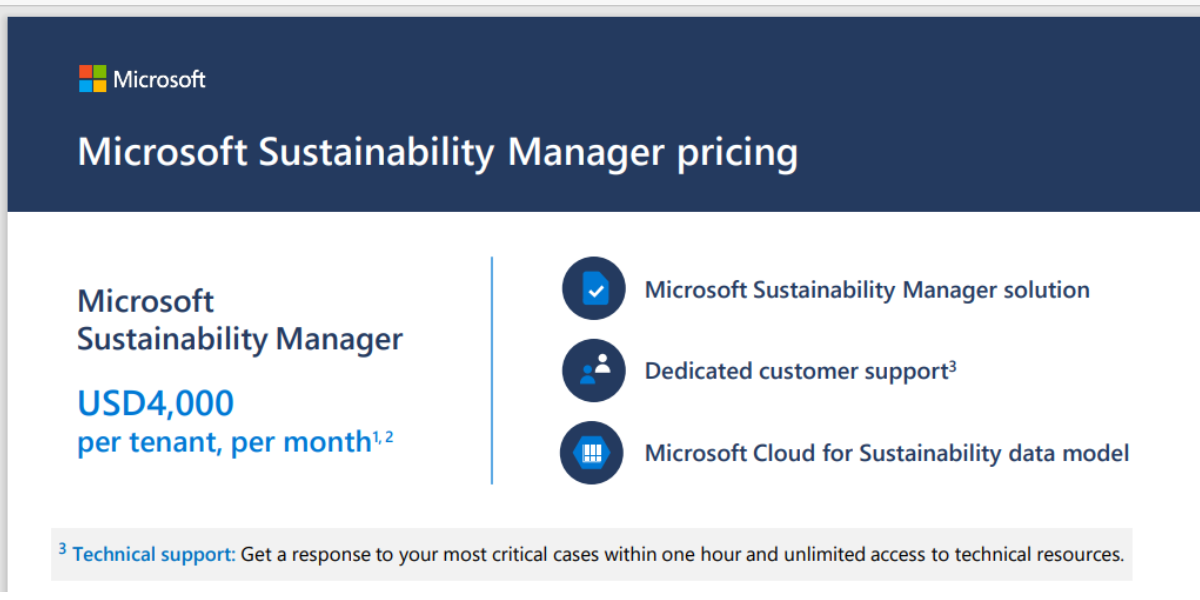
The second thing to know is that Sustainability Manager comes in two plans, and the gap between them is where most buyers get caught. Essentials is US$4,000 per tenant per month. Premium is US$12,000. Copilot, the ESG value chain solution, product carbon footprint, emissions allocations and four Scope 3 categories are Premium only.
This review covers current pricing and what each plan actually includes, the licensing structure the headline price hides, the features Microsoft has deprecated since 2025, and whether the shrinking EU reporting mandate still justifies the spend.
What Microsoft actually sells, and what each name means
The naming here causes real confusion, so it is worth separating cleanly:
- Microsoft for Sustainability is the umbrella. Microsoft describes it as a suite of cloud services bringing ESG capabilities together across its cloud portfolio and partner ecosystem. It is a portfolio label, not a SKU.
- Microsoft Sustainability Manager is the application you license and use. It is built on Power Platform and Dataverse, it ships monthly, and it is where emissions, water and waste data is ingested, calculated and reported.
- Microsoft Cloud for Sustainability is now mostly the name of the shared data model beneath Sustainability Manager, and of the community portal. Microsoft’s own documentation has largely moved to “Microsoft for Sustainability.”
If a vendor, consultant or comparison site quotes you “Microsoft Cloud for Sustainability pricing,” they mean Sustainability Manager.
Microsoft Sustainability Manager pricing in 2026
Microsoft publishes its list prices, which is unusual in this category and genuinely useful. Both plans are priced per tenant, not per user.
| Plan | List price | What it is for |
|---|---|---|
| Sustainability Manager Essentials | US$4,000 per tenant per month | Foundational carbon, water and waste data management. Scopes 1 and 2, and Scope 3 categories 1 to 9, 12 and 13. |
| Sustainability Manager Premium | US$12,000 per tenant per month | Everything in Essentials, plus all of Scope 3, Copilot, ESG value chain, product carbon footprint and allocations. |
The licensing detail the headline price hides
Microsoft’s licensing documentation is explicit that the tenant price is not the whole bill. Two SKUs are required. Every tenant deploys the tenant-level Sustainability Manager SKU, and in addition each user in the tenant requires a Sustainability Manager USL, a user-level SKU. Power Apps and Power Automate use rights are bundled into that USL, but only within the context of Sustainability Manager.
Microsoft further footnotes that certain features in the plan require Azure meters and other Microsoft licences, naming Microsoft 365 and Power BI. Budget for the tenant SKU, the per-user SKUs, and the surrounding Microsoft estate, not for $4,000 a month.
One more thing to pin down in writing: Microsoft’s own two pages disagree on the Dataverse entitlement. The product page footnote says the licence includes database capacity of 10 GB per month for Essentials and 50 GB for Premium. The plans and licensing documentation lists database 3 GB for both plans, with the difference in log capacity instead (12 GB versus 52 GB). Capacity overage is billable, so get the entitlement confirmed on the order form rather than from a web page.
How to buy, and the trial
Microsoft sells Sustainability Manager through an Enterprise Agreement via your account executive, or through a Cloud Solution Provider partner. There is no self-serve online purchase.
There is a genuine free 30-day trial, and it is more generous than most: it grants most Premium features, and you can load sample data or your own. Two sign-up routes exist, a direct one with your Microsoft account, and an admin-led one through the Microsoft 365 admin center for organisations that block individual trial sign-ups.
Be deliberate about what you test. Because the trial is Premium-shaped, evaluating on the trial and then buying Essentials is how teams end up surprised.
Essentials or Premium? What the 3x buys
This is the decision that matters, so here is the split as Microsoft documents it.
| Capability | Essentials | Premium |
|---|---|---|
| Carbon, water, waste, energy, social and governance data model | Yes | Yes |
| Scope 1 and Scope 2 calculations | Yes | Yes |
| Scope 3 categories 1 to 9, 12, 13 | Yes | Yes |
| Scope 3 categories 10, 11, 14, 15 | No | Yes |
| Data ingestion, data collection, workflow approvals, Power BI dashboards, goals, Teams collaboration | Yes | Yes |
| External reporting (CSRD, ASRS, BRSR, GRI, IFRS, SASB) | Yes | Yes |
| Factor libraries: ADEME, EPA, EXIOBASE, IPCC, DEFRA, EU energy, Taiwan MoE, Australian NGA | Yes | Yes |
| IEA factor library | No | Yes |
| Copilot in Sustainability Manager (preview) | No | Yes |
| Intelligent insights, what-if analysis, document analysis | No | Yes |
| Emissions allocations (static and dynamic) | No | Yes |
| ESG value chain solution | No | Consumption-based |
| Product carbon footprint | No | Yes |
| Carbon fee | No | Yes |
| Reporting metrics, report versioning | No | Yes |
| Water and waste intensity KPIs | No | Yes |
| 2,000 authenticated Power Pages users | No | Yes |
Read that table against your own reporting obligation rather than feature-counting. Two lines decide most cases:
- Scope 3 categories 10, 11, 14 and 15 are processing of sold products, use of sold products, franchises and investments. A manufacturer whose footprint is dominated by how its products are used, or a financial institution whose material emissions are its investments, cannot do its actual job on Essentials.
- The ESG value chain solution is how you collect data directly from suppliers with surveys rather than estimating it. If supplier engagement is the reason you are buying, Essentials will not do it.
Microsoft is also specific about what happens if you drop down. On switching Premium to Essentials, Premium data is not deleted but stops being visible, the premium Scope 3 categories disappear from the Power Query and Excel import experiences, and you can no longer configure calculation models for them. If a Premium licence simply lapses without switching, the features stay in the interface but are disabled, which is worse. The existing-customer Premium offer code expired in May 2024, so there is no longer a grandfathered route.
What Microsoft has retired since 2025
Microsoft has pruned this portfolio hard, and its deprecations page is the single most useful document for anyone evaluating or already running it. In Microsoft’s own wording, each change is “part of Microsoft’s ongoing efforts to streamline its offerings.”
| Retired or deprecated | When | What to use instead |
|---|---|---|
| Environmental Credit Service (preview) | New trial onboarding paused 4 Feb 2025; sandbox access ended 6 Mar 2025 | Sustainability Manager and its allocation profiles. Carbon credit origination infrastructure is gone. |
| Microsoft for Sustainability API (preview) | 30 May 2025 | Azure carbon optimization |
| CSRD template in Purview Compliance Manager (preview) | 31 Oct 2025 | External reporting in Sustainability Manager |
| Sustainability data solutions in Microsoft Fabric | Moved to a GitHub repository 14 Nov 2025 | Same functionality, but documentation removed from Microsoft Learn and access is now by request |
| Data capture solution for processing invoices | 5 Jan 2026 | Build your own OCR with Copilot Studio, AI Builder and Power Automate, or use the Arcadia connector |
| Data trail report (preview) | Replaced | Calculation data trail report. Microsoft states it is a different specification and “isn’t a drop-in replacement” |
| Microsoft Cloud Solution Center | Deprecated | Power Platform admin center for all deployments |
Two of these deserve emphasis. The invoice data capture removal matters because reading utility and supplier invoices is exactly the tedious work a buyer expects this product to automate, and Microsoft’s answer is now “build it yourself in Power Platform.” The Environmental Credit Service never left preview and is gone, so if carbon credit tracing is part of your plan, it is not here.
Two field renames also break older documentation and training material: the Emissions source field became Sustainability data definition when the product expanded past carbon into water and waste, and the Is market based column was replaced by Accounting method and Alternate result basis.
How it works and how it ships
Sustainability Manager is a Power Platform application on Dataverse, and that shapes everything about running it. You deploy and update it through the Power Platform admin center, you administer it the way you administer any Dynamics 365 or Power Apps workload, and Dataverse capacity is a real operational constraint rather than a footnote.
Releases are monthly and versioned. The July 2026 release is version 2.35, and it supports version 2.33 or later across all environments, so falling more than a couple of releases behind is not an option. Availability lands region by region, with sandbox environments updating automatically about two weeks after release and production a week after that.
The working loop is ingest, calculate, report:
- Ingest through Power Query connections, Excel templates, partner data provider connectors, and Data Collection requests sent to internal data owners for approval. Recent releases added bulk Excel responses for data collection and a preview data export job.
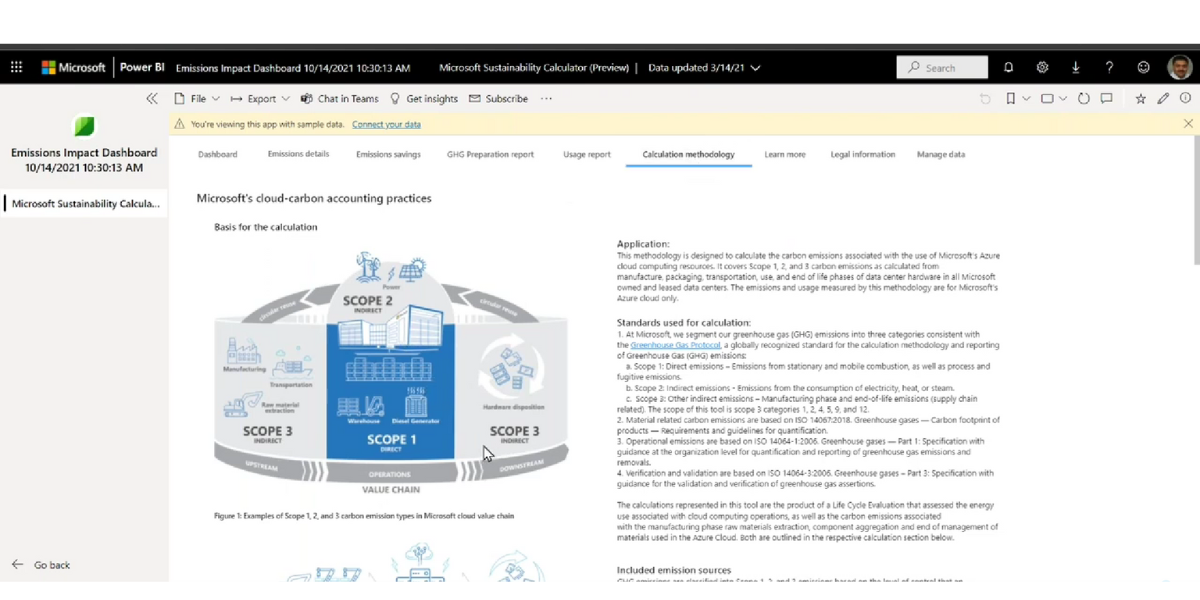
- Calculate with prebuilt and custom calculation models against factor libraries, with a calculation data trail that produces a downloadable CSV snapshot of inputs, models, emission factors and factor mappings. That trail is what makes the numbers defensible under assurance.
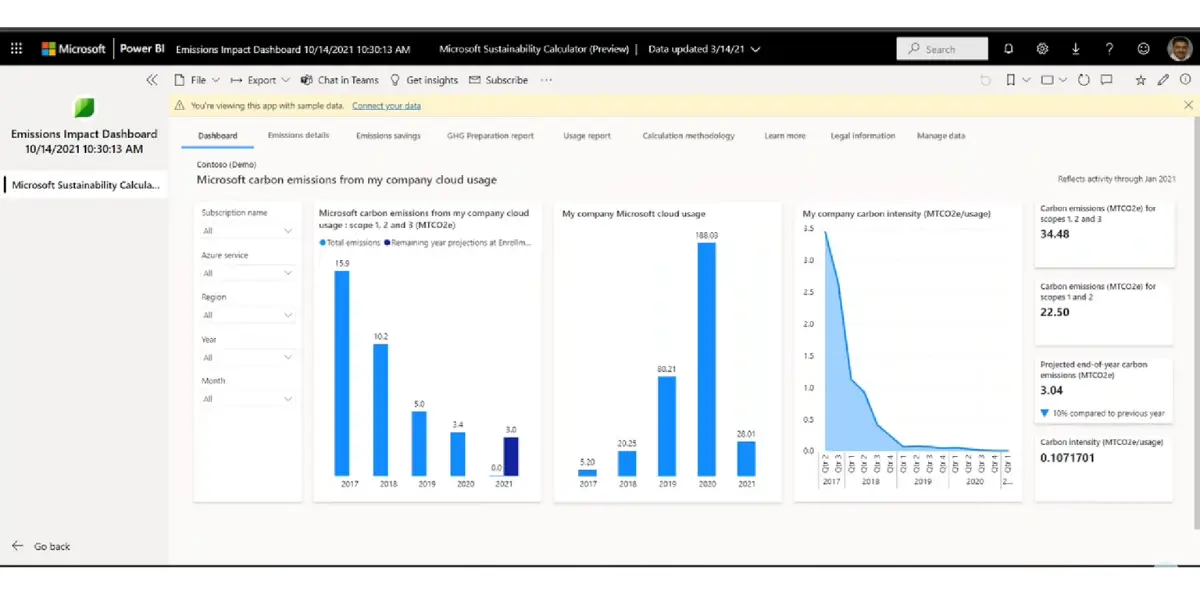
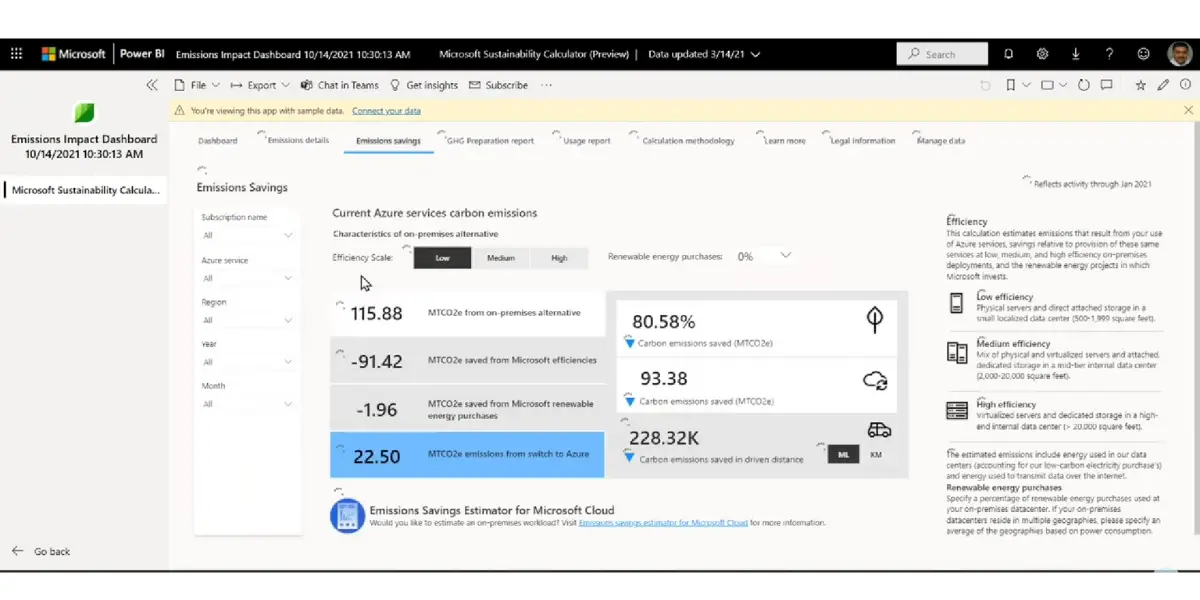
- Report through Power BI dashboards, goals and scorecards, and external reporting that builds preparatory reports for CSRD, the Australian Sustainability Reporting Standards, BRSR 1 and 2, GRI, IFRS S1 and S2, and SASB.
Do you still need it? The 2026 CSRD reality check
The business case for this category was built on the assumption that EU reporting rules would pull in tens of thousands of companies. That assumption no longer holds.
The EU’s Omnibus package cut the scope of the Corporate Sustainability Reporting Directive sharply, and the changes entered into force on 18 March 2026. An EU company is now in scope only if it exceeds both more than 1,000 employees and more than EUR 450 million in net turnover. Non-EU groups come in at EUR 450 million of EU revenue. Listed SMEs and the original wave 3 are out entirely. Companies from the original wave 1 that still meet the thresholds keep reporting through fiscal 2026 data.
At $48,000 a year for Essentials before user SKUs, and $144,000 for Premium, this is not a product you buy speculatively. If a filing obligation no longer applies to you, the purchase has to be justified by customer and investor pressure, supply chain questionnaires or your own targets. Those are legitimate reasons. They are just weaker ones, and they should change the number you are willing to pay.
Where it is strong
- Published pricing. Rare in this market. Salesforce, by contrast, has withdrawn its Net Zero Cloud price list entirely. Being able to model cost before a sales call is a real advantage.
- Per-tenant pricing on the main SKU. A large sustainability team does not multiply the tenant licence, which suits organisations with many occasional contributors.
- Breadth of reporting standards. CSRD, ASRS, BRSR, GRI, IFRS and SASB out of the box matters for groups filing in several jurisdictions.
- Factor library coverage. ADEME, EPA, EXIOBASE, IPCC, DEFRA, EU energy, Taiwan and Australian NGA are all included at Essentials level, which is a better regional spread than most competitors ship.
- Power Platform underneath. If you already run Dynamics 365 or Power Platform, the connectors, security model, admin tooling and skills carry straight over, and Power Automate and Power Apps rights come with the user SKU.
- Beyond carbon. Water quantity and wastewater quality, waste tracking and circularity dashboards are in the base plan, not sold as modules.
Where it is not
- The plan split is aggressive. A 3x price step that gates four Scope 3 categories, supplier data collection, allocations and all AI means many organisations discover during implementation that they bought the wrong tier. Map your material Scope 3 categories before choosing.
- The headline price is not the bill. A per-user USL is required on top of the tenant SKU, some features need Azure meters, and Microsoft names Microsoft 365 and Power BI as additional licences. Dataverse overage is billable and the published capacity figures conflict between Microsoft’s own pages.
- A visible pattern of retirement. Seven deprecations in roughly eighteen months, including an API, a preview service, a Purview template and invoice data capture, with one replacement Microsoft itself says is not a drop-in. Preview features here have a real track record of not surviving, which is worth weighing before you build a process on one. Several capabilities still central to the pitch, including Copilot, the ESG value chain solution and allocations, remain in preview.
- Invoice OCR was removed, not replaced. Microsoft’s guidance is to build your own with Copilot Studio, AI Builder and Power Automate. That is a project, and it lands on the customer.
- Monthly releases are mandatory in practice. Supporting only version 2.33 and later at 2.35 means a narrow window, so someone has to own upgrade testing continuously.
- It assumes a Microsoft estate. Outside one, you are adopting Power Platform administration to do carbon accounting, and the incidental licence requirements get expensive.
Who is using it
Microsoft publishes customer stories including Södra, the Swedish forest industry group, assessing climate data across its value chain; PwC, using it to help clients gather regulatory-grade sustainability data; ICONICS, reporting 10 to 20 percent energy cost savings for its customers; World Wide Technology, which migrated its emissions data and reports 20 percent time savings on calculations; and the Global FoodBanking Network.
The pattern worth noticing is that several are technology providers and consultancies delivering it to their own clients, which tells you where the implementation expertise sits.
Alternatives
- Salesforce Net Zero Cloud, the closest like-for-like if your data estate is Salesforce rather than Microsoft. Note that it no longer publishes list prices.
- Persefoni and Greenly, carbon accounting specialists that do not require a platform underneath.
- Sphera and IBM Environmental Intelligence Suite, stronger where EHS and operational risk sit next to carbon.
- Sinai Technologies, focused on decarbonisation modelling.
- Our wider carbon accounting software comparison covers the rest of the market.
FAQs
How much does Microsoft Cloud for Sustainability cost?
The product you buy is Microsoft Sustainability Manager, and Microsoft publishes two list prices: Essentials at US$4,000 per tenant per month and Premium at US$12,000 per tenant per month. Both are tenant-level. On top of the tenant SKU, each user requires a Sustainability Manager USL user-level SKU, and Microsoft notes that some features additionally require Azure meters and other licences such as Microsoft 365 and Power BI.
What is the difference between Essentials and Premium?
Essentials covers the carbon, water, waste, energy and social and governance data model, Scopes 1 and 2, Scope 3 categories 1 to 9, 12 and 13, external reporting, dashboards and most factor libraries. Premium adds Scope 3 categories 10, 11, 14 and 15, Copilot, intelligent insights, what-if analysis, emissions allocations, the ESG value chain solution, product carbon footprint, carbon fee, report versioning, the IEA factor library, and water and waste intensity KPIs.
Is there a free trial of Microsoft Sustainability Manager?
Yes. Microsoft offers a free 30-day trial that grants most Premium features, and you can use sample data or your own. You can sign up directly with your Microsoft account, or an administrator can start it from the Microsoft 365 admin center if your organisation blocks individual trial sign-ups. Because the trial is Premium-shaped, be careful about evaluating on it and then buying Essentials.
Is Microsoft Cloud for Sustainability being discontinued?
No. Microsoft Sustainability Manager ships monthly and the July 2026 release is version 2.35. However, Microsoft has retired a number of surrounding pieces since 2025: the Microsoft for Sustainability API on 30 May 2025, the CSRD template in Purview Compliance Manager on 31 Oct 2025, the invoice data capture solution on 5 Jan 2026, the Environmental Credit Service preview, and the Cloud Solution Center. Sustainability data solutions in Microsoft Fabric moved to a GitHub repository on 14 Nov 2025.
What happens if I downgrade from Premium to Essentials?
Premium data is not deleted but stops being visible. You lose the ability to import or calculate Scope 3 categories 10, 11, 14 and 15, and those categories are removed from the Power Query and Excel import experiences. Allocations, what-if analysis, intelligent insights, document analysis, the ESG value chain solution, report versioning, the IEA factor library and water and waste intensity KPIs all become unavailable. If a Premium licence lapses without switching plans, the features remain visible in the interface but are disabled.
Do I need Dynamics 365 or Power Platform to use it?
Sustainability Manager is built on Power Platform and Dataverse, deployed and updated through the Power Platform admin center. Power Apps and Power Automate use rights are included in the user SKU but only within the context of Sustainability Manager. You do not need Dynamics 365 itself, but you are taking on Power Platform administration and Dataverse capacity management either way.
The short version
Microsoft Sustainability Manager is a serious carbon, water and waste accounting platform with unusually transparent pricing and strong regional factor and reporting-standard coverage. It is the obvious candidate if you already run Power Platform.
Two things decide whether it works out. Map your material Scope 3 categories before you pick a plan, because categories 10, 11, 14 and 15 and supplier data collection sit behind a 3x price step and are the most common reason a deployment stalls. And read the deprecations page before you build a process on any preview feature, because this portfolio has retired a lot in a short time and several headline capabilities are still in preview.
Using Google Search? Add erp-information.com as a preferred source.