Two things about Salesforce Net Zero Cloud have changed since most of the pages describing it were written, and both matter before you take a sales call.
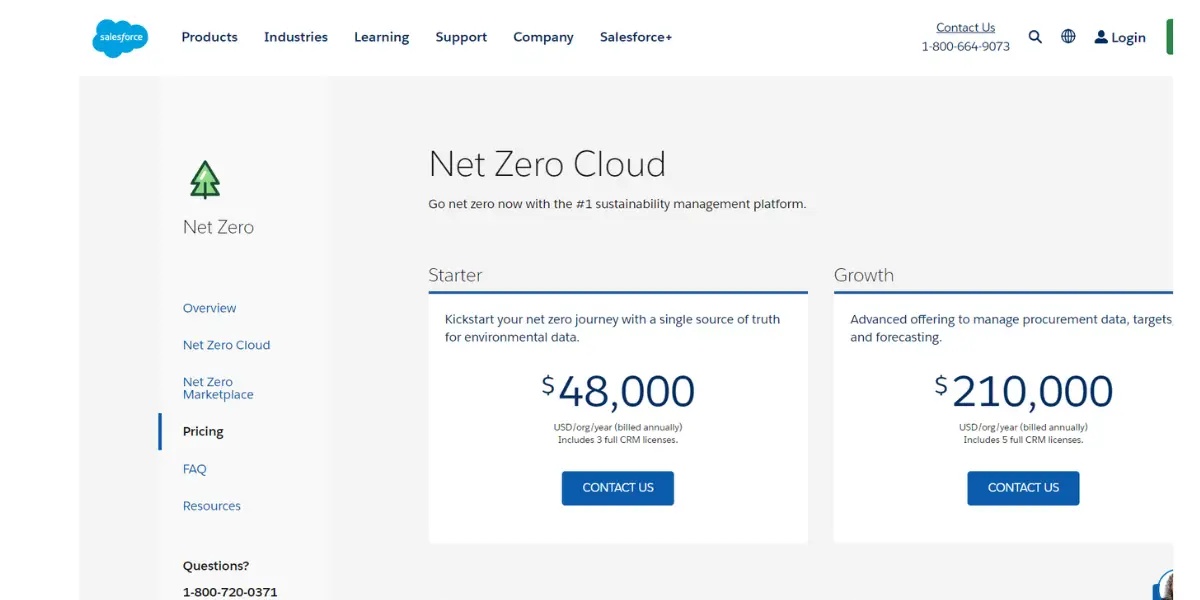
Salesforce has stopped publishing list prices for it. The Net Zero Cloud pricing page once carried a public price sheet with two named editions and hard dollar figures. Today every tier and every add-on on that page reads “Contact us for pricing.” The $48,000 and $210,000 figures still circulating across software directories are a withdrawn 2022 price list, not a current quote.
The product is also being renamed. Salesforce is folding it into its Agentforce branding as Agentforce Net Zero, and the transition is only half finished, so the same product now appears under two names across Salesforce’s own properties.
This review covers what the product is called now, what Salesforce actually publishes about cost in 2026 and what drives it, what is in the current edition, and whether the shrinking EU reporting mandate still makes it necessary.
Net Zero Cloud or Agentforce Net Zero? Where the naming actually stands
Net Zero Cloud is Salesforce’s carbon accounting and ESG reporting platform, built as a set of custom objects and dashboards on the core Salesforce platform rather than as a standalone application. It collects environmental data, applies emissions factors, and produces auditable disclosure reports.
Its name has moved three times, which is why searching for it turns up contradictory results:
- Sustainability Cloud was the original name. Salesforce announced Sustainability Cloud 2.0 at Dreamforce on 21 September 2021. Several software directories still file the product under this name.
- Net Zero Cloud arrived with the global launch of Net Zero Cloud 2.0 on 16 February 2022, the same day Salesforce made sustainability its fifth core company value.
- Agentforce Net Zero is the current direction. Salesforce Trailhead now titles the introductory badge “Agentforce Net Zero Basics,” and both G2 and AWS Marketplace list the product as Agentforce Net Zero, formerly Salesforce Net Zero Cloud.
The rename is not complete. As of July 2026, salesforce.com/net-zero still uses “Net Zero Cloud” throughout its navigation, pricing page and product documentation, and it lists “Agentforce for Net Zero Cloud” as a separately priced add-on rather than as the product itself. Treat the two names as the same platform, and expect a sales representative to use either.
Salesforce Net Zero Cloud pricing in 2026
Salesforce publishes no price for Net Zero Cloud. The current pricing page lists a single edition, Net Zero Cloud Growth, and shows “Contact us for pricing” against it and against every add-on. There is no self-serve trial and no online purchase path. Contracts are annual.
That is a real change, not an oversight, and it is worth knowing before you compare quotes against numbers you found elsewhere.
What the withdrawn price list said
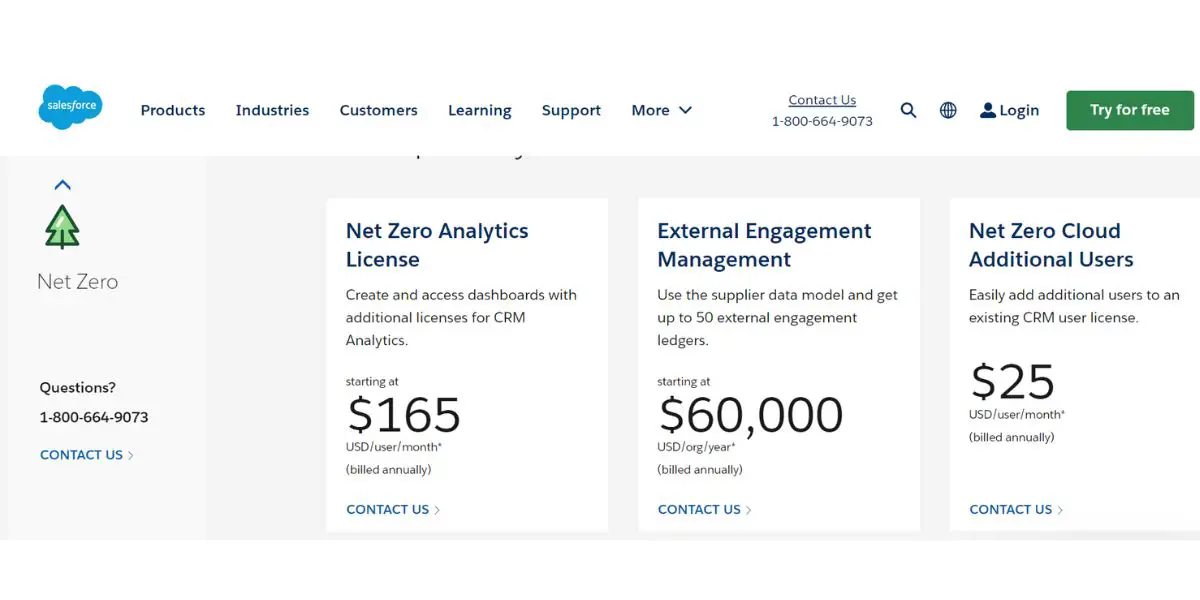
Salesforce did publish list prices until roughly 2024. Those figures are reproduced below because directories still quote them as current, and because they are useful as an order-of-magnitude anchor. They are not a quote you can hold Salesforce to.
| Line item (historical list price) | Price as published | Notes |
|---|---|---|
| Net Zero Cloud Starter | $48,000 USD per org per year | Billed annually, included 3 full CRM licenses. Edition no longer listed. |
| Net Zero Cloud Growth | $210,000 USD per org per year | Billed annually, included 5 full CRM licenses. Still the only named edition today. |
| Net Zero Analytics License | $165 USD per user per month | Billed annually. Now sold as Advanced Analytics and Forecasting. |
| External Engagement Management | $60,000 USD per org per year | Billed annually, covered up to 50 external engagement ledgers. |
| Net Zero Cloud Additional Users | $25 USD per user per month | Billed annually. Note: per month, not per year. |
What actually drives the number on your quote
Since there is no list price to work from, the useful thing is knowing which lines a Net Zero Cloud proposal is built from. Ask for the quote broken out this way:
- The base Growth licence, priced per org rather than per seat, with a small number of full CRM licences bundled in.
- Additional users beyond the bundled licences, priced per user per month on an annual commitment.
- Advanced Analytics and Forecasting, which adds CRM Analytics licences for what-if analysis and visual forecasting. Dashboards beyond the out-of-the-box set generally sit behind this.
- External Engagement Management, the supplier-facing add-on. If Scope 3 supplier data collection and supplier scorecards are the reason you are buying, this is a separate line, not part of the base.
- Agentforce for Net Zero Cloud, the agentic AI layer, priced separately again.
- Multi-Organization Support, if franchisees or investee companies need to do their own environmental accounting inside a parent org.
- A Success Plan. The Standard plan is included. Premier is priced at 30% of net license fees, which is a published figure and a material addition to any of the numbers above. Signature is quote-only.
- Implementation. Salesforce sells the licence; a partner almost always does the deployment, emissions factor configuration and data integration.
One trap worth flagging. Salesforce’s own pricing FAQ states that to use Einstein generative AI capabilities on Net Zero Cloud, you must buy Net Zero Cloud plus one of the Einstein 1 SKUs: Einstein for Platform, Einstein for Sales Cloud, or Agentforce for Service Cloud. The AI capability that features heavily in the marketing is not included in the base licence.
What is in Net Zero Cloud today
The feature set has grown well beyond the carbon-footprint-and-dashboards product of 2022. Taken from the current edition comparison, the Growth edition covers:
| Area | What it does |
|---|---|
| Scope 1 and 2 emissions | Stationary and mobile combustion, purchased electricity, with pre-loaded emissions factors and custom fuel types and units of measure. |
| Scope 3 emissions | The full indirect footprint. Scope 3 Light covers business travel (Category 6) and freight hauling (Categories 4 and 9). Growth adds waste (Categories 5 and 12) and the Scope 3 Hub. |
| Scope 3 Hub | A matching tool that calculates emissions from spend for purchased goods and services (Category 1) and other spend-based categories, assigning emission factors at scale. |
| Disclosure and Compliance Hub | Report authoring against reporting frameworks, with a plugin for Microsoft 365 Word. |
| Information Library | A central auditable store for sustainability content used across disclosures. |
| Data acquisition | Data gap filling, advanced emissions factor management, a simplified collection flow, and an Intelligent Document Reader that OCRs source documents such as utility bills. |
| Waste and water | Hazardous and non-hazardous waste and water impact analysis. |
| Targets and forecasting | Science-based target setting, emission forecasting, and marginal abatement cost visualisations for ranking reduction options by cost. |
| Energy and credits | Building energy intensity, energy attribute credit and REC management, and carbon credit management. |
| Beyond environmental | A social and governance data model, materiality assessment, and ESG program management. |
| Supplier engagement | Supplier sustainability data and scorecards, via the External Engagement Management add-on. |
Salesforce also runs the Net Zero Marketplace, a carbon credit marketplace announced in September 2022, where project pricing and third-party ratings can be browsed without an account. It is a separate property from the Net Zero Cloud licence.
Agentforce for Net Zero Cloud
Salesforce announced Agentforce for Net Zero Cloud on 24 June 2025. It is an add-on, generally available, and it does two things that matter to a sustainability team.
- Insights in natural language. Questions such as “identify our least energy-efficient buildings” or “what is our year-over-year energy consumption for real estate” are answered against your own data rather than requiring a report to be built.
- Disclosure assistance. Draft responses for CSRD, SASB and CDP are generated from the Information Library and saved documents.
The same release brought Data Cloud integration, which is the more consequential half. It lets Net Zero Cloud read granular data held in finance, procurement and operations systems, such as smart meter reads, expense-platform travel data and supplier invoices, without copying or reformatting it first. Custom no-code agents can be built in Agent Builder on top of that.
Do you still need it? The 2026 CSRD reality check
Most carbon accounting software was sold on the assumption that EU sustainability reporting would sweep in tens of thousands of companies. That assumption no longer holds, and it changes the business case.
The EU’s Omnibus package cut the scope of the Corporate Sustainability Reporting Directive sharply. The changes entered into force on 18 March 2026. An EU company now falls in scope only if it exceeds both more than 1,000 employees and more than EUR 450 million in net turnover. Non-EU groups come in at EUR 450 million of EU revenue, with an EU branch threshold of EUR 200 million. Listed SMEs and the original wave 3 are out entirely.
Two practical consequences:
- Companies that were in the original wave 1 and still meet the revised thresholds keep reporting, through fiscal 2026 data published in 2027. Those that fall out may be exempted as early as FY25, but only where their member state has legislated it, so the answer is jurisdiction-specific.
- If you are below the thresholds, a platform priced in this range is now a voluntary purchase driven by customer and investor demands, supply chain questionnaires or your own targets, not by a filing deadline. That is a legitimate reason to buy, but it is a different business case and a much weaker one for a six-figure commitment.
Confirm your own status before treating any ESG platform as mandatory. This is the single question that most changes whether Net Zero Cloud is worth its cost in 2026.
Where it is strong
- It is Salesforce-native. If your procurement, expense or account data already lives in Salesforce, the emissions data sits next to it under the same security model, reporting tools and audit trail. That is a genuine advantage no standalone ESG vendor can match.
- Spend-based Scope 3 at scale. The Scope 3 Hub converts procurement spend into categorised emissions with factors assigned automatically, which is the part of carbon accounting that most often defeats a spreadsheet.
- Audit-ready output. The Information Library plus the Disclosure and Compliance Hub are built around producing a defensible trail, which matters when a report is assured rather than just published.
- Coverage past carbon. Waste, water, and the social and governance data model mean one platform can carry a full ESG report, not just the emissions chapter.
Where it is not
- You cannot price it without a sales call. No list price, no published edition ladder beyond a single Growth tier, no trial, no self-serve purchase. Budgeting requires a quote, and comparison shopping against directory figures is unreliable.
- The interesting capabilities are add-ons. Supplier Scope 3 collection, advanced analytics and forecasting, multi-org support and the Agentforce layer are all priced separately, and generative AI additionally requires an Einstein 1 SKU. A base quote can look reasonable and then double once the features you came for are added.
- It assumes a Salesforce shop. The product is objects, permission set licences and dashboards on the core platform. If you do not already run Salesforce, you are adopting a CRM platform and its administration overhead to do carbon accounting, and the bundled CRM licences in the historical editions are a hint at how that was priced.
- Implementation is not the licence. Emissions factor configuration, data integration and dashboard work are partner projects. Both of the Salesforce customer stories below name a consulting partner, which tells you something about the expected delivery model.
- The naming churn has a cost. Three product names in five years means documentation, directory listings, training material and review sites disagree with each other, and it makes verifying any claim about the product harder than it should be.
Who is using it
- Mastercard uses it, with Accenture, for insight into supplier emissions so it can work with its partner network on reductions.
- Deloitte Germany tracks emissions on a project-by-project basis, giving clients the carbon cost of an individual engagement. Deloitte reports that client questions about carbon transparency have in some cases decided whether it wins the work.
- MillerKnoll uses it, with partner Orion Global Solutions, to see supplier environmental impact in one view across 15 global locations and to flag anomalous emissions data for investigation.
Training and certification
Training is free and reasonably deep, which is worth stating because several reviews of this product claim none exists. Salesforce publishes a Net Zero trailmix on Trailhead including Agentforce Net Zero Basics, Net Zero Cloud Analytics Setup, Carbon Accounting for Assets, and Carbon Accounting for Scope 3.
There is also a formal credential, the Net Zero Cloud Accredited Professional (AP-218), aimed at practitioners who configure and implement the product. It runs 55 scored multiple-choice questions plus 5 unscored, 75 minutes, a 61% pass mark, and a $150 registration fee with the same again for a retake. It is delivered proctored, either at a test centre or online, and expects working Salesforce knowledge of objects and data modelling going in.
Alternatives
- Microsoft Cloud for Sustainability, the closest like-for-like if your data estate is Microsoft rather than Salesforce.
- Persefoni and Greenly, carbon accounting specialists that do not require a CRM platform underneath.
- Sphera and IBM Environmental Intelligence Suite, stronger where EHS and operational risk sit alongside carbon.
- Sinai Technologies, focused on decarbonisation modelling and marginal abatement analysis.
- Our wider carbon accounting software comparison covers the rest of the market.
FAQs
How much does Salesforce Net Zero Cloud cost?
Salesforce no longer publishes a price. The Net Zero Cloud pricing page lists one edition, Net Zero Cloud Growth, and shows Contact us for pricing against it and for every add-on. Contracts are annual and there is no trial or self-serve purchase. Until roughly 2024 Salesforce did publish list prices of $48,000 per org per year for a Starter edition and $210,000 for Growth, and those withdrawn figures are what most software directories still quote.
Is Net Zero Cloud the same as Agentforce Net Zero?
Yes. It is the same platform mid-rename. Salesforce Trailhead, G2 and AWS Marketplace now use Agentforce Net Zero, while salesforce.com/net-zero still says Net Zero Cloud and lists Agentforce for Net Zero Cloud as a separately priced AI add-on. Earlier still, the product was called Sustainability Cloud.
Does Net Zero Cloud include AI?
Not in the base licence. Agentforce for Net Zero Cloud, announced on 24 June 2025, is a separately priced add-on covering natural language insights and draft disclosure responses for CSRD, SASB and CDP. Salesforce also states that Einstein generative AI on Net Zero Cloud requires buying an Einstein 1 SKU in addition to Net Zero Cloud.
Do I still need CSRD reporting software in 2026?
Fewer companies do. The EU Omnibus changes took effect on 18 March 2026 and limit CSRD scope to EU companies with more than 1,000 employees and more than EUR 450 million net turnover. Non-EU groups qualify at EUR 450 million of EU revenue. Original wave 1 companies still in scope keep reporting through fiscal 2026 data. Below those thresholds, an ESG platform is a voluntary purchase driven by customers, investors and your own targets rather than a filing obligation.
Do you need Salesforce CRM to use Net Zero Cloud?
Effectively yes. Net Zero Cloud is a set of objects, permission set licences and dashboards on the core Salesforce platform, and it can be deployed into an existing org or a clean one. The historical editions bundled three to five full CRM licences for that reason. Organisations with no Salesforce footprint take on platform administration alongside the carbon accounting.
What does Scope 3 Hub do that Scope 3 Light does not?
Scope 3 Light covers business travel (Category 6) and freight hauling (Categories 4 and 9). The Growth edition adds waste (Categories 5 and 12) and the Scope 3 Hub, a matching tool that calculates emissions from spend for purchased goods and services (Category 1) and other spend-based categories, assigning the right emission factors at scale.
The short version
Net Zero Cloud, increasingly called Agentforce Net Zero, is a credible enterprise carbon accounting and ESG reporting platform, and it is the obvious candidate if you already run Salesforce and need spend-based Scope 3 and audit-ready disclosures in one place. Budget for the add-ons rather than the base licence, and get the quote itemised, because the supplier engagement, analytics and AI layers are all separate lines and the published price list that once anchored those conversations no longer exists.
Before any of that, check whether the EU thresholds that took effect in March 2026 still put you in scope. If they do not, this becomes a discretionary purchase and the price you are quoted should be judged accordingly.