Tipalti is finance automation for companies that pay a lot of people in a lot of countries. That is the honest one-line description, and it explains both why some buyers love it and why others find it expensive and heavy. If you process a few hundred domestic invoices a month, this is probably not your product. If you run several legal entities, pay suppliers or partners across borders, and have to survive a tax audit on it, it is one of a very small number of credible options.
The pricing below is the part most write-ups get wrong. Tipalti has repriced twice and renamed its plan tiers three times since 2024, and as of mid-2026 it publishes no named tiers at all.
Tipalti pricing in 2026
Two entry prices are published on Tipalti’s pricing page, re-checked 31 August 2026 and unchanged:
- Tipalti Accounts Payable: plans starting at $99 per month. Includes unlimited users, a self-service supplier portal and core automation.
- Tipalti Mass Payments: plans starting at $249 per month. Includes unlimited users and a payee portal.
Both figures are platform fees only. Transaction pricing is charged on top, per invoice and per payment, and Tipalti does not publish those rates. The quote is driven by payment volume, how many legal entities you run, which modules you enable, and which payment methods and currencies you need. There is no free tier and no per-user or per-approver fee, which is genuinely unusual in this category and matters if you have a lot of occasional approvers.
Anything above the entry level is a custom quote. As of mid-2026 there are no published tier names on the page at all.
Why you will see three different prices quoted elsewhere
Because all of them were correct once. This is the actual sequence, reconstructed from archived captures of Tipalti’s own pricing page:
- 2022 to early 2023: platform fee from $149/month.
- 2024: Starter at $129/month, with a Premium tier above it.
- December 2024: Starter drops to $99/month; tiers become Starter, Premium and Elite.
- Early 2026: tiers renamed Select ($99), Advanced ($199) and Elevate (custom).
- Between May and June 2026: the page is rebuilt and the tier names are removed entirely, leaving the two “plans starting at” figures above.
So a page quoting “Starter $129” is describing 2024, and a page quoting “Select $99 / Advanced $199” is describing spring 2026. Several large review sites are still publishing the second of those. Treat any Tipalti price you read, including this one, as perishable and check the source page before you build a budget on it.
You will also find aggregator sites quoting precise FX markups, per-transaction ranges and implementation fees. Tipalti publishes none of those numbers itself, so treat any figure presented as an official Tipalti rate card as unsourced. There is, however, a legitimate way to see real numbers, which the next section sets out.
What are Tipalti’s fees?
Tipalti charges on four separate lines: a monthly platform subscription from $99, a per-transaction fee on every invoice and payment, a foreign exchange margin on cross-border payouts, and professional services for complex implementations. Only the subscription is published. The transaction and FX rates are negotiated per contract, which is why no two customers quote the same numbers.
The table below separates what Tipalti confirms it charges for from what it actually discloses. Everything in it is taken from Tipalti’s own pricing page and pricing FAQ, checked 31 August 2026.
| Charge | What triggers it | Does Tipalti publish a rate? |
|---|---|---|
| Platform subscription | Monthly, per product. Accounts Payable from $99, Mass Payments from $249 | Entry price only. Nothing above it |
| Transaction fee | Per invoice processed and per payment executed | No. Tipalti states only that fees “vary by payment method and destination” |
| Foreign exchange margin | Paying a payee in a currency other than your funding currency | No. Described only as rates “built directly into the payment workflow” |
| Professional services | Multi-ERP setups, custom integrations, advanced compliance requirements | No, and standard implementations are included at no extra cost |
| Per-user or per-approver fee | Nothing. Pricing is by volume and modules, not seats | Yes. Tipalti states explicitly that it charges none |
| Free tier | Nothing. There is no free version | Yes. Tipalti states explicitly that none exists |
One line in that table contradicts most of what is written about Tipalti elsewhere. Review sites routinely quote a four-figure or five-figure mandatory implementation fee. Tipalti’s own pricing FAQ now says the opposite: “Standard implementations are included and cover common AP and payment workflows.” Additional professional services apply only to multi-ERP setups, custom integrations or advanced compliance work. Native connectors for NetSuite, Sage Intacct, SAP Business One and Microsoft Dynamics 365 Business Central carry no separate integration charge; only API-based or custom integrations may.
What Tipalti’s per-payment fees actually look like
Tipalti does not publish a payee rate card, but its customers do. Companies that pay creators and suppliers through Tipalti have to disclose the deduction to the people being paid, and two of them publish the full schedule. Both attribute the fees directly to Tipalti, and Vydia states that it adds nothing of its own: “Our partner payment platform Tipalti charges a fee for each transaction, which is automatically deducted from the payout. Vydia does not charge any additional fees for payments.”
| Payment method | Vydia, per transaction | Insight Timer, per transaction | Insight Timer minimum payout |
|---|---|---|---|
| ACH, US domestic | $1.15 | $1.00 | $10 |
| Global ACH / eCheck, international | $5.75 | $7.00 | $50 |
| eCheck, local UK bank account | $1.72 | not listed | not listed |
| Paper check | $3.45 | $1.99 | $10 |
| PayPal, US payee | $1.15 plus 2%, capped at $2.15 | $1.00 plus 2%, capped at $2.00 | $10 |
| PayPal, non-US payee | $1.15 plus 2%, capped at $21.15 | $1.00 plus 2%, capped at $2.00 | $10 |
| Wire, US domestic | $17.25 | $15.00 | $50, rising to $100 from 21 July 2025 |
| Wire, international paid in local currency | $23.00 | $20.00 | $50, rising to $100 from 21 July 2025 |
| Wire, international paid in USD | $29.90 | $26.00 | $50, rising to $100 from 21 July 2025 |
| Foreign exchange margin | 2.50% | 1.5% to 3%, by country and amount | not applicable |
Sources: Vydia’s Tipalti FAQ and Insight Timer’s payment documentation, both retrieved 31 August 2026. These are two contracts, not the whole market, and neither company is Tipalti. Read them as observed rates rather than a rate card.
The two schedules disagree, and that is the useful part
Comparing the two columns settles a question no vendor page answers: are Tipalti’s transaction fees a standard rate or a negotiated one? Five of the eight comparable line items in Vydia’s schedule are exactly 1.15 times Insight Timer’s, to the cent: ACH ($1.15 against $1.00), the PayPal base fee ($1.15 against $1.00), and all three wire tiers ($17.25 against $15.00, $23.00 against $20.00, $29.90 against $26.00).
The remaining two move in opposite directions. International eCheck is cheaper for Vydia ($5.75 against $7.00) while paper check is dearer ($3.45 against $1.99). A uniform reseller markup would not do that. The pattern is consistent with a per-method negotiated schedule, priced off a common base, with individual methods traded up or down deal by deal.
The practical consequence for a buyer: the per-payment fee is negotiable, and the wire tiers are where the money is. A 15% spread on a $1.00 ACH fee is fifteen cents. The same spread on international wires is $2.25 to $3.90 per payment. If you pay a few thousand cross-border invoices a year, the wire and FX lines are worth more in negotiation than the platform subscription you are being quoted on.
The fee nobody warns you about
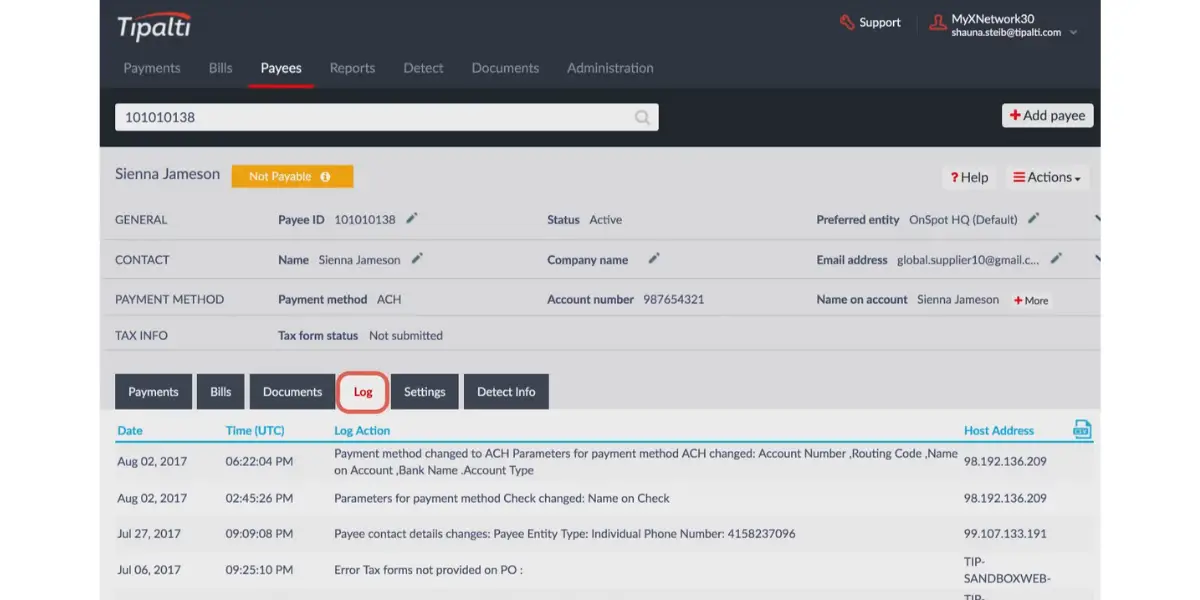
Both sources document a charge that does not appear in any pricing comparison: a rejection or compliance-review fee. Vydia’s terms state that if a payment sent through Tipalti is rejected or taken under compliance review, Tipalti may charge a fee, and the payee’s balance is debited for the full amount. The triggers it lists are incorrect payee details such as a wrong SWIFT, routing or account number, a rejection by the payee’s own bank or PayPal for regional reasons, and any payment that trips an Anti-Money Laundering or OFAC review.
This matters most for exactly the buyer Tipalti sells to. A business paying a large, self-onboarded payee network across many countries will have payees entering their own bank details, so a predictable share of payments will fail on bad data and each failure can carry a charge. Ask for the rejection fee in writing during the quote, because it is not in the published pricing and it scales with payee count rather than payment volume.
Who actually pays the fee
Tipalti lets the payer decide whether it absorbs the transaction fee or passes it to the payee, and the choice can differ by payment method. Both companies above pass it on: Insight Timer states plainly that “transaction fees are deducted from your earnings before payout” and that “Tipalti sets these fees”. That is the norm in creator and marketplace payouts and the reason those schedules are public at all. In a conventional accounts payable setup, where you are paying suppliers against invoices, the payer normally absorbs the fee instead, because deducting it would underpay the invoice.
Because the payer can also set fees per method, this is a lever rather than a fixed cost. Absorbing the $1.00 ACH fee while passing on the $26.00 international wire fee pushes payees toward the cheap rail without a policy fight, which is the single most effective way to reduce a Tipalti bill.
What Tipalti actually sells
Six products, which is two more than the company had when most articles about it were written. Note that two names commonly attributed to Tipalti are retired: “Purchase Order Management” is now Procurement, and “Global Partner Payments” is now Mass Payments.
Accounts Payable
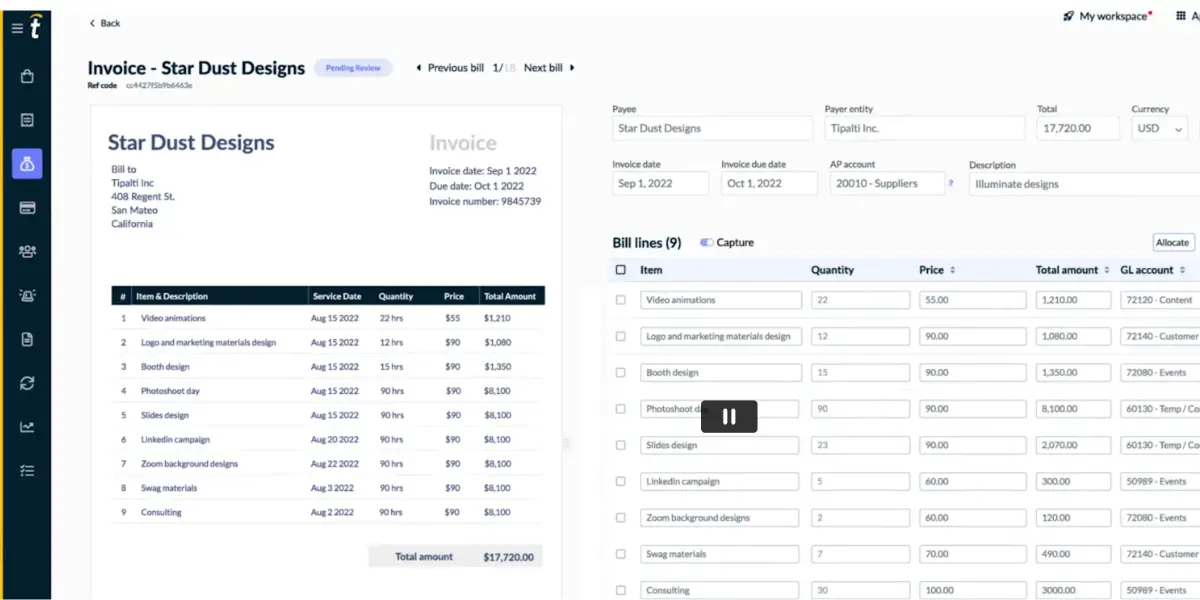
The core product: invoice capture and GL coding, supplier onboarding through a self-service portal, two- and three-way PO matching, approval routing, payment execution and automated reconciliation. Supplier onboarding is offered in 27 languages and invoice scanning covers 146, which is the kind of number that only matters until the day it matters a great deal.
Mass Payments
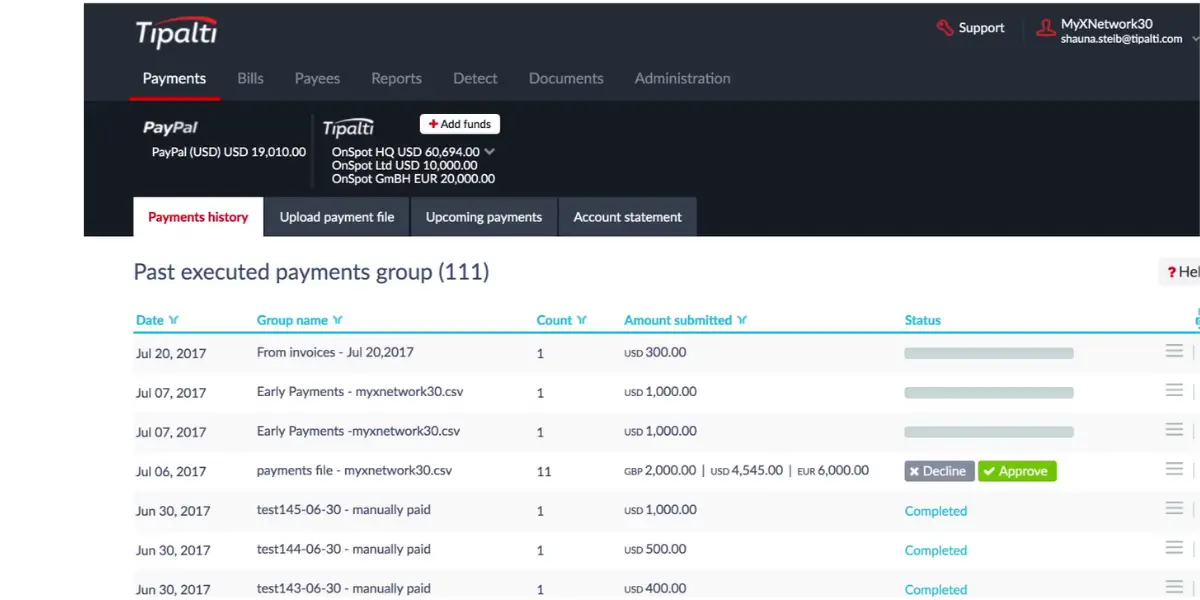
The product for paying publishers, affiliates, creators, marketplace sellers and gig workers at volume. It carries its own $249/month entry price and its own feature set: currency management, self-billing invoices, payee portals, performance-platform integrations, and Tipalti Detect for fraud screening. Coverage is stated as 200+ countries and territories, 120 currencies and 50+ payment methods. Tipalti’s own site is internally inconsistent here, with an older “196 countries” line still sitting on the expenses pages.
Procurement
Intake, requisitions, approvals and PO creation, feeding straight into AP matching. This came from Tipalti’s acquisition of Approve.com, announced April 2021, and it is a separate licensed module rather than a feature of AP.
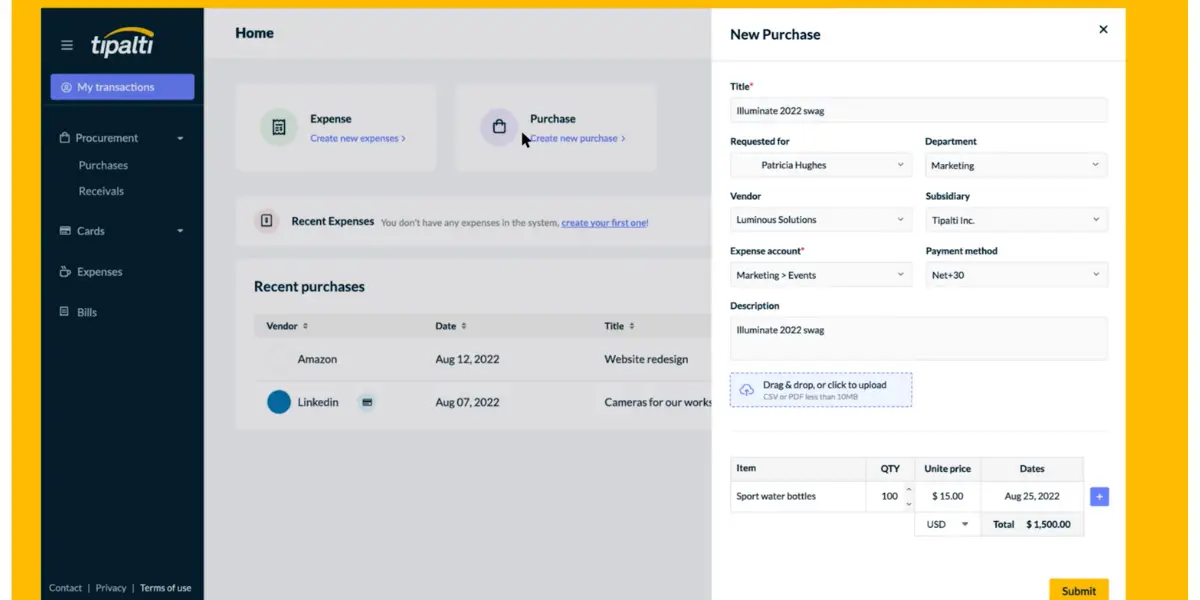
Expense Management and Tipalti Card
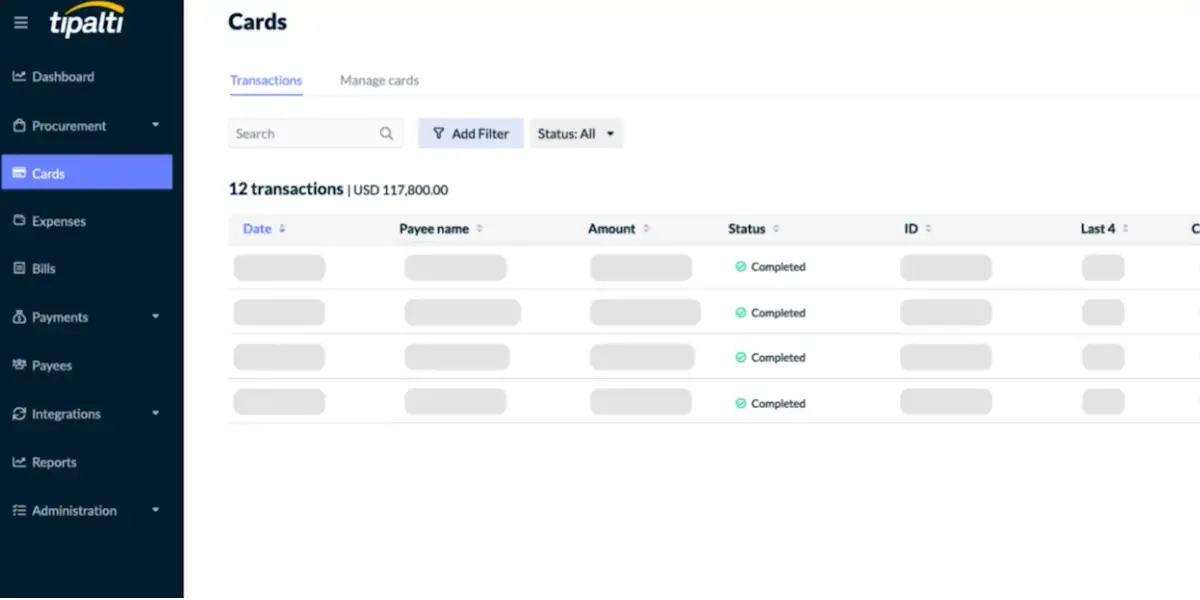
Employee expense claims and reimbursements, plus corporate cards. Tipalti Card now covers physical and virtual cards and has been extended to the UK. Tipalti states there is no additional cost to issue cards for AP customers; it markets cashback but does not publish the rate.
Treasury
The newest line and the one no older review covers. Tipalti acquired Statement, an AI-native treasury automation startup founded in 2022, announcing the deal on 17 June 2025 with terms undisclosed. It now sells as Statement Treasury: real-time cash visibility across accounts and AI cash-flow forecasting. If you are comparing Tipalti against a pure AP tool, this is a genuine scope difference rather than marketing.
Tipalti AI, and the feature that no longer exists
If you read an article praising Tipalti Pi, or “Payables Intelligence”, it is describing a product that has been retired. Pi launched in March 2020 and appears nowhere on Tipalti’s site today.
What replaced it is branded Tipalti AI, framed as a set of named agents rather than one intelligence layer. The eight currently listed are the Reporting Agent, Bill Approvers Agent, Purchase Request Agent, Invoice Capture Agent, Tax Form Scan Agent, PO Matching Agent, ERP Sync Resolution Agent and Expense Receipt Scan Agent, alongside a conversational Tipalti AI Assistant. The ERP Sync Resolution Agent is the interesting one, because sync failures are the most consistent complaint customers raise (see below), and Tipalti has evidently productised the cleanup.
Tipalti raised $200 million in growth financing from Hercules Capital in September 2025 explicitly to fund AI development. That was debt, not equity, so it carries no valuation. Be careful with any source claiming a current valuation for Tipalti: the last figure the company itself disclosed was $8.3 billion at its Series F in December 2021, which is now well over four years old.
Integrations
Sixteen published ERP and accounting integrations: Oracle NetSuite, Sage Intacct and Sage, Microsoft Dynamics 365 Business Central, Microsoft Dynamics GP, QuickBooks, Acumatica, Xero, SAP Business One, SAP S/4HANA, Oracle Fusion, Workday, Infor, Brightpearl, Accolent, Odoo and Visibility. Mass Payments additionally connects to affiliate tracking platforms including Everflow, LinkTrust and HitPath.
Tipalti singles out NetSuite, Sage Intacct, QuickBooks, Microsoft Dynamics and SAP as its leading ERP connections.
Compliance and regulatory standing
This is where Tipalti earns its price, and it is worth stating precisely rather than in the vague way it usually appears.
Tipalti describes itself as a licensed money transmitter, regulated through money transmitter licences in the US, Canada, UK and EU. A common error, which this article previously repeated, is to call it “a money service business licensed by the US Treasury”. MSB status with FinCEN is a registration, not a Treasury licence, and money transmitter licences in the US are issued at state level. The multi-jurisdiction licensing is the substantive fact.
On tax: a KPMG-approved tax engine, W-9 and W-8 collection through the supplier portal, and tax ID validation across 62 countries against more than 3,000 rules. For EU mandates, Tipalti supports Peppol e-invoicing receipt. Security posture includes SOC 2 Type II, SAML single sign-on, and OFAC and AML screening on payees and payments.
Strengths

- Cross-border payments at real depth. 200+ countries, 120 currencies, 50+ methods. Very few competitors are close.
- Tax and regulatory compliance built in rather than bolted on, which is the main reason finance teams with international payees choose it.
- Genuine multi-entity support: entity-specific workflows, approval rules, branding on supplier communications and per-entity ERP mapping.
- No per-user pricing, so approvers and viewers cost nothing to add.
- Supplier self-service removes most of the onboarding and bank-detail chasing that consumes AP time.
Ratings sit at roughly 4.5 out of 5 on G2 across about 397 reviews and 4.5 across about 178 on Capterra, with G2 2026 Mid-Market Leader placements in AP automation, purchasing, invoice management and billing. Tipalti’s own marketing cites a slightly kinder 4.6, which is a small but characteristic bit of rounding in its favour.
Limitations

- Cross-border fees draw the sharpest criticism. Reviewers report foreign-currency costs well above competitors, and fees and transfer timing that are hard to predict in advance. Tipalti publishes no FX schedule, so model this against quoted rates for your own corridors before signing.
- NetSuite sync reliability. This is the most specific recurring complaint: updated purchase orders failing to post, requiring manual intervention. One 2025 reviewer went as far as saying they could not recommend Tipalti to anyone integrating with NetSuite. The new ERP Sync Resolution Agent suggests Tipalti knows.
- The interface shows its age. Click-heavy bill processing, back-and-forth navigation, and record search built around opaque internal IDs.
- Reporting gaps. Several users export to Excel to get what they need.
- Compliance friction cuts both ways. The same tax-validation depth that makes Tipalti defensible makes onboarding slower for payees.
- Support is inconsistent. Most reviewers rate it well, a minority report unresponsiveness. Note that human support has historically been plan-gated, and the “24/7” claim now attaches to the AI Assistant rather than to people.
If you are a small business, read this part
Tipalti is deliberately moving away from you. Announcing job cuts in July 2025, chief executive Chen Amit said on the record that sales had been reorganised to “focus on mid-market customers and reduce our exposure to small customers”. A further round was reported in January 2026, where industry estimates put the number above 100 although the company declined to confirm a figure.
That is a strategy statement, not a scandal, and companies are entitled to pick a segment. But it should change how a small buyer reads the $99 entry price. The platform fee is the smallest part of the bill, the transaction pricing is where the cost lands, and the vendor has said plainly which customers it is optimising for.
One more caution on research: Tipalti’s Trustpilot profile is dominated by payees, people receiving payouts, not by the finance teams who buy the software. Complaints there about slow or misdirected payments come from a completely different population than the AP buyer, and reading them as customer reviews will mislead you.
Tipalti alternatives
Tipalti’s own president named AvidXchange, Coupa and Ramp as its competition in a June 2026 interview. In practice the shortlist depends on which half of the product you are buying.
- For AP automation: Stampli is the most common head-to-head, plus BILL, AvidXchange, Ramp, Medius and SAP Concur. Melio and Lightyear sit further down-market.
- For mass payouts: Payoneer, Trolley, Airwallex and PayPal Hyperwallet, which is a different market with different economics.
- For enterprise source-to-pay: Coupa, Basware and Esker.
Several names still circulating in Tipalti comparison lists are no longer independent companies. Bill.com renamed itself BILL. Beanworks was acquired by Quadient and is sold as Quadient AP. Airbase was acquired by Paylocity. MineralTree was acquired by Global Payments for $500 million back in 2021. If a comparison table offers you all four as current vendors, it has not been updated in years.
Frequently asked questions
How much does Tipalti cost?
Accounts Payable plans start at $99 per month and Mass Payments at $249 per month, both platform fees only, with per-invoice and per-payment transaction pricing charged on top. Everything above entry level is a custom quote. There is no free tier and no per-user fee.
Does Tipalti still have Starter, Premium and Elite plans?
No. Those names were used until around March 2026, then replaced by Select, Advanced and Elevate, and by mid-2026 Tipalti removed published tier names entirely.
What are Tipalti’s fees?
Tipalti charges a monthly platform subscription from $99 for Accounts Payable and $249 for Mass Payments, plus a per-transaction fee on each invoice and payment, a foreign exchange margin on cross-border payouts, and professional services for complex implementations. Only the subscription is published. Customers who disclose their schedules report roughly $1.00 to $1.15 for US ACH, $1.99 to $3.45 for a paper check, $15.00 to $17.25 for a domestic wire, $20.00 to $29.90 for an international wire, and a foreign exchange margin of 1.5% to 3%.
Does Tipalti charge an implementation fee?
Not for a standard implementation. Tipalti’s pricing FAQ states that standard implementations are included and cover common accounts payable and payment workflows. Additional professional services apply only to more complex environments such as multi-ERP setups, custom integrations or advanced compliance requirements. Native integrations with NetSuite, Sage Intacct, SAP Business One and Microsoft Dynamics 365 Business Central carry no separate charge, though API-based or custom integrations may.
Who pays Tipalti’s transaction fees, the payer or the payee?
The payer chooses, and can set the split differently for each payment method. In creator and marketplace payouts the fee is normally deducted from the payee’s earnings before payout. In conventional accounts payable, where you are paying suppliers against invoices, the payer usually absorbs it, because deducting it would underpay the invoice. Setting the split per method is also the most effective way to steer payees onto cheaper payment rails.
Is Tipalti safe?
It is a licensed money transmitter regulated in the US, Canada, UK and EU, holds SOC 2 Type II, and runs OFAC and AML screening on payees and payments, with fraud detection through Tipalti Detect. Those are the relevant credentials for handling payment flows.
What happened to Tipalti Pi?
It was retired. Pi, short for Payables Intelligence, launched in 2020 and no longer appears on Tipalti’s site. Its role has been taken over by Tipalti AI, a set of eight named agents plus an AI Assistant.
Where is Tipalti based?
Foster City, California. Older articles say San Mateo. It also has offices in Vancouver, Toronto, Plano, London, Amsterdam, Tel Aviv, Tbilisi and Medellin.
Is Tipalti public?
No. It is privately held and has not filed to go public. Its president said in June 2026 that the company is targeting sustained profitability by early 2027, which he framed as a precondition for any future listing.
Who should buy it
Buy Tipalti if you pay across borders at volume, run multiple entities, and need the tax and regulatory work handled rather than improvised. Its scale is real: Tipalti reported passing $200 million in ARR in September 2025, with payment volume around $90 billion annualised and customers stated as 5,000 in that release and 6,500 by a June 2026 interview. It is not a fragile vendor.
Skip it if your payables are domestic and straightforward, or if you need to self-serve without a sales cycle. And whichever way you lean, price your actual transaction volume and FX corridors before you compare the headline monthly fee against anything, because that fee is the part of the bill you will notice least. The wider accounts payable automation comparison is the place to start if you are still building a shortlist.