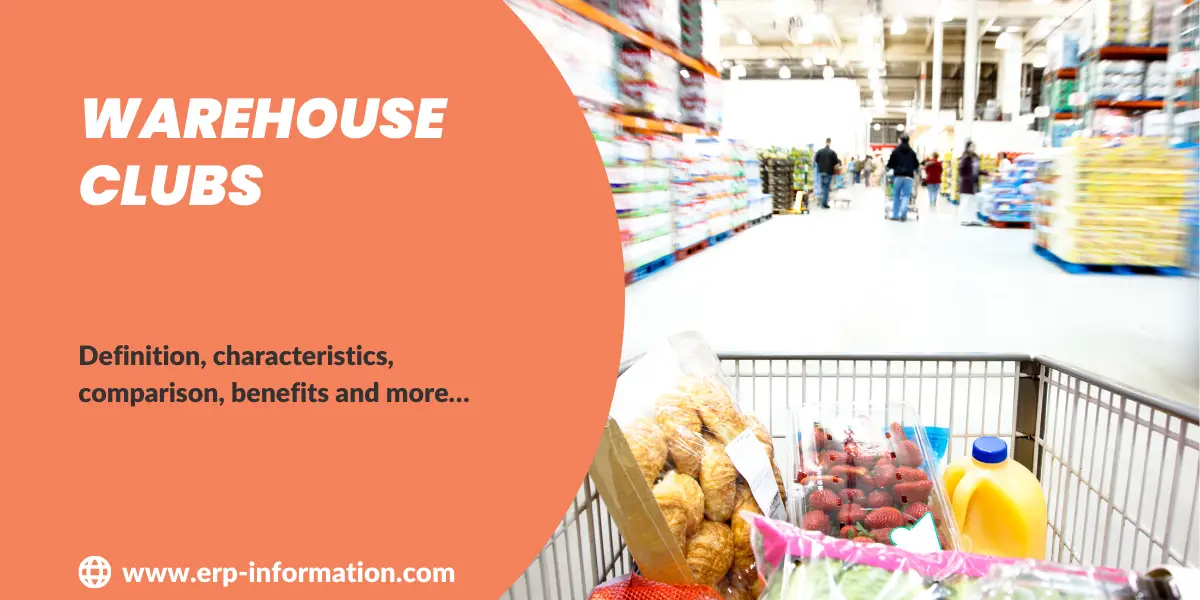
A warehouse club is a membership-only store that sells a deliberately narrow range of goods, mostly in bulk packs, at a low markup, and earns a large share of its profit from annual membership fees. In the US the format means Costco, Sam’s Club and BJ’s Wholesale Club, where a basic membership costs $60 to $65 a year in 2026.
Figures checked 1 October 2026 against each company’s latest annual report (10-K) and results release filed with the US Securities and Exchange Commission, and against the clubs’ own membership pages. Fees change every few years, so each fee below carries the date it took effect.
What are warehouse clubs?
Warehouse clubs are stores that only members can buy from. Members pay an annual fee, and in return the club sells at prices built on a much thinner markup than a supermarket’s. The model works because the club keeps its costs low in three ways: it stocks few products, it sells them in large packs straight off pallets, and it collects fee income up front.
Costco describes the trade-off in its own annual report:
We carry less than 4,000 active stock keeping units (SKUs) per warehouse in our core warehouse business, significantly less than other broadline retailers.
Costco Wholesale, Form 10-K for fiscal 2025
The fee matters more to the business than most shoppers realize. In its fiscal year to 30 August 2026, Costco collected $5.9 billion in membership fees against $9.2 billion of net income, so fees alone were equal to almost two-thirds of its profit (results release, 24 September 2026).
The format began with Price Club, which Sol and Robert Price founded in 1976. PriceSmart, the company the Price family started in 1996, still calls Price Club the original warehouse club operator, and the largest club today is Costco, an American company with 939 warehouses across the US, Puerto Rico and 13 other countries.
Examples
Four companies run membership warehouse clubs and publish audited accounts: Costco, Sam’s Club (owned by Walmart), BJ’s Wholesale Club and PriceSmart. This table compares what each charges and gives back, from their own filings and membership pages:
| Club | Where it operates | Basic fee | Upper tier | Reward on the upper tier |
|---|---|---|---|---|
| Costco | 939 warehouses: 647 in the US and Puerto Rico, plus Canada, Mexico, Japan, the UK, Korea, Australia, Taiwan, China, Spain, France, Sweden, Iceland and New Zealand | $65 Gold Star (or Business) | $130 Executive | 2% on qualified purchases, up to $1,250 a year |
| Sam’s Club | 601 clubs in 44 US states and Puerto Rico | $60 Club | $120 Plus | 2% Sam’s Cash on in-club purchases, up to $750 a year |
| BJ’s Wholesale Club | 267 clubs in 22 US states, mostly in the eastern half of the country | $60 Club | $120 Club+ | 2% cash back, up to $500 a year |
| PriceSmart | 57 clubs in 12 countries and one US territory in Central America, the Caribbean and Colombia | About $40 Diamond | About $80 Platinum | 2% rebate on most items, up to $500 a year |
When each fee last changed: Costco on 1 September 2024; BJ’s on 1 January 2025, from $55 and $110; Sam’s Club on 1 May 2026, from $50 and $110. PriceSmart’s fees vary by country and exclude local tax.
Often called warehouse clubs, but not warehouse clubs
Several retailers are regularly listed as warehouse clubs, including in an earlier version of this page, but do not work like one:
| Retailer | What it actually is |
|---|---|
| Dollar General | The largest US discount retailer by store count, with 20,959 small-box stores in 48 states and Mexico. There is no membership fee. |
| ShopRite | A supermarket chain of the Wakefern Food Corp. cooperative. Its Price Plus loyalty card is free. |
| Walmart+ | A Walmart membership program for free shipping, delivery from stores and fuel discounts, not a store format. |
| Boxed | An online bulk retailer that advertises No Membership on its own site. |
| CHEF’STORE | US Foods’ chain of more than 90 cash-and-carry stores aimed at restaurants and other small food businesses. |
Characteristics
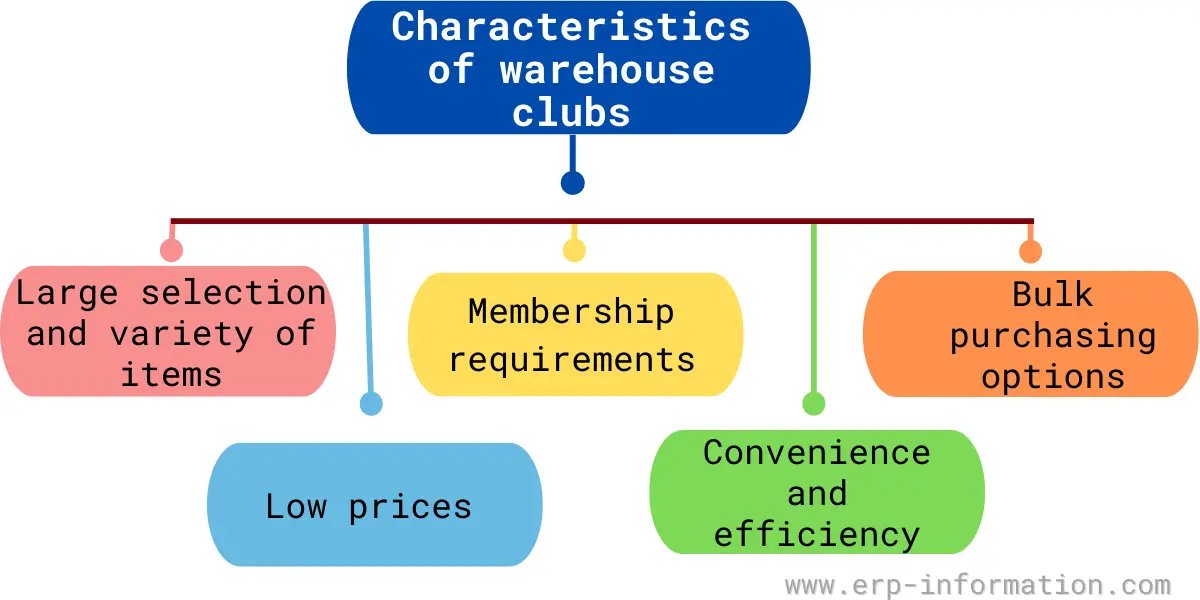
Large selection and variety of items
This is true across categories and false within them. A club sells groceries, tires, appliances, jewelry and prescriptions under one roof, but it stocks few versions of each product: Costco’s annual report says it seeks to limit most items to fast-selling models, sizes and colors. Costco’s fewer than 4,000 active items per warehouse are its own figure; PriceSmart’s annual report likewise describes offering a limited number of items in large pack sizes so shelves can be kept full with less labor.
Low prices
Club prices are low because the markup is low, and the companies’ accounts show it. Costco’s net sales of $269.9 billion and merchandise costs of $239.9 billion in fiscal 2025 leave a gross margin of about 11.1%. The supermarket chain Kroger reported a gross margin of 22.9% of sales for its 2025 fiscal year (Kroger 10-K). In other words, a supermarket keeps roughly twice as much of each sales dollar above what the goods cost.
Membership requirements
You must hold a paid card to shop, and the cards are cheap enough that most members keep renewing. Costco’s renewal rate was 92.3% in the US and Canada at the end of fiscal 2025, BJ’s reports a 90% renewal rate for tenured members, and PriceSmart’s trailing twelve-month rate was 88.8%. Most clubs include a second card for someone in the same household at no extra cost.
Convenience and efficiency
The efficiency is the club’s, and some of it passes to you as lower prices. Costco’s annual report notes that merchandise is generally stored on racks above the sales floor and displayed on full pallets, which cuts labor, and that its opening hours are shorter than many other retailers’. For shoppers, the convenience is mostly in the extras: BJ’s runs 206 BJ’s Gas locations, and Costco and Sam’s Club both offer pharmacy, optical and tire services.
Bulk purchasing options
Many everyday items are sold only in bulk. Costco states that many consumable products are offered only in case, carton or multiple-pack quantities. That lowers the unit price but raises the cash you spend per trip and the storage space you need at home, which is why a club suits large households and small businesses better than single shoppers.
What are the different types of warehouse clubs?
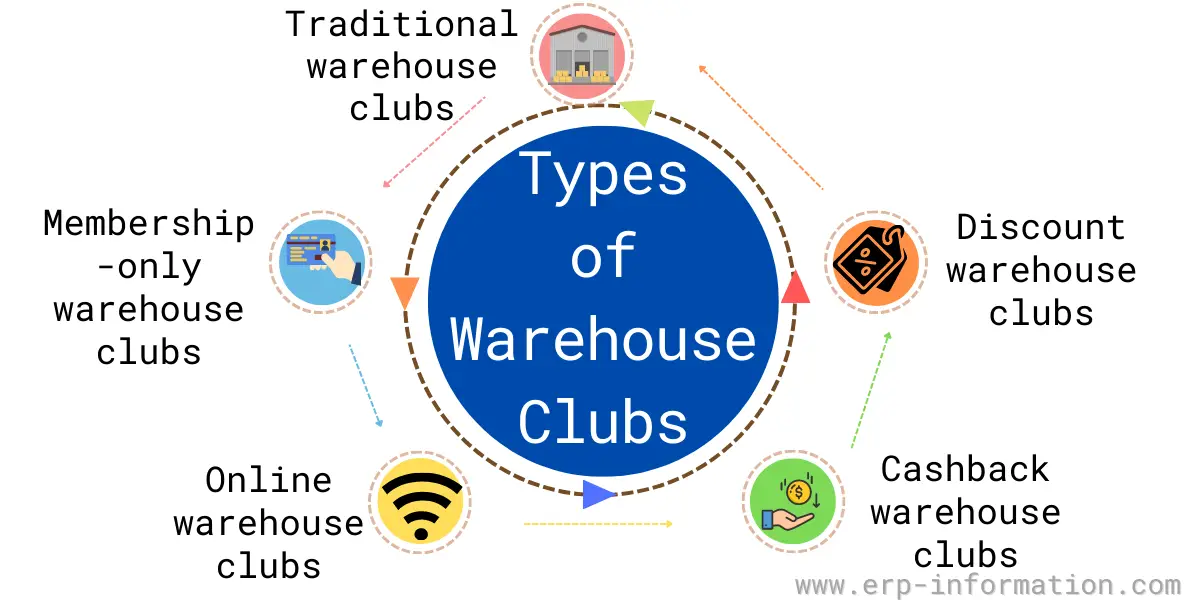
Traditional
The original format that Price Club created in 1976: a large warehouse building, a limited range of brand-name and own-brand goods, and an annual fee. Costco, Sam’s Club, BJ’s and PriceSmart are all traditional clubs.
Membership-only
Every traditional club is membership-only. Walmart’s annual report describes Sam’s Club as a membership-only warehouse club, and BJ’s states that customers at warehouse clubs are generally limited to members who pay an annual fee. Costco also sells Business memberships, limited to businesses, which can add extra cardholders for the same annual fee.
Online
All the big clubs now sell online as well. Costco runs e-commerce sites in nine markets and carries 9,000 to 10,000 items online, far more than in a warehouse, while Sam’s Club sells through samsclub.com and its app. Boxed shows the online model without a fee: it sells bulk packs online and advertises that no membership is needed.
Cashback
Cashback is a membership tier, not a separate kind of club. Each club’s upper tier returns 2% of qualifying spending, up to a cap: $1,250 a year at Costco Executive, $750 at Sam’s Club Plus (in-club purchases only), and $500 at BJ’s Club+ and PriceSmart Platinum. The next section works out when the upgrade pays for itself.
Discount
Discount stores and cash-and-carry wholesalers sell cheaply without a membership, so they are not warehouse clubs, even though they are often listed as one. Dollar General is a small-store discount chain, and US Foods’ CHEF’STORE outlets sell foodservice packs to restaurants and caterers.
Membership packages
Every club sells a basic tier and an upper tier that costs about twice as much and returns 2% of what you spend. The upgrade pays for itself once your annual spending times 2% exceeds the extra fee:
| Club | Extra cost of the upper tier | Annual spend to break even | Spend at which the reward cap is reached |
|---|---|---|---|
| Costco (Gold Star to Executive) | $65 | $3,250 (about $271 a month) | $62,500 |
| Sam’s Club (Club to Plus) | $60 | $3,000 in-club (about $250 a month) | $37,500 |
| BJ’s (Club to Club+) | $60 | $3,000 (about $250 a month) | $25,000 |
| PriceSmart (Diamond to Platinum) | About $40 | About $2,000 | $25,000 |
Below the break-even spend, the basic tier is cheaper. The upper tiers also carry perks that are not cash: Sam’s Club Plus adds free shipping on orders over $50 and early shopping hours, BJ’s Club+ adds a 5-cent per gallon fuel discount and two free same-day deliveries, and Costco Executive members get exclusive shopping hours in the US. Extra cards cost $65 each for Costco Business affiliates, $45 each at Sam’s Club and $35 each at BJ’s, with limits on how many.
Is warehouse club membership worth it?
A basic membership is worth it if what you save on the goods you would have bought anyway is more than the fee. The break-even point is the fee divided by your savings rate. If clubs save you 10% on your regular basket, a $65 Costco card pays for itself after $650 a year of spending; at a 20% saving, after $325. Savings vary by product, so check the unit prices of your own most-bought items before joining.
BJ’s makes its own claim in its annual report:
We believe that members can save over ten times their $60 Club membership fee versus what they would otherwise pay at traditional supermarket competitors when they spend $2,500 or more per year at BJ’s on manufacturer-branded groceries.
BJ’s Wholesale Club, Form 10-K for fiscal 2025
The same report says BJ’s consistently offers up to 25% savings on a representative basket of manufacturer-branded groceries compared with traditional supermarkets. These are company claims, not independent tests, but they show the order of magnitude the clubs themselves assume: savings of roughly a quarter on branded groceries. Three habits make the difference in practice:
- Shop from a list. Clubs also sell appliances, furniture and seasonal goods, and one unplanned purchase can cancel out a year of grocery savings.
- Compare the unit price, not the pack price: divide the price by the ounces or the count, and check it against your supermarket’s.
- Buy perishables only in quantities you will finish. Bulk produce that spoils is not a saving.
Benefits
- Lower prices on most staples, made possible by a markup roughly half a supermarket’s.
- Own brands such as Costco’s Kirkland Signature, which Costco says are generally priced below national brands.
- Cheaper fuel at club gas stations, where the club has one.
- Pharmacy, optical, tire and travel services at member prices.
- A 2% reward on spending for upper-tier members, capped by each club.
Disadvantages
- An annual fee of $60 to $65 in the US, which only pays off if you spend enough there.
- Limited choice: few brands and sizes of each product.
- Bulk packs that need cash up front and storage space at home, and that go to waste if you cannot use them.
- Patchy coverage: BJ’s operates in 22 states and Sam’s Club in 44, so not everyone has a club nearby.
- Crowded parking lots and queues at weekends and before holidays.
Conventional supermarkets vs warehouse clubs
Warehouse clubs usually win on unit price and lose on choice and convenience. The table compares the two formats on the points that decide which one suits you:
| Warehouse clubs | Conventional supermarkets | |
|---|---|---|
| Unit prices | Lower: Costco’s gross margin was about 11.1% in fiscal 2025 | Higher: Kroger’s gross margin was 22.9% in fiscal 2025 |
| Range | Narrow: fewer than 4,000 active items per Costco warehouse | Much wider, with several brands and sizes of most products |
| Pack sizes | Mostly cases, cartons and multipacks | Single items and small packs |
| Fee | $60 to $65 a year in the US | None; loyalty cards such as ShopRite’s Price Plus are free |
| Store count | About 1,500 Costco, Sam’s Club and BJ’s clubs in the US and Puerto Rico | Many more stores, usually closer to home |
The two formats also work well together: club trips for staples, cleaning products and household goods, and supermarket trips for fresh food and smaller quantities.
Warehouse club market size
The four listed operators reported about $416 billion of combined annual sales in their latest fiscal years, and Costco alone accounts for roughly 70% of it:
| Club | Latest fiscal year | Net sales | Membership fee income | Locations | Renewal rate |
|---|---|---|---|---|---|
| Costco | 52 weeks to 30 Aug 2026 | $297.2 billion | $5.9 billion | 939 | 92.3% US and Canada (fiscal 2025) |
| Sam’s Club US | Year to 31 Jan 2026 | $93.0 billion | Not reported separately | 601 | Not reported |
| BJ’s Wholesale Club | Year to 31 Jan 2026 | $21.0 billion | $499.8 million | 267 (Aug 2026) | 90% tenured members |
| PriceSmart | Year to 31 Aug 2025 | $5.2 billion (merchandise) | $85.6 million | 57 (May 2026) | 88.8% |
Fiscal years differ between the companies, so the total is an approximation. The Sam’s Club figures cover its US business only.
FAQs
What do warehouse clubs sell?
Groceries, fresh food and household basics in large packs, plus electronics, appliances, clothing, furniture and home goods. Costco also runs gas stations, pharmacies, optical and hearing-aid centers, food courts and tire installation. The range is deliberately narrow: Costco carries fewer than 4,000 active items per warehouse.
Why are warehouse clubs popular?
Because their prices are built on a much smaller markup. Costco kept about 11 cents of each sales dollar after the cost of goods in its 2025 fiscal year, against 22.9 cents at the supermarket chain Kroger. The annual fee pays for much of the difference, and members keep renewing: 92.3% at Costco in the US and Canada and 90% at BJ’s.
How did warehouse clubs become mainstream?
Sol and Robert Price opened Price Club, the first membership warehouse club, in 1976. Costco and Sam’s Club both started in 1983 and BJ’s in 1984. Today the four listed operators, Costco, Sam’s Club, BJ’s and PriceSmart, report more than $400 billion of combined annual sales.
What is the cheapest warehouse club membership in 2026?
In the US, Sam’s Club and BJ’s both charge $60 a year for a basic membership and Costco charges $65. Sam’s Club raised its fees from $50 and $110 to $60 and $120 on 1 May 2026, which put it level with BJ’s. PriceSmart, which operates in Central America, the Caribbean and Colombia, charges about $40 in most of its markets.
Is Dollar General a warehouse club?
No. Dollar General is a chain of about 21,000 small-box discount stores with no membership fee. A warehouse club charges an annual fee and sells a narrow range of goods in bulk from large warehouse buildings.
Which was the first warehouse club?
Price Club, created in 1976 by Sol and Robert Price. The Prices later founded PriceSmart in 1996, and its annual report still describes Price Club as the original warehouse club operator and the first membership warehouse club business.
How we compiled this page
On 1 October 2026 we read each club’s latest Form 10-K and most recent results release on the SEC’s EDGAR system, took the warehouse counts, fees, reward caps, renewal rates and sales from those filings, and checked the fees against Costco’s and Sam’s Club’s own membership pages. Where a filing predated a fee change, as Walmart’s did for Sam’s Club, we used the club’s current page and dated the change. Gross margins were calculated from reported net sales and merchandise costs (Costco) or taken as reported (Kroger); the two companies define cost of goods slightly differently, so treat the comparison as approximate. We did not run our own basket price test, so we give the break-even formula rather than a savings figure of our own.
Conclusion
A warehouse club is worth joining if your household spends a few thousand dollars a year on the kind of staples clubs sell, and if you have the space to store them. In the US, Sam’s Club and BJ’s are now the cheapest at $60, Costco is $65 with the most locations, and the upper tiers only pay for themselves above about $3,000 of annual spending. Dollar General, ShopRite and Walmart+ are not alternatives to a club; they are different kinds of shop. For how the goods get to the shelves, see our guide to the warehouse management system.
References
- Costco Wholesale, Form 10-K for the fiscal year ended 31 August 2025 and fiscal 2026 results release, 24 September 2026
- Walmart Inc., Form 10-K for the fiscal year ended 31 January 2026 (Sam’s Club U.S.)
- BJ’s Wholesale Club Holdings, Form 10-K for the fiscal year ended 31 January 2026 and second-quarter fiscal 2026 results, 21 August 2026
- PriceSmart, Form 10-K for the fiscal year ended 31 August 2025 and third-quarter fiscal 2026 results, 8 July 2026
- Dollar General, Form 10-K for the fiscal year ended 30 January 2026
- Kroger, Form 10-K for the fiscal year ended 31 January 2026
- US Foods, Form 10-K for fiscal 2025 (CHEF’STORE)
- Costco membership page and Sam’s Club membership page, checked 1 October 2026
- CNBC: Walmart-owned Sam’s Club raises its annual membership fee to $60, 1 April 2026
- ShopRite Price Plus club card page
- Warehouse club history (Wikipedia)