
Sustainability reporting is the practice of publicly disclosing an organisation’s environmental, social and governance performance: its impacts on people and the planet, and the sustainability risks and opportunities that affect the business itself. It is published for investors, regulators, customers and employees, and in a growing number of jurisdictions it is now a legal requirement rather than a voluntary exercise.
This page explains what sustainability reporting is, the two materiality models that decide what belongs in a report, and the current status of every major standard as of 13 September 2026. That last part matters more than it sounds: several frameworks that most guides still list as current have been wound up or absorbed, and reporting against a retired framework is a common and avoidable mistake.
Meaning and Framework of Sustainability Reporting
Sustainable reporting is a report that discloses the Social and ESG goals and Environmental communication. That means publishing non-financial information in a well-mannered way that can be easily understandable. This is to increase corporate transparency and effective business engagement.

Companies worldwide are starting to share information about how they care for the environment. This type of information is called sustainability reporting.
The Global Reporting Initiative Standards is a popular way for companies to do this reporting. It relates to other non-financial reporting forms like triple bottom line and Corporate Social Responsibility (CSR) reporting.
Businesses and governments need people to trust them to have a healthy economy. Every day, organizations make decisions affecting the people involved, like banks, labor groups, citizens, and more.
Their decisions are based not just on money but also on risks and opportunities in the short-term and long term. This sustainability reporting helps analyze the risk and make decisions.
Double materiality vs enterprise value: the choice that decides everything else
Before choosing a standard, understand the question each one asks. This single distinction determines what goes into the report, and most introductory guides skip it.
| Financial materiality | Impact materiality | |
|---|---|---|
| The question | How do sustainability matters affect the company’s cash flows and enterprise value? | How does the company affect people and the environment? |
| Who the information is for | Investors and other providers of capital | Investors and other stakeholders |
| Used by | IFRS S1 and IFRS S2 (ISSB) | ESRS, in combination with financial materiality |
Double materiality means applying both tests: a topic goes in the report if it is material from either direction. That is the ESRS model. The ISSB model applies the financial test only. The joint ESRS-ISSB Standards Interoperability Guidance, published in May 2024 by the ISSB, the European Commission services and EFRAG together, states it precisely:
While in ESRS the double materiality assessment of what is decision-useful considers both investors and other stakeholders (including in relation to impact materiality), in ISSB Standards this assessment is focused on the information needs of investors. On financial materiality, the two assessments are expected to provide an aligned outcome.
The practical consequence is the useful part, and it is more encouraging than most coverage suggests. Because the two definitions of financial materiality are aligned and “almost all the disclosures in ISSB Standards related to climate are included in ESRS”, a company is not forced to choose one camp permanently. The same guidance confirms that “regardless of whether it starts with ESRS or ISSB Standards, an entity can comply with the climate requirements of both sets of standards by following the content of this interoperability guidance”. Build the double materiality assessment once, and an ISSB-only report is a subset of it rather than a second project.
Sustainability Report Format
It has no specific format but should involve companies’ social and environmental responsibility and ESG goals. It should have complete communication of how the company is progressing, what its efforts are to reach the goal, how it impacts the progress, etc.
What do Sustainability Reports Contain?
The reports contain how companies are protecting the environment. Depending on where the company is, there could be different rules. However, the report should follow certain standards like GRI or SASB so that all of the information is accurate and true.
Sustainability Reporting Standards
Organizations need to decide which sustainability reporting standards and frameworks they will use. It is good to do a few things well than try to do everything. Start with some established standards, ones other businesses have used before you.
These standards can help your organization set goals, know what is important, measure progress, prepare for risks, and make necessary changes.
Below we are providing a list of sustainability reporting standards.
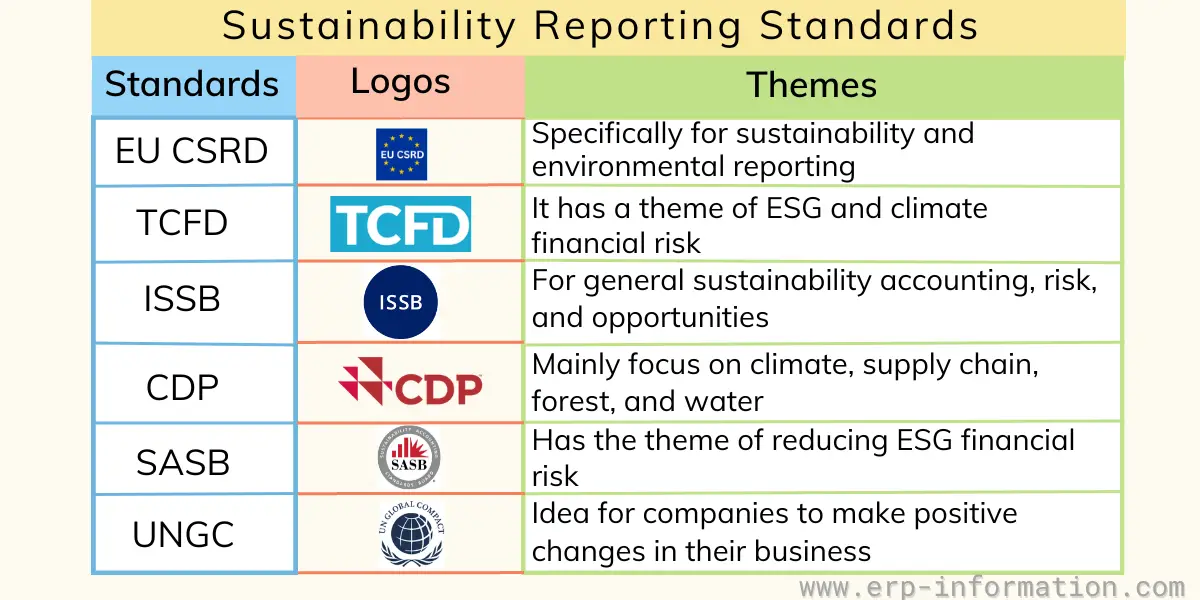
EU CSRD (ESRS)
Substantially rewritten in 2026. Most guides still describe the 2022 version.
The Corporate Sustainability Reporting Directive, Directive (EU) 2022/2464, replaced the reporting regime the Non-Financial Reporting Directive had created, by amending the Accounting Directive rather than repealing the NFRD outright. It requires in-scope companies to report sustainability information to a common standard and to have it assured.
Since then it has been cut back twice, and this is where most published guidance is now wrong. Two amending directives are both adopted and in force, not proposals:
| Instrument | Status | What it did |
|---|---|---|
| Directive (EU) 2025/794 14 April 2025 (“stop the clock”) | In force 17 April 2025 | Delayed reporting waves 2 and 3 by two years. Wave 1 was deliberately not delayed. |
| Directive (EU) 2026/470 24 February 2026 (the “Omnibus”) | In force 18 March 2026; transposition due 19 March 2027 | Rewrote the scope test, abolished wave 3 and sector-specific standards, raised third-country thresholds, and relaxed assurance. |
Who is actually in scope now
From financial years beginning on or after 1 January 2027, the test in Article 19a of the Accounting Directive as amended is an undertaking that exceeds both:
- net turnover of EUR 450,000,000, and
- an average of 1,000 employees during the financial year.
Three precision points, each of which is commonly got wrong:
- The two criteria are cumulative. It is turnover and headcount, not either one.
- There is no balance sheet total criterion in the new test. If a guide gives you three thresholds, it is describing the old regime.
- Listed SMEs are out entirely. The third wave was not postponed, it was deleted, along with the separate listed-SME standards.
For reports published in 2026 and 2027, the only cohort filing is wave 1: large public-interest entities with more than 500 employees, and public-interest parent undertakings of large groups above the same headcount. Wave 2 does not begin until financial year 2027, reported in 2028, under the new thresholds.
⚠️ One genuine uncertainty, stated rather than glossed. The Omnibus lets Member States exempt wave 1 companies that fall below the new thresholds from reporting for financial years 2025 and 2026. That relief is a Member State option, and the transposition deadline is 19 March 2027, which falls after the 2025 reporting season. Whether a smaller wave 1 company must file for those two years therefore depends on its own Member State’s transposition and is not settled uniformly across the EU as of 13 September 2026. Companies above both thresholds have no such relief.
Which ESRS version applies
The European Sustainability Reporting Standards are the standards the CSRD reports are written to. There are now two versions in play, and only one of them is law today.
| Version | Status on 13 Sept 2026 | Applies to |
|---|---|---|
| Delegated Regulation (EU) 2023/2772, as amended by (EU) 2025/1416 of 11 July 2025 | In force. This is the law today. | Current reporting |
| Revised, simplified ESRS: Commission delegated act C(2026) 5010 final of 3 July 2026 | Adopted by the Commission but NOT yet in force, still in the Parliament and Council scrutiny window and not yet published in the Official Journal | Financial years beginning on or after 1 January 2027 |
The simplification is substantial: the Commission states the revision will “reduce the number of mandatory datapoints by over 60%” and the total number of datapoints by over 70%. For financial year 2026 the revised act contains a transitional choice, letting an undertaking apply the current standards, or the new Annex I, or the current standards plus eight named reliefs, provided it states which basis it used.
Two things that were expected and are now not coming. Sector-specific ESRS have been abolished: the Omnibus deleted the Commission’s power to adopt them, so there will be no sector delegated act, at most non-binding guidance. And on assurance, the deadline for limited assurance standards moved to 1 July 2027 while the requirement to move to reasonable assurance was removed altogether. Companies are also not required to digitally tag sustainability reporting until the marking-up rules are adopted.
TCFD (Task Force on Climate-related Financial Disclosures): disbanded, and absorbed into IFRS S2
Do not start a new TCFD reporting project in 2026
The TCFD no longer exists as a body. The Financial Stability Board, which created it, put it plainly in its 2025 climate roadmap update: “In July 2023 the FSB announced that the work of the TCFD had been completed, with the two inaugural Standards issued in June 2023 by the International Sustainability Standards Board (ISSB) marking the ‘culmination of the work of the TCFD’. Having fulfilled its remit, the TCFD disbanded in October 2023, concurrent with the release of its 2023 status report.” The FSB’s current page on climate-related risks says the same in one line: “With the release of the ISSB Standards in 2023, the TCFD has been disbanded.”
This is the single most repeated out-of-date claim in sustainability reporting guidance, and most published lists of “current frameworks” still carry TCFD as though it were live alongside the ISSB standards. It is not a separate option any more.
What has not been lost is the substance. The four-pillar structure the TCFD invented, governance, strategy, risk management, and metrics and targets, is the architecture of IFRS S2, and the ISSB states plainly that “IFRS S1 and IFRS S2 fully incorporate the recommendations of the TCFD”. So a company that already reports against TCFD has done most of the work: the practical step is to move the same disclosures onto IFRS S2 rather than to start again. A company that has not started should go straight to IFRS S2.
ISSB (IFRS)
IFRS for general sustainability accounting, risk, and opportunities
The International Sustainability Standards Board (ISSB) issued its first two standards on 26 June 2023, not in 2022: IFRS S1, General Requirements for Disclosure of Sustainability-related Financial Information, and IFRS S2, Climate-related Disclosures. The ISSB’s own announcement described them as “its inaugural standards”.
Both standards apply financial materiality: they are designed to give investors sustainability information connected to the financial statements. IFRS S1 sets the general requirements and IFRS S2 covers climate specifically. Both are “effective for annual reporting periods beginning on or after 1 January 2024”. The pair matters for a second reason explained in the next section, because they are where the TCFD recommendations now live: the ISSB states that the standards “fully incorporate the recommendations of the Task Force on Climate-related Financial Disclosures (TCFD)”.
Two developments to know if you are planning a 2026 or 2027 report. First, the ISSB issued Amendments to Greenhouse Gas Emissions Disclosures (Amendments to IFRS S2) on 11 December 2025, “effective for reporting periods beginning on or after 1 January 2027, with early application permitted”. They provide relief on Scope 3 Category 15 financed emissions, on classification systems other than GICS, and on Global Warming Potential values. No amendments have been issued to IFRS S1.
Second, adoption is the reason this set is becoming the global baseline. As of the IFRS Foundation’s April 2026 update, “more than 40 jurisdictions have now decided to use or are taking steps to introduce ISSB Standards in their legal or regulatory frameworks”, on information available to the Foundation as of the end of March 2026.
CDP (formerly the Carbon Disclosure Project)
CDP standards mainly focus on climate, supply chain, forest, and water
CDP runs an environmental disclosure system rather than a reporting standard. Companies respond to a questionnaire covering climate change, forests and water security, with an optional module on the supply chain, and CDP scores and publishes the responses. Most organisations use it alongside a standard rather than instead of one, because investors and large buyers request the CDP score specifically.
The important update is that CDP is no longer a parallel track. CDP states: “Since 2024, CDP questionnaire has been aligned with IFRS S2 Climate-related Disclosures (IFRS S2)”, and describes itself as “the largest single source of consistent, globally comparable IFRS S2-aligned climate data for investors and decision-makers”. Its Scaling the Standard 2026 analysis, published 30 April 2026, is built on 10,413 corporate disclosures from 2025 across 100 countries.
⚠️ One caveat worth carrying, because it is easy to overstate. CDP is explicit that it is “substantially aligned with the pre-Omnibus ESRS climate standard (ESRS E1)” and is still developing an updated mapping. Do not assume a CDP response satisfies ESRS as the European rules now stand.
SASB Standards (now maintained by the ISSB)
The standards are alive and maintained. The standard-setter no longer exists separately.
This one is widely misreported in both directions, so be precise. The Value Reporting Foundation, which housed the SASB Standards, consolidated into the IFRS Foundation effective 1 August 2022, alongside the Climate Disclosure Standards Board. There is no longer a separate Sustainability Accounting Standards Board setting standards.
The standards themselves, however, are very much in use and are still called the SASB Standards. The IFRS Foundation states: “The International Sustainability Standards Board (ISSB) is responsible for the SASB Standards. The ISSB is maintaining and enhancing the SASB Standards.” Their distinguishing feature is that they are industry-based, with disclosure topics and metrics defined separately for 77 industries, which is why they remain useful: they answer the question of which sustainability matters are financially material in your specific sector. The IFRS Foundation describes them as playing “an important role in the IFRS Sustainability Disclosure Standards” and as putting companies “on the path toward implementation” of them.
GRI Standards
The impact-first standard, and the most widely used in the world
The GRI Standards, set by the independent Global Sustainability Standards Board, are the impact side of the picture: they report an organisation’s effects on the economy, environment and people, for all stakeholders rather than investors alone. They are the most widely used sustainability reporting standards globally, and they remain independent of the IFRS Foundation.
The structure trips people up, so be precise about which part you mean. The Universal Standards (GRI 1 Foundation, GRI 2 General Disclosures, GRI 3 Material Topics) are the 2021 editions, “in effect for reporting from 1 January 2023”, and there is no newer edition of them. The Topic Standards are where the recent movement is:
| Standard | Published | Effective |
|---|---|---|
| GRI 101: Biodiversity 2024 | 24 January 2024 | 1 January 2026 |
| GRI 102: Climate Change 2025 | 26 June 2025 | 1 January 2027 |
| GRI 103: Energy 2025 | 26 June 2025 | 1 January 2027 |
GRI and the IFRS Foundation are also converging rather than competing. They published a joint statement on 26 May 2026, Facilitating efficient reporting when using the GRI and ISSB Standards, building on a 2022 memorandum of understanding, and a June 2025 statement had already established equivalence for Scope 1, 2 and 3 greenhouse gas disclosures between GRI 102 and IFRS S2. In practice that means a company can report impacts under GRI and investor-facing risk under the ISSB standards without maintaining two separate emissions data sets.
UNGC (United Nations Global Compact)
The UN Global Compact is not a reporting standard. It is a voluntary commitment initiative built on ten principles covering human rights, labour, environment and anti-corruption, and participating companies file an annual Communication on Progress. Launched in 2000, it now states that it has “20,000+ companies based in over 160 countries, both developed and developing, representing nearly every sector and size” (UN Global Compact, read 13 September 2026). Treat participation as a commitment signal, not as a substitute for reporting under GRI, ESRS or the ISSB standards.
Benefits of Sustainability Reporting
- A sustainability report is more useful for easily understanding the opportunities and risks.
- Companies can get good recognition.
- It is helpful to boost the employees.
- It increases the business ability.
- It enhances the operating ability and reduces the risk of environmental failures.
Challenges of Sustainability Reporting
- Reporting is time-consuming for small companies.
- Need a trained or educated person to collect the data.
- A lack of understanding in the organization may cause damage.
- Reporting may suffer from overloaded data.
- Chances of having low-quality data.
- It is difficult to report constantly changing information about environmental impact and changes.
- Data management and meaningful reporting are difficult tasks for all kinds of organizations.
FAQS
Is TCFD still a sustainability reporting framework in 2026?
No. The Financial Stability Board announced in July 2023 that the TCFD’s work was complete, and the task force disbanded in October 2023 alongside its final status report. Monitoring of corporate climate disclosure passed to the IFRS Foundation from 2024. The TCFD’s four pillars and its recommended disclosures were not retired: they are fully incorporated into IFRS S2. So a company reporting against TCFD today is following a frozen 2017 document, and the practical step is to move those disclosures onto IFRS S2.
What is the difference between double materiality and the ISSB approach?
Double materiality, used by the European Sustainability Reporting Standards, applies two tests: whether a sustainability matter affects the company’s cash flows and enterprise value, and whether the company affects people and the environment. A topic is reported if either test is met. The ISSB standards, IFRS S1 and IFRS S2, apply the financial test only, aimed at investors. The joint ESRS-ISSB interoperability guidance confirms the two definitions of financial materiality are aligned, so the ISSB view is effectively a subset of the ESRS view.
Who has to comply with the CSRD, and when?
Following the Omnibus directive, Directive (EU) 2026/470, in force since 18 March 2026, the scope test for financial years beginning on or after 1 January 2027 is an undertaking exceeding both EUR 450 million net turnover and an average of 1,000 employees. Both criteria must be met, and there is no balance sheet criterion. Listed SMEs were removed from scope entirely. For reports published in 2026 and 2027 the only cohort filing is wave 1: large public-interest entities above 500 employees.
Which version of the ESRS applies right now?
Delegated Regulation (EU) 2023/2772 as amended by (EU) 2025/1416 is the version in force on 13 September 2026. The revised and simplified ESRS were adopted by the Commission on 3 July 2026 as C(2026) 5010 final, but they are not yet in force, are not yet published in the Official Journal, and apply to financial years beginning on or after 1 January 2027. The Commission expects the revision to cut mandatory datapoints by over 60 percent.
Is SASB still a separate standard-setter?
No, though the standards themselves are alive and widely used. The Value Reporting Foundation, which housed the SASB Standards, consolidated into the IFRS Foundation effective 1 August 2022. The IFRS Foundation states that the ISSB is responsible for the SASB Standards and is maintaining and enhancing them. They keep the SASB name, cover 77 industries, and remain the industry-based reference for identifying which sustainability matters are financially material in a given sector.
Do I have to choose between GRI and the ISSB standards?
No, and they answer different questions. GRI reports the organisation’s impacts on the economy, environment and people for all stakeholders; the ISSB standards report sustainability risks and opportunities to investors. GRI and the IFRS Foundation published a joint statement on 26 May 2026 on efficient reporting when using both, and an earlier statement established equivalence for Scope 1, 2 and 3 greenhouse gas disclosures between GRI 102 and IFRS S2, so a company can use both without maintaining two separate emissions data sets.
What are the main areas of sustainability reporting?
Sustainability reporting is usually organised around environmental, social and governance topics, often shortened to ESG. Environmental covers emissions, energy, water, waste and biodiversity; social covers workforce, health and safety, human rights and communities; governance covers board oversight, business conduct and how sustainability risk is managed. Which of these you must report, and in what depth, is decided by the materiality assessment required by whichever standard applies to you.
Conclusion
The hardest part of sustainability reporting in 2026 is not the data collection. It is working out which rules actually apply to you, because the landscape changed faster than the guidance describing it. Two of the frameworks that appear in most comparison tables are no longer separately maintained, the EU regime has been rewritten twice in eighteen months, and the standards that will govern European reports from 2027 have been adopted but are not yet law.
A workable sequence: decide whether you are reporting for investors, for stakeholders, or under legal obligation, because that picks your materiality model. Run the materiality assessment once, on the double materiality basis if there is any chance the EU rules reach you, since the investor-facing view is a subset of it. Then map to the specific standard and version that applies, and check the version rather than the name. And if you already report against TCFD, treat that as a head start on IFRS S2 rather than as something to maintain separately.
How this page was researched. Every date, threshold, version and quotation above was read from the primary source on 13 September 2026: the Official Journal texts on EUR-Lex, the Commission’s own delegated acts, and the publications of the FSB, IFRS Foundation, GRI, CDP and UN Global Compact. Where a figure could not be verified against a primary source it has been left out rather than estimated. The status of the revised ESRS was checked against the EUR-Lex record of amendments to Delegated Regulation (EU) 2023/2772, which on that date still listed no 2026 amending act.
Primary sources
- Directive (EU) 2022/2464 (CSRD) and Directive (EU) 2025/794 (stop the clock), EUR-Lex
- Directive (EU) 2026/470 (the Omnibus), OJ L, 2026/470, 26.2.2026
- Climate-related Risks, Financial Stability Board, on the disbanding of the TCFD
- ISSB and TCFD and SASB Standards, IFRS Foundation
- ESRS-ISSB Standards Interoperability Guidance, ISSB, European Commission services and EFRAG, May 2024
- GRI Universal Standards, Global Reporting Initiative
- Framework alignment, CDP
- What is the UN Global Compact, United Nations Global Compact
Using Google Search? Add erp-information.com as a preferred source.