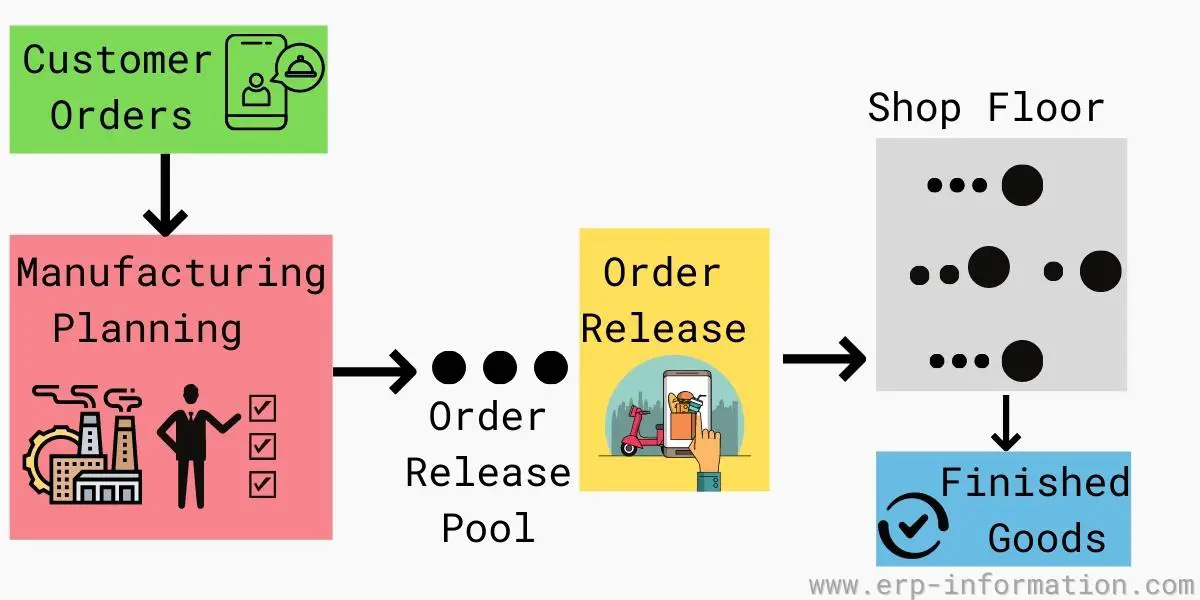
Order release is the point at which a planned order becomes a live, authorized order that the shop floor or a supplier is allowed to act on. It is the hand-off from planning to execution: until an order is released it exists only as a suggestion inside the planning system, and no material is issued and no labour is booked against it.
Concretely, material requirements planning generates planned orders. Releasing one converts it into a manufacturing order for the plant, or into a purchase order for a vendor. That conversion is the release.
One point of confusion worth clearing up: order release is about authorising work to start, not about shipping finished goods to a customer. The release date is when production or procurement may begin. It is not the ship date or the delivery date, and the two can sit weeks apart.
Where order release sits in production activity control
Order release is not a standalone administrative step. It is the first of the three functions of production activity control (PAC), also called shop floor control, whose job is to see that work happens as planned and to report back when it does not.
- Order release authorises the order and issues the paperwork and material against it.
- Dispatching decides the sequence in which released orders are run at each work center.
- Progress reporting feeds actual completions and hours back so the plan can be corrected.
Reading it this way explains why release timing matters so much. Dispatching can only sequence orders that have already been released, so anything still sitting unreleased is invisible to the floor no matter how urgent it is.
Order release process
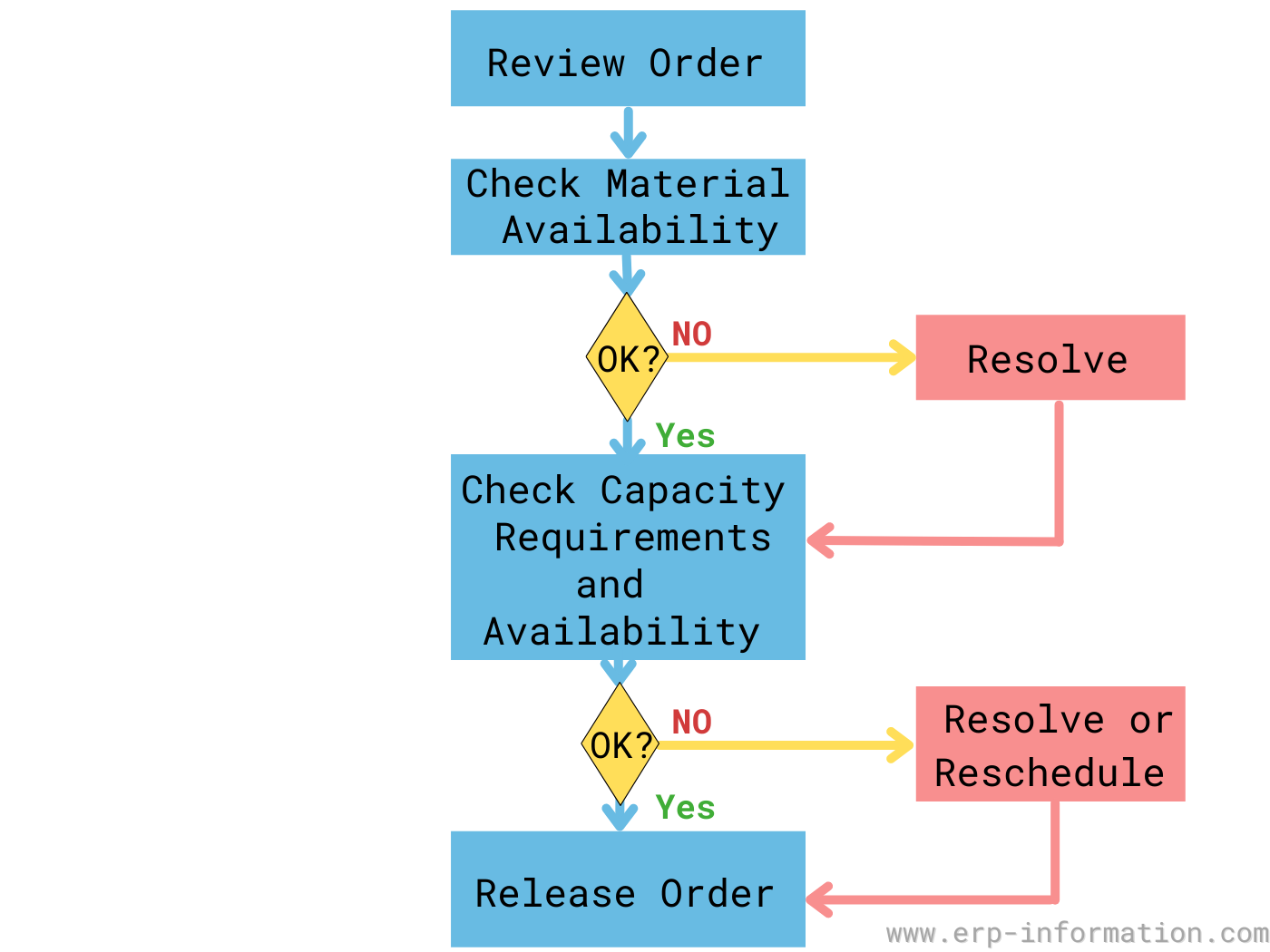
The below image shows the process of order release in the form of a flow chart.
- The first step is to review the order. Then check the available materials required to produce the product of the ordered quantity.
- Check the capacity requirements and available production capacity if sufficient materials are available. On the other hand, if you find a shortage of materials, then solve that problem and check capacity requirements.
- Once you check the availability of the capacity requirement, you can release the order for further processing.
What is an order release form?
An order release form includes the details of the dealer and all other details regarding the material being released by the storage for production.
It is like a formal order being released directed toward the warehouse to begin the production-related activities. It is the power to convert the customer orders into production orders against those customer orders and start the processing activities.
Many restrictions are lifted once an order release has been issued.
- A confirmation is released about the order at hand. A particular customer order gets confirmed once a release order has been put out. This order then starts the processing of the demanded units. Raw materials are ordered to be released, laborers are appointed to this job, and the production procedure finally begins.
- Shop floor papers are printed after the order release of a customer order. Without the release order, the design and architecture preparation is also halted.
- Movements of prepared goods or the end products cannot be ordered without a release order. That also means release order shipping efficiently delivers the set and ready items after completion. So, a release order is being issued to start with the processing, follow the entire production process, and finally, when the fulfillment is over, ship and deliver the orders to the customers.
An order release must be well-timed. If not, a mix-up can originate that might halt the production, and the company might also suffer losses.
Therefore timing a release order exactly when the firm is ready to begin production is crucial.
Order release management
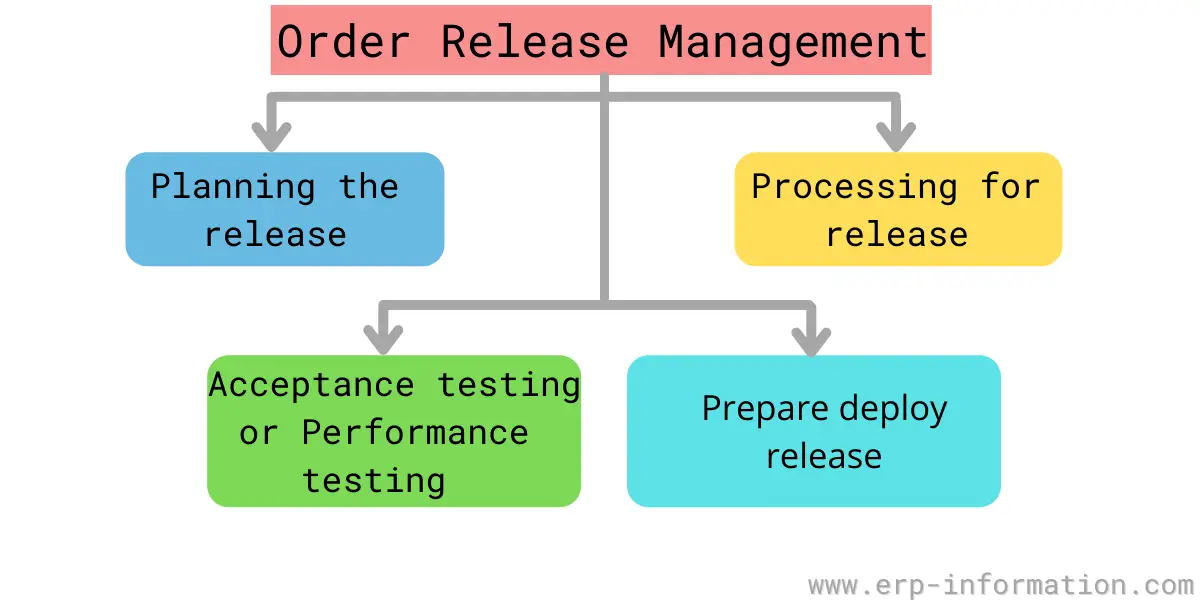
Order release management is the set of rules deciding when a planned order is allowed onto the floor. The naive policy is to release every order as soon as its planned release date arrives. Plants that do this often find work in progress climbing while output does not move, because releasing an order does not create capacity, it only creates a queue.
Check the release conditions before authorising
A release that cannot actually be worked is worse than no release, because it consumes material and floor space while blocking the queue. Most ERP systems will test some or all of the following, and will either warn or block depending on how the plant has configured it.
| Condition checked | What it asks | Typical result if it fails |
|---|---|---|
| Material availability | Are all components on hand or firmly scheduled? | Order held, or released short with a flagged shortage |
| Capacity | Does the work center have rated capacity in the period? | Release deferred to a later period |
| Tooling and labour | Are the required tools and skills available? | Order held pending the constraint |
| Documentation | Is the routing and drawing revision current? | Release blocked until engineering clears it |
| Release time fence | Is the order inside the horizon where changes are still allowed? | Requires planner override |
Releasing too early and too late both cost you
Release too early and material is committed before it is needed, work in progress and queue lengths grow, and lead times stretch because every new job waits behind the ones already released. Priorities also become harder to change, since the work is now physically on the floor.
Release too late and the order cannot recover the time, because the routing still needs its full run and queue time. Late release is the more visible failure, which is why plants drift toward releasing early, and then treat the resulting congestion as a capacity problem rather than a release-policy problem.
Control the workload, not just the dates
The alternative to date-driven release is to hold planned orders in a pool and release them only when the shop’s workload falls below an agreed ceiling, measured in hours of load per work center. Input rate is then matched to demonstrated output rate, which is the same principle input and output control applies to capacity.
This is also where release connects back upstream: if a work center is repeatedly unable to absorb released orders, the shortfall usually did not originate at release. It originated in capacity requirements planning, or earlier still in the master schedule.
Conclusion
Order release is the moment a plan becomes a commitment. Everything before it is adjustable at no cost; everything after it consumes material, capacity and floor space. That is why the release decision deserves an explicit policy rather than being treated as a date that arrives.
The two questions worth auditing in your own plant are whether release conditions are genuinely checked before an order goes out, and whether orders are released against a workload ceiling or simply because their planned date came up. Congestion on the floor is far more often a symptom of the second question than of missing capacity.