
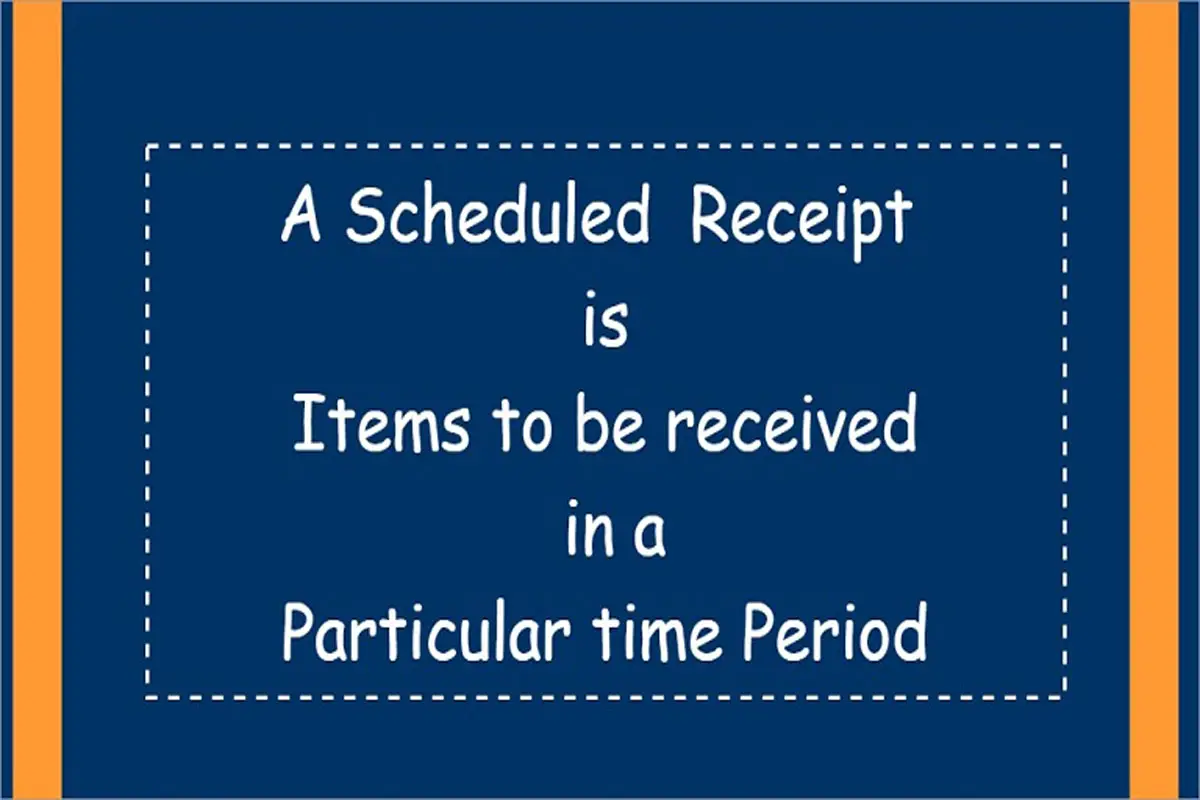
A scheduled receipt is an open order that has already been placed but not yet received. It is a purchase order sent to a supplier, or a production order released to the shop floor, that is confirmed and due to arrive on a set date. In material requirements planning (MRP), scheduled receipts are the quantities already on order, so the system counts them as incoming supply when it nets demand for each period.
The key point: a scheduled receipt is real, committed supply. The order exists, the supplier has it, and it will land on its due date. That is what separates it from a planned order, which MRP has only suggested and no one has released yet.
What is a scheduled receipt?
A scheduled receipt is an existing open order with a due date. Someone has already committed to it: a buyer has issued the purchase order, or a planner has released the work order. It sits between two states. The material is not on hand yet, but it is no longer just a plan either. It is on its way.
Every scheduled receipt carries two pieces of information that MRP needs: the quantity due and the period it is due in. MRP reads that row and treats the quantity as supply arriving in that period, exactly like on-hand stock that shows up later. Because the order already exists, MRP will not suggest a new order to cover demand that a scheduled receipt already fills.
Where scheduled receipts come from
Scheduled receipts are not created directly. They are the next stage in the life of a planned order. The sequence runs like this:
- MRP nets demand and suggests a planned order receipt for the quantity and period that need cover.
- It offsets that quantity backward by the lead time to create a planned order release, the date the order must be placed.
- When a planner or buyer actually places that order, it stops being a plan. On the next MRP run it moves into the scheduled receipts row as a firm, open order.
So today’s scheduled receipt was last week’s planned order release. Once it is a scheduled receipt, MRP stops planning around it and starts counting on it.
Scheduled receipt example in an MRP record
The clearest way to see a scheduled receipt is inside an MRP grid. Take a single component with these inputs:
- Beginning on-hand inventory: 30 units
- Lead time: 2 periods, ordered lot-for-lot (order exactly what is needed)
- One scheduled receipt: 50 units due in period 2, from an order the buyer placed earlier
| Period | 1 | 2 | 3 | 4 | 5 | 6 |
|---|---|---|---|---|---|---|
| Gross requirements | 20 | 30 | 40 | 30 | 50 | 40 |
| Scheduled receipts | 0 | 50 | 0 | 0 | 0 | 0 |
| Projected on-hand (start 30) | 10 | 30 | 0 | 0 | 0 | 0 |
| Net requirements | 0 | 0 | 10 | 30 | 50 | 40 |
| Planned order receipts | 0 | 0 | 10 | 30 | 50 | 40 |
| Planned order releases | 10 | 30 | 50 | 40 | 0 | 0 |
Read the scheduled receipts row and watch what it does:
- Period 1: 30 on hand minus 20 gross requirements leaves 10 on hand. No order needed.
- Period 2: the 50-unit scheduled receipt arrives. 10 carried in, plus 50, minus 30 demand, leaves 30 on hand. Because that order was already placed, MRP does not plan a new one here. This is the scheduled receipt doing its job.
- Period 3: 30 on hand minus 40 demand leaves a shortage of 10. That 10 is the net requirement, so MRP plans a receipt of 10.
- Periods 4 to 6: on-hand is exhausted, so each period’s net requirement becomes a planned order receipt, offset two periods back into a planned order release.
Notice that the scheduled receipt in period 2 never generates a planned order. MRP already knows the supply is coming. If you had entered that same 50 units as a planned order receipt instead, MRP would treat it as optional and could reschedule or cancel it. The scheduled receipt is firm.
You can check the arithmetic behind any of these columns with our net requirements calculator.
Scheduled receipt vs planned order receipt vs planned order release
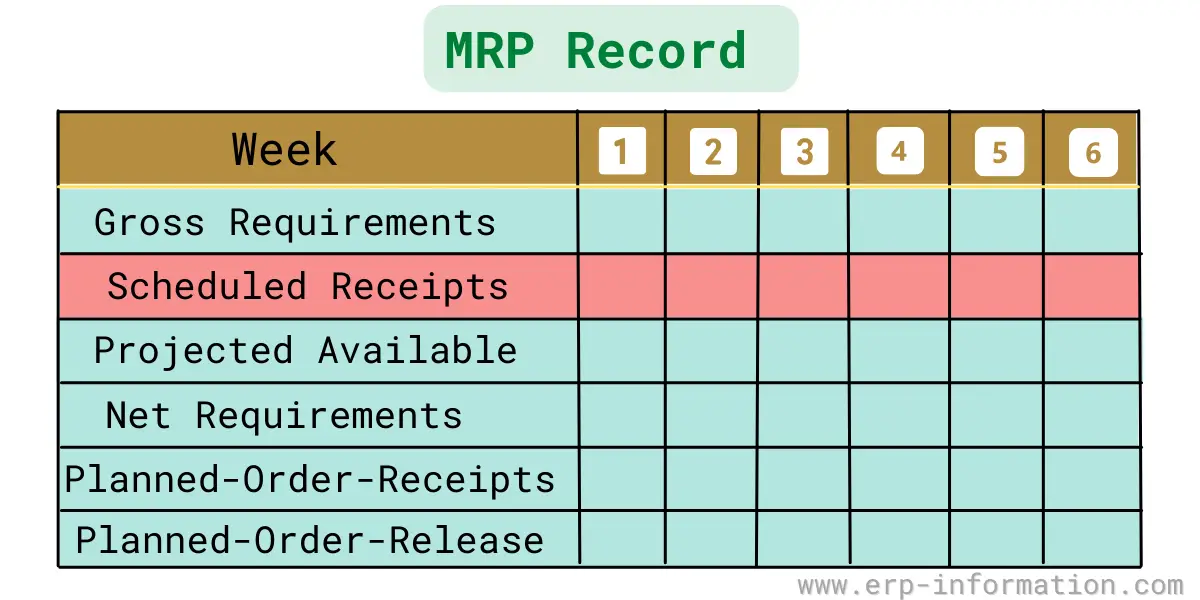
These three rows sit next to each other in every MRP record and get mixed up constantly. The difference is simply how firm the order is and who has acted on it.
| Row | What it is | Firm or planned? | Who created it |
|---|---|---|---|
| Scheduled receipt | An order already placed and due to arrive on a set date | Firm, committed supply | A buyer or planner who released the order |
| Planned order receipt | A quantity MRP suggests should arrive to cover a net requirement | Planned, not yet acted on | The MRP calculation |
| Planned order release | The same planned quantity offset back by lead time, showing when to place the order | Planned, not yet acted on | The MRP calculation |
The link between them is time. A planned order release that a planner acts on becomes a scheduled receipt on the next run. Until someone places it, it stays a plan that MRP can move or drop as demand changes.
How scheduled receipts fit into MRP
MRP is a stock control and planning method that keeps just enough inventory to meet production demand without overbuying. It runs on three inputs: the master production schedule, inventory status records, and the bill of materials. Scheduled receipts live in the inventory status records, because they are supply the business has already committed to.
Within a single MRP record, scheduled receipts work alongside the other standard rows:
- Gross requirements: total demand for the item in each period
- Scheduled receipts: firm open orders due to arrive
- Projected available balance: on-hand inventory carried period to period
- Net requirements: the shortage left after on-hand and scheduled receipts, plus any safety stock
- Planned order receipt: the quantity MRP plans to receive to cover a net requirement
- Planned order release: that planned receipt offset back by lead time
The netting logic is straightforward: for each period, subtract on-hand inventory and scheduled receipts from gross requirements, then add safety stock. Anything left over is a net requirement that a planned order must cover. Because scheduled receipts are subtracted first, accurate ones keep MRP from ordering material you already have coming.
Related calculators
FAQs
What is the difference between a scheduled receipt and a planned order receipt?
A scheduled receipt is an order that has already been placed and is due to arrive, so it is firm supply. A planned order receipt is a quantity MRP suggests you receive to cover a shortage, but no one has ordered it yet. When a planned order is actually released and placed, it becomes a scheduled receipt on the next MRP run.
Where do scheduled receipts come from?
They come from planned orders that have been acted on. MRP first suggests a planned order receipt and a planned order release. When a buyer or planner places that order with a supplier or the shop floor, it moves into the scheduled receipts row as a firm open order.
How do scheduled receipts affect net requirements?
MRP subtracts scheduled receipts, along with on-hand inventory, from gross requirements before calculating what is still needed. A scheduled receipt due in a period reduces or eliminates the net requirement for that period, so MRP will not plan a new order to cover demand the scheduled receipt already fills.
Are scheduled receipts the same as on-hand inventory?
No. On-hand inventory is stock you physically hold now. A scheduled receipt is stock you have ordered but not yet received. MRP treats both as available supply, but a scheduled receipt only counts in the period it is due to arrive.
Conclusion
A scheduled receipt is the point where a plan becomes a commitment: an order placed, confirmed, and due to arrive. In MRP it is firm supply that the system subtracts from demand before planning anything new, which is why keeping these dates and quantities accurate matters. Get them right and MRP orders exactly what you need. Get them wrong and it either double-orders or leaves you short.