A warehouse zone is an area set aside for one kind of goods or one kind of work. Some zones follow the work (receiving, storage, picking, packing, dispatch). Others follow what the goods need: chilled, frozen, flammable, gas cylinders, quarantine or high value. Zoning decides what goes where, and that sets travel time, safety and stock rotation.
Below are the zone types with the US and UK rules that apply to each, a six-step way to zone a warehouse, and how warehouse software sets zones up.
Calculators for planning zones:
- How many pallets fit: Warehouse Capacity Calculator
- What the space costs: Warehouse Storage Costs Calculator
- What storing an item costs: Storage Cost of Inventory Calculator
Definition of Warehouse Zone
Note on the video: it gives the refrigerated range as 0 to 38 °F. Refrigerated vaccines belong at 2 to 8 °C (36 to 46 °F) (CDC) and chilled food at 40 °F (4 °C) or below (FDA). Current ranges are in the table below.
A warehouse zone is a physically or logically segregated area within a warehouse, defined by the type of material it holds (bulk or rack storage, hazardous material and so on) or by the work, equipment and people used to put away, move and pick.
Zoning is part of inventory management: it decides where each item lives. Physical zones are walls, cages, cold rooms and marked floor areas. Logical zones are groups of locations that a warehouse management system treats as one, for putaway or picking rules, even when they sit side by side.
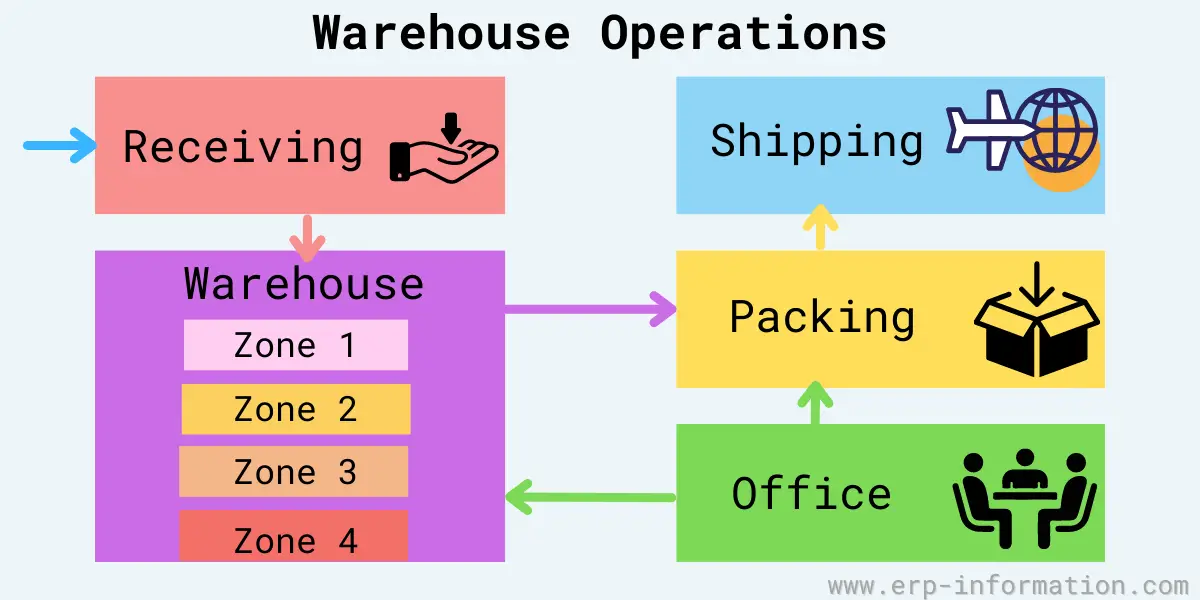
Different Types of Warehouse Zones in a Storage Area
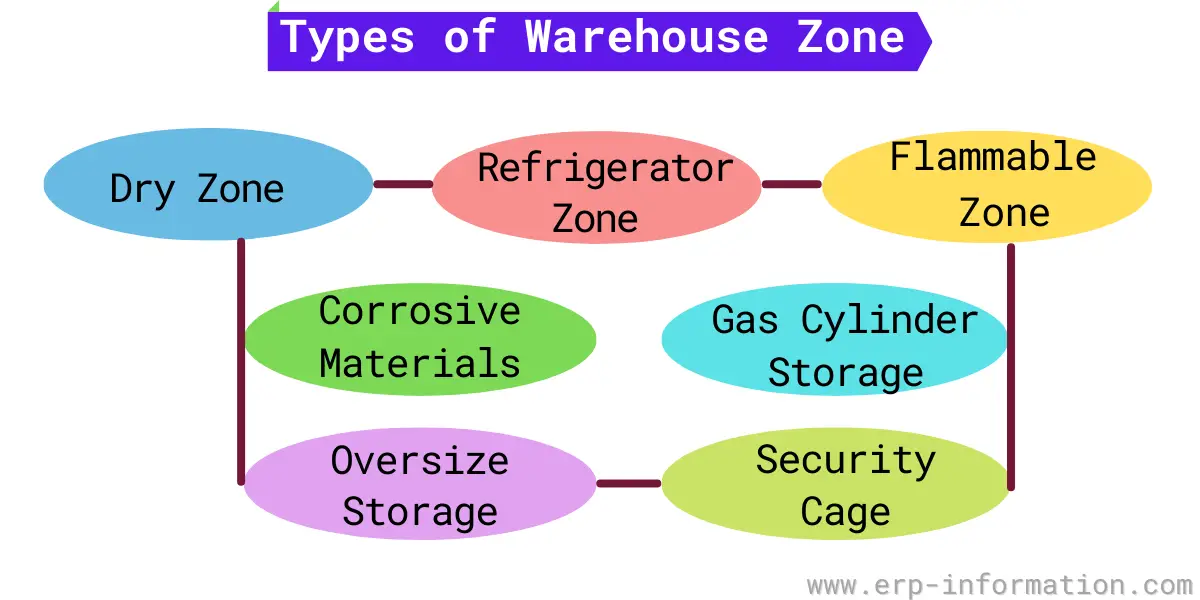
Some goods must be kept apart by law or by the product’s own requirements. These are the zones they need, with the rule that sets each one:
| Zone | What goes there | Rule to know |
|---|---|---|
| Dry (ambient) | Goods kept cool and dry | Dry food: 50 °F (10 °C) best, 70 °F (21 °C) adequate (USDA Foods, California) |
| Chilled | Food that must be refrigerated | 40 °F (4 °C) or below (FDA) |
| Frozen | Frozen food | 0 °F (−18 °C) (FDA) |
| Vaccines | Refrigerated or frozen vaccines | 2 to 8 °C, or −50 to −15 °C if frozen (CDC) |
| Flammable | Flammable liquids in cabinets | US: 60 gal per cabinet, Category 1 to 3 (OSHA); UK: 50 L of the most flammable (HSE) |
| Gas cylinders | Oxygen and fuel gas | 20 ft apart, or a 5 ft fire barrier (OSHA) |
| Corrosive | Acids, alkalis | Keep apart from what section 7 of the safety data sheet lists |
| Quarantine | Drugs awaiting quality release | Required in US drug manufacturing (FDA) |
| Oversize | Long or heavy goods | Stacks stable and secure (OSHA) |
| Security cage | High-value goods | Limited access |
Temperature zones
Chilled food belongs at 40 °F (4 °C) or below and frozen food at 0 °F (−18 °C). FDA: “Keep the refrigerator temperature at or below 40° F (4° C). The freezer temperature should be 0° F (-18° C)”.
For dry food, the California Department of Education, which distributes USDA Foods, advises: “Store dry foods at 50°F for maximum shelf life. However, 70°F is adequate for dry storage of most products”.
Vaccines need their own zones: 2 to 8 °C (36 to 46 °F) in the refrigerator, −50 to −15 °C for vaccines supplied frozen, and −90 to −60 °C for those that need an ultra-cold freezer (CDC). CDC’s storage sheet says to put “vaccines that are first to expire in front” and never to freeze refrigerated vaccines.
Flammable liquids
In the US a storage cabinet may hold “not more than 60 gallons of Category 1, 2, or 3 flammable liquids, nor more than 120 gallons of Category 4”.
In the UK, HSE guidance (HSG51) recommends no more than 50 litres per cabinet or bin of extremely or highly flammable liquids, or of liquids with a flashpoint below the room’s highest temperature. For other flammable liquids with a flashpoint up to 60 °C, the limit is 250 litres.
Gas cylinders
Oxygen must not sit next to fuel gas. OSHA requires oxygen cylinders in storage to be separated from fuel-gas cylinders or combustible materials by “a minimum distance of 20 feet (6.1 m) or by a noncombustible barrier at least 5 feet (1.5 m) high” with a fire-resistance rating of at least half an hour.
Corrosives and other chemicals
What may share a zone is on each product’s safety data sheet. OSHA’s format requires section 7 to state “conditions for safe storage, including any incompatibilities”. Read it before placing acids, alkalis or oxidisers.
Quarantine and returns
US drug makers must hold finished drugs apart until they are approved. FDA’s manufacturing rules require warehousing procedures that include “quarantine of drug products before release by the quality control unit”. The same idea works for returns and damaged goods awaiting a decision.
Oversize and security
Long, heavy or awkward items need floor space or cantilever racking, and OSHA requires that stacked storage be “stable and secure against sliding or collapse”. High-value items go in a locked cage with limited access.
Zones by activity: receiving to dispatch
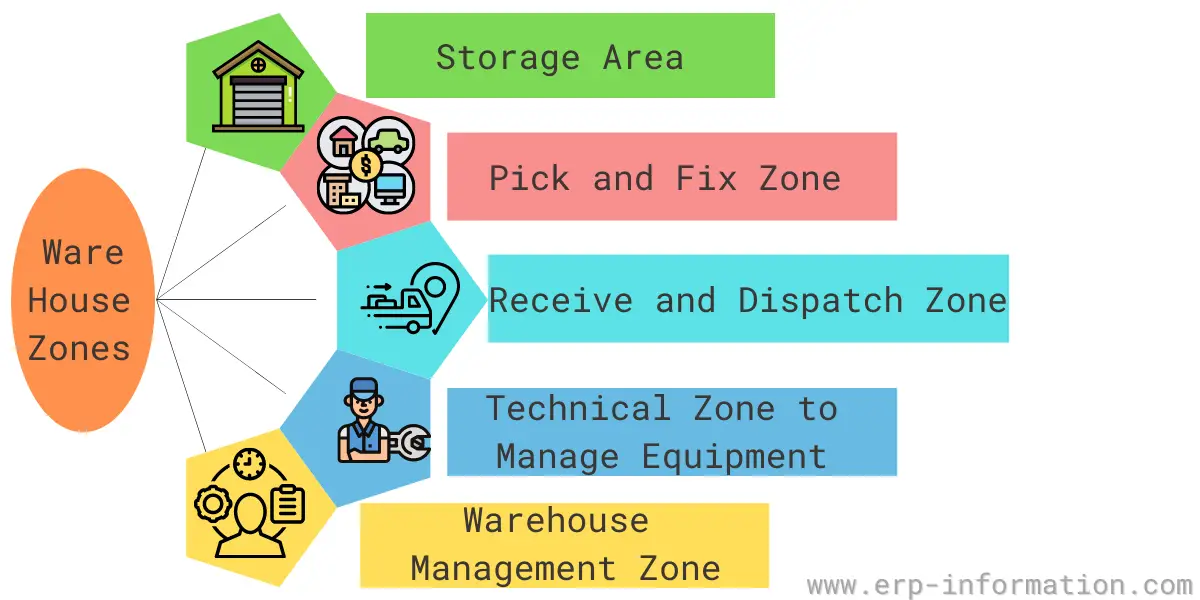
- Receiving and dispatch: docks with staging lanes so incoming and outgoing loads do not cross. A warehouse management system can book each truck to a door.
- Storage area: racks and bulk floor for reserve stock, sized to the products’ dimensions.
- Picking zone: the fast movers, close to packing, so most walking happens over the shortest distance.
- Packing: between picking and dispatch, with materials at hand.
- Equipment and charging: OSHA requires that “battery charging installations shall be located in areas designated for that purpose”.
- Office: supervision and the screens that run the warehouse system.
- Aisles: under OSHA, “permanent aisles and passageways shall be appropriately marked”.
How to zone a warehouse in six steps
- List every item with its storage condition, hazard class (from the safety data sheet), value, size and how often it is picked.
- Separate what must be separate. Cold, flammable, gas, corrosive, quarantine and high-value goods get their own zones first, using the rules above.
- Rank the rest by picks. Sort items by pick lines over the last few months and split them into fast, medium and slow (ABC analysis by picks, not by value).
- Place by rank. Fast movers go nearest packing and dispatch at waist height; slow movers go high, deep or far.
- Draw the flow. Receiving, reserve storage, picking, packing and dispatch should run in one direction where the building allows.
- Set the zones in your system and mark them on the floor, so putaway and picking follow the plan rather than memory.
FIFO, FEFO and when LIFO is acceptable
Rotation is a zoning decision because the layout decides which unit a picker can reach first.
- FIFO (first in, first out): the oldest stock leaves first. Use flow racks or single-depth racks so the oldest unit is in front.
- FEFO (first expired, first out): the stock that expires soonest leaves first. CDC asks for exactly this with vaccines: “put vaccines that are first to expire in front”.
- LIFO (last in, first out): drive-in racks and floor stacks give you the newest unit first. Use it only for goods that do not expire or date, such as bricks or sand. For anything perishable, LIFO leaves the oldest stock in the warehouse longest and increases waste.
These are physical picking rules. Valuing stock by FIFO or weighted average in the accounts is a separate choice, explained in the perpetual inventory system guide.
How warehouse software sets up zones
Every warehouse system has a place for zones, though the names differ. Most nest the same way: warehouse, then zone, then location or bin. Here is what each vendor’s own documentation calls it:
| System | Zone object | What it drives |
|---|---|---|
| SAP EWM (S/4HANA 2025) | Storage type, storage section, bin | Putaway search |
| Dynamics 365 Supply Chain | Zone, zone group | Replenishment, work, location directives |
| Oracle WMS Cloud 26D | Alloc, pick, replenishment and task zones | Allocation, picking, tasks |
| NetSuite WMS | Zone | Pick and putaway strategies |
| Odoo 19 | A parent location (Zone A) | Putaway rules, storage categories |
| Infor WMS 2026.x | Zone | One zone per location |
SAP calls the zone a storage type: “A storage type is a storage space, storage facility, or storage zone”. Inside it, a storage section “groups together storage bins with similar attributes for the purpose of putaway”. For putaway, “the system first determines the storage type by determining and applying a storage type search sequence”.
Dynamics 365 defines zones as “a logical or physical grouping of locations within a warehouse” and uses them “as filters in warehouse management processes, such as replenishment and work templates”. Location directives are the “rules that help identify pick and put locations for inventory movement”.
NetSuite: “Zones are areas in your warehouse that contain items with similar qualities or requirements”. Infor is stricter: “A zone is a collection of locations. Each location can be in only one zone”.
Odoo’s documentation treats a zone as part of the location tree: in its example, “In location WH/Stock/Zone A/Refrigerator 1, Refrigerator 1 is the location name, and Zone A is the parent location”. Storage categories are “used with putaway rules to assign a storage location to incoming products while accounting for the capacity of that location”.
Whatever the system, name locations so the zone is readable on the label. In our example, CH-04-12-3-B means the chilled zone, aisle 4, rack 12, level 3, bin B, so a picker knows the zone before reading the rest.
Types of Warehouse
The zones above exist in every kind of warehouse. The kinds differ by who owns them and what they are for (more in types of warehouses).
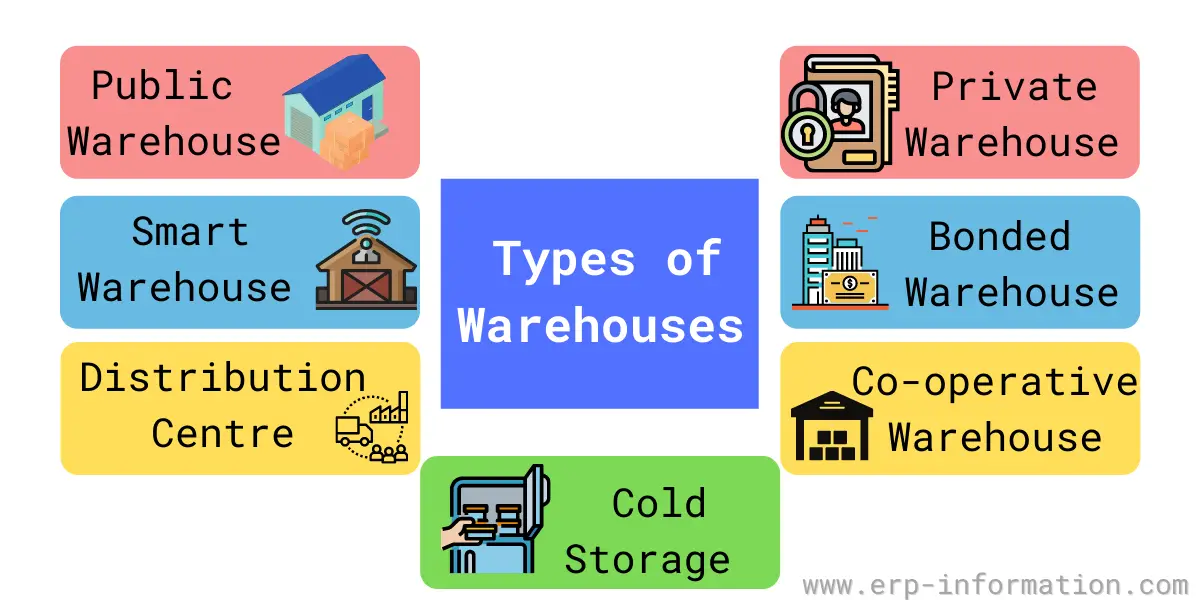
- Public warehouse: a business that stores other firms’ goods for a fee. US commercial law defines a warehouse as “a person engaged in the business of storing goods for hire”. It suits firms that need space without a lease.
- Private warehouse: owned or leased by the manufacturer, distributor or retailer for its own goods.
- Distribution centre: built for throughput rather than long storage, with large picking, packing and dispatch zones.
- Bonded or customs warehouse: imported goods are stored with duty unpaid. In the US they may be withdrawn “at any time within 5 years from the date of importation”. In the UK, customs warehousing “allows importers to store goods while suspending duties and import VAT”.
- Smart warehouse: one run largely by automation, such as conveyors, shuttles and robots directed by warehouse software.
- Co-operative warehouse: owned by a co-operative, such as farmers, for its members’ goods.
- Cold storage: a warehouse that is all temperature zones (cold storage warehouses).
FAQs
What is a Warehouse?
A warehouse is a building for storing goods until they are needed or sold. In US commercial law the business that stores other people’s goods for a fee is itself the warehouse: Article 7 of the Uniform Commercial Code defines a warehouse as a person engaged in the business of storing goods for hire.
What is the primary goal of warehouse zoning?
To put every item where its conditions are met and where it costs the least to move. Goods that need cold, fire separation or security go first into their own zones; everything else is placed by how often it is picked, so the busiest items travel the shortest distance.
How can the ideal zoning be determined for a warehouse?
List every item with its storage condition, hazard class, value, size and pick frequency. Give the items with special conditions their own zones, then rank the rest by picks and place the fastest movers nearest packing and dispatch. Check it against the flow from receiving to dispatch.
What safety measures should be implemented within each zone?
Use the rules that apply to the goods. In the US, OSHA requires marked permanent aisles, stable stacks, limits on flammable liquids per storage cabinet, oxygen cylinders kept apart from fuel gas, and battery charging in a designated area. Each product’s safety data sheet lists its storage incompatibilities.
Is it necessary to adapt zoning as a business evolves?
Yes. New products bring new storage conditions, and pick frequencies change with demand. Re-rank items by picks at regular intervals and move those that have changed class, starting with the fastest movers.
Which zones does your warehouse need?
- Every warehouse: receiving and dispatch, storage, picking, marked aisles and an equipment charging area.
- Food: chilled at 40 °F (4 °C) or below and frozen at 0 °F (−18 °C), with FIFO or FEFO rotation.
- Medicines: a 2 to 8 °C (36 to 46 °F) refrigerator zone for vaccines and a quarantine zone for stock awaiting release.
- Chemicals or fuel: flammable cabinets within the OSHA or HSE limits, separated gas cylinders, and zones set by each safety data sheet.
- Imports held before duty: a bonded or customs warehouse.
Rules on this page were checked against the issuers’ own pages on 30 October 2026.
Using Google Search? Add erp-information.com as a preferred source.