
Aggregate planning is the medium-term process of setting the overall level of production, workforce, and inventory a company needs to meet forecast demand, usually over a horizon of three to twelve months. It works at an aggregate level, planning by product family or total output rather than individual items, so managers can balance demand against capacity without getting lost in the detail of every SKU.
It sits between long-range capacity decisions and the master production schedule (MPS): the aggregate plan sets the totals, and the MPS then breaks them into specific products and dates. The aim is to meet demand at the lowest sensible combination of hiring, overtime, inventory, and subcontracting cost.
Definition
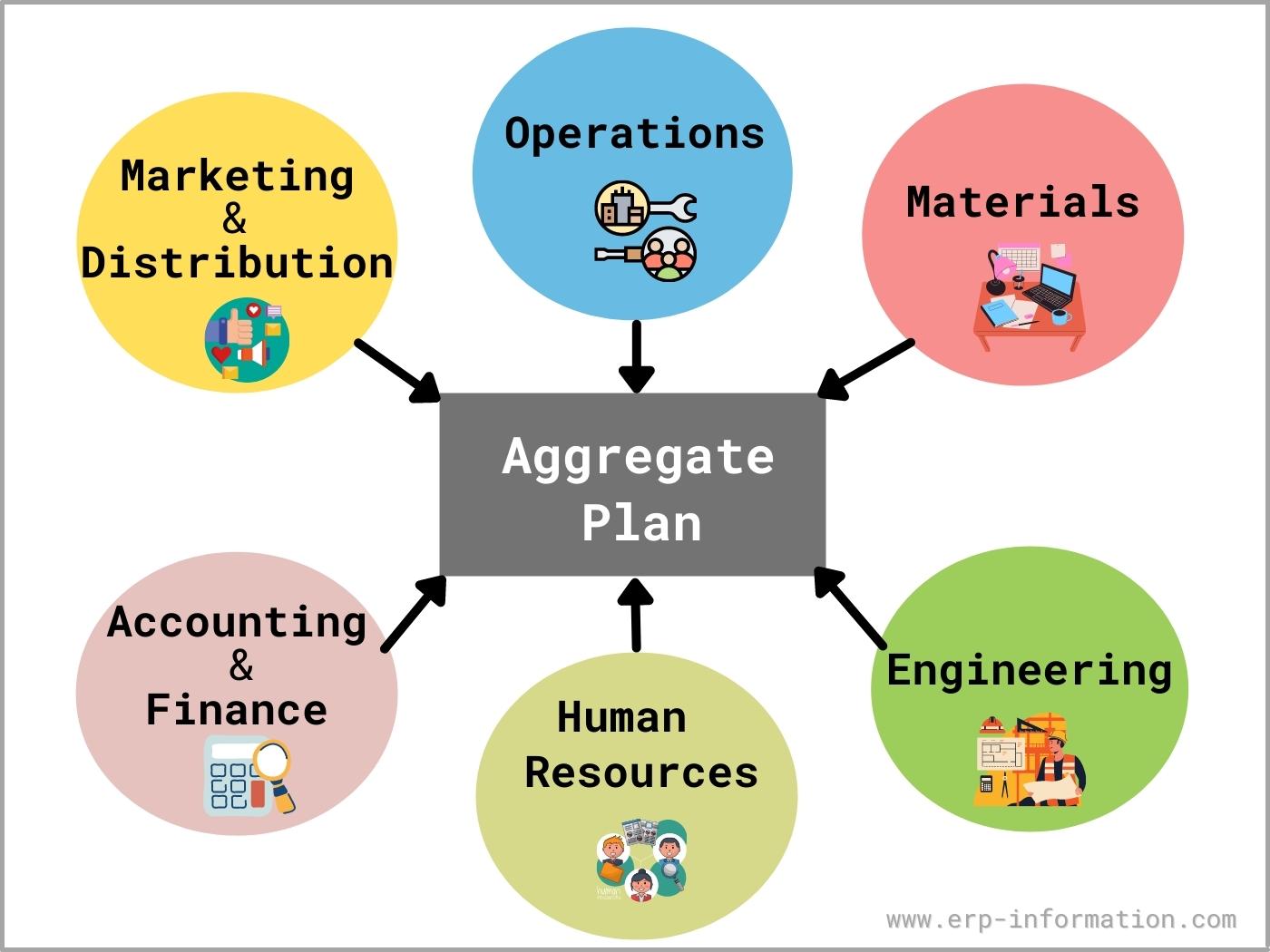
Aggregate planning is a way to plan the production of all products for a company over a period of time. It starts by listing all the important requirements for uninterrupted production. The usual planning horizon ranges from three to twelve months.
The word ‘aggregate’ comes from the Latin word ‘aggregāre.’ It means ‘to add to.’ It is frequently used in economics or business. This is why aggregate production planning is the exercise of developing an overall production schedule for all products combined for a company.
Aggregate planning does not differentiate colors, sizes, and features. For example, in a mobile handset manufacturing company, aggregate planning considers only the total number of handsets, not the separate models’ colors.
Aggregate Planning Example
The clearest way to see aggregate planning is to cost out the two main strategies, level and chase (both explained below), against the same demand. Suppose a plant forecasts this demand for one product family over four months, and each worker produces 200 units a month:
| Month | Forecast demand | Workers needed (demand ÷ 200) |
|---|---|---|
| 1 | 800 | 4 |
| 2 | 1,000 | 5 |
| 3 | 1,200 | 6 |
| 4 | 1,000 | 5 |
Level plan: hold output steady
Keep the workforce at 5 (1,000 units a month) and let inventory absorb the swings. Starting inventory is zero, and holding stock costs $10 per unit per month.
| Month | Produced | Demand | Ending inventory |
|---|---|---|---|
| 1 | 1,000 | 800 | 200 |
| 2 | 1,000 | 1,000 | 200 |
| 3 | 1,000 | 1,200 | 0 |
| 4 | 1,000 | 1,000 | 0 |
Inventory is carried for 400 unit-months in total (200 + 200 + 0 + 0). At $10 each, the level plan costs $4,000, with no hiring or firing.
Chase plan: match output to demand
Now vary the workforce so production equals demand every month and no inventory is held. Starting from 5 workers, and with hiring at $500 and a layoff at $700:
| Month | Workers needed | Change from prior month |
|---|---|---|
| 1 | 4 | lay off 1 |
| 2 | 5 | hire 1 |
| 3 | 6 | hire 1 |
| 4 | 5 | lay off 1 |
That is two hires and two layoffs, so the chase plan costs (2 × $500) + (2 × $700) = $2,400, with no inventory to hold.
| Strategy | What varies | Total cost |
|---|---|---|
| Level | Inventory (400 unit-months) | $4,000 |
| Chase | Workforce (2 hires, 2 layoffs) | $2,400 |
In this example the chase plan wins because holding inventory is expensive relative to adjusting labor. Flip those numbers, make layoffs costly or skilled workers hard to replace, and the level plan becomes the cheaper choice. Weighing exactly that trade-off, at the lowest total cost, is the whole job of aggregate planning.
The planning covers various elements, such as
- Human resources
- Raw material
- Financial planning
- Operations
- Engineering
- Marketing and distribution
This comprehensive approach serves as a vital tool for companies, aiding in the optimization of immediate production processes. By harmonizing these processes with the organization’s long-range plans, it ensures strategic alignment and facilitates efficient operations.
Importance
- It helps to reach financial goals by decreasing overall variable costs.
- It reduces the cost of inventory stocking.
- It helps to utilize the maximum available production capacity.
- It helps achieve the demand on time and reduces the customer’s waiting time.
- It enables the organization to meet scheduled goals and satisfies workforce planning.
Types of Aggregate Planning Strategies
Two types of aggregate planning strategies are level strategy and chase strategy. The third approach is utilizing the best of both methods.
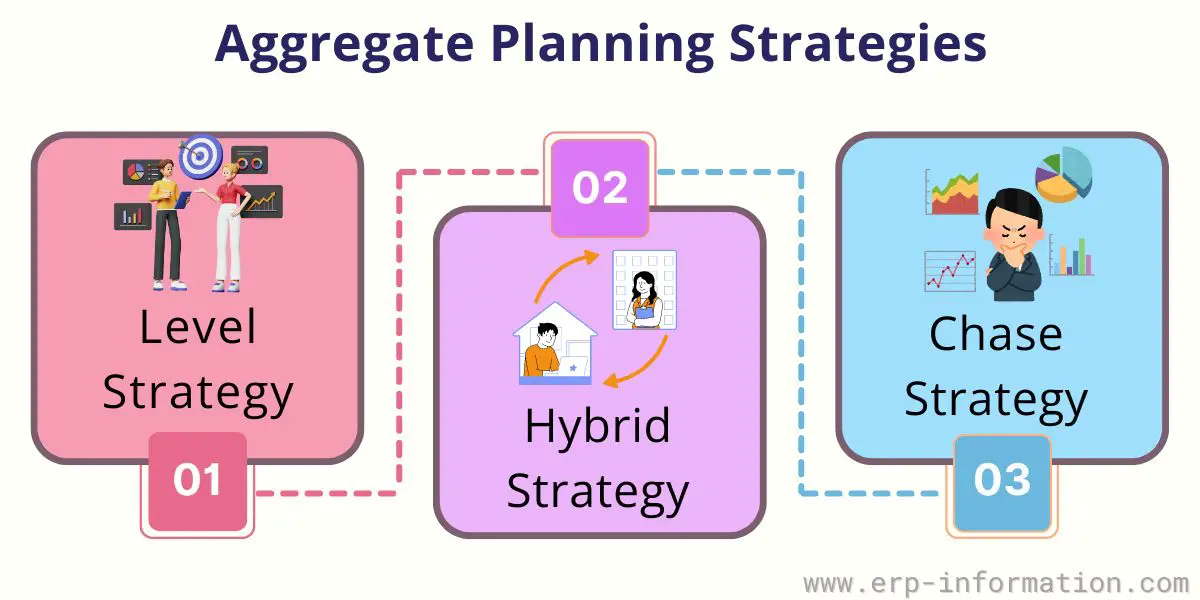
Level strategy
This is also known as a production-smoothing plan or a stable plan.
It focuses on maintaining consistent production levels and managing the workforce within a company. The expected demand rate is achieved by adjusting various factors, such as financial resources and the utilization of human capital.
Though this strategy helps maintain human resources, it also stocks inventory. There are also chances of not meeting the expected targets, resulting in backlogs costing a lot more to the firm.
The level strategy is best suited to situations where inventory carrying costs are not high.
Read more on Level Production Strategy
Chase strategy
The chase strategy varies output period by period so production tracks, or “chases”, demand. Capacity is flexed up and down mainly by hiring and laying off workers, adding or cutting overtime, or subcontracting, which keeps finished-goods inventory close to zero.
Because it holds little stock, the chase strategy suits products that are costly or perishable to store, or that change too fast to build ahead. Its downside is on the people side: constant hiring, layoffs, and overtime push up labor costs, strain morale, and raise attrition.
Chase is best suited to situations where the cost of changing the production rate is low relative to the cost of holding inventory.
Read more on Chase Production Strategy
Evaluate Chase production strategy using our Online Chase production strategy calculator
Hybrid strategy
A hybrid strategy in aggregate planning uses a combination of methods to arrive at the final production plan.
For example, a company may use a mathematical model to calculate an optimal production plan and then adjust it against feedback from the actual production process. What the combination trades for is the stability of a level plan, which holds the workforce and output rate steady, alongside the responsiveness of a chase plan, which flexes capacity when demand moves.
Most manufacturers end up somewhere on this spectrum rather than at either extreme. A common pattern is to staff a stable core workforce at roughly the average demand rate, then absorb the peaks with overtime, temporary labor, or subcontracting, so that neither inventory nor hiring and firing has to carry the whole swing on its own.
The hybrid strategy in aggregate production-planning balances production rate, hiring/firing, and stock level.
Where aggregate planning sits: S&OP, the master schedule and MRP
Aggregate planning is rarely a standalone exercise. It is the supply side of sales and operations planning (S&OP), the recurring cycle, usually monthly, in which commercial and operations teams commit to a single set of numbers. ASCM, the association behind the APICS certifications, puts the purpose plainly: through S&OP, organizations “align their daily activities with overall corporate strategy and ensure a better match between supply and demand”.
This also explains why aggregate planning works in product families rather than individual items. A family is the level at which its decisions are actually taken: you hire people, authorize overtime, or run an extra shift for a group of similar products, not for one stock keeping unit. Each level below narrows the horizon and adds detail.
| Planning level | Decides | Level of detail | Typical horizon |
|---|---|---|---|
| Business and capacity strategy | Plants, lines, major equipment | The business as a whole | Beyond roughly 18 months |
| Aggregate plan (the supply side of S&OP) | Output rate, workforce level, inventory and backlog | Product family | Intermediate term, commonly a few months up to about 18 |
| Master production schedule | Which specific end items to build, and when | Individual end item | Weeks to months |
| Material requirements planning | Component and material orders | Every part on the bill of materials | Set by component lead times |
The master production schedule is where the aggregate plan gets disaggregated. It translates the agreed family level output rate into a feasible build schedule for specific items that operations and suppliers can execute, and it then becomes the primary input to material requirements planning. Capacity is re-checked on the way down as well, which is the job rough-cut capacity planning does against the master schedule.
Two practical consequences follow, and they are why this hierarchy is worth understanding rather than memorizing. First, an aggregate plan that was never tested against capacity does not fail at the aggregate level; it fails later, as an infeasible number handed to a master scheduler who has no authority to add the capacity it assumes. Second, how you define a product family is a real design decision rather than a labeling exercise: group products that draw on the same labor and equipment, because the entire premise of planning in aggregate is that the members of a family compete for the same capacity.
What is the Criterion that Influences Aggregate Planning?
- Is the hiring and firing of employees allowed?
- Is overtime allowed based on the fluctuation in demand?
- Are backorders allowed?
- It is crucial that before planning, complete details about the product must be collected and analyzed. The inventory and production capacity have to be thoroughly understood.
- A reliable demand prediction helps in planning better.
- Every process of the firm contributes to successful aggregate planning. Therefore, all organizational factors must be considered, from quality control to labor morale management.
- Proper financial management ensures appropriate costing.
It assures that all production factors are thoroughly examined to achieve the firm’s goal.
Two main factors while calculating aggregate planning are aggregate demand and aggregate capacity.
Aggregate Demand and Aggregate Capacity
Aggregate planning starts with the establishment of aggregate demand and aggregate capacity.
What is aggregate demand?
In aggregate planning, aggregate demand is the combined forecast of everything the plant must produce over the horizon, expressed in a common aggregate unit rather than by individual product. Instead of a separate forecast for each model, colour, or size, demand for a whole product family is added into one number per period.
Rolling the forecasts up this way smooths the noise in any single item and gives a clearer view of the total load the operation has to carry. That single aggregate figure is what the plan then balances against capacity, period by period.
What is the aggregate capacity?
Aggregate capacity is the total production capacity available to meet the aggregate demand, measured in the same broad units as the plan. Aggregate planning only checks capacity at this rough, total level; once the plan becomes a master schedule, capacity is verified in detail by rough-cut capacity planning and then capacity requirements planning.
The process of ascertaining the company’s overall volume and ability to perform its entire resources is called aggregate capacity management. The steps involved in aggregate capacity management are
- Understanding the aggregate demand and supply for a specific period
- Preparation of suitable plans and contingency plans for situations where the demand levels might fluctuate
- Finalizing an appropriate plan
An organization needs to understand the capacity of its resources. That will help the business know its production capacity, leading to proper sales forecasting and prompt supply of products to the customers.
That will also ensure the right balance between the demand and supply without stressing the resources.
The resources can vary from company to company, but aggregate capacity considers manual and machinery resources and does not differentiate between the two.
For instance, if the company is into the production of bikes, the aggregate capacity will consider only the end product numbers.
It will not consider the complexity of each bike, the variations, and the specialties. Instead, it looks from a macroscopic view.
Aggregate planning becomes successful when both aggregate demand and aggregate capacity are equal.
When there is an imbalance between them, the organization must decide whether to add or reduce capacity to attain demand or add or reduce the need to achieve capacity.
Here are some tips to increase demand to meet the available capacity.
- Price: Lessen the cost of the product or service to increase the demand. For example, cloth industries offer discount sales at the end of the season to increase demand. Some hotels also fix seasonal rates to attract customers.
- Advertise: Many companies promote their products through advertising and direct marketing.
- Generate new demands: Industries like hotels and bars offer some complimentary services to create some extra demands. Likewise, grocery shops offer home delivery services to create demand.
- Backorders: To smooth the demand, some companies shift the current orders to the next period when the capacity is not used correctly.
Here are some tips to increase or decrease the capacity to meet the existing demand.
- Overtime: The organization can create additional capacity by making the employees work extra time in a day or work another day per week. It is an excellent choice to increase capacity without much investment in hiring workers.
- Hiring or firing workers: It is one of the ways to make capacity and demand balanced. The company can hire employees to increase the capacity required for the increased demand or fire some current employees to decrease the capacity for reduced demand.
- Part-time workers: The company can hire workers on a contract or on-call basis to meet the demand.
- Final product inventory: It is one of the common methods companies use. The company can stock the finished products when demand is less and capacity is high to use those products to fulfill the current demand without increasing the capacity.
- Sub-contracting: The organization can obtain temporary capacity by subcontracting to another manufacturer or service provider.
- Cross-training: Train the employees so that they will be able to do not only their work but also they can do some flexible work if it is needed.
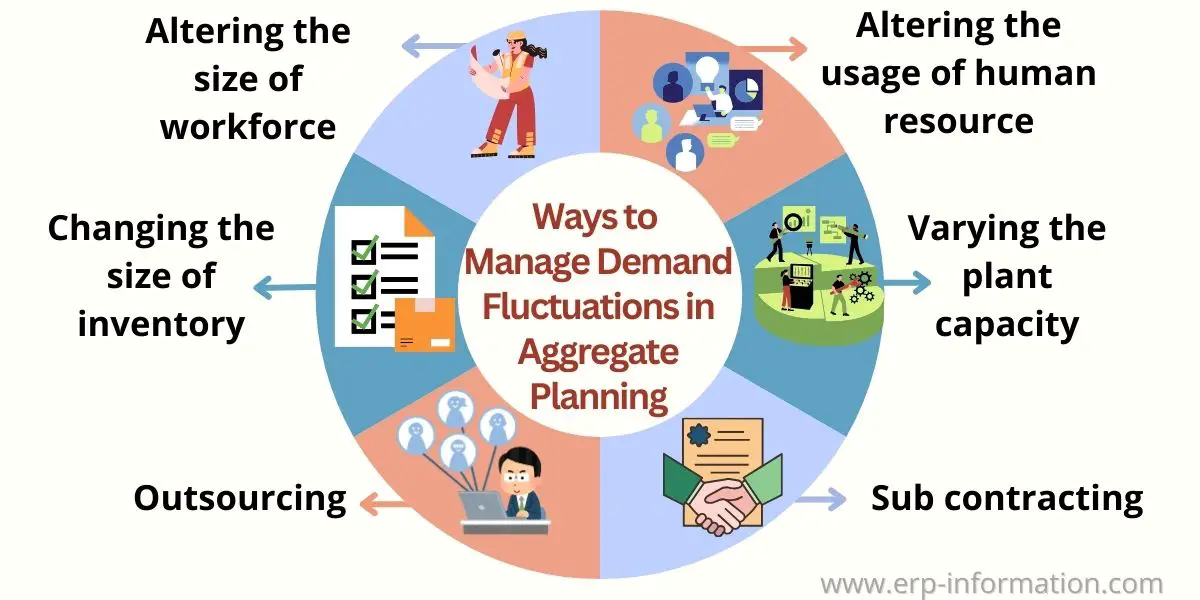
How to manage demand fluctuations through aggregate capacity management?
Generally, the business will have pure strategies ready to meet such unexpected situations. However, a combination is also used based on the needs.
- Altering the size of the workforce: This involves getting more people to work or laying off people when there is an excess of resources.
- Altering the usage of human resources: Utilizing the existing workforce by providing overtime, incentives, and such schemes.
- Changing the size of inventory: Depending on how much the production can be leveraged, the inventory is ordered.
- Outsourcing, sub-contracting, varying the plant capacity: Passing on the work and meeting the production requirements
Objectives
- Decrease expenditures in different inventories
- Increase the usage of devices and equipment
- Decrease the variations in the production rate
- Provide good customer service
- Decrease the workforce level variations
- Decrease the cost of planning outline

Challenges
Limited time range
- Short-term focus may lead to neglect of long-term goals and strategic initiatives.
- It necessitates frequent revisions to accommodate changing circumstances, which can be resource-intensive and disruptive to operations.
Assumption of stability
- Aggregate planning often assumes a level of stability in demand, supply, and other factors, which may not align with the dynamic nature of many business environments.
- Unexpected disruptions such as natural disasters, economic downturns, or supply chain disruptions can render the plan ineffective or obsolete.
Balancing conflicting objectives
- Aggregate planning involves trade-offs between various organizational objectives such as minimizing costs, maximizing utilization of resources, and meeting customer demand.
- Finding the optimal balance among these objectives while considering constraints like capacity limitations and labor regulations can be intricate and require sophisticated decision-making processes.
Human resource considerations
- Adjustments in workforce levels and scheduling to align with aggregate plans can pose challenges in terms of employee morale, job satisfaction, and labor relations.
- Layoffs, temporary shutdowns, or changes in working hours may lead to resistance or discontent among employees, affecting productivity and organizational culture.
Aggregate Planning Flowchart
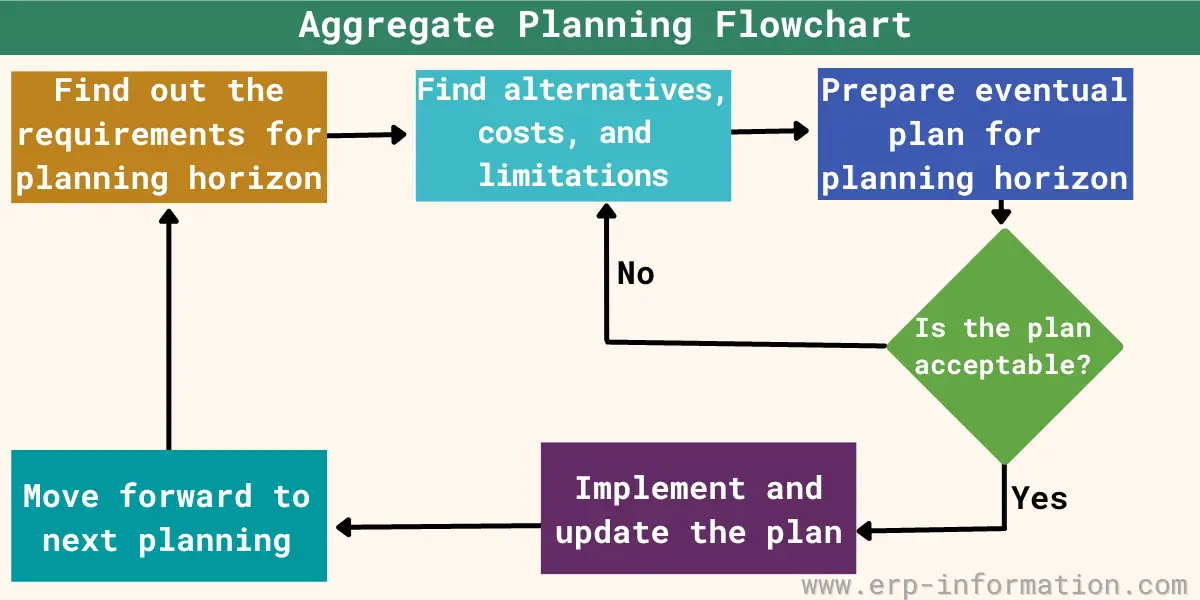
The Mathematical Approach to Aggregate Planning
We will list some mathematical techniques used in more composite aggregate planning applications.
Linear Programming
It is one of the refinement techniques that help the customer generate more revenue with minimum resources or available capacities.
The transportation model (special linear programming) allows customers to balance capacity and demand with minimum cost.
Mixed-inter Programming
This technique will be helpful when the aggregate planning is intrinsically the sum of plans for individual production lines.
In this case, mixed-integer programming allows finding out the number of units produced in each production line.
Linear decision rule
It is one more optimization technique. It helps attain a single quadratic equation by using cost-approximating functions ( three of them are quadratic) to reduce production costs.
Then you can derive two linear equations from that quadratic equation and use one equation for planning the output for each period and another for planning the workforce for each period.
Management co-efficient model
This method is formed on the production rate for any period that this equation will set
ie P t = aW t-1 − bI t -1 + cF t+1 + K, where a,b,c,K are constants and using regression analysis you can find their values.
P t – the production rate set for period t
W t – 1 – is the workforce in the past period
I t-1 – the ending inventory for the past period
F t+1 – the forecast of demand for the next period
Search decision rule
This technique helps overcome some of the limitations of linear programming techniques about cost assumptions.
It enables the customer to express cost data inputs in standard terms. First, it needs computer programming to evaluate any production plan’s cost. Then it searches for alternative methods with minimum prices among them.
Advanced planning and scheduling (APS) software can quickly assist in aggregate planning. APS is a process that enables organizations to plan and schedule activities more precisely.
This process helps to keep the total cost of an organization’s projects low by minimizing disruptions caused by unplanned events.
APS works from real constraints, the available capacity at each resource, material availability, and order due dates, and searches for a schedule that satisfies all of them at once. Because it recalculates quickly when something changes, it lets planners test aggregate options and see the effect on work assignments and delivery dates before committing to a plan.
FAQs
Why is aggregate production planning needed?
The demand for the various products of a company could vary. If the need changes, how do you commit your resources to meet this variation in the market? So, to balance the variations aggregate planning is needed.
Conclusion
Aggregate planning is a method of planning for the future. Organizations should use it to help them understand how their current activities will affect other areas soon and what could happen if they change their strategies or policies.
There are many benefits to using a holistic process. These include increased efficiency, lower costs, improved innovation and creativity, and reduced risks from unanticipated events. However, there are also some drawbacks, such as the high upfront cost and complexity.
References:
- How to Control Product Portfolio – Researchgate
- Aggregate Planning and Forecasting – Benedictine University
Using Google Search? Add erp-information.com as a preferred source.