If you are searching for Beanworks in 2026, the first thing to know is that the brand no longer exists. The Vancouver company was bought by Quadient in March 2021, renamed twice, and is sold today simply as Quadient AP. The software itself never went away. Same product, same four modules, no forced migration. But the name, the pricing model, and the target customer have all moved.
That distinction matters, because most pages still describing “Quadient AP by Beanworks” in the present tense are quoting a brand Quadient retired from its own marketing. Below is what actually changed, what the product does now, and where the free tier went.
What happened to Beanworks
Beanworks was founded in Vancouver, British Columbia in 2012 and built AP automation for small and mid-sized finance teams. By the time it was acquired it had roughly 90 employees and about 800 customers, and Quadient reported that more than €11.9 billion a year was flowing through the platform.
- 22 March 2021. Quadient announces the acquisition. Quadient’s own release puts the price slightly above US$85 million (about C$106 million) excluding transaction costs, for roughly 96% of the company; two Beanworks leaders retained a minority stake. Some press coverage cites C$104 to 105 million, so treat the exact figure as approximate.
- 7 November 2022. The product is renamed Quadient Accounts Payable Automation by Beanworks.
- Since then, “by Beanworks” has been dropped from Quadient’s marketing entirely. The product page is now headed simply Quadient AP, and beanworks.com returns a 308 redirect to quadient.com. The old name survives only in the legal terms of service, which are still titled “Specific Terms and Conditions Quadient AP (Beanworks)” and were last revised in December 2025.
Nobody was migrated anywhere. If you inherited a Beanworks contract, you are a Quadient AP customer, and the workflow you were trained on is the workflow that ships today.
One correction worth making: Beanworks never did accounts receivable
This is the most common error in write-ups of this product, and this article carried it too until it was corrected. Beanworks was, and Quadient AP still is, accounts payable only.
Quadient does sell AR automation, including credit assessment, DSO tracking, collections and the AR dashboard. But that came from a completely separate acquisition: YayPay, bought in July 2020 for around US$28 million and now sold as Quadient AR. Two different companies, two different deals, two different products. If a comparison page lists credit scoring or collections under “Beanworks features,” it has merged them.
What Quadient AP does today
The product still ships as four modules, which is how it is licensed and how the pricing conversation is structured.
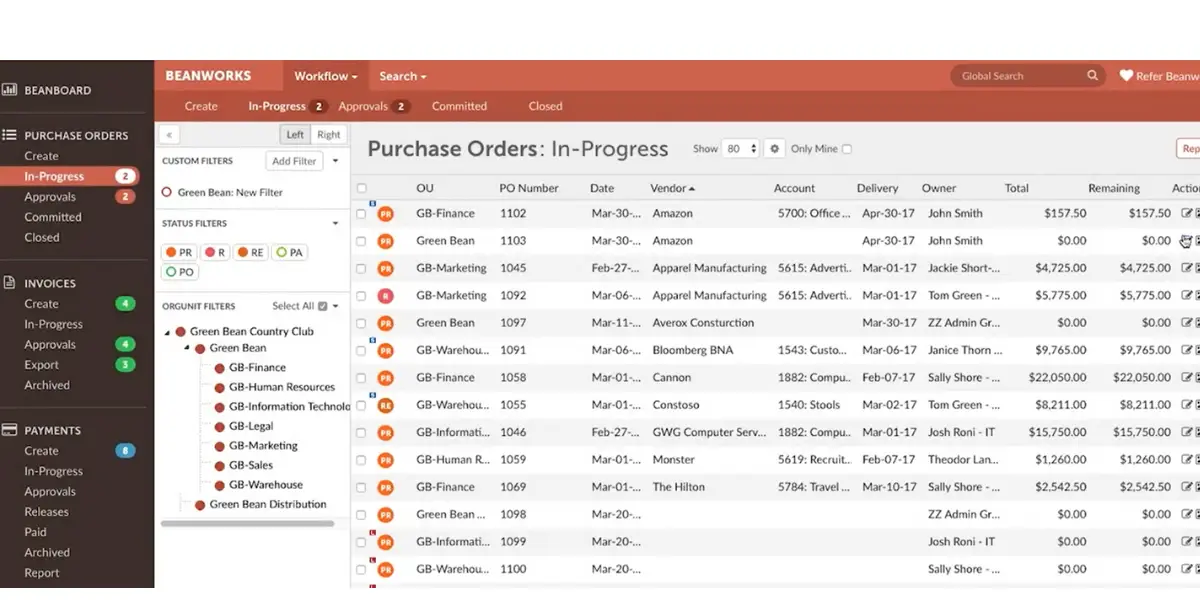
Purchase orders
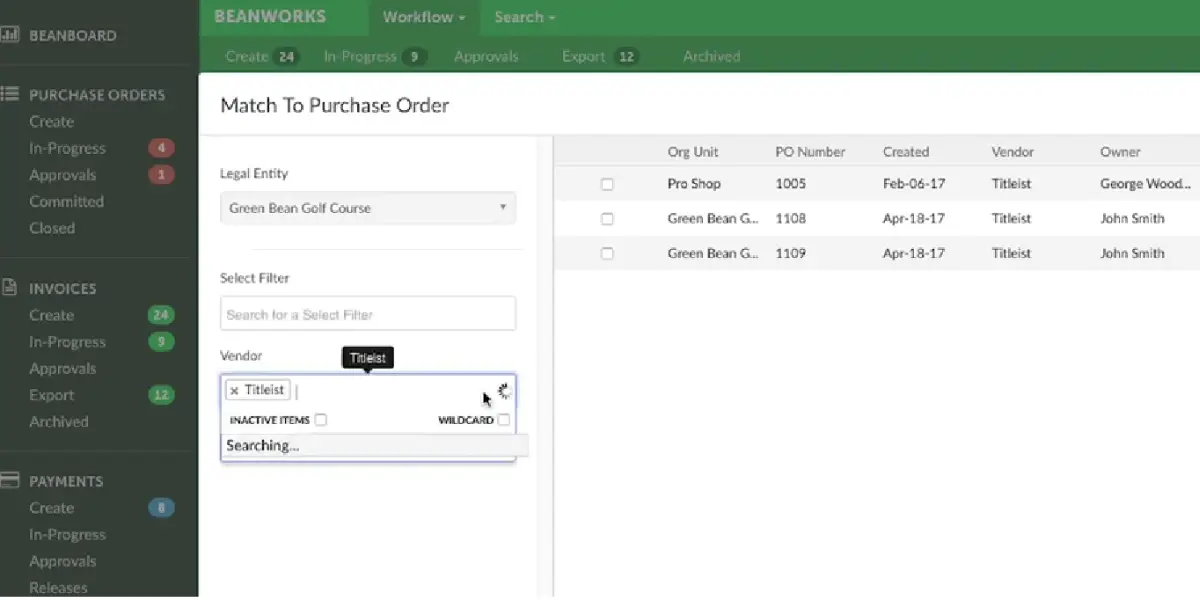
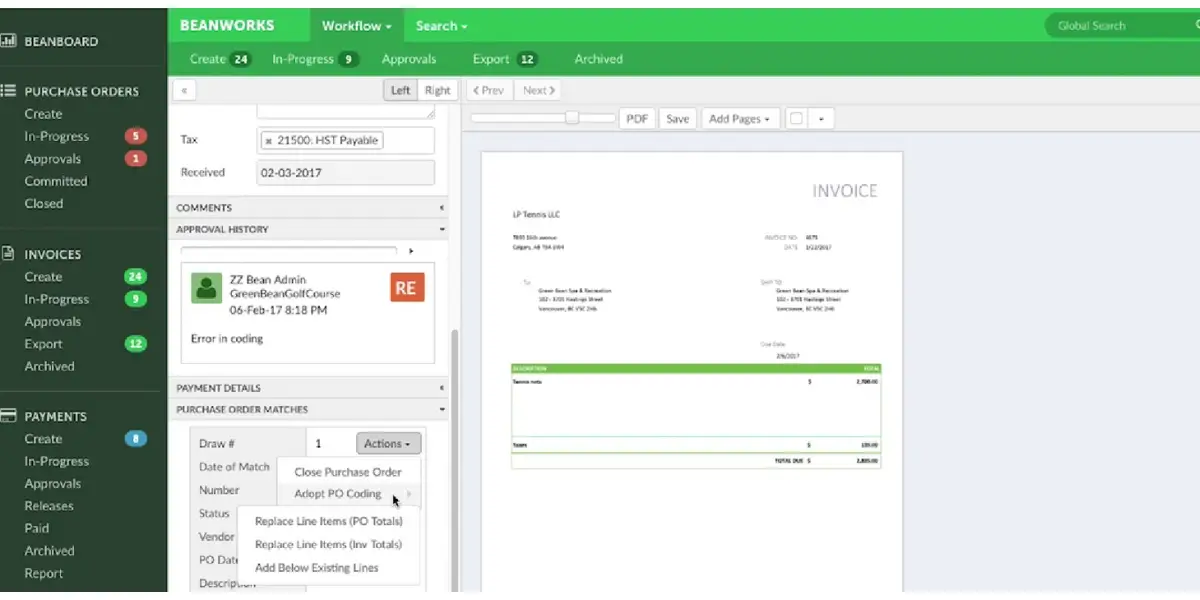
Requisitions are raised and approved in the same system that later receives the invoice, so budget checks happen before the spend commits rather than after. POs carry through to two- and three-way matching against the invoice and the receipt.
Invoice automation
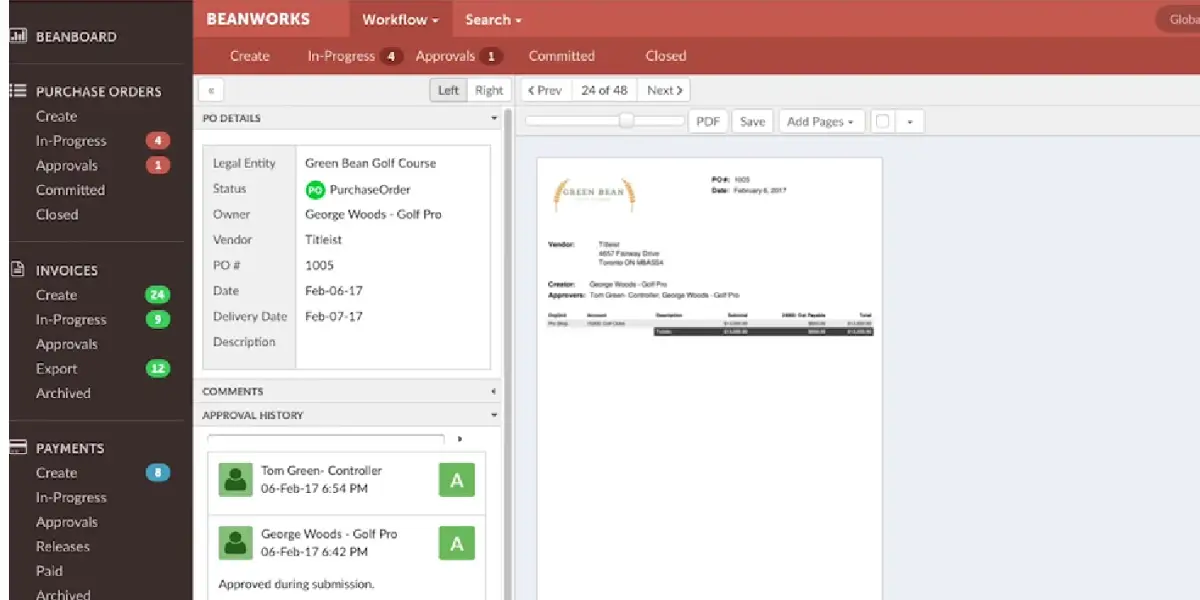
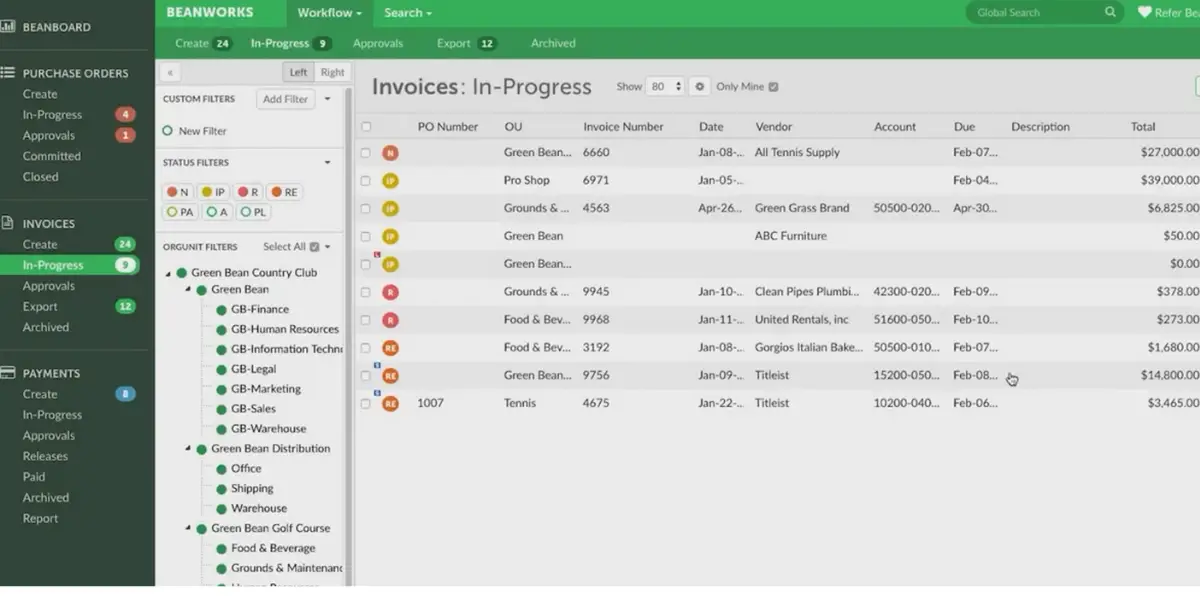
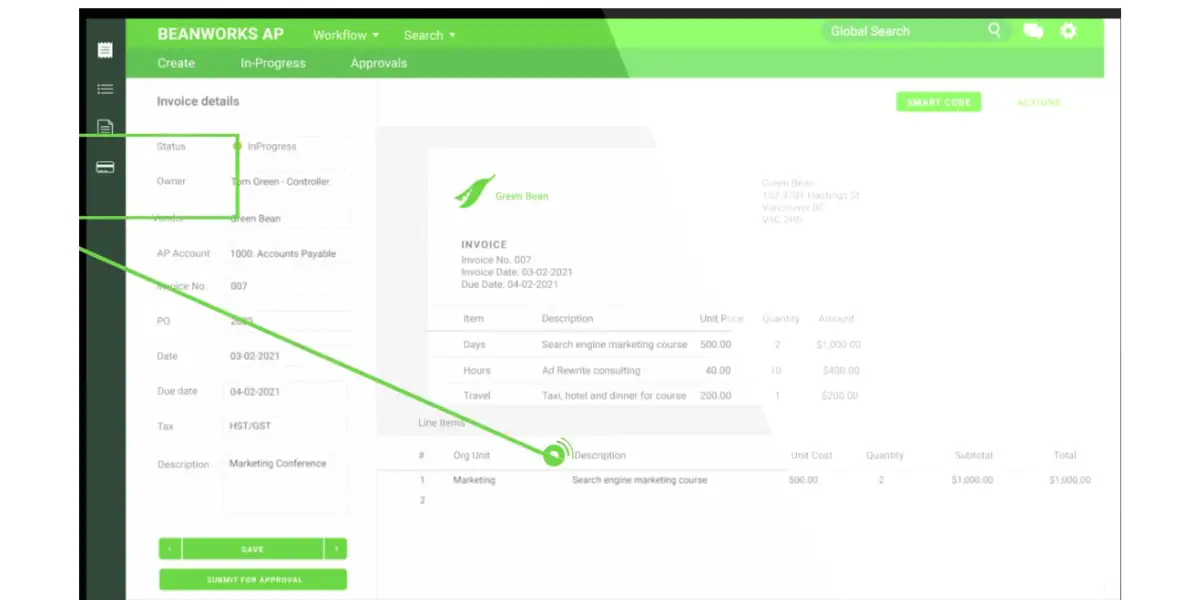
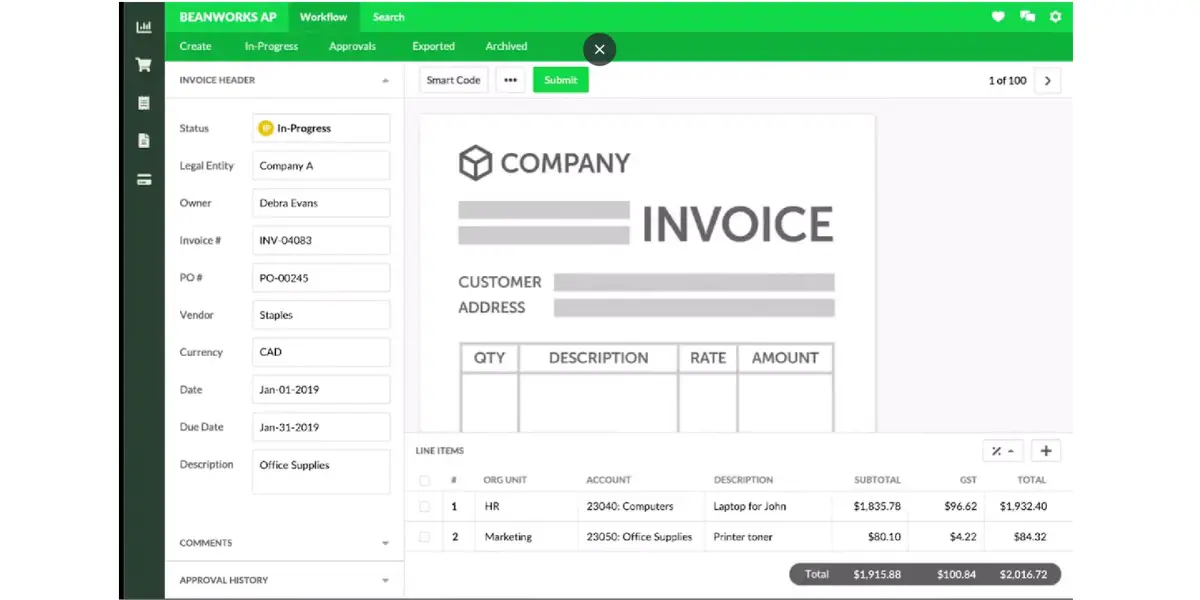
Invoices arrive by email, upload or supplier portal, get read by the capture engine, and are coded to the GL and routed for approval on rules you configure. Quadient claims 99% capture accuracy and 50% less invoice processing time. Those are the vendor’s own figures, not independently audited, so treat them as a marketing claim rather than a benchmark.
The part that holds up in customer reviews is less glamorous: every invoice keeps an electronic audit trail, and approvers can act from a phone, which is what actually removes the bottleneck in a distributed finance team.
Payment automation
Approved invoices become payments without re-keying, and the payment run syncs back to the accounting system for reconciliation. Supported methods across Quadient’s listings include ACH, cheque, EFT and wire. Virtual card support is claimed in some third-party directories but is not stated plainly on Quadient’s current pages, so confirm it with the vendor if card rebates are part of your business case.
Expenses
Employee expense claims run through the same approval chain and coding rules as supplier invoices, which is the main reason to buy it as a module rather than bolting on a separate expense tool.
Pricing: what is actually published, and what is not
Quadient publishes no prices for AP. The product page offers a demo request and nothing else. Capterra’s listing shows four plans, all “custom quote,” billed per year, with no free version and no free trial.
Two things follow from that, and they are the practical answer to “what does Beanworks cost”:
- The free tier is gone. Beanworks launched a free entry plan called Beansprout in December 2021, offering a shared invoice inbox, payment approvals and cloud storage for very low volumes. There is no free sign-up path on Quadient’s site today and the directory listings record no free version. Quadient never published a discontinuation notice, so the date it was withdrawn is not documented; what is verifiable is that you cannot start on it now.
- It is no longer priced at the small end. Quadient’s closest published qualification gate, which sits on the AR side, asks for a minimum of £7.8 million in annual revenue. AP is sold the same enterprise way: annual contract, unlimited user licences, unlimited workflow rules, quoted against invoice volume and module mix.
You will find sites quoting figures like $25,000 to $75,000 a year for 10,000 to 50,000 invoices. Those come from procurement-data aggregators reselling negotiated-contract estimates, not from Quadient. They are a reasonable order-of-magnitude sanity check and nothing more, so do not take them into a negotiation as if they were list prices.
Integrations
Named on Quadient’s current AP pages: QuickBooks, Xero, Sage, Sage Intacct, Oracle NetSuite, Microsoft Dynamics, Rent Manager, Northstar, Jonas (Club) and ClubEssential, with custom integrations offered for anything unlisted.
Two gaps worth knowing before you shortlist. Acumatica is not on the list. And Quadient does not version-qualify its ERP support on the page. It says “Microsoft Dynamics,” not which one. Beanworks historically shipped a dedicated Dynamics GP connector; whether GP is still actively supported given Microsoft’s end-of-sale position is not something Quadient states publicly, so ask directly if you are still on GP.
Who it suits now
The integration list gives away the verticals better than the marketing does. Rent Manager points at property management, Jonas Club and ClubEssential at clubs and hospitality, and recent reviewers describe construction, government and manufacturing finance teams. Multi-entity organisations that need one approval structure across several companies are the natural fit, and that capability, plus unlimited users, is what customers consistently single out.
Quadient also states it now serves 2,100+ AP customers, up from roughly 800 at acquisition, and its growth story has shifted decisively toward e-invoicing compliance. It is a registered platform for the French e-invoicing reform and acquired Serensia to strengthen that position. If you operate in the EU, that regulatory roadmap is a more important buying criterion in 2026 than any feature checkbox, and it is the thing a 2022-era comparison will not mention at all.
Strengths

- Unlimited user licences, so approvers do not have to be rationed by seat cost
- Centralised control across multiple entities and locations
- Approvals from mobile, which is where the reviews consistently give it credit
- Searchable digital invoice storage with a full audit trail
- Duplicate payment prevention and enforced approval limits
Recent reviews on Capterra, where it now averages 4.5 out of 5 across 80 reviews, run in the same direction. A controller in construction (February 2026) credited the document management and the ability to access invoices from anywhere; a finance supervisor in government administration (December 2025) singled out delegating approvals while on holiday. That is a modest review base: useful as signal, too small to treat as a verdict.
Limitations

- No free version and no free trial. You evaluate it through a sales-led demo, which rules it out for anyone wanting to self-serve.
- No published pricing at all, so budgeting requires a sales cycle before you know whether it is even in range.
- Integration friction is the recurring complaint theme in current reviews, covering sync behaviour with the accounting system and coding that has to be corrected after the fact. This is the one negative pattern that has persisted across the rebrand.
- Acumatica is not supported on the published integration list.
- It has moved upmarket. The small-business on-ramp that made Beanworks attractive no longer exists.
Older write-ups of this product circulate a few very specific complaints: an 80-invoices-per-page limit, USD invoices failing to sync with Great Plains, export modules that cannot emit data and PDF together. Each traces back to single reviews from the pre-Quadient era and none is reproducible against the current product, so they are not repeated here as current limitations.
Alternatives to Quadient AP
For a mid-market finance team, the realistic head-to-head set is Stampli, Tipalti, BILL (formerly Bill.com), AvidXchange, Medius, Ramp and SAP Concur. Melio and Lightyear sit further down-market and are the more honest comparison if the free Beansprout tier was what drew you here.
At the enterprise end, Gartner published its first Magic Quadrant for Accounts Payable Applications on 19 March 2025, evaluating 15 vendors. Basware, Esker and Medius each announced Leader placement. Quadient says it was recognised in the report but has not stated its quadrant position, and vendors generally use that phrasing when they are not Leaders, so treat the inclusion as meaningful and the placement as unknown.
One warning about researching this further: almost every “best Beanworks alternatives” page ranking today is published by a competitor. Stampli, Tipalti, Rillion and Ramp all run one. They are useful for feature vocabulary and worthless for comparative judgement.
Frequently asked questions
Is Beanworks still in business?
The software is, the company is not. Beanworks was acquired by Quadient in March 2021 and no longer operates as a separate business. The product is sold as Quadient AP and beanworks.com redirects to quadient.com.
What is Beanworks called now?
Quadient AP. It was branded “Quadient Accounts Payable Automation by Beanworks” from November 2022, and the “by Beanworks” suffix has since been dropped from Quadient’s marketing.
How much does Quadient AP cost?
Quadient does not publish prices. It is sold as an annual contract quoted on invoice volume and which of the four modules you take, with unlimited users included. There is no free version and no free trial.
Does Quadient AP handle accounts receivable?
No. Quadient sells AR automation separately as Quadient AR, which came from its 2020 acquisition of YayPay. Beanworks was always accounts payable only.
Do existing Beanworks customers have to migrate?
No. The rename did not involve a platform change or a forced migration. Existing contracts carried over to Quadient, which is why the legal terms are still titled “Quadient AP (Beanworks).”
The short version
Beanworks is a name change, not a shutdown. The product survived the acquisition intact and is being actively invested in. Quadient’s financial automation bookings are growing on the back of European e-invoicing mandates. What changed for buyers is narrower and more practical: the free entry plan is gone, pricing is now enterprise-style custom quoting, and the product is sold as one component of the Quadient Suite rather than a standalone SMB tool.
If you came here because a small team needs cheap AP automation, that is no longer this product, and the wider accounts payable automation comparison is the better starting point. If you are a multi-entity mid-market finance team already running QuickBooks, Sage Intacct or NetSuite, it remains a credible shortlist entry. Just budget for a sales-led evaluation and press hard on how your specific ERP version syncs.