Logs tools are an essential component of any successful operation, providing detailed and accurate records of events and activities that have taken place in a given system or organization.
This data is used for various purposes, including system monitoring, security auditing, troubleshooting issues, analyzing trends or usage patterns, and more.
By utilizing these log tools effectively, companies can gain greater insight into their operations while ensuring the stability and reliability of their systems.
This blog post will explain log management tools, their uses, and the best log tools available in the market, with their pricing, features, likes, and dislikes.
What are Log Management Tools?
Log management tools are programs that help people to organize, look at, and get rid of data. These tools will also inform you how your systems work in real time so you can keep track of their performance and security.
- Log management software help organizations keep track of all the data they collect.
- These tools decide what type of data is important, how it should be saved, and how long it needs to be kept.
- Logging tools are made to help tech experts. They make it easier for them by doing log management automatically.
- It helps tech experts save time and do a better job with managing logs.
Uses of Logs Tools
- Log management tools help keep track of records, save data, and delete old information.
- They also help network security experts by alerting them when something is wrong, monitoring how much data is used, and showing who can access the network.
- Logs tools gather information about user interactions with systems, such as login activity, data transfers, errors, and warnings.
- They also record changes to resources over time, such as the creation and deletion of users, changes to permissions and settings, modifications to files or databases, etc.
10 Best Logs Tools
1. Sematext logs management tool
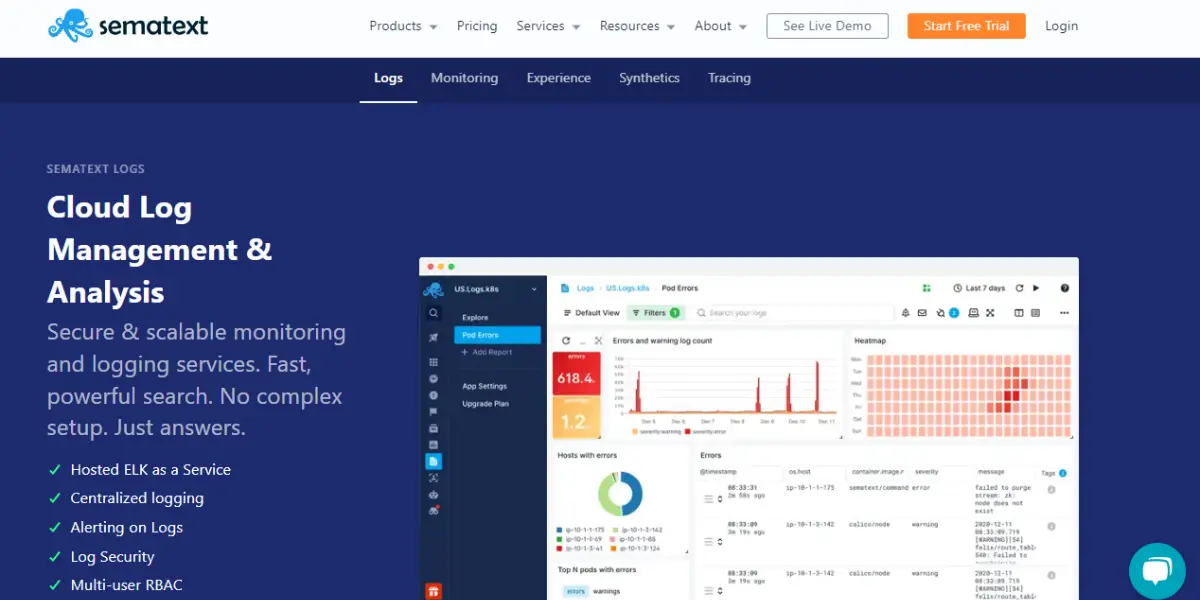
Sematex is a tool that helps you manage logs. It makes it easy to monitor and log information securely and with lots of space. You can search quickly without needing a complicated setup, and you will get answers immediately.
Features
- It allows the monitoring of private, public, and hybrid cloud services
- Multi-user RBAC
- Integration with all types of cloud and container platforms
- Provides security
- Alerting on logs
- Centralized logging
- Hosted ELK as a service
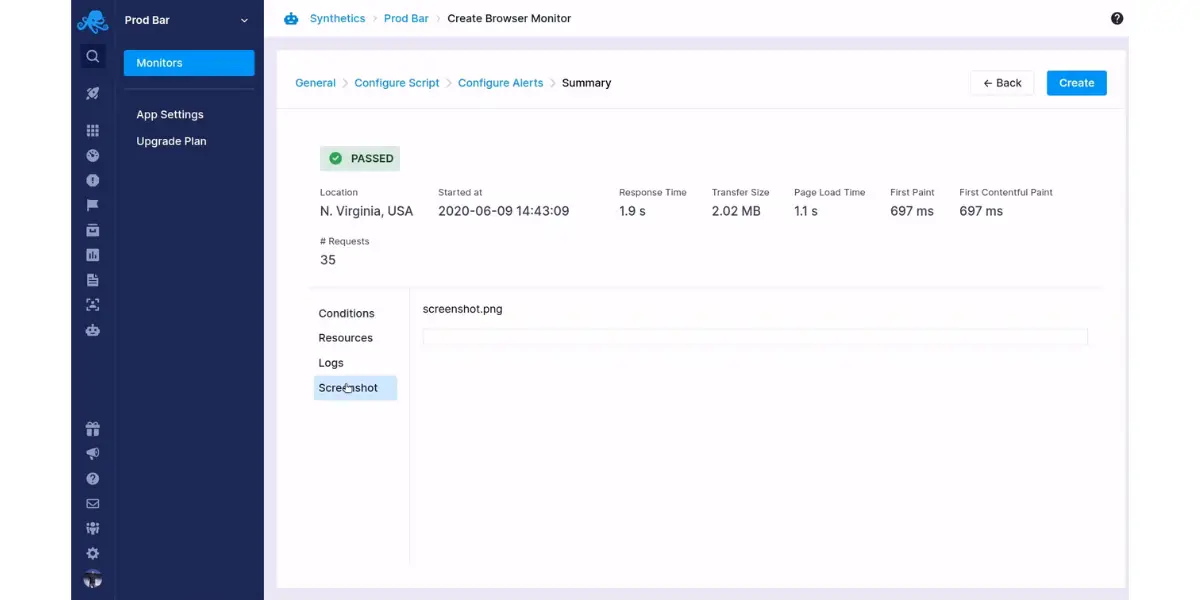
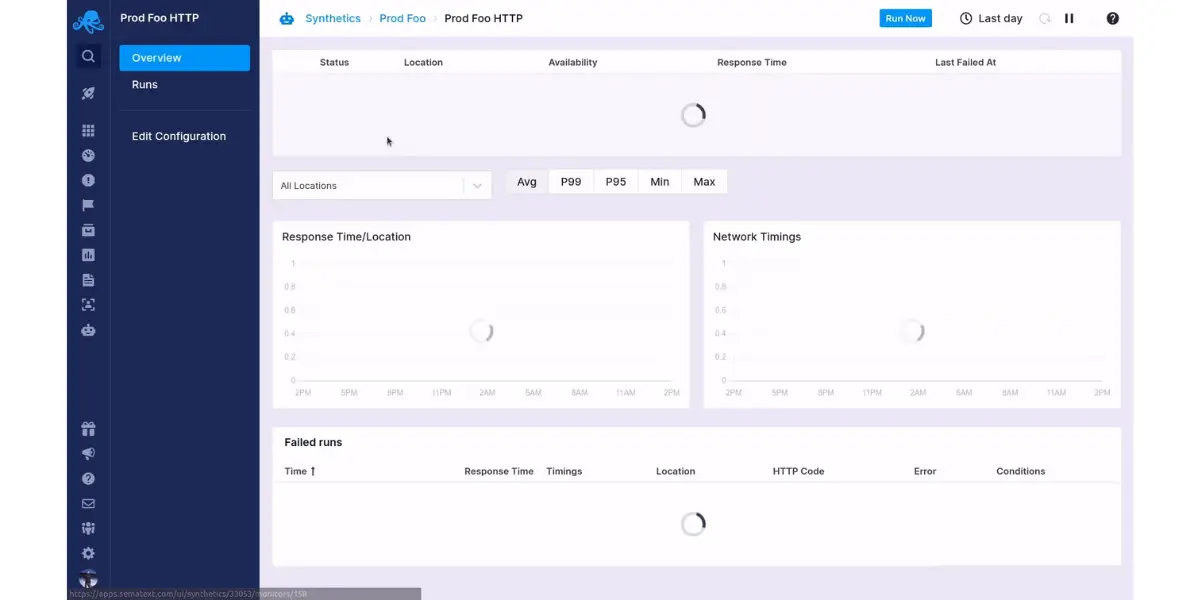
Some screenshots of the Sematext logs management tool
Pricing
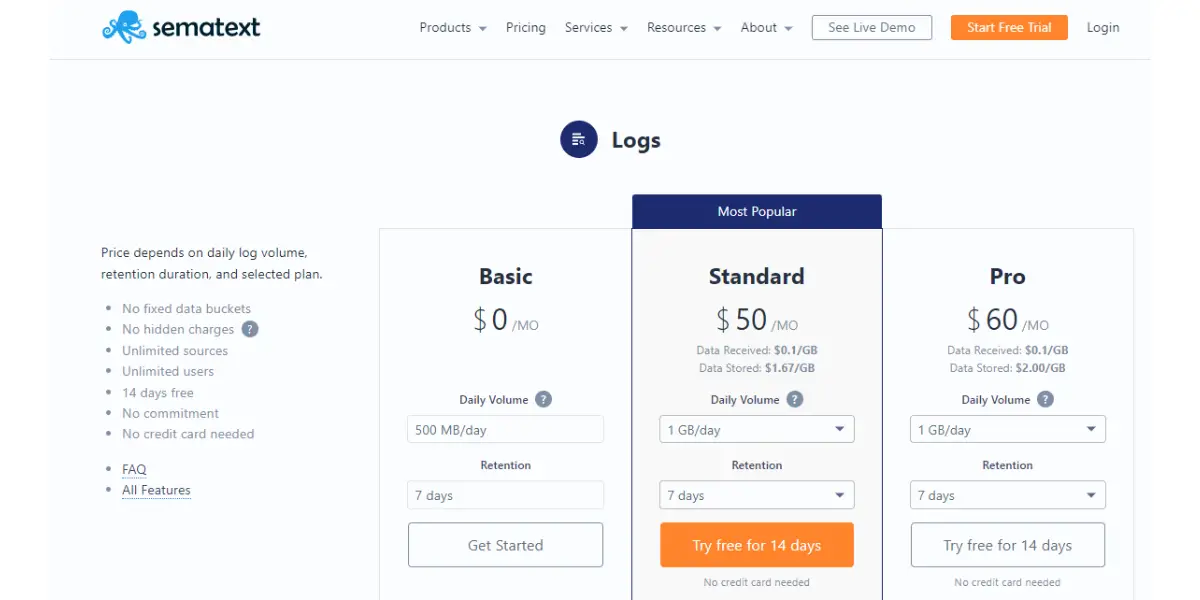
There is a 14-day free trial. Sematext prices each product on its platform separately rather than bundling them, and Logs starts at $5 per month. What you pay above that is driven by daily ingest volume and how long the logs are kept, so the two numbers to settle before comparing quotes are your GB per day and your required retention.
The older Basic, Standard at $50 and Pro at $60 tiers are no longer the published line-up. Because Sematext bills per product, a realistic bill usually includes more than Logs alone once infrastructure monitoring or tracing is added.
Likes
- Sematex can help you look at your logs and find important information.
- Sematext is easy to use because it has a nice, organized design with no extra complicated parts.
- The instructions are also really helpful
- Easy integration with a tech stack
- Sematex documentation is very helpful.
- The web user interface is easy to understand and use.
- Includes Kibana
Dislikes
- The user expects more integration with security tools
- Bit expensive than others
- Mobile App is not available
Other details
| Deployment | Cloud, SaaS, Web-based |
| Supported device | Android, iPhone, iPad |
| Support | 24/7 (Live rep), Chat, FAQs/Forum, Phone Support, Knowledge Base, Email/Help Desk |
| Training | Live Online, Documentation, Videos, In-Person, Webinars |
| Customer ratings | Capterra: 4.8 out of 5 (27+ reviews), |
User opinion
Sematext helps customers worldwide with their data, training, and production for Elastic Search, ELK/Elastic Stack, and Apache Solr.
They can help you figure out problems with those things and give you advice. Sematext also offers a way to manage your logs without using Elasticsearch or managing infrastructure.
2. Solarwinds Loggly
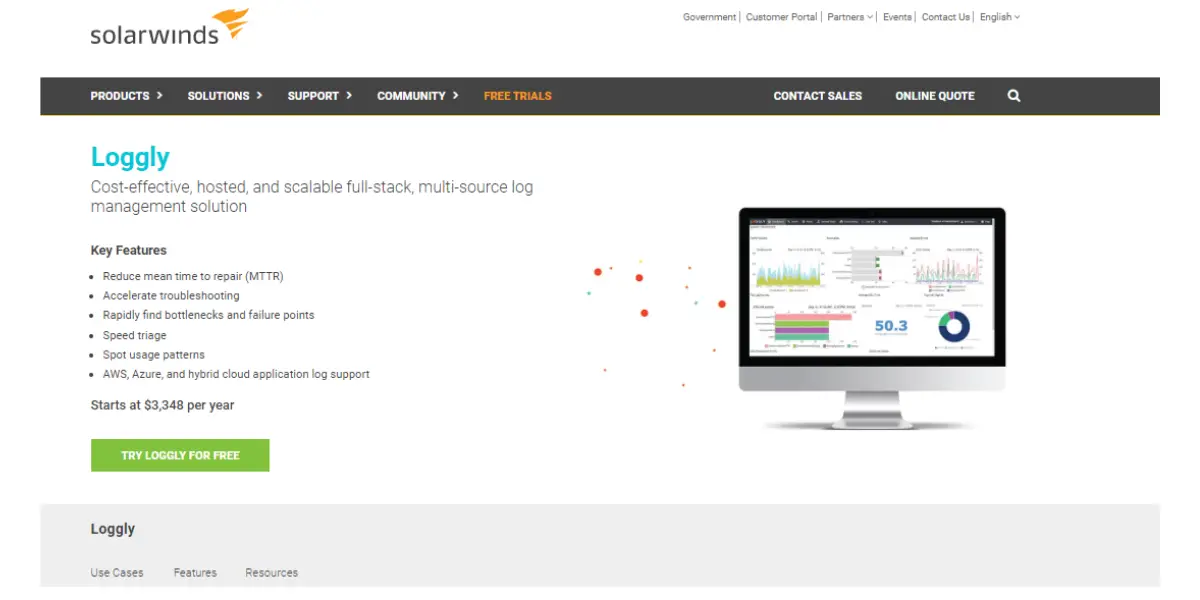
Loggly is a helpful service from SolarWinds. It gives you access to cloud logging, meaning you can store and manage logs on the internet. You can use Syslog to send logs to Loggly and use scripts to help with log aggregation.
Features
- Accelerate troubleshooting
- Reduce mean time to repair(MTTR)
- Digital experience monitoring
- Azure application log monitoring
- Application performance monitoring
- Spot usage patterns
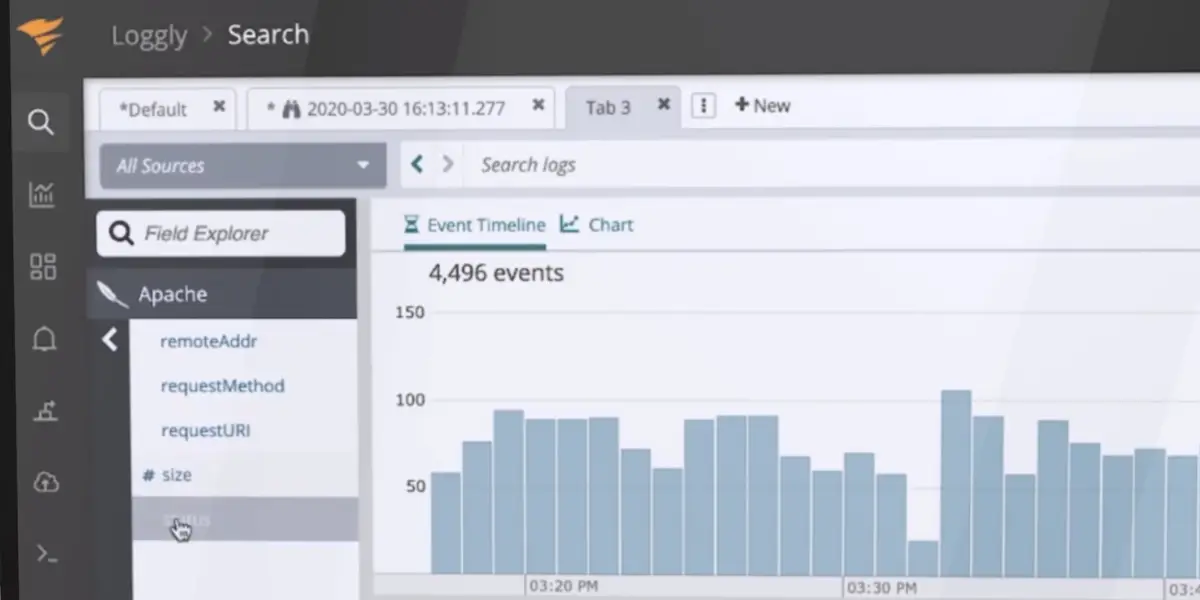
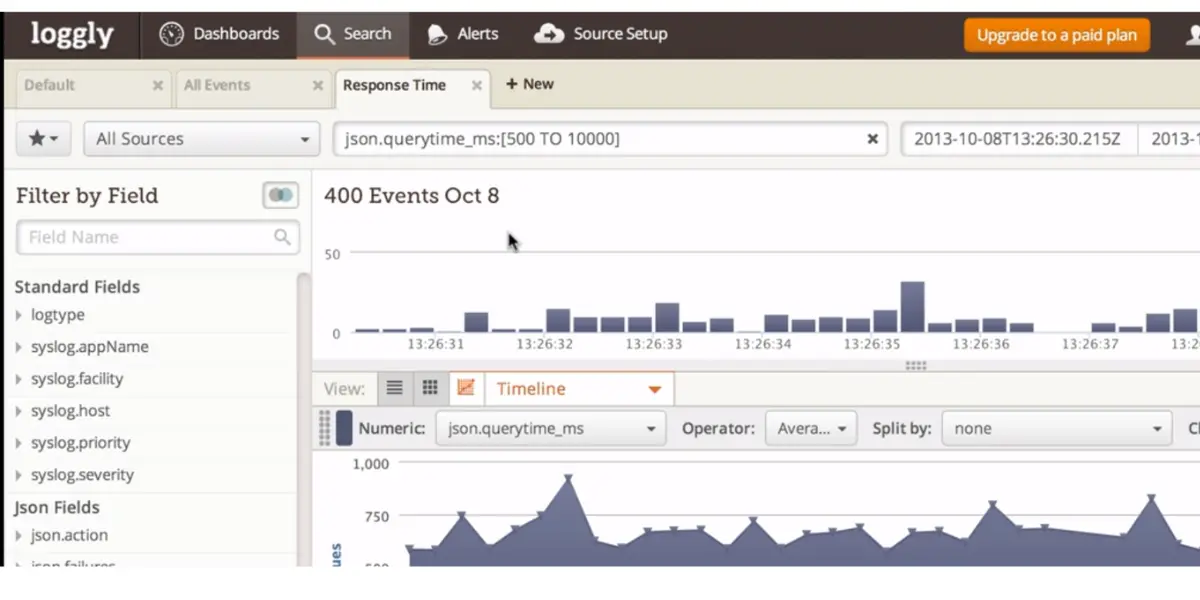
Some screenshots of SolarWinds Loggly
Pricing
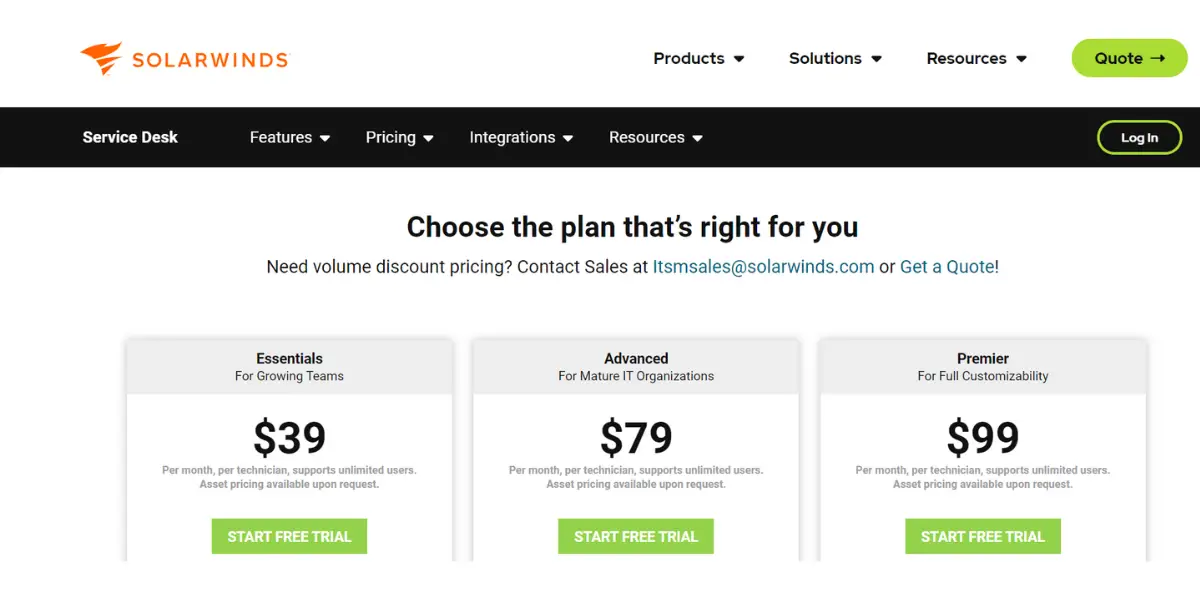
Loggly publishes three paid tiers, all billed annually, alongside a free trial:
- Standard: starts at $79 per month, aimed at small business.
- Pro: starts at $159 per month, adding dashboards and direct support access.
- Enterprise: starts at $279 per month, adding S3 archiving and peak overage protection.
The earlier Essentials, Advanced and Premier names at $39, $79 and $99 have been replaced, and the entry price has roughly doubled, so any budget built on the old figures will be short. Note also who owns this: Loggly is a SolarWinds product, and SolarWinds itself was taken private by Turn/River Capital on 18 July 2025 in a $4.4 billion deal at $18.50 per share, ending its NYSE listing. Papertrail, entry 10 on this list, is the same company, so those two entries are one vendor rather than two independent options.
Likes
- Easy integration and reliable
- Easy to use and appreciable performance
- SolarWinds Loggly can tell you when something is wrong with your system. It will send you a notification so that you can fix the problem before it affects the people who use it.
- Responsive customer service
Dislikes
- No daily summary in the inbox
- No facility for sending reports via email
- Users expect more AI for creating dashboards
- UI is a bit outdated
- Comparatively, log storage is less
- Need improvement in searching and user management
Supported industries
- Small business
- Enterprise
- Education
- Public sector
Other details
| Deployment | Cloud, SaaS, Web-based |
| Supported device | Android, iPhone, iPad, Mac, Windows, Linux |
| Support | 24/7 (Live rep), FAQs/Forum, Knowledge Base, Phone Support, Email/Help Desk, Chat |
| Training | Live Online, Documentation, Videos, In-Person, Webinars |
| Customer ratings | Capterra: 4.6 out of 5 (460+ reviews), |
User opinion
Overall, SolarWinds Loggly is a service that helps you manage your logs. It has many features like searching, creating alerts, and making reports to help find problems quickly. This saves time and helps you fix the problem faster. However, consider a few loopholes before going with this.
3. Sumo Logic
Sumo Logic helps you get rid of walls that keep information separate. It also uses modern tools to help watch, find, and fix problems, keep your data safe, and give you important business information.
Features
- Real-time alerts
- Security
- The historical and live-streaming platform
- Integration with AWS, GCP, and Azure
- Standard Support
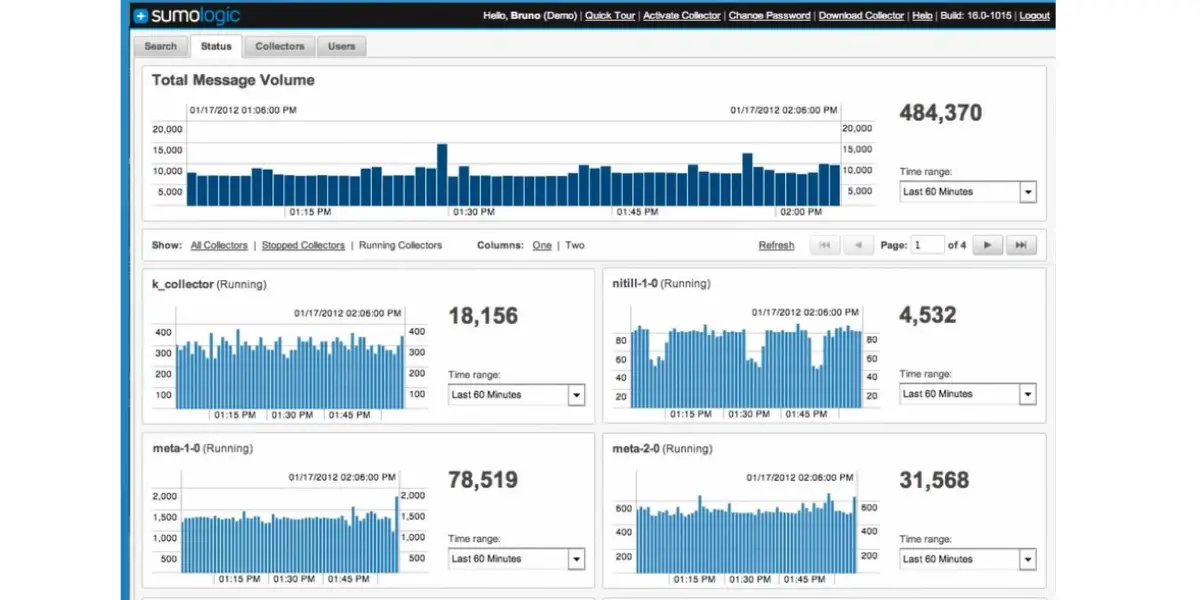
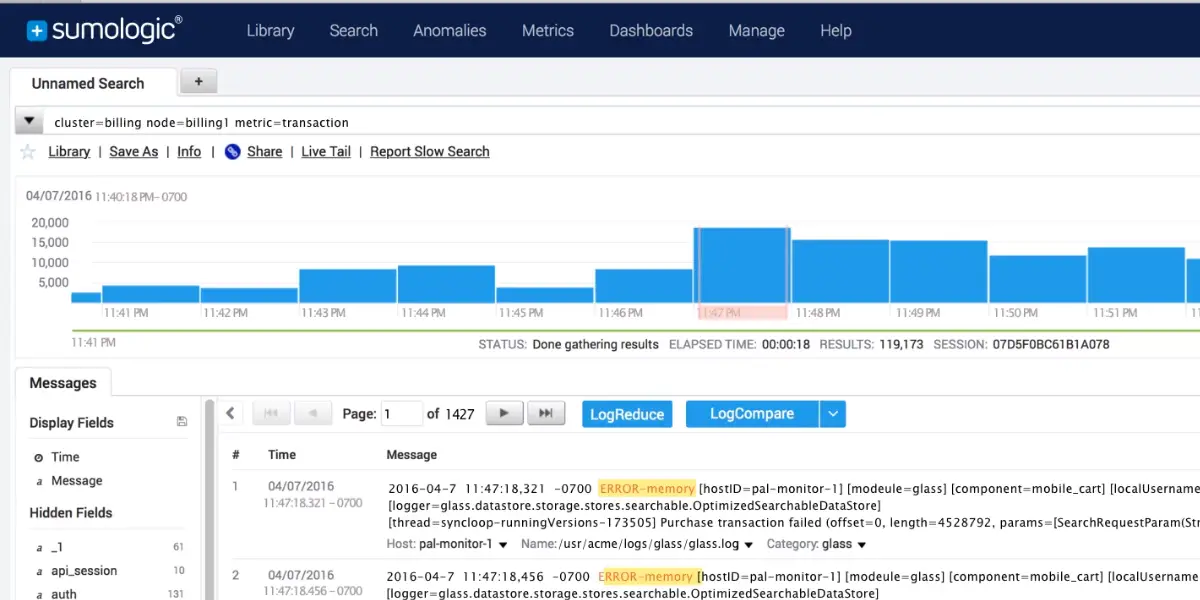
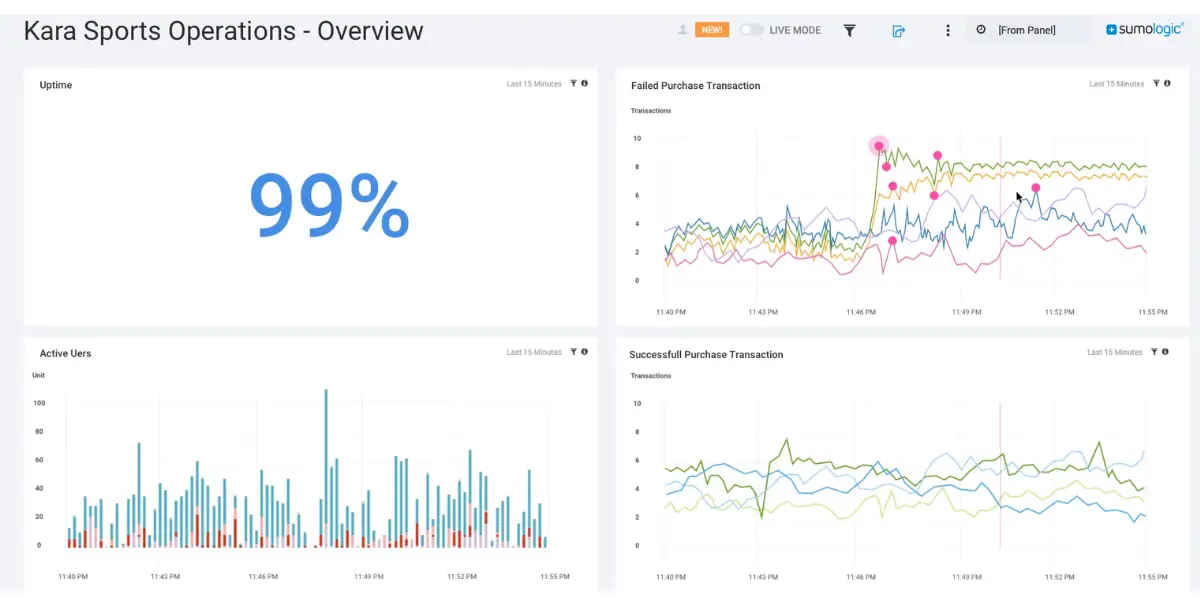
Some screenshots of Sumo Logic
Pricing
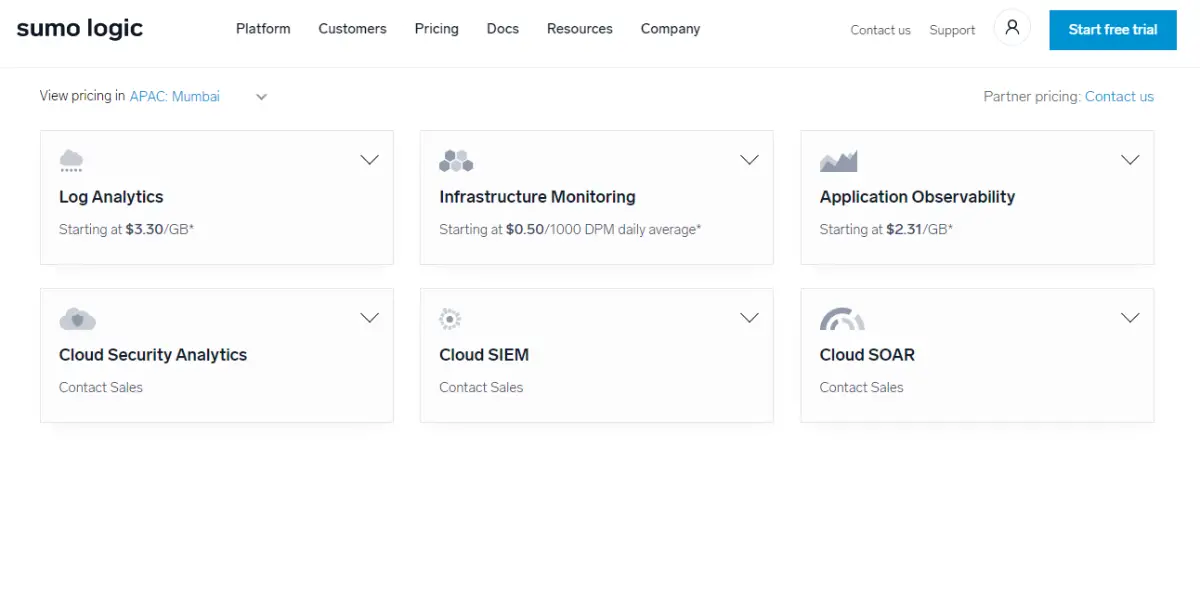
Sumo Logic no longer sells log management by the gigabyte. It now licenses the platform in credits, a single pool of value you draw down across whichever capabilities you switch on, which makes the old per-GB comparison against rivals misleading. The two packages are Essentials and Enterprise Suite, both quote-based, and there is a free trial plus a flex pricing calculator. Credits can be bought self-serve by card up to $25,000; past that it goes through sales.
Ownership changed too: Francisco Partners completed its acquisition of Sumo Logic on 12 May 2023, paying $12.05 per share in a deal valuing the company at about $1.7 billion and removing it from the Nasdaq.
Likes
- Sumo Logic is a powerful tool that helps you look at logs and get useful information.
- It has different ways to help you report what you find, and it can also export logs in high quality.
- You can search using simple words or more complex phrases, which is good for both beginners and experienced people.
- The search feature is fast and powerful, and you can share the information you find with your organization.
Dislikes
- Queries can be difficult to compose sometimes.
- It took time to decide how much to pay for different levels of services.
- Using the API (Application Programming Interface) can take a lot of work to get access to its more complicated functions, such as checking logs.
- Bit expensive.
Other details
| Deployment | Cloud, SaaS, Web-based |
| Support | Knowledge Base, Email/Help Desk, Chat, Phone Support, FAQs/Forum, 24/7 (Live rep) |
| Training | Live Online, Documentation, Videos, In-Person, Webinars |
| Customer ratings | Captarra: 4.6 out of 5 (26+ reviews), G2: 4.6 out of 5 (273+ reviews) |
User opinion
Overall, Sumo Logic is a good platform for managing logs. It gives you two kinds of dashboards. The live dashboard shows data as it happens but doesn’t show older data. The interactive dashboard shows the whole picture – all events and trends.
4. DataDog
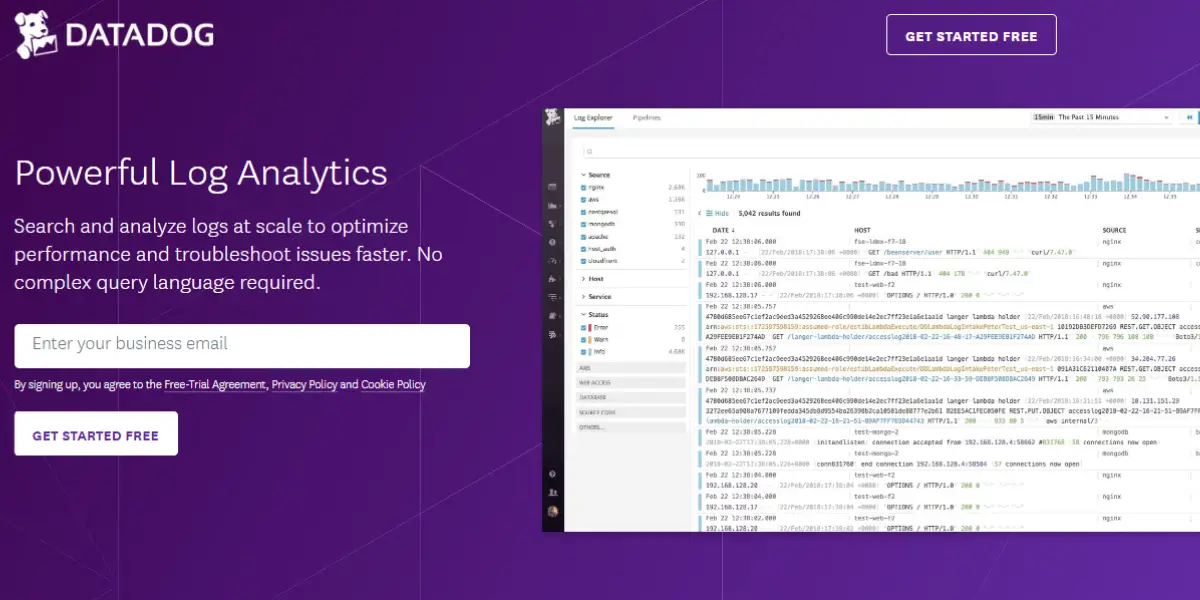
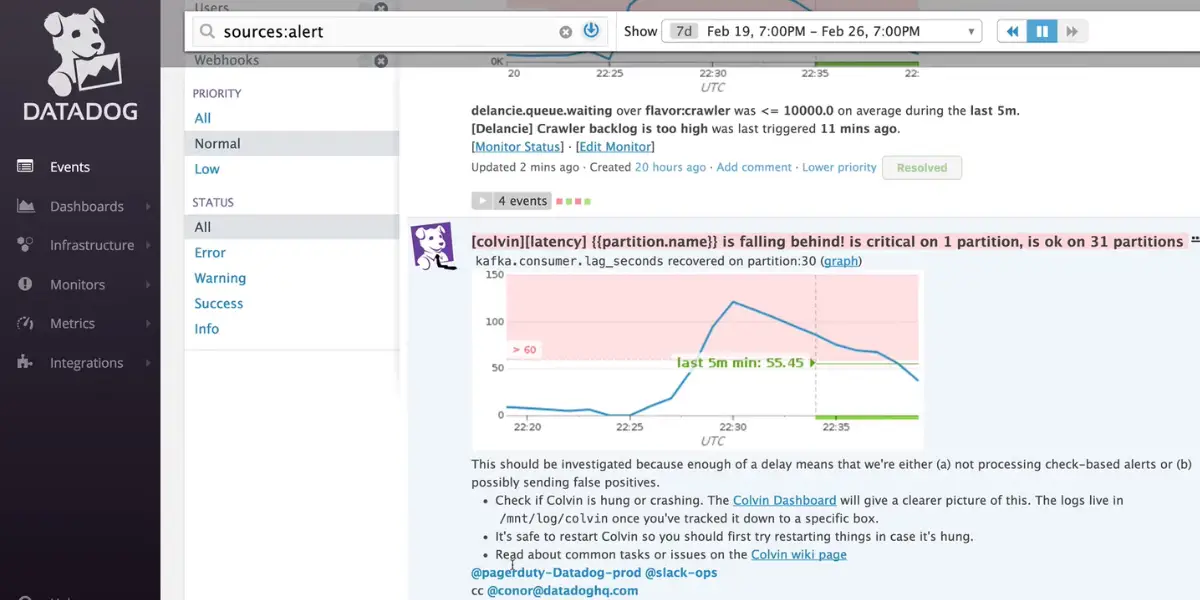
Datadog is a tool that helps you look through lots of logs quickly to make your system run better and faster. You don’t need to know any special words or phrases to use them.
Datadog Log Management integrates log data with unified software by allowing accurate data entry into log files retrieved from the control panel.
For example, the log pattern functions detect trends to identify occurrences and help to enhance performance over a longer duration.
Features
- Investigate and troubleshoot issues faster
- Easily manages the logs
- Control costs without sacrificing visibility
- Scalable log management
- Protect sensitive data
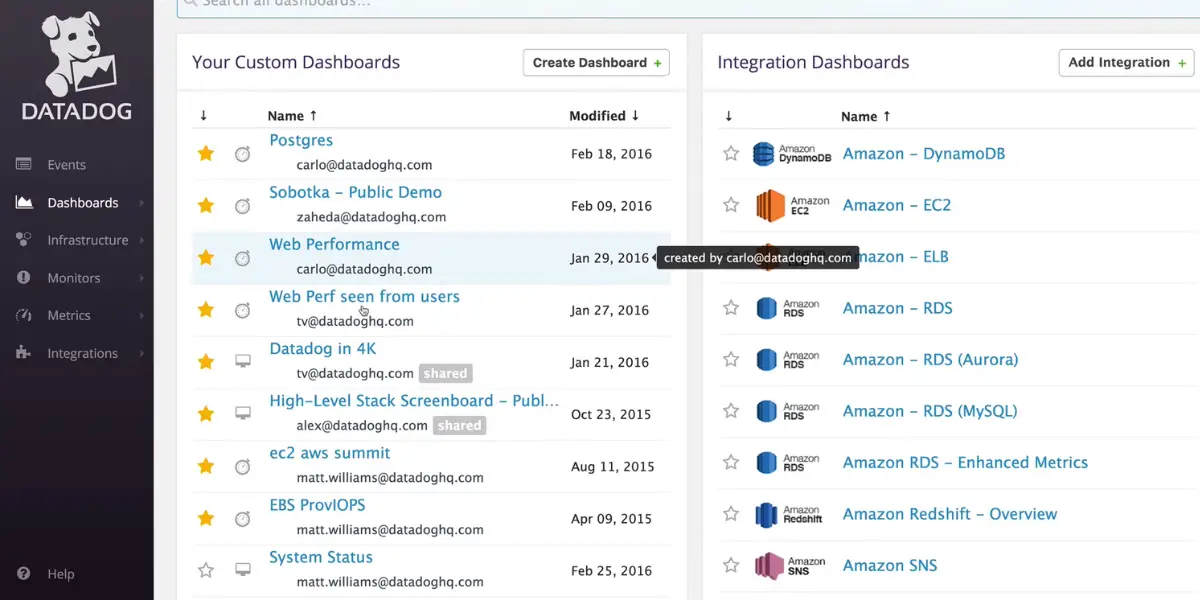
Some screenshots of Datadog
Pricing
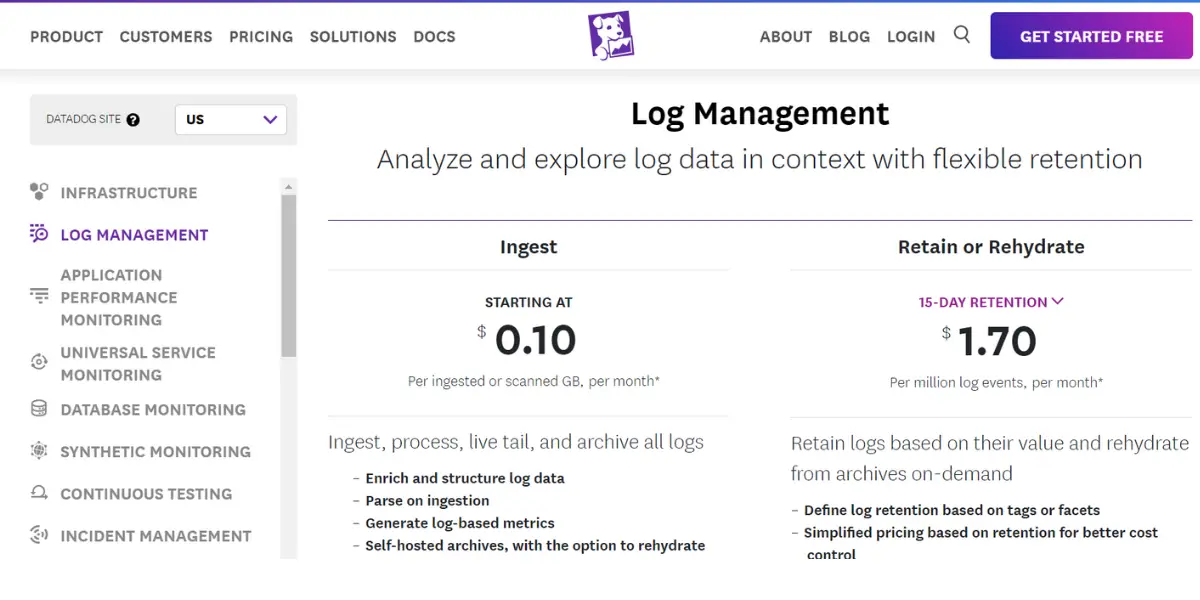
Datadog splits the bill between taking logs in and keeping them searchable, and the two halves are measured in different units, which is the part that catches people out:
- Ingest: $0.10 per GB ingested, billed monthly on an annual commitment. This covers processing, live tail and archiving.
- Standard indexing: $1.70 per million log events with 15-day retention ($2.55 on demand). Retention is configurable at 3, 7, 15 or 30-plus days.
- Flex storage: $0.05 per million events stored, for retention of 1 to 15 months where you need history for audit or compliance rather than live alerting.
Read those units carefully before modelling a bill. Ingest is charged by volume in gigabytes while indexing is charged by event count, so an application that writes many small log lines can cost far more to index than its GB figure suggests, and the usual lever is to ingest everything cheaply but index only what you actually query.
Likes
- Great insight and alerting feature
- Easy to share with others
- Professional user interface
- Easy to setup dashboards
- Good customer support
Dislikes
- Not good for Microsoft Azure monitoring
- Documentation is not easy to understand
- Users felt that it was a bit technical to use
- Poor rendering of metrics on phones
Supported industries
- Financial Services
- Manufacturing & Logistics
- Healthcare/Life Sciences
- Retail/E-Commerce
- Government
- Education
- Media & Entertainment
- Technology
- Gaming
Other details
| Deployment | Cloud, SaaS, Web-based |
| Supported device | Mac, Windows, Linux, Windows, On-Premise – Linux, Android, iPhone, iPad |
| Support | FAQs/Forum, Phone Support, Knowledge Base, Email/Help Desk, Chat |
| Training | Live Online, Documentation, Videos, Webinars |
| Customer ratings | Captarra: 4.6 out of 5 (222+ reviews) |
User opinion
Datadog has special dashboards that you can customize with a few clicks. It helps you compare logs, metrics, and request traces to see how your systems work. You can also see how they change over time.
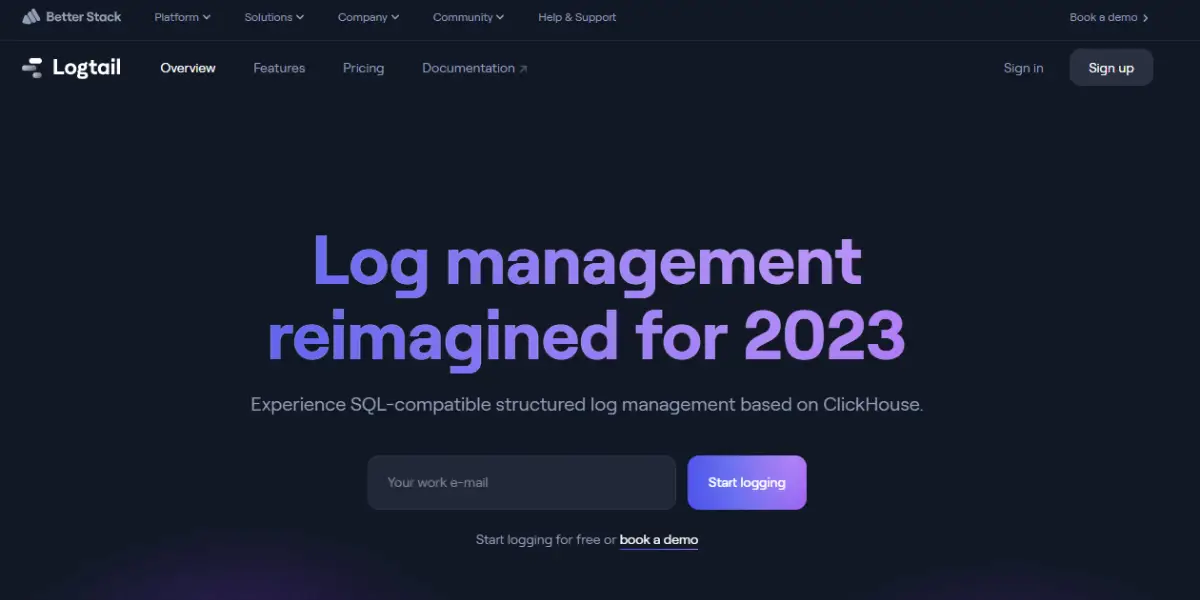
5. Logtail (now Better Stack)
Logtail was Better Stack’s log product, and it has now been folded into the parent brand entirely: logtail.com redirects to Better Stack’s log management page, so this is the same product under a new name rather than a separate tool. It collects logs from cloud services and works with Kubernetes, Heroku, Logstash, Rails, Docker, and AWS.
It is designed to save money and make working with logs easier. The data is sent to Grafana, so it’s easy to see and understand the information the logs provide.
Features
- Build quality software faster
- Easy integration with many software
- Attractive charts and dashboard
- One-click filter by context
- Secure by design
Pricing
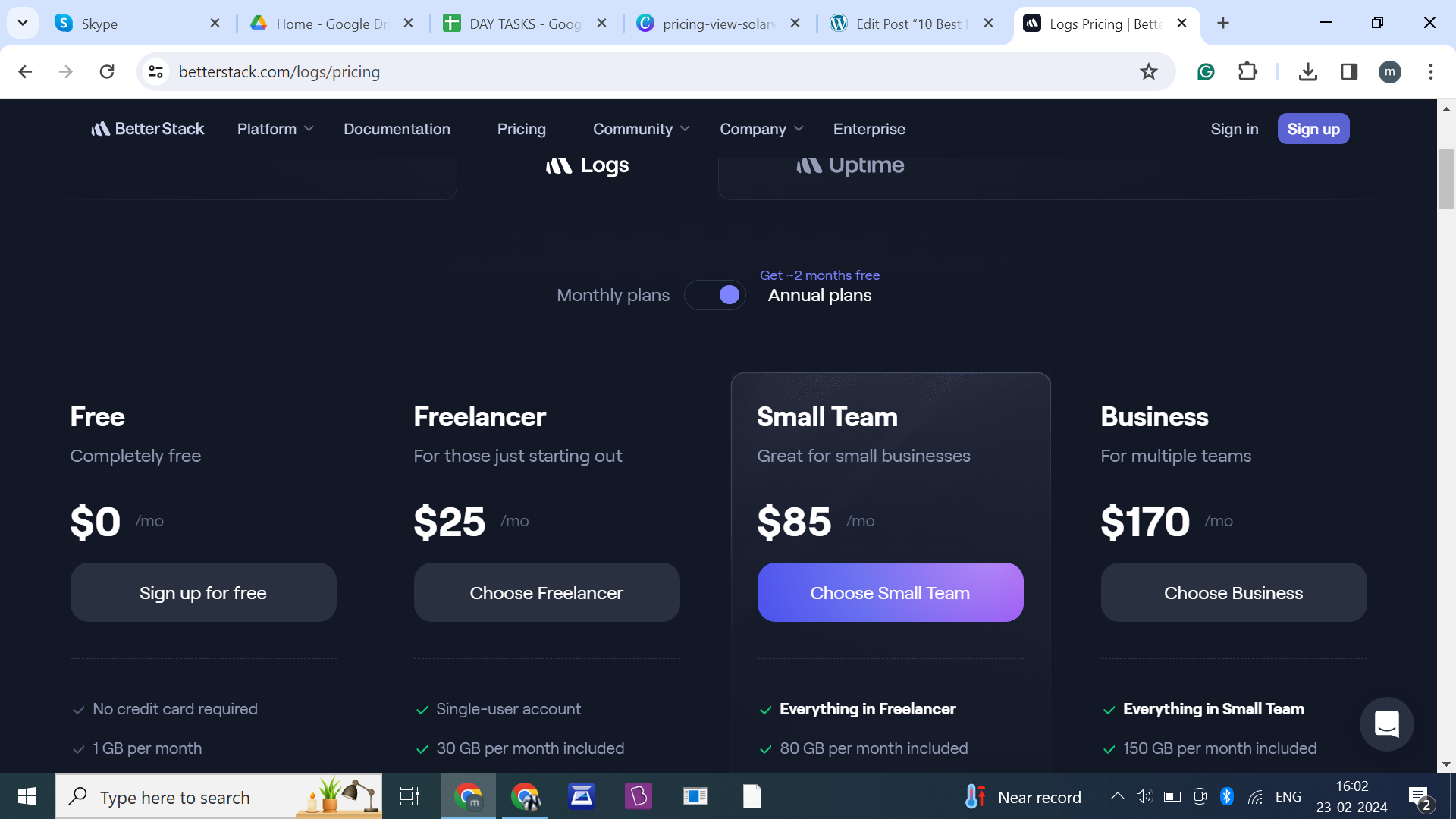
Better Stack no longer sells a standalone logs plan. It sells telemetry bundles that cover logs, metrics and traces together, priced on included log volume with 30-day retention as standard:
- Free: 3 GB of logs retained for 3 days.
- Nano: $45 per month, or $38 on annual billing, including 40 GB of logs.
- Micro: $180 per month, or $150 annually, including 160 GB.
- Mega: $375 per month, or $315 annually, including 340 GB.
- Tera: $750 per month, or $630 annually, including 700 GB.
Beyond the included volume it is pay as you go at $0.15 per GB ingested and $0.08 per GB per month retained. The old Freelancer, Small team and Business tiers at $30, $100 and $200 no longer exist, and because the bundle now includes metrics and traces the cheapest plans are not directly comparable with a logs-only competitor.

Likes
- Simple to setup
- Advanced SQL is easy to use, and it works with many types of languages and programs.
- Logging in with this system is very simple. Grafana also connects well with this system.
- Logtail has features that can help you look at your system and application logs.
- It also has a dashboard to help you keep track of things. Best of all, it is free to use!
Dislikes
- Need more support for Android
- Need more configuration
Other details
| Deployment | Cloud, SaaS, Web-based |
| Support | Chat, Phone Support, Knowledge Base, FAQs/Forum, Email/Help Desk, 24/7 (Live rep) |
| Training | Live Online, Documentation, Videos, Webinars |
User opinion
Overall, Logtail is a way to look at your logs like you would a database. It costs less money and makes searching for things with SQL easier.
You can create charts showing your logs with Grafana, save pieces of the logs, let other people see them, and be alerted if something strange happens.
6. Splunk
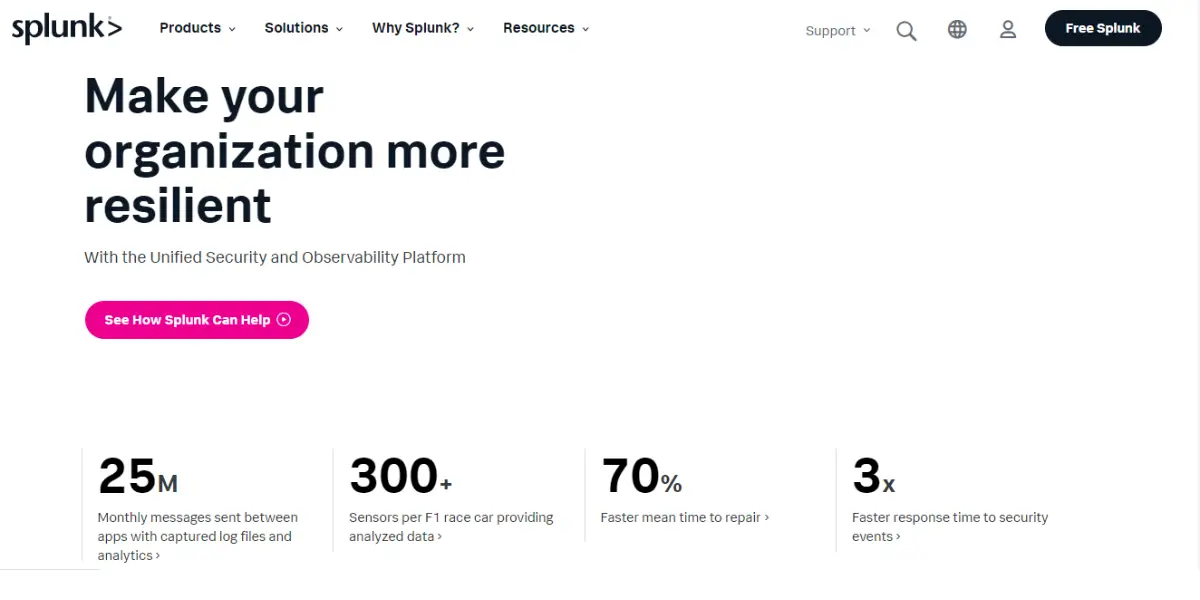
Splunk is a log management software that helps you store data in your environment. It keeps track of different types of data, like numbers and words.
Splunk can also show you what is happening with the data differently, like graphs and charts, and there is a free tier as well as paid editions. The important change since this category was last stable is ownership: Cisco completed its acquisition of Splunk on 18 March 2024, paying $157 per share in a deal worth roughly $28 billion. Splunk is now sold as part of Cisco’s observability and security portfolio, which matters if you are already a Cisco customer negotiating an enterprise agreement, and matters equally if you were choosing Splunk specifically to stay independent of a network vendor.
Features
- Powerful searching, analyzing, and visualizing the data
- Explores many security options
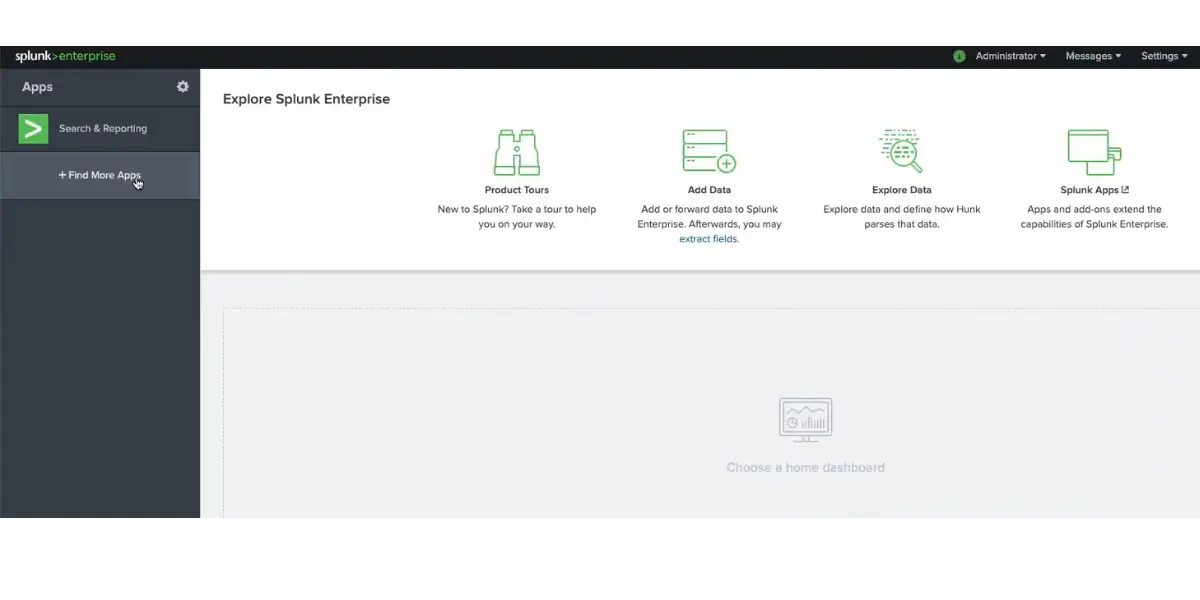
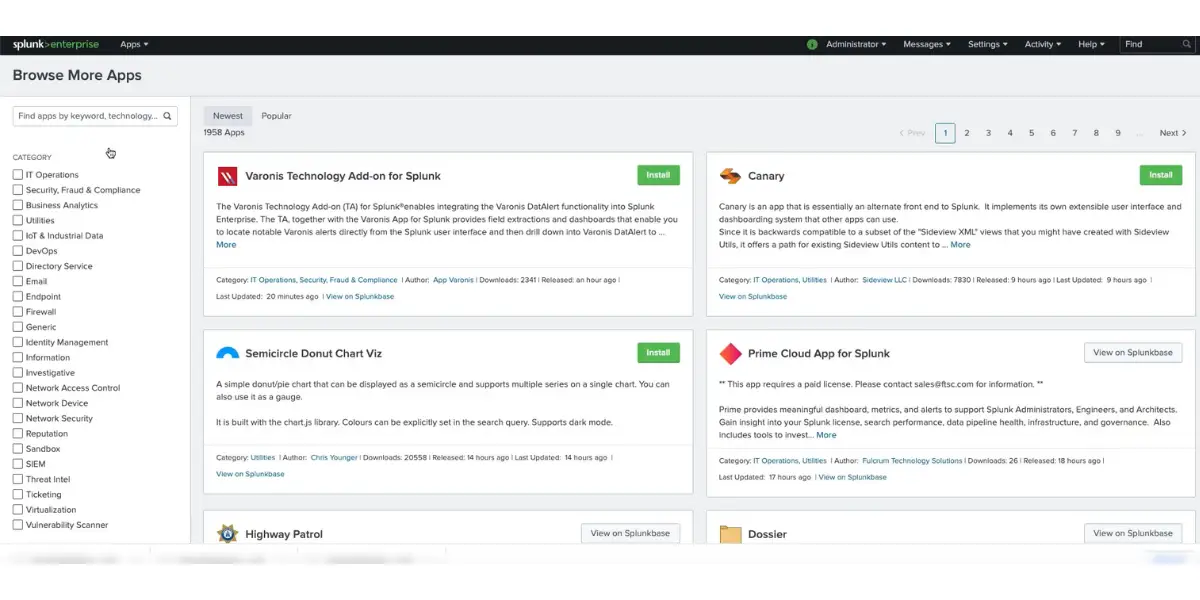
Some screenshots of Splunk
Pricing
Splunk offers different pricing modules according to your business needs. It offers a 14days free trial and a 60-day free trial for the enterprise edition.
- Workload pricing: This means you pay the same amount for the types of work that you do.
- Ingest pricing: Splunk will charge you depending on how much data you put into the Splunk Platform.
- Entity pricing: This is based on how many people use Splunk observability products.
- Activity-based pricing: You can link your costs to activities like metric time series (MTS), how many traces you analyze per minute, and how many sessions or uptime requests are made.
Likes
- Log filtering helps you find what you need when looking through logs.
- Ability to create your Splunk fields
- Easy to set up dashboards and alerts
- It provides two ways of the dashboard.UI way and the source coding
- Helpful to track the code flow and reduces troubleshooting time
- Easy consolidation of log files
Dislikes
- Difficult to create queries
- Splunk only works if used with other Splunk products.
- Difficult beginners need advanced knowledge of networking concepts
- Sometimes it will lag and takes time to load
- Dashboards are confusing
Supported industries
- Communication
- Online services
- Manufacturing
- Financial service
- Public sector
- Retail
User opinion
Overall Splunk is a good log platform. It will send you a message by email or RSS so you can stay current. You can also use Splunk to create special reports and charts that help you see your data better and protect yourself from security problems.
7. MEZMO (LogDNA)
Mezmo has a platform that helps you get information from data. Then, it takes the data, makes sure it is correct, and sends it to people who can use it quickly to do something important.
Features
- Search and filter the log data
- Visualizing the critical logs with graphs and charts
- Provides log alerts
- Kubernetes Enrichment
- Flexible retention tiers
- Capacity to restore the log data
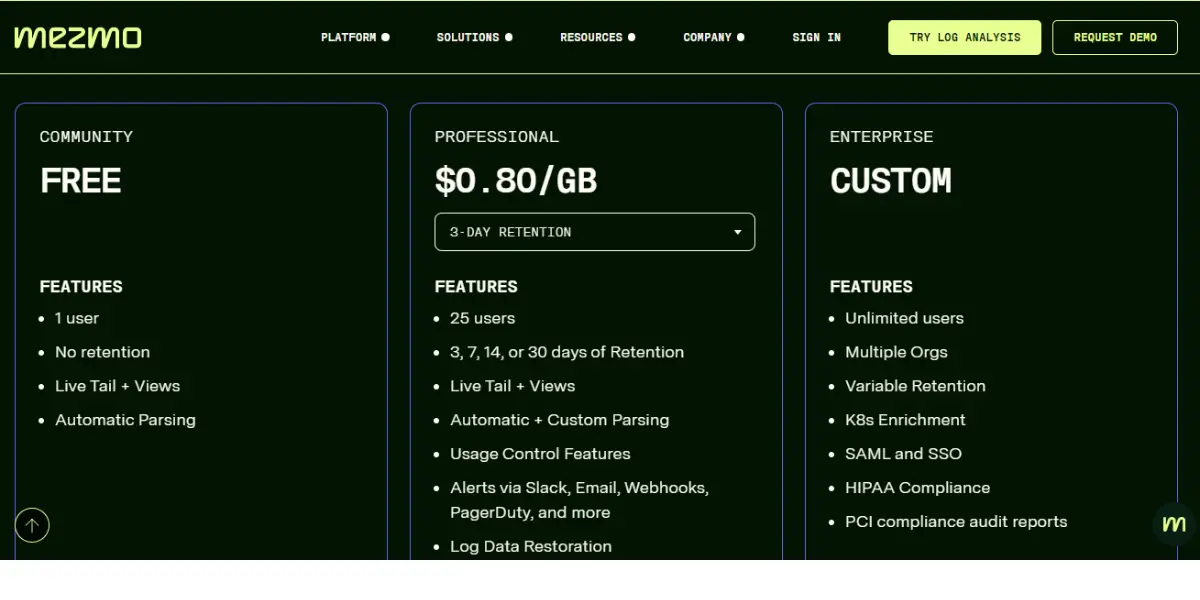
Pricing
It offers a 14-day free trial.
- Community: Free (Single user)
- Professional: $0.80/GB( 25 users)
- Enterprise: Customization(Unlimited users)
Likes
- Easy to implement and good UI
- Easy reading of logs and good visualization
- Good search experience, and TBH
- Easily understandable documentation
- Easy integration
Dislikes
- Figuring out how to use the web application can be confusing.
- You can’t use “log” when logging in to NodeJS. Instead, you must use one of the following: “debug,” “trace,” “info,” “warn,” or “error .” For example, if you try to log in using {level: ‘log’}, you will get an error message.
- Debug, info, and trace are in the same color.
- Some users faced trouble getting information out of structured (JSON) logs.
- Less language integration
Supported industries
- Financial service
- Software tech
Other details
| Deployment | Cloud, SaaS, Web-based |
| Support | Chat, Phone Support, Knowledge Base, FAQs/Forum, Email/Help Desk, 24/7 (Live rep) |
| Training | Live Online, Documentation, Videos, Webinars |
| Customer ratings | Captarra: 4.7 out of 5 (42+ reviews), G2: 4.6 out of 5 (216+reviews) |
User opinion
Overall, Mezmo (formerly LogDNA) makes it easy for companies to keep track of their logs. It combines many features, like collecting the logs, setting up rules about who can see them, and searching and analyzing them quickly.
8. LogicMonitor
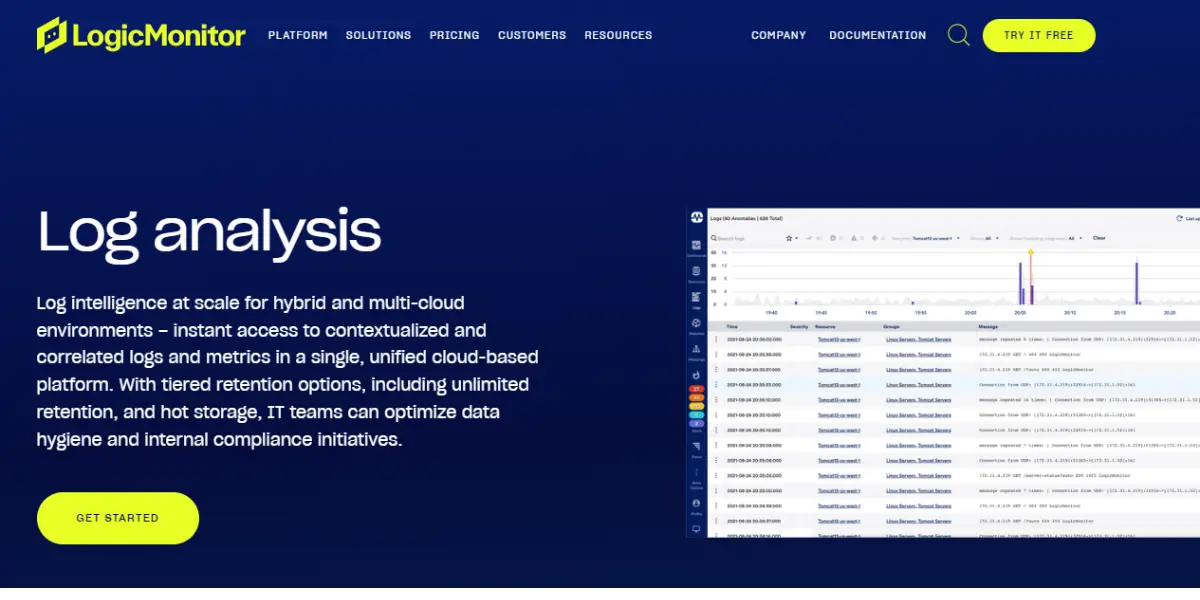
LogicMonitor Logs uses special methods to understand what is happening in an IT environment. Then, it looks for patterns and changes from those patterns. Changes are called anomalies. By finding these anomalies quickly, teams can fix problems before they become bigger and more expensive.
Features
- Centralized data and metric data
- Streamline IT workflow
- Reduces the risk and increases control
- Unified logs and metrics
- AIOps-powered anomaly detection
Pricing
LogicMonitor now publishes its prices rather than quoting only, and there are three tiers, not two. All are priced per hybrid unit, the vendor’s own billing unit covering a monitored resource:
- Essentials: $16 per hybrid unit.
- Advanced: $27 per hybrid unit.
- Signature, with Edwin AI: $53 per hybrid unit, adding the AI event-intelligence layer.
The hybrid unit is the thing to pin down in a quote, because how your estate maps onto units decides the bill far more than the headline rate does. Note too that LogicMonitor is an infrastructure monitoring platform with logs attached, rather than a log-first product, so compare it on the whole platform rather than on log search alone.
Likes
- Good layout design and you can change how the widgets and dashboards look for yourself and each customer, and it is simple to do.
- Easy-to-use software
- Great customization option
Dislikes
- LM has a system to store logs, but it’s not turned on by default and is difficult to find.
- Limited reporting features
- Need some technical experience
- The mobile version is not good
- Some users faced issues with alerts when adding a new device
- Not SMB friendly
- Implementation is time-consuming
- Pricing and contractual terms are a bit tuff.
Supported industries
- Financial services
- Health & life sciences
- Manufacturing
- Retail
- Education
- State and local
- Software companies
- MSP
Other details
| Deployment | Cloud, SaaS, Web-based |
| Supported languages | English |
| Supported device | Linux, Windows |
| Support | Chat, Phone Support, Knowledge Base, FAQs/Forum, Email/Help Desk, 24/7 (Live rep) |
| Training | Live Online, Documentation, Videos, Webinars |
| Customer ratings | Captarra: 4.6 out of 5 (106+ reviews), G2: 4.5 out of 5 (475+reviews) |
User opinion
Overall, Logic Monitor(LM) makes managing IT Infrastructure and Logs easier by using one platform.
In addition, this platform has over 2,000 parts, pieces, and templates ready for use with systems on-premises. That way, you don’t have to switch between different products.
9. LOGZ.io
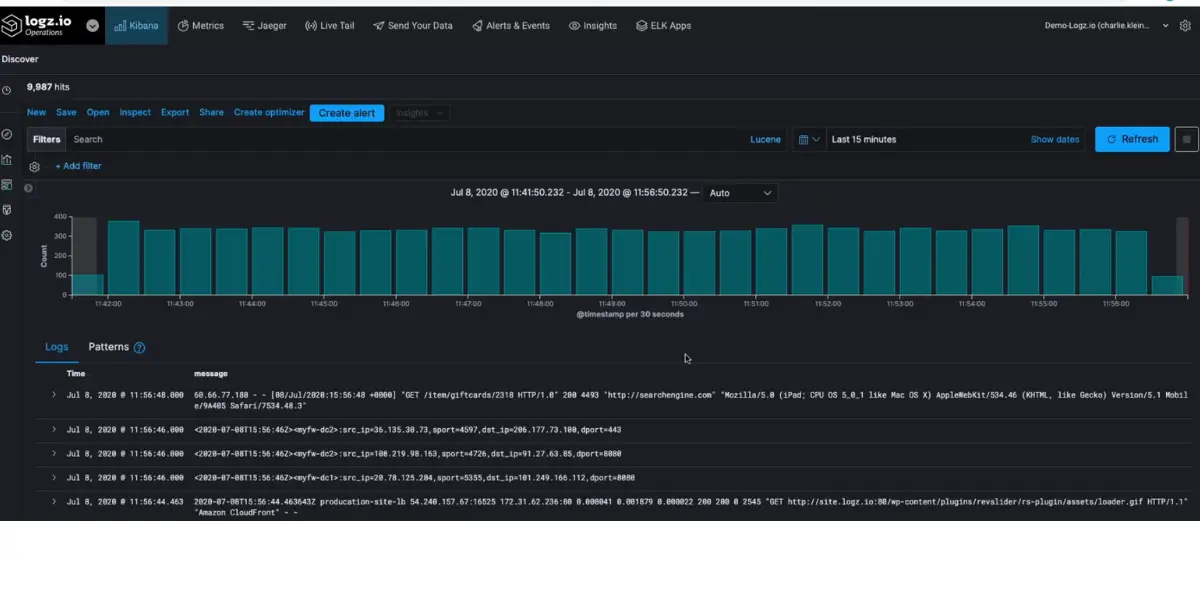
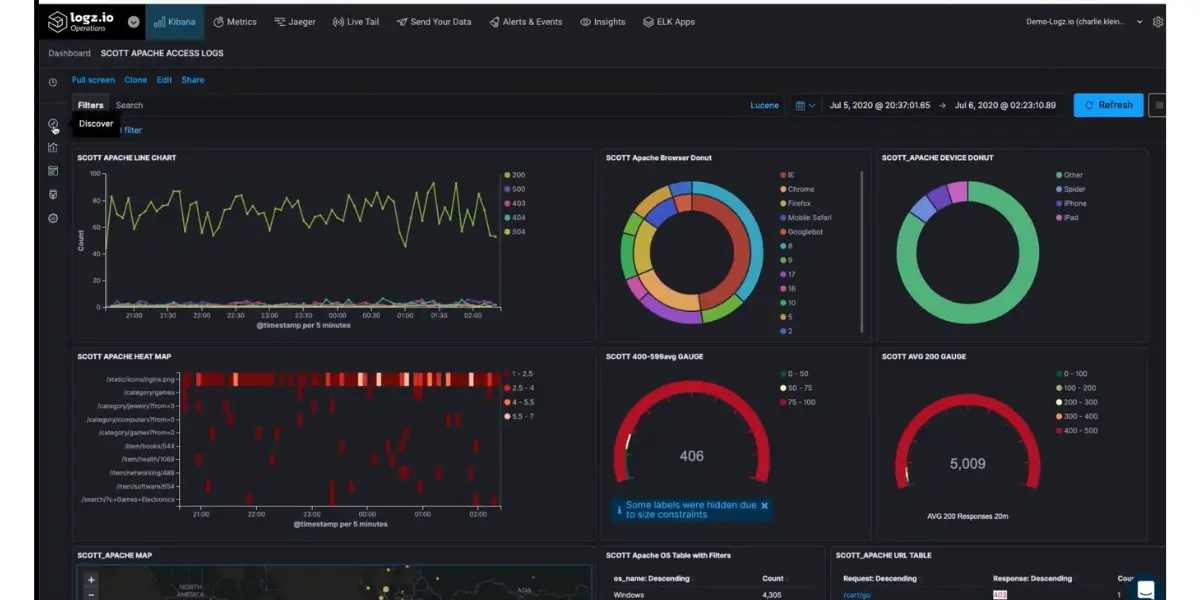
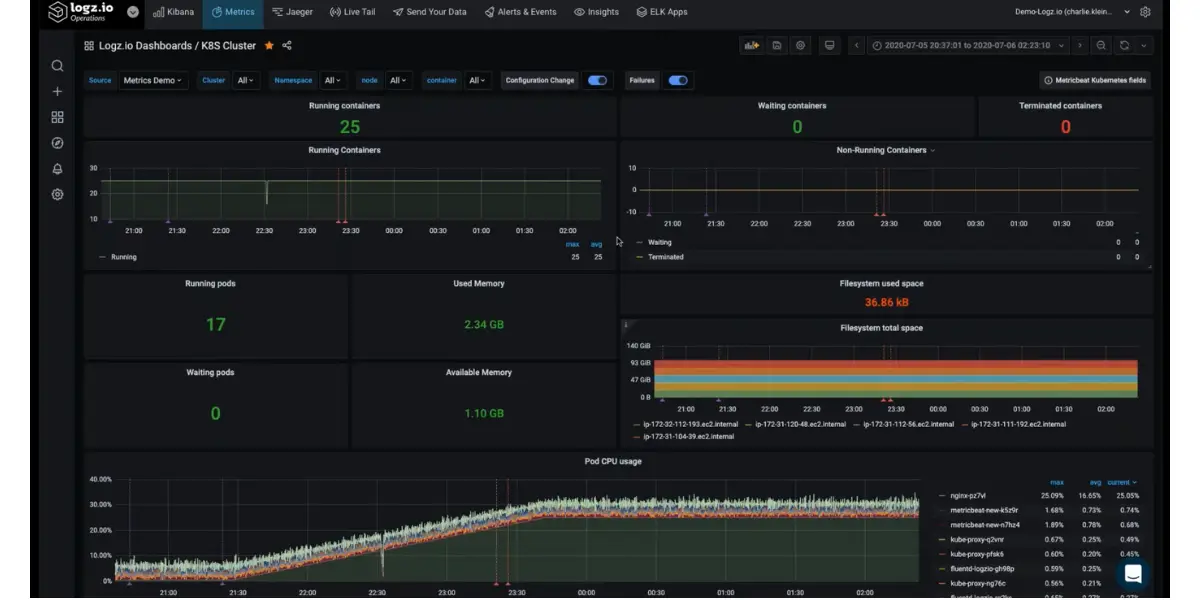
Logz.io is a log management software that can help you collect and analyze logs quickly and cheaply. It uses the Elastic Stack and Grafana, which allows it to work on a large scale while remaining secure.

Features
- Zero maintenance log collection
- Automatically surface expectation errors.
- Complete visibility
- Real-time alerting
Some screenshots of LOGZ.io
Pricing
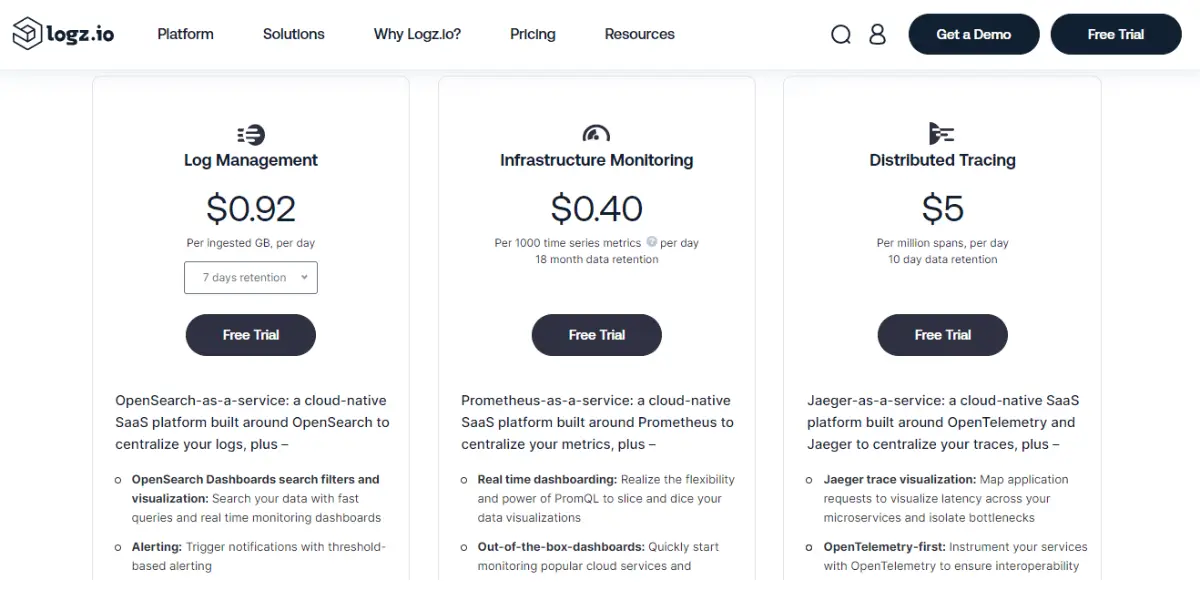
- Log management: $0.92( per ingested GB per day,7 days retention)
- Three plans are available.
- Community: Free
- Pro: free trial available
- Enterprise
Likes
- You can use different fields to sort through logs.
- Logz makes it simple to change what the results look like. You can easily add or remove columns.
- Their visualization builder is easy to use but has many features.
- They also have great customer service and are always ready to help.
Dislikes
- Logzio only shows me 1000 results. Learning how to use the commands and shortcuts to make searching easier is hard.
- Sometimes the logs will only appear correctly when you refresh the page. Try a few times before they show up correctly.
- The code that connects AWS and logs.io is not written with JavaScript. Instead, it was written in the programming language called Python.
- The interface is confusing.
Supported industries
- Gaming
- Financial services
- E-commerce
- Digital media and entertainment
- IoT
Other details
| Deployment | Cloud, SaaS, Web-based |
| Supported languages | English |
| Supported device | Linux, Windows, Mac |
| Support | FAQs/Forum, Email/Help Desk, Knowledge Base, Chat, 24/7 (Live rep) |
| Training | Live Online, Documentation, Videos, Webinars, In-Person |
| Customer ratings | Captarra: 4.6 out of 5 (31+ reviews), G2: 4.6 out of 5 (141+reviews) |
User opinion
With logz.io, you can search through a lot of data very quickly and find out what is causing any problems by sorting through different servers, applications, or other parameters that might be important to you. This could be your best selection.
10. SolarWinds Papertrail
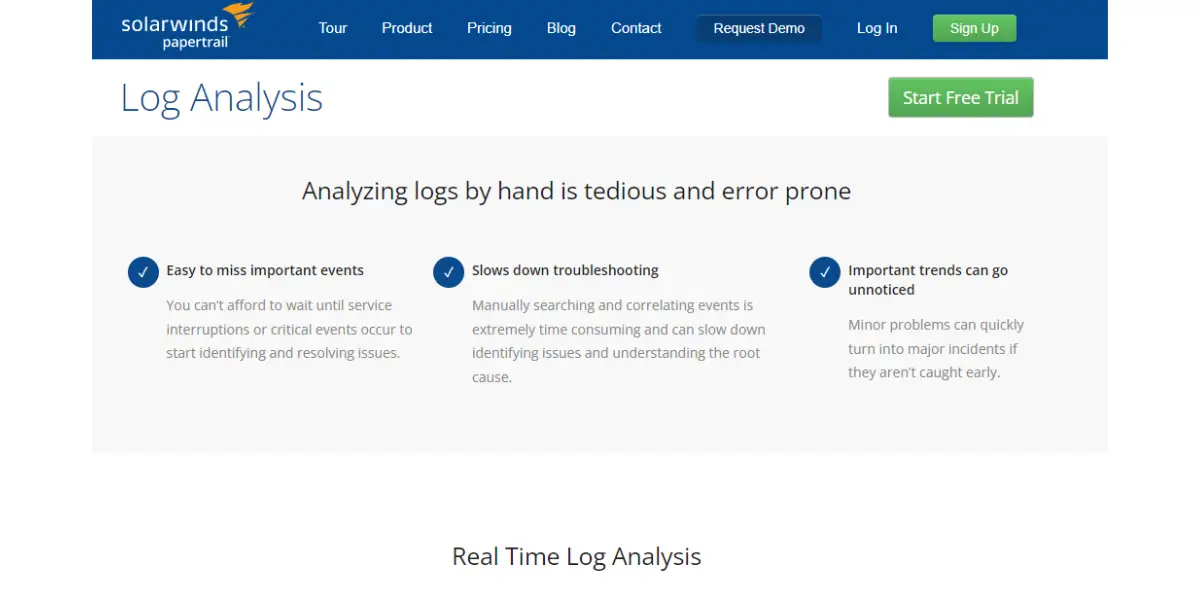
Papertrail is a cloud-hosted log management software. It helps you look at logs more easily. Logs include text log files, Apache Logs, and Windows log events. Papertrail can scan all these types of logs for you, so you don’t need to do it yourself.
Feature
- Real-time log analysis
- Consolidation of logs
- Filters unwanted events
- Uncover real-time insights
Pricing
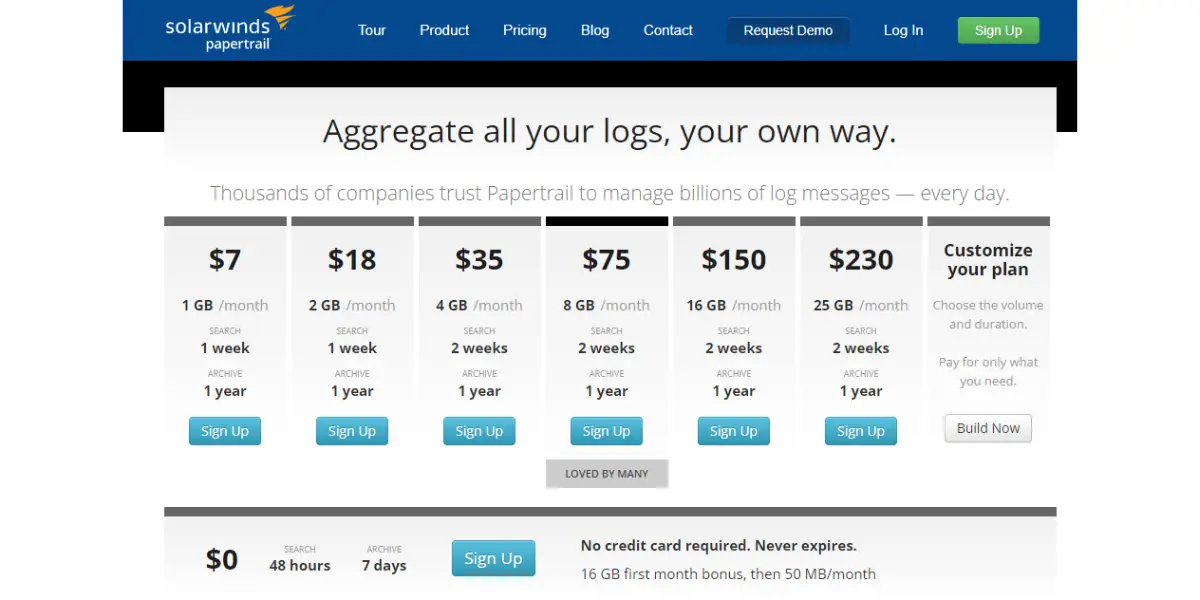
Papertrail has moved off the fixed volume ladder it used to sell. Its log observability plan now starts at $5.00 per GB per month, with a free trial, so you size it on the volume you actually send rather than picking the nearest bracket. The old $7 for 1 GB through $230 for 25 GB steps are no longer the published rates.
One thing worth knowing before you shortlist both: Papertrail and Loggly, entry 2 on this list, are the same vendor. Both are SolarWinds products, and SolarWinds was taken private by Turn/River Capital on 18 July 2025. Treating them as two independent options on a shortlist gives you less real choice than the list suggests. Papertrail is the simpler, tail-and-search tool of the two; Loggly is the heavier analytics product.
Likes
- Affordable tool
- Easy to set up
- Good search capability helps to advance monitoring
- Smooth GUI
- Easy to configure alerts and webhooks
Dislikes
- No depth additional features
- Quite confusing for beginners
Other details
| Deployment | Cloud, SaaS, Web-based |
| Support | Email/Help Desk, Phone Support, Knowledge Base, Chat, FAQs/Forum |
| Training | Live Online, Documentation |
| Customer ratings | Captarra: 4.3 out of 5 (12+ reviews) |
User opinion
Overall, Papertrail is easy to use and can help you find problems quickly. You can filter what information you look at by date, time, how important it might be, or other factors. Then, you can take this data and make charts or graphs to see what patterns appear.
How log tools are actually priced, and what decides the bill
Every product above will search your logs. What separates them on a real invoice is the pricing model, and there are only a few in use. Knowing which one you are being quoted matters more than the headline rate, because the same estate can cost very different amounts under each.
- Per GB ingested. You pay for volume arriving, whatever you do with it afterwards. Simple to forecast if you know your daily volume. Papertrail and Logz.io work this way.
- Split ingest and index. Cheap to take everything in, dearer to keep it searchable. Datadog is the clearest example, and it is why its two rates are quoted in different units, per GB for ingest and per million events for indexing.
- Included-volume bundles. A flat monthly fee with an allowance, then overage. Better Stack sells this way, and it bundles metrics and traces in, which makes a like-for-like comparison with a logs-only tool harder than it looks.
- Credits or units. A pool of value spent across whichever features you enable, as Sumo Logic now does, or a per-resource unit as LogicMonitor’s hybrid unit does. Flexible, and the hardest to compare between vendors, so make the vendor model your own estate.
Retention is usually the real cost, not search
Most teams size a log tool on how much they send and then get surprised by how long they have to keep it. Retention is frequently set by obligation rather than preference: PCI DSS expects a year of audit-log history with three months readily available, HIPAA and SOC 2 audits turn on being able to produce access records, and GDPR pulls the other way by limiting how long personal data sits in logs at all. Decide your retention period before you compare prices, because a tool that is cheap at seven days can be the expensive one at thirteen months.
The usual way out of that squeeze is tiering: keep a short hot window that is fully indexed and instantly searchable, and push the rest to cheap archive or cold storage that can be rehydrated when someone actually needs it. Datadog’s flex storage, Loggly’s S3 archiving and Logz.io’s retention extensions are all versions of this. If a vendor has no archive tier, long retention will be charged at live-search rates.
Log management is not the same thing as SIEM
These categories overlap and vendors blur them. A log management tool collects, parses, searches and alerts, and it is aimed at engineers debugging systems. A SIEM does that and adds correlation rules, threat detection content and case management for a security team. Sumo Logic and Splunk sell into both; Papertrail and Better Stack are firmly engineering tools. Buying a log platform expecting security operations out of the box, or a SIEM when all you wanted was fast search, is the most expensive mistake in this category.
What this list does not cover
The ten products above are commercial, hosted services, and that is a genuine limit worth stating rather than implying the category ends here. The open-source and self-hosted end is missing: the Elastic Stack and its fork OpenSearch, Grafana Loki and Graylog all run log management at scale for the cost of the infrastructure and the staff time to operate them, which is the right trade for some teams and the wrong one for most small ones.
Two other groups are absent as well. The broad observability suites, New Relic and Dynatrace, treat logs as one signal beside metrics and traces. And the cloud providers’ own services, chiefly Amazon CloudWatch Logs and Microsoft Sentinel, are often the default simply because the data is already there. If you are running mostly in one cloud, price its native option first, then judge whether a dedicated tool earns the difference.
Conclusion
We have listed the ten best log management tools available in the market. They all have unique features, each with variable pricing depending on your needs.
It is important to consider what you need the logs tool for and what prices fit within your budget before deciding which one to choose.
Regardless of whether you have simplistic or advanced needs for logging, it is worth evaluating the available options against pricing and features and making an educated decision tailored towards your business growth strategy.
Reference