
Available to promise (ATP) is the uncommitted portion of on-hand inventory and planned production that can still be promised to a new customer order. It answers the question a salesperson has to answer before quoting a date: if we accept this order today, can we actually ship it when we say we will?
On-hand quantity and ATP are rarely the same number. On-hand tells you what sits in the warehouse; ATP tells you what is left once every promise you have already made is honoured. Quoting from the on-hand figure is how an order book fills up with dates that cannot be met.
In one line: ATP takes what you have plus what is already scheduled to arrive, then subtracts what you have already sold. Whatever remains is what you are free to sell next.
Click here for Available to Promise Online Calculator
What is Available to Promise Inventory?
Availability to promise is a metric that measures the amount of product that a company can deliver to a customer shortly.
When a customer places an order with a company, they generally expect to receive their purchase on time. However, sometimes production delays or other issues can cause significant delivery delays.
To ensure that customers are not left disappointed, companies need to understand their availability to promise. This metric measures the amount of product a company can deliver to a customer shortly, and it is essential to ensure that customer expectations are met.
By monitoring availability to promise, companies can avoid overpromising and underdelivering, damaging customer relationships.
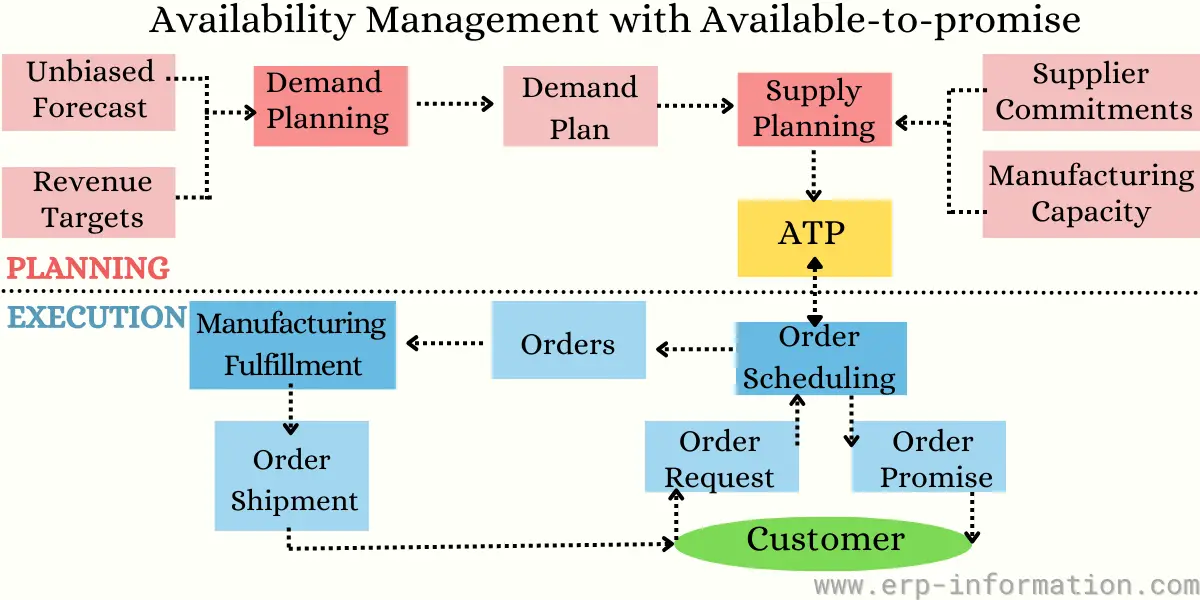
Available To Promise Formula
The formula for calculating Available to Promise is,
ATP = Quantity on hand + Total supply – Total demand
Here, quantity on hand means the number of readily available products.
Total supply means the number of products produced.
Total demand means the number of products that customers are ready to purchase.
ATP can be positive or negative.
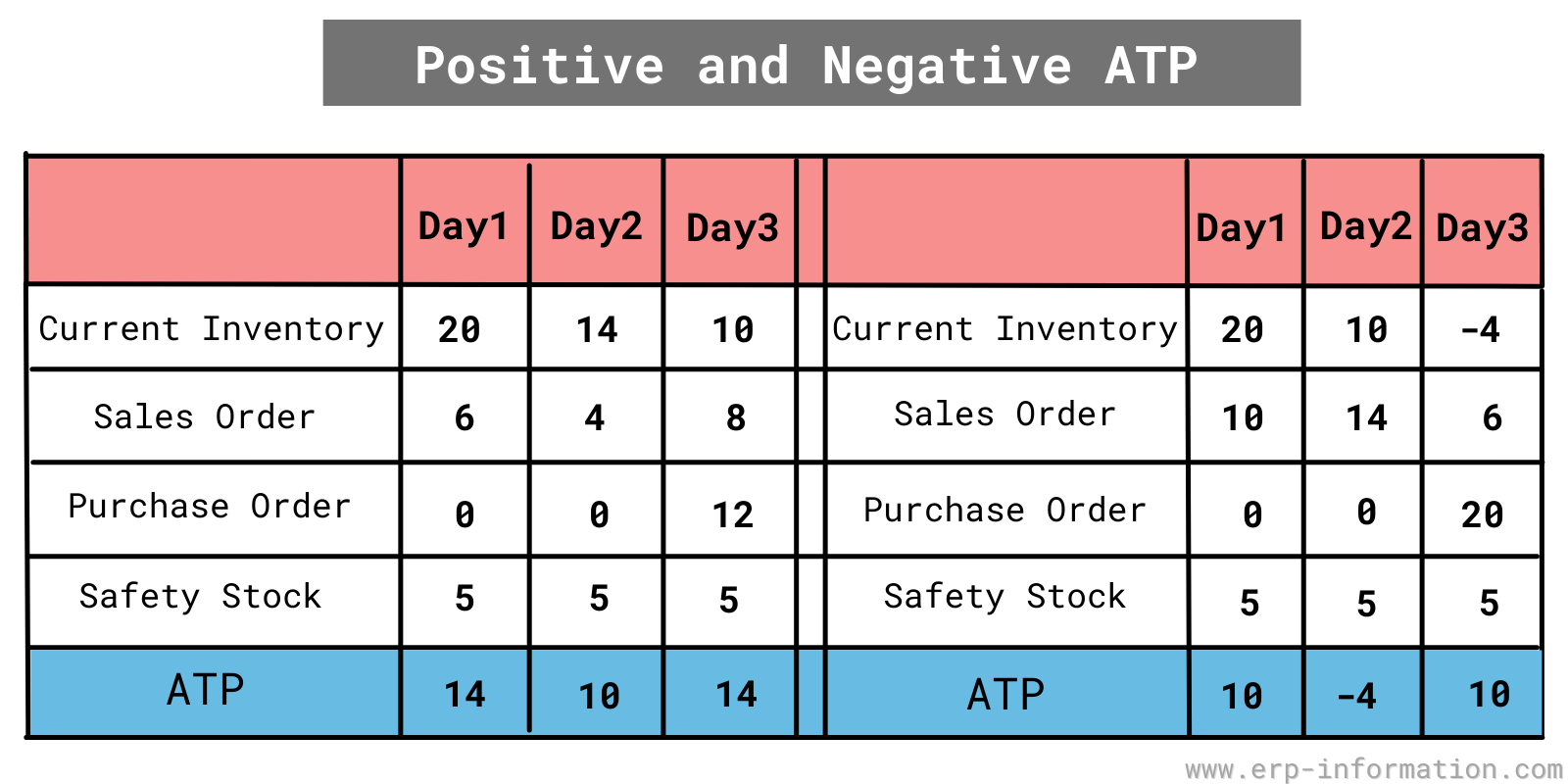
Factors that help to find ATP
- Current inventory: On-hand products that are readily available for urgent shipping
- Sales order: It is a report that upholds the sale. The vendor will issue this report to the customer before shipping the products to the customer’s place. The quantity of the product in the sales order is the amount committed to the customer even though it is in your stock.
- Purchase order(PO): The document created by the customer. When approved, it acts as an agreement between the customer & the vendor and is used to order the goods.
- Safety stock: It is the stock you need to hold to face the sudden demand and delayed inventory
Methods of Calculating ATP
There are three methods of calculation.
Discrete ATP
In this method, the calculation of ATP is based on its value in the primary schedule.
For example, the first period is the sum of starting inventory and MPS (Master Production Schedule) quantity minus backlog for all periods until the unit is scheduled again.
For other periods, the quantity has been scheduled for that specific period minus client commitments for this and different periods until the additional amount is planned in the MPS.
Cumulative ATP with a Look Ahead
The equation for calculating the production rate is the sum of ATP from the previous period and MPS of the period minus the backlog of the period.
The difference between the backlogs and MPSs of all future periods is also subtracted. This calculation is continued until production exceeds the backlog.
Cumulative ATP without Look Ahead
It is the sum of ATP in the previous period and the MPS minus the considered backlog. It will not be accurate if customer demand changes in the future.
Consequently, businesses should carefully monitor customer demand and adjust their production schedules accordingly.
A worked ATP example
The methods are easier to see with numbers. A plant starts week 1 with 80 units on hand. The MPS schedules two receipts of 100 units, in weeks 2 and 4. Customer orders are already committed in every week.
| Week | 1 | 2 | 3 | 4 | 5 |
|---|---|---|---|---|---|
| MPS receipt | 0 | 100 | 0 | 100 | 0 |
| Committed orders | 40 | 30 | 25 | 20 | 10 |
| Discrete ATP | 40 | 45 | not calculated | 70 | not calculated |
| Cumulative ATP (without look ahead) | 40 | 110 | 85 | 165 | 155 |
Reading the discrete row. Discrete ATP is only calculated in a week that has an MPS receipt, and it consumes the orders due between that receipt and the next one. Week 1 uses the opening stock: 80 minus the 40 committed in week 1 leaves 40. Week 2 receives 100 and must cover weeks 2 and 3 (30 plus 25), leaving 45. Week 4 receives 100 and must cover weeks 4 and 5 (20 plus 10), leaving 70. Weeks 3 and 5 have no receipt of their own, so they have no discrete figure.
Reading the cumulative row. Cumulative ATP without look ahead carries the balance forward: previous ATP plus this week’s MPS minus this week’s committed orders. So week 2 is 40 plus 100 minus 30, which is 110, and the series ends at 155.
The two rows agree, which is a useful check on your own numbers: the discrete figures sum to 40 plus 45 plus 70, or 155, exactly the closing cumulative value. Cumulative with look ahead would go one step further and deduct any future week where committed orders exceed scheduled supply, so that an early order cannot quietly consume stock a later week has already promised. In this schedule no such shortfall occurs, so it returns the same answer.
Which row you should trust depends on the product. Discrete suits goods that expire or date quickly, such as food, pharmaceuticals or seasonal fashion, because it refuses to carry availability forward. The cumulative methods suit stock with a long shelf life, where unsold units really are still sellable next month.
Categories of Available To Promise
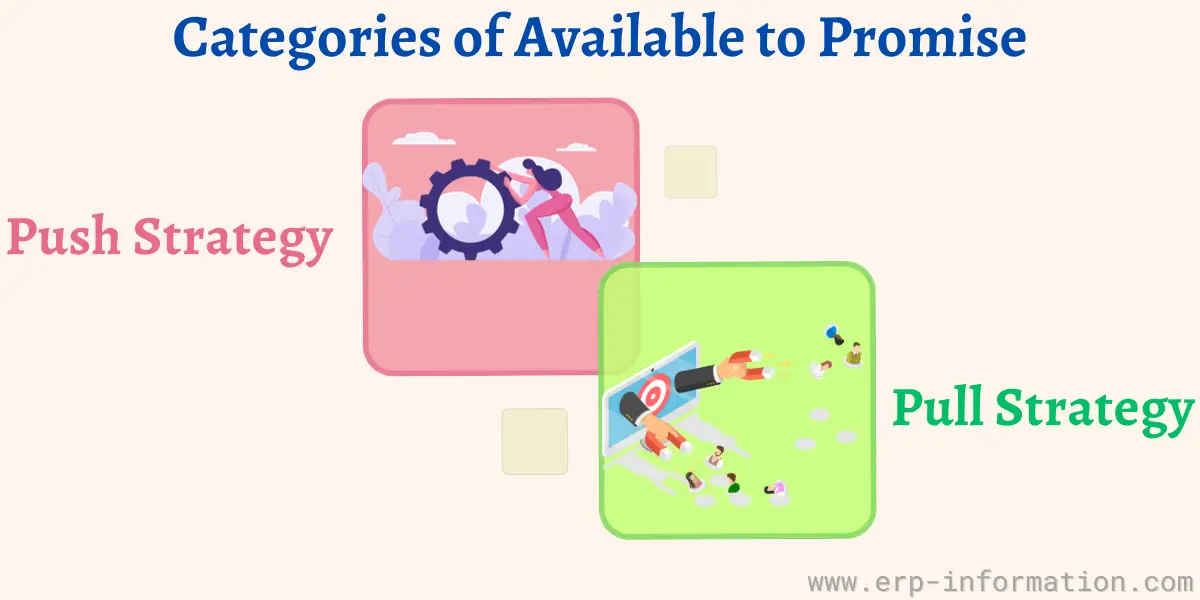
It is divided into two categories, Push and pull strategies.
Push ATP
A push strategy is nothing but real-time ATP. Here, the quantities and delivery due dates are derived based on the demand that has been forecasted. Then, the inventory and operation capacities are deduced based on regular production trends.
With appropriate scheduling, real-time ATP can be easily computed. Therefore, this is more favored than the pull strategy since pre-planning and preparing for unexpected production requirements.
The formula for the push strategy is
Push-based ATP = (On-Hand Inventory + Supply) – (Sales Orders + Forecasted Demand)
- On-hand inventory: Currently available products
- Supply: Purchase order, planned order
- Demand: Demand forecast and sales orders
Pull ATP
In a pull strategy, the company only produces what it has been ordered to make by the customer and not before.
Pull strategy does not consider forecasts. Hence, this method suits start-ups because they will not manage excess inventories.
The formula for the pull strategy is the same as the push strategy, with a slight difference.
Pull-Based ATP = (On-Hand Inventory + Supply) – Sales Orders
- On-hand inventory: Currently available products
- Supply: Purchase order, planned order
- Demand: Sales orders only
How is ATP Useful?
When this process is automated with efficient ERP systems, it helps to analyze the customer demands and adjust the required production schedules accordingly.
It even assists the customers to easily understand when they can expect the delivery for the orders placed.
Best Practices for ATP Inventory
Most ATP failures are not arithmetic errors. They come from feeding the calculation the wrong inputs, or from quoting a number that was correct hours ago.
Net against every commitment, not just open sales orders
Stock can be spoken for without an open order attached to it. Reservations, intercompany transfers, allocations held for key accounts, quality holds and consignment stock all reduce what you can genuinely promise. Safety stock should be excluded too. If your inventory management system nets only against sales orders, ATP will read high and the shortfall surfaces at the shipping dock.
Match the calculation method to the product’s shelf life
This is the choice that most often gets made by default rather than deliberately. Perishable, dated or seasonal goods need discrete ATP, because availability that is not consumed in its own window is not really available later. Durable goods with a long shelf life are better served by a cumulative method, which would otherwise strand sellable stock.
Decide between real time and batch checking, and be honest about the gap
ATP can be evaluated the moment an order is entered, or in batches at set intervals for accumulated orders. Batch checking is cheaper and perfectly workable, but between two runs your quoted availability is an estimate. If two sales channels can commit the same unit inside one batch window, you have found the cause of your overselling.
Escalate to capable to promise instead of guessing
When ATP returns nothing for the date a customer wants, the answer is not to promise anyway and hope. That is the point at which capable to promise should take over and test whether spare capacity and materials could create a new supply. Give inventory planners, customer service and supply chain leaders one agreed rule for when that escalation happens, so the promise date does not depend on who answered the phone.
Available to Promise vs Safety Stock with Example
Consider a tech gadget store that has 100 smartphones in stock. They receive orders for 50 smartphones. The Available to Promise quantity, in this scenario, is the remaining 50 smartphones that the store can promise to new customers without affecting the fulfillment of existing orders.
The store maintains a Safety Stock of 20 additional smartphones to guard against potential stockouts.
That reserve is deliberately held back from the ATP figure. Safety stock exists to absorb demand spikes and late supplier deliveries, so promising it away to a new order would remove the very cushion it was created to provide. In this example the store can promise 50 units, not 70.
Note: You can calculate your safety stock using our free online calculators. Check the list below
FAQs
What is the difference between available to promise and capable to promise?
ATP looks only at material that already exists or is already scheduled, and it assumes capacity is unlimited. Capable to promise (CTP) goes a step further and asks whether a new supply could be created for the requested date, checking production capacity, supplier lead times and material availability together.
So ATP is a question about inventory, while CTP is a question about the factory. If ATP says no units are free on the date a customer wants, CTP can still return a valid promise date by scheduling additional production.
Are available to promise and safety stock the same?
No, and they serve opposite purposes. Safety stock is a buffer held back on purpose to absorb demand spikes and supplier delays. Available to promise is the quantity you are free to sell, which is calculated after safety stock and every other commitment has been set aside.
A positive ATP means uncommitted stock is available and you can accept new orders for that date. A negative ATP means you have already committed more than you can supply, so existing promises are at risk and the schedule needs correcting.
Conclusion
ATP can help your organization better understand customer demand, improve supplier relations, and make more informed decisions about inventory.
While it is not a silver bullet for solving all supply chain problems, it can be a valuable tool in your arsenal.