Supply chain execution (SCE) is the layer of software that carries out the physical movement of goods once the planning is done: receiving, storing, picking, packing, shipping, and transporting orders to customers. Where supply chain planning decides what to make, buy, and stock, execution turns those plans into action on the warehouse floor and on the road.
An SCE system is usually a set of connected applications: a warehouse management system, a transportation management system, an order management system, and supporting tools for the yard, labor, and warehouse equipment. They share real-time data so an order moves from the shelf to the customer’s door with fewer errors and lower cost.
For the software itself, Gartner’s 2026 reports name four vendors as Leaders in both warehouse management and transportation management: Blue Yonder, Manhattan Associates, Oracle and SAP.
Definition of Supply Chain Execution
Execution starts when an order is released and ends when the shipment is delivered and invoiced, so it runs on live data: bin quantities, trailers at the gate, carrier status.
Gartner’s definitions mark the boundary. A warehouse management system “helps manage and intelligently execute the operations of a warehouse, distribution center (DC) or fulfillment center (FC)”. A transportation management system supports the “sourcing, planning and execution of the physical transport of goods across the supply chain”.
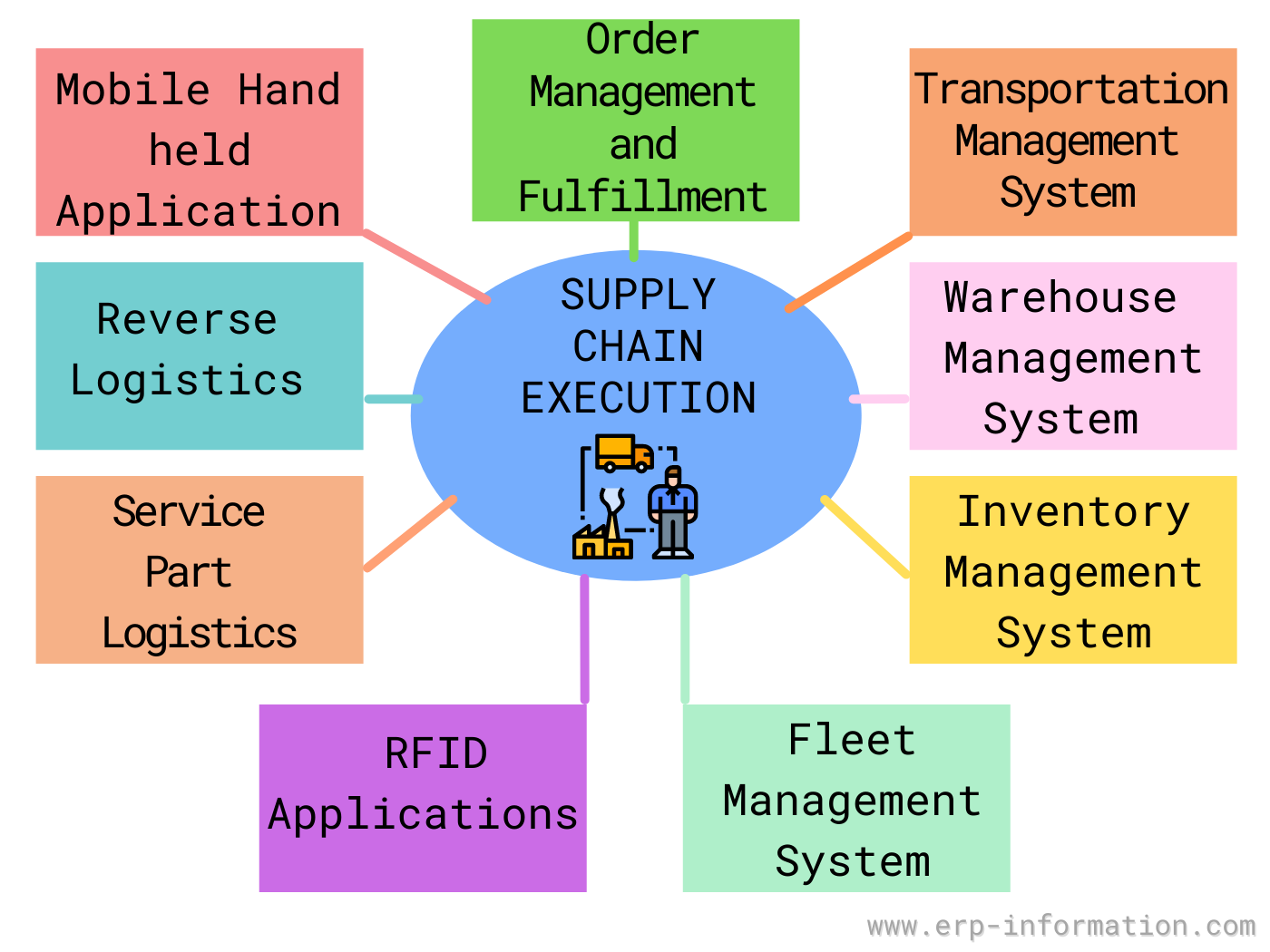
The core execution applications are an order management system, warehouse management software and transportation management software. Yard, labor and warehouse-control systems sit around them, and factories add a manufacturing execution system on the shop floor.
The components that make up a typical SCE system
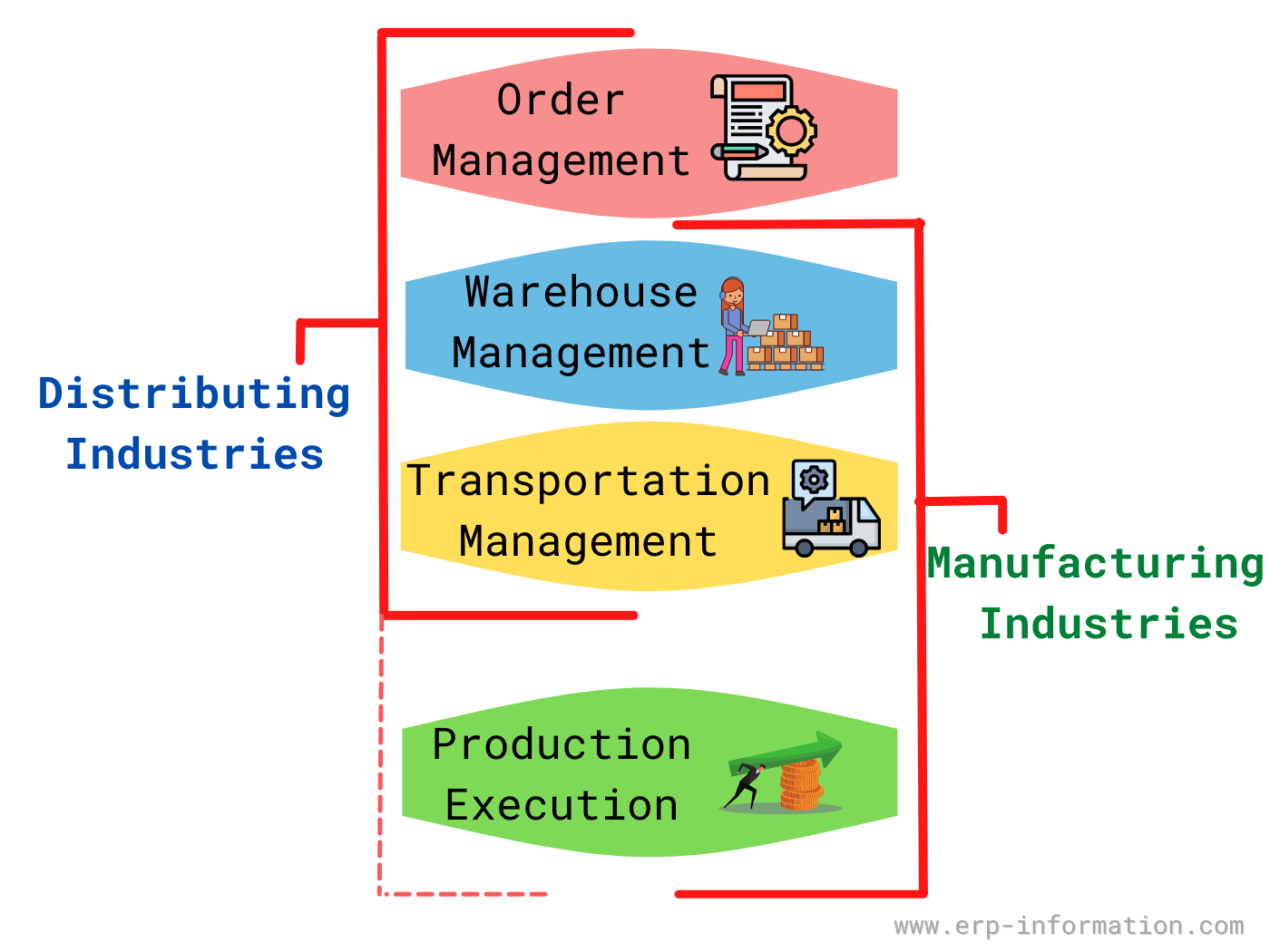
The main components are order management, inventory management, warehouse management, transportation management and, in factories, production execution. Production planning is not one of them: it is a planning task, and the manufacturing execution system carries out the schedule it produces.
Supply Chain Execution Software
Execution spans several products, so the useful test is coverage. Gartner rates the two core execution categories in separate reports: the Magic Quadrant for Warehouse Management Systems (29 April 2026, 18 vendors) and the Magic Quadrant for Transportation Management Systems (30 March 2026, 16 vendors).
| Vendor | 2026 WMS report | 2026 TMS report |
|---|---|---|
| Blue Yonder | Leader | Leader |
| Manhattan Associates | Leader | Leader |
| Oracle | Leader | Leader |
| SAP | Leader | Leader |
| Infios (a Körber company) | Leader | Challenger |
| Infor | Leader | Not in report |
| E2open (a WiseTech Global company) | Not in report | Leader |
| Microsoft | Challenger | Not in report |
The products behind those placements:
- Blue Yonder: Blue Yonder warehouse management and Blue Yonder Transportation Management.
- Manhattan Associates: Manhattan Active Warehouse Management and Manhattan Active Transportation Management, on one platform that also includes yard and labor management.
- Oracle: Oracle Fusion Cloud Warehouse Management and Oracle Fusion Cloud Transportation Management (OTM).
- SAP: SAP Extended Warehouse Management (EWM) and SAP Transportation Management (TM).
- Infios: four separate WMS products and Infios TM, which it acquired from MercuryGate in October 2024.
- Infor: Infor WMS. Infor is owned by Koch Industries.
- E2open: e2open Transportation Management.
- Microsoft: Dynamics 365 Finance and Supply Chain Management, where the WMS is part of the cloud ERP.
Which one fits your warehouse
Gartner grades warehouses from Level 1, “the most basic warehouse operation”, to Levels 4 and 5, “the most complex and automated”. Most warehouses worldwide are Level 3 or below, and Gartner says those “do not require, nor would they normally use, the most advanced functionality”. So size the system to the warehouse:
- Levels 1 to 2 (paper or handheld, little automation): the ERP’s own inventory module is often enough. Gartner places Oracle Fusion Cloud Inventory Management at “Level 1 to Level 2 warehouse functionality”, and Infor’s Factory Track, bundled with its ERP, at “simplified Level 1 and low Level 2”.
- Levels 2 to 3: SAP EWM “is most often used in Level 2 and Level 3 warehouse operations but can scale to Level 5”. Microsoft’s WMS has historically been used most often at Levels 2 and 3. India-based Vinculum, a Niche Player built mainly for e-commerce and omnichannel retail, fits “paper- or mobile-based, manual Levels 1 through 3” operations.
- Levels 3 to 5 (system-directed, often automated): Infor’s WMS is most often used at Level 3. Blue Yonder’s is used mainly at Levels 3 and 4 and scales to Level 5. Manhattan Active WM is most often used at Levels 4 and 5.
If freight costs you more than warehouse errors, read the TMS column first. If you want both from one vendor, the four Leaders in both reports are Blue Yonder, Manhattan Associates, Oracle and SAP. If you already run SAP, Oracle or Microsoft ERP, evaluate that vendor’s own module first, because the link to orders, stock and finance already exists.
Supply Chain Execution Applications
A complete SCE stack is made up of several specialized systems, each responsible for one part of moving an order from the shelf to the customer. Here is how the main ones fit together.
| System | What it manages | Core job |
|---|---|---|
| Order Management System (OMS) | Customer orders across every channel | Order capture, inventory allocation, fulfillment, and returns |
| Warehouse Management System (WMS) | Warehouse and distribution-center operations | Receiving, put-away, picking, packing, and shipping |
| Transportation Management System (TMS) | Freight and carriers | Route planning, carrier selection, and shipment tracking |
| Warehouse Control System (WCS) | Warehouse equipment | Directs conveyors, sorters, and scanners in real time |
| Slotting software | Product placement inside the warehouse | Positions SKUs by velocity and order mix to speed picking |
| Yard Management System (YMS) | Trailers, docks, and the yard | Bridges the WMS-TMS gap; schedules docks and gates |
| Labor Management System (LMS) | Warehouse workforce | Tracks and forecasts labor performance against standards |
Gartner counts labor management, slotting, yard management and dock scheduling as extended WMS capabilities, “value-added capabilities that supplement core functions”. A WMS vendor often supplies them too.
Order Management System
It allows businesses to receive, process, and fulfill orders from multiple customers. That includes order creation, prioritization, inventory allocation, shipping scheduling, and returns management.
Transportation Management System
It plans and books freight across modes: it consolidates orders into loads, chooses the route, rate and carrier, tenders the load and tracks the shipment to delivery.
Gartner’s definition also covers freight audit: “Matching expected transportation charges against actual charges to manage discrepancies”.
Warehouse Management System
It can be used to manage the operations of warehouses and distribution centers. That can include tasks such as receiving and putting away, order picking and packing, and shipping.
To time your picking, our order picking performance calculator adds up time per item picked, time per order and walking time.
Warehouse Control System
It can be used along with the warehouse management system to manage warehouse equipment such as conveyor belts, sorters, and scanners and manage their status and performance.
Slotting Software
Slotting software decides which location each item lives in, from how often it is picked, its size and the usual order mix.
Fast movers go in the easiest-to-reach slots near packing and shipping, and slow movers go farther away. Items that look alike are kept apart, so a picker is less likely to grab the wrong one.
Yard Management System
A yard management system tracks the trailers between the gate and the dock doors, so the WMS knows what has arrived and the TMS knows when a carrier can load.
Carriers book pickup and delivery slots, which X12 carries as the 163 Transportation Appointment Schedule Information message. Gate and dock times then give a measured record of each carrier’s delivery performance.
Labor Management Tool
A labor management system sets a standard time for each task, such as a pick, a put-away or a trailer load, and compares each worker’s actual time with it.
Gartner lists workforce and labor management among the common WMS capabilities, so many warehouses get it from their WMS vendor.
Distributors mostly run order, warehouse and transport execution. Manufacturers add production execution on the shop floor, the job of a manufacturing execution system.
How one order moves through the execution systems
Take one replenishment order. A retailer orders 40 cartons from a manufacturer that keeps finished goods at a third-party logistics (3PL) warehouse and ships by full truckload. Steps 2 to 7 are the manufacturer’s outbound logistics.
Between companies, each hand-off is a standard electronic message. The numbers and names below are from the X12 transaction set list.
| Step | What happens, and in which system | X12 message |
|---|---|---|
| 1. Order | The retailer’s purchase order reaches the manufacturer’s order management system (OMS), which reserves 40 cartons at the 3PL warehouse. | 850 Purchase Order |
| 2. Release | The OMS tells the 3PL’s warehouse management system (WMS) to make the shipment. | 940 Warehouse Shipping Order |
| 3. Carrier | The manufacturer’s transportation management system (TMS) builds the load and offers it to a truckload carrier, which accepts or declines. | 204 Motor Carrier Load Tender, answered by a 990 Response to a Load Tender |
| 4. Appointment | The carrier books a pickup slot. The yard management system checks the trailer in at the gate and assigns a dock door. | 163 Transportation Appointment Schedule Information |
| 5. Pick and load | The WMS releases the order to picking, directs packing and loading, and tells the manufacturer what actually shipped. | 945 Warehouse Shipping Advice |
| 6. Ship notice | The retailer receives a list of what is on the truck, carton by carton. | 856 Ship Notice/Manifest |
| 7. Transit | The carrier reports pickup, position and delivery. | 214 Transportation Carrier Shipment Status Message |
| 8. Billing | The carrier bills the freight, and the manufacturer invoices the retailer. | 210 Motor Carrier Freight Details and Invoice, then 810 Invoice |
The 945 is where a short shipment shows up. X12 says the message “is used to reconcile order quantities with shipment quantities”. If the 940 asked for 40 cartons and the 945 reports 38, the manufacturer knows before the truck arrives, and the 856 should tell the retailer 38, not 40.
Inside one company the same steps run as ERP documents or API calls rather than EDI. The hand-offs, and the places where quantities and dates can disagree, stay the same.
What a warehouse management system must do
Gartner’s 2026 WMS report lists 18 mandatory capabilities. Grouped by where the work happens:
- Inbound: receiving, inspection and quality, put-away, and cross-docking.
- Storage: stock locating, inventory management, location management, replenishment, and cycle counting.
- Outbound: order allocation, wave planning, picking, staging, packing, truck loading, manifesting, and shipping.
- Equipment: interfaces to automated material handling equipment (MHE), such as conveyors and sorters.
Gartner’s list of common, but not mandatory, capabilities includes labor management, task interleaving, slotting, yard management and dock appointment scheduling.
It finds “near-functional parity for basic core WMS capabilities across WMS providers”. So vendors differ elsewhere: in those extended capabilities and in what Gartner lists as “usability, adaptability, decision support, scalability”.
What is Supply Chain Planning?
Supply chain planning helps map the manufacturing process, logistics, and inventory required to meet future demand.
It balances supply and demand by combining demand forecasts, supply and production plans, inventory targets and distribution requirements planning.
Supply chain planning v/s supply chain execution
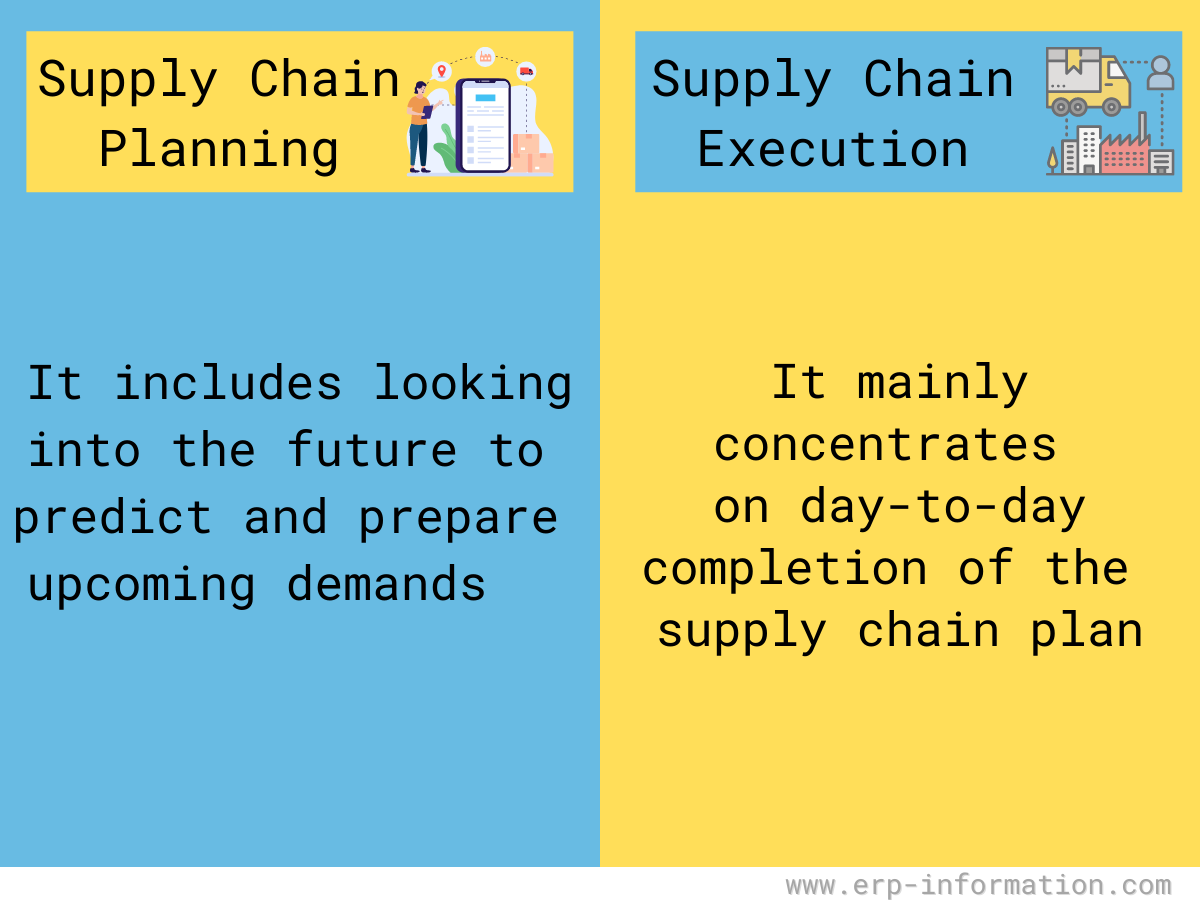
Planning and execution are two halves of the same job. Planning decides what should happen; execution makes it happen. The table below shows how they differ.
| Supply chain planning | Supply chain execution | |
|---|---|---|
| Focus | Strategy and forecasting | Action and daily operations |
| Time horizon | Weeks to years ahead | Real time to a few days |
| Key question | What, how much, and when to make or buy | How to move, store, and deliver what was planned |
| Typical systems | Demand planning, S&OP, inventory optimization | WMS, TMS, OMS, YMS |
How do you Build a Good Supply Chain Network?
Execution can only be as good as the network it runs on. A 2001 EDN article describes four stages that a supply chain network moves through as more members join:
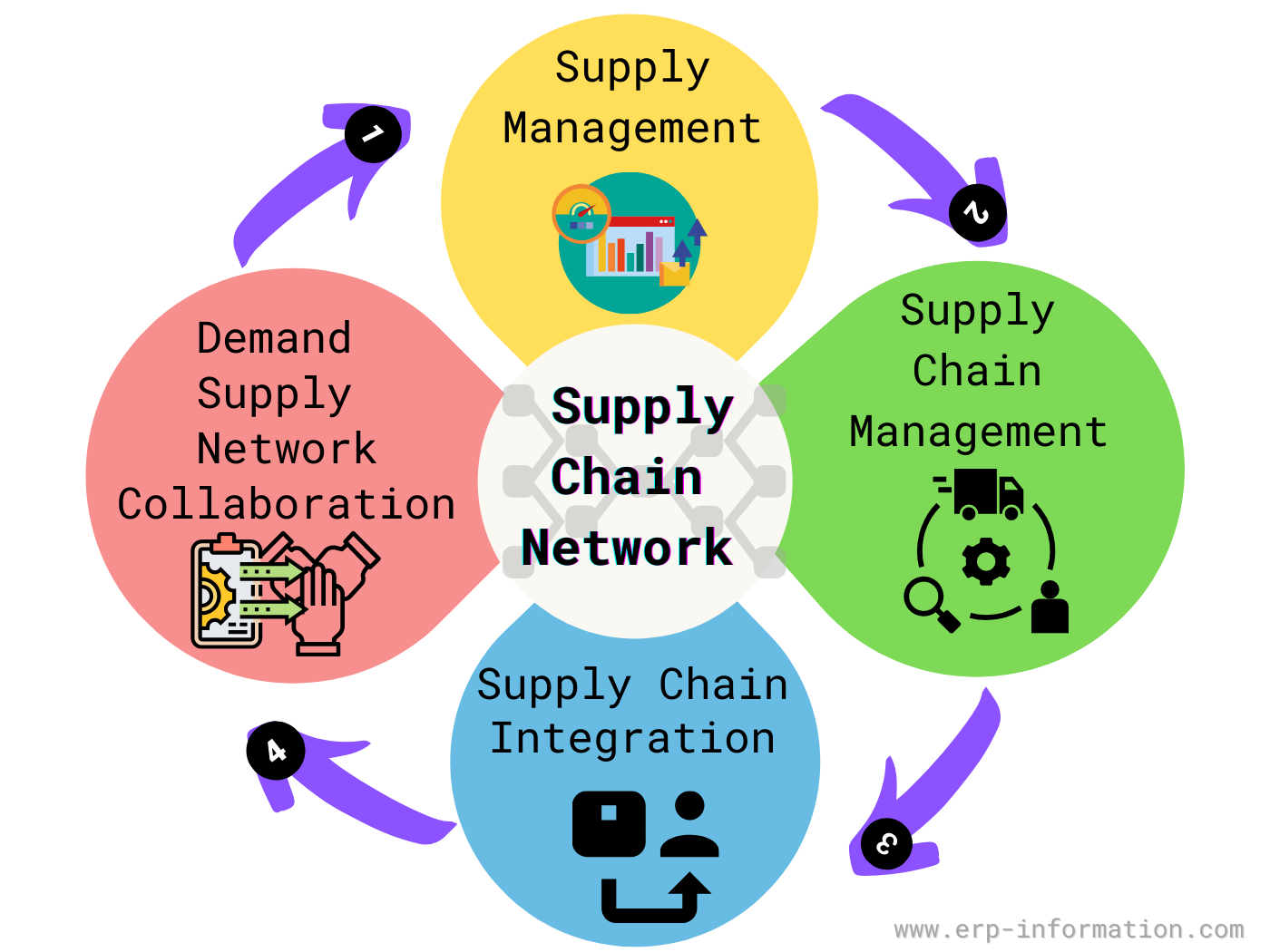
- Stage 1, supply management: built around an internal, lead-time-driven MRP system, with tier-one suppliers only. Communication is transactional: quotes, purchase orders and releases.
- Stage 2, supply chain management: tier-two suppliers and beyond join, with more status reporting and some data sharing. Communication stays transactional, “with the addition of data flow”.
- Stage 3, supply chain integration: members plan strategy and share risk together, and communication goes “well beyond transactions and data”.
- Stage 4, demand-supply network collaboration: critical information “flows freely and simultaneously throughout the supply network”, which the article calls the “glass pipe”.
Its warning holds for execution systems too: “Any supply chain will perform at the level of its least developed participants.” A carrier that cannot send 214 status messages limits the shipment visibility of every shipper that uses it.
Designing the supply chain network
Network design is a planning job, but it sets what execution has to handle. The usual steps:
- Set the goals: the customer service level the market expects, the transport modes that balance cost and speed, how many warehouses you need, how much stock each product needs, and which warehouse serves which customers.
- Collect the data: demand by product, transport, inventory and warehouse costs, and transit lead times.
- Choose a tool: a network optimization tool that can model those decisions for your business.
- Review and revise: re-run the analysis as demand and costs change.
Benefits of Supply Chain Execution
Execution software pays back in three places: labor, cost and accuracy.
Enhance Productivity
The WMS directs work instead of paper lists: each worker gets the next task on a handheld scanner or by voice.
Task interleaving, one of the common WMS capabilities, pairs jobs such as a put-away on the way back from a pick, so fewer trips run empty.
Lower freight and storage cost
A TMS cuts freight cost through “order and shipment consolidation, mode selection, routes, rate and carrier selection”, in Gartner’s words, and by checking each carrier invoice against the expected charge.
A WMS cuts handling cost through slotting and directed work. Accurate stock records also let less safety stock cover the same orders.
Improve order accuracy
Scanning at each step catches the wrong item or quantity before the truck leaves.
The 945 and 856 messages then tell the seller and the customer exactly what shipped, so receiving and invoicing match across the supply chain, with fewer credit notes and re-shipments.
Challenges
SCE is a complex and challenging process, and several factors can contribute to these challenges, including:
- Complexity: SCE involves the coordination of many different activities and stakeholders, which can make it difficult to manage and optimize.
- Coordination: One of the biggest challenges is coordinating activities among different players within the supply chain, such as suppliers, manufacturers, distributors, and retailers
- Unpredictability: SCE is often subject to unexpected disruptions, such as natural disasters, political instability, and economic downturns. These disruptions can make it difficult to meet customer demand and maintain profitability.
- Visibility: It can be difficult to track the goods and materials movements throughout the supply chain, making it difficult to identify and address problems.
- Cost: SCE can be a significant expense for businesses, and it is important to find ways to reduce costs without sacrificing efficiency or quality.
Tips to Overcome Challenges
Here are some tips for overcoming the challenges of supply chain execution:
Invest in technology
Automate the routine steps first, such as carrier tendering and shipment confirmations. Each one removes a manual re-keying step and the errors that come with it.
Develop strong supplier relationships
Strong relationships with suppliers are crucial for a steady supply of goods and materials. Businesses should work with their suppliers to develop joint plans and to identify and mitigate risks.
Improve visibility
Businesses need to track goods and materials throughout the supply chain. Shipment confirmations from the warehouse (945) and status messages from carriers (214) give a near real-time view of inventory, order status and shipments.
Build flexibility into the supply chain
The supply chain is constantly changing, so building flexibility into the system is important. That can be done using multiple suppliers, contingency plans, and investing in scalable infrastructure.
Which execution system to fix first
Start where the cost or the errors are:
- Mis-picks, lost stock or slow picking in the building: a WMS, sized to your warehouse level.
- Freight is the biggest bill, or loads are still booked by phone and email: a TMS.
- Orders arrive from several channels and you promise stock you do not have: an OMS.
- Trucks queue at the gate or wait for a door: yard management and dock appointments.
- You already run several of these: fix the hand-offs first, the 940 and 945 pair and the 204 and 990 pair, because that is where quantities and dates drift apart.
Using Google Search? Add erp-information.com as a preferred source.