Tryton is a free, open-source ERP platform written in Python. It is fully open source under the GPLv3 license, with no paid “enterprise” edition, and it is governed by a non-profit foundation rather than a single company. That independence makes it one of the most vendor-neutral options in the open-source ERP space.
Tryton is modular and known for a clean data model, strong backward compatibility, and long-term support releases. This review covers what Tryton is, who maintains it, its architecture, modules, pricing, and its honest strengths and limitations.
Click here for similar kinds of Open-source ERP Software
Latest version: Tryton 8.0, a long-term support (LTS) release published on April 21, 2026 (latest maintenance release 8.0.7, July 2026). Tryton ships a new series every six months; standard series are supported for one year, while each major LTS release is supported for five years. The previous LTS, 7.0, is supported until November 2028.
Tryton at a glance
| Software | Tryton, a general-purpose open-source ERP |
| Latest version | Tryton 8.0 LTS (April 2026) |
| License | GPL-3.0, fully open source, no enterprise edition |
| Maintained by | The Tryton Foundation, a non-profit in Liège, Belgium |
| First released | November 2008, as a fork of TinyERP (the predecessor of Odoo) |
| Built with | Python server (trytond), PostgreSQL database, a GTK desktop client and the “Sao” web client |
| Architecture | Three-tier: client, application server, database |
| Modules | Highly modular, with well over 100 official modules |
| Hosting | Self-hosted, or via independent Tryton service providers (no official SaaS) |
| Best for | Organizations wanting a stable, independent, fully open-source ERP with some technical capacity |
| Website | tryton.org |
What is Tryton?
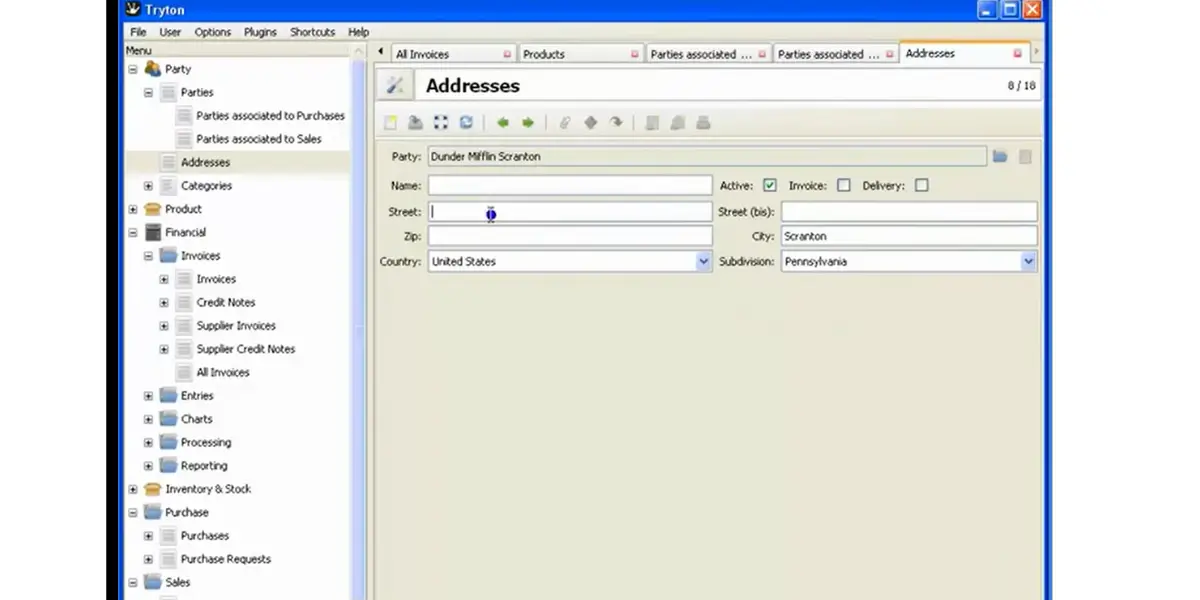
Tryton is a general-purpose ERP for small, medium, and larger organizations. It brings accounting, sales, purchasing, inventory, manufacturing, and projects together on a single, consistent data model, so information flows between areas without separate integrations.
It uses a three-tier architecture: a desktop or web client, an application server written in Python (called trytond), and a PostgreSQL database. Because Tryton is highly modular, you install only the modules you need and add more as your requirements grow. Its design priorities are correctness, a clean model, and stability across upgrades rather than a large marketplace of add-ons.
Who develops Tryton?
Tryton is not owned by a single company. It was first released in November 2008 as a fork of TinyERP, the software that later became Odoo, and was created by the founders of the Belgian firm B2CK. The rights to the code, trademark, and website were handed to the Tryton Foundation, a non-profit based in Liège, Belgium, specifically so that no single vendor could control the project.
Today the Foundation holds the infrastructure and the Tryton trademark, while development comes from a community of contributors and a network of independent companies. For a buyer, this governance model is the main thing that sets Tryton apart: there is no commercial “enterprise” version to upsell you, and no roadmap tied to one company’s interests.
Tryton pricing
Tryton is 100% open source and free of charge. There is no license fee, no per-user cost, and no paid edition; every official module shares the same GPLv3 license. Your only costs are optional: hosting and professional help.
Most users either self-host Tryton or hire one of the independent Tryton service providers for hosting, setup, support, and custom development. The Tryton project itself does not sell a managed cloud, but several providers offer hosted Tryton. A free online demo is available on the Tryton website so you can try it before installing.
Technical Information
| Programming languages | Python (server) and JavaScript (Sao web client) |
| Database | PostgreSQL for production; SQLite for testing |
| Architecture | Three-tier: client, application server (trytond), database |
| Clients | Native desktop client (GTK) and the Sao web client |
| Operating systems | BSD, Linux, macOS, Windows |
| License | GPL-3.0, fully open source, no enterprise edition |
| Maintained by | The Tryton Foundation (non-profit, Belgium) |
| Interface languages | Available in many languages, including English, French, German, Spanish, and more |
| Deployment | Self-hosted, or hosted through independent Tryton service providers (no official SaaS) |
| Support | Community forum and documentation; paid support via the service-provider network |
Reasons to Choose Tryton
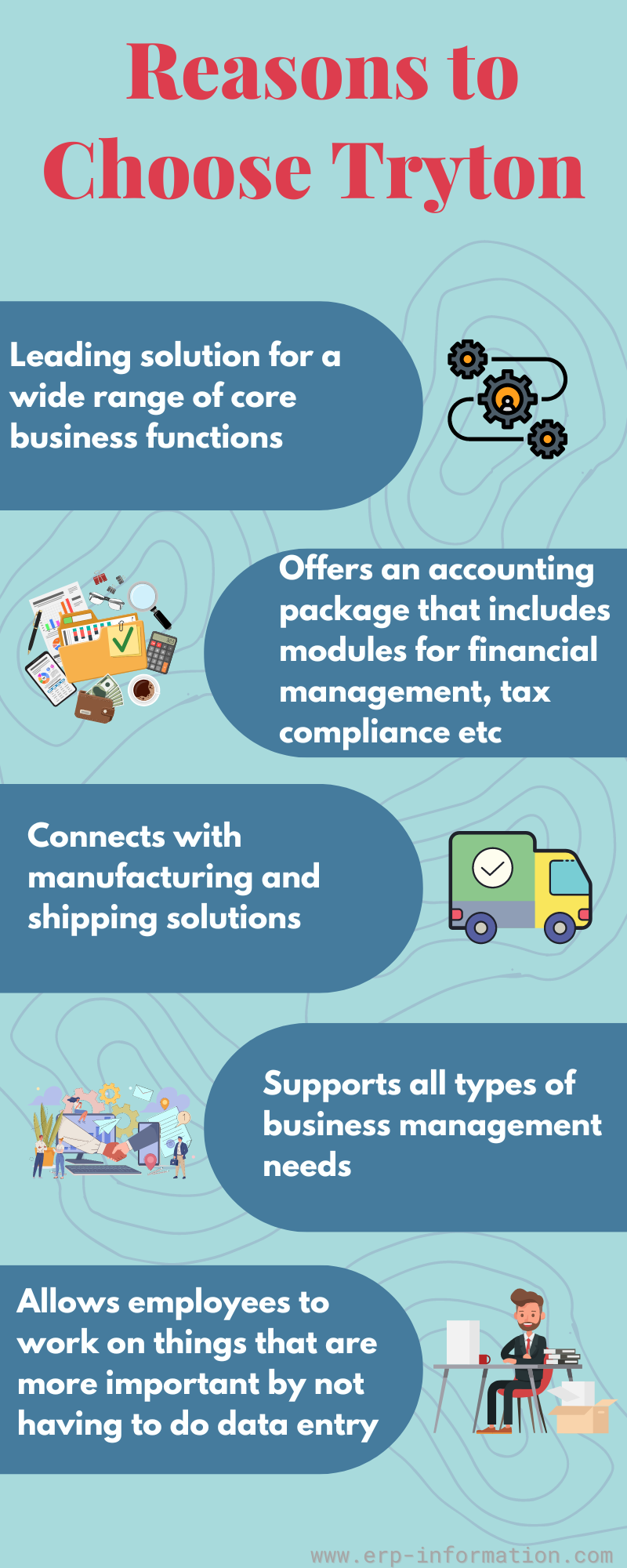
- It is fully open source under GPLv3, with no paid edition and no per-user license fees.
- It is governed by a non-profit foundation, so there is no single-vendor lock-in.
- Long-term support releases (five years) and disciplined six-month release cycles make upgrades predictable.
- A modular design lets you install only the functions you need, from accounting to manufacturing.
- A clean, consistent data model and a documented API make it straightforward to customize and integrate.
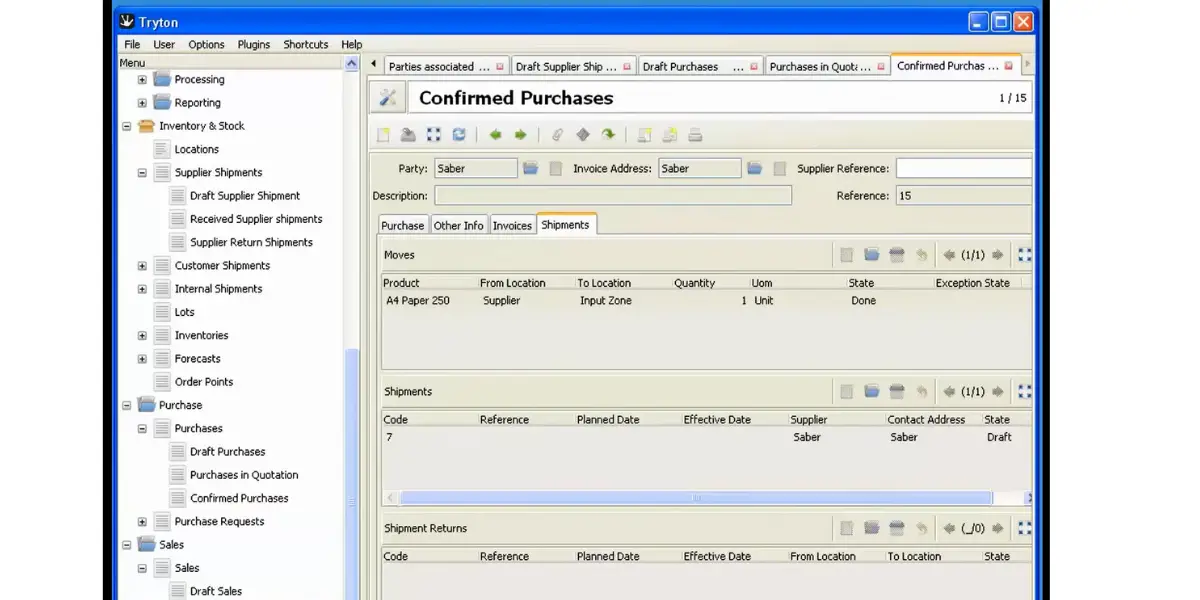
Tryton Modules
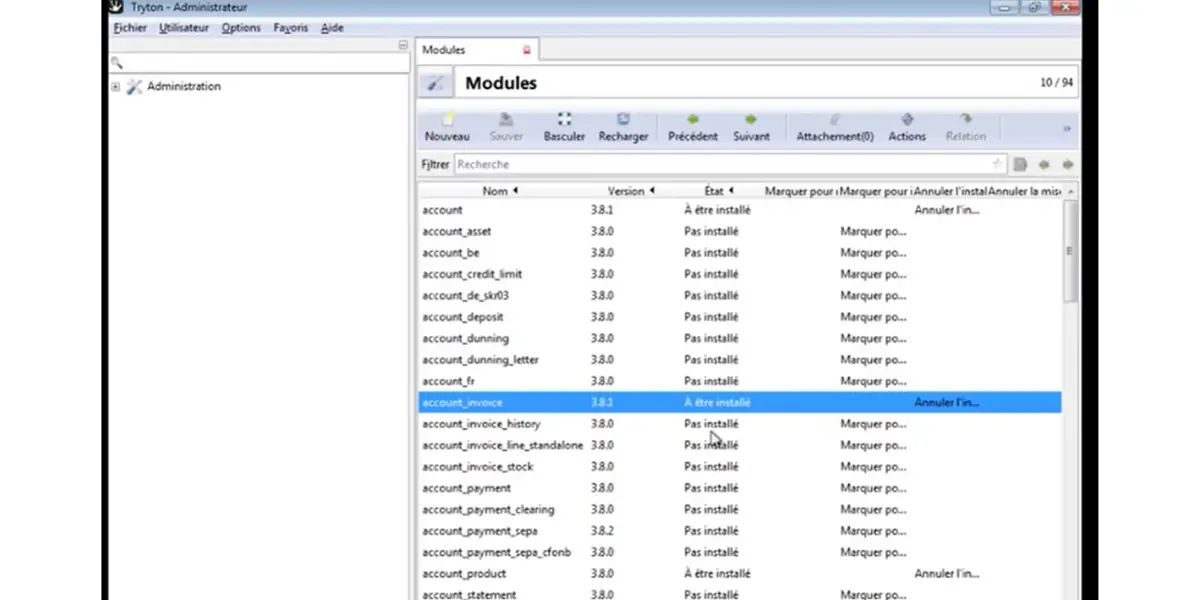
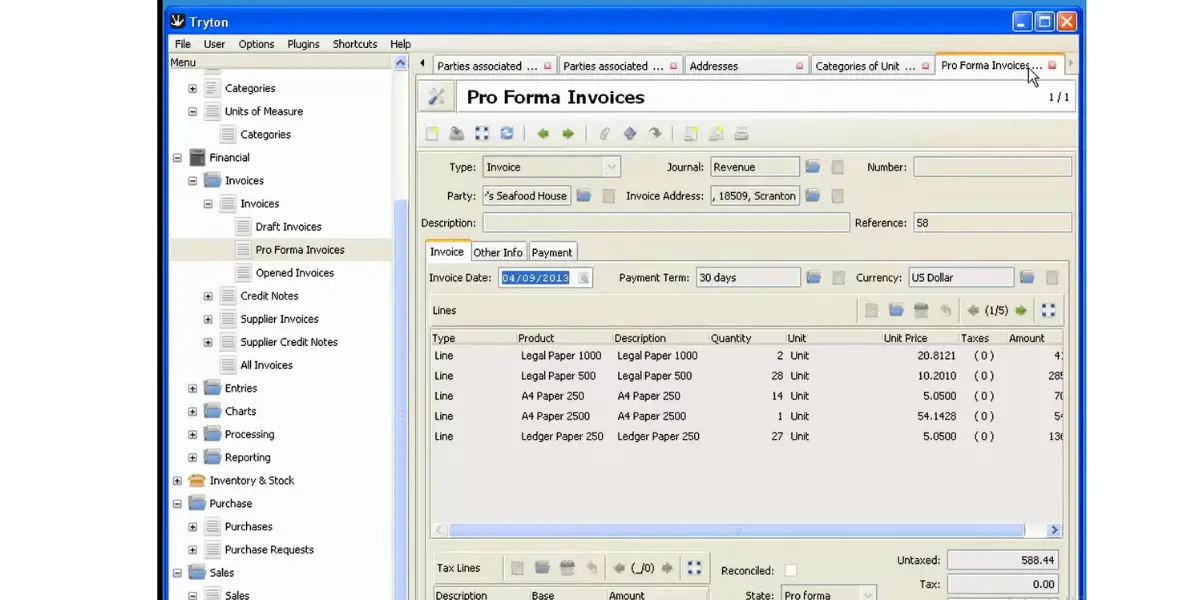
- Financial Accounting
- To do all account-related transactions and to record all transactions.
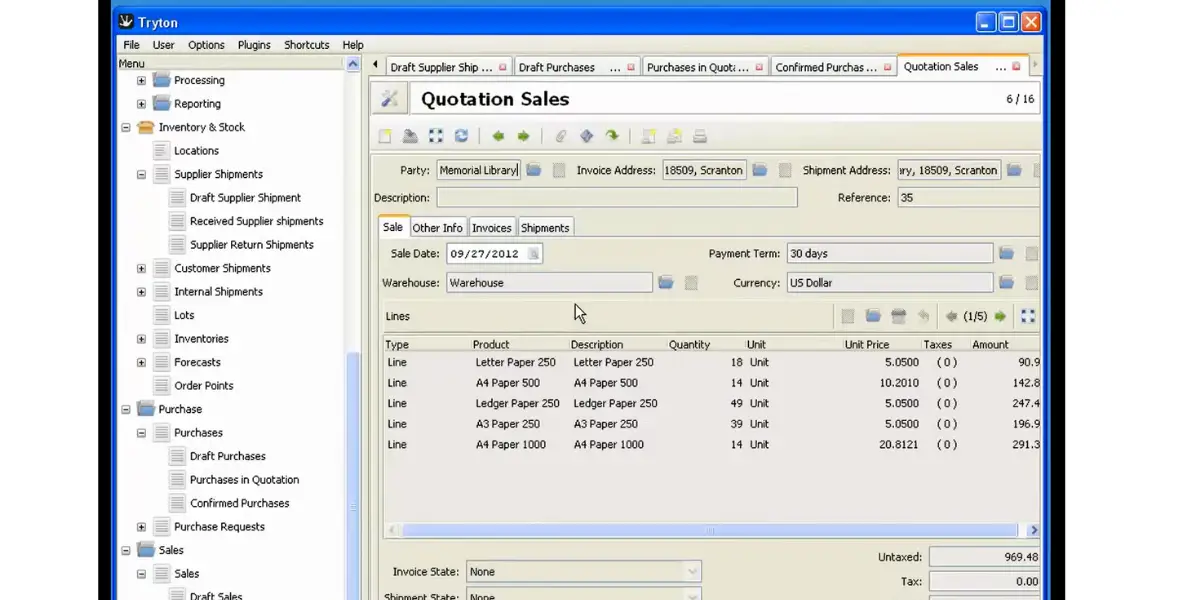
- Sales
- To track and monitor orders from quotation to customer satisfaction.
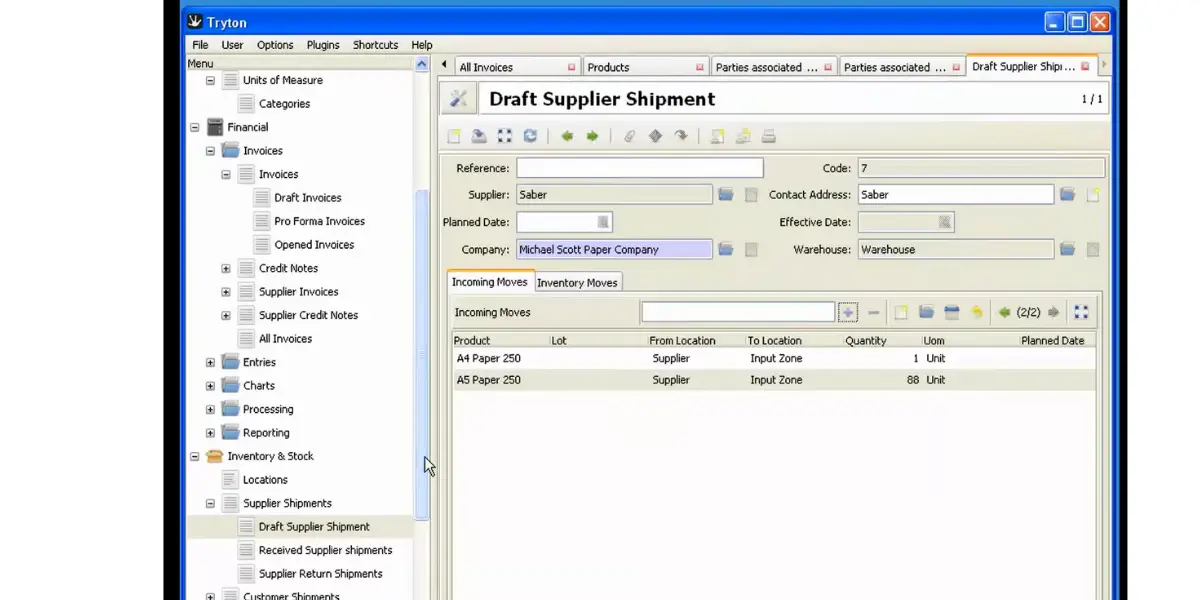
- Inventory and stock
- To monitor and maintain the inventories in the warehouse from receipt to dispatch.
- Analytic accounting
- To categorize revenues and expenses.
- CRM
- To have good relationships with customers and convert that into sales.
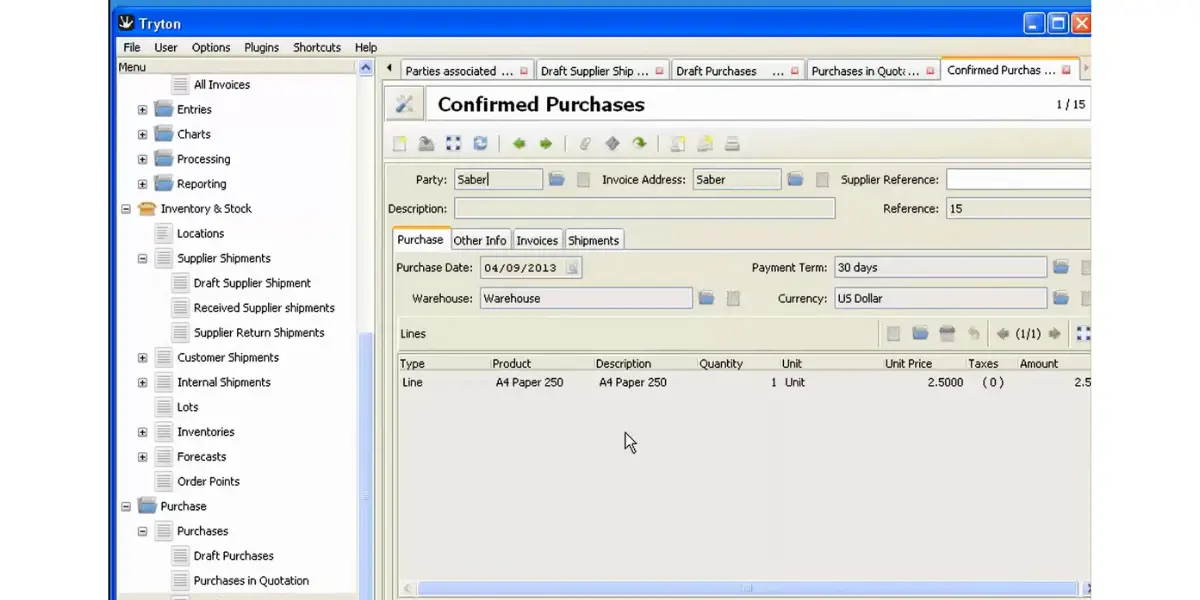
- Purchasing
- To Track orders and to save time by grouping the orders
- Supply chain
- To fulfill the warehouse on time.
- Manufacturing
- To convert the raw materials into fully finished products with the help of a bill of materials and routing.
- Shipping
- To make proper shipment.
- Project management
- To explore the gainfulness of projects and to remind invoice clients.
- Subscription management
- To generate return invoices for customer contracts.
- Third-party integration
- To automate communication with websites, banks, etc
Advantages and Disadvantages
Advantages
- Fully open source with no license or per-user fees, and no vendor lock-in.
- Highly modular, so it stays lean and you add only the functions you need.
- Strong stability, backward compatibility, and long five-year LTS support windows.
- A clean data model and documented API that make customization and integration reliable.
Disadvantages
- A smaller ecosystem than Odoo, with far fewer third-party apps, themes, and integrations.
- More technical to set up and run, since polished hosting comes only from third-party providers.
- A leaner, more utilitarian interface, with no official native mobile app.
- Fewer out-of-the-box industry verticals and a smaller commercial provider network.
What industries does it support?
It supports industries such as
- Chemical
- Pharmaceutical
- Logistics
- Trade
- Manufacturing
- Project management
- Other industries
Tryton vs Odoo and ERPNext
Odoo, ERPNext, and Tryton are the best-known open-source ERPs. They differ most in how they are governed and licensed.
| Tryton | Odoo | ERPNext | |
|---|---|---|---|
| Governed by | Non-profit foundation | Odoo S.A. (company) | Frappe Technologies (company) |
| Paid edition | None | Enterprise (per user) | None |
| License | GPL-3.0 | Community LGPLv3 / Enterprise proprietary | GPL-3.0 |
| Emphasis | Stability, clean model, long LTS | Breadth and a large app store | All-in-one, low-code |
Choose Tryton if you value independence, stability, and long support windows over a large app marketplace; choose Odoo for the biggest ecosystem and the most polished commercial features; choose ERPNext for a fully open, low-code all-in-one system.
Tryton Alternatives
Conclusion
Tryton is a strong choice for organizations that want a genuinely independent, fully open-source ERP with a clean data model and long, predictable support. Because it is foundation-governed with no paid edition, there is no upsell and no vendor lock-in.
The trade-off is a smaller ecosystem and a more technical setup than Odoo or ERPNext, so Tryton fits teams that have some in-house technical capacity or that work with a Tryton service provider. If stability and independence matter more to you than a large marketplace of add-ons, it is well worth evaluating.
References:
Frequently asked questions
Is Tryton free?
Yes. Tryton is fully open source under the GPLv3 license, with no license fee, no per-user cost, and no paid “enterprise” edition. Every official module is free. Your only optional costs are hosting and professional support if you choose to pay for them.
What is the latest version of Tryton?
Tryton 8.0, a long-term support release, came out on April 21, 2026. Tryton publishes a new series every six months; standard series get one year of support, while each major LTS release is supported for five years. The earlier 7.0 LTS is supported until November 2028.
Who maintains Tryton?
Tryton is maintained by the Tryton Foundation, a non-profit based in Liège, Belgium, together with a community of contributors and independent companies. It began in November 2008 as a fork of TinyERP, the software that became Odoo. No single company owns or controls Tryton.
What is Tryton built on?
Tryton uses a three-tier architecture: a client, an application server written in Python (trytond), and a PostgreSQL database. It offers a native desktop client built with GTK and a web client called Sao. SQLite is supported for testing.
Tryton vs Odoo: what is the difference?
Tryton is governed by a non-profit foundation and is fully GPLv3 with no paid edition. Odoo is owned by a company and splits into a free Community edition and a paid Enterprise edition priced per user. Tryton emphasizes stability and independence; Odoo offers a larger app ecosystem and more polished commercial features.