Production planning decides what will be made, in what quantity and by when, then commits the materials, labour and machine time to deliver it. It sits between the forecast and the shop floor: the forecast says what the market will probably want, and the production plan says what the factory is actually going to build.
It outlines all the necessary processes, resources, and steps involved in manufacturing, ranging from demand forecasting to identifying the required raw materials, labor, and equipment.
The word that carries the weight there is feasible. A plan that ignores capacity is a wish list, and it will be quietly rewritten on the shop floor by whoever is holding the shortage that week.
Planning or scheduling? Production planning answers what to make and how much of it. Scheduling answers which machine, which shift and in what order. Treating the two as one job is the most common reason a plan cannot be executed.
Evaluate your overall cost of ownership by utilizing our Total Cost of Ownership Calculator
What is the Production Planning?
Production planning is a process that creates a plan for producing products. The production plan is a document that explains what will be produced and when it will be produced.
The objectives of production planning are to make sure the right products are made at the right time and in the correct quantities.
This outlines how a company’s products will be manufactured efficiently and at high quality. It specifies production targets, necessary resources, processes, and schedules. This plan details each operational step and its dependencies, aiming to streamline workflow, reduce waste, and cut costs.
Initially popular with large manufacturers, production planning has become widespread among small and midsize businesses across various industries, thanks to advancements in technology. It encompasses everything from demand forecasting to managing raw materials, workforce, equipment, and production steps.
It ensures that supply chain management, production scheduling, material requirements, lead times, and capacity planning are all optimized, contributing significantly to a business’s overall efficiency and success.
What is the Importance of Production Planning?
Production planning is where the promises sales has made get tested against what the plant can physically do. Where it is done badly the symptoms are consistent: expedited freight, overtime that was never budgeted, materials bought for orders that moved, and a shop floor that has quietly stopped believing the schedule.
Boosts Profit and Revenue
A well-designed production plan minimizes errors and inefficiencies, leading to higher profit margins and revenue.
Enhances Operational Knowledge
It provides a clear framework for understanding necessary resources and production steps, helping to anticipate and mitigate potential issues.
Increases Efficiency
Streamlined planning reduces bottlenecks, optimizes resource use, and maintains high product quality within budget.
Improves Customer Satisfaction
Ensures timely delivery of products, boosting customer trust and encouraging repeat business.
Minimizes Lead Time
Reduces the time between order placement and fulfillment, crucial for industries with tight constraints or just-in-time production.
Supports Capacity Planning
Helps manage and allocate resources effectively, determining how much can be produced within a given timeframe.
Prevents Resource Waste
Ensures appropriate use of materials, labor, and equipment, preventing both shortages and excesses.
Types of Production Planning
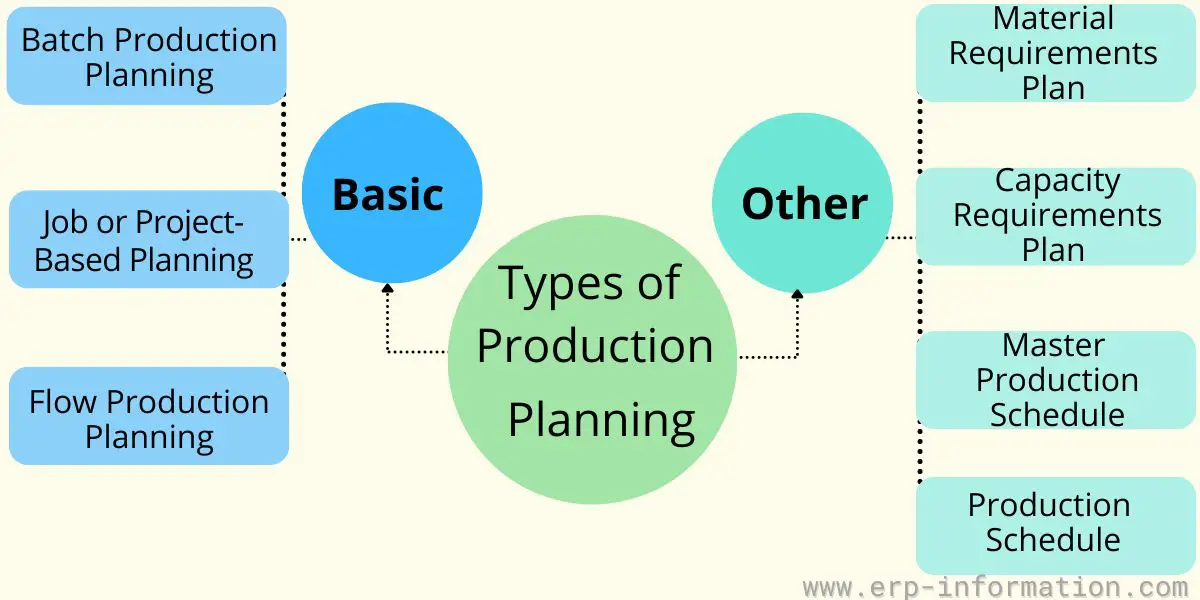
Two different things get called “types of production planning”, and mixing them up is the usual reason the topic feels confusing. The first is the production method, meaning how the factory itself is organised, and there are five: job, batch, flow, mass and process. The second is the level of planning, such as the master schedule or material requirements planning, which are stages in one hierarchy rather than alternatives to each other. The five methods come first, and the hierarchy follows below.
Batch Production Planning
Batch production involves making identical items in groups rather than individually or continuously. This method can greatly enhance efficiency for businesses.
Effective batch production planning groups similar items for efficiency and anticipates bottlenecks during changeovers between batches. For example, a furniture workshop may run a batch of oak tables, then a batch of matching chairs and shelves.
Job or Project-Based Planning
Commonly used by small and medium-sized businesses, this method focuses on creating single, customized items by an individual or a team.
It’s ideal when client-specific requirements make bulk production impractical. Each product is tailored to the client’s specifications, common in industries like custom electronics or artisanal crafts.
Flow Production Planning
Also known as continuous production, this method involves the mass production of standardized items on an assembly line. It’s perfect for large manufacturers seeking a constant output of finished goods. In flow production, each item moves seamlessly from one assembly stage to the next.
This method minimizes costs and delays when there’s a steady demand for products. Constantly mass-produces standardized items. For example, Think of a factory producing smartphones or packaged snacks on assembly lines.
Mass Production Planning
Mass production runs very high volumes of a standardised item with almost no variation between units. Planning is less about what to make next and more about protecting uptime, because the line is sized around a fixed rate and any stoppage costs output that cannot be recovered later. Fasteners, packaging and consumer electronics components are typical.
Process or Continuous Production Planning
Process manufacturing makes goods that are measured rather than counted: fuel, chemicals, cement, food ingredients. Output varies by grade instead of by model, and the plant is designed to run continuously, so a shutdown is expensive enough that planners will accept building stock they do not yet need in order to avoid one. Yield, not unit count, is the number that matters.
| Method | Volume | Variety | Changeovers | Unit cost | Typical industries |
|---|---|---|---|---|---|
| Job | One-off | Highest, specified by the customer | Every job is a setup | Highest | Bespoke machinery, prototypes, shipbuilding |
| Batch | Low to medium | Families of similar items | Frequent and disruptive | Medium | Bakery, paint, pharmaceuticals, apparel |
| Flow | High | Options within one model | Infrequent | Low | Vehicle assembly, appliances |
| Mass | Very high | Very low, standardised | Rare | Lowest | Fasteners, packaging, electronic components |
| Process | Very high, measured not counted | Grades rather than models | Avoided; the plant runs continuously | Lowest per unit | Refining, chemicals, cement, food ingredients |
Which row you sit in decides which planning problem you actually have. Job and batch shops fight sequencing and changeover time. Flow and mass lines fight line balancing and uptime. Process plants fight yield and the cost of stopping at all. Advice written for one row is often useless in another, which is worth remembering when reading generic production planning guidance.
The Production Planning Hierarchy
The terms below are not competing methods. They are levels of one hierarchy, known formally as manufacturing planning and control, and each level takes the output of the one above it and adds detail. Planning at the top is aggregate and long range; by the bottom it is a specific job on a specific machine this afternoon.
| Level | Planning unit | Typical horizon | The question it answers |
|---|---|---|---|
| Sales and operations planning | Product families, aggregate | Months, often out to about 18 | How much can we make in total, on how many shifts |
| Master production schedule | Specific finished items | Weeks to a few months | What exactly are we building, and when |
| Rough cut capacity planning | Key work centres only | Same as the master schedule | Is that schedule even possible |
| Material requirements planning | Components, from the bill of materials | Driven by the master schedule | What must we buy and make to support it |
| Capacity requirements planning | Work centres, in hours | Short | Does each work centre actually have the hours |
| Shop floor control | Jobs, machines, shifts | Days and hours | What runs next on this machine |
Those horizons are conventions, not rules, and they move with the industry. A discrete manufacturer waiting on long supplier lead times commonly runs a rolling master schedule of twelve to sixteen weeks, while a food and beverage plant with short shelf life may only schedule four to eight weeks ahead. What does not change is the order: a master schedule that was never checked against capacity will be rewritten on the shop floor, whatever the software says.
At the aggregate level there is also a choice about how to absorb demand that moves through the year: hold output steady and let inventory rise and fall with a level production strategy, or move output up and down to track demand with a chase production strategy. Most plants land somewhere between the two.
Master Production Schedule (MPS)
MPS details the production timelines for specific products within a set timeframe. Typically generated by software, these schedules can be fine-tuned manually to meet precise requirements.
Material Requirements Planning (MRP)
MRP is a system used to plan production, schedule tasks, and manage inventory. It ensures raw materials are available, keeps inventory levels low, and coordinates manufacturing and purchasing activities. While often automated, it can also be done manually.
Capacity Planning
Capacity planning evaluates an organization’s ability to meet fluctuating demands. It determines if the current resources are adequate or if adjustments are needed to handle future needs. What is Capacity Planning? (Strategies, Tools, and Process)
Click here for the Capacity Planning online calculator
Workflow Planning
Workflow planning organizes the sequence of tasks performed by employees or teams. It ensures operations are carried out efficiently and in the correct order, enhancing overall productivity.
Steps to Create a Production Plan/Process Flow
It is a comprehensive process that encompasses forecasting, process design, and monitoring. Here are five essential steps to develop a production plan:
1. Forecast Product Demand
Begin by estimating the demand for each product over a specific period. Utilize historical data and consider market trends and economic factors. Demand planning software can aid in making informed decisions about the required product quantity.
2. Map Production Steps and Options
Determine the processes, resources, and steps necessary for production. Explore various options to achieve production goals, such as outsourcing. Identify interdependent steps and those that can occur simultaneously. Ensure equipment availability and assess potential risks.
3. Choose a Plan and Schedule Production
Evaluate different production plans based on cost, time, and risks. Share the selected plan with stakeholders to ensure alignment. Develop a detailed production schedule outlining resource allocation and timing for each step.
4. Monitor and Control
Track production performance against set targets. Continuous monitoring helps detect issues promptly for swift resolution.
5. Adjust Accordingly
Anticipate unforeseen events like changes in client specifications or supply chain disruptions. Keep the production plan flexible to accommodate adjustments as needed. Regularly review and refine the plan for ongoing improvement.
Businesses employ a diverse array of tools to develop production plans and monitor progress, ranging from visualization aids to advanced software solutions. Here are some typical tools used:
Tools
Visual Timeline Tools
Gantt Charts: A Gantt chart offers a detailed visual representation of all tasks scheduled for a specific job. Originally conceived by mechanical engineer Henry Laurence Gantt over a century ago, this chart remains indispensable in manufacturing and various industries.
It visually depicts task timings and durations, facilitating coordination and scheduling in production planning.
Data Management Solutions
Spreadsheets: Initially used by small companies for basic production plan tracking, spreadsheets quickly prove insufficient for managing the complexities of production planning as businesses grow.
Advanced Software Solutions
This software encompasses a wide range of functionalities, including forecasting, supply chain management, inventory tracking, and job scheduling.
Given the multifaceted nature of production planning, businesses often rely on enterprise resource planning (ERP) suites that integrate production planning software. Such suites provide a comprehensive solution for managing various aspects of business operations, including finance.
Difference Between Production Planning and Production Scheduling
| Aspect | Production Planning | Production Scheduling |
| Definition | Provides an overview of what the company plans to produce. | Creates a detailed view of how the company will execute the production plan. |
| Focus | Outlines production targets, required resources, processes, and overall schedule. | Specifies when each step will occur and assigns workers, machinery, and other resources to specific tasks. |
| Complexity | Generally broader and less detailed. | Can be extremely complex, especially with many interdependent steps and simultaneous production of multiple products. |
| Details | Maps out operational steps and their dependencies. | Details the specific timing and resources for each production step. |
| Tools | Often involves planning software and forecasting tools. | Utilizes scheduling software to create, monitor, and adjust detailed schedules in real time. |
| Goal | To design an efficient, cost-effective production process that meets quality standards. | To ensure that the production plan is executed smoothly and efficiently on a detailed, day-to-day basis. |
| Adjustments | Provides a framework for adjustments when problems occur. | Allows for real-time monitoring and quick adjustments to address issues as they arise. |
| Scope | Covers long-term production strategy and overall workflow. | Focuses on the short-term execution of the production plan, including daily and weekly schedules. |
One thing detailed scheduling adds is protection for the near term. Schedulers lock the closest part of the schedule inside a frozen zone, where quantities and dates cannot change, so the shop floor has a stable plan to build to while later periods stay open to adjustment.
Outcomes
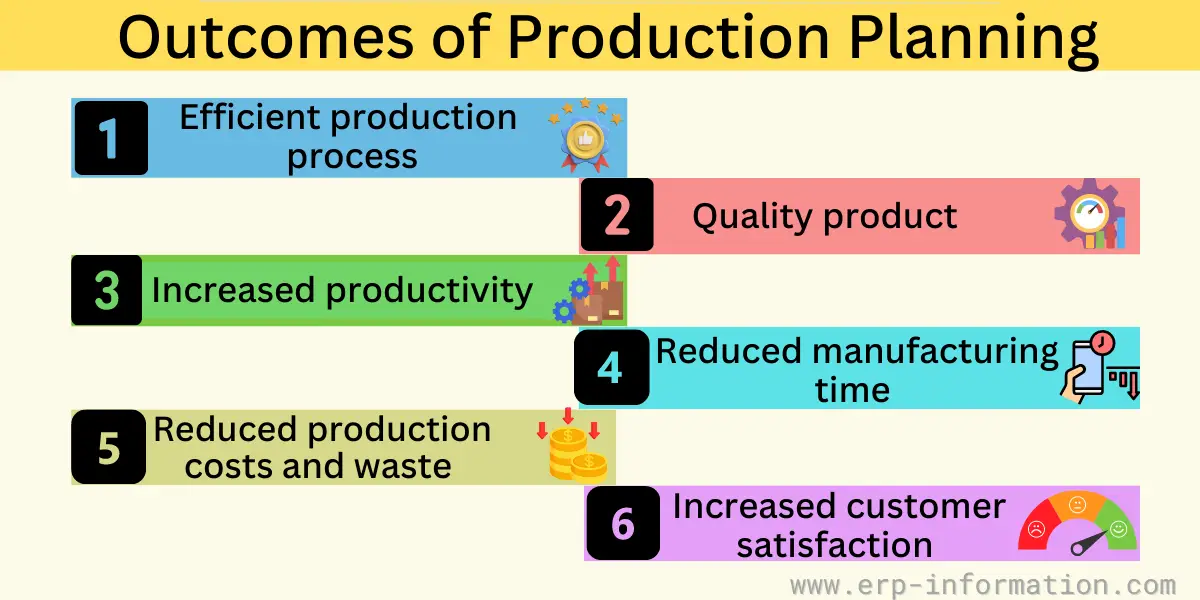
The outcomes of a better production planning process are:
- A well-organized and efficient production process
- Improved quality of the final product
- Increased productivity and efficiency
- Reduced manufacturing time
- Reduced waste and scrap
- Reduced production costs
- Increased customer satisfaction and reduced lead time.
List of production planning software
- Microsoft Excel – Microsoft Excel is one of the most common and popular software for production planning. Small and medium businesses widely use it because it is easy to use and versatile.
- Oracle Primavera – Primavera is a production planning software used by larger businesses. It offers more features than Microsoft Excel, such as creating Gantt charts.
- SureTrak Project Manager – SureTrak was Primavera’s entry-level scheduling tool, a scaled-down option for smaller projects, and is now discontinued. Primavera P6 is the enterprise flagship, with far more capability, including detailed resource, inventory, and cost tracking.
- Microsoft Project – Microsoft Project is a project management software used for production planning. It has more features than Microsoft Excel, such as creating timelines and tracking costs.
- Workfront production planning software – Workfront is a cloud-based software that helps businesses manage their production planning. It has features such as the ability to track tasks and costs and to create reports.
Most modern ERP solutions include a production planning module in them.
FAQs
Why is production planning important in supply chain management?
Production planning is essential in supply chain management because it allows for the smooth and efficient flow of goods from the supplier to the customer. Production planning also helps ensure that the correct quantities of goods are produced and produced on time. Production planning also helps to keep costs down and minimizes waste.
How do you plan human resources in production?
When planning human resources as part of manufacturing production planning, it is vital to consider its needs and the available workforce. Some factors to consider when planning human resources include:
– The number of employees needed
– The types of positions needed
– The skills and experience required for the positions
– The geographical location of the employees
– The availability of qualified employees
What is Production Planning and Inventory Control?
Production planning and inventory control (PPIC) is a process that determines the number of products to produce when to make, and what resources are needed.
PPIC also determines the types and quantities of materials from suppliers and the need for finished goods inventory. As a result, PPIC helps companies ensure they have the right products on hand to meet production orders while minimizing costs.
What are some common mistakes in production planning?
Common mistakes in production planning include inadequate forecasting, insufficient consideration of resource availability, underestimating setup times, and overlooking potential bottlenecks in the production process.
What is the history of production planning?
Production planning originated during the Industrial Revolution to manage mass production more effectively. Key figures like Frederick Taylor and Henry Gantt pioneered early techniques, with Gantt’s chart revolutionizing task scheduling. The demands of World War II advanced systematic planning approaches. The mid-20th century saw computers enhance precision and data analysis, leading to the development of complex planning software. Enterprise Resource Planning (ERP) systems emerged later, integrating various business processes. In the 21st century, advancements in AI, machine learning, and IoT have further evolved production planning, making it more adaptive and efficient.
Conclusion
Effective production planning is important for any business aiming to meet customer demands efficiently and cost-effectively. By understanding and implementing the various types of production planning, utilizing the right tools, and monitoring key performance indicators, companies can streamline their operations and improve productivity.
A well-constructed production plan not only optimizes resource use but also minimizes downtime and enhances overall product quality.