Lot tracking is how a business ties a group of finished products back to the raw materials, production run, and date that made them, so that if something goes wrong with one lot, the company can find every affected unit without pulling every product off every shelf.
This article covers what lot tracking actually is, how lot numbers are formatted under the GS1 standard, why it matters (including a real recall case and the current FSMA 204 compliance deadline), how it differs from serial tracking, and the software categories and current vendors that support it.
What is lot tracking?
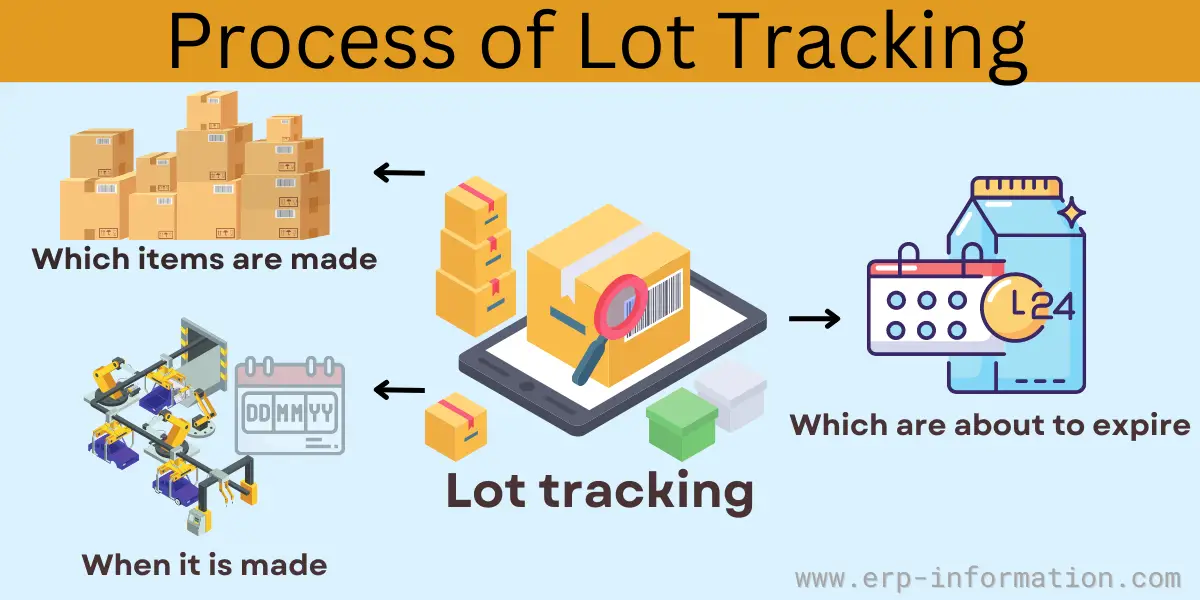
Lot tracking, also called batch tracking, records which raw materials and production run went into a specific group (a “lot” or “batch”) of finished product, and follows that lot from manufacturing through distribution to the point of sale.
It organizes stock by lot rather than by individual unit, which gives a business visibility into shelf life, origin, and quality status at the batch level, so that a problem discovered in one production run can be traced to exactly the units it affects instead of the entire product line.
How a lot number is actually structured
Under the GS1 Global Traceability Standard, the batch/lot number is application identifier (AI) 10, one of the data fields carried in a GS1-128 barcode alongside the product’s GTIN (Global Trade Item Number). For lot-level traceability, the barcode carries GTIN plus lot number; for unit-level traceability (the serial tracking covered below), it carries GTIN plus a unique serial number instead. A GS1-128 barcode can carry up to 48 characters, enough to encode the GTIN, lot number, and a production or expiration date (formatted YYMMDD) in a single scan.
This matters practically because it is what makes a recall scan-able rather than manual: a distribution center or retailer scanning inbound product can identify the lot instantly, rather than reading a printed code off a label by eye.
Who needs lot tracking, and why
Lot tracking adds cost and complexity, since it requires labeling, recording, and reconciling stock at the batch level rather than treating inventory as one interchangeable pool. That cost is worth it, and in several industries is not optional, for perishable and regulated goods: food and beverages, vitamins and supplements, pharmaceuticals, cosmetics, and electronics with date-sensitive components.
It is also frequently a certification requirement, not just a best practice, for the Food and Drug Administration (FDA), ISO quality standards, and CFIA (Canada), since all three require the ability to trace a product’s origin and shelf life on demand.
FSMA 204: the current US food traceability deadline
In the US, food businesses handling items on the FDA’s Food Traceability List face a specific new requirement under FSMA Section 204: assigning a Traceability Lot Code (TLC) to covered foods, capturing defined Key Data Elements (KDEs) at Critical Tracking Events (CTEs) such as receiving, transformation, and shipping, and producing those records to the FDA within 24 hours of a request.
The compliance date has moved: it was originally January 20, 2026, but the FDA proposed a 30-month extension and Congress directed the agency not to enforce the rule before July 20, 2028. If you’re evaluating lot tracking software now because of this rule, note that some large retailers are not waiting for the federal deadline: Walmart’s own supplier traceability requirement took effect August 1, 2025, with chargebacks for non-compliant shipments already being assessed.
Importance
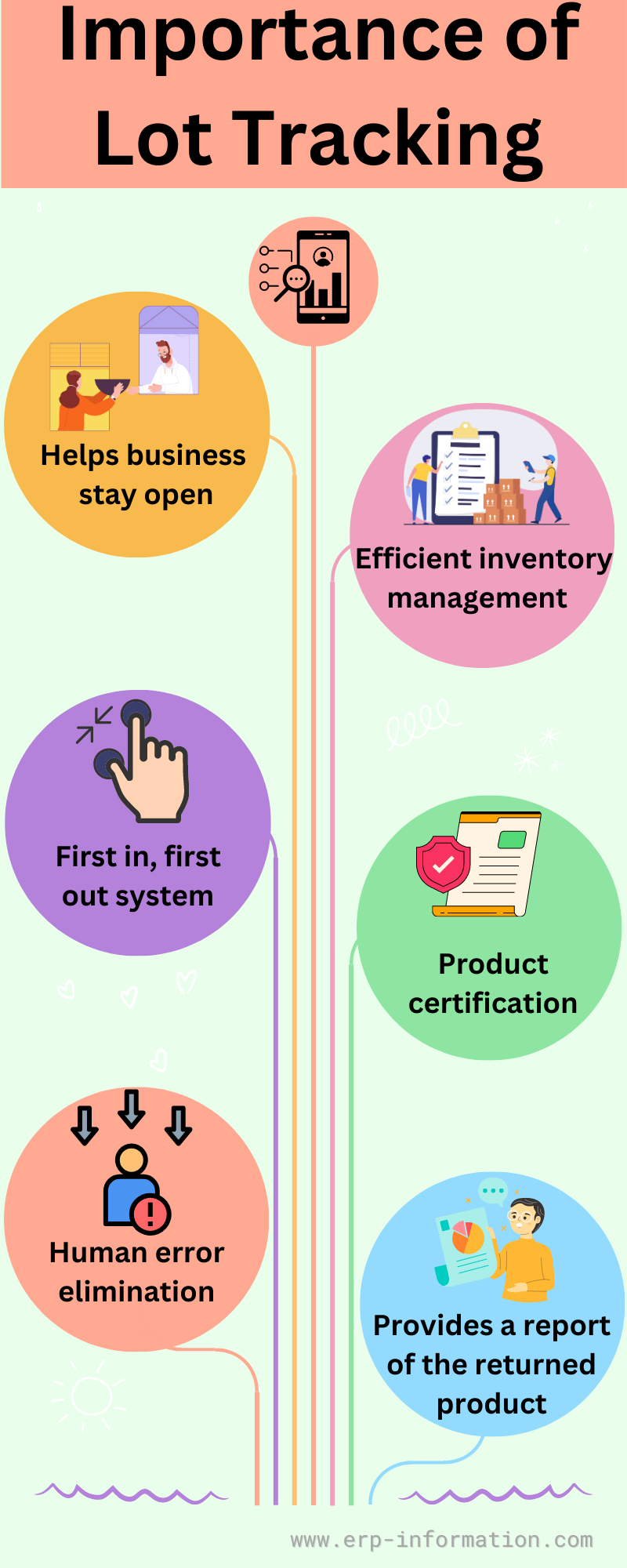
Makes a recall targeted instead of total
The clearest real-world case for lot tracking is Abbott’s 2022 powdered infant formula recall. After Cronobacter sakazakii and Salmonella Newport were linked to its Sturgis, Michigan plant, Abbott identified the affected product by lot code: cans with specific code prefixes, plant codes, and expiration dates after April 1, 2022. Because the products were lot-coded, Abbott could publish a lookup tool where parents entered the code on their own can to check whether it was affected, rather than every can of Similac, Alimentum, or EleCare nationwide being pulled or presumed unsafe. That is what lot tracking is actually for: narrowing a safety problem to the exact units it touches.
Efficient inventory management
Lot tracking keeps warehouse inventory organized by batch, so fulfillment can pull by expiration date, inventory scans reconcile against known lots rather than loose counts, and distribution centers ship the correct batch rather than the most convenient one.
First-in-first-out (and first-expired-first-out)
Lot tracking combined with FIFO, or FEFO (first-expired-first-out) for perishables, keeps a business from accidentally shipping expired stock, which is both a compliance risk and a direct driver of customer complaints and returns.
Certification
FDA, ISO, and CFIA certifications for perishable or regulated products generally require lot-level traceability as a precondition, including the ability to prove where a product’s ingredients originated, which matters for organic and origin-based claims specifically.
Reduces human error
Scanning a GS1-128 barcode at each step removes the manual reading and re-keying of lot numbers, which is where most shipping and audit errors originate.
Turns returns into a diagnostic signal
A spike in returns tied to a specific lot is a much stronger signal than a spike in returns generally. Lot-level return data can point straight at a specific production run, ingredient supplier, or shift, rather than leaving the cause to guesswork.
Main users
- Food, beverage, and nutrition manufacturers, and perishable product producers generally
- Cosmetics manufacturers
- Pharmaceutical and supplement manufacturers
- Pet food manufacturers
- Manufacturers of hazardous or regulated materials
Lot tracking vs. serial tracking
| Lot tracking | Serial tracking |
| Tracks a bulk group of items made together as one unit. | Tracks a single, individually identified item. |
| GS1 barcode carries GTIN + lot number (AI 10). | GS1 barcode carries GTIN + a unique serial number per unit. |
| Identifies which production run an item came from and when it expires. | Identifies the specific unit sold to a specific customer, useful for warranty claims and high-value asset tracking. |
| Typical examples: food, beverages, pharmaceuticals, textiles. | Typical examples: vehicles, appliances, electronics, insured equipment. |
Lot tracking software categories
Lot tracking is rarely a standalone purchase; it is usually a feature inside one of these system categories, and the right one depends on where in the business the traceability requirement actually lives.
- Distribution accounting software: costs and values inventory at the lot level, so cost of goods sold reflects the actual batch shipped.
- Manufacturing and resource planning software: plans production runs against lot numbers and links output lots back to the input lots consumed.
- Inventory management software: tracks stock in and out at the lot level rather than as an undifferentiated quantity.
- Warehouse management software: uses lot numbers to drive putaway location and pick sequencing (typically FEFO for perishables), not just in/out counts.
- Manufacturing execution software: verifies that the correct input lots and ingredients were actually used in a given production run, which is the record an FDA audit or FSMA 204 request will ask for.
Food and beverage traceability platforms specifically built around FSMA 204 and lot-level compliance include:
- FoodLogiQ, built specifically around FSMA 204 compliance, capturing Critical Tracking Event data at each step.
- BatchMaster, process manufacturing ERP with lot traceability that integrates with QuickBooks, Sage, Microsoft Dynamics GP, and SAP Business One.
- Trustwell, food safety and traceability compliance software.
- Wherefour, batch and lot traceability aimed at food and beverage producers.
- Document Compliance Network, food safety documentation and traceability software.
When evaluating any of these against your own FSMA 204 exposure, the criteria that matter are native CTE/KDE capture at every stage (not a bolt-on spreadsheet), automatic linking of the Traceability Lot Code from input ingredients to output product, and the ability to produce records within the FDA’s 24-hour window, alongside standard ERP integration.
Benefits of lot tracking and traceability
- Reduces waste by making expiring stock visible at the batch level
- Keeps the supply chain compliant with FDA, ISO, and CFIA requirements
- Turns a recall into a targeted, lot-specific action instead of a total product pull
- Supports FIFO and FEFO stock rotation
- Surfaces quality issues at the batch level through inbound and outbound testing
- Speeds up audits, since lot records answer “where did this come from” without a manual search
The main tradeoff: lot tracking adds real labeling, scanning, and record-keeping overhead, which is why very small operations with low volume sometimes defer it until either regulation or a distributor requirement (like Walmart’s supplier mandate) makes it necessary.
What is Serial tracking?
Serial number tracking follows a single, individually identified item from manufacturing through sale, using a unique serial number per unit rather than a shared batch code. It’s used for warranty claims and high-value asset tracking, where lot tracking alone can’t identify one specific unit.
What is the FSMA 204 lot tracking compliance deadline?
The FDA’s Food Traceability Rule (FSMA 204) was originally set to take effect January 20, 2026, but the compliance date was extended 30 months, and Congress directed FDA not to enforce it before July 20, 2028. Some large retailers, including Walmart, already enforce their own supplier traceability requirements ahead of that federal deadline.
What information does a lot or batch number need to include?
Under the GS1 standard, a batch/lot number is application identifier (AI) 10, carried in a GS1-128 barcode together with the product’s GTIN. A GS1-128 barcode can hold up to 48 characters, enough to include the GTIN, lot number, and a production or expiration date, which is what allows a lot to be identified with a single scan rather than a manual lookup.
Conclusion
Lot tracking exists for one reason: when something goes wrong with a production run, a business needs to know exactly which units it reached without guessing or recalling everything. The GS1 lot number standard is what makes that traceable with a barcode scan instead of a paper trail, and FSMA 204, even with its compliance date now pushed to July 20, 2028, is making that traceability a legal requirement rather than a best practice for a widening set of food businesses in the US.
Whether lot tracking runs through dedicated food-traceability software or as a module inside a broader ERP, warehouse, or manufacturing execution system depends on where your actual compliance and operational exposure sits, not on which category sounds most complete.