Microsoft Dynamics GP, originally Great Plains, is Microsoft’s on-premises accounting and ERP system for small and mid-sized businesses. Since April 1, 2026, Microsoft sells it only to existing customers. Support ends on December 31, 2029, and security updates on April 30, 2031. Microsoft’s own replacement is Dynamics 365 Business Central.
- Latest version: 18.9, the October 2026 release, with eight new features.
- Staying supported: install at least one of Microsoft’s three yearly updates, due around June 1, October 1 and December 1.
This video dates from April 2022, before Microsoft announced GP’s end dates. For dates and costs, use the text on this page.
What is Microsoft Dynamics GP?
GP stands for Great Plains. Great Plains Software made it, and Microsoft bought the company in April 2001 for about $1.1 billion in stock. Microsoft counts more than 40 years of availability for the product.
There is no “Dynamics 365 GP.” Dynamics 365 Business Central is a separate product, and it is the one Microsoft encourages GP customers to move to.
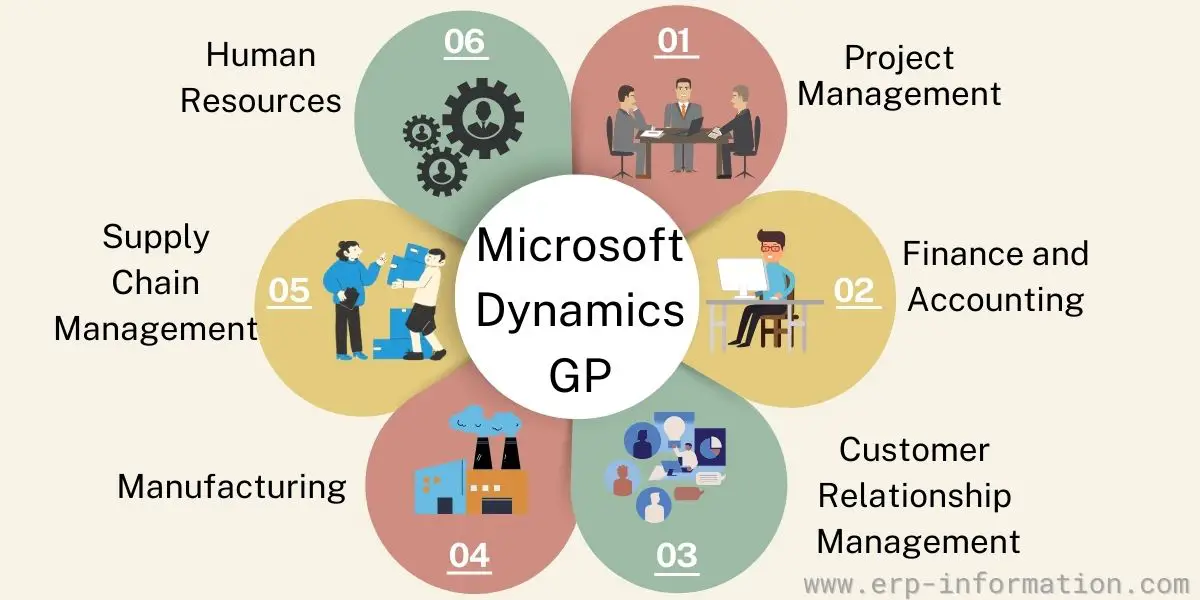
Microsoft’s GP documentation groups the product into five areas:
- Financials: general ledger, bank reconciliation, multicurrency, intercompany, fixed assets, analytical accounting, receivables and payables.
- Distribution: sales orders, purchase orders, invoicing, inventory, and Encumbrance Management, which reserves budget when a purchase order is created.
- Project Accounting: project costs and billing.
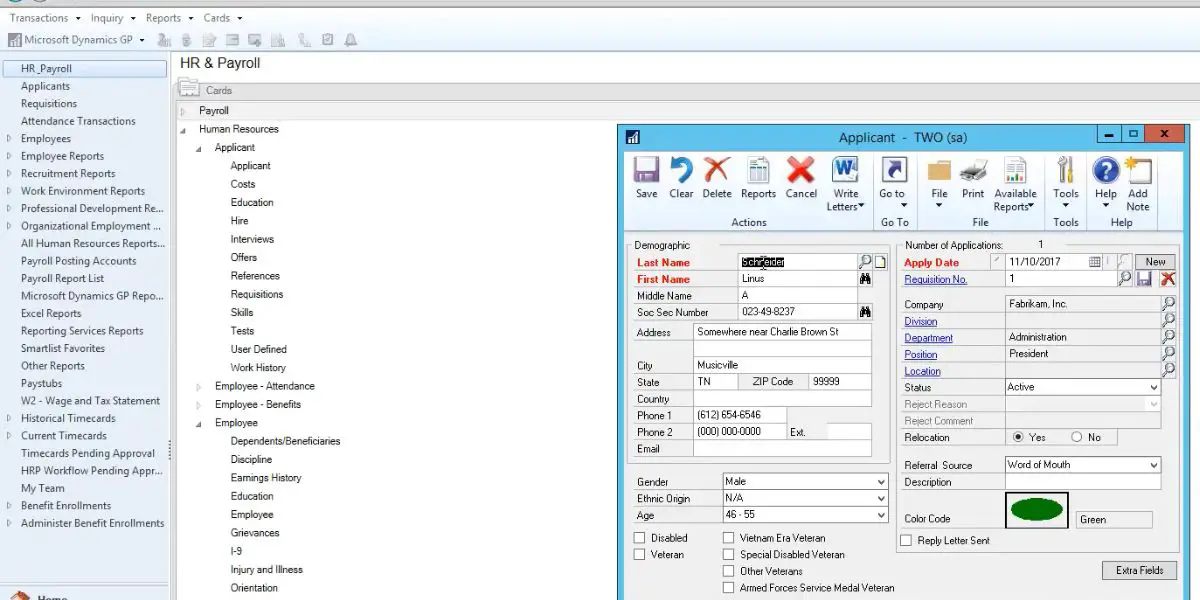
- Payroll and Human Resources: U.S. payroll, Canadian year-end, advanced HR and paid time off.
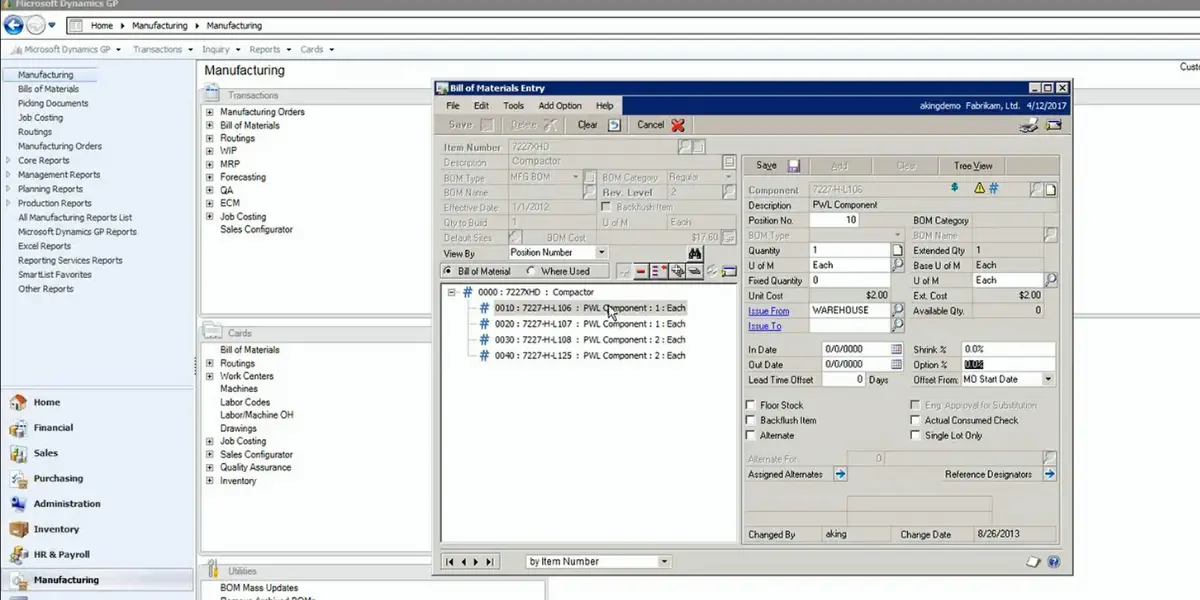
- Discrete Manufacturing: bills of materials, routings, manufacturing orders and MRP.
Is Microsoft Dynamics GP cloud based?
No. GP is installed software, not a cloud service. It can run on cloud servers, but you or a hosting partner install and maintain it there.
Microsoft’s guide to running GP on Azure says so directly: “The Microsoft Dynamics GP you deploy in Microsoft Azure is the same one that you would deploy in your own office or data center.”
Staff outside the office reach GP through Remote Desktop Services or Citrix, or in a browser through GP’s web client.
Business Central online is the cloud product. Moving to it means copying your GP data from SQL Server into Business Central, not upgrading GP.
Is Microsoft Dynamics GP still supported? (2026 lifecycle status)
Yes, for existing customers, until December 31, 2029. These are the dates Microsoft has set.
| Date | What changes |
|---|---|
| April 1, 2026 | GP is sold only to existing customers. It was the last day a new customer could license a GP subscription. |
| December 31, 2029 | Product enhancements, tax and regulatory updates, and technical support end. Microsoft moved this from September 30, 2029. |
| April 30, 2031 | Security updates end. Service Plan coverage ends, subscriptions can no longer be renewed, perpetual users can no longer be added, and hosted use under SPLA licenses is expected to end. |
Microsoft’s GP documentation now warns that support “may no longer match the standards you’ve come to expect, as resources and updates for Dynamics GP become increasingly limited.”
Older versions run on fixed dates, and most have already passed:
| Version | Extended support ended or ends |
|---|---|
| GP 2013 and 2013 R2 | April 11, 2023 |
| GP 2015 and 2015 R2 | April 8, 2025 |
| GP 2016 and 2016 R2 | July 14, 2026 |
| GP 2018 and 2018 R2 | January 11, 2028 |
On GP 2018, installing any compatible tax release or hotfix takes you to version 18.5 or later, which puts you on the 2029 and 2031 dates above.
What does Microsoft Dynamics GP cost in 2026?
A new customer cannot buy GP at any price. Since April 1, 2026, Microsoft licenses it only to existing customers.
If you already run GP, your costs are set in your agreement with your reselling partner. Until April 30, 2031 you can renew a subscription or add perpetual users.
A perpetual GP license starts with a Starter Pack, which covers core financials and distribution and includes the first three Full users. On top of it sit an optional Extended Pack and extra user licenses.
GP’s Full and Limited user licenses are concurrent, so several people can share one as long as they are not signed in at the same time. Self-serve users, who only view their own employee data and request supplies, are licensed per person.
What will Business Central cost a GP site?
Microsoft lists three Business Central licenses. Each is a monthly fee per person, paid yearly.
| License | USD per user per month | Who it is for |
|---|---|---|
| Essentials | 80 | People who enter and post transactions in finance, sales, purchasing, inventory and projects |
| Premium | 110 | The same, plus manufacturing and service management |
| Team Members | 8 | People who read data, approve workflows, update existing records, or handle quotes and time sheets |
Count people, not GP seats. A Business Central license belongs to one named user, while GP’s Full and Limited licenses are shared.
Manufacturing decides the tier. Essentials and Premium can run side by side only in separate environments, and each user reaches only the environment their license covers. If a GP company uses Manufacturing, plan on Premium for every full user who works in it.
Formula: monthly cost = people who post transactions × $80 (or $110 for Premium) + people who only read and approve × $8. Multiply by 12 for the year.
Worked example: a company has 8 GP Full licenses shared by 14 people who post transactions. Four more people only look up data and approve purchase orders.
- Essentials: 14 × $80 + 4 × $8 = $1,152 a month, or $13,824 a year.
- Premium, if the company runs GP Manufacturing: 14 × $110 + 4 × $8 = $1,572 a month, or $18,864 a year.
- Counting the 8 GP seats instead (8 × $80 + 4 × $8 = $672 a month) would understate the Essentials cost by $480 a month, or $5,760 a year.
These are license costs only. Partner fees for migration and setup, add-on apps, Copilot Credits for agents and extra database capacity or environments cost extra.
Partners also advertise a Microsoft “Bridge to Cloud” discount on new Business Central licenses added in 2026 and later, on a three-year term. Ask your partner for Microsoft’s written terms before you budget on it.
What moves from GP to Business Central, and what does not?
Microsoft’s cloud migration tool copies GP data into Business Central online. Its documentation lists what comes across.
| GP data | What Microsoft’s tool does with it |
|---|---|
| Chart of accounts | The main segment becomes the account number; other segments become dimensions |
| General ledger history | Summary balances per fiscal period. Detail can come over as a separate GP Historical Snapshot |
| Customers, vendors, open receivables and payables | Moved, with each open document at the amount still owed |
| Open purchase orders | Moved, except lines already fully received and invoiced |
| Inventory items | Moved with their cost method, quantities, locations, and lot or serial numbers |
| Checkbooks | Moved with unreconciled transactions; undeposited receipts are not |
| 1099 vendor data | From tax year 2024 |
Microsoft’s list of migrated data names no payroll, HR, manufacturing, project accounting or fixed-asset data. Ask your partner how each module you use will move before you sign.
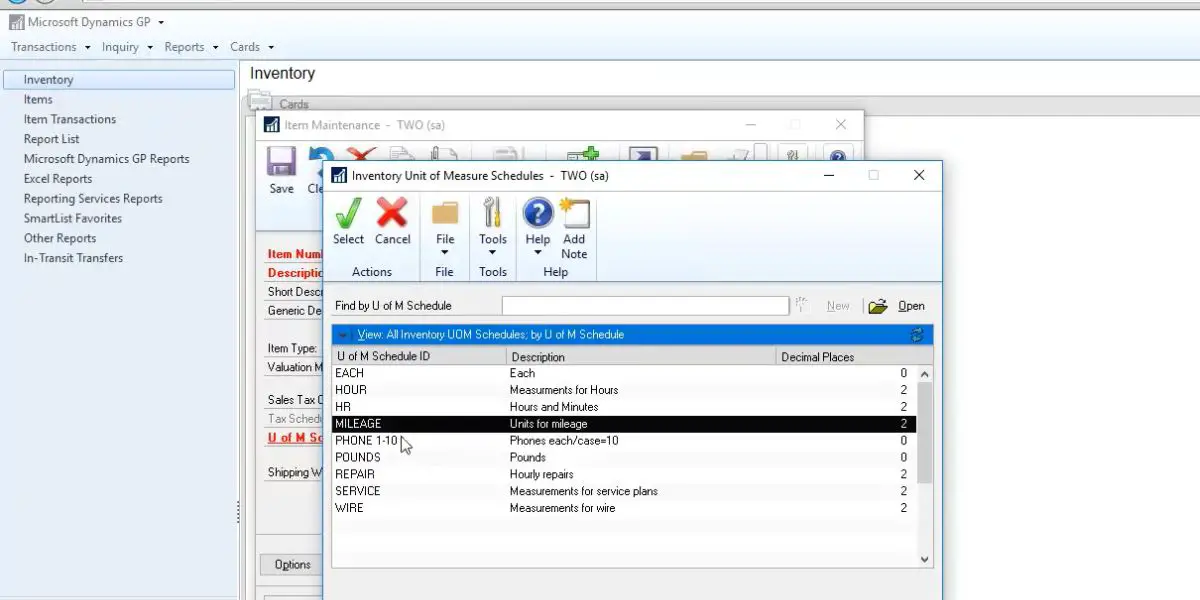
Two details need planning. Years marked historical in GP arrive open and must be closed again in Business Central. GP’s unit of measure schedules have no equivalent there, so units are set per item.
Microsoft also offers a migration assessment tool that checks a GP system’s readiness before you start.
Microsoft Dynamics GP pros and cons
Strengths, for a company that keeps it:
- Microsoft keeps shipping tax and regulatory updates three times a year until the end of 2029.
- It works with Office: Word templates for documents, and Excel import for purchasing transactions and stock counts.
- Budget control is built in: Encumbrance Management reserves budget on purchase orders and reports actual against budgeted amounts.
- You choose where it runs: your own servers, a partner’s, or Azure virtual machines.
Limits:
- No new customer can buy it, and its end dates are fixed.
- Microsoft itself warns that GP support may fall short of past standards.
- New features arrive slowly: the October 2026 release added eight.
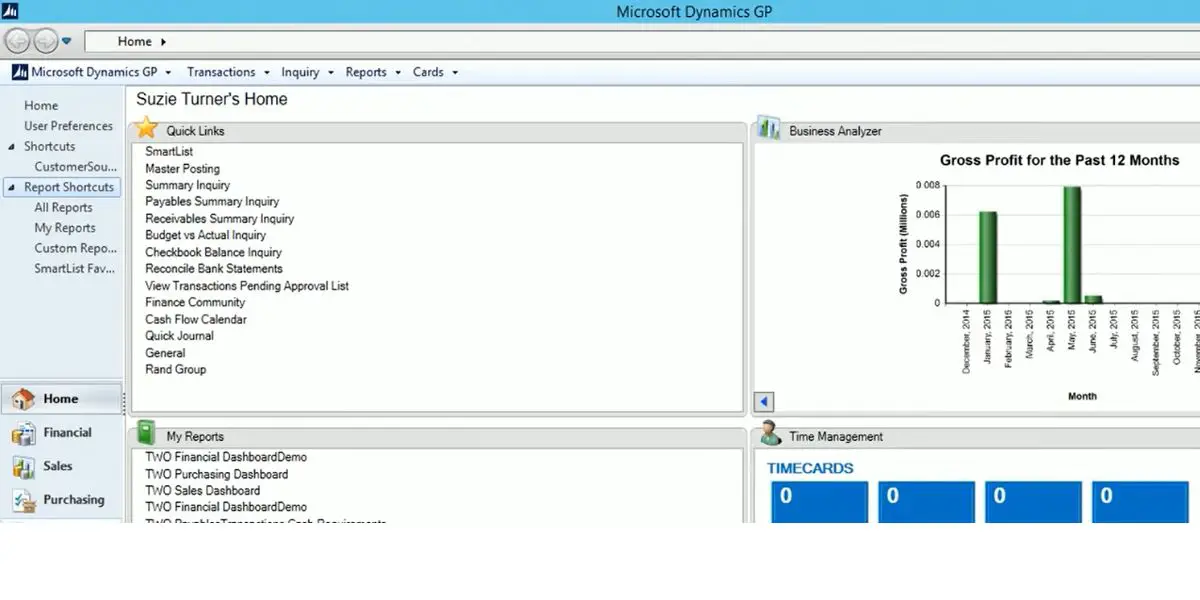
- You run the servers and SQL Server, plus SQL Server Reporting Services if you want the Home page charts.
- Hosted use under SPLA licenses is expected to end on April 30, 2031.
Correction: an earlier version of this page said GP has no budgeting or warehousing, and listed customers we could not trace to Microsoft. GP has the budget control above and inventory by site, and the customer list has been removed.
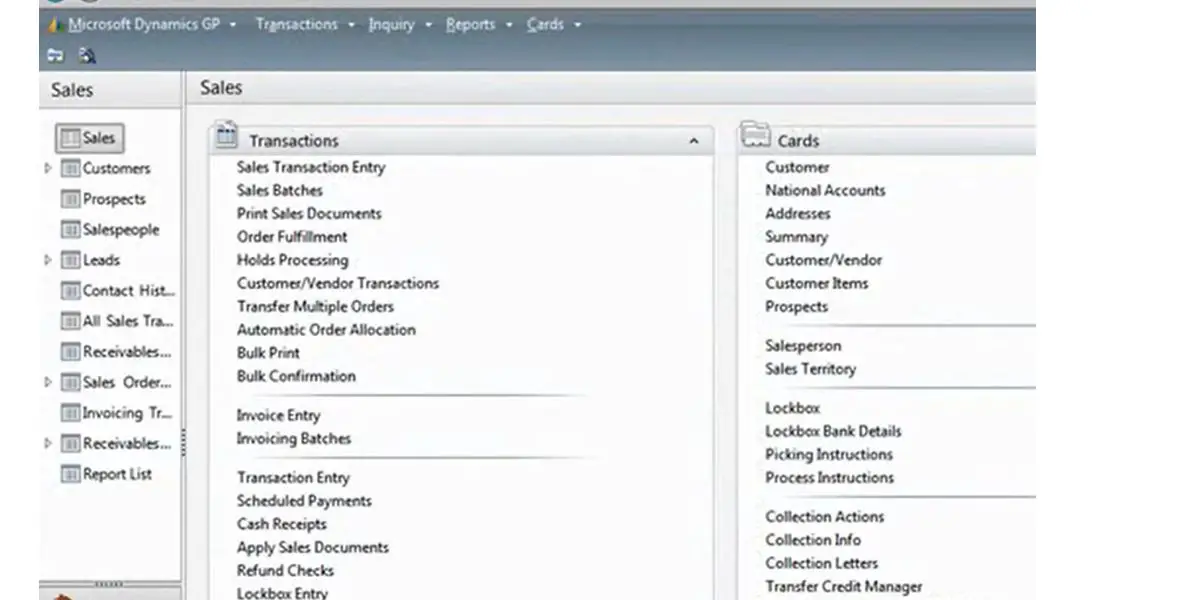
What does Dynamics GP look like?
These screens come from a GP demo company.
Alternatives for Microsoft GP
Microsoft’s own successor is Dynamics 365 Business Central, covered in the cost and migration sections above. Other mid-market ERP systems we review:
- NetSuite, also compared in Microsoft Dynamics vs NetSuite
- SAP Business One
- Epicor
- Acumatica
- Odoo
- Sage 100
- Deltek Costpoint
Should you stay on GP or move?
If GP runs your business today, nothing forces a move before the end of 2029. Keep taking at least one update a year and keep your partner agreement current.
Price the move now with the formula above, counting people rather than seats. Then check each module you use against Microsoft’s migration list, above all payroll and manufacturing.
If you are choosing an ERP for the first time, GP is not an option. Compare Business Central with the alternatives above, or browse our list of ERP vendors.
Using Google Search? Add erp-information.com as a preferred source.