IFS Cloud is the enterprise software most people mean by “IFS ERP.” It is best known for its depth in asset-intensive and service-heavy industries, such as aerospace and defense, energy and utilities, engineering and construction, manufacturing, and field service, rather than as a generalist ERP for every small business. What sets it apart is that it combines ERP, enterprise asset management (EAM), and field service management (FSM) on a single platform instead of three systems bolted together.
This review covers IFS Cloud (formerly IFS Applications): its 2026 release, realistic pricing, modules, implementation, support, and honest pros and cons, so you can judge whether it fits your business.
Latest release: IFS Cloud 26R1 (2026). IFS ships two releases a year, a spring “R1” and an autumn “R2”, so customers get a predictable twice-yearly upgrade cadence.
Note: IFS Cloud replaced the older IFS Applications line in 2021, unifying ERP, enterprise asset management, and field service management into a single product.
What is IFS ERP?
IFS Cloud is a single, composable platform that brings ERP, enterprise asset management, and field service management together. IFS, founded in Sweden in 1983, aims it at mid-sized to large, asset- and service-intensive organizations such as manufacturers, construction and engineering firms, utilities, and aerospace and defense operators, rather than small businesses looking for a simple accounting package.
Its functional footprint is broad: financial management, project management, procurement and supply chain management, human resources, and asset management, which is why it suits organizations running complex, multi-function operations rather than a single department.
An agile solution allows organizations to customize the software with the required modules instead of buying different software.
IFS.ai delivers Artificial Intelligence (AI) across all IFS capabilities, enhancing every aspect of their enterprise solutions.
IFS ERP Pricing
IFS does not publish official list prices, and there is no free version or free trial. Based on independent ERP pricing research (ERP Research, Top10ERP, ERP Pilot), IFS Cloud subscriptions typically run ~$110 to $250 per user per month, and a mid-market implementation commonly lands in the ~$100,000 to $400,000 range depending on scope. Treat these as planning ballparks, the real figure depends on the modules you switch on, user counts, and customization. Pricing is quoted per your modules, scale, deployment type, and location.
License and subscription cost
| On-premise | Cloud-based/SaaS | For both deployment types |
| Based on a perpetual license-based model, the license fee includes an upfront cost for owning the software and IP for a fixed term, along with implementation, maintenance, system upkeep, customization, and third-party integration. The typical rate for perpetual or renewal licensing for ERP systems ranges from 10% to 15%. | Based on a recurring subscription model, costs are calculated per user, per month. | costs vary depending on the number of user licenses, access levels, applications, organization size and type, and required customization. |
Implementation cost
For both on-premise and cloud deployment, costs exceed the upfront or subscription fees. They vary based on the number of users, system architecture, implementation scope and complexity, company size, industry, additional applications, add-ons, and third-party integrations.
Maintenance cost
| On-premise | Cloud-based/SaaS | For both deployment types |
| Costs exceed the license fee. Requires ongoing maintenance and upgrade support and users must enter a maintenance agreement for annual support, costing 10% to 20% of the original license fee. | Additional costs for ongoing maintenance and upgrades are not included in the subscription fee. | Costs vary based on the number of users. Upgrade fees are charged for new releases, which are essential for the ERP system to remain fully functional. |
Because every IFS quote is configured, always request a written quote and a fixed-scope implementation estimate before you commit, and budget for annual maintenance (roughly 10 to 20% of licence value on the perpetual model) and the upgrade effort each new release brings.
Implementation
The implementation process for IFS Cloud ERP depends on the system’s complexity and the organization’s specific requirements. On average the process takes between 6 months to 2 years. The steps are as follows:
Planning: The first step involves identifying the business goals and objectives. It is crucial to select an experienced implementation partner who can provide guidance and best practices throughout the process.
Analysis and Design: During this stage, the project team collaborates with the organization to conduct a thorough analysis of current business operations and identify areas for improvement.
Data Migration: This critical step involves transferring information from the company’s current system to the new ERP system. Due to the large volume of data involved, this process is complex and requires meticulous attention to detail.
Testing and Training: This step encompasses comprehensive testing of the new system to ensure alignment with requirements. Additionally, it includes conducting training sessions for users to facilitate seamless adoption.
Post-implementation: Once the new ERP system goes live, the project team oversees a smooth transition and attends to any possible issues. The team also provides ongoing support and maintenance including offline (classroom) and online sessions. Offline training usually spans 2 to 3 days, varying based on the course, while online sessions range from 1 to 4 hours, also depending on the course.
Services and Supports
It provides a wide range of support plans, from basic plans to 24/7 emergency support.
Other than that, it supports via phone, internet, and community forums.
IFS ERP Modules
IFS Cloud is unusual in that it brings enterprise resource planning (ERP), enterprise asset management (EAM), and field service management (FSM) together on a single platform. Its composable architecture means you can run one capability on its own (EAM-only or FSM-only, for example) and add the rest as you grow, instead of buying separate systems that then have to be integrated.
The core functional modules are:
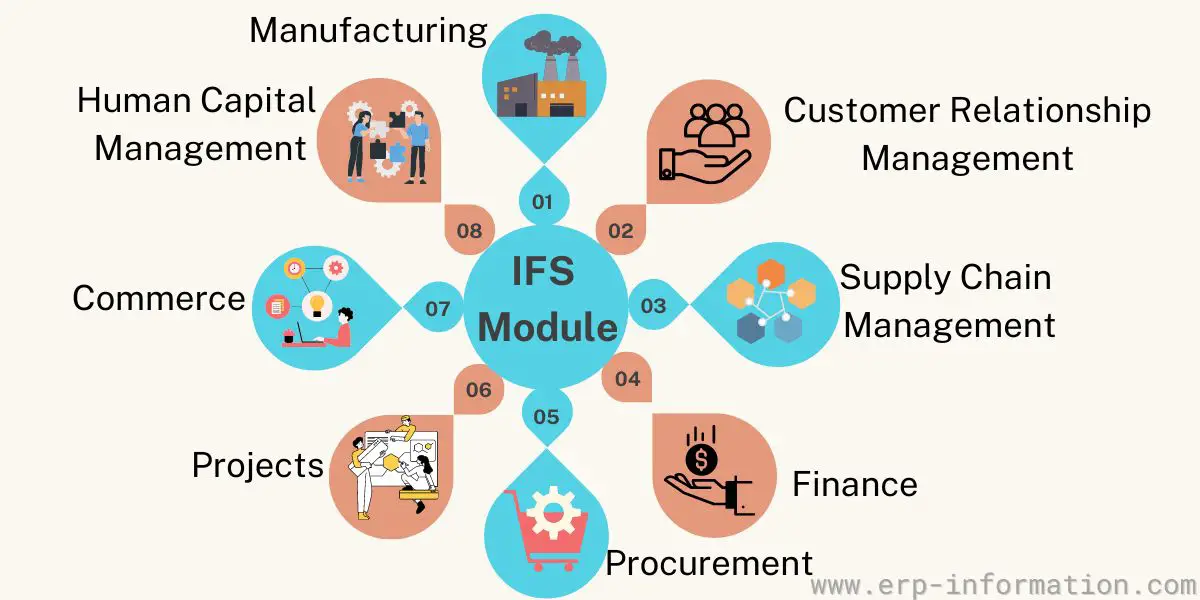
- Finance: general ledger, accounts payable and receivable, budgeting, and reporting, with multi-company and multi-currency support.
- Supply Chain Management: inventory, order management, and logistics across the demand-to-delivery cycle.
- Procurement: sourcing, purchasing, and supplier management, tied into the wider supply-chain suite.
- Manufacturing: supports discrete, process, and project-based production, including MRP, shop-floor scheduling, and mixed-mode manufacturing.
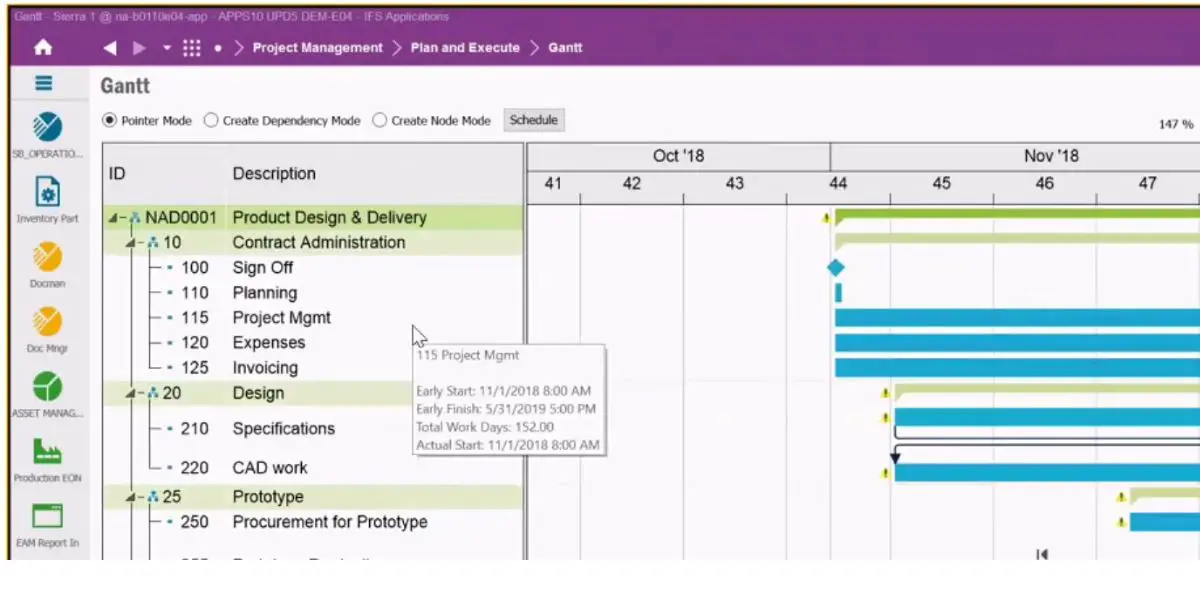
- Projects: end-to-end project management with budgeting, resource planning, and progress tracking, aimed at contract- and engineering-heavy businesses.
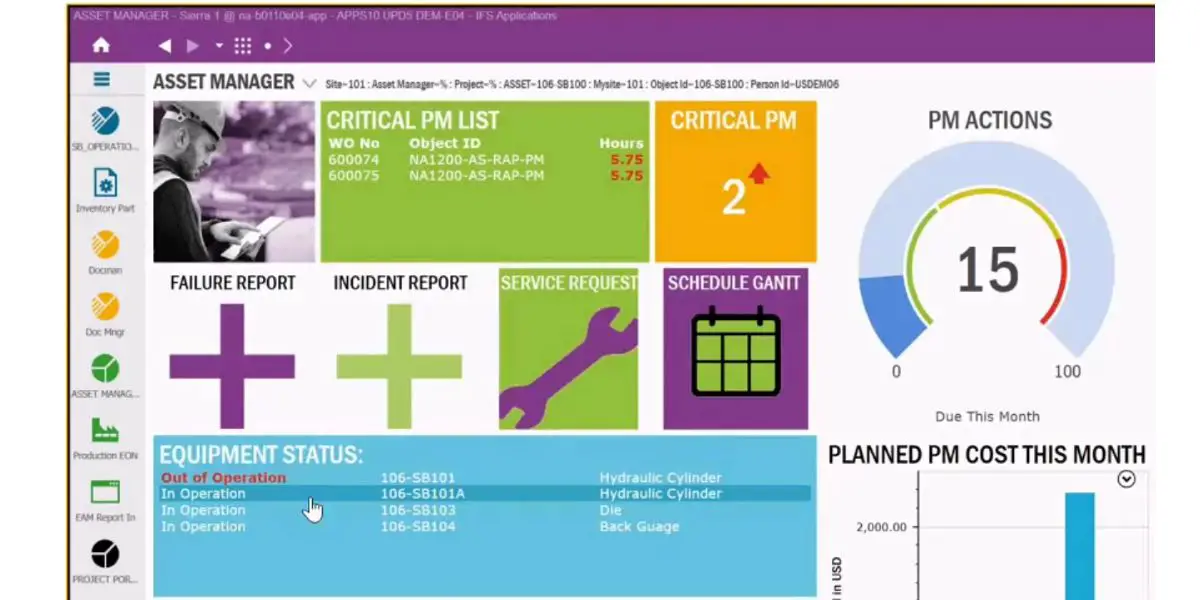
- Enterprise Asset Management (EAM): maintenance planning, work orders, and full asset-lifecycle tracking. This is a signature IFS strength: it has ranked #1 in Gartner’s EAM market-share analysis for three consecutive years.
- Service Management (FSM): scheduling, dispatch, work orders, and mobile tools for field technicians. IFS has been named a Leader in Gartner’s Magic Quadrant for Field Service Management every year since 2014.
- Human Capital Management: core HR, workforce planning, and talent management.
- Customer Relationship Management: sales, marketing, and customer-service records tied into the same data as operations.
- Commerce: B2B and B2C e-commerce that connects directly to inventory, pricing, and order data.
In short, IFS is strongest for asset-intensive and service-heavy industries, where managing physical assets and field service matters as much as the finance ledger. That focus, plus embedded Industrial AI through IFS.ai, is what sets it apart from broader horizontal ERP suites.
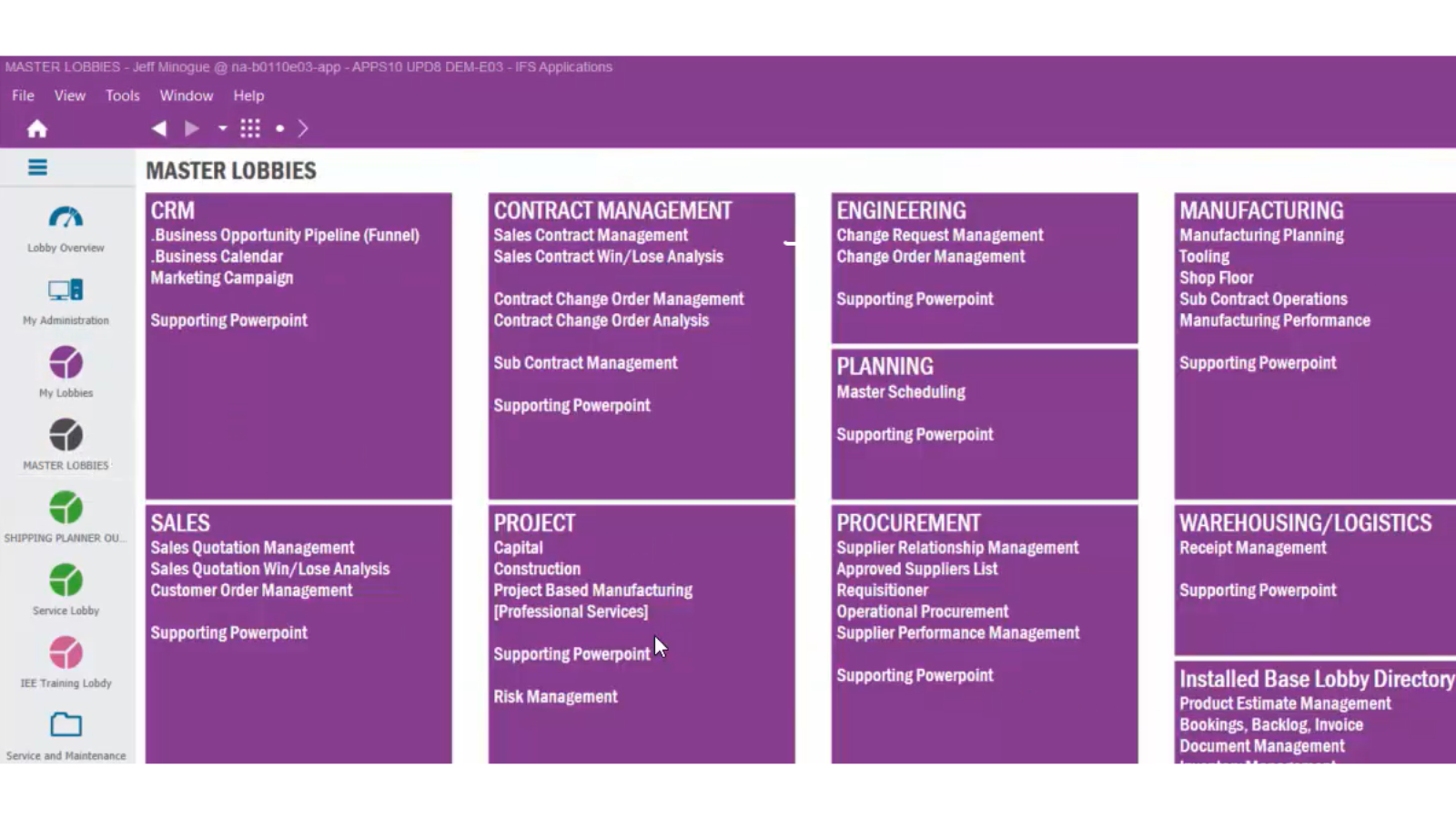
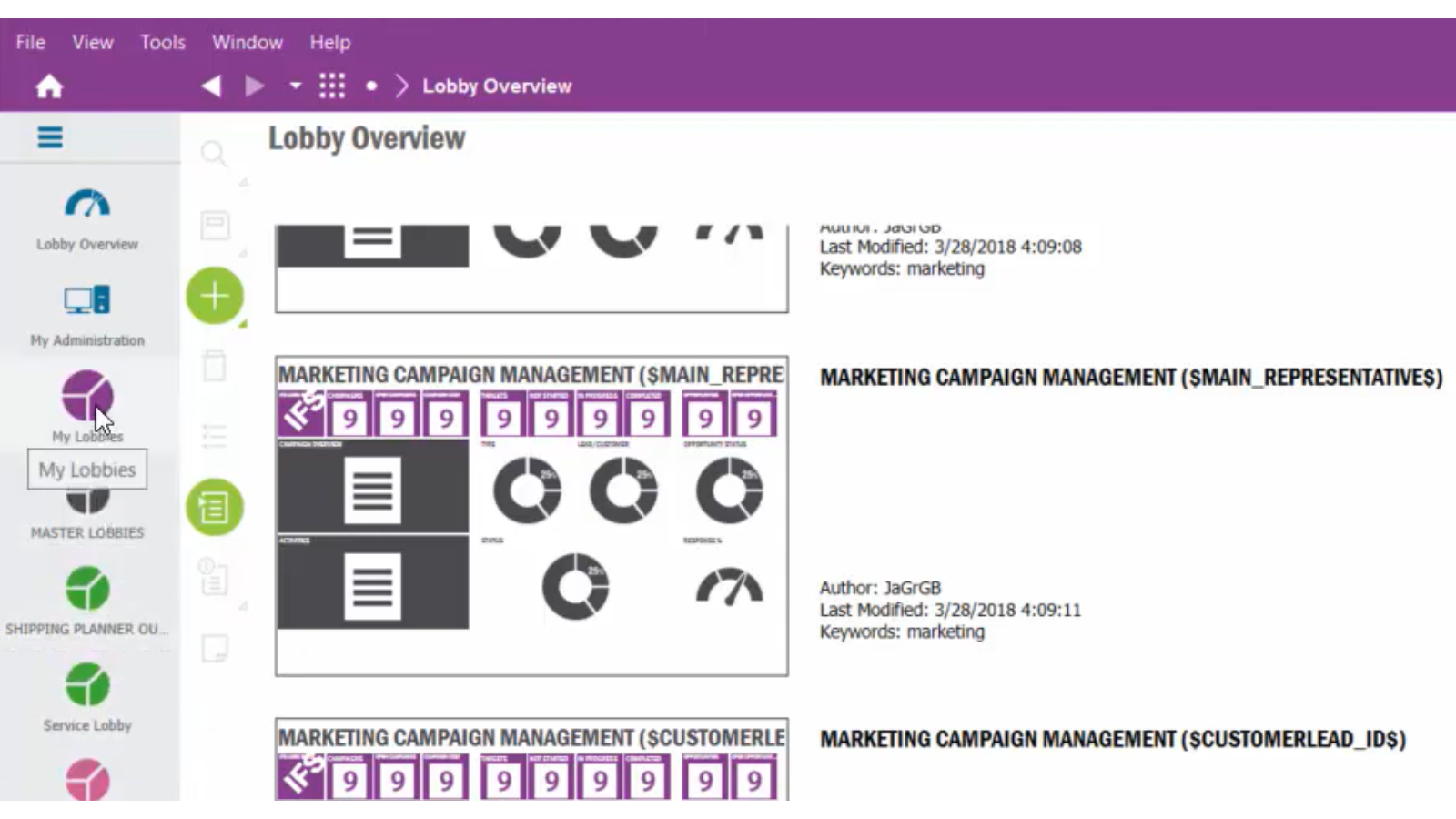
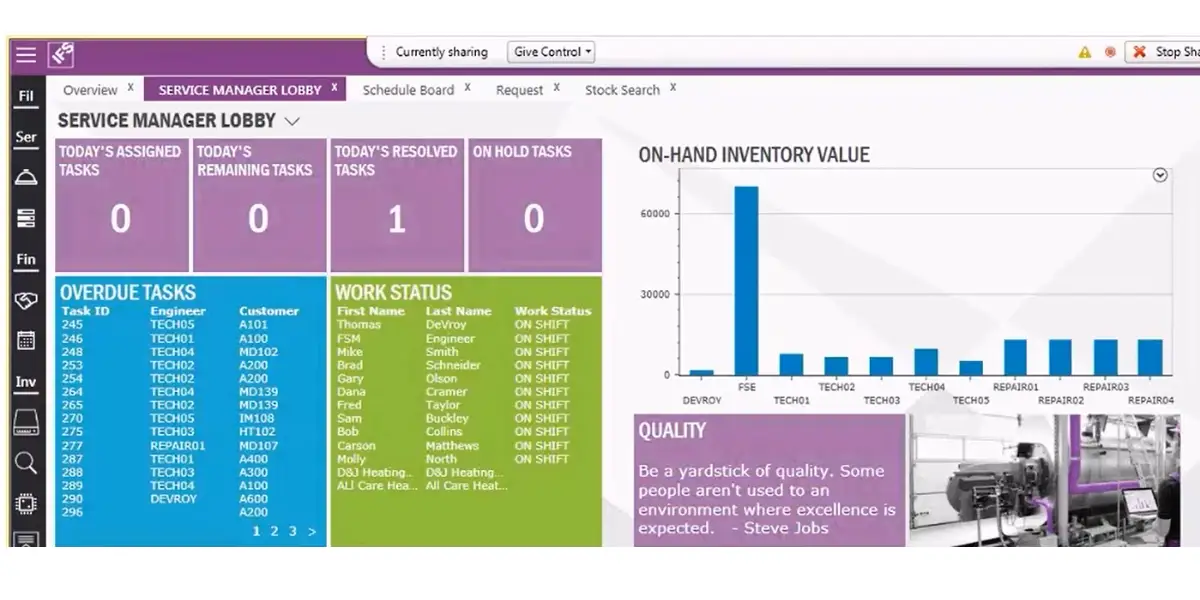
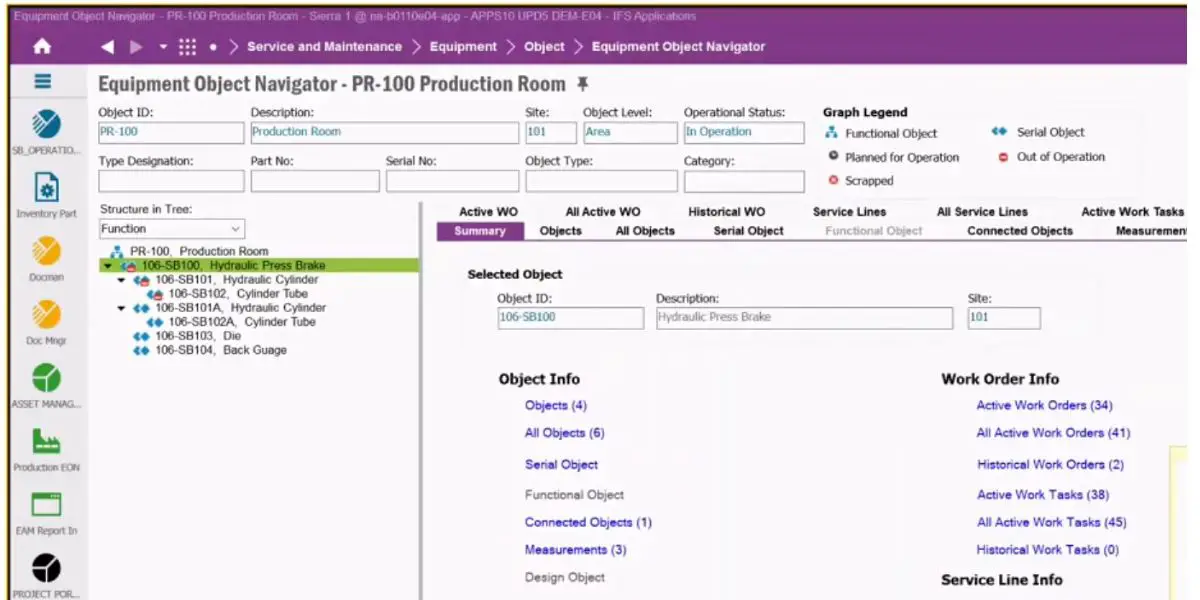
Screenshots of IFS ERP Modules
Advantages of IFS ERP
- Best-in-class asset and service management. IFS is consistently rated a leader in enterprise asset management and field service management, if uptime and field service matter as much as accounting, this is its core strength.
- One platform instead of three. ERP, EAM, and FSM share a single data model, so you avoid stitching together separate systems and duplicating data.
- Deep industry fit. Strong out-of-the-box functionality for aerospace and defense, energy and utilities, engineering and construction, and complex manufacturing.
- Composable and configurable. Start with one capability and add others as you grow, with extensive configuration to match your processes.
- Embedded industrial AI. IFS.ai adds AI across the suite for areas like predictive maintenance, planning, and scheduling.
Disadvantages
- Users often struggle with a complex interface that frequently generates error messages.
- The cost may pose affordability challenges for certain businesses.
- Some intricate features can be daunting to grasp and utilize effectively.
- Businesses seeking a straightforward accounting system might find it less suitable.
- The substantial initial investment might discourage potential users.
- The integration of IFS with SAP products was successful, though with minor recurring issues, particularly concerning the migration of accounts.
- The abundance of options can sometimes be a bit overwhelming.
- Accessing old data can be challenging while preparing analytic reports.
What industries does it support?
It supports industries such as
- Aerospace & Defence
- Energy Utilities and Resources
- Engineering & Construction
- Manufacturing
- Telecommunication
- Service Industries
Customers
IFS ERP customers often praise the software for its comprehensive functionality and ability to streamline business processes. Its strong integration capabilities are also known for allowing businesses to connect with various systems and data sources.
A few of the existing customers include,
- Cognizant
- Panasonic
- DE Havilland Aircraft of Canada Limited
- Anticimex
- BPPL
- Carshop
- Cheer Pack
- Indigo
- Motorola
- Copa Airlines
Alternatives
- SAP (S/4HANA and Business One)
- Oracle NetSuite
- Infor CloudSuite
- Epicor Kinetic
- Acumatica
- Microsoft Dynamics 365
- Deltek (for project-based businesses)
FAQs
What is IFS Cloud (IFS ERP)?
IFS Cloud is IFS’s flagship enterprise platform that combines ERP, enterprise asset management (EAM), and field service management (FSM) on a single system. It is aimed at asset- and service-intensive industries such as aerospace and defense, energy, utilities, construction, and manufacturing, and it replaced the older IFS Applications line in 2021.
Is IFS Applications the same as IFS Cloud?
Effectively yes. IFS Cloud is the successor to IFS Applications 10, unifying ERP, asset management, and field service into one product. IFS now ships two releases a year (a spring R1 and an autumn R2); the current release is 26R1.
How much does IFS Cloud cost?
IFS does not publish official list prices. Independent research puts IFS Cloud at roughly $110 to $250 per user per month, with mid-market implementations commonly in the $100,000 to $400,000 range. There is no free version or trial, so always request a written quote.
What industries is IFS best for?
IFS is strongest in asset-intensive and service-heavy sectors: aerospace and defense, energy and utilities, engineering and construction, complex manufacturing, and field service organizations. It is less suited to small businesses that only need simple accounting.
Is IFS the same as SAP?
No, IFS is not the same as SAP. Both are enterprise software suites, but IFS is often praised for its configuration flexibility and its depth in asset and field service management, while SAP is a broader horizontal ERP. The right choice depends on your industry and priorities.
Conclusion
IFS Cloud is a strong choice when physical assets and field service matter as much to your business as the finance ledger, in aerospace and defense, energy, utilities, construction, and complex manufacturing. Its combined ERP, EAM, and FSM platform and deep industry functionality are genuine differentiators, backed by IFS’s long record in asset and service management.
The trade-offs are real: it is built for mid-sized and larger organizations, carries a substantial upfront investment, and its breadth can feel complex. If you mainly need straightforward accounting or a lightweight system for a small business, IFS is likely more than you need. A lighter cloud ERP such as NetSuite, Acumatica, or Business Central would fit better. Match the shortlist to your asset intensity and industry, and get a written quote before committing.
References: