
Manufacturing Resource Planning (MRP II) is a method for planning all the resources of a manufacturing company in one closed loop: materials, production capacity, labor and money. It extends Material Requirements Planning (MRP I) by checking every material plan against capacity, feeding shop-floor results back into the plan and expressing the plan in financial terms. Oliver Wight popularized the term in his 1981 book, MRP II.
Where MRP I answers “what materials do we need, and when,” MRP II answers the harder question: “can we actually make this plan with the capacity, people and money we have?” This guide shows the difference with a worked example, traces where the term came from, and maps the MRP II loop to the ERP systems that carry it today.
Key facts
- MRP II = MRP I (materials) + capacity planning + shop-floor feedback + financial planning, run as a closed loop.
- Joseph Orlicky’s book Material Requirements Planning (1975) codified MRP; Oliver Wight’s book MRP II (1981) popularized the name of its successor.
- Gartner introduced the term ERP in 1990, presenting it as the next generation of MRP II.
- Every modern manufacturing ERP still runs the MRP II loop: master schedule, MRP, capacity checks, execution, feedback.
What is Manufacturing Resource Planning (MRP II)?
MRP II is a planning hierarchy that turns a business plan into a schedule the factory can actually execute, and keeps checking it as reality changes. Each level is tested against the resources it needs before the next level is planned:
- Business plan: revenue, margin and investment targets, in money.
- Sales and operations planning (production plan): volumes by product family, checked against plant-level resources (resource planning).
- Master production schedule (MPS): what to build, in which configuration and week, checked by rough-cut capacity planning.
- Material requirements planning: the MPS is exploded through the bill of materials and netted against inventory to time purchase and work orders.
- Capacity requirements planning (CRP): the detailed load of those work orders on each work center.
- Execution and feedback: shop-floor control and purchasing report what actually happened, and the plan is revised.
Alongside the units, MRP II translates the plan into money: purchase commitments, inventory projections and shipment values, so finance and operations read the same numbers.
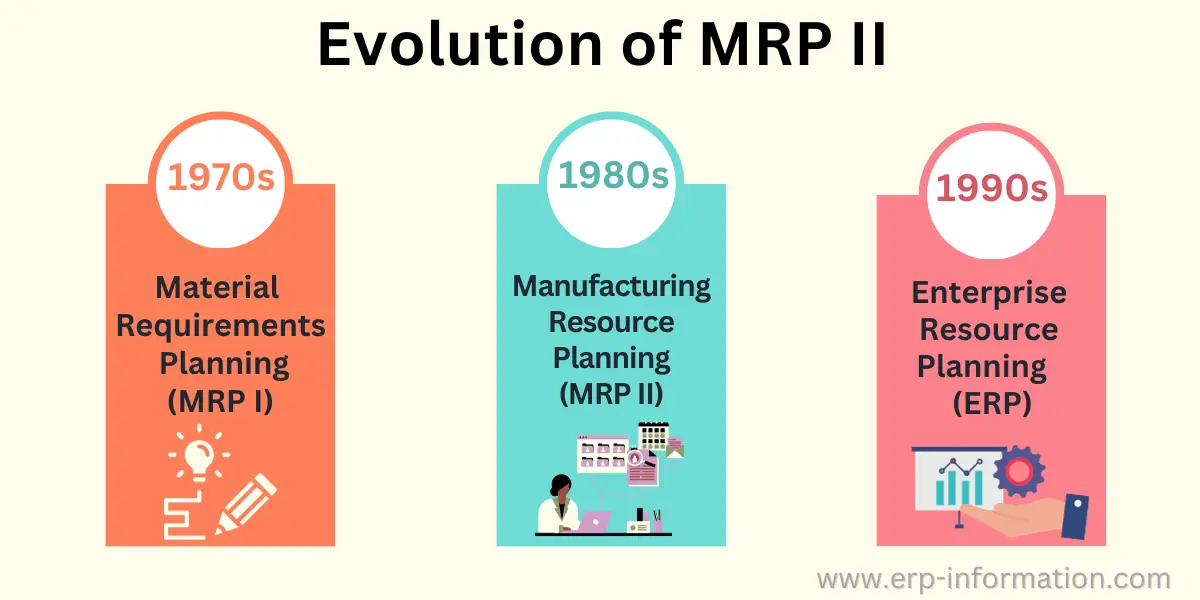
Where MRP II came from
MRP II grew out of the American production and inventory control movement of the 1970s and 1980s. The milestones below are taken from library catalog records and from the organizations involved.
| Year | Milestone | Why it matters |
|---|---|---|
| 1969 | Oliver Wight’s consulting firm is founded | The firm that later led the move from MRP to MRP II and to sales and operations planning |
| 1975 | Joseph Orlicky publishes Material Requirements Planning (McGraw-Hill) | The book that codified MRP: time-phased netting of dependent demand through the bill of materials |
| 1977 | The first Oliver Wight checklist | Rated companies A, B, C or D on how well they actually ran the system, not just whether they owned it |
| 1981 | Oliver Wight publishes MRP II | Popularizes the term manufacturing resource planning; revised in 1984 as Manufacturing Resource Planning: MRP II |
| 1989 | Darryl Landvater and Christopher Gray publish MRP II Standard System | A functional definition of what MRP II software had to do |
| 1990 | Gartner introduces the term ERP | Presented as the next generation of MRP II |
The vision for ERP was first articulated by the Gartner Group (Wylie, 1990). […] With its roots in manufacturing, ERP was first presented as a “next-generation MRP II.”
E. Burton Swanson, Innovating with Packaged Business Software in the 1990s, UCLA Anderson School of Management, 2000
Between MRP and MRP II sat closed-loop MRP: the same material plan, but with capacity checks and shop-floor feedback added so the plan was revised as work progressed. MRP II added the financial layer on top of that loop.
MRP I vs MRP II: what is the difference?
MRP I plans materials. MRP II plans materials together with the capacity, labor and money needed to turn them into finished goods, and it revises the plan from shop-floor feedback.
| MRP I (Material Requirements Planning) | Closed-loop MRP | MRP II (Manufacturing Resource Planning) | |
|---|---|---|---|
| Plans | Materials and inventory | Materials, checked against capacity | Materials, capacity, labor and finance |
| Core question | What to order, how much and when | Can the plant execute the material plan | Can we make the plan, with what capacity and at what cost |
| Capacity planning | Not included | Included | Included, from resource planning down to CRP |
| Finance | Not included | Not included | Plan expressed in money as well as units |
| Feedback | Open loop: plan only | Closed loop | Closed loop |
| Period | 1970s | Between the two | 1980s |
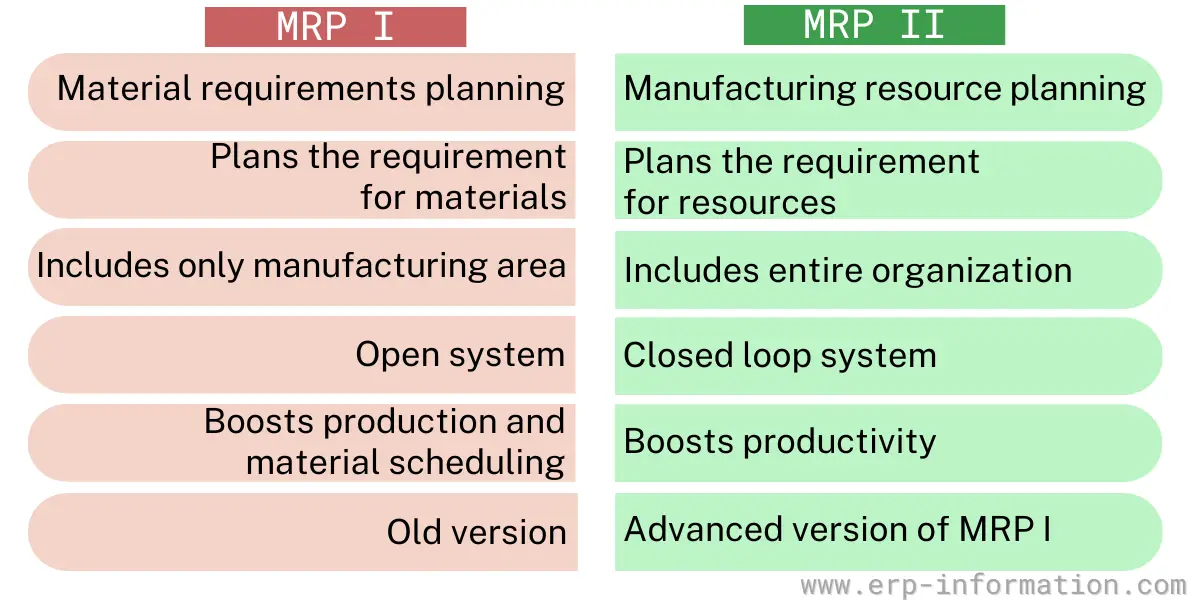
MRP II contains everything MRP I does. It wraps material planning inside a wider plan that also checks whether the factory has the capacity and the cash to carry it out. Material Requirements Planning (MRP I) explains the material calculation itself.
How MRP II works: the core components
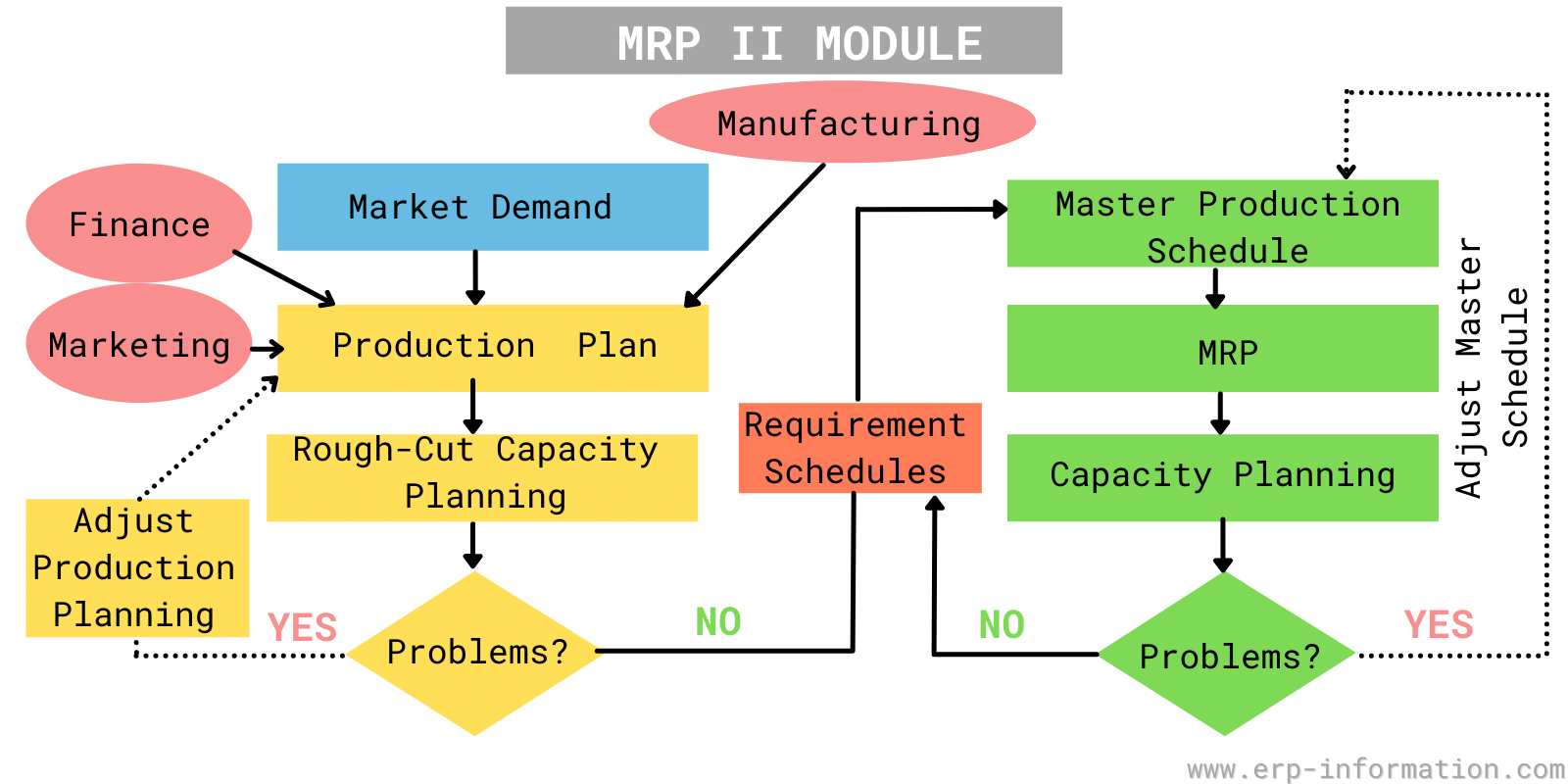
An MRP II system is built from a few connected parts. The first three are inherited from MRP I; the rest are what make it MRP II.
- Master production schedule (MPS): what to build and when, based on forecast and customer demand. It drives everything downstream.
- Bill of materials (BOM): the parts, components and sub-assemblies needed for each product, with quantities.
- Inventory status: stock on hand, on order and allocated, so demand is netted against what is already available.
- Capacity planning: rough-cut checks on the master schedule and detailed CRP checks on work orders, flagging where the schedule will not fit. This is the piece MRP I lacked.
- Shop-floor control: tracks jobs and progress on the production floor and reports the results back into the plan.
- Purchasing: times purchase orders to the plan and tracks supplier delivery.
- Financial planning: costs the plan in money, so operations and finance work from the same figures.
These components run as a loop: the MPS sets the target, MRP explodes it into materials, capacity planning tests it, the shop floor executes and reports back, and the schedule adjusts. You can size one part of that loop with our production capacity calculator.
MRP II example: one plan, one capacity problem
The example below uses invented but internally consistent numbers to show what MRP II adds to MRP I. A furniture maker must finish 200 office chairs in week 3 and 300 in week 4. Each chair needs one upholstered seat, made in house in one week, and five casters, bought with a two-week lead time. There are 50 seats and 600 casters in stock.
Step 1: the MRP I result (materials only)
| Item | Gross requirement | On hand | Net requirement | Lead time | Order release |
|---|---|---|---|---|---|
| Seats | Week 3: 200; week 4: 300 | 50 | Week 3: 150; week 4: 300 | 1 week | Week 2: 150; week 3: 300 |
| Casters (5 per chair) | Week 3: 1,000; week 4: 1,500 | 600 | Week 3: 400; week 4: 1,500 | 2 weeks | Week 1: 400; week 2: 1,500 |
MRP I stops here. It assumes the upholstery shop can make 300 seats in week 3.
Step 2: the capacity check MRP II adds
Each seat takes 0.25 hours of upholstery, and the shop has two upholsterers with 35 productive hours each, so capacity is 70 hours a week. The seat orders load week 2 with 150 × 0.25 = 37.5 hours and week 3 with 300 × 0.25 = 75 hours. Week 3 is overloaded by 5 hours, or 20 seats.
Step 3: the money question
The planner has two obvious fixes. Overtime costs 5 hours × $42 = $210. Building 20 seats a week early instead means holding 20 seats worth $35 each for one extra week; at a 25% annual carrying-cost rate that is about $3.37. MRP II moves 20 seats into week 2: releases become 170 in week 2 (42.5 hours) and 280 in week 3 (70 hours), and both weeks fit.
Step 4: the loop closes
A machine breakdown means only 160 of the 170 seats are finished in week 2. The shortfall is reported back, the remaining 10 seats move into week 3, and week 3 is now loaded with 290 × 0.25 = 72.5 hours. The planner authorizes 2.5 hours of overtime ($105) rather than miss the week 4 shipment. Material plan, capacity plan and cost were reconciled in each step, which is the whole point of MRP II.
Class A MRP II: how implementations were judged
Owning MRP II software was never the measure. From the late 1970s, companies were graded on how well they actually ran the process, and the grading survives today in a broader form.
To evaluate their progress, the original Oliver Wight Checklist was created in 1977. By objectively answering the detailed questions in the latest version, the level of proficiency can be determined and categorized as A, B, C, or D.
Oliver Wight, company history
In practice the grades separated companies that ran the business from the formal plan, with data and schedules people trusted, from companies that owned the software but kept running the plant on spreadsheets and expediting. The checklist has since grown into the Oliver Wight Class A Standard for Business Excellence, which the firm says is now in its seventh edition, and its scope reaches well beyond manufacturing planning.
MRP II vs ERP
MRP II and ERP are often confused because ERP grew directly out of MRP II. The difference is scope: MRP II plans the manufacturing operation, while ERP plans the whole enterprise on one system. See Enterprise Resource Planning (ERP).
| MRP II | ERP | |
|---|---|---|
| Scope | Manufacturing resources and their financial plan | The entire business |
| Covers | Production, materials, capacity, costing | All of MRP II, plus HR, sales, CRM, procurement and projects |
| Focus | Making the product efficiently | Running every department on one system |
| Relationship | The manufacturing core | A superset that includes MRP II |
Where the MRP II loop lives in today’s ERP
Today the MRP II loop is usually sold as part of a manufacturing ERP rather than as a separate product. Two examples from the vendors’ own documentation, checked 7 October 2026:
- Oracle NetSuite: the supply planning glossary describes the master production schedule as the set of planning numbers that drives Material Requirements Planning. Its Rough-Cut Capacity Planning report compares the capacity available at manufacturing work centers with the capacity required by work orders and planned work orders, and needs the Manufacturing Routing and Work Center and Advanced Bill of Materials features.
- Microsoft Dynamics 365: in Supply Chain Management, master planning runs through the Planning Optimization add-in; for smaller manufacturers, Business Central has its own supply planning.
MRP II software today
Most systems that run the full MRP II loop are sold as manufacturing ERP. Names checked against the vendors’ own sites on 7 October 2026:
- Acumatica (manufacturing management)
- Infor (CloudSuite for industrial manufacturing)
- Epicor Kinetic
- Oracle NetSuite (manufacturing editions)
- Microsoft Dynamics 365 Supply Chain Management and Business Central
- DELMIAWorks, formerly IQMS (Dassault Systèmes)
- Abas ERP (Forterro)
- Fishbowl, inventory and light manufacturing for QuickBooks and Xero users
- Autodesk Fusion Operations, formerly Prodsmart: shop-floor production management rather than a full MRP II suite
Benefits of MRP II
- Realistic schedules: capacity is checked as part of planning, so the schedule reflects what the factory can actually do.
- Lower inventory: materials are ordered to the plan rather than held as a just-in-case buffer.
- Better capacity use: bottlenecks show up before they stall production, as in the week 3 overload above.
- One set of numbers: operations, purchasing and finance work from the same data.
- Faster response: the closed loop reschedules around delays and demand changes instead of letting them cascade.
Limits of MRP II, and what came after
MRP II plans with fixed lead times and checks capacity rather than scheduling it: capacity planning shows an overload, but a planner has to resolve it, as in the example above. Plans also change every time demand or supply changes, which planners call nervousness. Two later approaches respond to this: advanced planning and scheduling (APS) systems, which schedule against finite capacity, and demand-driven MRP (DDMRP), which NetSuite’s supply planning glossary describes as a formal multi-level planning and execution method for planning material needs that lets a company build more closely to market requirements. Both still sit on the MRP II data: bills of materials, routings, inventory and the master schedule.
What makes an MRP II system succeed
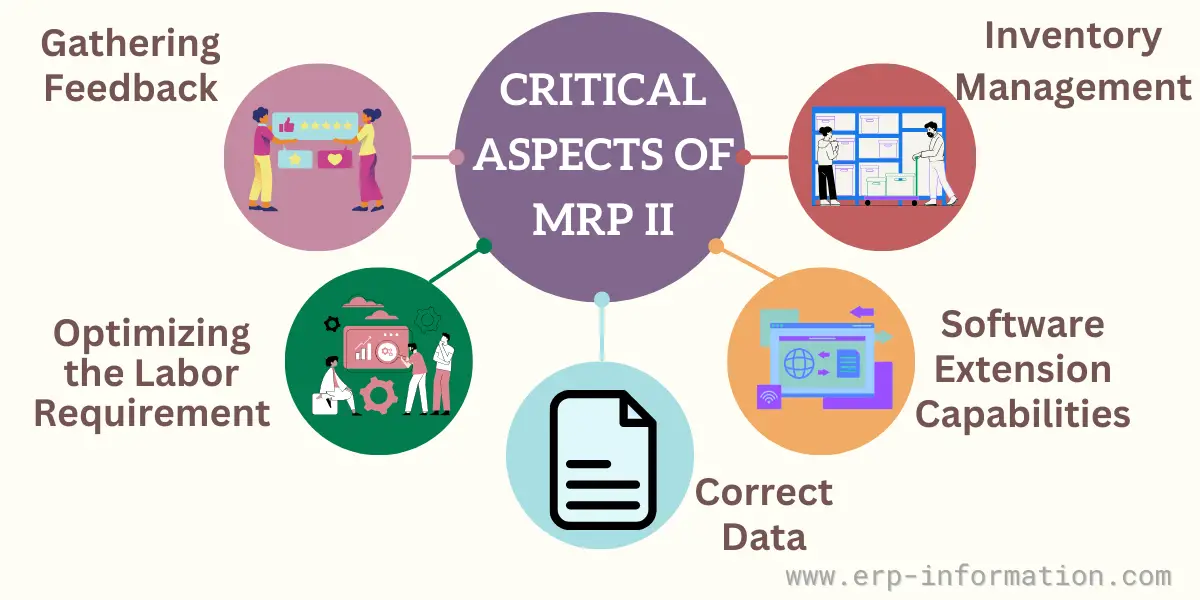
MRP II is only as good as the data and discipline behind it, which is exactly what the Class A checklist tested:
- Accurate data: bills of materials, inventory records and lead times have to be right; see data accuracy.
- Honest feedback: the loop only works if the shop floor reports real progress and problems.
- Realistic capacity data: machine rates and labor availability must reflect the real plant, or capacity planning gives false confidence.
- Trust in the plan: planners and operators must run the business on the system rather than on spreadsheets alongside it.
FAQs
What does MRP II stand for?
MRP II stands for Manufacturing Resource Planning. It is an integrated method for planning all the resources of a manufacturing company, including materials, production capacity, labor and finance. The II distinguishes it from MRP I, Material Requirements Planning, which it extends.
What is the difference between MRP and MRP II?
MRP, or MRP I, plans only materials: what to order, how much and when. MRP II adds capacity planning, shop-floor feedback and financial planning, so it plans the whole manufacturing operation and checks whether the plan can actually be executed. MRP II includes everything MRP I does.
Is MRP II the same as ERP?
No. MRP II plans manufacturing resources, while ERP plans the entire enterprise. ERP grew out of MRP II: Gartner introduced the term in 1990 as the next generation of MRP II, extending the same integrated approach to HR, sales, procurement and the rest of the business.
What is closed-loop MRP?
Closed-loop MRP is the stage between MRP and MRP II. It adds capacity checks and shop-floor feedback to material planning, so progress, delays and shortages are reported back and the plan is revised. MRP II then added financial planning on top of that loop.
Who developed MRP II?
The term is most closely associated with Oliver Wight, whose book MRP II was published in 1981 and revised in 1984 as Manufacturing Resource Planning: MRP II. It built on Material Requirements Planning, codified by Joseph Orlicky in his 1975 book of that name.
What are the main inputs to MRP II?
The three core inputs are the master production schedule, the bill of materials and the inventory status records. MRP II adds capacity data, such as work center hours and routings, and cost data, so it can plan resources and money, not just materials.
How this page was checked
Checked 7 October 2026. Publication dates come from library catalog records (Open Library) for the Orlicky, Wight, and Landvater and Gray books; the Gartner origin of ERP from Swanson’s UCLA working paper; the checklist history and current edition from Oliver Wight’s own pages; ERP features from NetSuite and Microsoft documentation; and every product name from the vendor’s site. The worked example uses invented numbers chosen to be internally consistent.
Corrections in this revision: the FAQ section was not displaying, so its questions were visible only to search engines; the software list linked Microsoft to its older Dynamics GP product and listed Prodsmart, which Autodesk now sells as Fusion Operations.
Sources
- Joseph Orlicky, Material Requirements Planning (catalog record), McGraw-Hill, 1975
- Oliver W. Wight, MRP II, 1981, and Manufacturing Resource Planning: MRP II, 1984
- Darryl Landvater and Christopher Gray, MRP II Standard System, Oliver Wight Publications, 1989
- E. Burton Swanson, Innovating with Packaged Business Software in the 1990s, UCLA Anderson School of Management, September 2000
- Oliver Wight, History and Class A Standard for Business Excellence
- Oracle NetSuite documentation: Rough-Cut Capacity Planning and Supply Planning Glossary
- Microsoft Learn: Master planning system architecture and Business Central supply planning
Using Google Search? Add erp-information.com as a preferred source.