MixERP is a free, open-source ERP built on ASP.NET (C#) and a PostgreSQL database, first published on GitHub in 2013 by the developer Binod Nirvan. Its defining trait is unusual: most of the business logic lives inside the database itself as PostgreSQL functions rather than in the application layer. The important thing to know before you evaluate it, though, is that MixERP is no longer maintained. Its last release was version 1.5 in October 2015, and the official repository and the mixerp.org website have both been taken offline. This guide covers what MixERP is, the evidence that development has stopped, and the actively maintained open-source ERPs to use in its place.
| Software | MixERP |
| Category | Open-source ERP (self-hosted) |
| Created by | Binod Nirvan (GitHub: binodnp) |
| On GitHub since | 2013 |
| Tech stack | ASP.NET WebForms (C#) with a PostgreSQL database |
| Architecture | Business logic held in PostgreSQL functions (PL/pgSQL is about 72% of the code) |
| License | GNU GPL version 3 (GPLv3) |
| Latest release | Version 1.5, October 2015 |
| Maintenance status | Not maintained; the official repository and website have been removed |
| Cost | Free |
| Core modules | Finance, Inventory, Purchasing, Sales and POS, HRM, MRP and MPS |
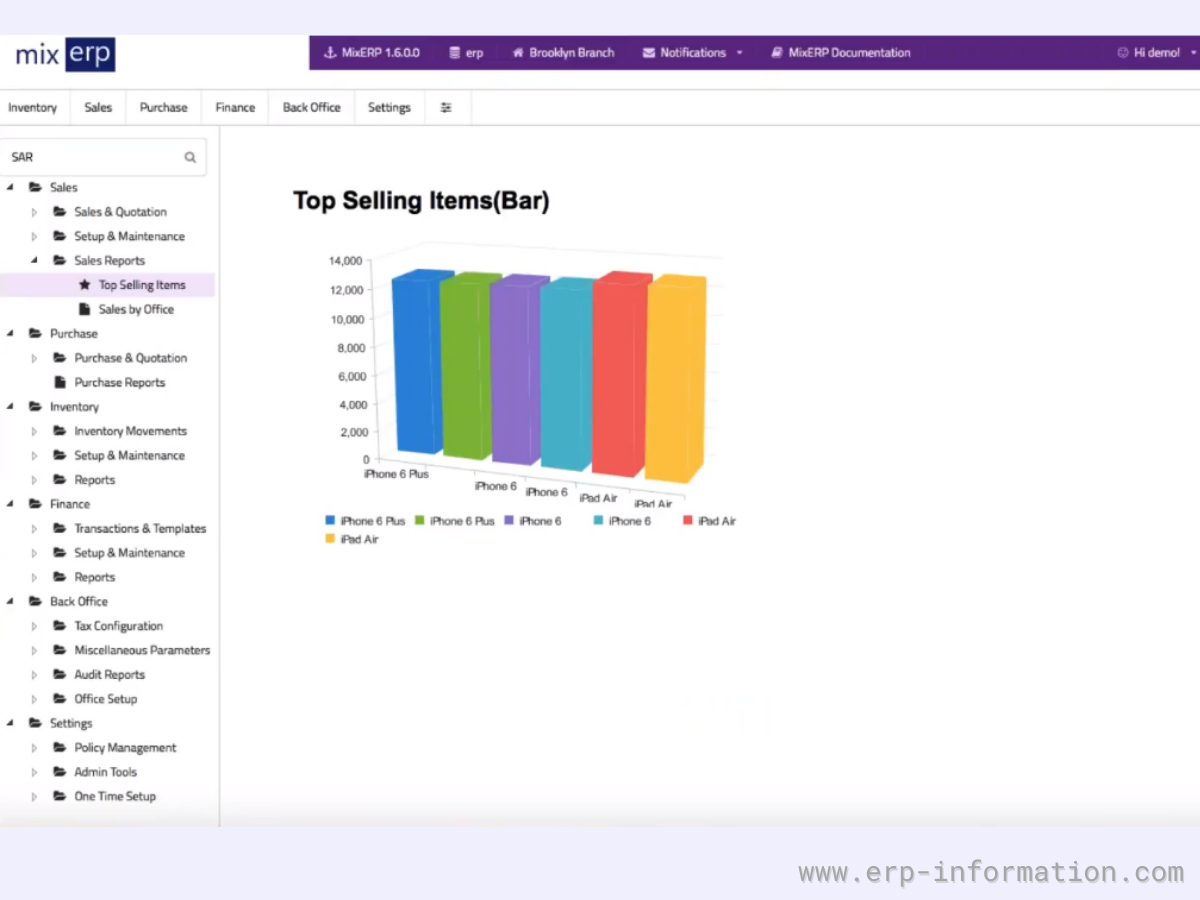
What is MixERP?
MixERP is a web-based ERP for small and mid-sized businesses that bundles finance, inventory, purchasing, sales and human-resource functions into one self-hosted application. It is multi-currency, multi-lingual and multi-establishment, so a single install can serve several offices or branches. The project described itself simply as “Open Source ERP, HRM, MRP, MPS”.
What set MixERP apart technically was its architecture. Rather than putting the accounting and inventory logic in the C# code, the project pushed almost all of it down into PostgreSQL as stored functions. In the final codebase, PL/pgSQL (PostgreSQL procedural code) accounted for roughly 72% of the source, with C# making up under 20%. The ASP.NET WebForms layer on top was mostly a thin interface over the database. That design made MixERP a genuinely interesting example of a database-first ERP, and it is still the main reason to study the code today.
Is MixERP still maintained?
No, and the evidence is unambiguous. The original repository at github.com/mixerp/mixerp now returns a 404: it has been deleted, not just archived. The separate repositories for the planned version 2 rewrite (built on the author’s “Frapid” framework, with modules such as finance, inventory, sales and HRM) have all been removed too. The last Internet Archive snapshot of the repository, from October 2020, shows a final release of version 1.5 dated October 2015 and a last commit in November 2019.
The mixerp.org domain is gone as well; it now resolves to a parked, for-sale placeholder page. The version 2 rewrite was announced for early 2017 but no general-availability release was ever shipped, and the creator’s public work moved on to blockchain projects by around 2018. In short, meaningful development ended close to a decade ago. You can still find the source in community forks and in the Internet Archive, so MixERP is useful for learning or reference, but it should not be chosen for a new production deployment.
Architecture and tech stack
MixERP runs as an ASP.NET WebForms application on Windows and IIS, backed by a PostgreSQL server. Because the business rules are implemented as PostgreSQL functions, the database does the heavy lifting for posting transactions, validating entries and building reports. This gives strong data integrity and makes the logic easy to audit in SQL, but it also ties the project tightly to a specific PostgreSQL-and-.NET stack, which is one reason a modern, more portable ERP is the better starting point now.
Features and modules
- Finance and accounting: journal entries, trial balance, multi-currency exchange rates and end-of-day processing
- Inventory management: items, stores, stock adjustments and transfers
- Purchasing: accounts payable, cost pricing and reorder tracking
- Sales and Point of Sale management
- Human Resource Management: employees, attendance and contracts
- Manufacturing: MRP (material requirements planning) and MPS (master production scheduling)
MixERP pricing
MixERP is free. It was released under the GPLv3 open-source license with no paid edition and no official cloud or SaaS version, so the only cost is hosting it yourself on a Windows server with PostgreSQL. Because the project is dormant, there is no vendor to buy support or updates from, which is the practical reason the cost of running it long-term is higher than the “free” label suggests.
MixERP vs actively maintained open-source ERPs
If you were considering MixERP, these open-source ERPs do the same job and are still actively developed. The table compares them on the points that matter for a self-hosted deployment.
| Open-source ERP | Language / database | License | Status (2026) | Best suited for |
|---|---|---|---|---|
| MixERP | ASP.NET (C#) / PostgreSQL | GPLv3 | Not maintained (last release 2015) | Studying a database-centric ERP design |
| ERPNext | Python (Frappe) / MariaDB | GPLv3 | Active (v15, 2026) | The closest full-featured replacement |
| Odoo Community | Python / PostgreSQL | LGPLv3 | Active | A large modular app ecosystem |
| Tryton | Python / PostgreSQL | GPLv3 | Active | Vendor-neutral, accounting-led ERP |
| metasfresh | Java / PostgreSQL | GPLv2 and v3 | Active (rolling releases) | Supply chain and logistics |
| Dolibarr | PHP / MySQL | GPLv3 | Active (v23, 2026) | Small businesses and shared hosting |
For most teams replacing MixERP, ERPNext is the natural choice: it is a mature, full-featured ERP under the same GPLv3 license, with an active community and frequent releases. Odoo Community suits teams that want a large ecosystem of add-on apps, Tryton appeals to those who value a vendor-neutral, accounting-focused core, and metasfresh is strong for supply-chain and logistics use. Dolibarr is the lightest option and installs on ordinary PHP and MySQL hosting. You can compare more options in our list of ERP software.
Is MixERP still maintained?
No. MixERP is no longer maintained. Its last release was version 1.5 in October 2015, and both the original GitHub repository and the mixerp.org website have since been taken down. For a new deployment, pick an actively maintained open-source ERP such as ERPNext or Odoo Community instead.
Is MixERP free?
Yes. MixERP is free and open-source software released under the GNU General Public License version 3 (GPLv3). There was never a paid tier or an official cloud edition; you install and self-host it on your own server.
What is MixERP built on?
MixERP is an ASP.NET WebForms application written in C# that runs on a PostgreSQL database. Its defining trait is that most of the business logic lives inside the database as PostgreSQL functions, so PL/pgSQL makes up roughly 72 percent of the codebase.
Who created MixERP?
MixERP was created by the developer Binod Nirvan, who published it on GitHub from 2013. Development slowed after the 2015 release, and the author later moved on to blockchain projects, which is why the ERP is now dormant.
What are the best alternatives to MixERP?
The closest actively maintained replacement is ERPNext, which covers accounting, inventory, manufacturing and HR. Odoo Community, Tryton, metasfresh and Dolibarr are other well-supported open-source ERPs worth comparing before you commit.