Discrete manufacturing is the production of distinct, countable items that are assembled from separate components and can be taken apart again: cars, furniture, aircraft, smartphones, appliances, machine tools. Each unit is built to a bill of materials, follows a routing through the plant, and can be identified by a serial number.
It is the counterpart of process manufacturing, which makes bulk goods from formulas and recipes and measures output in kilograms, litres or gallons rather than in units. The distinction is not academic: it decides what master data your ERP needs, how you count inventory, and how you trace a defect back to its cause.
The article discloses the definition of discrete manufacturing, its examples, its workflow, technology trends, types of other manufacturing processes, and the difference between discrete manufacturing and process manufacturing.
What is Discrete Manufacturing?
Discrete manufacturing involves the creation of distinct, countable products, furniture, airplanes, toys, smartphones, computer hardware, automobiles, and defense systems. This process assembles various parts and components, such as nuts, bolts, brackets, and wires, into complete items.
Unlike process manufacturing, which produces bulk output such as paint, fuel, medicines or soft drinks, discrete manufacturing produces recognizable items that can be disassembled, repaired and recycled at the end of their life. That reversibility is one of the defining traits of the discrete side: you can take a laptop apart and recover its components, but you cannot recover the flour and eggs from a baked cake.
Production in discrete manufacturing ranges from low-volume, high-complexity items to high-volume, low-complexity goods. This necessitates either a flexible manufacturing system for complex items, ensuring quality and speed while reducing costs, or efficient inventory control and waste management for simpler items.
This method is typically not continuous; production processes can start, stop, and operate at varying rates. The final products can be made from multiple components, such as the different parts of a smartphone, or a single material, like steel for a structure.
Successful discrete manufacturing relies on meticulous organization and planning, often facilitated by project management software with features like customizable Kanban boards for tracking and managing the production cycle.
Examples
Toys, automobiles, smartphones, aircraft, furniture, medical devices, industrial machinery and defense systems are all discrete. So is anything with a part number, a serial number and a screw.
A useful boundary case: the same material can sit on both sides of the line. The plastic pellets fed into an injection moulding machine are process manufactured, measured and consumed by weight. The housings moulded from them are discrete, counted in units and tracked individually. Many real plants therefore run both models, and this is exactly where a single-mode ERP starts to hurt.
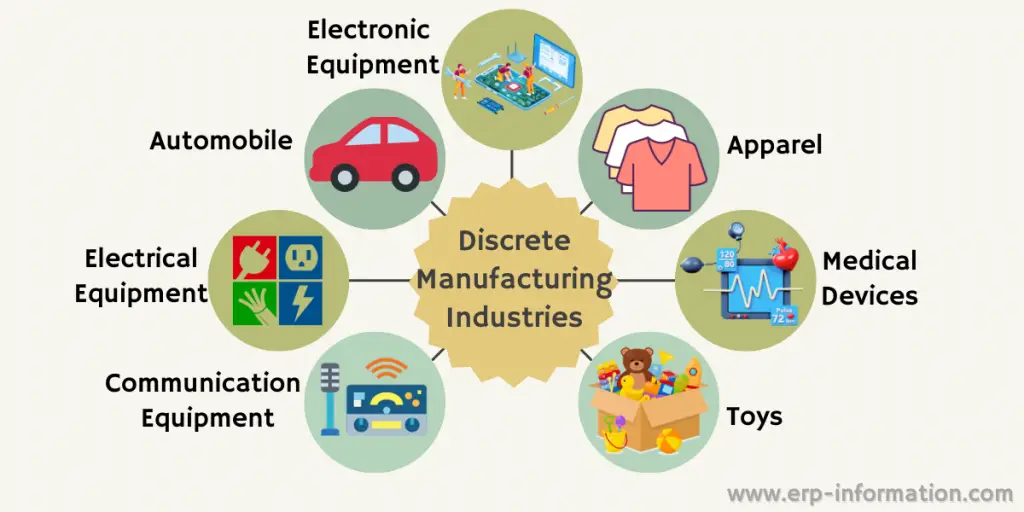
During the production planning phase, the real-time data collected across plants and resources will help the managers analyze the firm’s current production status.
Because demand shifts and product mixes change, a discrete plant has to be able to change over from one item to another without rebuilding the line. That adaptability is one of the defining strengths of discrete manufacturing, and it is the main thing a process plant cannot easily do.
The cost of that flexibility is complexity: more part numbers, more setups, more changeovers, and quality control that has to catch defects on individual units rather than sampling a batch.
Key Elements of Discrete Manufacturing
It involves converting raw materials into distinct, finished products. Though the specifics can vary by industry, several core elements are common across all discrete manufacturing processes.
Supply Chain Management
The supply chain is crucial in discrete manufacturing due to the need for sourcing parts and components from various suppliers. Efficient supply chain management boosts operational efficiency by tracking production, ensuring consistent product quality, and maintaining resource availability.
Effective supply chain oversight is essential for profitability and smooth operations.
Bill of Materials (BOM)
A Bill of Materials (BOM) is an essential document listing all parts, components, and assemblies needed to create a finished product.
It serves as a detailed guide for assembling the product. Proper BOM management is critical, as changes and updates to components can significantly impact the production process.
Production Routing
Production routing details the step-by-step sequence of operations used to make the product. The routing is a separate record from the bill of materials, not part of it, and confusing the two is a common source of trouble when setting up an ERP.
Three master data records run a discrete plant, and each answers a different question:
- Bill of materials: what goes into the product. Components, sub-assemblies and quantities.
- Routing: how it gets made. The ordered operations such as cut, machine, weld, assemble, test and pack, with setup and run times.
- Work center: where each operation happens, and the capacity available there.
The routing also carries expected scrap and yield at each operation, which is what lets the system inflate the order quantity so the right number of good units reaches the end of the line.
Assembly Line Process
In discrete manufacturing, the assembly line method organizes the production of parts and assemblies into a cohesive final product.
This involves multiple workstations, each performing specific tasks to build the product progressively. The assembly line ensures efficient and organized production of distinct components.
Quality Control
Quality control is vital in discrete manufacturing to meet customer, industry, and regulatory standards. It involves inspecting products to remove defects, documenting processes, and having plans to address any issues quickly.
Maintaining high-quality standards ensures reliable and satisfactory final products.
ERP Systems for Discrete Manufacturing
It is also vital that a firm chooses an ideal software for discrete manufacturing that will help in good inventory management so that the company doesn’t waste time getting stocks for unexpected demand.
It must also ensure that it doesn’t overstock the goods, making them obsolete and increasing expenses.
ERP systems are developed to manage discrete manufacturing processes. These ERP systems help the organization control the manufacturing process, reduce waste, save time required by the product manufacturing, and get a clear vision of the manufacturing process.
The other functionalities of the ERP systems include material management, supply chain management, financial management, and customer relationship management.
ERP vendors
Some good ERP vendors are NetSuite, Epicor, SAP, Infor, etc. ERP modules of these vendors are flexible and easily customizable to meet customers’ requirements.
Deployment has shifted decisively: new discrete manufacturing ERP is now bought as cloud software by default, and on-premises installations are mostly long-lived existing systems rather than new purchases. Plants with hard latency or air-gap requirements on the shop floor commonly keep execution local while running the ERP in the cloud.
Workflow
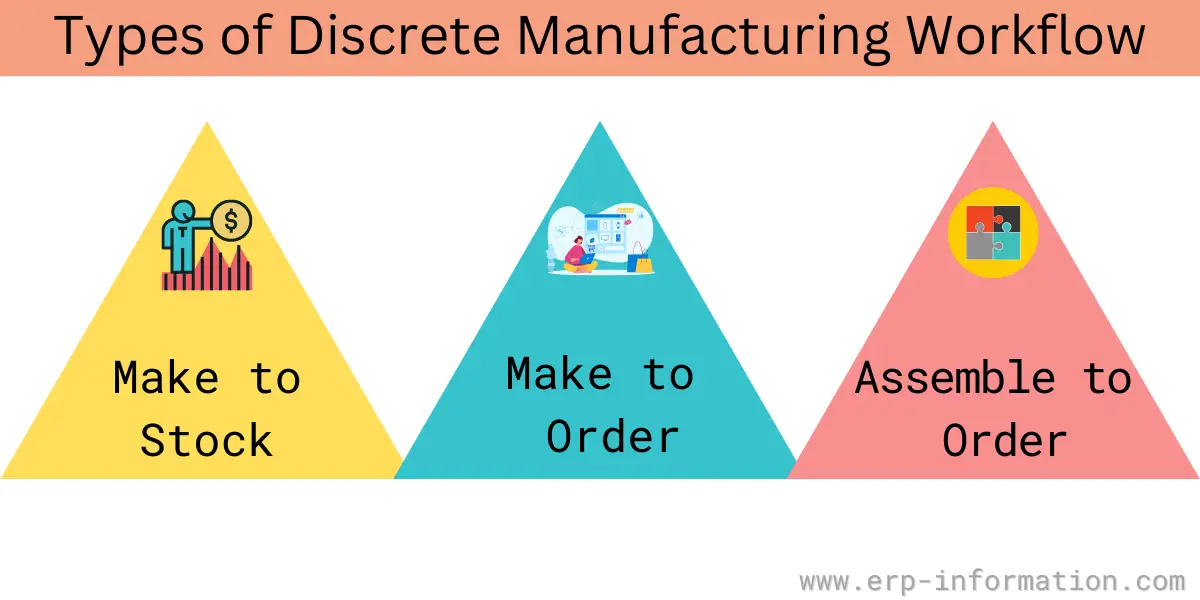
This process supports the following workflow.
1. Make-to-stock: In this type of workflow, you keep stock of products before customers order.
2. Make to order: In this workflow, you do not keep more product stock in your warehouse. Instead, you manufacture the product only when a customer order comes in.
3. Assemble to order: This workflow sits between make-to-stock and make-to-order. You build and stock the components ahead of demand, then assemble the finished configuration once the order arrives, which keeps the customer lead time short without holding finished goods.
4. Engineer to order: The product is designed for the individual order, so engineering work begins only after the order is won. Common in capital equipment, shipbuilding and industrial plant. Lead times are the longest of the four and the bill of materials often does not exist when the order is taken.
5. Job shop or one-off production: Small quantities of varied work routed through general-purpose equipment rather than a fixed line, as in a machine shop or toolroom.
These are not plant-wide labels. A single discrete manufacturer commonly runs several at once, stocking standard items while engineering specials to order, which is why the workflow is set per product rather than per factory.
Discrete Manufacturing vs Process Manufacturing
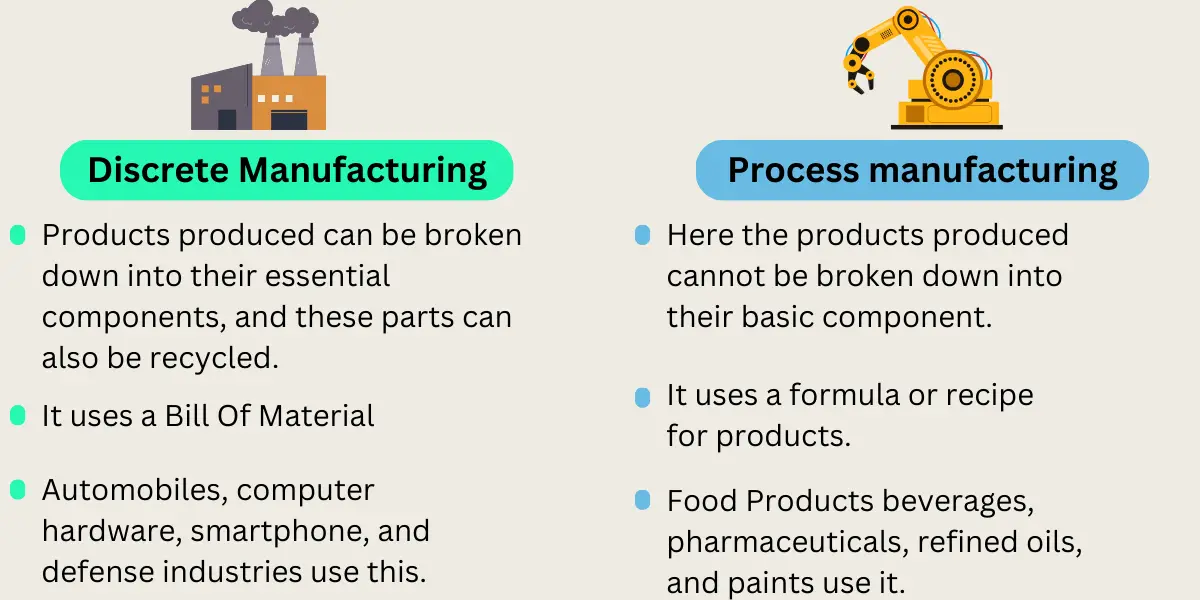
The short version: discrete manufacturing assembles parts into countable units, process manufacturing mixes ingredients into bulk output. Everything else follows from that one difference.
| Discrete manufacturing | Process manufacturing | |
|---|---|---|
| Output | Distinct, countable items | Bulk liquids, powders, gases, granules |
| Master data | Bill of materials plus routing | Formula or recipe |
| Inputs are called | Parts and components | Ingredients |
| Unit of measure | Each, units, serial numbers | Kilograms, litres, gallons, tonnes |
| Traceability | Serial number per unit | Lot or batch number |
| Reversible? | Yes. Can be disassembled and components recovered | No. Ingredients cannot be recovered once combined |
| Partial runs | No. Every part must be present to build a unit | Yes. Half the ingredients makes half the batch |
| Typical industries | Automotive, aerospace, electronics, furniture, machinery, medical devices | Food and beverage, chemicals, pharmaceuticals, cosmetics, paints, refining |
Two of those rows do more work than the rest.
Reversibility is what makes discrete rework, repair, warranty and recycling possible. A faulty unit can be opened, the bad component swapped, and the unit put back into stock. A contaminated batch of syrup cannot be un-mixed; it is scrapped or reprocessed as a whole.
Partial runs is the difference most people miss. A process formula scales: if it calls for 1,000 gallons of an ingredient and only 500 are on hand, you make half the batch. Discrete assembly does not scale that way. One missing 20 cent fastener stops the build of a 30,000 dollar machine, which is why discrete plants live or die on component availability and why material requirements planning matters so much more on this side.
Neither label describes a whole company. A food manufacturer cooks sauce by formula, then fills, labels and cases it as counted units. A vehicle plant is discrete on the assembly line and process in the paint shop. When choosing an ERP, the question is not which type you are, but whether the system can run both where your plant actually does.
Manufacturing vs Assembly
Manufacturing and assembly are two distinct processes within the broader context of production. The below table shows the key differences between them.
| Manufacturing | Assembly |
|---|---|
| It involves converting raw materials into components, parts, or products. It encompasses various stages, such as design, fabrication, and quality control. | Assembly involves assembling individual components or parts to form a complete or final product. It is a subset of the overall manufacturing process. |
| Manufacturing techniques can include casting, forging, machining, molding, extrusion, and many other methods to create the required parts or components. | Assembly can involve manual labor or automated systems, such as robots or assembly lines, to combine components efficiently. |
In short, manufacturing makes the parts and assembly joins them. Assembly is one stage inside manufacturing rather than an alternative to it, which is why a plant can outsource fabrication and still run an assembly line of its own.
What is Discrete Manufacturing Software?
The software is enterprise resource planning (ERP) or manufacturing execution system (MES) software designed specifically for companies that produce distinct or separate products, such as automobiles, electronics, furniture, or machinery.
The organizations use computer-aided design and manufacturing tools (CAD/CAM) that are interconnected with ERP.
Discrete companies also use Manufacturing Operations Management (MOM) software for production. It allows companies to enhance production performance, efficiency, and flexibility by connecting virtual and physical manufacturing.
MES is crucial for discrete manufacturers to face new markets, technologies, and materials.
Features of MES for discrete manufacturing are as follows.
- Production process synchronization
- Quality Requirements and Regulatory Integration
- Real-time shop floor visibility
- Enhanced manufacturing operations and WIPs (work-in-progresses)
- Access to production documentation
- Enhanced resource allocation, material management
Discrete Manufacturing Technology Trends
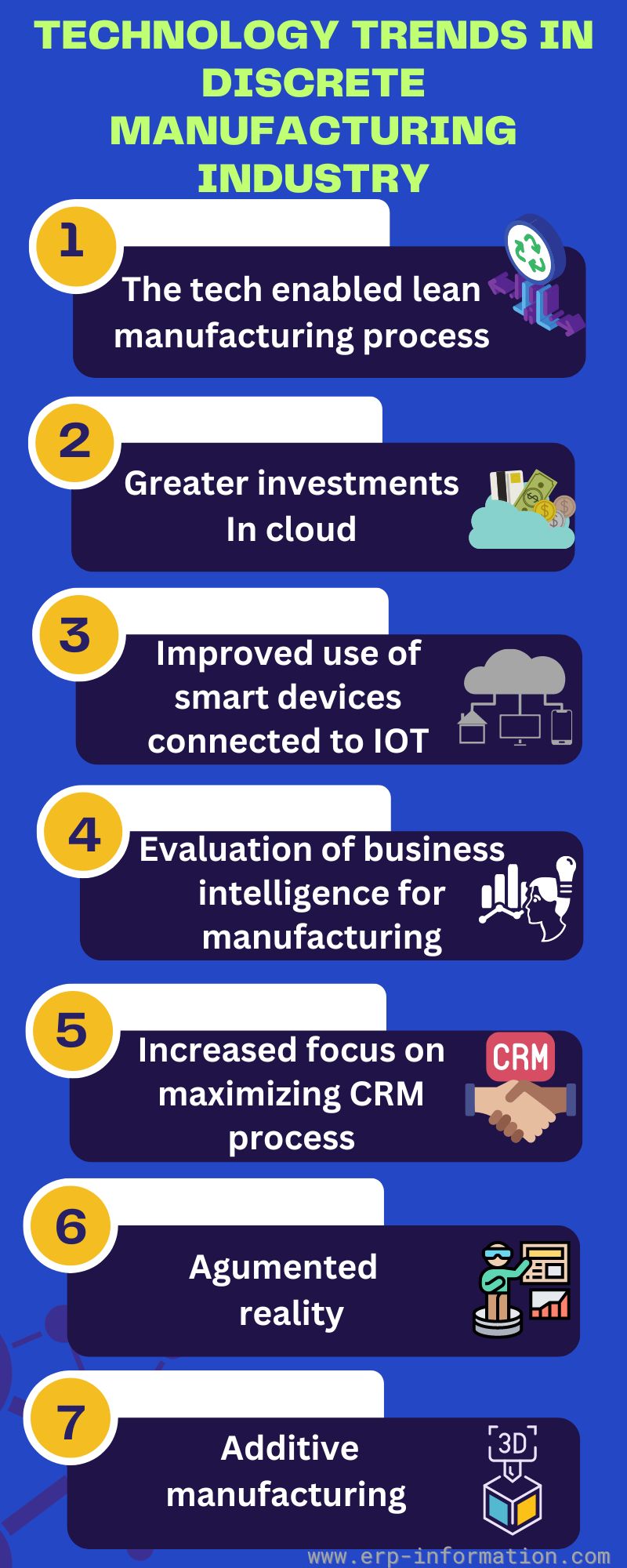
1. The tech-enabled lean manufacturing process
Technology embedded in modern ERP enables mid-market manufacturers to apply lean manufacturing techniques that were formerly unavailable.
2. Greater investments in cloud
Increased global customers, enhanced competition, regulatory pressures, and decentralization of operations have led to greater industry investment in cloud-based software.
3. Improved use of smart devices connected to IoT
Smart devices have the ability to transfer data between each other. Businesses are finding ways to configure their ERP system to take advantage of these things.
4. Evaluation of business intelligence for manufacturing
BI Technology has evolved beyond an IT department responsibility into a real-time data tool to analyze big data. So, decision-makers can use it to improve the business.
5. Increased focus on maximizing the CRM process
With increased computation, buyers are more informed than ever before. Manufacturers are beginning to invest in improved CRM principles.
6. Augmented reality
Manufacturers have adopted AR to enhance workflow and productivity. It provides seamless communication and reduces errors.
7. Additive manufacturing
The additive manufacturing technique uses only the materials needed for the part, which drastically reduces waste during production.
Advantages and Drawbacks of Discrete Manufacturing
These are properties of the production model itself, not of the software used to run it.
| Advantages | Drawbacks |
|---|---|
| Product variety and changeover: The same line can be reconfigured to build a different model, so a wide catalogue is possible without a separate plant per product. | Component complexity: A single product can carry thousands of part numbers, each needing to be sourced, stocked and revision controlled. |
| Unit-level traceability: Serial numbers let a single faulty unit be identified, recalled and repaired without touching the rest of the output. | All-or-nothing builds: One missing part stops the whole unit. There is no partial build, so shortages hit output immediately. |
| Rework and repair: Because assembly is reversible, defective units can be opened, corrected and recovered instead of scrapped. | Setup and changeover losses: Switching between products costs time on the line, which penalises small batches and pushes up cost per unit. |
| Customization: Configure-to-order and engineer-to-order variants can be produced without redesigning the production system. | Capital-intensive setup: Tooling, fixtures, jigs and automation require significant investment before the first unit ships. |
| Modular improvement: A component can be upgraded or resourced on its own, without reformulating the entire product. | Demand sensitivity: High fixed costs mean margins fall quickly when volumes drop below the level the line was sized for. |
FAQs
What are the products made by process manufacturing?
Products made by process manufacturing are jam, juices, beverages, chemicals, medicines, oils, etc.
What are the key benefits of discrete manufacturing?
Discrete manufacturing offers greater flexibility and allows for customized production and quick adjustments to meet changing demands.
It provides better traceability and quality control for individual items or batches. It also streamlines the regulatory compliance and documentation processes.
This industry helps in reducing production costs and ultimately leads to increased customer satisfaction.
What are the challenges faced with discrete manufacturing?
Some of the challenges associated with discrete manufacturing are
* Managing inventory for various components
* Production complexity of processes
* Dealing with frequent changeovers during the production of a variety of
products.
* Global competition
What strategies can be used for managing the complexities of discrete manufacturing operations?
Strategies that could help in reducing the complexities are
* Implementation of efficient production planning and scheduling systems
* Utilization of advanced ERP (Enterprise Resource Planning) platform
* Adoption of agile manufacturing practices
How can discrete manufacturing benefit from Industry 4.0 and IoT?
Industry 4.0 and IoT technologies can lend a helping hand to discrete manufacturing by enabling real-time monitoring, predictive maintenance, and data-driven decision-making to optimize production efficiency and reduce downtime.
How are lean manufacturing and discrete manufacturing related?
Lean manufacturing is a methodology that focuses on eliminating waste and improving efficiency in production processes. It is applicable to discrete manufacturing as it can help reduce costs and enhance quality by minimizing non-value-added activities.
What is the difference between a bill of materials and a routing?
They are two separate records. The bill of materials lists WHAT goes into the product: components, sub-assemblies and quantities. The routing lists HOW it is made: the ordered sequence of operations, the work center each one runs at, and the setup and run times. The routing is not part of the bill of materials, and treating it as though it were is a common ERP setup error.
Is discrete manufacturing only for low volumes?
No. Discrete manufacturing covers the full range from one-off engineered equipment to high-volume production of millions of identical units such as smartphones and cars. What makes it discrete is that the output is countable, individually traceable and can be disassembled, not how many are made.
Conclusion
Discrete manufacturing is the production of distinct, countable units assembled from components. It covers everything from one-off engineered machines to millions of identical smartphones, so volume is not what defines it. What defines it is that the output can be counted, serialised and taken apart again.
If you are deciding how to run or systemise a plant, the three things that matter most are on this page: keep the bill of materials and the routing as separate records, pick the workflow per product rather than per factory, and check whether any part of your operation is really process manufacturing before assuming one model fits the whole site.