
Rough-cut capacity planning (RCCP) is the process of checking whether a master production schedule (MPS) is realistic before it is released, by converting the schedule into the capacity it demands from a few key resources, typically critical work centers, labor, and machinery. In one line: it answers whether you have enough capacity to build what the schedule promises.
RCCP is a medium-term and deliberately approximate check. It looks only at the resources most likely to become a bottleneck rather than every work center, and it runs before material requirements planning (MRP). That timing is the whole point: an unachievable master schedule gets caught while there is still room to add capacity or move the plan, instead of surfacing as a missed shipment weeks later.
Evaluate Rough Cut Capacity using our Online Rough Cut Capacity Planning Calculator
Definition
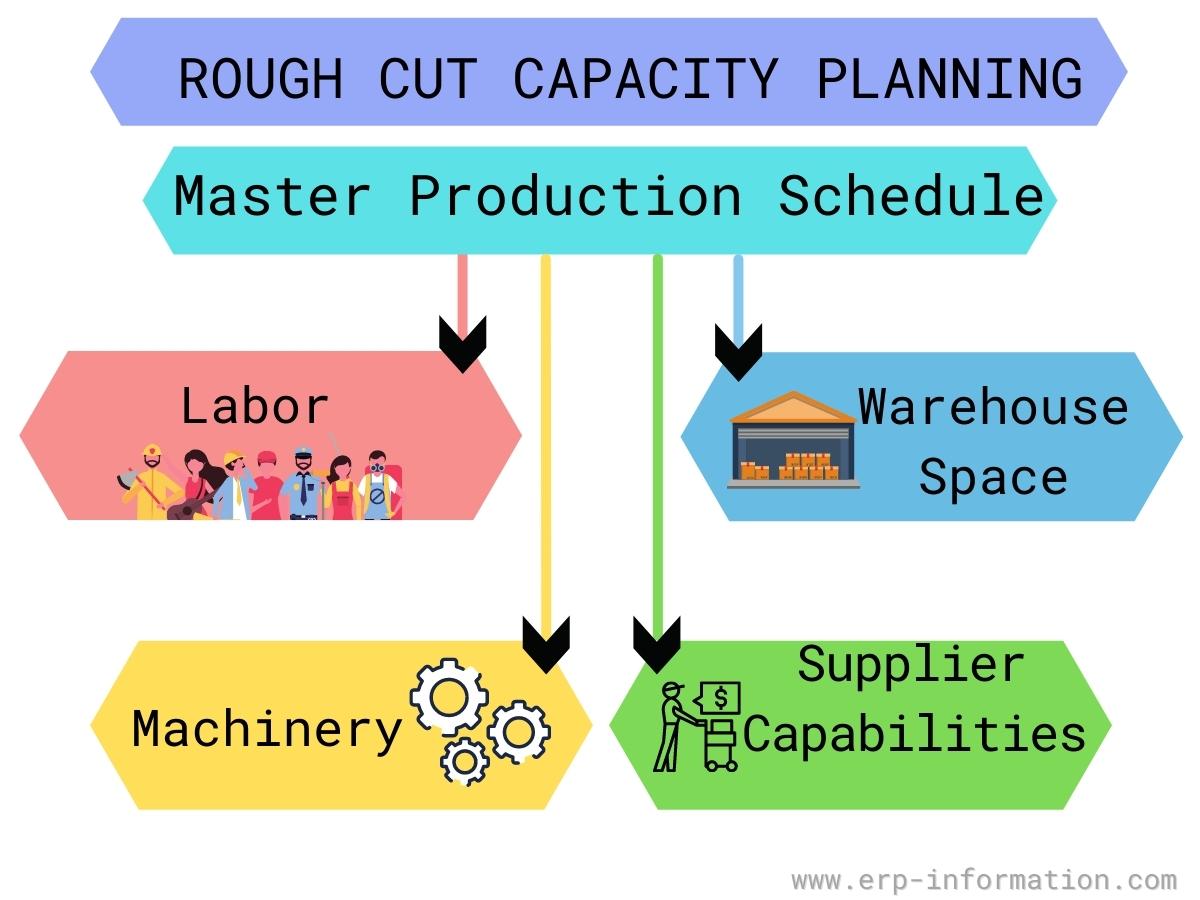
Rough-cut capacity planning is a medium-term capacity planning check that converts the master production schedule into the load it places on key resources. Comparing that load against available capacity confirms whether the plan is achievable, so a shortfall can be fixed early rather than discovered on the shop floor.
It converts the master production schedule into requirements for critical resources, often including labor, machinery, warehouse space, and supplier capabilities.
The word “rough-cut” describes how the capacity is measured, not materials. RCCP works in broad strokes, using standard hours at a few key work centers rather than a detailed, operation-by-operation load on every resource.
Because it works straight from the finished-goods schedule, RCCP does not net against on-hand inventory or scheduled receipts, and it does not size component lots. That detail belongs to MRP for materials and to capacity requirements planning (CRP) for capacity. RCCP’s only job is to flag whether the key resources can carry the load the MPS creates.
More on RCCP
Because it works from the master production schedule rather than detailed shop-floor routings, RCCP gives planners a fast, approximate read on whether the key resources can support the plan.
Rough-cut capacity planning is an easy and simplified technique that does not involve many hidden values or inventories.
That makes it a quick, high-level check, meant to catch obvious overloads early, before the more detailed capacity planning that follows.
Rough cut capacity planning software
In practice, RCCP is run inside an ERP or APS module. It takes the master production schedule, multiplies each period’s planned output by a bill of labor or resource profile, and flags any work center whose required load exceeds its available capacity, so planners can act before the schedule is released to MRP.
A firm must convert its demands into capacity, labor, materials, orders, and finished goods inventory. Therefore, it needs to balance its assets and plan accordingly.
It is a model that establishes a computational relationship between production designs, process sheets, consumption of raw materials, time available, labor availability, etc.
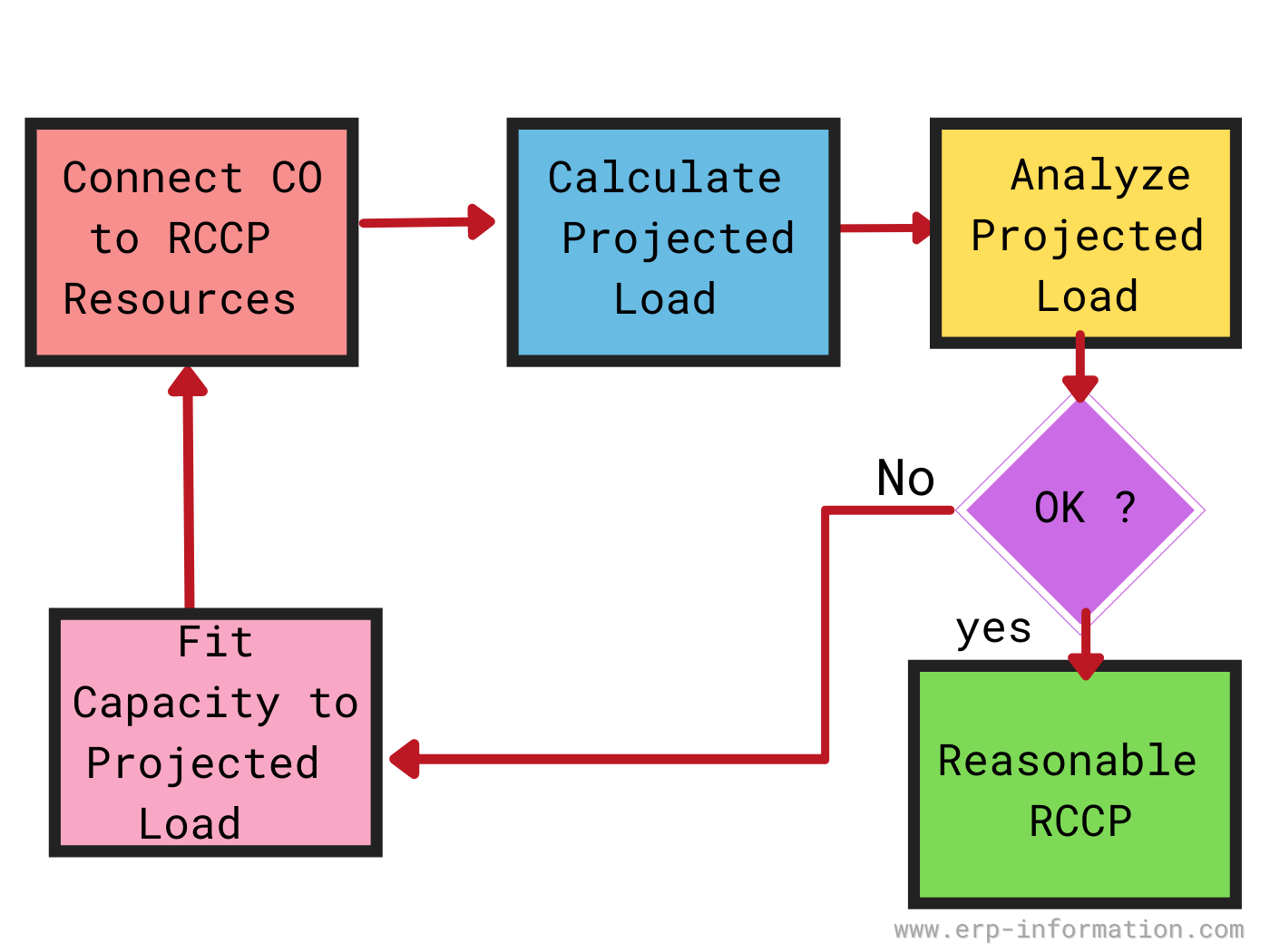
Where RCCP fits in the planning hierarchy
RCCP is one layer in a chain of capacity checks that get more detailed as planning moves from long-range strategy down to the shop floor. Each layer tests a different plan against a different level of resource detail:
- Resource requirements planning (RRP) checks the long-range production plan and the sales and operations plan against major resources such as whole plants and large equipment.
- Rough-cut capacity planning (RCCP) checks the master production schedule against a few key work centers, over the medium term. This is the layer covered in this guide.
- Capacity requirements planning (CRP) checks the detailed MRP plan against every work center, using routings and current shop-floor load, over the short term.
The three form a funnel: RRP works at the plant level, RCCP narrows to the key bottleneck resources, and CRP checks every work center in detail. RCCP sits in the middle because it is detailed enough to trust the master schedule, yet rough enough to re-run quickly whenever that schedule changes.
Short-term and long-term capacity responses
When RCCP shows that a key resource cannot carry the scheduled load, the fix falls into one of two time horizons. Which one a planner reaches for depends on how large the capacity gap is and how long it is expected to last.
- Short-term capacity planning
- Long-term capacity planning
Short-term capacity planning
In the short-term plan, the goal is to lift production capacity quickly, using levers like overtime, extra shifts, or subcontracting, to absorb unexpected spikes in demand.
Managing increased demand needs plenty of changes, but the foremost is to increase production hours, which means overtime for the employees.
Setting up extra facilities and acquiring more materials is also a way to proceed.
Many employees are happy doing overtime, which means extra bonuses and increased wages.
Overtime can go on for a few days or even a few months. Depending on the rush and also on the other aspects of production.
Long-term capacity planning
Long-term capacity planning is a cumulative effect of numerous short-term outcomes in the case of long-term capacity planning. Increasing shifts temporarily to meet immediate demands can, in the long run, add to the production capacity if continued.
Opening up a new facility or increasing hiring and investing in proper training also increases production capacity in the long run.
Adding capital equipment and modifying the production plan is another opportunity to increase production capacity.
Some manufacturing firms can efficiently delay demands by backlogging, queuing demands, or managing an anticipatory inventory that takes care of sudden rises in order during particular periods.
It allows the firm to perform at its own pace smoothly.
Three Methods of Rough Cut Capacity Planning
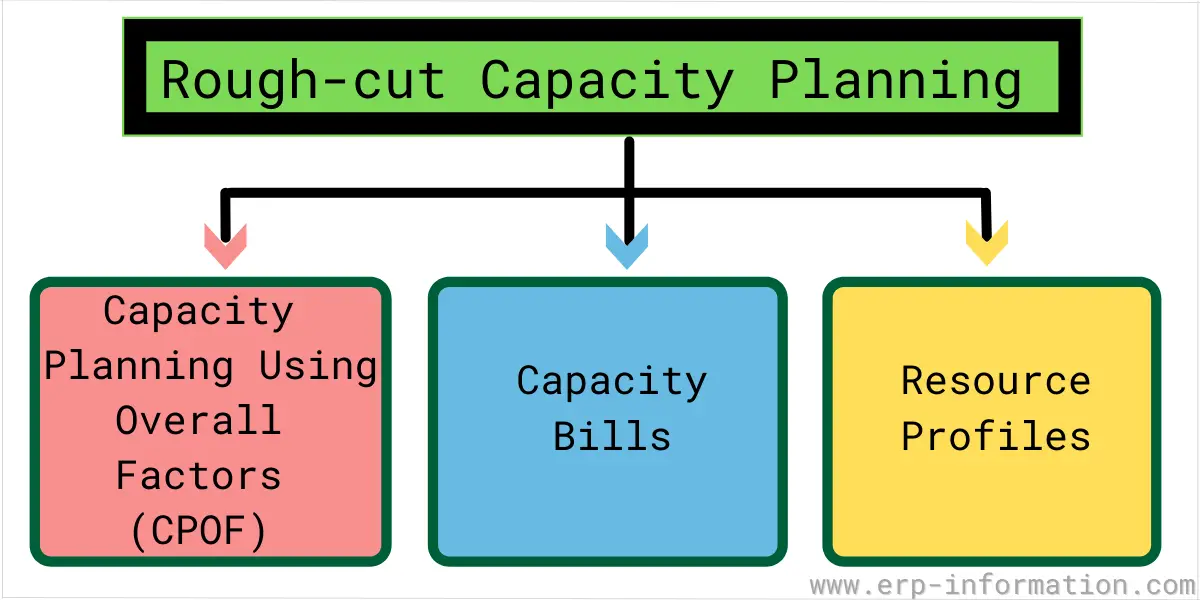
RCCP is calculated with one of three standard techniques, listed here from the least to the most detailed. The more detail a method uses, the more accurate it is and the more data it takes to maintain.
1. Capacity planning using overall factors (CPOF)
CPOF is the quickest and least detailed method. It takes the total output in the master schedule, multiplies it by an overall standard number of hours per unit, and then splits that total across work centers using historical proportions from past production. Because it leans on a single overall factor, CPOF is fast to run but insensitive to product mix: if the mix shifts toward more labor-intensive products, CPOF understates the real load.
2. Bill of labor (bill of capacity)
The bill of labor method keeps a separate record for each product listing the standard hours it needs at each key work center. Required capacity is then the bill of labor multiplied by the master production schedule, product by product. Because it works from per-product hours rather than one blended factor, it correctly picks up shifts in product mix. What it does not do is time-phase the load: it assumes all the hours fall in the period the item is scheduled, ignoring the lead-time offset between work centers.
3. Resource profile
The resource profile method is the most detailed of the three. It takes the bill of labor a step further by spreading each product’s capacity requirement across the actual periods the work happens in, using lead-time offsets, so machining hours can land in an earlier week than final assembly. This gives the most realistic period-by-period load, at the cost of maintaining lead-time data for every product and resource.
Levels for Calculating RCCP
RCCP can be calculated at two levels of detail: routing-based RCCP and rate-based RCCP.
When you want to do a capacity plan by resource, you can use routing-based RCCP. When you want to do a capacity plan by production line, you can use rate-based RCCP. The capacity load ratio is the output of both routing-based and rate-based RCCP.
That is
Capacity load ratio = Required capacity / Available capacity
1. Routing-based RCCP
It helps you to calculate each resource’s required and available capacity in hours per week. That shows resource availability. Formula is
Resource capacity load ratio (hours per week) = Resource required capacity (hours per week) / Resource available capacity (hours per week)
2. Rate-based RCCP
It helps you to calculate the required and available capacity per week per production line. That shows production capacity. Formula is
Production line capacity load ratio (per week) = Production line required capacity (per week) / Production line available capacity (per week)
Rough Cut Capacity Planning Examples
Let us take the instance of a factory that produces two items, boots and sandals. An MPS calculation takes place before the production of the pieces begins.
The amount of material required and the necessary working hours are calculated.
A rough-cut capacity planning includes charting out the,
- Staff hours necessary to fulfill the job
- The units required
- Days that will be needed to complete the task eventually
- The amount of material that needs to be purchased.
This chart would not consider inventory management details or scheduled late arrival receipts. Hence a rough cut capacity planning schedule is simple, intuitive, and similar to organizational planning to chart out the requirements in a rough estimation.
Some advantages and disadvantages of rough-cut capacity planning are mentioned here.
Advantages
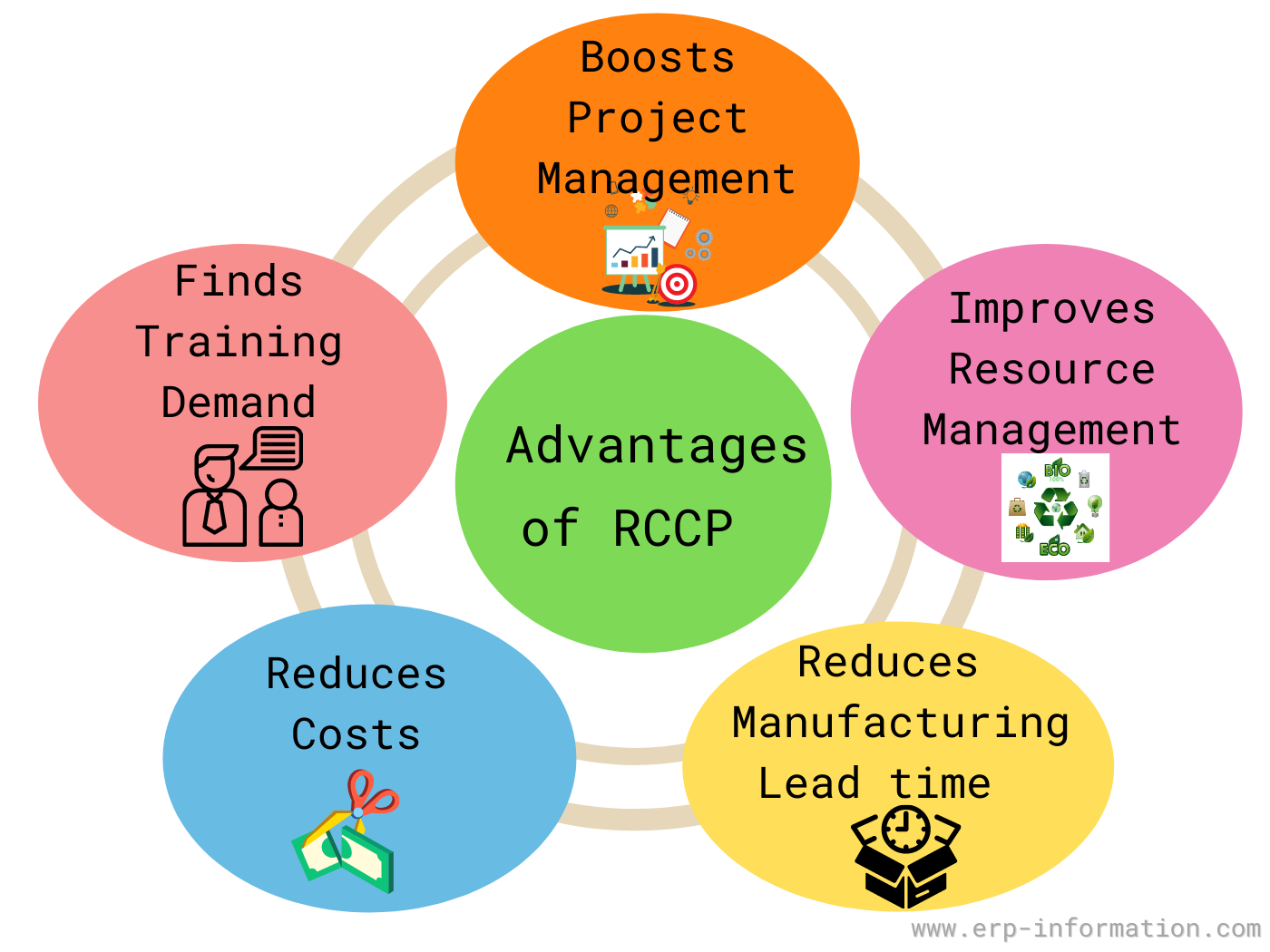
Boosts project management
You can quickly identify which work should start first and which job you can start later because of rough cut capacity planning.
Hence you and your team make sure about your work priority. In this way, it improves your project management.
Improves resource management
You can get a clear idea of the resources available and the working hours required for each process in each workstation.
Hence you can quickly identify the more or less workload and adjust the capacity by increasing or decreasing the shifts and increasing the number of workstations.
Decreases manufacturing lead time
Rough cut capacity planning helps the manufacturer find out the issues in the manufacturing process and allows him to address the problem immediately. Hence it reduces the manufacturing lead time.
Reduces costs
Knowing your team’s capacity can forecast how you can take on many training projects in a given period. That helps to bring down costs by reducing the waste on the training team.
Helps to find training demands
It allows you to check out the training demand depending on the available resources like working hours, budget, and skills.
Challenges
Limited accuracy
RCCP relies on estimates and assumptions about future demand. It requires data accuracy about current and future demand and available resources such as labor, equipment, and materials. If this data is not readily available or reliable, RCCP plans may be inaccurate or incomplete.
So it is important to take care about gathering and reconciling information. Exporting data from trusted sources and integrating it into a single solution is the better way to overcome this problem.
Accurate calculations
RCCP depends on many calculations. Inaccurate calculation leads to inaccurate demand forecasts, which causes problems in the RCCP process.
Inflexibility
Once an RCCP plan has been developed, adjusting for unexpected changes in demand or resource availability can be difficult. That can lead to over- or under-utilization of resources and increased costs.
Resource constraints
Even with accurate data and robust planning processes, there may be situations where resource constraints limit an organization’s ability to meet production demands.
For example, a shortage of skilled labor or raw materials could prevent an organization from fully utilizing its capacity.
Communication
During the RCCP process, all departments of an organization participate. That may lead to a communication gap. To avoid this gap, have a single location for planning that improves communication between departments.
Time
The process can consume more time. Because data collection, analysis, and making decisions takes more time. When you repeat this process, you need to commit more time. To avoid this, you can use capacity planning software solutions to automate data collection and analysis.
Difference Between RCCP and Capacity Planning
Capacity planning and rough cut capacity planning (RCCP) are both planning processes that help organizations ensure they have the resources to meet their production requirements. Let us have a look into some key differences between these two approaches.
| RCCP | Capacity planning |
| It estimates whether an organization can meet its production plans. It is typically done before capacity planning. | It analyzes current & future demand, assesses available resources (such as labor, equipment, and materials), and develops a plan to optimize resource utilization. |
| It does not consider the specific details of individual machines or processes. Instead, it focuses on identifying potential capacity constraints at a high level and determining whether additional resources may be needed. | It considers specific details about individual machines or processes, allowing for more accurate resource allocation. |
Difference Between RCCP and CRP
| RCCP | Capacity Requirement Planning (CRP) |
| It is used in the beginning planning stage for the master production schedule. | It is usable for the final capacity check for the master production schedule. |
| It gives rapid feedback. | It gives feedback slowly. |
| It is less precise comparatively. | It is more precise. |
RCCP Calculation
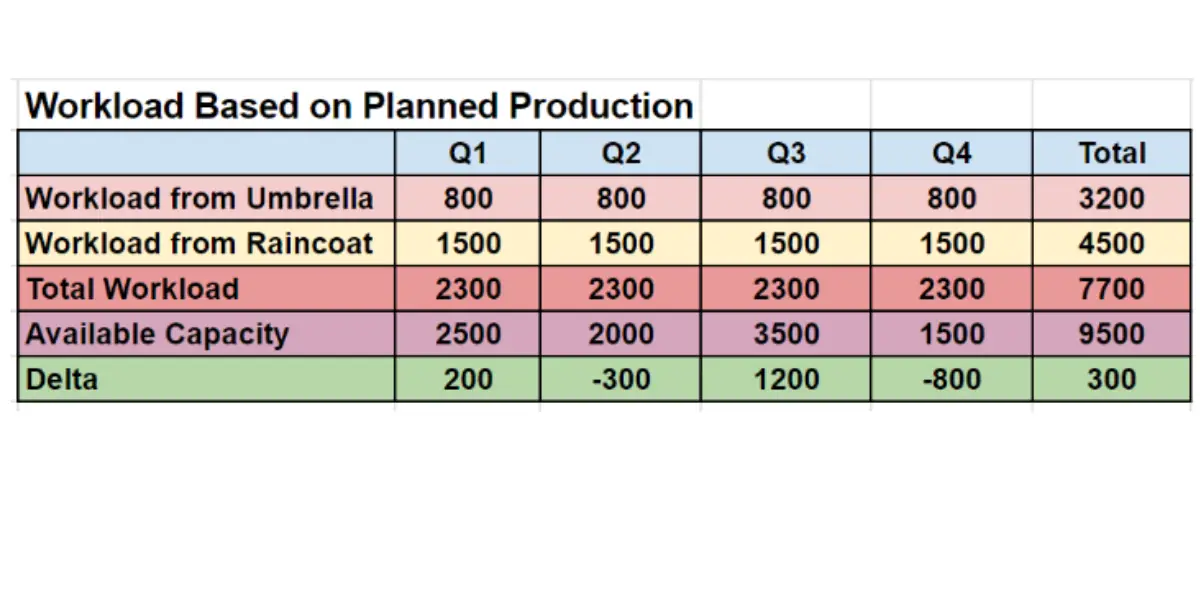
Here is a worked example using the bill of labor method. A plant makes two products, A and B, that both pass through two key work centers, Machining and Assembly. The bill of labor lists the standard hours each product needs at each work center:
| Product | Machining (hrs/unit) | Assembly (hrs/unit) |
|---|---|---|
| A | 0.5 | 0.4 |
| B | 0.3 | 0.6 |
The master production schedule for next week calls for 200 units of A and 150 units of B. Multiplying the schedule by the bill of labor gives the required capacity at each work center:
- Machining: (200 × 0.5) + (150 × 0.3) = 100 + 45 = 145 hours
- Assembly: (200 × 0.4) + (150 × 0.6) = 80 + 90 = 170 hours
Each work center has 160 hours of available capacity next week (four people at 40 hours). The load ratio is required capacity divided by available capacity:
- Machining: 145 / 160 = 91%, within capacity.
- Assembly: 170 / 160 = 106%, overloaded by 10 hours.
RCCP has done its job. It shows the master schedule is not achievable at Assembly as it stands, and it shows this before MRP runs or any material is ordered. The planner now has a clear, early choice: add about 10 hours of overtime at Assembly, move some of product B into an adjacent week, or trim the schedule, all while there is still time to act.
To run the calculation on your own numbers, download the worksheet below.
FAQs
What is rough cut capacity planning in SAP?
Rough cut capacity in SAP is a collection of outlooks on the organization’s resources. That means the organization considers one whole working day instead of hours and minutes and considers work center groups instead of a single work center.
SAP capacity planning predicts future needs based on available resources and anticipated demands. This type of planning is a wide-ranging activity that involves decisions related to people, processes, products, equipment, and finances.
Conclusion
RCCP stands for rough-cut capacity planning. RCCP is a process that helps manufacturers estimate the number of units they can produce in a given period, and it’s an integral part of manufacturing.
Because it works at the resource-group level rather than every operation, RCCP is fast enough to re-run whenever the master schedule changes. When it flags an overload on a key work center, the planner has clear choices: add overtime or a shift, offload the work, or revise the schedule, all before the detailed capacity plan and the shop floor inherit the bottleneck.
The rough-cut capacity planning technique has various advantages and disadvantages but is considered a safe starting point.