
ERP modules are the parts of an enterprise resource planning (ERP) system that each run one business function (finance, purchasing, inventory, sales, production or HR) on one shared database. Gartner says ERP tools “share a common process and data model”, and that shared model is what makes a module more than a standalone app.
Below are the core modules and what each one records. We show how modules actually connect, using SAP’s documentation and Odoo 20’s source code, then compare how SAP, Oracle, Microsoft, NetSuite and Odoo name and license their modules today. A short method for choosing yours closes the page. We checked every vendor fact against the vendor’s own pages on 10 October 2026.
Introduction to ERP System Modules
A module is the unit you buy, switch on and configure. Each one owns a set of transactions, such as a purchase order, a goods receipt or a sales invoice. All of them read and write the same customers, items and general ledger. SAP’s S/4HANA 2025 scope document states the rule for stock: “a document must be generated and stored in the system for every transaction/event that causes a change in stock.” Because every module leaves its documents in the same database, the next module picks them up without anyone retyping them.
| Module | What it handles | Where SAP S/4HANA 2025 files it |
|---|---|---|
| Finance | General ledger, payables, receivables, assets, cash, closing | Finance |
| Procurement | Requisitions, purchase orders, supplier invoices | Sourcing and Procurement |
| Inventory | Stock quantities and values, goods movements, warehouses | Supply Chain |
| Sales | Quotations, sales orders, deliveries, billing | Sales |
| Production | Bills of materials, routings, production orders, MRP | Manufacturing |
| Quality | Quality planning, inspections | Manufacturing |
| Human resources | Employee records, time recording, payroll | Human Resources |
| Projects | Project structures, costs, billing | R&D / Engineering |
| Maintenance | Technical assets, maintenance orders | Asset Management |
| Service | Service agreements, service orders | Service |
Types of ERP Modules

This page groups modules three ways, as in the picture above. Treat it as a teaching map, not a vendor standard. SAP’s own S/4HANA 2025 scope document lists lines of business, such as Finance, Sourcing and Procurement, and Supply Chain. It files the technical pieces separately, under “Analytics Technology” and “Enterprise Technology”.
- Functional modules run a business function: finance, procurement, inventory, sales, production and HR.
- Technical modules are the platform underneath: database, security, interfaces, programming tools and analytics.
- Application suites are separate systems beside the ERP that reach outside the company: CRM toward customers, SRM and SCM toward suppliers, and PLM for product data.
A fourth split matters more when you buy: which modules come with the base licence and which cost extra. Vendors answer that very differently, as the pricing section below shows.
ERP Functional Modules

Six modules make up the core. Microsoft’s list of functional areas for Business Central, its ERP for small and midsize companies, includes all six: Finance, Sales, Purchasing, Inventory, Manufacturing and Human Resources. It adds projects, fixed assets, warehouse management and service management. SAP’s S/4HANA lines of business cover the same ground.
1. Finance Module in ERP
The finance module keeps the general ledger and the subledgers that feed it: payables, receivables, fixed assets and cash. Every other module posts into it. In Odoo 20, for example, the Purchase app cannot even be installed without the invoicing module it depends on. In SAP S/4HANA the postings land in one place. The Simplification List calls the Universal Journal “the common line item table ACDOCA for FI and CO”, so financial accounting and controlling no longer need a separate reconciliation.
To know more about this module, read ERP Finance Module: 7 Types of Reports and Valuable Features.
2. HR (Human Resources) Module
HR holds employee records, organisation structure, time and absence, and payroll. Several vendors keep it as a separate product. SAP S/4HANA 2025 supports “integration with an external HR system (currently SAP SuccessFactors Employee Central)”. ERPNext moved HR and payroll into a separate app, Frappe HR, from version 14. Microsoft still sells Dynamics 365 Human Resources as its own licence, at $135 per user per month.
For the HR submodules, read ERP HR Module: 6 HRM Submodules & Features Explained.
3. Production Module
Production plans and records what the factory makes. Its master data are bills of materials, routings and work centers. SAP uses work centers to represent machines, production lines and employees. Planning starts from demand and runs through material requirements planning (MRP). SAP’s 2025 scope document says MRP covers demand “by supply elements (for example, inhouse production orders) without considering the available capacity”. That is why capacity planning sits beside it. In Odoo 20 the Manufacturing app depends on the Inventory module, so production cannot run there without stock.
For planning features, read ERP Production Planning Module (Features, Types, Objectives).
4. Procurement Module in ERP
Procurement runs the buy side: supplier records, requisitions, sourcing, purchase orders, receipts and supplier invoices. Oracle’s current Procurement product lists Sourcing, Contracts, Purchasing, Self Service Procurement, Supplier Management and Sustainability. What makes it an ERP module rather than a buying tool is the link to stock and money. SAP describes Logistics Invoice Verification as “a part of Materials Management (MM)”, and posting the invoice updates both Materials Management and Financial Accounting. Beyond the company, procurement feeds the wider supply chain.
For the procurement process flow, read ERP Purchasing Module: Features & Procurement Process Flow.
5. Inventory Module
Inventory records what you hold, where, and what it is worth: receipts, issues, transfers, counts and valuation (see inventory management). Vendors differ on when a stock movement reaches the ledger. In SAP, a goods movement that affects the general ledger creates an accounting document in parallel with the material document. Odoo 20 values stock in its Inventory app in real time, but its Accounting app “updates accounting inventory valuation only when specifically requested, most often for closing”. Under perpetual accounting it also updates when vendor bills or customer invoices are posted.
Ask any vendor which way it works. The answer decides how current the stock value in your ledger is between closings.
To know more about this module, read ERP Inventory Module (Features & Types).
6. Sales Module in ERP
Sales covers quotations, sales orders, pricing, deliveries and billing, plus the customer data behind them, such as addresses, payment terms and shipping instructions. Odoo’s Sales app describes its flow as quotation, then sales order, then invoice. SAP S/4HANA 2025 files the same work under Order and Contract Management, including a credit check that runs when a sales document is created or changed.
For the sales flowchart, read ERP Sales Module: Features, Flowchart, and More.
Beyond the core six, these modules are common, and vendors often price them separately.
1. Order Management Module
Order management takes an order from entry to fulfilment across channels and warehouses. Oracle places it in its supply chain group as Oracle Fusion Cloud Order Management. NetSuite lists Order Management as a product in its ERP group and says its order management capabilities are included with the NetSuite platform licence.
2. Warehouse Management Module
Warehouse management runs the work inside the building: putaway, bins, picking, packing and shipping. SAP says its basic warehouse management gives “real-time transparency into managing and processing material movements”. NetSuite sells the same ground as Warehouse & Fulfillment, and Microsoft includes warehouse management in Business Central.
For warehouse systems in depth, read Warehouse Management System (WMS).
3. Professional Services Automation (PSA) Module
Professional services automation serves firms that sell time: projects, resource planning, timesheets, expenses and project billing. NetSuite says its PSA product helps firms “generate invoices accurately and efficiently”. Microsoft sells Dynamics 365 Project Operations at $135 per user per month, and Odoo groups Project, Timesheets and Planning under Services.
4. Workforce Management Module
Workforce management schedules people and records time, attendance and leave. In Frappe HR it appears as the Shift and Attendance and Leaves modules, and NetSuite’s own guide to ERP modules lists it as a module of its own. You can test staffing numbers with our Workforce Planning Calculator.
Related article: 10 Best Workforce Management Software List
5. E-commerce Module
An e-commerce module runs a web shop on the ERP’s own product, price and stock data. Odoo 20’s eCommerce module (website_sale) depends on its website and sales modules, so a web order is a sales order from the start. NetSuite and Microsoft sell commerce as separate products: NetSuite Commerce and Dynamics 365 Commerce.
Related article: 10 Best B2B eCommerce Platform
6. Marketing Automation Module
Marketing automation sends and tracks campaigns. Odoo groups Email Marketing, SMS Marketing, Social Marketing, Marketing Automation and Surveys under Marketing, and NetSuite’s guide to ERP modules counts marketing automation among its 13 modules.
How do ERP modules connect to each other?
Every vendor says its modules are integrated. You can see what that means in two places: the documents one transaction creates, and the dependencies each module declares.
In SAP: one goods receipt, two documents
- A buyer creates a purchase order in Materials Management.
- When the goods arrive, posting the goods receipt creates a material document as proof of the movement. SAP’s documentation: “Parallel to the material document, the system creates an accounting document.” That happens when the movement updates the general ledger.
- Goods receipts and supplier invoices are offset on a clearing account; SAP calls it “the GR/IR clearing account”.
- When the supplier invoice is posted in Logistics Invoice Verification, the system updates Materials Management and Financial Accounting, and the GR/IR clearing account is cleared.
Nobody in finance retypes the receipt. That is the whole case for buying modules from one suite. It also gives you a test for any demo: post a receipt, then ask to see the journal entry it produced.
In Odoo 20: bridge modules you can read in the source code
Odoo is open source, so its module dependencies are public. We read the manifest file of each module on the 20.0 branch of odoo/odoo on 10 October 2026. The Inventory module does not depend on accounting, and Purchase depends only on the invoicing module. The link between stock and money is a separate module, stock_account, which Odoo names “WMS Accounting”: it depends on both and installs itself once both are present. Sales, Purchase and Manufacturing each reach it through their own bridge: sale_stock, purchase_stock and mrp_account.
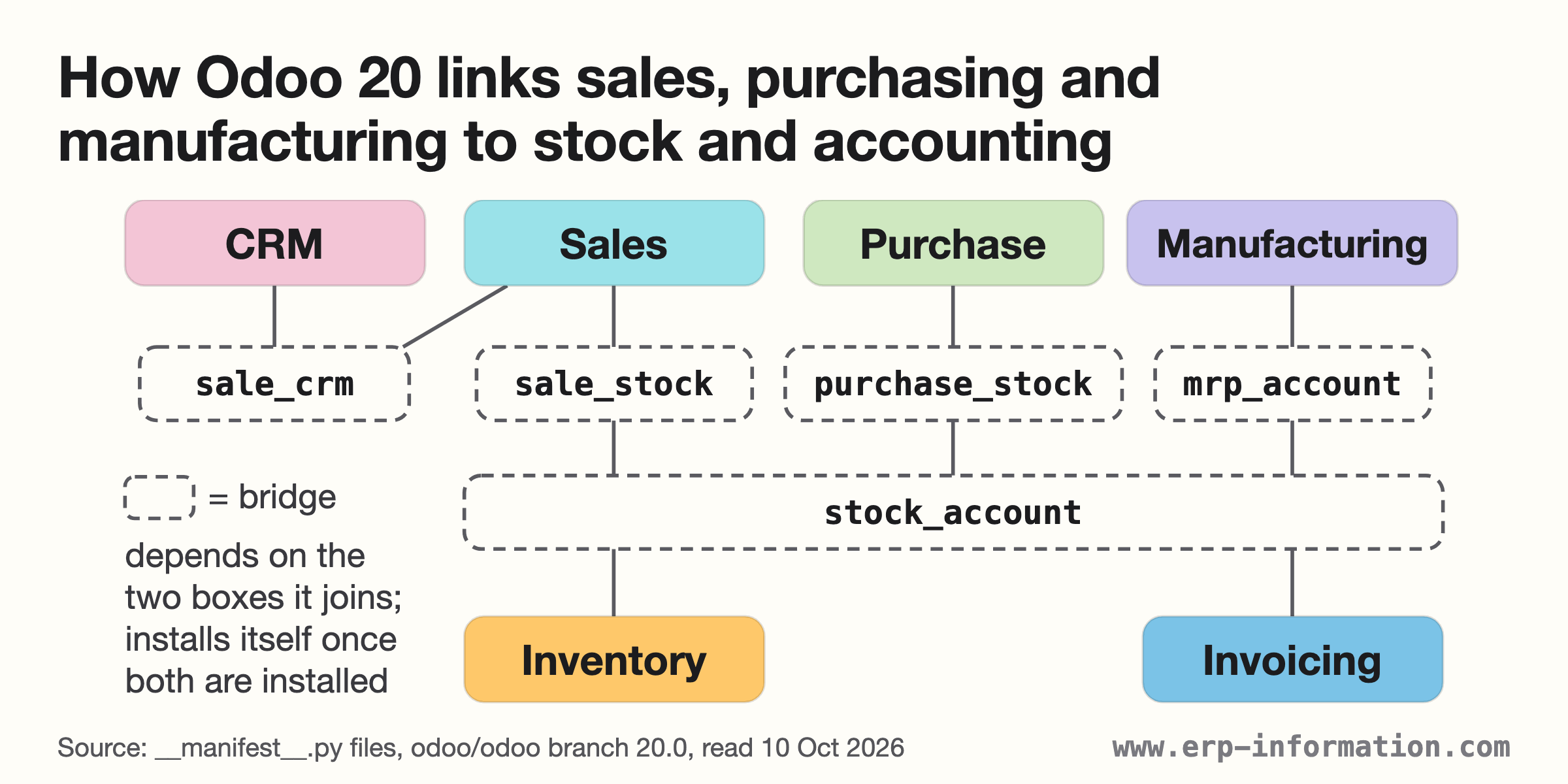
The map changes between versions. In Odoo 19 the point-of-sale module depended on stock_account directly; in Odoo 20 that link moved into a new bridge, pos_stock. An upgrade can move integration into a different module, which is worth knowing before you customise one.
Technical Modules of ERP

Technical modules are the platform the functional modules run on. You rarely buy them by name: they come with the licence, and in a cloud ERP the vendor operates most of them. SAP’s S/4HANA 2025 scope document lists them under “Analytics Technology” and “Enterprise Technology”, which makes a useful checklist for any vendor.
Basic Components
These are the database and the application server. SAP describes S/4HANA as an ERP “based on SAP HANA database”, and says its ABAP platform “is the foundation for ABAP-based SAP solutions”. On a hosted plan this layer is the vendor’s job: Odoo says all its plans include unlimited support, hosting and maintenance. If you run the ERP on your own servers, the hardware, software and backups are yours.
Security Module
Security covers users, roles, approvals and the audit trail. The hard part is segregation of duties: making sure, for example, that the person who creates a supplier cannot also pay it. Oracle’s product for this is Oracle Fusion Cloud Risk Management and Compliance, with three areas: Cybersecurity Command Center, Transaction Monitoring and Assurance, and Automate Control and Audit Testing. Network defences such as firewalls protect the server, but they cannot see who approved what inside the ERP.
Networking and Interface
This layer moves data in and out: screens, printed and emailed documents, and connections to other systems. SAP lists Output Control, which lets business applications “define and trigger outgoing communication with business partners”, and a Process Management and Integration area in it.
Management Information System
A management information system (MIS) gives managers the reports they decide with. In current ERPs it is built in rather than bought separately. SAP’s analytics framework lets customers “consolidate business data from different virtual data models, work with real-time data, and build reports”.
Application Programming Module
These are the tools for extending the ERP with your own code. SAP’s S/4HANA is built on its ABAP platform. Odoo modules are declared in Python manifest files like the ones behind the diagram above, and Odoo lists Studio and External API under its Custom plan, not its Standard plan.
Analytic Module
The analytic module puts dashboards and analysis on top of the transaction data. Oracle Fusion ERP Analytics is now part of Oracle Fusion Data Intelligence, with prebuilt analytics for general ledger, receivables, payables, spend, expenses, procurement, projects and assets. NetSuite lists Enterprise Performance Management and Analytics & Reporting among its products.
APIs Opened for External Use
APIs let other systems read and write ERP data. SAP says S/4HANA “provides application program interfaces (API) to further extend or integrate your system”, and it publishes a public catalog of them. Check which plan includes API access before you buy: Odoo lists External API only on its Custom plan.
Integration of ERP with the Application Suite

An application suite adds systems that work across the company’s boundary. SAP’s Business Suite 7 sold them as separate products beside SAP ERP: SAP CRM, SAP SRM and SAP SCM. They also share ERP’s end dates. SAP’s list of Business Suite 7 core applications covered by its 2027 and 2030 maintenance dates names SAP ERP 6.0, CRM 7.0, SCM 7.0 and SRM 7.0.
Supply Chain Management (SCM)
SCM plans supply against demand across plants, suppliers and transport. SAP describes SAP SCM as connecting “all your planning processes to respond quickly and cost-effectively to changes in supply, demand, and market conditions”. Oracle groups planning, execution, order management and logistics as its supply chain products, separate from its ERP applications.
Supplier Relationship Management (SRM)
SRM handles the supplier side of buying: sourcing, quotations, contracts and collaboration. In SAP’s words it coordinates “your business processes with your key suppliers”. The diagram above now labels it SRM; an earlier version of this page’s image called it SCM by mistake.
Customer Relationship Management (CRM)
CRM covers the customer side before and after the order: leads, opportunities, campaigns and service. SAP describes SAP CRM as “supporting all customer-focused business areas”. It meets the ERP at the quotation: in Odoo 20 the bridge module sale_crm, named “Opportunity to Quotation”, depends on both CRM and Sales.
Product Lifecycle Management (PLM)
Product lifecycle management keeps product data from design to production. SAP documents Product Lifecycle Management (PLM) as a Logistics component of SAP ERP itself, while Oracle puts Oracle Fusion Cloud Product Lifecycle Management in its supply chain group.
Related article: What is Enterprise Application Integration (EAI)?

How are ERP modules sold and priced?
Module boundaries are also price boundaries. Three vendors that publish their rules show three different models. We checked these on 10 October 2026; prices are US list prices unless stated.
| Vendor | How modules are licensed | List price per user per month |
|---|---|---|
| Microsoft Dynamics 365 | Each app is a separate licence. A user’s first licence must be the highest priced (the base); further apps are cheaper attach licences with the same capabilities. Finance and Supply Chain Management need at least 20 users. | Finance or Supply Chain Management $210 (Premium $300); Project Operations $135; Human Resources $135; attach licences on a Finance base $20 or $30; Business Central Essentials $80, Premium $110. Paid yearly. |
| NetSuite | An annual licence made of core platform, optional modules and the number of users, plus a one-time implementation fee. | No list price on the NetSuite pages we checked (ERP, products, financial management, order management pricing). |
| Odoo 20 | One App Free: one app, unlimited users. Standard and Custom include all apps for one fee; Custom adds Studio, multi-company and External API. | Set by country. Served in India: Standard Rs 725, Custom Rs 1,350 (billed yearly). A 20% first-year discount is a promotion, not the list price. |
Read the table as three buying rules. On Microsoft, the second module is the cheap one. On NetSuite, each optional module adds to an annual fee that NetSuite quotes to you. On Odoo, once you pay for Standard, another module costs nothing extra, so the decision becomes the number of users. We could not get Odoo’s US dollar prices: odoo.com sets the currency by the visitor’s location.
Benefits of ERP Modules
- One entry, several records. In SAP, a goods receipt creates the material document and the accounting document together, so the warehouse and the ledger cannot disagree about that receipt.
- Fewer reconciliations. S/4HANA posts financial accounting and controlling to one line item table (ACDOCA), so the two no longer need a separate reconciliation.
- Buy in steps. Odoo’s One App Free plan, NetSuite’s optional modules and Microsoft’s attach licences all let you start with one or two modules and add more later.
- Records regulators ask for. Package-level drug tracing is already required in the US, and food lot records will be from July 2028. Both live in inventory, purchasing and sales (see the industry table below).
- The trade-off. Shared data means shared setup. A change to item, customer or account settings reaches every module that uses them, so the module owners have to agree on master data before go-live.
Role of ERP Modules in Different Industries
The core modules are the same everywhere. What changes by industry is the record a regulator or contract demands, and that record decides which module becomes essential.
| Industry | Module that becomes essential | Why (primary source) |
|---|---|---|
| Food (US) | Lot tracking across inventory, purchasing and sales | FDA Food Traceability Rule (FSMA 204): records of Key Data Elements for Critical Tracking Events on listed foods, given to FDA within 24 hours. Compliance date 20 July 2028, after Congress directed FDA not to enforce earlier. |
| Drug distribution (US) | Package-level serial tracking | Drug Supply Chain Security Act: interoperable, electronic tracing at the package level. Small dispensers are exempt from some requirements until 27 November 2027. |
| Non-profit (US GAAP) | Fund and restriction tracking in finance | FASB ASU 2016-14: net assets with and without donor restrictions, and expenses by natural and functional class. |
| Professional services and subscriptions | Revenue recognition and project billing | ASC 606 and IFRS 15 set five steps from contract to revenue. Oracle and NetSuite both sell revenue modules built for these standards. |
| Construction (US) | Job costing and progress billing | AIA G702 and G703: the contractor applies for payment against a schedule of values, showing retainage and change orders, and the architect certifies it. |
| Manufacturing | Production, MRP and quality | MRP plans supply to cover demand from sales and production. Maintenance planning matters too; see predictive maintenance. |
Some sectors leave the core ERP altogether. ERPNext removed its healthcare, education, agriculture, non-profit and hospitality domains from the core product in version 14, released in August 2022.
SAP ERP Modules
The classic SAP module codes (FI, CO, MM, SD and the rest) come from SAP ECC. SAP’s library for SAP ERP 6.0 (EHP8, documentation published June 2026) groups them under Accounting, Logistics and Human Resources. The table gives the codes as SAP spells them and where the same work sits in S/4HANA 2025.
| Code | SAP name | In S/4HANA 2025 (SAP scope document) |
|---|---|---|
| FI | Financial Accounting | Finance: Accounting and Financial Close |
| CO | Controlling | Finance, sharing the Universal Journal with FI |
| FIN-FSCM | Financial Supply Chain Management (credit, cash and liquidity, treasury) | Finance: Treasury Management, Financial Operations |
| MM | Materials Management | Sourcing and Procurement; Supply Chain: Inventory |
| SD | Sales and Distribution | Sales: Order and Contract Management |
| LE | Logistics Execution | Supply Chain: Delivery and Transportation, Warehousing |
| PP | Production Planning and Control | Manufacturing: Production Planning, Production Operations |
| QM | Quality Management | Manufacturing: Quality Management |
| PM | Plant Maintenance | Asset Management: Maintenance Management |
| PS | Project System | R&D / Engineering: Enterprise Portfolio and Project Management |
| CS | Customer Service | Service |
| PLM | Product Lifecycle Management | R&D / Engineering: Product Development Foundation |
| PA, PT, PY, PE | Personnel Management, Personnel Time Management, Payroll, Training and Event Management | Human Resources, or SAP SuccessFactors |
ECC itself is in its last support years. Mainstream maintenance for SAP ERP 6.0 with enhancement packages 6, 7 or 8 runs to 31 December 2027. Optional extended maintenance runs to 31 December 2030, at a premium of two percentage points on the maintenance basis. Systems on no enhancement package, or on packages 1 to 5, left mainstream maintenance on 31 December 2025. On 7 October 2026 SAP said the dates “have not changed”.
For the largest and most complex customers, SAP offers a paid subscription, now called Transition Option for SAP ERP, covering 2031 to 2033. Systems must first move to SAP ERP, private edition on SAP HANA before 31 December 2030, and SAP says the option “is not a maintenance prolongation of SAP ERP”.
Two S/4HANA changes affect every ECC conversion. Customers and suppliers are no longer separate master records: the Business Partner is “the single point of entry to create, edit, and display master data for business partners, customers, and suppliers (vendors)”. And FI and CO post to one Universal Journal. On 10 October 2026 the newest releases were S/4HANA 2025 (feature package stack 02) on premises and in private cloud, and S/4HANA Cloud Public Edition 2608.
For HR, SAP offers SAP Human Capital Management for SAP S/4HANA on premises, and SAP SuccessFactors in the cloud. In 2020 SAP said it was committed to this offering until 2040. Small companies use a different product, SAP Business One (current version 10.0 FP 2608). SAP lists its areas as accounting and financials, purchasing, inventory, sales and customer relationships, and reporting and analytics.
Oracle ERP Modules
Oracle sells Oracle Fusion Cloud ERP as a set of applications and updates them quarterly. The newest What’s New document on 10 October 2026 was for release 26D. The names below are the ones on Oracle’s product pages that day.
| Oracle application | Areas Oracle lists |
|---|---|
| Financial Management | Core Accounting; Spend; Cash and Payments; Receivables and Collections; Revenue Management; Assets and Leasing |
| Project Management | Planning and Scheduling; Costing and Control; Billing and Revenue; Resource Management; Program Management; Grants |
| Procurement | Sourcing; Contracts; Purchasing; Self Service Procurement; Supplier Management; Sustainability |
| Risk Management and Compliance | Cybersecurity Command Center; Transaction Monitoring and Assurance; Automate Control and Audit Testing |
| Enterprise Performance Management | Connected Planning; Financial Consolidation and Close; Profitability and Cost Management; Account Reconciliation; Tax Reporting; Enterprise Data Management |
| ERP Analytics | Oracle Fusion ERP Analytics, now part of Oracle Fusion Data Intelligence |
| Supply chain (Oracle Fusion Cloud SCM) | Product Lifecycle Management; Supply Chain Planning; Supply Chain Execution; Order Management; Logistics |
Older lists, including Oracle’s own 2023 article and the earlier version of this page, use names Oracle no longer shows. Payables now sits under Spend and assets under Assets and Leasing, and expenses appear as an Expenses Agent. Project asset management, enterprise risk management and business continuity planning are not named on the current product pages or in the documentation lists we checked. Accounting Hub survives as a book in Oracle’s 26D documentation.
Oracle’s older suite, PeopleSoft, is still sold in four families: Human Capital Management, Enterprise Resource Planning, Campus Solutions, and PeopleTools and Technology. Oracle’s Lifetime Support Policy dated 7 August 2026 gives its current releases Premier Support through at least December 2037.
Microsoft Dynamics 365, NetSuite and Odoo Modules
Microsoft Dynamics 365
Microsoft splits its ERP into separately licensed apps: Dynamics 365 Finance, Supply Chain Management, Project Operations, Human Resources and Commerce, plus Dynamics 365 Business Central for small and midsize businesses. Business Central’s functional areas, per Microsoft Learn, are Finance, Financial Business Intelligence, Sales, Purchasing, Inventory, Project Management, Fixed Assets, Relationship Management, Human Resources, Planning, Assembly Management, Manufacturing, Warehouse Management and Service Management. Human Resources was not retired: Microsoft moved it onto the finance and operations infrastructure and does not require customers to merge environments.
NetSuite
NetSuite’s product list includes Financial Management, Global Business Management, Enterprise Performance Management, Inventory Management, Order Management, Supply Chain Management, Warehouse & Fulfillment and Procurement. CRM, PSA, Human Resource Management, Field Service and Commerce are further products. The product list we read has no separate manufacturing product: NetSuite describes its suite as covering accounting, orders, inventory, projects, production, supply chain and warehouse operations. Its Financial Management features include subscription billing and revenue recognition to comply with “ASC 606 and IFRS 15”.
Odoo 20
Odoo 20 was released in September 2026. Odoo presents its apps in eight groups: Finance, Sales, Websites, Supply Chain, Human Resources, Marketing, Services and Productivity. Supply Chain, for example, holds Inventory, Manufacturing, Maintenance, PLM, Quality and Purchase. Odoo comes in two editions: Community, which is open source, and Enterprise, which is licensed and built on Community.
ERPNext
ERPNext, an open-source ERP, is on version 16 (v16.0.0 was published in January 2026). Its code lists modules including Accounts, CRM, Buying, Selling, Stock, Manufacturing, Projects, Assets, Maintenance, Quality Management, Support and Subcontracting. HR and payroll left the core in version 14 and now ship as Frappe HR, which requires ERPNext.
Which ERP modules does your business need?
Our method, built from the evidence on this page: start from the documents your business must produce, and work outward.
- List the documents. Invoices, purchase orders, goods receipts, production orders and payslips, plus any record a regulator requires, such as food lot records, drug package serials or donor restrictions. Each document belongs to a module.
- Start with finance. Every other module posts into the ledger; in Odoo 20 even Purchase cannot be installed without the invoicing module.
- Add the modules that carry your volume. Distributors need inventory, order management and warehouse management. Manufacturers add production, which in Odoo requires Inventory. Service firms add projects or PSA.
- Decide HR on its own. SAP, Microsoft and ERPNext all offer HR as a separate product, so it is a real choice, not a default.
- Price the combination. Ask for the base, attach or optional-module price of exactly the set you chose, at your user count, with the billing term written down.
- Test the bridges in the demo. Post one receipt and one supplier invoice with your own data and ask to see the journal entries each one created. If the vendor has to build that link for you, it is integration work, not a module.
The vendor whose modules pass step 6 with your data, at the price you wrote down in step 5, is the one to shortlist.
FAQs
What are ERP modules?
ERP modules are the parts of an ERP system that each run one business function, such as finance, procurement, inventory, sales, production or HR. They share one database, so a transaction in one module, such as a goods receipt, creates the records the others need, such as the matching accounting entry, without rekeying.
What are the core modules of an ERP system?
Finance, procurement, inventory, sales, production and human resources. SAP S/4HANA 2025 organises the same ground into lines of business such as Finance, Sourcing and Procurement, Supply Chain, Manufacturing, Sales, Service, Asset Management and Human Resources, and Microsoft lists Finance, Sales, Purchasing, Inventory, Manufacturing and Human Resources among the areas of Business Central.
Are ERP modules sold separately?
Often, but the rules differ. Microsoft licenses each Dynamics 365 app separately, with a full-price base licence and cheaper attach licences. NetSuite charges an annual fee made of a core platform, optional modules and users. Odoo’s Standard and Custom plans include all apps for one per-user fee. We checked these terms on 10 October 2026.
How do ERP modules share data?
Through shared master data and documents. In SAP, posting a goods receipt creates a material document and, in parallel, an accounting document. In Odoo 20, small bridge modules such as stock_account and sale_stock depend on two apps at once and install themselves when both are present.
What is the difference between an ERP module and an application suite such as CRM or SCM?
A module is part of the ERP and shares its database. An application suite adds separate systems that reach outside the company, such as CRM for customers, and SRM and SCM for suppliers. SAP sold CRM 7.0, SRM 7.0 and SCM 7.0 as separate products beside SAP ERP 6.0, with the same maintenance end dates.
How we researched this page
Updated 10 October 2026. We read each vendor’s own documentation and product pages that day. For SAP: the S/4HANA 2025 Feature Scope Description and Simplification List, the SAP ERP 6.0 library and SAP News. For Oracle: product pages and 26D release documents. For Microsoft: pricing pages, Product Terms and the Licensing Guide. For NetSuite: product pages. For Odoo: the module manifests on the 20.0 branch of its source code, and its documentation. For ERPNext: the ERPNext and Frappe HR repositories. Regulatory facts come from FDA, FASB, the IFRS Foundation and AIA. Prices are US list prices unless stated.
This update fixed three errors. An image labelled supplier relationship management as SCM. The list of Oracle modules was out of date. And the page said SAP had stated its 2027 date would not move again, while SAP’s published wording is that the dates “have not changed”.
References
- Gartner, Enterprise Resource Planning (ERP) definition
- SAP, Feature Scope Description, SAP S/4HANA 2025 (PDF, version of 7 October 2026)
- SAP, Simplification List for SAP S/4HANA 2025 (PDF)
- SAP, Feature Scope Description, SAP S/4HANA Cloud Public Edition 2608 (PDF)
- SAP Help Portal, SAP ERP 6.0 EHP8 library: SAP ERP Central Component
- SAP Help Portal, results of a goods receipt posting (material and accounting documents)
- SAP Help Portal, Logistics Invoice Verification
- SAP Help Portal, GR/IR clearing account
- SAP Help Portal, SAP ERP and Business Suite product descriptions
- SAP News, 4 February 2020: maintenance for SAP Business Suite 7 to 2027 and 2030
- SAP News, 7 October 2026: beyond 2030 for SAP Business Suite 7 customers
- SAP News, 4 February 2025: SAP ERP, private edition, transition option
- SAP Community (SAP employee), maintenance timelines for SAP ERP 6.0
- SAP Community (SAP employee), 2020: what the Business Suite 7 extension means for SAP ERP HCM
- SAP, SAP Business One product page; SAP Business One 10.0 FP 2608 overview note
- Oracle, Fusion Cloud ERP applications; Financial Management; Project Management; Procurement; Risk Management and Compliance; EPM; Fusion ERP Analytics
- Oracle, Fusion Cloud Financials 26D What’s New; Financials 26D documentation books
- Oracle, PeopleSoft products; Oracle Lifetime Support Policy, effective 7 August 2026 (PDF)
- Microsoft, Dynamics 365 ERP; pricing for Finance, Supply Chain Management, Project Operations, Business Central
- Microsoft, Dynamics 365 Licensing Guide (October 2026); Microsoft Product Terms, Dynamics 365
- Microsoft Learn, Business Central business functionality; Human Resources infrastructure merge
- NetSuite, products; NetSuite ERP and its pricing model; NetSuite Financial Management; NetSuite, ERP Modules: Types, Features & Functions (2 April 2026)
- Odoo, release notes; odoo/odoo source code, branch 20.0 (module manifests); Odoo 20 documentation, inventory valuation
- Odoo, pricing; Odoo apps; Odoo editions
- ERPNext version 16 module list; ERPNext v16.0.0 release; ERPNext v14.0.0 release notes; Frappe HR repository
- FDA, FSMA Final Rule on Requirements for Additional Traceability Records for Certain Foods
- FDA, Drug Supply Chain Security Act; FDA, exemptions under DSCSA
- FASB, ASU 2016-14 (PDF); FASB, ASU 2014-09, Topic 606 (PDF); IFRS Foundation, IFRS 15
- AIA Contract Documents, G702 and G703
Using Google Search? Add erp-information.com as a preferred source.