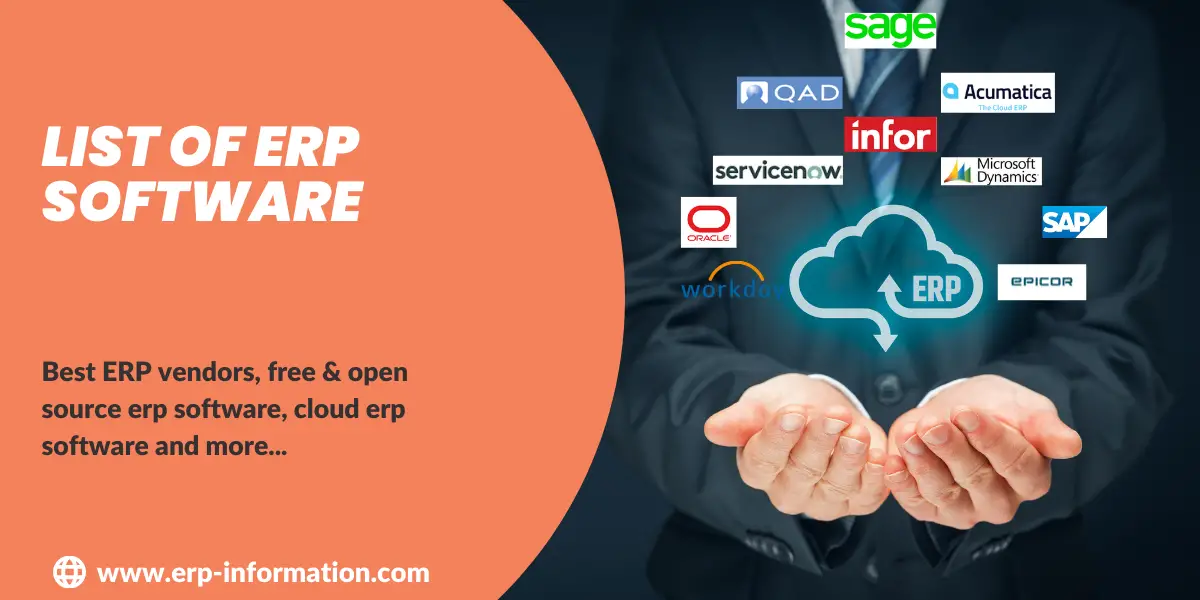
This list of ERP software covers 39 products: the large commercial suites from SAP, Oracle and Microsoft, mid-market and industry ERPs, and 18 open-source systems. For each one we name the maker, who owns it, the latest release and its date, how it is deployed and how it is priced, checked on the maker’s own pages on October 10, 2026.
Two things the ranking lists we compared leave out are here as well. One is whether a product is still maintained: several open-source ERPs have not published a numbered release in years, and one is discontinued. The other is whether it has security flaws that attackers are known to exploit, from the U.S. government’s CISA catalog.
List of ERP
The ERP software on this page, with the maker and the newest generally available release we could confirm on the maker’s own site or code repository. Names link to our full reviews where we have one.
| ERP software | Made by | Latest release |
|---|---|---|
| NetSuite | Oracle | 2026.2 (Sep 2026) |
| Oracle Fusion Cloud ERP | Oracle | Update 26D (Sep 2026) |
| SAP Business One | SAP | 10.0 FP 2608 (Aug 2026) |
| SAP S/4HANA Cloud Public Edition | SAP | 2608 (Aug 2026) |
| Microsoft Dynamics 365 Business Central | Microsoft | Version 29 (Oct 2026) |
| Microsoft Dynamics 365 Finance and Supply Chain Management | Microsoft | 10.0.49 (Sep 2026) |
| Microsoft Dynamics GP | Microsoft | 18.9 (Oct 2026); no new customers |
| Epicor Kinetic | Epicor (CD&R, CVC) | 2026.100 (May 2026) |
| Infor CloudSuite (LN, M3, SyteLine) | Infor (Koch Industries) | Continuous cloud updates |
| Sage 100 | Sage | 2026.1 (Jul 2026) |
| Sage Intacct | Sage | 2026 R3 (Aug 2026) |
| QAD Adaptive ERP | QAD (Thoma Bravo) | Champion AI release (Nov 2025) |
| Acumatica | Acumatica (Vista Equity) | 2026 R2 (Oct 2026) |
| Workday Financial Management | Workday | 2026R2 (Sep 2026) |
| IFS Cloud | IFS (EQT, Hg) | 26R1 (May 2026) |
| Certinia | Certinia (Haveli) | Summer 2026 |
| Deltek Costpoint | Deltek (Roper) | 2026.3 (Jul 2026) |
| JobBOSS² (formerly E2 Shop) | ECI Software Solutions | Not published |
| BizAutomation | BizAutomation, Inc. | Not published |
| OnCloudERP | Cloud Pencils | Not published |
| OpenPro | OpenPro, Inc. | 9.0.9 (Nov 2020) |
| ERP software | Made by | Latest release |
|---|---|---|
| Odoo | Odoo S.A. | 20 (Sep 2026) |
| Dolibarr | Community | 24.0.2 (Oct 2026) |
| ERPNext | Frappe | 16 (Jan 2026) |
| iDempiere | Community | 13 Orion (Mar 2026) |
| ADempiere | Community | 3.9.4.001 (Dec 2023) |
| Apache OFBiz | Apache Software Foundation | 24.09.07 (Jun 2026) |
| metasfresh | metas GmbH | 5.175 (Jun 2023); rolling builds |
| Tryton | Tryton Foundation | 8.2 (Oct 2026) |
| webERP | Community | 5.0.1 (Jan 2026) |
| Axelor | Axelor SAS | 9.1.9 (Oct 2026) |
| FrontAccounting | Community | 2.4.20 (Apr 2026) |
| Flectra | FlectraHQ Inc. | 3.0 (Mar 2024) |
| LedgerSMB | Community | 1.13.8 (Sep 2026) |
| BlueSeer | Terry Vaughn | 8.0 (Jun 2026) |
| EasyERP | Discontinued | Last code change Jan 2018 |
| ERP5 | Nexedi | 5.5 (2014); code still updated |
| Onfinity (formerly VIENNA Advantage) | VIENNA IT Solutions | 6.4.1.0 (Sep 2026) |
| Libertya | Community | 26.09 (Aug 2026) |
Earlier versions of this page listed ServiceNow and Salesforce as ERP. They are not; see why below.
How this list was checked. On October 10, 2026 every product below was checked against its maker’s website, documentation, release notes, code repository or licence file, or, for listed companies, the latest annual report filed with the SEC. Where we could not confirm a fact we left it out and say so. The order within each section is editorial, not a score. Details are in How we researched this list.
Top 10 Vendors of ERP
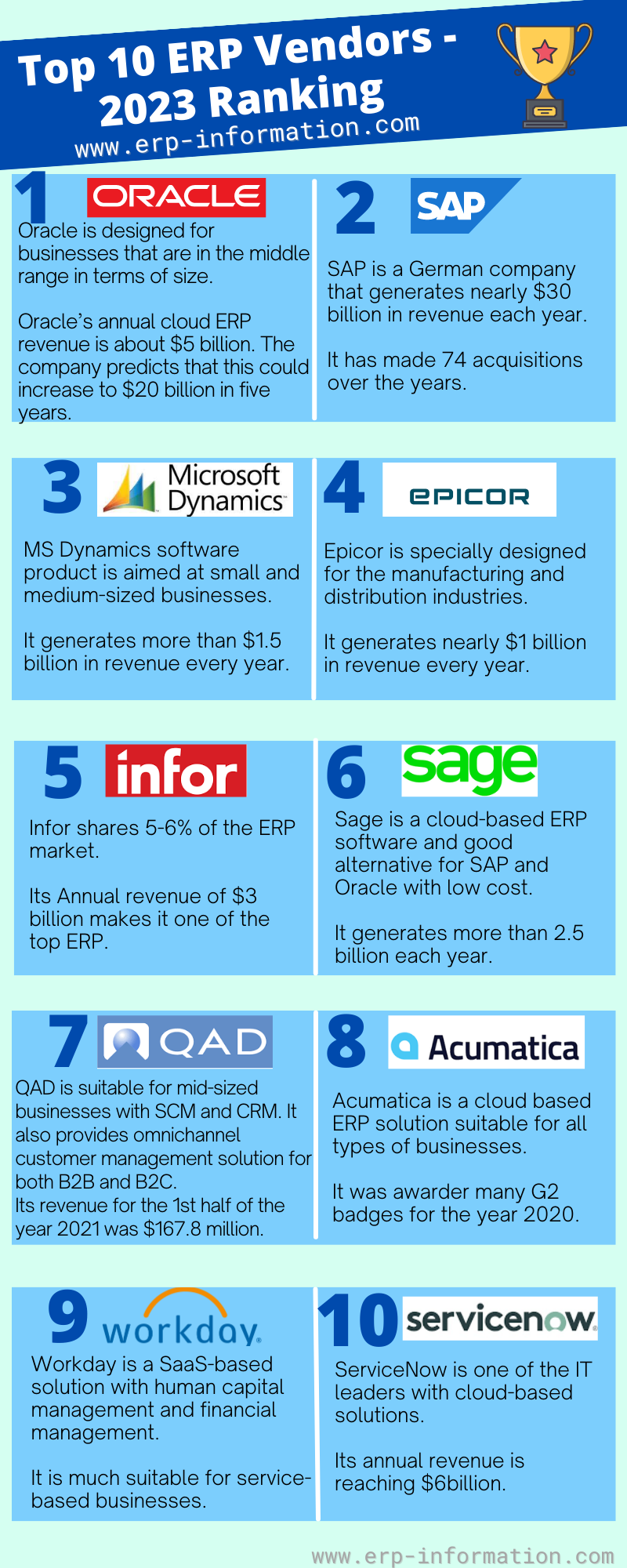
Ten large commercial ERP vendors and the ERP products each sells today. The order is not a ranking. The infographic below summarizes who makes and who owns each one.
The video above is a 2022 ranking of ERP vendors. The entries below were checked on October 10, 2026, and their order is not a ranking.
1. NetSuite
NetSuite is Oracle’s cloud ERP: financials, order management, inventory and warehouse, procurement, CRM and e-commerce in one subscription. It is sold only as a service; there is no on-premise edition. Oracle bought NetSuite in 2016, and its annual report says NetSuite is “generally marketed to small to medium-sized organizations”.
Oracle also sells a separate cloud ERP, Oracle Fusion Cloud ERP. Unlike NetSuite, it has a published list price: US$625 per named user per month, with a 10-user minimum and a standard three-year term (Oracle price list dated October 8, 2026). It is updated every quarter; the current update is 26D.
| Made by | Oracle NetSuite, a business unit of Oracle (acquired 2016) |
| Founded | 1998, as NetLedger |
| Headquarters | Austin, Texas, U.S. |
| Latest release | NetSuite 2026.2 (release notes dated September 21, 2026); two upgrades a year plus monthly minor releases |
| Deployment | Cloud (SaaS) only |
| Pricing | Quote-based annual subscription: core platform, modules and number of users, plus a one-time implementation fee |
| Free trial | 3-day self-guided trial |
| Customers | 44,000+ in 220 countries and territories (NetSuite’s figure) |
| Mobile apps | iOS and Android |
Checked October 10, 2026 against: About NetSuite · NetSuite contact page · NetSuite 2026.2 release notes · How NetSuite is priced · Oracle 10-K, fiscal 2026 · Oracle Fusion Cloud price list · Oracle ERP update readiness
More details about NetSuite ERP
Related on this site: NetSuite Advanced Financials · Microsoft Dynamics vs NetSuite
2. SAP Business One
SAP Business One is SAP’s ERP for small and midsize businesses and for subsidiaries of larger groups, sold and supported mainly through SAP partners. It runs on-premise or in a partner’s cloud, on Microsoft SQL Server or SAP HANA. Version 10.0 is still current and gets two feature packages a year.
SAP’s other ERP, SAP S/4HANA Cloud, is designed, in SAP’s words, “for organizations of all sizes”. SAP upgrades the Public Edition, which its annual report now also calls SAP Cloud ERP, twice a year on a fixed schedule. Release 2608 was scheduled for production systems on August 15 and 16, 2026, and customers are emailed four weeks before their test system is upgraded. In the Private Edition, sold within RISE with SAP, SAP runs an upgrade when the customer requests it; the current version is 2025 FPS02. SAP’s website blocked our price checks, so we do not quote S/4HANA prices.
| Made by | SAP SE (listed company) |
| Founded | 1972 (SAP SE) |
| Headquarters | Walldorf, Germany |
| Latest release | 10.0 Feature Package 2608 (What’s New published August 3, 2026) |
| Deployment | On-premise or partner-hosted cloud; Microsoft SQL Server or SAP HANA |
| Pricing | Quote-based, through partners; no list price published |
| Free trial | Not from SAP directly; demos through partners |
| Customers | Over 85,000 (SAP’s figure for Business One) |
| Languages | 28 languages, 50 country versions |
| Mobile apps | SAP Business One, Sales and Service apps (iOS; Sales and Service also on Android) |
Checked October 10, 2026 against: SAP Business One product page · SAP Business One What’s New · SAP Business One solution brief · SAP Form 20-F, 2025 · S/4HANA Cloud Public Edition upgrade schedule · S/4HANA Cloud Private Edition 2025 upgrade guide
More details about SAP Business One ERP
3. Microsoft Dynamics 365 Business Central and Dynamics GP
Microsoft’s ERP for small and mid-sized organizations is now Dynamics 365 Business Central, the product Microsoft names as the next step for Dynamics GP and Dynamics NAV customers. It runs as a Microsoft-hosted service or on-premises and gets two major updates a year, in April and October. Unlike most commercial ERPs on this list, it has published prices: Essentials US$80, Premium US$110 and Team Members US$8 per user per month, paid yearly (U.S. prices; Microsoft says they vary by country). Microsoft says 55,000 companies use it.
Dynamics GP is closed to new customers. Microsoft stopped selling new GP subscriptions to new customers on April 1, 2026. Existing customers still receive releases (GP 18.9 shipped on October 5, 2026), but enhancements, tax updates and technical support end on December 31, 2029, and security patches on April 30, 2031.
For medium-sized and large organizations, Microsoft sells Dynamics 365 Finance and Dynamics 365 Supply Chain Management: US$210 per user per month each (Premium US$300), with a minimum of 20 licences (10 for Premium).
| Made by | Microsoft Corporation |
| Headquarters | Redmond, Washington, U.S. |
| Latest release | Business Central 2026 release wave 2 (version 29), from October 1, 2026 |
| Deployment | Microsoft-hosted (SaaS) or on-premises |
| Pricing | Essentials US$80, Premium US$110, Team Members US$8 per user per month, paid yearly |
| Free trial | 30 days |
| Customers | 55,000 companies (Microsoft’s figure) |
| Dynamics GP | No new customers since April 1, 2026; support ends December 31, 2029; latest release 18.9, October 5, 2026 |
Checked October 10, 2026 against: Business Central pricing · Business Central product page · What’s new in version 29.0 · Business Central on-premises lifecycle · Dynamics GP lifecycle · Microsoft: migration options for GP customers · Dynamics GP downloads · Dynamics 365 Finance pricing · Microsoft Product Terms (minimums)
More details about Microsoft Dynamics GP
4. Epicor Kinetic
Epicor sells industry ERP to what it calls the “make, move and sell” industries: manufacturing, distribution, automotive, building supply and retail. Kinetic (formerly Epicor ERP) is its manufacturing ERP; the company also sells other ERPs such as Prophet 21, Eclipse and BisTrack. Kinetic is cloud-first. From the May 2026 release it moved from two releases a year to monthly updates. The last on-premises feature release will be 2028.1, planned for January 2028, with active support until December 31, 2029.
| Made by | Epicor Software Corporation (owned by funds of Clayton, Dubilier & Rice and CVC; CVC’s stake closed October 30, 2024) |
| Founded | 1972 |
| Headquarters | Austin, Texas, U.S. |
| Latest release | Kinetic 2026.100 (May 2026), now on monthly updates |
| Deployment | Cloud on Microsoft Azure; on-premises and hybrid until release 2028.1 |
| Pricing | Quote-based bundles: platform core, cloud package and number of concurrent users |
| Free trial | No; demo and product tour |
| Customers | 23,000 in 150+ countries, across all Epicor products (Epicor’s figure) |
Checked October 10, 2026 against: Epicor home page · Kinetic product page · Release 2026.100 of Kinetic · Final on-premises feature releases · CVC investment closes · Kinetic bundles
5. Infor CloudSuite (LN, M3, SyteLine)
Infor is a company with several ERPs, each sold as an industry “CloudSuite” on AWS: SyteLine (CloudSuite Industrial) for small and midsize manufacturers, LN for complex, global, project-driven manufacturers, and M3 for manufacturing and distribution. The cloud versions are updated continuously rather than by numbered release. Older on-premises lines such as M3 Business Engine 15.1.4 are still maintained, and Infor runs a programme, Infor Leap, to move those customers to the cloud. Infor has been wholly owned by Koch Industries since 2020, so the vendor is Infor and Koch is the owner.
| Made by | Infor (wholly owned by Koch Industries since 2020) |
| Founded | 2002 |
| Headquarters | Atlanta, Georgia, U.S. (New York is now a regional office) |
| Latest release | Continuous cloud updates; M3 cloud documentation is versioned 2026.x (July 22, 2026) |
| Deployment | Multi-tenant cloud on AWS; legacy on-premises installations still supported |
| Pricing | Quote-based; no price list published |
| Free trial | No; demos |
| Customers | 60,000+ across all Infor products, 15,000+ in the cloud (Infor’s figures) |
| Mobile apps | Infor Go for iOS and Android |
Checked October 10, 2026 against: About Infor · Infor contact · Koch completes Infor acquisition · Infor SyteLine · Infor LN · Infor M3 · M3 cloud documentation
6. Sage 100
Sage 100 is ERP for manufacturing, distribution and retail businesses that Sage says is “best-suited to US-based, single entity businesses, that may have outgrown basic accounting software”. It is installed on your own server or hosted by a Sage partner, not run by Sage as a multi-tenant service. Sage ships a yearly version plus product updates. Older reviews and quotes may call it Sage 100cloud; Sage now calls it simply Sage 100.
Sage’s cloud-only alternative is Sage Intacct, financial management software that Sage updates every quarter for all customers; its latest release is 2026 R3 (August 7, 2026), with R4 scheduled for November 6, 2026.
| Made by | The Sage Group plc (listed on the London Stock Exchange) |
| Founded | 1981, in Newcastle |
| Headquarters | Newcastle upon Tyne, U.K. |
| Latest release | Sage 100 2026.1 (version 7.50.1.0), July 21, 2026; base 2026.0 on April 16, 2026 |
| Deployment | On your own server, or partner-hosted (Sage Partner Cloud); SQL Server or ProvideX database |
| Pricing | Quote-based; no price list published |
| Free trial | No; demo on request |
Checked October 10, 2026 against: Sage 100 product page · Sage 100 2026.1 release notes · Sage 100 2026.1 announcement · Sage Partner Cloud for 2026.1 · About Sage · Sage Intacct release notes · Sage Intacct release calendar
More details about Sage 100 ERP
7. QAD Adaptive ERP
QAD Adaptive ERP is cloud ERP for manufacturers. QAD Inc. has been owned by the private equity firm Thoma Bravo since November 2021, and since buying Redzone in 2023 it trades as “QAD | Redzone”. QAD no longer publishes numbered versions; its latest named release, QAD Adaptive with Champion AI (AI agents for tasks such as procurement and accounts payable), became generally available on November 13, 2025. Besides the ERP, QAD sells Redzone connected-workforce software and supply chain software.
| Made by | QAD Inc. (owned by Thoma Bravo since November 5, 2021) |
| Founded | 1979 |
| Headquarters | Miami, Florida, U.S. (it was Santa Barbara, California) |
| Latest release | QAD Adaptive with Champion AI, generally available November 13, 2025 |
| Deployment | Cloud (QAD-hosted, on AWS) |
| Pricing | Quote-based; no price list published |
| Free trial | No; demo on request |
| Mobile apps | iOS and Android |
Checked October 10, 2026 against: QAD fall 2025 release · Thoma Bravo completes QAD acquisition · QAD about · QAD contact · QAD get started
8. Acumatica
Acumatica Cloud ERP is built for small and mid-sized businesses and sold only through partners. It is not priced per user: you license applications and a resource level, and users are unlimited. You can run it as Acumatica’s SaaS or under a private cloud licence on your own or a partner’s servers. Vista Equity Partners agreed to buy Acumatica from EQT in May 2025.
| Made by | Acumatica, Inc. (owned by Vista Equity Partners; agreement signed May 29, 2025) |
| Founded | 2008 |
| Headquarters | Bellevue, Washington, U.S. |
| Latest release | Acumatica 2026 R2, generally available October 1, 2026 (two releases a year) |
| Deployment | SaaS on AWS, or private cloud licence (partner- or self-hosted) |
| Pricing | Quote via a partner; based on applications, resource level and deployment, unlimited users |
| Free trial | No; free demo and interactive product tour |
| Customers | 10,000+ (Acumatica’s figure) |
| Mobile apps | iOS and Android |
Checked October 10, 2026 against: About Acumatica · Vista acquisition announcement · Acumatica 2026 R2 release · Acumatica pricing · Acumatica FAQ · Acumatica contact
9. Workday Financial Management
Workday sells its ERP as Workday Financial Management, alongside Workday HCM, Spend Management and Adaptive Planning. It is finance- and people-centric: there is no manufacturing module, and its supply chain product is for healthcare. It is cloud only, and gets two feature releases a year (R1 in March, R2 in September) on top of weekly updates.
| Made by | Workday, Inc. (listed on Nasdaq: WDAY) |
| Founded | 2005 |
| Headquarters | Pleasanton, California, U.S. |
| Latest release | Workday 2026R2, in all production tenants from September 19, 2026 |
| Deployment | Cloud (SaaS) only |
| Pricing | Quote-based; no price list published |
| Customers | More than 11,500 organizations (Workday 10-K for the year to January 31, 2026) |
| Languages | Over 30 (Workday’s figure) |
| Mobile apps | iOS and Android |
Checked October 10, 2026 against: Workday 10-K, fiscal 2026 · Workday our story · Workday contact
Related on this site: Workday vs SuccessFactors
10. IFS Cloud
IFS Cloud is ERP for asset-, project- and service-intensive companies: IFS names aerospace and defense, engineering and construction, energy and utilities, manufacturing, telecoms and service as its focus industries. It combines ERP with enterprise asset management, field service management and service management. It replaced IFS Applications: version 10 of that older product left standard support in March 2025 and gets extended support until March 27, 2028. IFS Cloud ships twice a year.
| Made by | IFS (Industrial and Financial Systems AB); co-controlled by EQT and Hg, with TA Associates as a minority investor; ADIA and CPP Investments agreed minority investments in April 2025 |
| Founded | 1983 |
| Registered office | Linköping, Sweden |
| Latest release | IFS Cloud 26R1 (May 2026); releases twice a year |
| Deployment | IFS-hosted cloud, or on-premise and other hosting |
| Pricing | Quote-based; no price list published |
| Customers | 5,500 (IFS’s figure) |
Checked October 10, 2026 against: IFS Cloud releases · About IFS · IFS support policy · EQT, Hg and TA ownership announcement · IFS H1 2026 results · IFS legal notice
Top 10 Free and Open Source ERP Software
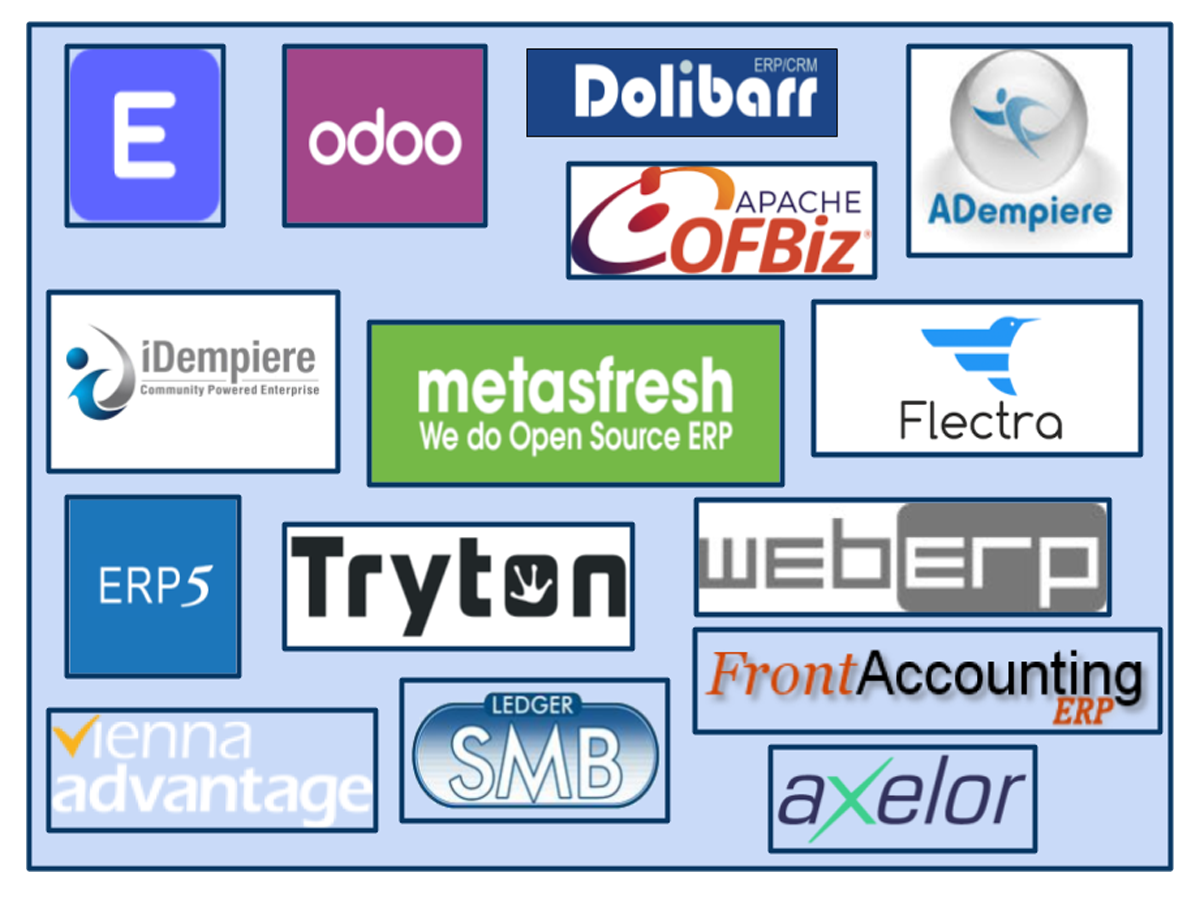
Ten widely used open-source ERP systems. Each entry gives the licence and the date of the latest release, which tells you whether the project is still moving. Free means no licence fee; hosting, implementation and support still cost money.
1. Odoo
Odoo is open-core, not fully open source. Odoo Community is free under the LGPLv3 and includes CRM, sales, invoicing, inventory, manufacturing, purchasing, projects and a website builder. Odoo Enterprise is licensed and adds full accounting, payroll, PLM, quality, helpdesk, Studio, the mobile apps, version upgrades and vendor support. Odoo 20, the current major version, came out in September 2026 with standard support planned to September 2029.
| Made by | Odoo S.A. (founder-led; Summit Partners is a minority investor) |
| Founded | 2005, as TinyERP; renamed OpenERP, then Odoo in 2014 |
| Headquarters | Grand-Rosière, Belgium |
| Latest release | Odoo 20, September 2026 (Odoo Online also gets 19.1 to 19.4 between majors) |
| Deployment | Odoo Online (SaaS), Odoo.sh (platform) or self-hosted |
| Licence | Community: LGPLv3. Enterprise: proprietary Odoo Enterprise Edition License |
| Pricing | Per user per month; prices are set by country (see odoo.com/pricing). One app is free with unlimited users on Odoo Online |
| Free trial | Yes, Odoo Online, no credit card |
| Users | 28 million (Odoo’s figure, users not customers) |
| Built with | Python, JavaScript, PostgreSQL |
Checked October 10, 2026 against: Odoo editions compared · Odoo version support table · Odoo 20 release notes · Odoo licences · About Odoo · Odoo pricing
2. Dolibarr
Dolibarr is a PHP web ERP and CRM that its README says is “designed for small, medium or large companies, foundations and freelancers”. About 100 modules ship with it (CRM, quotes and invoices, stock, purchasing, manufacturing, projects, HR, point of sale, double-entry accounting) and you switch on only the ones you need. There is no vendor. The project is led by Laurent Destailleur and promoted by the Association Dolibarr, a French non-profit. It ships about two major versions a year.
| Made by | The Dolibarr project (Association Dolibarr, a French non-profit, since 2009) |
| Founded | 2002 (version 1.0 in September 2003) |
| Registered seat | Olivet, France (the association) |
| Latest release | 24.0.2, October 2, 2026 (major version 24.0 on August 20, 2026) |
| Deployment | Self-hosted (Windows, macOS, Linux, Docker) or paid hosting from third parties |
| Licence | GPL v3 or later |
| Pricing | Free software; hosted plans are priced by each host |
| Free trial | Free 30 to 45 day test instance via the hosts listed on dolibarr.org |
| Languages | 119 locale files ship with the code |
| Built with | PHP; MariaDB, MySQL or PostgreSQL |
Checked October 10, 2026 against: Dolibarr project · Origin and history · Dolibarr 24 release · README (licence) · Online demo
More details about Dolibarr ERP
3. ERPNext
ERPNext has one edition, free under the GPLv3, with no per-user fee and no paid “enterprise” tier. Its maker, Frappe, earns money from hosting (Frappe Cloud) and support. Version 16 came out in January 2026 and gets roughly weekly point releases. Industry modules such as Education and Healthcare are no longer part of ERPNext; since version 14 they are separate apps.
| Made by | Frappe Technologies Pvt. Ltd. (founder-led) |
| Founded | 2008; product named ERPNext in 2010 |
| Headquarters | Mumbai, India |
| Latest release | Version 16 (January 12, 2026); point release v16.50.0 on October 6, 2026 |
| Deployment | Self-hosted (Linux or Docker) or Frappe Cloud |
| Licence | GPLv3 |
| Pricing | Software free. Frappe Cloud hosting from US$5 per site per month; servers from US$20 per month |
| Free trial | 14 days on Frappe Cloud |
| Customers | 30,000+ companies (Frappe’s figure) |
| Built with | Python and JavaScript on the Frappe Framework; MariaDB |
Checked October 10, 2026 against: ERPNext pricing · ERPNext releases · ERPNext v16.0.0 · Licence file · Frappe contact · Frappe story
More details about ERPNext ERP
4. iDempiere (OSGi + ADempiere)
iDempiere is a 2011 fork of ADempiere rebuilt on the OSGi plugin framework, so you extend it with plugins instead of editing the core. It covers ERP, CRM and supply chain for small and mid-size organizations and is the actively developed branch of the Compiere family. It is a community project with no company behind it; its co-founders are based in Colombia and Malaysia.
| Made by | iDempiere community, led by co-founders Carlos Ruiz and Heng Sin Low |
| Founded | 2011, as a fork of ADempiere |
| Latest release | iDempiere 13 “Orion” LTS, announced March 12, 2026 (version 14 in development) |
| Deployment | Self-hosted (installers or Docker); no official hosted service |
| Licence | GPL v2 |
| Pricing | Free; paid services from independent implementers |
| Free trial | Public test servers |
| Built with | Java 17, OSGi, ZK web UI; PostgreSQL or Oracle |
Checked October 10, 2026 against: iDempiere home · iDempiere 13 Orion · Founders · Licence file · Download
More details about iDempiere ERP
5. ADempiere
ADempiere is the 2006 community fork of Compiere that later produced iDempiere and metasfresh. It still works, but as a product it is near-dormant: the last release, 3.9.4.001, came out in December 2023, and the main branches have not moved since. Its contributors now work on new add-on projects such as a Vue web interface. If you want the Compiere family on an active release line, look at iDempiere.
| Made by | ADempiere community; no commercial vendor |
| Founded | 2006, as a fork of Compiere |
| Registered seat | ADempiere e.V., an association in Berlin, represents the project in Germany |
| Latest release | 3.9.4.001, December 20, 2023 (last feature release 3.9.4, January 25, 2023) |
| Deployment | Self-hosted only (binaries, Docker, Kubernetes) |
| Licence | GPL v2 |
| Pricing | Free; implementation by independent providers |
| Built with | Java 11/17; PostgreSQL or Oracle |
Checked October 10, 2026 against: ADempiere on GitHub · Release 3.9.4.001 · Release 3.9.4 · ADempiere e.V. · Licence file
More details about ADempiere ERP
6. Apache OFBiz
Apache OFBiz is an open-source framework plus a set of business applications (accounting, order management, inventory, manufacturing, e-commerce) from the Apache Software Foundation, where it has been a top-level project since December 2006. It suits teams with Java developers who want to build their own ERP on a proven base. There is no vendor and no official hosting.
Security note. Three OFBiz flaws are on CISA’s catalog of vulnerabilities exploited in real attacks: CVE-2024-32113, CVE-2024-38856 and CVE-2024-45195. The old 18.12 line is closed (last release 18.12.19, April 2025). Run the current 24.09 line.
| Made by | Apache OFBiz project, Apache Software Foundation (non-profit) |
| Founded | 2001; Apache top-level project since December 2006 |
| Latest release | 24.09.07, June 2026 |
| Deployment | Self-hosted only |
| Licence | Apache License 2.0 |
| Pricing | Free |
| Free trial | Online demos of the 24.09 branch |
| Built with | Java 17, Groovy, FreeMarker; Derby, MySQL, PostgreSQL or Oracle |
Checked October 10, 2026 against: Apache OFBiz · Release notes 24.09.07 · Apache downloads · Licence file · OFBiz demos · CISA KEV catalog
More details about Apache OFBiz ERP
7. Metasfresh
metasfresh is an ERP for wholesale and manufacturing companies, grown out of ADempiere by metas GmbH in Bonn. The code is GPL and very active on GitHub, but the last numbered release there is 5.175 from June 2023; since then the software ships as continuously rebuilt Docker images. The company now sells it mainly to German-speaking businesses as a paid service (its English site redirects to the German one).
| Made by | metas GmbH (independent) |
| Founded | metas GmbH in 2004; the ERP since 2006; public on GitHub as metasfresh in October 2015 |
| Headquarters | Bonn, Germany |
| Latest release | 5.175 (June 27, 2023) is the last numbered GitHub release; Docker images are rebuilt continuously (several builds on October 10, 2026) |
| Deployment | Self-hosted (Docker, Ubuntu) or metas cloud hosting in German data centers |
| Licence | GPL v2 |
| Pricing | Software free. Service from EUR 79 (annual) or EUR 99 (monthly) per user per month, plus hosting from EUR 249 per month, excluding VAT |
| Free trial | No; demo on request |
| Built with | Java, PostgreSQL, React |
Checked October 10, 2026 against: metasfresh imprint · metasfresh founder page · metasfresh prices · GitHub releases · Licence file
More details about metasfresh ERP
8. Tryton
Tryton is a three-tier ERP (client, server, PostgreSQL database) written in Python and governed by the Tryton Foundation, a Belgian private foundation, rather than a company. A new series comes out every six months and is supported for one year; each new major version, such as 8.0, gets five years of long-term support. Paid help comes from independent service providers.
| Made by | Tryton Foundation and community; core developers at B2CK SRL |
| Founded | 2008 (first release November 17, 2008); descends from TinyERP |
| Headquarters | Liège, Belgium (the foundation) |
| Latest release | Tryton 8.2, October 5, 2026; current long-term-support series 8.0 (April 20, 2026) |
| Deployment | Self-hosted (Docker, source, Linux packages); web or desktop client |
| Licence | GPL v3 or later |
| Pricing | Free; paid services from independent providers |
| Free trial | Free public demo server |
| Built with | Python, PostgreSQL |
Checked October 10, 2026 against: Tryton Foundation · Tryton 8.2 announcement · Server release history · Download · trytond on PyPI (licence)
9. webERP
webERP is a browser-based accounting and business administration system written in PHP, aimed at wholesale, distribution, manufacturing and multi-branch retail businesses. It is a community project with no company or head office behind it. Version 5.0, released in November 2025, moved it to PHP 8.1 or later with a new installer.
| Made by | The webERP project (community; maintained on GitHub by Tim Schofield and contributors) |
| Founded | 2003 (SourceForge project registered January 7, 2003) |
| Latest release | 5.0.1, January 1, 2026 (5.0.0 on November 24, 2025) |
| Deployment | Self-hosted on your own PHP web server |
| Licence | GPL v2 |
| Pricing | Free |
| Free trial | Free live demo |
| Built with | PHP 8.1+, JavaScript; MySQL or MariaDB |
Checked October 10, 2026 against: webERP on GitHub · Release 5.0.1 · SourceForge project record · Licence file
10. Axelor
Axelor Open Suite is a Java ERP with more than 30 apps (CRM, sales, accounting, purchasing, stock, manufacturing, projects, HR) plus no-code tools such as Studio and BPM. The Community edition is free under the AGPLv3 and self-hosted; the paid editions add support, hosting and, in Enterprise, Axelor AI. Version 9 (January 2026) moved the platform to Java 21, so check customizations before upgrading from 8.
| Made by | Axelor SAS |
| Founded | 2005; the open-source suite started in 2014 |
| Headquarters | Champs-sur-Marne (Paris area), France |
| Latest release | Axelor Open Suite 9.1.9, October 1, 2026 (9.0 was January 16, 2026) |
| Deployment | Self-hosted (Tomcat or Docker), private cloud or SaaS |
| Licence | AGPL v3 |
| Pricing | Community free. Pro EUR 35 per user per month billed annually (10-user minimum); Enterprise EUR 55 (20-user minimum) |
| Free trial | No time-limited trial; Community is free to download, demo on request |
| Mobile apps | Axelor Open Mobile for iOS and Android |
| Built with | Java, PostgreSQL, React |
Checked October 10, 2026 against: Axelor pricing · Axelor about · Axelor contact · Changelog · Licence file
Other Cloud ERP Solutions
More commercial ERPs, several of them built for one industry. Not all are cloud only: Deltek Costpoint and OpenPro can also run on your own servers.
11. Certinia
Certinia, called FinancialForce until May 2023, sells software for services businesses that runs inside Salesforce. Its products are PS Cloud (professional services automation), FM Cloud for financial management (renamed from ERP Cloud in 2025) and CS Cloud for customer success. Because it is built on the Salesforce Platform, you also need Salesforce licences. It is not a manufacturing or distribution ERP.
| Made by | Certinia Inc. (majority owned by Haveli Investments since 2023; TA Associates, General Atlantic and Salesforce Ventures hold stakes) |
| Founded | 2009 |
| Headquarters | Austin, Texas, U.S. |
| Latest release | Summer 2026 release (three releases a year: Winter, Spring, Summer) |
| Deployment | Cloud only, running on the Salesforce Platform |
| Pricing | Quote-based; no published prices |
| Free trial | No; demo on request |
| Customers | 1,400+ in more than 30 countries (Certinia’s figure) |
Checked October 10, 2026 against: About Certinia · Certinia contact · TA Associates investment · ERP Cloud is now Financial Management Cloud · Summer 2026 what’s new (PSA)
More details about Certinia ERP
12. Deltek Costpoint
Costpoint is Deltek’s ERP for U.S. government contractors; Deltek says 84% of the top 25 government contractors use it. It manages the project life cycle of a government contract: capture and contract management, accounting and financial management, time and expense, supply chain and procurement, and manufacturing. Deltek has been owned by Roper Technologies since December 2016. Version numbers changed in late 2024: after 8.2.15, releases are named by year and quarter.
For defense work, read the cloud claim carefully. Deltek says its Costpoint GovCon Cloud Moderate “meets FedRAMP Moderate Equivalency per DoD policy” and supports DFARS 7012 and CMMC requirements with U.S.-only hosting. Equivalency is not the same as a FedRAMP authorization.
| Made by | Deltek, Inc. (owned by Roper Technologies since December 27, 2016) |
| Founded | 1983 |
| Headquarters | Herndon, Virginia, U.S. |
| Latest release | Costpoint 2026.3, released July 15, 2026 (cumulative bundle 2026.3.3 on October 1, 2026) |
| Deployment | Deltek-hosted cloud (including a U.S.-only GovCon cloud) or on-premise |
| Pricing | Quote-based. Costpoint Essentials for small contractors: US$800 per month for 10 users, licences and implementation included |
| Free trial | No; demo and product tour |
| Customers | Deltek states 30,000 customers across all its products; no Costpoint-only count |
Checked October 10, 2026 against: Deltek company · Costpoint product page · Costpoint Essentials · Costpoint release notes · Roper 10-K (Deltek acquisition) · Deltek locations
More details about Deltek Costpoint ERP
13. JobBOSS² (formerly E2 Shop System)
E2 Shop System, ERP for job shops and make-to-order manufacturers, is now sold as JobBOSS². ECI Software Solutions bought its maker, Shoptech of Glastonbury, Connecticut, in November 2020, and in May 2021 combined E2 SHOP and JobBOSS into JobBOSS², a cloud product. The older E2 MFG is kept for existing customers only. ECI itself is privately owned, co-controlled by Leonard Green & Partners and the Apax Funds since 2025.
| Made by | ECI Software Solutions (owned by Leonard Green & Partners and the Apax Funds) |
| Founded | Shoptech was incorporated in 1984 |
| Headquarters | Westlake, Texas, U.S. (ECI) |
| Latest release | Not published: ECI keeps release notes in its customer portal |
| Deployment | JobBOSS²: cloud only |
| Pricing | Quote-based, three tiers (Silver, Gold, Platinum), minimum one user |
| Free trial | No; demo and quote |
| Customers | ECI states 25,000 customers across all its products |
Checked October 10, 2026 against: ECI completes Shoptech acquisition (archived) · JobBOSS² product page (archived September 2026) · JobBOSS² pricing (archived April 2026) · Apax and Leonard Green co-control (archived)
More details about E2 Shop System
14. BizAutomation
BizAutomation is cloud ERP for mid-market wholesale distributors and discrete manufacturers, and only for them. Its own FAQ answers “Do you serve industries other than manufacturing and distribution?” with “No.” It is an independent, privately held company and, unlike most commercial ERPs on this list, it publishes a price. It does not publish version numbers or release notes.
| Made by | BizAutomation, Inc. (independent, privately held) |
| Founded | Not stated today; the company’s own archived pages say it was formed in 1999 and founded in 2001 |
| Headquarters | United States (mailing address in Santa Ana, California) |
| Latest release | Not published |
| Deployment | Multi-tenant SaaS; dedicated single-tenant servers for large customers |
| Pricing | US$999 per month for 10 users, plus US$99.95 per additional user per month, one-year term |
| Free trial | No; demo on request |
Checked October 10, 2026 against: About BizAutomation · BizAutomation pricing · BizAutomation contact · BizAutomation about page, 2003 (archived)
More details about BizAutomation
15. OnCloudERP
OnCloudERP is a low-cost cloud ERP for distribution, wholesale, retail and services businesses, developed in Chennai, India, by Cloud Pencils Private Limited. Since 2018 that company has been a wholly owned subsidiary of Cloud Pencils LLC of San Antonio, Texas. The site, prices, sign-up and demo all work, but its blog stops in June 2019 and its product-manual portal is gone, so ask for a recent release history before you commit.
| Made by | Cloud Pencils Private Limited, Chennai (owned by Cloud Pencils LLC, San Antonio, Texas, since 2018) |
| Founded | January 1, 2015; stable version launched January 2016 |
| Latest release | Not published |
| Deployment | Cloud (SaaS) on Google Cloud Platform |
| Pricing | Per user per month: StartUp US$10 (5-user minimum), Standard US$15 (10-user minimum), Enterprise US$20 (20-user minimum) |
| Free trial | 14 days, no credit card |
| Built with | Microsoft .NET, C#, SQL Server, Angular |
Checked October 10, 2026 against: About OnCloudERP · Plans and pricing · Contact · Blog
16. OpenPro
This page used to list OpenPro as open-source ERP, but it is not: OpenPro, Inc. calls it “licensed Enterprise Resource Planning (ERP) software using open source LAMP technology”. There is no open-source licence or public code; customers who want to modify it can buy the source code. It covers financials, supply chain and manufacturing and can run on your own servers or in OpenPro’s cloud. Public activity is thin: the newest release the vendor announces is 9.0.9, from November 2020, although it says it ships updates through a customer portal every three months.
| Made by | OpenPro, Inc. (privately held, founder-led) |
| Founded | 1998 |
| Headquarters | Fountain Valley, California, U.S. |
| Latest release | 9.0.9, announced November 12, 2020 (later updates via the customer portal) |
| Deployment | On your own servers (Linux or Windows) or vendor-hosted cloud |
| Licence | Proprietary; source code available to buy |
| Pricing | Published: a 5-user Easy ERP package under US$5,000; on your servers US$1,000 per user plus up to US$1,000 per major module, one time; cloud from US$44 per user per month; labor and maintenance extra |
| Free trial | No; demo on request |
| Built with | PHP on LAMP; MySQL/MariaDB, SQL Server, Oracle or DB2 |
Checked October 10, 2026 against: OpenPro company · OpenPro prices · OpenPro 9.0.9 release · OpenPro updates · OpenPro offices
More details about OpenPro ERP
Often called ERP, but not ERP: ServiceNow and Salesforce
Both appeared in earlier versions of this list. Neither sells an ERP of its own. They matter to ERP buyers because ERP products are built on Salesforce, and ServiceNow connects to ERPs such as SAP and Oracle.
ServiceNow
ServiceNow is a workflow platform for IT, HR, customer service and other business processes. It does not sell an ERP. Its finance and procurement products sit on top of one: ServiceNow’s own annual report says its Source-to-Pay Operations product “connects organizations’ existing enterprise resource planning and procurement systems”. Its Zero Copy Connector for ERP (formerly ERP Canvas) connects to data in SAP ECC, SAP S/4HANA, Oracle E-Business Suite and Workday without copying it into ServiceNow.
If you already run ServiceNow, it can front your ERP processes. It cannot replace the ERP. Two ServiceNow platform flaws (CVE-2024-4879 and CVE-2024-5217) are on CISA’s exploited-vulnerabilities catalog, added July 29, 2024.
| Made by | ServiceNow, Inc. (listed on NYSE: NOW) |
| Founded | 2004, as Glidesoft |
| Headquarters | Santa Clara, California, U.S. |
| Latest release | Brazil family release, generally available October 8, 2026 |
| Customers | About 8,700 (10-K, December 31, 2025) |
Checked October 10, 2026 against: ServiceNow 10-K, 2025 · ServiceNow release notes · Zero Copy Connector for ERP release notes · CISA KEV catalog
Salesforce
Salesforce is a CRM company, not an ERP vendor. Its own annual report describes it as “a global leader in customer relationship management (‘CRM’) technology”, and the only ERP that report mentions is one Salesforce implemented for its own use. It belongs in an ERP list only as a platform: independent ERP products run on it.
Two of them: Rootstock, manufacturing and distribution ERP built on the Salesforce Platform and majority-owned by Gryphon Investors since August 2022, and Certinia (formerly FinancialForce), covered above. Both need Salesforce licences underneath.
| Made by | Salesforce, Inc. (listed on NYSE: CRM); formerly salesforce.com, inc. |
| Founded | 1999 |
| Headquarters | San Francisco, California, U.S. |
| Latest release | Winter ’27, rolled out to production October 3 to 10, 2026 (three releases a year) |
| ERP of its own | None; ERPs such as Rootstock and Certinia run on its platform |
Checked October 10, 2026 against: Salesforce 10-K, fiscal 2026 · Salesforce Trust: Winter ’27 maintenance · Gryphon Investors: Rootstock
Other Open Source ERP Solutions
Smaller open-source ERP and accounting systems. Check the release dates before you choose: one project is discontinued, and some have not published a numbered release in years.
11. FrontAccounting
FrontAccounting is web-based accounting for small companies that reaches into ERP: sales and purchase orders, inventory, manufacturing, fixed assets and dimensions on top of the general ledger. It is a non-profit community project funded by donations, with no company or published office behind it. Version 2.4.20 (April 2026) included security fixes, and the project urges users to upgrade.
| Made by | The FrontAccounting team (community; lead developers Joe Hunt and Janusz Dobrowolski) |
| Founded | SourceForge project registered April 7, 2007 |
| Latest release | 2.4.20, April 28, 2026 (2.4.19 on November 7, 2025) |
| Deployment | Self-hosted on a PHP web server |
| Licence | GPL v3 |
| Pricing | Free; donations welcome |
| Free trial | Free public demo |
| Languages | 42 language packages in the official 2.4 repository, plus English |
| Built with | PHP, JavaScript; MySQL or MariaDB |
Checked October 10, 2026 against: FrontAccounting home · Release 2.4.20 · Licence file · Code mirror on GitHub
More details about FrontAccounting ERP
12. Flectra
Flectra is a fork of Odoo. Version 1.0 forked Odoo in January 2018, and the current 3.0 was rebuilt from Odoo 17 and released in March 2024; since then fixes have shipped on the 3.0 branch without new tagged releases. The Community edition is free under the LGPLv3; paid plans add the Pro apps, hosting and support. The company, FlectraHQ Inc., gives an address in Delaware, U.S., and its terms are governed by Indian law.
| Made by | FlectraHQ Inc. |
| First release | 1.0, January 25, 2018 (forked from Odoo) |
| Stated address | Middletown, Delaware, U.S. (terms under the law of India, jurisdiction Jaipur) |
| Latest release | 3.0, March 15, 2024 (based on Odoo 17); branch updated to June 2026 |
| Deployment | Self-hosted (Linux, Windows, Docker) or Flectra Cloud |
| Licence | Community: LGPLv3 |
| Pricing | Community free. Standard US$19 and Custom US$29 per user per month (billed yearly); Lifetime US$999 per user, one time |
| Free trial | 15-day demo instance |
| Users | “More than 13,000 teams” (Flectra’s claim) |
| Built with | Python, PostgreSQL, JavaScript |
Checked October 10, 2026 against: Flectra release notes · Flectra pricing · Flectra contact · Flectra terms of service · Source code and licence · Version 1.0 tag
13. LedgerSMB
LedgerSMB is web-based double-entry accounting with quotations, orders, invoicing, projects, timecards, inventory and shipping. It has no manufacturing module, so it suits trading and service businesses rather than factories. It began in 2006 as a fork of SQL-Ledger and is run by a community of contributors, not a company.
| Made by | The LedgerSMB Project (community) |
| Founded | 2006, as a fork of SQL-Ledger |
| Latest release | 1.13.8, September 11, 2026 (1.13 supported to October 2027; 1.12 to December 2026) |
| Deployment | Self-hosted or official Docker image; hosting from independent providers |
| Licence | GPL v2 or later |
| Pricing | Free; paid support from independent providers |
| Languages | 45 (LedgerSMB’s figure) |
| Built with | Perl, PostgreSQL, JavaScript (Vue) |
Checked October 10, 2026 against: LedgerSMB home · Supported releases · Release 1.13.8 · README · Copyright and licence
14. BlueSeer
BlueSeer is a free desktop ERP for small and mid-sized manufacturers, written in Java by one developer, Terry Vaughn. What sets it apart is a built-in EDI tool: it maps X12, EDIFACT, CSV, XML and JSON documents and exchanges them over FTP or AS2. It runs on Windows and Linux with SQLite for one user or MySQL for several. A one-person project carries continuity risk, so weigh that.
| Made by | Terry Vaughn (independent developer) |
| Founded | 2017 |
| Based in | Dillon, South Carolina, U.S. |
| Latest release | 8.0, June 2026 (patch level 8.0.18, October 9, 2026) |
| Deployment | Desktop app (Windows, Linux) with a local or cloud MySQL server |
| Licence | MIT |
| Pricing | Free |
| Languages | 8 (English, French, Spanish, Turkish, German, Romanian, Arabic, Chinese) |
| Built with | Java (Swing); SQLite or MySQL |
Checked October 10, 2026 against: BlueSeer README · Release 8.0 · Licence file · BlueSeer website (archived January 20, 2026)
More details about Blueseer ERP
15. EasyERP (discontinued)
Do not choose EasyERP for a new system. It was an open-source ERP and SaaS from Ukraine, formed in 2014, with inventory, CRM, HR and accounting. The product is gone: easyerp.com no longer serves a website, the hosted service and its free trial have disappeared, and the last change to the open-source code was in January 2018. The code is still on GitHub under the MIT licence, built on Node.js 4 and MongoDB 3 era components that are long out of support.
| Made by | EasyERP (Ukraine); no live company site |
| Founded | 2014 |
| Last code change | January 26, 2018; no tagged release was ever published |
| Status | Discontinued: website offline, hosted service and Android app withdrawn |
| Licence | MIT (not LGPLv3 as this page used to say) |
| Built with | JavaScript (Node.js), MongoDB, Redis |
Checked October 10, 2026 against: EasyERP source on GitHub · Commit history · Licence file · easyerp.com, last archived product page (July 2023)
16. ERP5
ERP5 is a Python ERP from Nexedi built on one data model (the “Unified Business Model”) for every module. Nexedi says it has been adopted by banks, governments and corporations, and is frank that it suits organizations willing to invest developer time and pay for support, not buyers who want a quick off-the-shelf system. The last numbered release on erp5.com is 5.5 from November 2014; development continues on the main code branch, deployed through Nexedi’s SlapOS.
| Made by | Nexedi SA |
| Founded | 2001 |
| Headquarters | La Madeleine (Lille area), France |
| Latest release | 5.5, November 2014 is the last numbered release; code updated continuously (commits in October 2026) |
| Deployment | Self-hosted on Linux (Debian) or SlapOS; paid hosting from Nexedi |
| Licence | GPL v2 or later |
| Pricing | Software free; implementation, support and hosting are paid Nexedi services |
| Languages | 6 (English, French, German, Brazilian Portuguese, Japanese, Korean) |
| Built with | Python (Zope), JavaScript |
Checked October 10, 2026 against: Nexedi about · Nexedi legal notice · ERP5 releases · ERP5 deploy · ERP5 for executives · ERP5 commits
17. Onfinity (formerly VIENNA Advantage)
VIENNA Advantage is now called Onfinity ERP and CRM; viennaadvantage.com redirects to onfinity.io. The products belong to VIENNA IT Solutions in Mohali, India, and its German subsidiary is in Zetel. Only the free community edition, Pluto, is open source (Eclipse Public Licence). The paid editions, Nova and Galaxy, give source access only to their open-source modules. It runs on Microsoft’s .NET stack, so the server needs Windows.
| Made by | VIENNA IT Solutions Private Limited, Mohali, India (German subsidiary: Vienna Advantage GmbH, Zetel) |
| Founded | 2005 |
| Latest release | Community package 6.4.1.0 (files dated September 18, 2026); framework 7.1.1.0 released September 24, 2026 |
| Deployment | Self-hosted (Windows server, PostgreSQL or Oracle) or vendor cloud |
| Licence | Pluto community edition: Eclipse Public Licence; Nova and Galaxy: commercial |
| Pricing | Pluto free. Onfinity SME Cloud in India from INR 1,999 per user per month; Nova and Galaxy by quotation |
| Mobile apps | iOS |
| Built with | C# and ASP.NET; PostgreSQL or Oracle |
Checked October 10, 2026 against: Onfinity imprint · Meet VIENNA · Installation packages · Open-source edition · Onfinity India prices · Framework releases
More details about Vienna advantage
18. Libertya
Libertya is a free Java ERP from Argentina whose strength is Argentine tax compliance (AFIP/ARCA electronic invoicing, withholdings, ARBA). It is in Spanish only. After several quiet years the project announced “No estábamos muertos” (we were not dead) in June 2026 and shipped 26.05 and 26.09. There is no paid edition; support, consulting and cloud hosting come from its partner consultancies.
| Made by | Libertya community, with Disytel Consulting S.A. (Buenos Aires) as founding partner |
| Founded | SourceForge project registered June 3, 2011 |
| Headquarters | Buenos Aires, Argentina (commercial office) |
| Latest release | 26.09, August 28, 2026 (the download page still offers 26.05) |
| Deployment | Self-hosted on Windows or Linux (Docker available) or cloud hosting from partners |
| Licence | Libertya Public License 1.0 (derived from the CDDL) |
| Pricing | Free, no user limit; paid support and hosting by quote |
| Languages | Spanish |
| Built with | Java 11, PostgreSQL, JBoss or Tomcat |
Checked October 10, 2026 against: Libertya 26.05 announcement · Libertya FAQ · Release 26.09 · Licence · Premium services
More details about Libertya ERP
Benefits of open source ERP
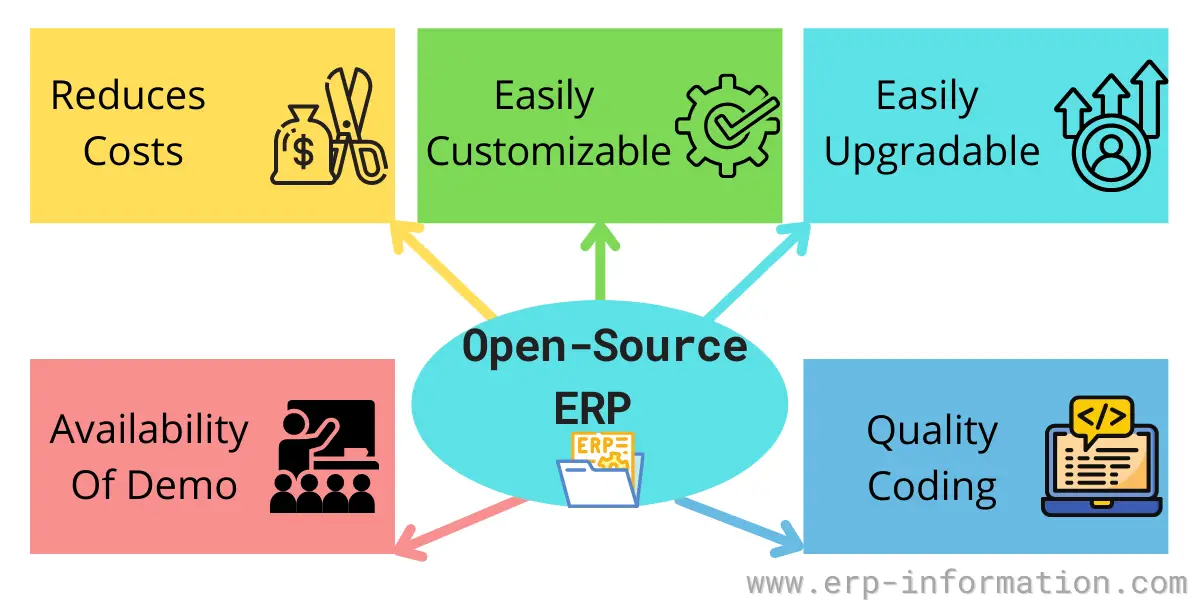
Open-source ERP gives you the program code under a licence such as the GPL or LGPL. What you save is the licence fee. What you take on is hosting, upgrades, security patches and support, unless you pay someone to handle them.
Reduces costs
Dolibarr, ERPNext, Tryton, iDempiere, LedgerSMB and Odoo Community charge no licence fee per user, so adding users costs nothing in licences. Odoo is the one to read closely: its free Community edition leaves out full accounting, payroll and several other apps, which are only in the paid Enterprise edition. Hosting, implementation and support still cost money (see the challenges below).
Easily customizable
You have the source code, so you or a partner can change anything without waiting for a vendor. The cost comes later: every change is yours to carry to the next version. Odoo’s upgrade documentation puts it plainly: when a new version breaks a customization, “it is the responsibility of the maintainer of your custom module to make it compatible with the new version of Odoo.”
Free upgrades
New versions cost nothing to download, and the larger projects publish how long each version is supported. Odoo supports each major version for three years. Tryton supports each six-monthly series for one year and each new major version for five. LedgerSMB 1.13 is supported until October 2027.
Upgrading is still work. Odoo will not upgrade a database that contains custom modules until those modules exist for the target version. With a paid Odoo Enterprise subscription, Odoo upgrades the standard modules for free.
Availability of demo
You can try most open-source ERPs without a sales call. Dolibarr’s website creates a free test instance for 30 to 45 days through its hosting partners. Tryton and iDempiere run public demo servers. Odoo Online and Frappe Cloud (for ERPNext) offer free trials, 14 days in Frappe’s case.
Open code you can inspect
Anyone can read the code, its change history and its bug tracker, which shows how active a project is before you commit to it. Open code is not automatically safe code: Apache OFBiz, an Apache Software Foundation project, has three vulnerabilities on CISA’s catalog of flaws that attackers have exploited.
Challenges of open source ERP
Unexpected expenses
The licence is free; running the system is not. Budget for hardware or hosting, backups, implementation, data migration, training and someone to call when it breaks. If you need features that an open-core vendor keeps for its paid edition, that becomes a per-user subscription as well.
Limited features
It depends on the project. Open-core products keep some ERP modules for the paid edition: Odoo Community has invoicing but not full accounting, and it has no payroll, PLM, quality, helpdesk, Studio or mobile apps. Others ship everything in one free edition: ERPNext has a single GPLv3 edition with no paid tier. Smaller projects can be narrow; LedgerSMB, for example, has no manufacturing module.
Needs IT department with advanced knowledge
Someone has to install, configure, back up, patch and extend the system. When you self-host, that is your team or a partner you pay. Support exists, but you buy it: Odoo Enterprise includes functional support, Frappe sells hosting with support tickets, and community projects such as Tryton, iDempiere and LedgerSMB point you to independent service providers.
Security is your job when you self-host
Management sometimes worries that public code is less safe. The bigger risk is an unpatched server. When you self-host, installing security releases is your job, and attackers do target ERP systems: CISA added three Apache OFBiz flaws to its exploited-vulnerabilities catalog between August 2024 and February 2025. Before you choose a project, check how quickly it publishes security fixes.
Documentation varies by project
The larger projects publish full manuals: Odoo, ERPNext, Tryton and Dolibarr all have public documentation sites. Smaller projects may offer little more than a README and a forum, so read the documentation before you commit.
Time and money-consuming.
Implementation is a project, not an install: processes to map, data to migrate, reports to build and people to train. A free licence removes one line from the budget, not the others.
Benefits of Cloud ERP software
In cloud (SaaS) ERP the vendor runs the servers, the database, backups and updates, and you use the system through a web browser or a mobile app.
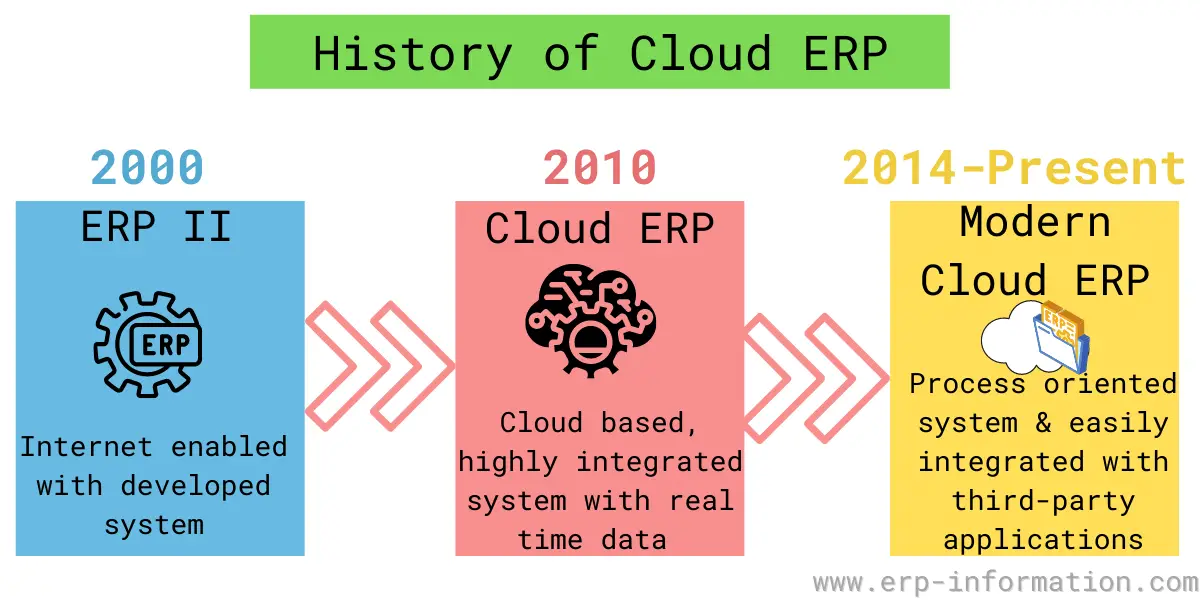
- No servers to run. Oracle, for example, deploys and manages Fusion Cloud ERP on its own cloud infrastructure.
- Updates arrive on a published schedule, with notice. Microsoft updates Business Central twice a year, in April and October, emails administrators when an update is scheduled, and lets them pick a date within a five-month window.
- Access from any browser. Several cloud ERPs on this list, including NetSuite, Acumatica, Workday and QAD Adaptive, also have iOS and Android apps.
- Cost is spread out as a subscription rather than a large upfront licence: NetSuite charges an annual licence fee, and Oracle Fusion Cloud ERP is priced per user per month.
Disadvantages of Cloud ERP software
Limited Customization
You extend a cloud ERP through the vendor’s extension tools, not by changing its code, and the vendor’s update calendar wins. During Business Central’s enforced update period, Microsoft says “any extensions causing the update to the next major version to fail … might be automatically uninstalled from the environment so that the update succeeds.”
Expensive
The subscription runs as long as you use the system. Oracle’s list price for Fusion Cloud ERP is US$625 per user per month, with a 10-user minimum and a standard three-year term. At list price, 10 users for three years come to US$225,000 before any discount or implementation cost (our calculation: 625 x 10 users x 36 months).
Security Issues
Your data sits on the vendor’s servers, so the vendor’s security controls become part of yours. Ask for its audit reports and certifications before you sign. U.S. defense contractors should read cloud claims closely: Deltek describes its Costpoint GovCon cloud as meeting “FedRAMP Moderate Equivalency per DoD policy”, which is not the same as a FedRAMP authorization.
You do not control the update calendar
In SaaS you rent access, and the vendor decides when the software changes. You get notice (SAP emails customers four weeks before their test system is upgraded; Microsoft emails Business Central administrators), but you cannot stay on an old version for ever. SAP upgrades every S/4HANA Cloud Public Edition system on its half-yearly schedule, and Microsoft enforces Business Central updates once the update and grace periods have passed.
Internet Issues
No connection, no ERP. Sites where stopped work costs money, such as a warehouse or a factory floor, need a backup internet link.
What is the difference between cloud ERP and on-premise ERP?
| Cloud ERP (SaaS) | On-premise ERP | |
|---|---|---|
| Who runs the servers | The vendor | You or your IT partner |
| Who installs updates | The vendor, on its schedule | You, when you choose |
| How you pay | Subscription | A licence plus ongoing maintenance, or no licence fee for open source |
| Customization | Through the vendor’s extension tools | Anything, if you maintain it |
| Examples on this page | NetSuite, Workday, QAD Adaptive | SAP Business One, Dolibarr, Tryton |
Which ERP software is on CISA’s list of exploited vulnerabilities?
CISA, the U.S. Cybersecurity and Infrastructure Security Agency, keeps a catalog of vulnerabilities that attackers have used in real attacks. We searched its October 8, 2026 version (1,739 entries) for every product and maker on this page. Two products have entries:
| Product | Vulnerability | Added |
|---|---|---|
| Apache OFBiz | CVE-2024-32113 (path traversal) | Aug 7, 2024 |
| Apache OFBiz | CVE-2024-38856 (incorrect authorization) | Aug 27, 2024 |
| Apache OFBiz | CVE-2024-45195 (forced browsing) | Feb 4, 2025 |
| ServiceNow platform | CVE-2024-4879 (input validation) | Jul 29, 2024 |
| ServiceNow platform | CVE-2024-5217 (incomplete list of disallowed inputs) | Jul 29, 2024 |
No entry does not mean no vulnerabilities. It means none has been confirmed as exploited in the wild. For self-hosted ERP, the practical lesson is the OFBiz one: the release this page used to list, 18.12.13, predates the fixes for two of the three flaws. Whatever you run, subscribe to its security announcements and keep to a supported release line.
How to shortlist ERP software from this list
A list of names does not pick an ERP for you. These five checks, all answerable from the entries above, narrow it to a shortlist worth a demo.
- Match the market the vendor says it serves. Business Central, SAP Business One, Acumatica and NetSuite are aimed at small and mid-sized companies, and Dynamics 365 Finance at medium-sized and large ones; SAP says S/4HANA Cloud is for organizations of all sizes. QAD, Epicor Kinetic, JobBOSS² and BizAutomation are built for manufacturers or distributors, Deltek Costpoint for U.S. government contractors, and Workday and Certinia for services and people-centric organizations with no factory floor.
- Decide who runs it. NetSuite, Workday, QAD Adaptive, Sage Intacct and JobBOSS² are cloud only. Business Central, IFS Cloud, Acumatica and Deltek Costpoint can also run on your own servers. Epicor ends on-premises feature releases with 2028.1.
- Check that it is alive. Look at the latest release date in each entry. A product whose last numbered release is years old (ERP5, ADempiere, OpenPro) or that is discontinued (EasyERP) needs a hard look at who will maintain it.
- Get the price structure in writing. Licences are only part of the cost of ERP, and vendors charge for them in different ways: per named user (Business Central, Oracle Fusion, Axelor, OnCloudERP), per concurrent user (Epicor Kinetic) or per resource with unlimited users (Acumatica). Hosting for ERPNext on Frappe Cloud is priced per site or server. Minimums matter: Dynamics 365 Finance needs 20 licences, Oracle Fusion Cloud ERP 10.
- Check the security record. Search CISA’s Known Exploited Vulnerabilities catalog for the product, and ask how quickly the vendor or project ships security fixes.
Frequently asked questions
What are some examples of ERP software?
Widely used ERP software includes SAP S/4HANA Cloud and SAP Business One, Oracle Fusion Cloud ERP and NetSuite, Microsoft Dynamics 365 Business Central and Dynamics 365 Finance, Infor LN, M3 and SyteLine, Epicor Kinetic, Sage Intacct and Sage 100, Acumatica, Workday Financial Management and IFS Cloud. Open-source examples include Odoo, ERPNext, Dolibarr, Tryton and iDempiere.
Which ERP software is free?
Odoo Community, ERPNext, Dolibarr, Tryton, iDempiere, Apache OFBiz, webERP, FrontAccounting, LedgerSMB, BlueSeer and the Axelor Community edition charge no licence fee. You still pay for hosting, implementation and support. Odoo’s free edition also leaves out full accounting and payroll, which are in the paid Enterprise edition.
Which ERP vendors publish their prices?
Microsoft lists Dynamics 365 Business Central at US$80 (Essentials) and US$110 (Premium) per user per month, and Dynamics 365 Finance at US$210 with a 20-licence minimum. Oracle’s price list shows Fusion Cloud ERP at US$625 per user per month with a 10-user minimum and a three-year term. Axelor, Flectra, metasfresh, OpenPro, BizAutomation, OnCloudERP and Deltek’s Costpoint Essentials also publish prices; most other commercial vendors quote on request. These are list prices checked on October 10, 2026.
Is Microsoft Dynamics GP still available?
Not to new customers. Microsoft stopped selling new GP subscriptions on April 1, 2026. Existing customers keep support until December 31, 2029 and security patches until April 30, 2031. Microsoft points GP customers to Dynamics 365 Business Central.
Is Salesforce or ServiceNow an ERP?
No. Salesforce is a CRM company and ServiceNow a workflow platform; neither sells an ERP of its own. ERP products such as Rootstock and Certinia run on the Salesforce Platform, and ServiceNow connects to ERPs such as SAP and Oracle E-Business Suite.
Which ERP software on this list is made in India?
ERPNext is made by Frappe Technologies in Mumbai. Onfinity, formerly VIENNA Advantage, belongs to VIENNA IT Solutions in Mohali. OnCloudERP is developed in Chennai by Cloud Pencils, which has been owned by a U.S. company since 2018.
How we researched this list
This page was rebuilt on October 10, 2026. For each product we checked these facts against the maker’s own pages:
- who makes it, and who owns that company, including private equity owners and later sales;
- the founding year and the headquarters;
- the latest generally available release and its date;
- the deployment options, the pricing model and any published list price.
The sources were product and pricing pages, documentation, release notes, code repositories, licence files and app store listings, plus annual reports filed with the U.S. SEC for listed companies. The links under each entry show which ones we used.
Where a maker’s website blocked automated checks, we used the Internet Archive’s dated copy of that site and say so in the entry. Where we could not confirm a fact, we left it out: we do not quote SAP S/4HANA prices, for example, and we removed customer counts, language lists and support claims that the makers do not publish. Customer counts that remain are the makers’ own figures. Security entries come from CISA’s Known Exploited Vulnerabilities catalog, version 2026.10.08.
What changed in this update:
- stale release versions were replaced throughout;
- owners that had been listed as vendors were corrected (Infor’s vendor is Infor; Koch Industries owns it);
- ServiceNow and Salesforce moved to their own section, because neither is an ERP;
- OpenPro moved out of the open-source list, because its licence is proprietary;
- EasyERP is marked discontinued, and E2 Shop System and VIENNA Advantage appear under their current names;
- Oracle Fusion Cloud ERP, SAP S/4HANA Cloud and Dynamics 365 were added inside their vendors’ entries.
References
- CISA, Known Exploited Vulnerabilities catalog
- Oracle Fusion Cloud Service Global Price List, October 8, 2026
- Oracle Corporation, Form 10-K, fiscal year ended May 31, 2026
- SAP SE, Form 20-F for 2025
- Microsoft, Dynamics 365 Business Central pricing
- Microsoft Learn, Business Central update cycles
- Microsoft Learn, Dynamics GP lifecycle
- Workday, Form 10-K, fiscal year ended January 31, 2026
- ServiceNow, Form 10-K for 2025
- Odoo, Community and Enterprise editions compared
- Odoo documentation, Upgrade
- Odoo documentation, Standard and extended support
Using Google Search? Add erp-information.com as a preferred source.